



Pyrite: an authigenic host phase for tungsten in sulfidic sediments
Affiliations | Corresponding Author | Cite as | Funding information
Published by the European Association of Geochemistry
under Creative Commons License CC BY-NC-ND 4.0
Keywords: methane seepage environments, tungsten, marine sediment, pyrite, sulfidic environments


- Share this article


-
Article views:1,229Cumulative count of HTML views and PDF downloads.
- Download Citation
- Rights & Permissions

top
Abstract
Figures
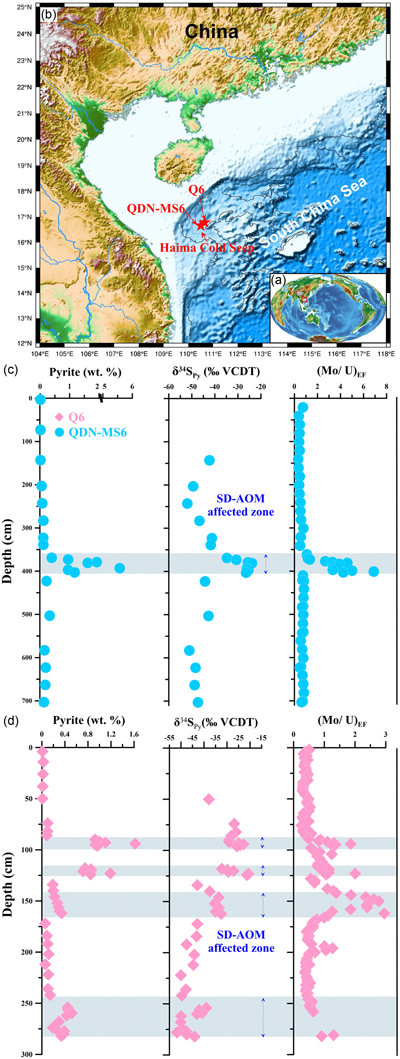 Figure 1 (a) Map of the World. The red rectangle represents the study area (b). (b) The red stars represent the sampling locations. (c, d) Down core variations of pyrite, δ34SPy, (Mo/U)EF and TS/TOC ratios in sediments of Q6 (based on Miao et al., 2021, 2022) and QDN-MS6 (based on Miao et al., 2024b), respectively. δ34SPy = sulfur isotope of pyrite; (Mo/U)EF = (Mo/U) enrichment factor ratios; TS/TOC = total sulfur/total organic carbon. | 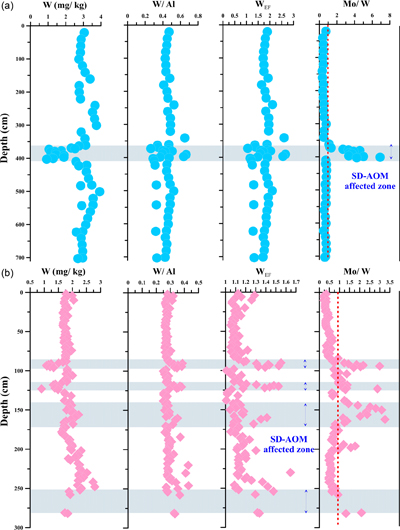 Figure 2 Geochemical characteristics of sediments in (a) QDN-MS6 and (b) Q6. The bands (blue) indicate areas affected by sulfate-driven anaerobic oxidation of methane (SD-AOM). The red dotted line represents the Mo/W molar ratio of the upper continental crust, which is 0.9 (Rudnick and Gao, 2014). | 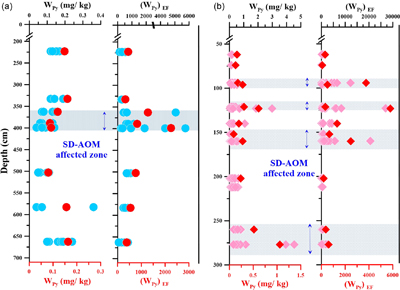 Figure 3 Down core variations of the W contents and WEF in pyrite samples in cores (a) QDN-MS6 and (b) Q6. The bands (blue) indicate areas affected sulfate-driven anaerobic oxidation of methane (SD-AOM). Each blue and pink symbol corresponds to a single pyrite measurement, with red symbols showing mean values. | 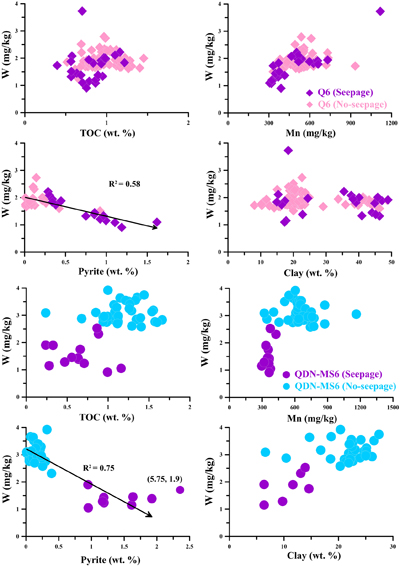 Figure 4 Relationships between W content and contents of TOC, Mn, pyrite, and clay in sediments. |
| Figure 1 | Figure 2 | Figure 3 | Figure 4 |
top
Introduction
Tungsten (W), a redox-sensitive transition metal, has gained prominence as a tracer for reconstructing redox evolution in marine systems (Cui et al., 2021
Cui, M., Luther III, G.W., Gomes, M. (2021) Cycling of W and Mo species in natural sulfidic waters and their sorption mechanisms on MnO2 and implications for paired W and Mo records as a redox proxy. Geochimica et Cosmochimica Acta 295, 24–48. https://doi.org/10.1016/j.gca.2020.12.007
; Kurzweil et al., 2021Kurzweil, F., Archer, C., Wille, M., Schoenberg, R., Münker, C., Dellwig, O. (2021) Redox control on the tungsten isotope composition of seawater. Proceedings of the National Academy of Sciences 118, e2023544118. https://doi.org/10.1073/pnas.2023544118
, 2022Kurzweil, F., Dellwig, O., Wille, M., Schoenberg, R., Arz, H.W., Münker, C. (2022) The stable tungsten isotope composition of sapropels and manganese-rich sediments from the Baltic Sea. Earth and Planetary Science Letters 578, 117303. https://doi.org/10.1016/j.epsl.2021.117303
; Yang et al., 2022Yang, R., Li, T., Stubbs, D., Chen, T., Liu, S., Kemp, D.B., Li, W., Yang, S., Chen, J., Elliott, T., Dellwig, O., Chen, J., Li, G. (2022) Stable tungsten isotope systematics on the Earth’s surface. Geochimica et Cosmochimica Acta 322, 227–243. https://doi.org/10.1016/j.gca.2022.01.006
, 2023Yang, R., Stubbs, D., Elliott, T., Li, T., Chen, T., Paytan, A., Kemp, D.B., Ling, H., Chen, J., Hein, J.R., Coath, C.D., Li, G. (2023) Stable tungsten isotopic composition of seawater over the past 80 million years. Geology 51, 728–732. https://doi.org/10.1130/G51208.1
). Under oxic conditions, dissolved tungstate (WO42−) stabilises in seawater and becomes enriched in sediments through adsorption onto Fe-Mn (hydrogen)oxides (Kashiwabara et al., 2013Kashiwabara, T., Takahashi, Y., Marcus, M.A., Uruga, T., Tanida, H., Terada, Y., Usui, A. (2013) Tungsten species in natural ferromanganese oxides related to its different behavior from molybdenum in oxic ocean. Geochimica et Cosmochimica Acta 106, 364–378. https://doi.org/10.1016/j.gca.2012.12.026
; Mohajerin et al., 2014Mohajerin, T.J., Helz, G.R., White, C.D., Johannesson, K.H. (2014) Tungsten speciation in sulfidic waters: Determination of thiotungstate formation constants and modeling their distribution in natural waters. Geochimica et Cosmochimica Acta 144, 157–172. https://doi.org/10.1016/j.gca.2014.08.037
; Cui et al., 2021Cui, M., Luther III, G.W., Gomes, M. (2021) Cycling of W and Mo species in natural sulfidic waters and their sorption mechanisms on MnO2 and implications for paired W and Mo records as a redox proxy. Geochimica et Cosmochimica Acta 295, 24–48. https://doi.org/10.1016/j.gca.2020.12.007
). In sulfidic conditions, however, W transitions to soluble thiotungstate species (WOnS4−n2−) (Cui et al., 2021Cui, M., Luther III, G.W., Gomes, M. (2021) Cycling of W and Mo species in natural sulfidic waters and their sorption mechanisms on MnO2 and implications for paired W and Mo records as a redox proxy. Geochimica et Cosmochimica Acta 295, 24–48. https://doi.org/10.1016/j.gca.2020.12.007
), which conventional models associate with limited authigenic enrichment due to the absence of stable mineral hosts, resulting in either detrital-dominated signals or W-depleted anomalies (Cui et al., 2020Cui, M., Mohajerin, T.J., Adebayo, S., Datta, S., Johannesson, K.H. (2020) Investigation of tungstate thiolation reaction kinetics and sedimentary molybdenum/tungsten enrichments: Implication for tungsten speciation in sulfidic waters and possible applications for paleoredox studies. Geochimica et Cosmochimica Acta 287, 277–295. https://doi.org/10.1016/j.gca.2020.04.004
, 2021Cui, M., Luther III, G.W., Gomes, M. (2021) Cycling of W and Mo species in natural sulfidic waters and their sorption mechanisms on MnO2 and implications for paired W and Mo records as a redox proxy. Geochimica et Cosmochimica Acta 295, 24–48. https://doi.org/10.1016/j.gca.2020.12.007
; Miao et al., 2024aMiao, X., Oppo, D., Wei, J., Lin, Z., Liu, X., Wu, T., Yu, X., Wu, K., Li, J. (2024a) Enrichment pattern of tungsten in sediments under methane seepage environments: Applicability as a proxy for tracing and reconstructing (paleo-)methane seepage. Chemical Geology 663, 122262. https://doi.org/10.1016/j.chemgeo.2024.122262
). Leveraging this principle, previous studies compared W contents between methane-seep and non-seep sediments (Miao et al., 2024aMiao, X., Oppo, D., Wei, J., Lin, Z., Liu, X., Wu, T., Yu, X., Wu, K., Li, J. (2024a) Enrichment pattern of tungsten in sediments under methane seepage environments: Applicability as a proxy for tracing and reconstructing (paleo-)methane seepage. Chemical Geology 663, 122262. https://doi.org/10.1016/j.chemgeo.2024.122262
). The research revealed that methane-seep sediments exhibit lower W contents (avg. 1.5 mg/kg) than non-seep sediments (avg. 2.1 mg/kg), attributable to localised sulfidic conditions induced by sulfate-driven anaerobic oxidation of methane (SD-AOM) (Miao et al., 2024aMiao, X., Oppo, D., Wei, J., Lin, Z., Liu, X., Wu, T., Yu, X., Wu, K., Li, J. (2024a) Enrichment pattern of tungsten in sediments under methane seepage environments: Applicability as a proxy for tracing and reconstructing (paleo-)methane seepage. Chemical Geology 663, 122262. https://doi.org/10.1016/j.chemgeo.2024.122262
). However, these seep sediments (1.2 < WEF < 1.9) display a higher W enrichment factor (WEF) compared to non-seep sediments (1.2 < WEF < 1.5) (Miao et al., 2024aMiao, X., Oppo, D., Wei, J., Lin, Z., Liu, X., Wu, T., Yu, X., Wu, K., Li, J. (2024a) Enrichment pattern of tungsten in sediments under methane seepage environments: Applicability as a proxy for tracing and reconstructing (paleo-)methane seepage. Chemical Geology 663, 122262. https://doi.org/10.1016/j.chemgeo.2024.122262
), indicating that authigenic W enrichment persists even within sulfidic settings. This finding stands in contrast to the prevailing paradigm of W depletion in sulfidic sediments. Moreover, if this holds true, the assignment of authigenic W host phases in sulfidic sediments remains an unresolved scientific enigma. Crucially, this ambiguity significantly hinders the reliable reconstruction of palaeo-marine redox conditions using W enrichment patterns.Kurzweil et al. (2022)
Kurzweil, F., Dellwig, O., Wille, M., Schoenberg, R., Arz, H.W., Münker, C. (2022) The stable tungsten isotope composition of sapropels and manganese-rich sediments from the Baltic Sea. Earth and Planetary Science Letters 578, 117303. https://doi.org/10.1016/j.epsl.2021.117303
proposed that iron sulfides might be the primary host phase for authigenic W in sulfidic sediments, but this remains unverified. Methane seeps, ubiquitous along continental margins (Peckmann and Thiel, 2004Peckmann, J., Thiel, V. (2004) Carbon cycling at ancient methane–seeps. Chemical Geology 205, 443–467. https://doi.org/10.1016/j.chemgeo.2003.12.025
; Guan et al., 2013Guan, H., Sun, Y., Zhu, X., Mao, S., Feng, D., Wu, N., Chen, D. (2013) Factors controlling the types of microbial consortia in cold-seep environments: A molecular and isotopic investigation of authigenic carbonates from the South China Sea. Chemical Geology 354, 55–64. https://doi.org/10.1016/j.chemgeo.2013.06.016
; Skarke et al., 2014Skarke, A., Ruppel, C., Kodis, M., Brothers, D., Lobecker, E. (2014) Widespread methane leakage from the sea floor on the northern US Atlantic margin. Nature Geoscience 7, 657–661. https://doi.org/10.1038/ngeo2232
), create sulfidic environments through SD-AOM—a process generating hydrogen sulfide and enriching pyrite in sediments (Jørgensen et al., 2004Jørgensen, B.B., Böttcher, M.E., Lüschen, H., Neretin, L.N., Volkov, I.I. (2004) Anaerobic methane oxidation and a deep H2S sink generate isotopically heavy sulfides in Black Sea sediments. Geochimica et Cosmochimica Acta 68, 2095–2118. https://doi.org/10.1016/j.gca.2003.07.017
; Miao et al., 2022Miao, X., Feng, X., Li, J., Liu, X., Liang, J., Feng, J., Xiao, Q., Dan, X., Wei, J. (2022) Enrichment mechanism of trace elements in pyrite under methane seepage. Geochemical Perspectives Letters 21, 18–22. https://doi.org/10.7185/geochemlet.2211
; Chen et al., 2023Chen, C., Wang, J., Algeo, T.J., Zhu, J.-M., Wang, Z., Ma, X., Cen, Y. (2023) Sulfate-driven anaerobic oxidation of methane inferred from trace-element chemistry and nickel isotopes in pyrite. Geochimica et Cosmochimica Acta 349, 81–95. https://doi.org/10.1016/j.gca.2023.04.002
; Smrzka et al., 2024Smrzka, D., Lin, Z., Monien, P., Chen, T., Bach, W., Peckmann, J., Bohrmann, G. (2024) Pyrite-based trace element fingerprints for methane and oil seepage. Geochemical Perspectives Letters 29, 33–37. https://doi.org/10.7185/geochemlet.2409
). Therefore, sulfidic sediments within seep environments can be used to investigate the cause of the decoupling between W content and WEF, and to determine whether pyrite is the primary host phase for authigenic W in these sediments. The Haima Cold Seep (South China Sea; Fig. 1b), China’s largest active methane seep, features sulfide-rich seafloor deposits (Miao et al., 2021Miao, X., Feng, X., Liu, X., Li, J., Wei, J. (2021) Effects of methane seepage activity on the morphology and geochemistry of authigenic pyrite. Marine and Petroleum Geology 133, 105231. https://doi.org/10.1016/j.marpetgeo.2021.105231
, 2024bMiao, X., Wei, J., Li, J., Liu, X., Wang, D., Li, J., Feng, X. (2024b) Isotopically light Mo in sediments of methane seepage controlled by the benthic Fe–Mn redox shuttle process. Global and Planetary Change 239, 104512. https://doi.org/10.1016/j.gloplacha.2024.104512
). Previous analyses of Q6 and QDN-MS6 site sediments within this system revealed sulfidation markers, including elevated pyrite content, δ34S values, (Mo/U)EF ratios and TS/TOC ratios (Fig. 1c), confirming that methane-derived fluids drive sustained sulfidic conditions (Miao et al., 2021Miao, X., Feng, X., Liu, X., Li, J., Wei, J. (2021) Effects of methane seepage activity on the morphology and geochemistry of authigenic pyrite. Marine and Petroleum Geology 133, 105231. https://doi.org/10.1016/j.marpetgeo.2021.105231
, 2022Miao, X., Feng, X., Li, J., Liu, X., Liang, J., Feng, J., Xiao, Q., Dan, X., Wei, J. (2022) Enrichment mechanism of trace elements in pyrite under methane seepage. Geochemical Perspectives Letters 21, 18–22. https://doi.org/10.7185/geochemlet.2211
, 2024bMiao, X., Wei, J., Li, J., Liu, X., Wang, D., Li, J., Feng, X. (2024b) Isotopically light Mo in sediments of methane seepage controlled by the benthic Fe–Mn redox shuttle process. Global and Planetary Change 239, 104512. https://doi.org/10.1016/j.gloplacha.2024.104512
). Leveraging this framework, we present high-resolution W geochemical data from Haima Cold Seep sediments to address two unresolved queries: (1) the identification of authigenic W host phases under sulfidic sediments, and (2) the apparent contradiction between W enrichment patterns in sulfidic settings.Figure 1 (a) Map of the World. The red rectangle represents the study area (b). (b) The red stars represent the sampling locations. (c, d) Down core variations of pyrite, δ34SPy, (Mo/U)EF and TS/TOC ratios in sediments of Q6 (based on Miao et al., 2021
Miao, X., Feng, X., Liu, X., Li, J., Wei, J. (2021) Effects of methane seepage activity on the morphology and geochemistry of authigenic pyrite. Marine and Petroleum Geology 133, 105231. https://doi.org/10.1016/j.marpetgeo.2021.105231
, 2022Miao, X., Feng, X., Li, J., Liu, X., Liang, J., Feng, J., Xiao, Q., Dan, X., Wei, J. (2022) Enrichment mechanism of trace elements in pyrite under methane seepage. Geochemical Perspectives Letters 21, 18–22. https://doi.org/10.7185/geochemlet.2211
) and QDN-MS6 (based on Miao et al., 2024bMiao, X., Wei, J., Li, J., Liu, X., Wang, D., Li, J., Feng, X. (2024b) Isotopically light Mo in sediments of methane seepage controlled by the benthic Fe–Mn redox shuttle process. Global and Planetary Change 239, 104512. https://doi.org/10.1016/j.gloplacha.2024.104512
), respectively. δ34SPy = sulfur isotope of pyrite; (Mo/U)EF = (Mo/U) enrichment factor ratios; TS/TOC = total sulfur/total organic carbon.top
Samples and Methods
Sample location, analytical methods and data processing are described in the Supplementary Information.
top
Results and Discussion
Depletion of W content and its causes in sediments. The seep sediments (QDN-MS6: 0.9–2.5 mg/kg, avg. 1.6 mg/kg; Q6: 0.9–2.2 mg/kg, avg. 1.6 mg/kg) exhibit significantly lower W contents compared to non-seep sediments (QDN-MS6: 2.3–3.9 mg/kg, avg. 3.1 mg/kg; Q6: 1.4–2.8 mg/kg, avg. 1.9 mg/kg) (Fig. 2). This W depletion phenomenon in seep sediments is attributed to the fact that SD-AOM fundamentally alters the geochemical conditions. Under oxic environments, W accumulates through adsorption as WO42− on Fe-Mn (hydrogen)oxides (Kashiwabara et al., 2013
Kashiwabara, T., Takahashi, Y., Marcus, M.A., Uruga, T., Tanida, H., Terada, Y., Usui, A. (2013) Tungsten species in natural ferromanganese oxides related to its different behavior from molybdenum in oxic ocean. Geochimica et Cosmochimica Acta 106, 364–378. https://doi.org/10.1016/j.gca.2012.12.026
; Dellwig et al., 2019Dellwig, O., Wegwerth, A., Schnetger, B., Schulz, H., Arz, H.W. (2019) Dissimilar behaviors of the geochemical twins W and Mo in hypoxic-euxinic marine basins. Earth-Science Reviews 193, 1–23. https://doi.org/10.1016/j.earscirev.2019.03.017
; Cui et al., 2021Cui, M., Luther III, G.W., Gomes, M. (2021) Cycling of W and Mo species in natural sulfidic waters and their sorption mechanisms on MnO2 and implications for paired W and Mo records as a redox proxy. Geochimica et Cosmochimica Acta 295, 24–48. https://doi.org/10.1016/j.gca.2020.12.007
). However, sulfidic conditions induced by methane seepage (Jørgensen et al., 2004Jørgensen, B.B., Böttcher, M.E., Lüschen, H., Neretin, L.N., Volkov, I.I. (2004) Anaerobic methane oxidation and a deep H2S sink generate isotopically heavy sulfides in Black Sea sediments. Geochimica et Cosmochimica Acta 68, 2095–2118. https://doi.org/10.1016/j.gca.2003.07.017
; Lin et al., 2022Lin, Z., Sun, X., Chen, K., Strauss, H., Klemd, R., Smrzka, D., Chen, T., Lu, Y., Peckmann, J. (2022) Effects of sulfate reduction processes on the trace element geochemistry of sedimentary pyrite in modern seep environments. Geochimica et Cosmochimica Acta 333, 75–94. https://doi.org/10.1016/j.gca.2022.06.026
) trigger two critical processes: (1) Inhibition of Fe-Mn (hydrogen)oxides formation and their reductive dissolution eliminates primary W adsorption sites, increasing aqueous WO42− concentrations (Johannesson et al., 2013Johannesson, K.H., Dave, H.B., Mohajerin, T.J., Datta, S. (2013) Controls on tungsten concentrations in groundwater flow systems: The role of adsorption, aquifer sediment Fe(III) oxide/oxyhydroxide content, and thiotungstate formation. Chemical Geology 351, 76–94. https://doi.org/10.1016/j.chemgeo.2013.05.002
; Mohajerin et al., 2016Mohajerin, T.J., Helz, G.R., Johannesson, K.H. (2016) Tungsten–molybdenum fractionation in estuarine environments. Geochimica et Cosmochimica Acta 177, 105–119. https://doi.org/10.1016/j.gca.2015.12.030
); (2) Sulfurisation converts WO42− to soluble WOnS4−n2− species, particularly complete conversion to WS42− under strong sulfidic conditions (>1 mM H2S) (Mohajerin et al., 2014Mohajerin, T.J., Helz, G.R., White, C.D., Johannesson, K.H. (2014) Tungsten speciation in sulfidic waters: Determination of thiotungstate formation constants and modeling their distribution in natural waters. Geochimica et Cosmochimica Acta 144, 157–172. https://doi.org/10.1016/j.gca.2014.08.037
; Yang et al., 2022Yang, R., Li, T., Stubbs, D., Chen, T., Liu, S., Kemp, D.B., Li, W., Yang, S., Chen, J., Elliott, T., Dellwig, O., Chen, J., Li, G. (2022) Stable tungsten isotope systematics on the Earth’s surface. Geochimica et Cosmochimica Acta 322, 227–243. https://doi.org/10.1016/j.gca.2022.01.006
). These metastable thiotungstates exhibit enhanced seawater solubility and reduced sedimentary retention (Mohajerin et al., 2016Mohajerin, T.J., Helz, G.R., Johannesson, K.H. (2016) Tungsten–molybdenum fractionation in estuarine environments. Geochimica et Cosmochimica Acta 177, 105–119. https://doi.org/10.1016/j.gca.2015.12.030
; Dellwig et al., 2019Dellwig, O., Wegwerth, A., Schnetger, B., Schulz, H., Arz, H.W. (2019) Dissimilar behaviors of the geochemical twins W and Mo in hypoxic-euxinic marine basins. Earth-Science Reviews 193, 1–23. https://doi.org/10.1016/j.earscirev.2019.03.017
). Diagnostic geochemical signatures—elevated (Mo-U)EF values (Fig. 1c) and high Mo/W molar ratios (Fig. 2)—confirm persistent sulfidic conditions in the identified intervals, providing conclusive evidence for the sulfur-mediated W mobilisation mechanism in methane seep-affected sediments.Figure 2 Geochemical characteristics of sediments in (a) QDN-MS6 and (b) Q6. The bands (blue) indicate areas affected by sulfate-driven anaerobic oxidation of methane (SD-AOM). The red dotted line represents the Mo/W molar ratio of the upper continental crust, which is 0.9 (Rudnick and Gao, 2014
Rudnick, R.L., Gao, S. (2014) 4.1 - Composition of the Continental Crust. In: Holland, H.D., Turekian, K.K. (Eds.) Treatise on Geochemistry. Second Edition, Elsevier, Oxford, 1–51. https://doi.org/10.1016/B978-0-08-095975-7.00301-6
).The role of pyrite in the W cycle. The WEF revealed a counterintuitive pattern: instead of declining below expected thresholds, WEF values in seep sediments frequently exceeded baseline levels. Notably, average WEF values reached 1.3 at Q6 and 1.8 at QDN-MS6 (Fig. 3), surpassing values reported for sulfidic Black Sea sapropel (average WEF = 0.8; Dellwig et al., 2019
Dellwig, O., Wegwerth, A., Schnetger, B., Schulz, H., Arz, H.W. (2019) Dissimilar behaviors of the geochemical twins W and Mo in hypoxic-euxinic marine basins. Earth-Science Reviews 193, 1–23. https://doi.org/10.1016/j.earscirev.2019.03.017
). This apparent paradox directly challenges the established paradigm of limited authigenic W enrichment under sulfidic conditions (Dellwig et al., 2019Dellwig, O., Wegwerth, A., Schnetger, B., Schulz, H., Arz, H.W. (2019) Dissimilar behaviors of the geochemical twins W and Mo in hypoxic-euxinic marine basins. Earth-Science Reviews 193, 1–23. https://doi.org/10.1016/j.earscirev.2019.03.017
; Cui et al., 2021Cui, M., Luther III, G.W., Gomes, M. (2021) Cycling of W and Mo species in natural sulfidic waters and their sorption mechanisms on MnO2 and implications for paired W and Mo records as a redox proxy. Geochimica et Cosmochimica Acta 295, 24–48. https://doi.org/10.1016/j.gca.2020.12.007
), suggesting either unique biogeochemical processes in methane seepage environments or limitations in current geochemical proxies. Thus, our investigations will focus on uncovering the reasons behind the authigenic enrichment of W in the sulfidic environments.Figure 3 Down core variations of the W contents and WEF in pyrite samples in cores (a) QDN-MS6 and (b) Q6. The bands (blue) indicate areas affected sulfate-driven anaerobic oxidation of methane (SD-AOM). Each blue and pink symbol corresponds to a single pyrite measurement, with red symbols showing mean values.
Prior to related discussions, we considered whether the observed W enrichment could be attributed to the potential dilution effect by Al. To evaluate this, we calculated the W/Al ratios for each sample, as this represents a standard approach to account for potential Al dilution. The W/Al values were then compared to that of the UCC (∼0.25) (Rudnick and Gao, 2014
Rudnick, R.L., Gao, S. (2014) 4.1 - Composition of the Continental Crust. In: Holland, H.D., Turekian, K.K. (Eds.) Treatise on Geochemistry. Second Edition, Elsevier, Oxford, 1–51. https://doi.org/10.1016/B978-0-08-095975-7.00301-6
). As shown in Figure 2, the W/Al ratios in our samples are significantly higher than the UCC value. This indicates a clear relative enrichment of tungsten even after normalising to Al content, supporting the interpretation of authigenic enrichment and effectively ruling out Al dilution as a significant influencing factor.In sediments, W is commonly associated with host phases like Fe-Mn (hydrogen)oxides, clay minerals and organic matter, leading to the expectation that sediments rich in these components would exhibit elevated W content and authigenic enrichment (Kurzweil et al., 2021
Kurzweil, F., Archer, C., Wille, M., Schoenberg, R., Münker, C., Dellwig, O. (2021) Redox control on the tungsten isotope composition of seawater. Proceedings of the National Academy of Sciences 118, e2023544118. https://doi.org/10.1073/pnas.2023544118
; Yang et al., 2023Yang, R., Stubbs, D., Elliott, T., Li, T., Chen, T., Paytan, A., Kemp, D.B., Ling, H., Chen, J., Hein, J.R., Coath, C.D., Li, G. (2023) Stable tungsten isotopic composition of seawater over the past 80 million years. Geology 51, 728–732. https://doi.org/10.1130/G51208.1
, 2025Yang, R., Gutjahr, M., Scholz, F., Kurzweil, F., Eroglu, S., Münker, C. (2025) Stable tungsten (W) isotope systematics in marine sediments: a potential paleo-proxy for deep ocean oxygenation. Earth and Planetary Science Letters 660, 119346. https://doi.org/10.1016/j.epsl.2025.119346
). However, we observed low W content and the absence of a correlation with these typical host phases (Fig. 4), suggesting their limited role in authigenic W enrichment in our study area. Notably, at site QDN-MS6, TOC and clay contents also decrease in the seep sediments, in addition to Mn. This suggests that TOC and clay components may also be performing a function similar to Fe-Mn (hydrogen)oxides, though perhaps not as the dominant factor. Drawing on recent findings that iron sulfide can host W in sulfidic environments (Cui and Johannesson, 2017Cui, M., Johannesson, K.H. (2017) Comparison of tungstate and tetrathiotungstate adsorption onto pyrite. Chemical Geology 464, 57–68. https://doi.org/10.1016/j.chemgeo.2016.11.034
), and considering the known importance of pyrite authigenesis in methane seepage zones, we propose that pyrite is a key host phase for W in our study area. This conclusion is supported by the substantial pyrite formation observed in methane-impacted sediments and the strong correlation between W and pyrite content (R2 = 0.75 in QDN-MS6 and R2 = 0.58 in Q6; Fig. 4). Therefore, these findings strongly suggest that pyrite content is a key factor for the occurrence of authigenic W in sulfidic, methane seepage sediments.Figure 4 Relationships between W content and contents of TOC, Mn, pyrite, and clay in sediments.
Based solely on the correlation diagram between W and pyrite content, it is difficult to unequivocally confirm the authigenic enrichment of W on pyrite. This is because pyrite content itself serves as an indicator of sulfidic conditions and reflects the intensity of the sulfidic environment. Therefore, further analytical work focusing on the W content within pyrite is required. As shown in Figure 3, W content within pyrite (0.01–4.53 mg/kg) is significantly lower compared to Fe-Mn crusts (42–134 mg/kg; Yang et al., 2023
Yang, R., Stubbs, D., Elliott, T., Li, T., Chen, T., Paytan, A., Kemp, D.B., Ling, H., Chen, J., Hein, J.R., Coath, C.D., Li, G. (2023) Stable tungsten isotopic composition of seawater over the past 80 million years. Geology 51, 728–732. https://doi.org/10.1130/G51208.1
), which exhibit 9–4466 times higher W concentrations. This disparity reflects pyrite’s weaker adsorption capacity for W (Cui and Johannesson, 2017Cui, M., Johannesson, K.H. (2017) Comparison of tungstate and tetrathiotungstate adsorption onto pyrite. Chemical Geology 464, 57–68. https://doi.org/10.1016/j.chemgeo.2016.11.034
) and the enhanced solubility of WOnS4−n2− in sulfidic conditions (Kashiwabara et al., 2013Kashiwabara, T., Takahashi, Y., Marcus, M.A., Uruga, T., Tanida, H., Terada, Y., Usui, A. (2013) Tungsten species in natural ferromanganese oxides related to its different behavior from molybdenum in oxic ocean. Geochimica et Cosmochimica Acta 106, 364–378. https://doi.org/10.1016/j.gca.2012.12.026
; Cui and Johannesson, 2017Cui, M., Johannesson, K.H. (2017) Comparison of tungstate and tetrathiotungstate adsorption onto pyrite. Chemical Geology 464, 57–68. https://doi.org/10.1016/j.chemgeo.2016.11.034
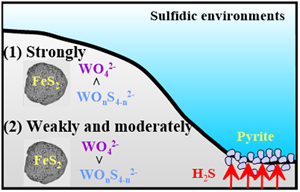
), meaning that pyrite formation, even in large amounts, cannot fully compensate for the W loss resulting from the reduction or absence of Fe-Mn (hydrogen)oxides. In addition, the pyrite at QDN-MS6 and Q6 sites in methane seepage environments showed significantly higher authigenic enrichment of W (Fig. 3). Its extraordinary WEF (reaching several thousand to tens of thousands) can dramatically amplify the bulk sediment WEF even at low pyrite abundance (Fig. 3). Therefore, the negative correlation arises because pyrite captures only low amounts of W compared to Fe-Mn (hydrogen)oxides. Meanwhile, this decoupling mechanism explains the paradoxical co-occurrence of low W content and high WEF in seep sediments.Pyrite tungsten enrichment patterns as indicators of sulfidation intensity. Varied methane seepage intensities at QDN-MS6 and Q6 result in differing sulfidic conditions and, consequently, distinct W enrichment patterns in pyrite. The seep sediments at QDN-MS6 display higher (Mo/U)EF, pyrite content and Mo/W molar ratio than those at Q6 (Fig. 1c and Fig. 2). This suggests that the methane seepage activity at QDN-MS6 is more intense, leading to a stronger sulfidic environment. Q6 exhibits a greater (WEF)Py than QDN-MS6, potentially stemming from the contrasting W species present. Thiotungstate anions may have lower particle reactivity than thiopolybdate anions (Cui and Johannesson, 2017
Cui, M., Johannesson, K.H. (2017) Comparison of tungstate and tetrathiotungstate adsorption onto pyrite. Chemical Geology 464, 57–68. https://doi.org/10.1016/j.chemgeo.2016.11.034
; Cui et al., 2021Cui, M., Luther III, G.W., Gomes, M. (2021) Cycling of W and Mo species in natural sulfidic waters and their sorption mechanisms on MnO2 and implications for paired W and Mo records as a redox proxy. Geochimica et Cosmochimica Acta 295, 24–48. https://doi.org/10.1016/j.gca.2020.12.007
). Stronger methane seepage at QDN-MS6 generates a more intensely sulfidic environment, favouring the dominance of WOnS4−n2−, which exhibits limited pyrite adsorption. Conversely, weaker methane seepage at Q6 leads to a weakly sulfidic environment where WO42−, with stronger pyrite affinity, predominates (Cui and Johannesson, 2017Cui, M., Johannesson, K.H. (2017) Comparison of tungstate and tetrathiotungstate adsorption onto pyrite. Chemical Geology 464, 57–68. https://doi.org/10.1016/j.chemgeo.2016.11.034
; Cui et al., 2021Cui, M., Luther III, G.W., Gomes, M. (2021) Cycling of W and Mo species in natural sulfidic waters and their sorption mechanisms on MnO2 and implications for paired W and Mo records as a redox proxy. Geochimica et Cosmochimica Acta 295, 24–48. https://doi.org/10.1016/j.gca.2020.12.007
). While this allows for higher W content and WEF within individual pyrite grains at Q6, the overall lower pyrite abundance due to the less intense sulfidic conditions ultimately results in a lower bulk WEF in Q6 sediments compared to the pyrite-rich, but less W-enriched, pyrite found at QDN-MS6 (Fig. 3).While studies of authigenic W enrichment in marine sediments have advanced understanding of historical ocean oxygenation—typically through its link with Fe-Mn (hydrogen)oxides (Kurzweil et al., 2022
Kurzweil, F., Dellwig, O., Wille, M., Schoenberg, R., Arz, H.W., Münker, C. (2022) The stable tungsten isotope composition of sapropels and manganese-rich sediments from the Baltic Sea. Earth and Planetary Science Letters 578, 117303. https://doi.org/10.1016/j.epsl.2021.117303
; Yang et al., 2023Yang, R., Stubbs, D., Elliott, T., Li, T., Chen, T., Paytan, A., Kemp, D.B., Ling, H., Chen, J., Hein, J.R., Coath, C.D., Li, G. (2023) Stable tungsten isotopic composition of seawater over the past 80 million years. Geology 51, 728–732. https://doi.org/10.1130/G51208.1
)—our results reveal a distinct mechanism relevant to sulfidic periods. By demonstrating pyrite’s significant role as an authigenic host for W in methane-seep environments, we therefore propose that pyrite can preserve signatures of W content from the sulfidic seawater. This finding provides a novel proxy for reconstructing marine palaeoenvironments during periods of widespread sulfide (Large et al., 2014Large, R.R., Halpin, J.A., Danyushevsky, L.V., Maslennikov, V.V., Bull, S.W., Long, J.A., Gregory, D.D., Lounjeva, E., Lyons, T.W., Sack, P.J., McGoldrick, P.J., Calver, C.R. (2014) Trace element content of sedimentary pyrite as a new proxy for deep-time ocean–atmosphere evolution. Earth and Planetary Science Letters 389, 209–220. https://doi.org/10.1016/j.epsl.2013.12.020
; Zheng et al., 2023Zheng, W., Gilleaudeau, G.J., Algeo, T.J., Zhao, Y., Song, Y., Zhang, Y., Sahoo, S.K., Anbar, A.D., Carmichael, S.K., Xie, S., Liu, C.-Q., Chen, J. (2023) Mercury isotope evidence for recurrent photic-zone euxinia triggered by enhanced terrestrial nutrient inputs during the Late Devonian mass extinction. Earth and Planetary Science Letters 613, 118175. https://doi.org/10.1016/j.epsl.2023.118175
), advancing the interpretation of redox-sensitive metal records in Earth’s biogeochemical history.top
Conclusions and Outlook
This study investigates the W content and enrichment characteristics in sediments and pyrite. The findings reveal that sediments experiencing methane seepage have a low W content but high WEF values. Correlation analysis shows a significant correlation between sediment W content and the pyrite content. Additionally, the WEF in pyrite under methane seepage is higher than in non-methane seepage environments, suggesting that pyrite plays a crucial role in the authigenic W cycle and serves as the main host phase in sulfidic environments. Moreover, the W content of pyrite varies significantly in different sulfide levels of sedimentary environments, possibly due to variations in W species. These findings position pyrite W enrichment patterns as a novel proxy for reconstructing aquatic sulfide histories, with future isotopic (δ182W) and microanalytical studies recommended to unravel full mechanistic details of sulfur-coupled W cycling.
top
Acknowledgements
This research was funded by the National Natural Science Foundation of China (42506053, 42276053), the Fundamental Research Funds for the Central Universities (202172002), China Postdoctoral Science Foundation (2023M743322), the Postdoctoral Fellowship Program of CPSF (GZB20240692), Hunan Provincial Natural Science Foundation (2024JJ8105) and the Young Taishan Scholars Program (202211069). We would also like to thank editor Juan Liu and the two anonymous reviewers for their constructive comments.
Editor: Juan Liu
top
Data Availability
The data used in this study are available at PANAGEA (https://www.pangaea.de/). The data have been shared in supporting information for peer review purposes.
top
References
Chen, C., Wang, J., Algeo, T.J., Zhu, J.-M., Wang, Z., Ma, X., Cen, Y. (2023) Sulfate-driven anaerobic oxidation of methane inferred from trace-element chemistry and nickel isotopes in pyrite. Geochimica et Cosmochimica Acta 349, 81–95. https://doi.org/10.1016/j.gca.2023.04.002
 Show in context
 Methane seeps, ubiquitous along continental margins (Peckmann and Thiel, 2004; Guan et al., 2013; Skarke et al., 2014), create sulfidic environments through SD-AOM—a process generating hydrogen sulfide and enriching pyrite in sediments (Jørgensen et al., 2004; Miao et al., 2022; Chen et al., 2023; Smrzka et al., 2024).
View in article
Cui, M., Johannesson, K.H. (2017) Comparison of tungstate and tetrathiotungstate adsorption onto pyrite. Chemical Geology 464, 57–68. https://doi.org/10.1016/j.chemgeo.2016.11.034
Show in context Drawing on recent findings that iron sulfide can host W in sulfidic environments (Cui and Johannesson, 2017), and considering the known importance of pyrite authigenesis in methane seepage zones, we propose that pyrite is a key host phase for W in our study area.
View in article
This disparity reflects pyrite’s weaker adsorption capacity for W (Cui and Johannesson, 2017) and the enhanced solubility of WOnS4−n2− in sulfidic conditions (Kashiwabara et al., 2013; Cui and Johannesson, 2017), meaning that pyrite formation, even in large amounts, cannot fully compensate for the W loss resulting from the reduction or absence of Fe-Mn (hydrogen)oxides.
View in article
Thiotungstate anions may have lower particle reactivity than thiopolybdate anions (Cui and Johannesson, 2017; Cui et al., 2021).
View in article
Conversely, weaker methane seepage at Q6 leads to a weakly sulfidic environment where WO42−, with stronger pyrite affinity, predominates (Cui and Johannesson, 2017; Cui et al., 2021).
View in article
Cui, M., Mohajerin, T.J., Adebayo, S., Datta, S., Johannesson, K.H. (2020) Investigation of tungstate thiolation reaction kinetics and sedimentary molybdenum/tungsten enrichments: Implication for tungsten speciation in sulfidic waters and possible applications for paleoredox studies. Geochimica et Cosmochimica Acta 287, 277–295. https://doi.org/10.1016/j.gca.2020.04.004
Show in context In sulfidic conditions, however, W transitions to soluble thiotungstate species (WOnS4−n2−) (Cui et al., 2021), which conventional models associate with limited authigenic enrichment due to the absence of stable mineral hosts, resulting in either detrital-dominated signals or W-depleted anomalies (Cui et al., 2020, 2021; Miao et al., 2024a).
View in article
Cui, M., Luther III, G.W., Gomes, M. (2021) Cycling of W and Mo species in natural sulfidic waters and their sorption mechanisms on MnO2 and implications for paired W and Mo records as a redox proxy. Geochimica et Cosmochimica Acta 295, 24–48. https://doi.org/10.1016/j.gca.2020.12.007
Show in context Tungsten (W), a redox-sensitive transition metal, has gained prominence as a tracer for reconstructing redox evolution in marine systems (Cui et al., 2021; Kurzweil et al., 2021, 2022; Yang et al., 2022, 2023).
View in article
Under oxic conditions, dissolved tungstate (WO42−) stabilises in seawater and becomes enriched in sediments through adsorption onto Fe-Mn (hydrogen)oxides (Kashiwabara et al., 2013; Mohajerin et al., 2014; Cui et al., 2021).
View in article
In sulfidic conditions, however, W transitions to soluble thiotungstate species (WOnS4−n2−) (Cui et al., 2021), which conventional models associate with limited authigenic enrichment due to the absence of stable mineral hosts, resulting in either detrital-dominated signals or W-depleted anomalies (Cui et al., 2020, 2021; Miao et al., 2024a).
View in article
Under oxic environments, W accumulates through adsorption as WO42− on Fe-Mn (hydrogen)oxides (Kashiwabara et al., 2013; Dellwig et al., 2019; Cui et al., 2021).
View in article
This apparent paradox directly challenges the established paradigm of limited authigenic W enrichment under sulfidic conditions (Dellwig et al., 2019; Cui et al., 2021), suggesting either unique biogeochemical processes in methane seepage environments or limitations in current geochemical proxies.
View in article
Thiotungstate anions may have lower particle reactivity than thiopolybdate anions (Cui and Johannesson, 2017; Cui et al., 2021).
View in article
Conversely, weaker methane seepage at Q6 leads to a weakly sulfidic environment where WO42−, with stronger pyrite affinity, predominates (Cui and Johannesson, 2017; Cui et al., 2021).
View in article
Dellwig, O., Wegwerth, A., Schnetger, B., Schulz, H., Arz, H.W. (2019) Dissimilar behaviors of the geochemical twins W and Mo in hypoxic-euxinic marine basins. Earth-Science Reviews 193, 1–23. https://doi.org/10.1016/j.earscirev.2019.03.017
Show in context Under oxic environments, W accumulates through adsorption as WO42− on Fe-Mn (hydrogen)oxides (Kashiwabara et al., 2013; Dellwig et al., 2019; Cui et al., 2021).
View in article
These metastable thiotungstates exhibit enhanced seawater solubility and reduced sedimentary retention (Mohajerin et al., 2016; Dellwig et al., 2019).
View in article
Notably, average WEF values reached 1.3 at Q6 and 1.8 at QDN-MS6 (Fig. 3), surpassing values reported for sulfidic Black Sea sapropel (average WEF = 0.8; Dellwig et al., 2019).
View in article
This apparent paradox directly challenges the established paradigm of limited authigenic W enrichment under sulfidic conditions (Dellwig et al., 2019; Cui et al., 2021), suggesting either unique biogeochemical processes in methane seepage environments or limitations in current geochemical proxies.
View in article
Guan, H., Sun, Y., Zhu, X., Mao, S., Feng, D., Wu, N., Chen, D. (2013) Factors controlling the types of microbial consortia in cold-seep environments: A molecular and isotopic investigation of authigenic carbonates from the South China Sea. Chemical Geology 354, 55–64. https://doi.org/10.1016/j.chemgeo.2013.06.016
Show in context Methane seeps, ubiquitous along continental margins (Peckmann and Thiel, 2004; Guan et al., 2013; Skarke et al., 2014), create sulfidic environments through SD-AOM—a process generating hydrogen sulfide and enriching pyrite in sediments (Jørgensen et al., 2004; Miao et al., 2022; Chen et al., 2023; Smrzka et al., 2024).
View in article
Jørgensen, B.B., Böttcher, M.E., Lüschen, H., Neretin, L.N., Volkov, I.I. (2004) Anaerobic methane oxidation and a deep H2S sink generate isotopically heavy sulfides in Black Sea sediments. Geochimica et Cosmochimica Acta 68, 2095–2118. https://doi.org/10.1016/j.gca.2003.07.017
Show in context Methane seeps, ubiquitous along continental margins (Peckmann and Thiel, 2004; Guan et al., 2013; Skarke et al., 2014), create sulfidic environments through SD-AOM—a process generating hydrogen sulfide and enriching pyrite in sediments (Jørgensen et al., 2004; Miao et al., 2022; Chen et al., 2023; Smrzka et al., 2024).
View in article
However, sulfidic conditions induced by methane seepage (Jørgensen et al., 2004; Lin et al., 2022) trigger two critical processes: (1) Inhibition of Fe-Mn (hydrogen)oxides formation and their reductive dissolution eliminates primary W adsorption sites, increasing aqueous WO42− concentrations (Johannesson et al., 2013; Mohajerin et al., 2016); (2) Sulfurisation converts WO42− to soluble WOnS4−n2− species, particularly complete conversion to WS42− under strong sulfidic conditions (>1 mM H2S) (Mohajerin et al., 2014; Yang et al., 2022).
View in article
Johannesson, K.H., Dave, H.B., Mohajerin, T.J., Datta, S. (2013) Controls on tungsten concentrations in groundwater flow systems: The role of adsorption, aquifer sediment Fe(III) oxide/oxyhydroxide content, and thiotungstate formation. Chemical Geology 351, 76–94. https://doi.org/10.1016/j.chemgeo.2013.05.002
Show in context However, sulfidic conditions induced by methane seepage (Jørgensen et al., 2004; Lin et al., 2022) trigger two critical processes: (1) Inhibition of Fe-Mn (hydrogen)oxides formation and their reductive dissolution eliminates primary W adsorption sites, increasing aqueous WO42− concentrations (Johannesson et al., 2013; Mohajerin et al., 2016); (2) Sulfurisation converts WO42− to soluble WOnS4−n2− species, particularly complete conversion to WS42− under strong sulfidic conditions (>1 mM H2S) (Mohajerin et al., 2014; Yang et al., 2022).
View in article
Kashiwabara, T., Takahashi, Y., Marcus, M.A., Uruga, T., Tanida, H., Terada, Y., Usui, A. (2013) Tungsten species in natural ferromanganese oxides related to its different behavior from molybdenum in oxic ocean. Geochimica et Cosmochimica Acta 106, 364–378. https://doi.org/10.1016/j.gca.2012.12.026
Show in context Under oxic conditions, dissolved tungstate (WO42−) stabilises in seawater and becomes enriched in sediments through adsorption onto Fe-Mn (hydrogen)oxides (Kashiwabara et al., 2013; Mohajerin et al., 2014; Cui et al., 2021).
View in article
Under oxic environments, W accumulates through adsorption as WO42− on Fe-Mn (hydrogen)oxides (Kashiwabara et al., 2013; Dellwig et al., 2019; Cui et al., 2021).
View in article
This disparity reflects pyrite’s weaker adsorption capacity for W (Cui and Johannesson, 2017) and the enhanced solubility of WOnS4−n2− in sulfidic conditions (Kashiwabara et al., 2013; Cui and Johannesson, 2017), meaning that pyrite formation, even in large amounts, cannot fully compensate for the W loss resulting from the reduction or absence of Fe-Mn (hydrogen)oxides.
View in article
Kurzweil, F., Archer, C., Wille, M., Schoenberg, R., Münker, C., Dellwig, O. (2021) Redox control on the tungsten isotope composition of seawater. Proceedings of the National Academy of Sciences 118, e2023544118. https://doi.org/10.1073/pnas.2023544118
Show in context Tungsten (W), a redox-sensitive transition metal, has gained prominence as a tracer for reconstructing redox evolution in marine systems (Cui et al., 2021; Kurzweil et al., 2021, 2022; Yang et al., 2022, 2023).
View in article
In sediments, W is commonly associated with host phases like Fe-Mn (hydrogen)oxides, clay minerals and organic matter, leading to the expectation that sediments rich in these components would exhibit elevated W content and authigenic enrichment (Kurzweil et al., 2021; Yang et al., 2023, 2025).
View in article
Kurzweil, F., Dellwig, O., Wille, M., Schoenberg, R., Arz, H.W., Münker, C. (2022) The stable tungsten isotope composition of sapropels and manganese-rich sediments from the Baltic Sea. Earth and Planetary Science Letters 578, 117303. https://doi.org/10.1016/j.epsl.2021.117303
Show in context Tungsten (W), a redox-sensitive transition metal, has gained prominence as a tracer for reconstructing redox evolution in marine systems (Cui et al., 2021; Kurzweil et al., 2021, 2022; Yang et al., 2022, 2023).
View in article
Kurzweil et al. (2022) proposed that iron sulfides might be the primary host phase for authigenic W in sulfidic sediments, but this remains unverified.
View in article
While studies of authigenic W enrichment in marine sediments have advanced understanding of historical ocean oxygenation—typically through its link with Fe-Mn (hydrogen)oxides (Kurzweil et al., 2022; Yang et al., 2023)—our results reveal a distinct mechanism relevant to sulfidic periods.
View in article
Large, R.R., Halpin, J.A., Danyushevsky, L.V., Maslennikov, V.V., Bull, S.W., Long, J.A., Gregory, D.D., Lounjeva, E., Lyons, T.W., Sack, P.J., McGoldrick, P.J., Calver, C.R. (2014) Trace element content of sedimentary pyrite as a new proxy for deep-time ocean–atmosphere evolution. Earth and Planetary Science Letters 389, 209–220. https://doi.org/10.1016/j.epsl.2013.12.020
Show in context This finding provides a novel proxy for reconstructing marine palaeoenvironments during periods of widespread sulfide (Large et al., 2014; Zheng et al., 2023), advancing the interpretation of redox-sensitive metal records in Earth’s biogeochemical history.
View in article
Lin, Z., Sun, X., Chen, K., Strauss, H., Klemd, R., Smrzka, D., Chen, T., Lu, Y., Peckmann, J. (2022) Effects of sulfate reduction processes on the trace element geochemistry of sedimentary pyrite in modern seep environments. Geochimica et Cosmochimica Acta 333, 75–94. https://doi.org/10.1016/j.gca.2022.06.026
Show in context However, sulfidic conditions induced by methane seepage (Jørgensen et al., 2004; Lin et al., 2022) trigger two critical processes: (1) Inhibition of Fe-Mn (hydrogen)oxides formation and their reductive dissolution eliminates primary W adsorption sites, increasing aqueous WO42− concentrations (Johannesson et al., 2013; Mohajerin et al., 2016); (2) Sulfurisation converts WO42− to soluble WOnS4−n2− species, particularly complete conversion to WS42− under strong sulfidic conditions (>1 mM H2S) (Mohajerin et al., 2014; Yang et al., 2022).
View in article
Miao, X., Feng, X., Liu, X., Li, J., Wei, J. (2021) Effects of methane seepage activity on the morphology and geochemistry of authigenic pyrite. Marine and Petroleum Geology 133, 105231. https://doi.org/10.1016/j.marpetgeo.2021.105231
Show in context The Haima Cold Seep (South China Sea; Fig. 1b), China’s largest active methane seep, features sulfide-rich seafloor deposits (Miao et al., 2021, 2024b).
View in article
Previous analyses of Q6 and QDN-MS6 site sediments within this system revealed sulfidation markers, including elevated pyrite content, δ34S values, (Mo/U)EF ratios and TS/TOC ratios (Fig. 1c), confirming that methane-derived fluids drive sustained sulfidic conditions (Miao et al., 2021, 2022, 2024b).
View in article
(c, d) Down core variations of pyrite, δ34SPy, (Mo/U)EF and TS/TOC ratios in sediments of Q6 (based on Miao et al., 2021, 2022) and QDN-MS6 (based on Miao et al., 2024b), respectively.
View in article
Miao, X., Feng, X., Li, J., Liu, X., Liang, J., Feng, J., Xiao, Q., Dan, X., Wei, J. (2022) Enrichment mechanism of trace elements in pyrite under methane seepage. Geochemical Perspectives Letters 21, 18–22. https://doi.org/10.7185/geochemlet.2211
Show in context Methane seeps, ubiquitous along continental margins (Peckmann and Thiel, 2004; Guan et al., 2013; Skarke et al., 2014), create sulfidic environments through SD-AOM—a process generating hydrogen sulfide and enriching pyrite in sediments (Jørgensen et al., 2004; Miao et al., 2022; Chen et al., 2023; Smrzka et al., 2024).
View in article
Previous analyses of Q6 and QDN-MS6 site sediments within this system revealed sulfidation markers, including elevated pyrite content, δ34S values, (Mo/U)EF ratios and TS/TOC ratios (Fig. 1c), confirming that methane-derived fluids drive sustained sulfidic conditions (Miao et al., 2021, 2022, 2024b).
View in article
(c, d) Down core variations of pyrite, δ34SPy, (Mo/U)EF and TS/TOC ratios in sediments of Q6 (based on Miao et al., 2021, 2022) and QDN-MS6 (based on Miao et al., 2024b), respectively.
View in article
Miao, X., Oppo, D., Wei, J., Lin, Z., Liu, X., Wu, T., Yu, X., Wu, K., Li, J. (2024a) Enrichment pattern of tungsten in sediments under methane seepage environments: Applicability as a proxy for tracing and reconstructing (paleo-)methane seepage. Chemical Geology 663, 122262. https://doi.org/10.1016/j.chemgeo.2024.122262
Show in context In sulfidic conditions, however, W transitions to soluble thiotungstate species (WOnS4−n2−) (Cui et al., 2021), which conventional models associate with limited authigenic enrichment due to the absence of stable mineral hosts, resulting in either detrital-dominated signals or W-depleted anomalies (Cui et al., 2020, 2021; Miao et al., 2024a).
View in article
Leveraging this principle, previous studies compared W contents between methane-seep and non-seep sediments (Miao et al., 2024a).
View in article
The research revealed that methane-seep sediments exhibit lower W contents (avg. 1.5 mg/kg) than non-seep sediments (avg. 2.1 mg/kg), attributable to localised sulfidic conditions induced by sulfate-driven anaerobic oxidation of methane (SD-AOM) (Miao et al., 2024a).
View in article
However, these seep sediments (1.2 < WEF < 1.9) display a higher W enrichment factor (WEF) compared to non-seep sediments (1.2 < WEF < 1.5) (Miao et al., 2024a), indicating that authigenic W enrichment persists even within sulfidic settings.
View in article
Miao, X., Wei, J., Li, J., Liu, X., Wang, D., Li, J., Feng, X. (2024b) Isotopically light Mo in sediments of methane seepage controlled by the benthic Fe–Mn redox shuttle process. Global and Planetary Change 239, 104512. https://doi.org/10.1016/j.gloplacha.2024.104512
Show in context The Haima Cold Seep (South China Sea; Fig. 1b), China’s largest active methane seep, features sulfide-rich seafloor deposits (Miao et al., 2021, 2024b).
View in article
Previous analyses of Q6 and QDN-MS6 site sediments within this system revealed sulfidation markers, including elevated pyrite content, δ34S values, (Mo/U)EF ratios and TS/TOC ratios (Fig. 1c), confirming that methane-derived fluids drive sustained sulfidic conditions (Miao et al., 2021, 2022, 2024b).
View in article
(c, d) Down core variations of pyrite, δ34SPy, (Mo/U)EF and TS/TOC ratios in sediments of Q6 (based on Miao et al., 2021, 2022) and QDN-MS6 (based on Miao et al., 2024b), respectively.
View in article
Mohajerin, T.J., Helz, G.R., White, C.D., Johannesson, K.H. (2014) Tungsten speciation in sulfidic waters: Determination of thiotungstate formation constants and modeling their distribution in natural waters. Geochimica et Cosmochimica Acta 144, 157–172. https://doi.org/10.1016/j.gca.2014.08.037
Show in context Under oxic conditions, dissolved tungstate (WO42−) stabilises in seawater and becomes enriched in sediments through adsorption onto Fe-Mn (hydrogen)oxides (Kashiwabara et al., 2013; Mohajerin et al., 2014; Cui et al., 2021).
View in article
However, sulfidic conditions induced by methane seepage (Jørgensen et al., 2004; Lin et al., 2022) trigger two critical processes: (1) Inhibition of Fe-Mn (hydrogen)oxides formation and their reductive dissolution eliminates primary W adsorption sites, increasing aqueous WO42− concentrations (Johannesson et al., 2013; Mohajerin et al., 2016); (2) Sulfurisation converts WO42− to soluble WOnS4−n2− species, particularly complete conversion to WS42− under strong sulfidic conditions (>1 mM H2S) (Mohajerin et al., 2014; Yang et al., 2022).
View in article
Mohajerin, T.J., Helz, G.R., Johannesson, K.H. (2016) Tungsten–molybdenum fractionation in estuarine environments. Geochimica et Cosmochimica Acta 177, 105–119. https://doi.org/10.1016/j.gca.2015.12.030
Show in context However, sulfidic conditions induced by methane seepage (Jørgensen et al., 2004; Lin et al., 2022) trigger two critical processes: (1) Inhibition of Fe-Mn (hydrogen)oxides formation and their reductive dissolution eliminates primary W adsorption sites, increasing aqueous WO42− concentrations (Johannesson et al., 2013; Mohajerin et al., 2016); (2) Sulfurisation converts WO42− to soluble WOnS4−n2− species, particularly complete conversion to WS42− under strong sulfidic conditions (>1 mM H2S) (Mohajerin et al., 2014; Yang et al., 2022).
View in article
These metastable thiotungstates exhibit enhanced seawater solubility and reduced sedimentary retention (Mohajerin et al., 2016; Dellwig et al., 2019).
View in article
Peckmann, J., Thiel, V. (2004) Carbon cycling at ancient methane–seeps. Chemical Geology 205, 443–467. https://doi.org/10.1016/j.chemgeo.2003.12.025
Show in context Methane seeps, ubiquitous along continental margins (Peckmann and Thiel, 2004; Guan et al., 2013; Skarke et al., 2014), create sulfidic environments through SD-AOM—a process generating hydrogen sulfide and enriching pyrite in sediments (Jørgensen et al., 2004; Miao et al., 2022; Chen et al., 2023; Smrzka et al., 2024).
View in article
Rudnick, R.L., Gao, S. (2014) 4.1 - Composition of the Continental Crust. In: Holland, H.D., Turekian, K.K. (Eds.) Treatise on Geochemistry. Second Edition, Elsevier, Oxford, 1–51. https://doi.org/10.1016/B978-0-08-095975-7.00301-6
Show in context The red dotted line represents the Mo/W molar ratio of the upper continental crust, which is 0.9 (Rudnick and Gao, 2014).
View in article
The W/Al values were then compared to that of the UCC (∼0.25) (Rudnick and Gao, 2014).
View in article
Skarke, A., Ruppel, C., Kodis, M., Brothers, D., Lobecker, E. (2014) Widespread methane leakage from the sea floor on the northern US Atlantic margin. Nature Geoscience 7, 657–661. https://doi.org/10.1038/ngeo2232
Show in context Methane seeps, ubiquitous along continental margins (Peckmann and Thiel, 2004; Guan et al., 2013; Skarke et al., 2014), create sulfidic environments through SD-AOM—a process generating hydrogen sulfide and enriching pyrite in sediments (Jørgensen et al., 2004; Miao et al., 2022; Chen et al., 2023; Smrzka et al., 2024).
View in article
Smrzka, D., Lin, Z., Monien, P., Chen, T., Bach, W., Peckmann, J., Bohrmann, G. (2024) Pyrite-based trace element fingerprints for methane and oil seepage. Geochemical Perspectives Letters 29, 33–37. https://doi.org/10.7185/geochemlet.2409
Show in context Methane seeps, ubiquitous along continental margins (Peckmann and Thiel, 2004; Guan et al., 2013; Skarke et al., 2014), create sulfidic environments through SD-AOM—a process generating hydrogen sulfide and enriching pyrite in sediments (Jørgensen et al., 2004; Miao et al., 2022; Chen et al., 2023; Smrzka et al., 2024).
View in article
Yang, R., Li, T., Stubbs, D., Chen, T., Liu, S., Kemp, D.B., Li, W., Yang, S., Chen, J., Elliott, T., Dellwig, O., Chen, J., Li, G. (2022) Stable tungsten isotope systematics on the Earth’s surface. Geochimica et Cosmochimica Acta 322, 227–243. https://doi.org/10.1016/j.gca.2022.01.006
Show in context Tungsten (W), a redox-sensitive transition metal, has gained prominence as a tracer for reconstructing redox evolution in marine systems (Cui et al., 2021; Kurzweil et al., 2021, 2022; Yang et al., 2022, 2023).
View in article
However, sulfidic conditions induced by methane seepage (Jørgensen et al., 2004; Lin et al., 2022) trigger two critical processes: (1) Inhibition of Fe-Mn (hydrogen)oxides formation and their reductive dissolution eliminates primary W adsorption sites, increasing aqueous WO42− concentrations (Johannesson et al., 2013; Mohajerin et al., 2016); (2) Sulfurisation converts WO42− to soluble WOnS4−n2− species, particularly complete conversion to WS42− under strong sulfidic conditions (>1 mM H2S) (Mohajerin et al., 2014; Yang et al., 2022).
View in article
Yang, R., Stubbs, D., Elliott, T., Li, T., Chen, T., Paytan, A., Kemp, D.B., Ling, H., Chen, J., Hein, J.R., Coath, C.D., Li, G. (2023) Stable tungsten isotopic composition of seawater over the past 80 million years. Geology 51, 728–732. https://doi.org/10.1130/G51208.1
Show in context Tungsten (W), a redox-sensitive transition metal, has gained prominence as a tracer for reconstructing redox evolution in marine systems (Cui et al., 2021; Kurzweil et al., 2021, 2022; Yang et al., 2022, 2023).
View in article
In sediments, W is commonly associated with host phases like Fe-Mn (hydrogen)oxides, clay minerals and organic matter, leading to the expectation that sediments rich in these components would exhibit elevated W content and authigenic enrichment (Kurzweil et al., 2021; Yang et al., 2023, 2025).
View in article
As shown in Figure 3, W content within pyrite (0.01–4.53 mg/kg) is significantly lower compared to Fe-Mn crusts (42–134 mg/kg; Yang et al., 2023), which exhibit 9–4466 times higher W concentrations.
View in article
While studies of authigenic W enrichment in marine sediments have advanced understanding of historical ocean oxygenation—typically through its link with Fe-Mn (hydrogen)oxides (Kurzweil et al., 2022; Yang et al., 2023)—our results reveal a distinct mechanism relevant to sulfidic periods.
View in article
Yang, R., Gutjahr, M., Scholz, F., Kurzweil, F., Eroglu, S., Münker, C. (2025) Stable tungsten (W) isotope systematics in marine sediments: a potential paleo-proxy for deep ocean oxygenation. Earth and Planetary Science Letters 660, 119346. https://doi.org/10.1016/j.epsl.2025.119346
Show in context In sediments, W is commonly associated with host phases like Fe-Mn (hydrogen)oxides, clay minerals and organic matter, leading to the expectation that sediments rich in these components would exhibit elevated W content and authigenic enrichment (Kurzweil et al., 2021; Yang et al., 2023, 2025).
View in article
Zheng, W., Gilleaudeau, G.J., Algeo, T.J., Zhao, Y., Song, Y., Zhang, Y., Sahoo, S.K., Anbar, A.D., Carmichael, S.K., Xie, S., Liu, C.-Q., Chen, J. (2023) Mercury isotope evidence for recurrent photic-zone euxinia triggered by enhanced terrestrial nutrient inputs during the Late Devonian mass extinction. Earth and Planetary Science Letters 613, 118175. https://doi.org/10.1016/j.epsl.2023.118175
Show in context This finding provides a novel proxy for reconstructing marine palaeoenvironments during periods of widespread sulfide (Large et al., 2014; Zheng et al., 2023), advancing the interpretation of redox-sensitive metal records in Earth’s biogeochemical history.
View in article
top
Supplementary Information
The Supplementary Information includes:
- Materials and Methods
- Tables S-1 to S-4
- Figure S-1
- Supplementary Information References
Download the Supplementary Information (PDF)
Figures
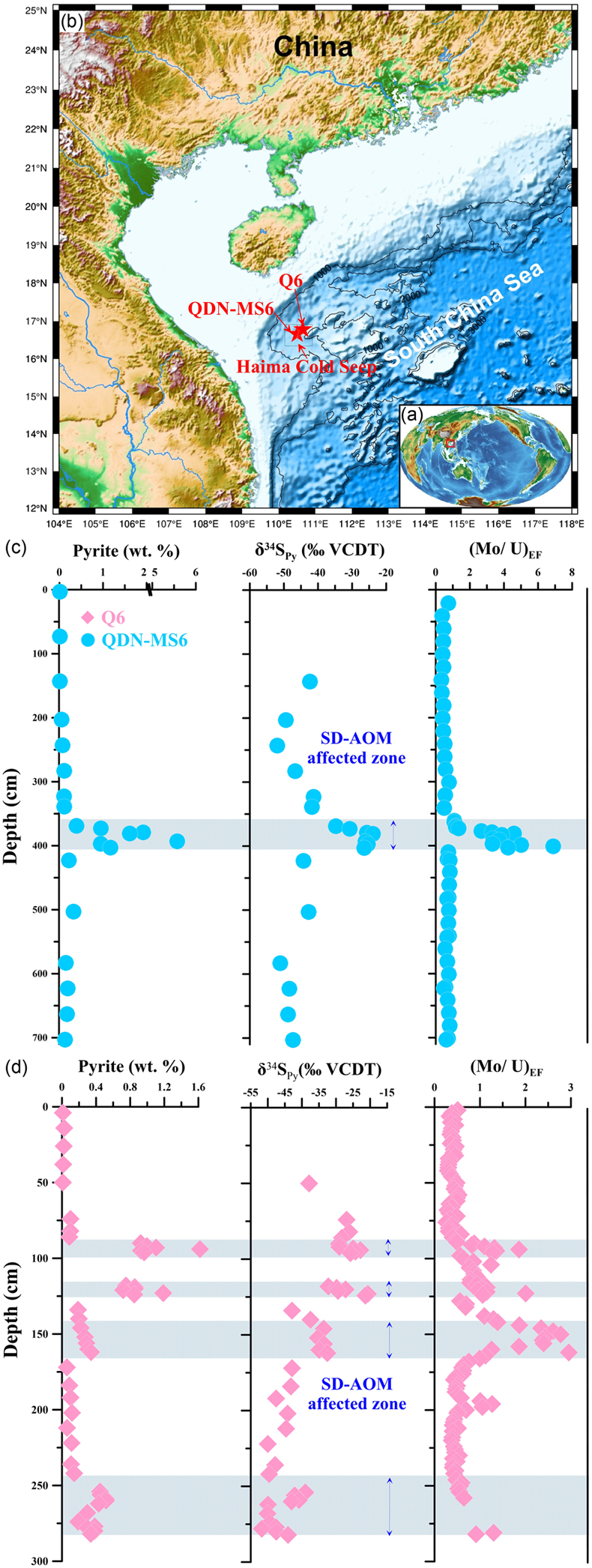
Figure 1 (a) Map of the World. The red rectangle represents the study area (b). (b) The red stars represent the sampling locations. (c, d) Down core variations of pyrite, δ34SPy, (Mo/U)EF and TS/TOC ratios in sediments of Q6 (based on Miao et al., 2021
Miao, X., Feng, X., Liu, X., Li, J., Wei, J. (2021) Effects of methane seepage activity on the morphology and geochemistry of authigenic pyrite. Marine and Petroleum Geology 133, 105231. https://doi.org/10.1016/j.marpetgeo.2021.105231
, 2022Miao, X., Feng, X., Li, J., Liu, X., Liang, J., Feng, J., Xiao, Q., Dan, X., Wei, J. (2022) Enrichment mechanism of trace elements in pyrite under methane seepage. Geochemical Perspectives Letters 21, 18–22. https://doi.org/10.7185/geochemlet.2211
) and QDN-MS6 (based on Miao et al., 2024bMiao, X., Wei, J., Li, J., Liu, X., Wang, D., Li, J., Feng, X. (2024b) Isotopically light Mo in sediments of methane seepage controlled by the benthic Fe–Mn redox shuttle process. Global and Planetary Change 239, 104512. https://doi.org/10.1016/j.gloplacha.2024.104512
), respectively. δ34SPy = sulfur isotope of pyrite; (Mo/U)EF = (Mo/U) enrichment factor ratios; TS/TOC = total sulfur/total organic carbon.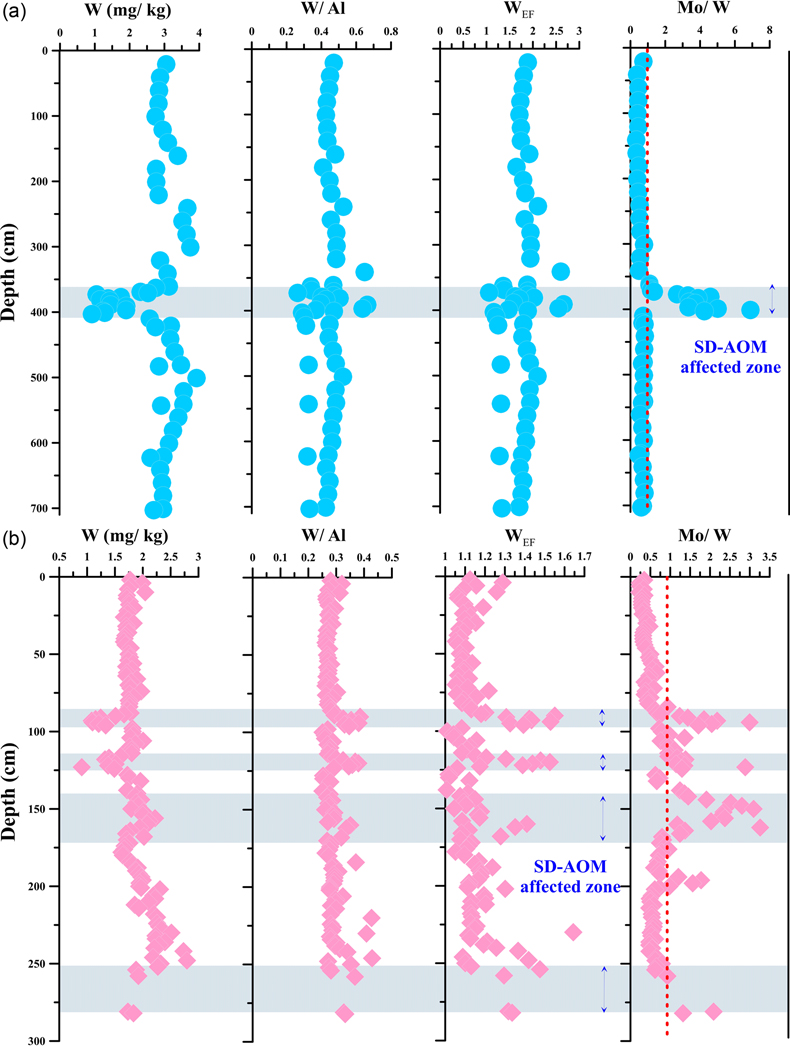
Figure 2 Geochemical characteristics of sediments in (a) QDN-MS6 and (b) Q6. The bands (blue) indicate areas affected by sulfate-driven anaerobic oxidation of methane (SD-AOM). The red dotted line represents the Mo/W molar ratio of the upper continental crust, which is 0.9 (Rudnick and Gao, 2014
Rudnick, R.L., Gao, S. (2014) 4.1 - Composition of the Continental Crust. In: Holland, H.D., Turekian, K.K. (Eds.) Treatise on Geochemistry. Second Edition, Elsevier, Oxford, 1–51. https://doi.org/10.1016/B978-0-08-095975-7.00301-6
).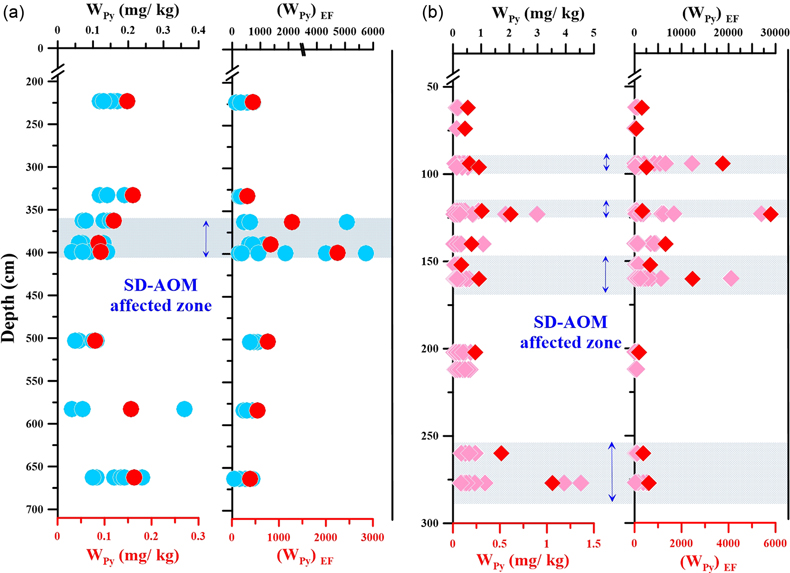
Figure 3 Down core variations of the W contents and WEF in pyrite samples in cores (a) QDN-MS6 and (b) Q6. The bands (blue) indicate areas affected sulfate-driven anaerobic oxidation of methane (SD-AOM). Each blue and pink symbol corresponds to a single pyrite measurement, with red symbols showing mean values.
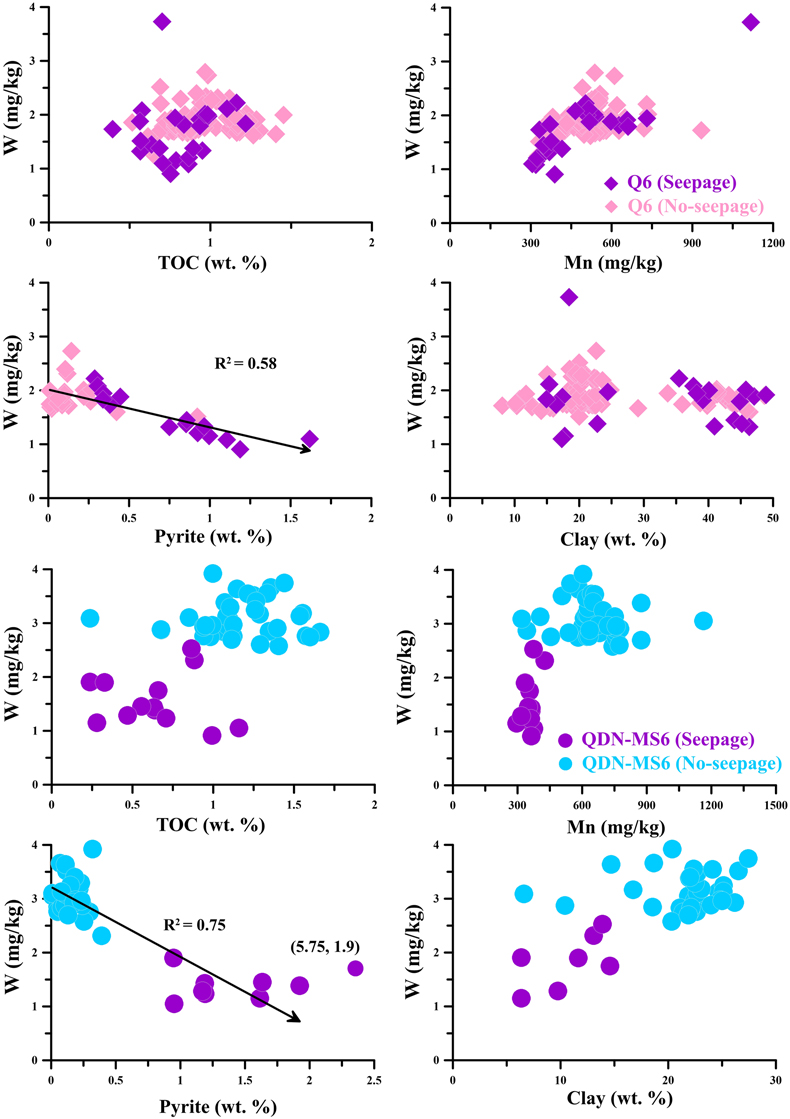
Figure 4 Relationships between W content and contents of TOC, Mn, pyrite, and clay in sediments.