



Testing ab initio garnet-clinopyroxene Ca-isotope fractionation models with natural data
Affiliations | Corresponding Author | Cite as | Funding information
Published by the European Association of Geochemistry
under Creative Commons License CC BY 4.0
Keywords: calcium isotopes, garnet-clinopyroxene Ca fractionation, equilibrium mineral-mineral stable isotope fractionation, empirical model, eclogite, garnet peridotite, mantle heterogeneity, magmatic differentiation, partial melting


- Share this article


-
Article views:1,113Cumulative count of HTML views and PDF downloads.
- Download Citation
- Rights & Permissions

top
Abstract
Figures
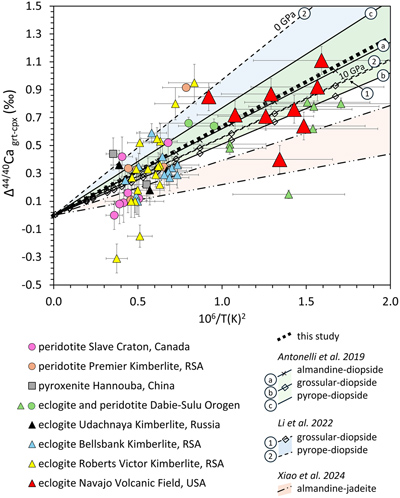 Figure 1 Δ44/40Cagrt-cpx plotted against 1/T2 for the samples in this study and previous work (see text). Natural data for eclogites (triangles), peridotites (circles) and pyroxenites (squares) are compared to DFT models by Antonelli et al. (2019), Li et al. (2022) and Xiao et al. (2022). All temperatures recalculated following the protocol described in Supplementary Information. Error bars represent 2 s.e., some are smaller than symbols. The Li et al. (2022) grossular-diopside and 10 GPa pyrope-diopside lines overlap. | 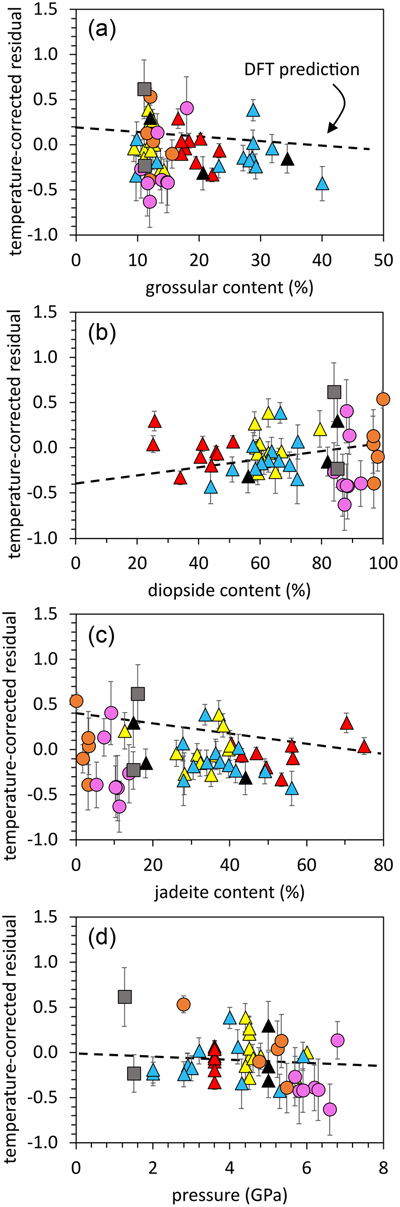 Figure 2 Plots of temperature-corrected Δ44/40Cagrt-cpx residuals against (a) garnet grossular content, (b) pyroxene diopside content, (c) pyroxene jadeite content, and (d) pressure estimates. Symbols as for Figure 1. | 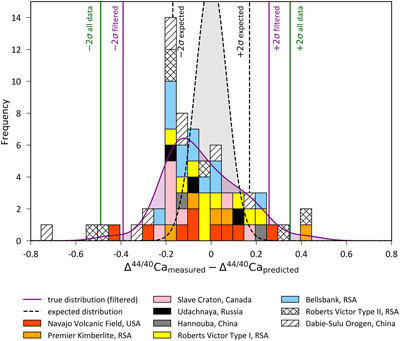 Figure 3 Histogram of Δ44/40Cagrt-cpx residuals, and error distribution expected from the predicted Δ44/40Cagrt-cpx and 1/T 2 uncertainty (dashed lines) compared to the actual distribution of filtered residuals (purple lines; excluded Dabie-Sulu or Roberts Victor Type II). | 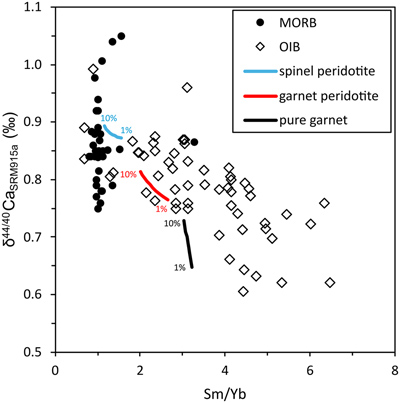 Figure 4 Comparison of δ44/40Ca versus Sm/Yb for MORB (Erikson and Jacobsen, 2022) and OIB (Eriksen et al., 2024). Lines represent batch melting of a spinel peridotite, garnet peridotite or pure garnet source, with 1 to 10 % partial melting. |
| Figure 1 | Figure 2 | Figure 3 | Figure 4 |
top
Introduction
Mantle peridotites exhibit limited variation in δ44/40Ca (δ44/40Ca = [(44Ca/40Ca)sample/(44Ca/40Ca)SRM915a − 1] × 1000; e.g., Dai et al., 2020
Dai, W., Wang, Z., Liu, Y., Chen, C., Zong, K., Zhou, L., Zhang, G., Li, M., Moynier, F., Hu, Z. (2020) Calcium isotope compositions of mantle pyroxenites. Geochimica et Cosmochimica Acta 270, 144–159. https://doi.org/10.1016/j.gca.2019.11.024
), but Ca isotopes are significantly fractionated during surface processes (He et al., 2023He, D., Liu, Y., Moynier, F., Foley, S.F., Chen, C., Zhu, Y., Lü, X., Zhang, G., Zong, K. (2023) Tightly coupled Ca-Zn-Sr isotope co-variations in basalts caused by recycled calcium carbonate in the mantle source. Chemical Geology 637, 121678. https://doi.org/10.1016/j.chemgeo.2023.121678
and references therein). Consequently, Ca isotopes have been utilised as tracers for recycled material and proxies for carbonate cycling in the mantle, especially when considering low-δ44/40Ca basalts or carbonatites (Kang et al., 2016Kang, J.-T., Zhu, H.-L., Liu, Y.-F., Liu, F., Wu, F., Hao, Y.-T., Zhi, X.-C., Zhang, Z.-F., Huang, F. (2016) Calcium isotopic composition of mantle xenoliths and minerals from Eastern China. Geochimica et Cosmochimica Acta 174, 335–344. https://doi.org/10.1016/j.gca.2015.11.039
, 2017Kang, J.-T., Ionov, D.A., Liu, F., Zhang, C.-L., Golovin, A.V, Qin, L.-P., Zhang, Z.-F., Huang, F. (2017) Calcium isotopic fractionation in mantle peridotites by melting and metasomatism and Ca isotope composition of the Bulk Silicate Earth. Earth and Planetary Science Letters 474, 128–137. https://doi.org/10.1016/j.epsl.2017.05.035
; Chen et al., 2023Chen, Q., Zhou, M.-F., Xia, X.-P., Liu, P.-P. (2023) Li and O isotopes of mantle xenoliths from deep fault-related Cenozoic basalts in eastern China: The role of subducted components in the generation of the heterogeneous lithospheric mantle. Chemical Geology 628, 121471. https://doi.org/10.1016/j.chemgeo.2023.121471
; Li et al., 2024Li, J.-L., Wang, X.-S., Wang, Z., Huang, J., Gao, J. (2024) Ca–Zn isotope fractionation during fluid–rock interaction in subduction zones and its implication for deep carbon cycle. Chemical Geology 670, 122425. https://doi.org/10.1016/j.chemgeo.2024.122425
; Zhu et al., 2025Zhu, H., Shan, Y., Liao, R., Zhang, L., Deng, J., Li, C., Du, L., Zhang, Z., Sun, W. (2025) Ca-Sr-Nd isotopic signatures of mid-ocean ridge basalts from the Central Indian Ridge and implications for recycled materials in the Indian Ocean mantle domain. Chemical Geology 673, 122546. https://doi.org/10.1016/j.chemgeo.2024.122546
). However, this view is challenged by a broad negative correlation between δ44/40Ca and La/Lu observed in mid-ocean ridge basalts (MORB) and ocean island basalts (OIB; Eriksen and Jacobsen, 2022Eriksen, Z.T., Jacobsen, S.B. (2022) Calcium isotope constraints on OIB and MORB petrogenesis: The importance of melt mixing. Earth and Planetary Science Letters 593, 117665. https://doi.org/10.1016/j.epsl.2022.117665
and references therein). Because garnet strongly fractionates both Ca isotopes and heavy REE, this correlation may reflect isotopic fractionation during melting of garnet-bearing lithologies (Eriksen et al., 2024Eriksen, Z.T., Jacobsen, S.B., Day, J.M.D., White, W.M. (2024) Calcium isotope variability among ocean islands reveals the physical and lithological controls on mantle partial melting. Geochimica et Cosmochimica Acta 373, 326–341. https://doi.org/10.1016/j.gca.2024.02.011
). In contrast, clinopyroxene-melt fractionation produces melts with δ44/40Ca values only <0.1 ‰ lower than spinel peridotites (Eriksen and Jacobsen, 2022Eriksen, Z.T., Jacobsen, S.B. (2022) Calcium isotope constraints on OIB and MORB petrogenesis: The importance of melt mixing. Earth and Planetary Science Letters 593, 117665. https://doi.org/10.1016/j.epsl.2022.117665
; Chen et al., 2024Chen, C., Foley, S.F., Tappe, S., Ren, H., Feng, L., Liu, Y. (2024) Calcium isotopes track volatile components in the mantle sources of alkaline rocks and associated carbonatites. Earth and Planetary Science Letters 625, 118489. https://doi.org/10.1016/j.epsl.2023.118489
). Parameterising garnet-clinopyroxene fractionation is therefore necessary to model the effects of melting of garnet-bearing sources on melt δ44/40Ca, better enabling us to distinguish contributions from equilibrium melting, sedimentary recycling and disequilibrium processes on the δ44/40Ca of xenoliths and mantle-derived melts.To characterise the behaviour of calcium isotopes during equilibrium fractionation, studies have focused on identifying the primary factors, such as temperature (Antonelli et al., 2019
Antonelli, M.A., Schiller, M., Schauble, E.A., Mittal, T., DePaolo, D.J., Chacko, T., Grew, E.S., Tripoli, B. (2019) Kinetic and equilibrium Ca isotope effects in high-T rocks and minerals. Earth and Planetary Science Letters 517, 71–82. https://doi.org/10.1016/j.epsl.2019.04.013
; Li et al., 2022Li, Y., Wu, Z., Huang, S., Wang, W. (2022) Pressure and concentration effects on intermineral calcium isotope fractionation involving garnet. Chemical Geology 591, 120722. https://doi.org/10.1016/j.chemgeo.2022.120722
), pressure (Chen et al., 2020Chen, C., Huang, J.-X., Foley, S.F., Wang, Z., Moynier, F., Liu, Y., Dai, W., Li, M. (2020) Compositional and pressure controls on calcium and magnesium isotope fractionation in magmatic systems. Geochimica et Cosmochimica Acta 290, 257–270. https://doi.org/10.1016/j.gca.2020.09.006
; Li et al., 2022Li, Y., Wu, Z., Huang, S., Wang, W. (2022) Pressure and concentration effects on intermineral calcium isotope fractionation involving garnet. Chemical Geology 591, 120722. https://doi.org/10.1016/j.chemgeo.2022.120722
) and mineral composition (Antonelli et al., 2019Antonelli, M.A., Schiller, M., Schauble, E.A., Mittal, T., DePaolo, D.J., Chacko, T., Grew, E.S., Tripoli, B. (2019) Kinetic and equilibrium Ca isotope effects in high-T rocks and minerals. Earth and Planetary Science Letters 517, 71–82. https://doi.org/10.1016/j.epsl.2019.04.013
; Chen et al., 2020Chen, C., Huang, J.-X., Foley, S.F., Wang, Z., Moynier, F., Liu, Y., Dai, W., Li, M. (2020) Compositional and pressure controls on calcium and magnesium isotope fractionation in magmatic systems. Geochimica et Cosmochimica Acta 290, 257–270. https://doi.org/10.1016/j.gca.2020.09.006
), that control inter-mineral or mineral-melt isotopic fractionation. Modelling the effects of these parameters is essential to constrain the δ44/40Ca variation generated during igneous and metamorphic processes under isotopic equilibrium (Li et al., 2025Li, Y., Hardin, J., Wang, W., Wu, Z., Huang, S. (2025) Mineral-melt calcium isotope fractionation factors constrained using ab initio molecular dynamics simulations and their implications to calcium isotope effects during partial melting in the upper mantle. Geochimica et Cosmochimica Acta 396, 51–70. https://doi.org/10.1016/j.gca.2025.02.032
). However, to date, most studies have relied on theoretical ab initio modelling (Antonelli et al., 2019Antonelli, M.A., Schiller, M., Schauble, E.A., Mittal, T., DePaolo, D.J., Chacko, T., Grew, E.S., Tripoli, B. (2019) Kinetic and equilibrium Ca isotope effects in high-T rocks and minerals. Earth and Planetary Science Letters 517, 71–82. https://doi.org/10.1016/j.epsl.2019.04.013
; Chen et al., 2020Chen, C., Huang, J.-X., Foley, S.F., Wang, Z., Moynier, F., Liu, Y., Dai, W., Li, M. (2020) Compositional and pressure controls on calcium and magnesium isotope fractionation in magmatic systems. Geochimica et Cosmochimica Acta 290, 257–270. https://doi.org/10.1016/j.gca.2020.09.006
; Li et al., 2022Li, Y., Wu, Z., Huang, S., Wang, W. (2022) Pressure and concentration effects on intermineral calcium isotope fractionation involving garnet. Chemical Geology 591, 120722. https://doi.org/10.1016/j.chemgeo.2022.120722
; Xiao et al., 2022Xiao, Z.-C., Zhou, C., Kang, J.-T., Wu, Z.-Q., Huang, F. (2022) The factors controlling equilibrium inter-mineral Ca isotope fractionation: Insights from first-principles calculations. Geochimica et Cosmochimica Acta 333, 373–389. https://doi.org/10.1016/j.gca.2022.07.021
), with limited use of natural or experimental samples to validate model predictions (Smart et al., 2021Smart, K.A., Tappe, S., Woodland, A.B., Greyling, D.R., Harris, C., Gussone, N. (2021) Constraints on Archean crust recycling and the origin of mantle redox variability from the δ44/40Ca – δ18O – fO2 signatures of cratonic eclogites. Earth and Planetary Science Letters 556, 116720. https://doi.org/10.1016/j.epsl.2020.116720
; Li et al., 2022Li, Y., Wu, Z., Huang, S., Wang, W. (2022) Pressure and concentration effects on intermineral calcium isotope fractionation involving garnet. Chemical Geology 591, 120722. https://doi.org/10.1016/j.chemgeo.2022.120722
, 2025Li, Y., Hardin, J., Wang, W., Wu, Z., Huang, S. (2025) Mineral-melt calcium isotope fractionation factors constrained using ab initio molecular dynamics simulations and their implications to calcium isotope effects during partial melting in the upper mantle. Geochimica et Cosmochimica Acta 396, 51–70. https://doi.org/10.1016/j.gca.2025.02.032
). Furthermore, the few natural samples analysed have predominantly come from South African kimberlite localities (Roberts Victor, Chen et al., 2020Chen, C., Huang, J.-X., Foley, S.F., Wang, Z., Moynier, F., Liu, Y., Dai, W., Li, M. (2020) Compositional and pressure controls on calcium and magnesium isotope fractionation in magmatic systems. Geochimica et Cosmochimica Acta 290, 257–270. https://doi.org/10.1016/j.gca.2020.09.006
; Li et al., 2022Li, Y., Wu, Z., Huang, S., Wang, W. (2022) Pressure and concentration effects on intermineral calcium isotope fractionation involving garnet. Chemical Geology 591, 120722. https://doi.org/10.1016/j.chemgeo.2022.120722
; Bellsbank, Smart et al., 2021Smart, K.A., Tappe, S., Woodland, A.B., Greyling, D.R., Harris, C., Gussone, N. (2021) Constraints on Archean crust recycling and the origin of mantle redox variability from the δ44/40Ca – δ18O – fO2 signatures of cratonic eclogites. Earth and Planetary Science Letters 556, 116720. https://doi.org/10.1016/j.epsl.2020.116720
; and Premier, Tappe et al., 2021Tappe, S., Massuyeau, M., Smart, K.A., Woodland, A.B., Gussone, N., Milne, S., Stracke, A. (2021) Sheared Peridotite and Megacryst Formation Beneath the Kaapvaal Craton: a Snapshot of Tectonomagmatic Processes across the Lithosphere–Asthenosphere Transition. Journal of Petrology 62, egab046. https://doi.org/10.1093/petrology/egab046
), which equilibrated at high temperatures (>800 °C). Hence, the temperature dependence of Ca-isotope fractionation has not yet been adequately tested.We present new mineral δ44/40Ca data for a suite of low-temperature eclogites from the Navajo Volcanic Field (NVF) in the Colorado Plateau, USA. These results are combined with existing garnet and clinopyroxene δ44/40Ca from natural samples to test first-principles δ44/40Ca fractionation models. We evaluate the proposed factors controlling garnet-clinopyroxene Ca-isotope fractionation, and consider the implications for δ44/40Ca fractionation during partial melting.
top
Sample Description Results
Eclogitic xenoliths (n = 9) from Garnet Ridge ultramafic diatreme were selected from the NVF xenolith collection at the University of Texas at Austin (UT-Austin). They are subrounded nodules approximately 2 to 4.5 cm in diameter, dominated by jadeite-rich pyroxene, almandine-rich garnet, with lawsonite and zoisite (Table S-1). Garnet and clinopyroxene major element compositions were determined by electron microprobe (Table S-2) for Mg-Fe garnet-clinopyroxene thermometry. Calcium isotope data were collected at UT-Austin. See Supplementary Information for method details. Garnet δ44/40Ca values range from 1.54 to 1.98 ‰ and pyroxenes vary from 0.76 to 1.21 ‰, with δ44/40Ca fractionation (Δ44/40Cagrt-cpx = δ44/40Cagarnet − δ44/40Caclinopyroxene) values of 0.64 to 1.11 ‰ (Table S-3).
top
Discussion
Comparison of natural data to Ca-isotope fractionation models. Density functional theory (DFT) models predict that Ca-isotope fractionation is primarily controlled by Ca-O bond strength, with vibrational frequencies and force constants influencing bond stiffness and thus isotope partitioning (Schauble, 2004
Schauble, E.A. (2004) Applying Stable Isotope Fractionation Theory to New Systems. Reviews in Mineralogy and Geochemistry 55, 65–111. https://doi.org/10.2138/gsrmg.55.1.65
; Antonelli et al., 2019Antonelli, M.A., Schiller, M., Schauble, E.A., Mittal, T., DePaolo, D.J., Chacko, T., Grew, E.S., Tripoli, B. (2019) Kinetic and equilibrium Ca isotope effects in high-T rocks and minerals. Earth and Planetary Science Letters 517, 71–82. https://doi.org/10.1016/j.epsl.2019.04.013
; Li et al., 2022Li, Y., Wu, Z., Huang, S., Wang, W. (2022) Pressure and concentration effects on intermineral calcium isotope fractionation involving garnet. Chemical Geology 591, 120722. https://doi.org/10.1016/j.chemgeo.2022.120722
; Xiao et al., 2022Xiao, Z.-C., Zhou, C., Kang, J.-T., Wu, Z.-Q., Huang, F. (2022) The factors controlling equilibrium inter-mineral Ca isotope fractionation: Insights from first-principles calculations. Geochimica et Cosmochimica Acta 333, 373–389. https://doi.org/10.1016/j.gca.2022.07.021
). Equilibrium fractionation arises from vibrational zero-point energy differences and partition functions, in which heavier isotopes preferentially occupy sites with stiffer bonds (e.g., Schauble, 2004Schauble, E.A. (2004) Applying Stable Isotope Fractionation Theory to New Systems. Reviews in Mineralogy and Geochemistry 55, 65–111. https://doi.org/10.2138/gsrmg.55.1.65
). Fractionation is proportional to 1/T2 because increasing temperature results in a smaller difference in vibrational energy between two phases. Because mineral composition variation affects lattice structure, this also influences Ca-O bond length and Δ44/40Cagrt-cpx (e.g., Antonelli et al., 2019Antonelli, M.A., Schiller, M., Schauble, E.A., Mittal, T., DePaolo, D.J., Chacko, T., Grew, E.S., Tripoli, B. (2019) Kinetic and equilibrium Ca isotope effects in high-T rocks and minerals. Earth and Planetary Science Letters 517, 71–82. https://doi.org/10.1016/j.epsl.2019.04.013
). This effect is predicted to be greater in garnet than in clinopyroxene because the garnet lattice is more rigid and therefore more affected by cation substitutions than the comparatively flexible pyroxene lattice (Antonelli et al., 2019Antonelli, M.A., Schiller, M., Schauble, E.A., Mittal, T., DePaolo, D.J., Chacko, T., Grew, E.S., Tripoli, B. (2019) Kinetic and equilibrium Ca isotope effects in high-T rocks and minerals. Earth and Planetary Science Letters 517, 71–82. https://doi.org/10.1016/j.epsl.2019.04.013
; Li et al., 2022Li, Y., Wu, Z., Huang, S., Wang, W. (2022) Pressure and concentration effects on intermineral calcium isotope fractionation involving garnet. Chemical Geology 591, 120722. https://doi.org/10.1016/j.chemgeo.2022.120722
).The accuracy of DFT models depends on theoretical assumptions, such as the choice of vibration energy model or functional (Local Density Approximation vs. Generalised Gradient Approximation), lattice framework chosen, choice of mineral endmembers, and parameters chosen for adjustment (e.g., composition or pressure; Li et al., 2025
Li, Y., Hardin, J., Wang, W., Wu, Z., Huang, S. (2025) Mineral-melt calcium isotope fractionation factors constrained using ab initio molecular dynamics simulations and their implications to calcium isotope effects during partial melting in the upper mantle. Geochimica et Cosmochimica Acta 396, 51–70. https://doi.org/10.1016/j.gca.2025.02.032
). Due to computational limitations, models are generally run for compositional endmembers rather than complex solid solutions. Uncertainties in vibrational frequency inputs and use of different approaches or software can introduce systematic errors (Li et al., 2025Li, Y., Hardin, J., Wang, W., Wu, Z., Huang, S. (2025) Mineral-melt calcium isotope fractionation factors constrained using ab initio molecular dynamics simulations and their implications to calcium isotope effects during partial melting in the upper mantle. Geochimica et Cosmochimica Acta 396, 51–70. https://doi.org/10.1016/j.gca.2025.02.032
), which may produce discrepancies between empirical data and ab initio predictions. Systematic errors within approaches may be cancelled out when using the same models for a mineral pair, but unpredictable errors may occur when approaches from different papers are combined (Li et al., 2025Li, Y., Hardin, J., Wang, W., Wu, Z., Huang, S. (2025) Mineral-melt calcium isotope fractionation factors constrained using ab initio molecular dynamics simulations and their implications to calcium isotope effects during partial melting in the upper mantle. Geochimica et Cosmochimica Acta 396, 51–70. https://doi.org/10.1016/j.gca.2025.02.032
).To test whether first-principles models accurately predict isotopic fractionation in natural samples, we present Δ44/40Cagrt-cpx from this and previous studies against 106/T2 (Fig. 1). To ensure estimated temperatures are internally consistent, we apply the same garnet-clinopyroxene Mg-Fe thermometer procedure to all NVF and literature samples (see Supplementary Information). The natural data are compared to DFT models from Antonelli et al. (2019)
Antonelli, M.A., Schiller, M., Schauble, E.A., Mittal, T., DePaolo, D.J., Chacko, T., Grew, E.S., Tripoli, B. (2019) Kinetic and equilibrium Ca isotope effects in high-T rocks and minerals. Earth and Planetary Science Letters 517, 71–82. https://doi.org/10.1016/j.epsl.2019.04.013
, Li et al. (2022)Li, Y., Wu, Z., Huang, S., Wang, W. (2022) Pressure and concentration effects on intermineral calcium isotope fractionation involving garnet. Chemical Geology 591, 120722. https://doi.org/10.1016/j.chemgeo.2022.120722
and Xiao et al. (2022)Xiao, Z.-C., Zhou, C., Kang, J.-T., Wu, Z.-Q., Huang, F. (2022) The factors controlling equilibrium inter-mineral Ca isotope fractionation: Insights from first-principles calculations. Geochimica et Cosmochimica Acta 333, 373–389. https://doi.org/10.1016/j.gca.2022.07.021
. The shaded regions show the model ranges for: Antonelli et al. (2019)Antonelli, M.A., Schiller, M., Schauble, E.A., Mittal, T., DePaolo, D.J., Chacko, T., Grew, E.S., Tripoli, B. (2019) Kinetic and equilibrium Ca isotope effects in high-T rocks and minerals. Earth and Planetary Science Letters 517, 71–82. https://doi.org/10.1016/j.epsl.2019.04.013
, where garnet almandine-grossular-pyrope composition is varied and clinopyroxene is fixed as diopside; Li et al. (2022)Li, Y., Wu, Z., Huang, S., Wang, W. (2022) Pressure and concentration effects on intermineral calcium isotope fractionation involving garnet. Chemical Geology 591, 120722. https://doi.org/10.1016/j.chemgeo.2022.120722
, bound by their 0 and 10 GPa pyrope-diopside models; and Xiao et al. (2022)Xiao, Z.-C., Zhou, C., Kang, J.-T., Wu, Z.-Q., Huang, F. (2022) The factors controlling equilibrium inter-mineral Ca isotope fractionation: Insights from first-principles calculations. Geochimica et Cosmochimica Acta 333, 373–389. https://doi.org/10.1016/j.gca.2022.07.021
, in which the garnet is fixed as almandine, and jadeite type changes with variable Na + Al substitution for Ca + Mg.Figure 1 Δ44/40Cagrt-cpx plotted against 1/T2 for the samples in this study and previous work (see text). Natural data for eclogites (triangles), peridotites (circles) and pyroxenites (squares) are compared to DFT models by Antonelli et al. (2019)
Antonelli, M.A., Schiller, M., Schauble, E.A., Mittal, T., DePaolo, D.J., Chacko, T., Grew, E.S., Tripoli, B. (2019) Kinetic and equilibrium Ca isotope effects in high-T rocks and minerals. Earth and Planetary Science Letters 517, 71–82. https://doi.org/10.1016/j.epsl.2019.04.013
, Li et al. (2022)Li, Y., Wu, Z., Huang, S., Wang, W. (2022) Pressure and concentration effects on intermineral calcium isotope fractionation involving garnet. Chemical Geology 591, 120722. https://doi.org/10.1016/j.chemgeo.2022.120722
and Xiao et al. (2022)Xiao, Z.-C., Zhou, C., Kang, J.-T., Wu, Z.-Q., Huang, F. (2022) The factors controlling equilibrium inter-mineral Ca isotope fractionation: Insights from first-principles calculations. Geochimica et Cosmochimica Acta 333, 373–389. https://doi.org/10.1016/j.gca.2022.07.021
. All temperatures recalculated following the protocol described in Supplementary Information. Error bars represent 2 s.e., some are smaller than symbols. The Li et al. (2022)Li, Y., Wu, Z., Huang, S., Wang, W. (2022) Pressure and concentration effects on intermineral calcium isotope fractionation involving garnet. Chemical Geology 591, 120722. https://doi.org/10.1016/j.chemgeo.2022.120722
grossular-diopside and 10 GPa pyrope-diopside lines overlap.The weighted regression of all the natural data yields the following line:
Eq. 1

with a mean squared weighted deviation (MSWD) of 7.5 (n = 65). The slope of this fractionation line is significantly greater than DFT predictions, and the intercept is non-zero, inconsistent with models. Li et al. (2022)
Li, Y., Wu, Z., Huang, S., Wang, W. (2022) Pressure and concentration effects on intermineral calcium isotope fractionation involving garnet. Chemical Geology 591, 120722. https://doi.org/10.1016/j.chemgeo.2022.120722
noted that Type II Roberts Victor samples (‘unmetasomatised’) form a steeply dipping array (increasing Δ44/40Cagrt-cpx with 106/T2) and contain samples with Δ44/40Cagrt-cpx < 0, inconsistent with model predictions. It is unclear whether this is a disequilibrium process (Antonelli et al., 2019Antonelli, M.A., Schiller, M., Schauble, E.A., Mittal, T., DePaolo, D.J., Chacko, T., Grew, E.S., Tripoli, B. (2019) Kinetic and equilibrium Ca isotope effects in high-T rocks and minerals. Earth and Planetary Science Letters 517, 71–82. https://doi.org/10.1016/j.epsl.2019.04.013
), pressure effect (Chen et al., 2020Chen, C., Huang, J.-X., Foley, S.F., Wang, Z., Moynier, F., Liu, Y., Dai, W., Li, M. (2020) Compositional and pressure controls on calcium and magnesium isotope fractionation in magmatic systems. Geochimica et Cosmochimica Acta 290, 257–270. https://doi.org/10.1016/j.gca.2020.09.006
), due to jadeite/high-pressure garnet that have since destabilised (Li et al., 2022Li, Y., Wu, Z., Huang, S., Wang, W. (2022) Pressure and concentration effects on intermineral calcium isotope fractionation involving garnet. Chemical Geology 591, 120722. https://doi.org/10.1016/j.chemgeo.2022.120722
), or a mixture of processes. Because the Ca-isotope equilibrium of those samples is debated, they are excluded, reducing the MSWD to 6.4 and bringing the regression more in line with predictions (see Eq. S-2).Additionally, we note that the only in situ samples are from the Dabie-Sulu Orogen, which has undergone slow exhumation (Hacker et al., 2006
Hacker, B.R., Wallis, S.R., Ratschbacher, L., Grove, M., Gehrels, G. (2006) High-temperature geochronology constraints on the tectonic history and architecture of the ultrahigh-pressure Dabie-Sulu Orogen. Tectonics 25, TC5006. https://doi.org/10.1029/2005TC001937
). Mg-Fe diffusion is more rapid and continues to lower temperatures than Ca diffusion (Ganguly, 2010Ganguly, J. (2010) Cation Diffusion Kinetics in Aluminosilicate Garnets and Geological Applications. Reviews in Mineralogy and Geochemistry 72, 559–601. https://doi.org/10.2138/rmg.2010.72.12
). Hence, these slowly-cooled samples are expected to have TMg-Fe less than TCa. Because the TMg-Fe is expected to not be in equilibrium with Δ44/40Cagrt-cpx, these samples are also not suited to this analysis. Removing Dabie-Sulu samples from the regression improves the MSWD to 5.7 (Eq. S-3). A final consideration is the non-zero intercept – DFT modelling and thermodynamics predict that Δ44/40Cagrt-cpx converges to 0 as T approaches infinity (Schauble, 2004Schauble, E.A. (2004) Applying Stable Isotope Fractionation Theory to New Systems. Reviews in Mineralogy and Geochemistry 55, 65–111. https://doi.org/10.2138/gsrmg.55.1.65
). Because no sign reversal is anticipated for Ca-isotope fractionation of garnet and clinopyroxene, the regression is forced to the intercept. The heavy dashed line is the weighted regression of all natural data, excluding Dabie-Sulu and Type II Roberts Victor (Fig. 1). The revised empirical, temperature-dependent model is now:Eq. 2

This model is consistent with DFT predictions, as the slope is within the range of Antonelli et al. (2019)
Antonelli, M.A., Schiller, M., Schauble, E.A., Mittal, T., DePaolo, D.J., Chacko, T., Grew, E.S., Tripoli, B. (2019) Kinetic and equilibrium Ca isotope effects in high-T rocks and minerals. Earth and Planetary Science Letters 517, 71–82. https://doi.org/10.1016/j.epsl.2019.04.013
and slightly higher than the slopes of 0.567 from Huang et al. (2019)Huang, F., Zhou, C., Wang, W., Kang, J., Wu, Z. (2019) First-principles calculations of equilibrium Ca isotope fractionation: Implications for oldhamite formation and evolution of lunar magma ocean. Earth and Planetary Science Letters 510, 153–160. https://doi.org/10.1016/j.epsl.2018.12.034
and 0.52 from Li et al. (2025)Li, Y., Hardin, J., Wang, W., Wu, Z., Huang, S. (2025) Mineral-melt calcium isotope fractionation factors constrained using ab initio molecular dynamics simulations and their implications to calcium isotope effects during partial melting in the upper mantle. Geochimica et Cosmochimica Acta 396, 51–70. https://doi.org/10.1016/j.gca.2025.02.032
. Increasing Δ44/40Cagrt-cpx fractionation is correlated with decreasing temperature (increasing 106/T2; MSWD = 6.8, n = 49, p < 0.001). The NVF eclogites, which have lower temperature estimates (∼500 to 800 °C; Table S-5) than most literature samples (∼900 to 1200 °C), have higher Δ44/40Cagrt-cpx, as predicted.By using the average garnet composition for all samples (Py47Alm34Grs18) to linearly mix the Antonelli et al. (2019)
Antonelli, M.A., Schiller, M., Schauble, E.A., Mittal, T., DePaolo, D.J., Chacko, T., Grew, E.S., Tripoli, B. (2019) Kinetic and equilibrium Ca isotope effects in high-T rocks and minerals. Earth and Planetary Science Letters 517, 71–82. https://doi.org/10.1016/j.epsl.2019.04.013
pyrope-, almandine- and grossular-diopside models, one obtains a model indistinguishable from Equation 2 (slope = 0.64). Hence, to a first order, DFT modelling accurately predicts natural observations.Constraining controls on natural Δ44/40Cagrt-cpx variability. Despite the similarity between the empirical and DFT models, the natural samples show significant scatter from the regression (Fig. 1 and Fig. S-5), which may be due to analytical error, or reflect the influence of factors such as pressure (Chen et al., 2020
Chen, C., Huang, J.-X., Foley, S.F., Wang, Z., Moynier, F., Liu, Y., Dai, W., Li, M. (2020) Compositional and pressure controls on calcium and magnesium isotope fractionation in magmatic systems. Geochimica et Cosmochimica Acta 290, 257–270. https://doi.org/10.1016/j.gca.2020.09.006
), garnet composition (Chen et al., 2020Chen, C., Huang, J.-X., Foley, S.F., Wang, Z., Moynier, F., Liu, Y., Dai, W., Li, M. (2020) Compositional and pressure controls on calcium and magnesium isotope fractionation in magmatic systems. Geochimica et Cosmochimica Acta 290, 257–270. https://doi.org/10.1016/j.gca.2020.09.006
; Li et al., 2022Li, Y., Wu, Z., Huang, S., Wang, W. (2022) Pressure and concentration effects on intermineral calcium isotope fractionation involving garnet. Chemical Geology 591, 120722. https://doi.org/10.1016/j.chemgeo.2022.120722
), pyroxene composition (Wang et al., 2019Wang, Y., He, Y., Wu, H., Zhu, C., Huang, S., Huang, J. (2019) Calcium isotope fractionation during crustal melting and magma differentiation: Granitoid and mineral-pair perspectives. Geochimica et Cosmochimica Acta 259, 37–52. https://doi.org/10.1016/j.gca.2019.05.030
; Li et al., 2022Li, Y., Wu, Z., Huang, S., Wang, W. (2022) Pressure and concentration effects on intermineral calcium isotope fractionation involving garnet. Chemical Geology 591, 120722. https://doi.org/10.1016/j.chemgeo.2022.120722
; Xiao et al., 2022Xiao, Z.-C., Zhou, C., Kang, J.-T., Wu, Z.-Q., Huang, F. (2022) The factors controlling equilibrium inter-mineral Ca isotope fractionation: Insights from first-principles calculations. Geochimica et Cosmochimica Acta 333, 373–389. https://doi.org/10.1016/j.gca.2022.07.021
), or disequilibrium effects (Antonelli et al., 2019Antonelli, M.A., Schiller, M., Schauble, E.A., Mittal, T., DePaolo, D.J., Chacko, T., Grew, E.S., Tripoli, B. (2019) Kinetic and equilibrium Ca isotope effects in high-T rocks and minerals. Earth and Planetary Science Letters 517, 71–82. https://doi.org/10.1016/j.epsl.2019.04.013
). To test the influence of these parameters, the departure of natural samples from the regression is quantified using residuals (measured Δ44/40Cagrt-cpx − predicted Δ44/40Cagrt-cpx). The linear regression (Eq. 2) is used to calculate the predicted Δ44/40Cagrt-cpx from temperature estimates for each sample, and the residuals are then compared to compositional parameters and pressure estimates (Fig. 2) to assess correlations.Figure 2 Plots of temperature-corrected Δ44/40Cagrt-cpx residuals against (a) garnet grossular content, (b) pyroxene diopside content, (c) pyroxene jadeite content, and (d) pressure estimates. Symbols as for Figure 1.
First, though, it is worth testing whether the scatter is due to random errors. The residuals are compared to the normal distribution of expected errors from thermometric uncertainty, isotopic measurement error and error in the linear regression (average total 2σ = 0.14 ‰; Fig. 3). The true residual 2σ is 0.34 ‰. Hence, while some departures may be due to uncertainty in Mg-Fe exchange thermometry and measured Δ44/40Cagrt-cpx, most scatter is unaccounted for.
Figure 3 Histogram of Δ44/40Cagrt-cpx residuals, and error distribution expected from the predicted Δ44/40Cagrt-cpx and 1/T2 uncertainty (dashed lines) compared to the actual distribution of filtered residuals (purple lines; excluded Dabie-Sulu or Roberts Victor Type II).
Varying garnet composition from grossular to almandine to pyrope is predicted to increase Δ44/40Cagrt-cpx (Antonelli et al., 2019
Antonelli, M.A., Schiller, M., Schauble, E.A., Mittal, T., DePaolo, D.J., Chacko, T., Grew, E.S., Tripoli, B. (2019) Kinetic and equilibrium Ca isotope effects in high-T rocks and minerals. Earth and Planetary Science Letters 517, 71–82. https://doi.org/10.1016/j.epsl.2019.04.013
) because these cation substitutions decrease the Ca-O bond length, but we do not observe correlations between residuals and garnet almandine, grossular, or pyrope content (grossular shown; Fig. 2). However, at high temperatures (>1000 K) the compositional effect is expected to be <0.2 ‰ (e.g., Li et al., 2025Li, Y., Hardin, J., Wang, W., Wu, Z., Huang, S. (2025) Mineral-melt calcium isotope fractionation factors constrained using ab initio molecular dynamics simulations and their implications to calcium isotope effects during partial melting in the upper mantle. Geochimica et Cosmochimica Acta 396, 51–70. https://doi.org/10.1016/j.gca.2025.02.032
), similar to the propagated measurement errors, and so compositional effects may not be easily observable given other sources of scatter. It is clear, however, that for a given temperature, Δ44/40Cagrt-cpx varies more than is predicted for compositional variation (Fig. 2).Due to similar ionic sizes, Mg-Fe substitution does not significantly alter the pyroxene lattice size. Hence, no Ca-O bond length change (or Δ44/40Cagrt-cpx effect) is expected. Consistent with this, there is no clear correlation between residuals and diopside content, as noted by Li et al. (2025)
Li, Y., Hardin, J., Wang, W., Wu, Z., Huang, S. (2025) Mineral-melt calcium isotope fractionation factors constrained using ab initio molecular dynamics simulations and their implications to calcium isotope effects during partial melting in the upper mantle. Geochimica et Cosmochimica Acta 396, 51–70. https://doi.org/10.1016/j.gca.2025.02.032
. A correlation between Δ44/40Cagrt-cpx and jadeite content was previously reported for Dabie-Sulu eclogites (Wang et al., 2019Wang, Y., He, Y., Wu, H., Zhu, C., Huang, S., Huang, J. (2019) Calcium isotope fractionation during crustal melting and magma differentiation: Granitoid and mineral-pair perspectives. Geochimica et Cosmochimica Acta 259, 37–52. https://doi.org/10.1016/j.gca.2019.05.030
), and DFT modelling by Xiao et al. (2022)Xiao, Z.-C., Zhou, C., Kang, J.-T., Wu, Z.-Q., Huang, F. (2022) The factors controlling equilibrium inter-mineral Ca isotope fractionation: Insights from first-principles calculations. Geochimica et Cosmochimica Acta 333, 373–389. https://doi.org/10.1016/j.gca.2022.07.021
predicts Δ44/40Cagrt-cpx changes depending on how Na + Al is substituted in jadeite. However, neither Chen et al. (2020)Chen, C., Huang, J.-X., Foley, S.F., Wang, Z., Moynier, F., Liu, Y., Dai, W., Li, M. (2020) Compositional and pressure controls on calcium and magnesium isotope fractionation in magmatic systems. Geochimica et Cosmochimica Acta 290, 257–270. https://doi.org/10.1016/j.gca.2020.09.006
nor Smart et al. (2021)Smart, K.A., Tappe, S., Woodland, A.B., Greyling, D.R., Harris, C., Gussone, N. (2021) Constraints on Archean crust recycling and the origin of mantle redox variability from the δ44/40Ca – δ18O – fO2 signatures of cratonic eclogites. Earth and Planetary Science Letters 556, 116720. https://doi.org/10.1016/j.epsl.2020.116720
observed Δ44/40Cagrt-cpx correlations with jadeite content in mantle eclogites. Similarly, no correlation is seen with the global dataset of Δ44/40Cagrt-cpx residuals and jadeite content (Fig. 2). Therefore, clinopyroxene composition does not detectably influence Δ44/40Cagrt-cpx.Clinopyroxene lattice structure is more compressible than that of garnet and is predicted to have shorter Ca-O bond lengths at greater pressures, increasing uptake of 44Ca into clinopyroxene and reducing Δ44/40Cagrt-cpx. Chen et al. (2020)
Chen, C., Huang, J.-X., Foley, S.F., Wang, Z., Moynier, F., Liu, Y., Dai, W., Li, M. (2020) Compositional and pressure controls on calcium and magnesium isotope fractionation in magmatic systems. Geochimica et Cosmochimica Acta 290, 257–270. https://doi.org/10.1016/j.gca.2020.09.006
determined pressure estimates and Δ44/40Cagrt-cpx for Roberts Victor eclogites to infer that Ca fractionation decreases by 0.3 ‰ over 3 to 4.5 GPa (1000 K). However, ab initio modelling by Li et al. (2022Li, Y., Wu, Z., Huang, S., Wang, W. (2022) Pressure and concentration effects on intermineral calcium isotope fractionation involving garnet. Chemical Geology 591, 120722. https://doi.org/10.1016/j.chemgeo.2022.120722
, 2025Li, Y., Hardin, J., Wang, W., Wu, Z., Huang, S. (2025) Mineral-melt calcium isotope fractionation factors constrained using ab initio molecular dynamics simulations and their implications to calcium isotope effects during partial melting in the upper mantle. Geochimica et Cosmochimica Acta 396, 51–70. https://doi.org/10.1016/j.gca.2025.02.032
) suggests garnet and clinopyroxene lattices are equally affected by pressure, yielding pressure-induced Δ44/40Cagrt-cpx variation of <0.05 ‰ at 1000 K. Significant pressure effects do occur when garnet Ca concentration is very low (<1 wt. %, pyrope-diopside models; Li et al., 2022Li, Y., Wu, Z., Huang, S., Wang, W. (2022) Pressure and concentration effects on intermineral calcium isotope fractionation involving garnet. Chemical Geology 591, 120722. https://doi.org/10.1016/j.chemgeo.2022.120722
), but most natural samples examined have Ca as a major element (up to 20 wt. %). We do not observe a correlation between the Δ44/40Cagrt-cpx residuals of natural samples and estimated published pressures (Fig. 2). It is not possible to clearly assess the pressure effect with current data because the pressure estimates are based on the Mg-Fe thermometry, and vice versa, but recent models predict small effects.Some unexplained scatter is likely due to disequilibrium (e.g., subsolidus Ca-isotope diffusion) or a mismatch between Ca and Mg-Fe closure temperatures. Overall, no clear signs of disequilibrium were observed when examining garnet-clinopyroxene Mg, Ti and REE partitioning (see Supplementary Information). Because rapid Mg-Fe diffusion continues to lower temperatures than Ca, where samples cooled slowly as for in situ Dabie-Sulu samples, the Mg-Fe temperature estimates are likely lower than the Ca-isotope closure temperature. This would result in overestimation of the predicted Δ44/40Cagrt-cpx so that residuals would be shifted to negative values. If the sample was rapidly heated, i.e. during eruption, Mg-Fe temperature may be reset to higher temperatures, whereas the Ca-isotope temperatures may remain unperturbed, producing the opposite shift in residuals. There is evidence of temperature inconsistencies when REE and Mg-Fe thermometry are compared (Fig. S-3), and this may be a major contributor to the broader than expected error distribution. Unfortunately, no garnet-clinopyroxene Ca geothermometer exists, but the Mg-Fe thermometers are the most accessible and widely used method, generally producing a reasonable approximation to the Ca-isotope temperature for rapidly exhumed samples.
Although disequilibrium processes (e.g., diffusion) likely affect some samples, most natural samples are close to equilibrium, within the current ability to determine temperature and Δ44/40Cagrt-cpx. General disequilibrium processes are unlikely to dominate during processes such as melt generation.
Ca-isotope variation in basalts. Ocean island basalts span a wider δ44/40Ca range and extend to lower values than MORB (Eriksen and Jacobsen, 2022
Eriksen, Z.T., Jacobsen, S.B. (2022) Calcium isotope constraints on OIB and MORB petrogenesis: The importance of melt mixing. Earth and Planetary Science Letters 593, 117665. https://doi.org/10.1016/j.epsl.2022.117665
). There is debate whether Ca-isotope variations in MORB and OIB primarily reflect variations in source composition (e.g., incorporation of recycled components; Huang et al., 2011Huang, S., Farkaš, J., Jacobsen, S.B. (2011) Stable calcium isotopic compositions of Hawaiian shield lavas: Evidence for recycling of ancient marine carbonates into the mantle. Geochimica et Cosmochimica Acta 75, 4987–4997. https://doi.org/10.1016/j.gca.2011.06.010
), isotopic fractionation variations due to melting of garnet-rich and garnet-poor lithologies (e.g., Dai et al., 2020Dai, W., Wang, Z., Liu, Y., Chen, C., Zong, K., Zhou, L., Zhang, G., Li, M., Moynier, F., Hu, Z. (2020) Calcium isotope compositions of mantle pyroxenites. Geochimica et Cosmochimica Acta 270, 144–159. https://doi.org/10.1016/j.gca.2019.11.024
), or disequilibrium fractionation during melt generation (e.g., kinetic effects; Antonelli et al., 2019Antonelli, M.A., Schiller, M., Schauble, E.A., Mittal, T., DePaolo, D.J., Chacko, T., Grew, E.S., Tripoli, B. (2019) Kinetic and equilibrium Ca isotope effects in high-T rocks and minerals. Earth and Planetary Science Letters 517, 71–82. https://doi.org/10.1016/j.epsl.2019.04.013
; Li et al., 2025Li, Y., Hardin, J., Wang, W., Wu, Z., Huang, S. (2025) Mineral-melt calcium isotope fractionation factors constrained using ab initio molecular dynamics simulations and their implications to calcium isotope effects during partial melting in the upper mantle. Geochimica et Cosmochimica Acta 396, 51–70. https://doi.org/10.1016/j.gca.2025.02.032
). Eriksen et al. (2024)Eriksen, Z.T., Jacobsen, S.B., Day, J.M.D., White, W.M. (2024) Calcium isotope variability among ocean islands reveals the physical and lithological controls on mantle partial melting. Geochimica et Cosmochimica Acta 373, 326–341. https://doi.org/10.1016/j.gca.2024.02.011
and Eriksen and Jacobsen (2022)Eriksen, Z.T., Jacobsen, S.B. (2022) Calcium isotope constraints on OIB and MORB petrogenesis: The importance of melt mixing. Earth and Planetary Science Letters 593, 117665. https://doi.org/10.1016/j.epsl.2022.117665
suggest the OIB δ44/40Ca correlation with La/Lu reflects mixing of melts derived from garnet-rich and garnet-poor lithologies, but also suggest involvement of recycling and source enrichment. Whereas previous studies used DFT models to constrain inter-mineral and mineral-melt isotopic fractionation, our study provides independent confirmation of DFT estimates using natural samples.Using the clinopyroxene-melt Ca-isotope fractionation of Li et al. (2025)
Li, Y., Hardin, J., Wang, W., Wu, Z., Huang, S. (2025) Mineral-melt calcium isotope fractionation factors constrained using ab initio molecular dynamics simulations and their implications to calcium isotope effects during partial melting in the upper mantle. Geochimica et Cosmochimica Acta 396, 51–70. https://doi.org/10.1016/j.gca.2025.02.032
and Equation 2, we model the δ44/40Ca range likely generated during melting of spinel peridotite, garnet peridotite, and garnet-dominated lithologies (e.g., garnetite or rodingite). The observed OIB δ44/40Ca range is unlikely to simply reflect mixing of melts from garnet and spinel peridotite, assuming a starting peridotite composition of ∼0.94 ‰ (Fig. 4). Assuming equal modal abundances of garnet and clinopyroxene, results show that partial melting of garnet peridotite (or eclogite) does not generate melts with δ44/40Ca < 0.78 ‰. Even melting of pure garnet lithologies cannot generate melts with δ44/40Ca < 0.69 ‰. Thus, the lowest observed OIB δ44/40Ca (high La/Lu and Sm/Yb) likely derive from anomalously low-δ44/40Ca sources, possibly due to incorporation of recycled carbonates or prior metasomatism by melts derived from garnet-bearing sources. Additionally, the global correlation observed between δ44/40Ca and La/Lu and Sr and Nd isotopes (Eriksen et al., 2024Eriksen, Z.T., Jacobsen, S.B., Day, J.M.D., White, W.M. (2024) Calcium isotope variability among ocean islands reveals the physical and lithological controls on mantle partial melting. Geochimica et Cosmochimica Acta 373, 326–341. https://doi.org/10.1016/j.gca.2024.02.011
) suggests that variation in source composition, rather than disequilibrium fractionation, is responsible for generating the large OIB δ44/40Ca range.Figure 4 Comparison of δ44/40Ca versus Sm/Yb for MORB (Erikson and Jacobsen, 2022
Eriksen, Z.T., Jacobsen, S.B. (2022) Calcium isotope constraints on OIB and MORB petrogenesis: The importance of melt mixing. Earth and Planetary Science Letters 593, 117665. https://doi.org/10.1016/j.epsl.2022.117665
) and OIB (Eriksen et al., 2024Eriksen, Z.T., Jacobsen, S.B., Day, J.M.D., White, W.M. (2024) Calcium isotope variability among ocean islands reveals the physical and lithological controls on mantle partial melting. Geochimica et Cosmochimica Acta 373, 326–341. https://doi.org/10.1016/j.gca.2024.02.011
). Lines represent batch melting of a spinel peridotite, garnet peridotite or pure garnet source, with 1 to 10 % partial melting.top
Acknowledgements
The authors are grateful to D. Smith for curating the UT-Austin NVF collection and sharing samples, the Navajo Nation for permission to collect on their land, K.S. Befus and A.V. Mott for assistance in obtaining electron microprobe analyses, and C. Sun for valuable discussions. The efficient editorial handling by R. Tartèse and constructive reviews of E. Schauble and an anonymous reviewer are greatly appreciated. This work was supported by a National Science Foundation (NSF) grant to JDB and JCL (#2234385) and Geological Society of America (GSA) Lipman Student Research Grant to JM.
Editor: Romain Tartèse
top
References
Antonelli, M.A., Schiller, M., Schauble, E.A., Mittal, T., DePaolo, D.J., Chacko, T., Grew, E.S., Tripoli, B. (2019) Kinetic and equilibrium Ca isotope effects in high-T rocks and minerals. Earth and Planetary Science Letters 517, 71–82. https://doi.org/10.1016/j.epsl.2019.04.013
 Show in context
 To characterise the behaviour of calcium isotopes during equilibrium fractionation, studies have focused on identifying the primary factors, such as temperature (Antonelli et al., 2019; Li et al., 2022), pressure (Chen et al., 2020; Li et al., 2022) and mineral composition (Antonelli et al., 2019; Chen et al., 2020), that control inter-mineral or mineral-melt isotopic fractionation.
View in article
However, to date, most studies have relied on theoretical ab initio modelling (Antonelli et al., 2019; Chen et al., 2020; Li et al., 2022; Xiao et al., 2022), with limited use of natural or experimental samples to validate model predictions (Smart et al., 2021; Li et al., 2022, 2025).
View in article
Density functional theory (DFT) models predict that Ca-isotope fractionation is primarily controlled by Ca-O bond strength, with vibrational frequencies and force constants influencing bond stiffness and thus isotope partitioning (Schauble, 2004; Antonelli et al., 2019; Li et al., 2022; Xiao et al., 2022).
View in article
Because mineral composition variation affects lattice structure, this also influences Ca-O bond length and Δ44/40Cagrt-cpx (e.g., Antonelli et al., 2019).
View in article
This effect is predicted to be greater in garnet than in clinopyroxene because the garnet lattice is more rigid and therefore more affected by cation substitutions than the comparatively flexible pyroxene lattice (Antonelli et al., 2019; Li et al., 2022).
View in article
The natural data are compared to DFT models from Antonelli et al. (2019), Li et al. (2022) and Xiao et al. (2022).
View in article
The shaded regions show the model ranges for: Antonelli et al. (2019), where garnet almandine-grossular-pyrope composition is varied and clinopyroxene is fixed as diopside; Li et al. (2022), bound by their 0 and 10 GPa pyrope-diopside models; and Xiao et al. (2022), in which the garnet is fixed as almandine, and jadeite type changes with variable Na + Al substitution for Ca + Mg.
View in article
Natural data for eclogites (triangles), peridotites (circles) and pyroxenites (squares) are compared to DFT models by Antonelli et al. (2019), Li et al. (2022) and Xiao et al. (2022).
View in article
It is unclear whether this is a disequilibrium process (Antonelli et al., 2019), pressure effect (Chen et al., 2020), due to jadeite/high-pressure garnet that have since destabilised (Li et al., 2022), or a mixture of processes.
View in article
This model is consistent with DFT predictions, as the slope is within the range of Antonelli et al. (2019) and slightly higher than the slopes of 0.567 from Huang et al. (2019) and 0.52 from Li et al. (2025).
View in article
By using the average garnet composition for all samples (Py47Alm34Grs18) to linearly mix the Antonelli et al. (2019) pyrope-, almandine- and grossular-diopside models, one obtains a model indistinguishable from Equation 2 (slope = 0.64).
View in article
Despite the similarity between the empirical and DFT models, the natural samples show significant scatter from the regression (Fig. 1 and Fig. S-5), which may be due to analytical error, or reflect the influence of factors such as pressure (Chen et al., 2020), garnet composition (Chen et al., 2020; Li et al., 2022), pyroxene composition (Wang et al., 2019; Li et al., 2022; Xiao et al., 2022), or disequilibrium effects (Antonelli et al., 2019).
View in article
Varying garnet composition from grossular to almandine to pyrope is predicted to increase Δ44/40Cagrt-cpx (Antonelli et al., 2019) because these cation substitutions decrease the Ca-O bond length, but we do not observe correlations between residuals and garnet almandine, grossular, or pyrope content (grossular shown; Fig. 2).
View in article
There is debate whether Ca-isotope variations in MORB and OIB primarily reflect variations in source composition (e.g., incorporation of recycled components; Huang et al., 2011), isotopic fractionation variations due to melting of garnet-rich and garnet-poor lithologies (e.g., Dai et al., 2020), or disequilibrium fractionation during melt generation (e.g., kinetic effects; Antonelli et al., 2019; Li et al., 2025).
View in article
Chen, C., Huang, J.-X., Foley, S.F., Wang, Z., Moynier, F., Liu, Y., Dai, W., Li, M. (2020) Compositional and pressure controls on calcium and magnesium isotope fractionation in magmatic systems. Geochimica et Cosmochimica Acta 290, 257–270. https://doi.org/10.1016/j.gca.2020.09.006
Show in context To characterise the behaviour of calcium isotopes during equilibrium fractionation, studies have focused on identifying the primary factors, such as temperature (Antonelli et al., 2019; Li et al., 2022), pressure (Chen et al., 2020; Li et al., 2022) and mineral composition (Antonelli et al., 2019; Chen et al., 2020), that control inter-mineral or mineral-melt isotopic fractionation.
View in article
However, to date, most studies have relied on theoretical ab initio modelling (Antonelli et al., 2019; Chen et al., 2020; Li et al., 2022; Xiao et al., 2022), with limited use of natural or experimental samples to validate model predictions (Smart et al., 2021; Li et al., 2022, 2025).
View in article
Furthermore, the few natural samples analysed have predominantly come from South African kimberlite localities (Roberts Victor, Chen et al., 2020; Li et al., 2022; Bellsbank, Smart et al., 2021; and Premier, Tappe et al., 2021), which equilibrated at high temperatures (>800 °C).
View in article
It is unclear whether this is a disequilibrium process (Antonelli et al., 2019), pressure effect (Chen et al., 2020), due to jadeite/high-pressure garnet that have since destabilised (Li et al., 2022), or a mixture of processes.
View in article
Despite the similarity between the empirical and DFT models, the natural samples show significant scatter from the regression (Fig. 1 and Fig. S-5), which may be due to analytical error, or reflect the influence of factors such as pressure (Chen et al., 2020), garnet composition (Chen et al., 2020; Li et al., 2022), pyroxene composition (Wang et al., 2019; Li et al., 2022; Xiao et al., 2022), or disequilibrium effects (Antonelli et al., 2019).
View in article
However, neither Chen et al. (2020) nor Smart et al. (2021) observed Δ44/40Cagrt-cpx correlations with jadeite content in mantle eclogites.
View in article
Chen et al. (2020) determined pressure estimates and Δ44/40Cagrt-cpx for Roberts Victor eclogites to infer that Ca fractionation decreases by 0.3 ‰ over 3 to 4.5 GPa (1000 K).
View in article
Chen, C., Foley, S.F., Tappe, S., Ren, H., Feng, L., Liu, Y. (2024) Calcium isotopes track volatile components in the mantle sources of alkaline rocks and associated carbonatites. Earth and Planetary Science Letters 625, 118489. https://doi.org/10.1016/j.epsl.2023.118489
Show in context In contrast, clinopyroxene-melt fractionation produces melts with δ44/40Ca values only <0.1 ‰ lower than spinel peridotites (Eriksen and Jacobsen, 2022; Chen et al., 2024).
View in article
Chen, Q., Zhou, M.-F., Xia, X.-P., Liu, P.-P. (2023) Li and O isotopes of mantle xenoliths from deep fault-related Cenozoic basalts in eastern China: The role of subducted components in the generation of the heterogeneous lithospheric mantle. Chemical Geology 628, 121471. https://doi.org/10.1016/j.chemgeo.2023.121471
Show in context Consequently, Ca isotopes have been utilised as tracers for recycled material and proxies for carbonate cycling in the mantle, especially when considering low-δ44/40Ca basalts or carbonatites (Kang et al., 2016, 2017; Chen et al., 2023; Li et al., 2024; Zhu et al., 2025).
View in article
Dai, W., Wang, Z., Liu, Y., Chen, C., Zong, K., Zhou, L., Zhang, G., Li, M., Moynier, F., Hu, Z. (2020) Calcium isotope compositions of mantle pyroxenites. Geochimica et Cosmochimica Acta 270, 144–159. https://doi.org/10.1016/j.gca.2019.11.024
Show in context Mantle peridotites exhibit limited variation in δ44/40Ca (δ44/40Ca = [(44Ca/40Ca)sample/(44Ca/40Ca)SRM915a − 1] × 1000; e.g., Dai et al., 2020), but Ca isotopes are significantly fractionated during surface processes (He et al., 2023 and references therein).
View in article
There is debate whether Ca-isotope variations in MORB and OIB primarily reflect variations in source composition (e.g., incorporation of recycled components; Huang et al., 2011), isotopic fractionation variations due to melting of garnet-rich and garnet-poor lithologies (e.g., Dai et al., 2020), or disequilibrium fractionation during melt generation (e.g., kinetic effects; Antonelli et al., 2019; Li et al., 2025).
View in article
Eriksen, Z.T., Jacobsen, S.B. (2022) Calcium isotope constraints on OIB and MORB petrogenesis: The importance of melt mixing. Earth and Planetary Science Letters 593, 117665. https://doi.org/10.1016/j.epsl.2022.117665
Show in context However, this view is challenged by a broad negative correlation between δ44/40Ca and La/Lu observed in mid-ocean ridge basalts (MORB) and ocean island basalts (OIB; Eriksen and Jacobsen, 2022 and references therein).
View in article
In contrast, clinopyroxene-melt fractionation produces melts with δ44/40Ca values only <0.1 ‰ lower than spinel peridotites (Eriksen and Jacobsen, 2022; Chen et al., 2024).
View in article
Ocean island basalts span a wider δ44/40Ca range and extend to lower values than MORB (Eriksen and Jacobsen, 2022).
View in article
Eriksen et al. (2024) and Eriksen and Jacobsen (2022) suggest the OIB δ44/40Ca correlation with La/Lu reflects mixing of melts derived from garnet-rich and garnet-poor lithologies, but also suggest involvement of recycling and source enrichment.
View in article
Comparison of δ44/40Ca versus Sm/Yb for MORB (Erikson and Jacobsen, 2022) and OIB (Eriksen et al., 2024).
View in article
Eriksen, Z.T., Jacobsen, S.B., Day, J.M.D., White, W.M. (2024) Calcium isotope variability among ocean islands reveals the physical and lithological controls on mantle partial melting. Geochimica et Cosmochimica Acta 373, 326–341. https://doi.org/10.1016/j.gca.2024.02.011
Show in context Because garnet strongly fractionates both Ca isotopes and heavy REE, this correlation may reflect isotopic fractionation during melting of garnet-bearing lithologies (Eriksen et al., 2024).
View in article
Eriksen et al. (2024) and Eriksen and Jacobsen (2022) suggest the OIB δ44/40Ca correlation with La/Lu reflects mixing of melts derived from garnet-rich and garnet-poor lithologies, but also suggest involvement of recycling and source enrichment.
View in article
Additionally, the global correlation observed between δ44/40Ca and La/Lu and Sr and Nd isotopes (Eriksen et al., 2024) suggests that variation in source composition, rather than disequilibrium fractionation, is responsible for generating the large OIB δ44/40Ca range.
View in article
Comparison of δ44/40Ca versus Sm/Yb for MORB (Erikson and Jacobsen, 2022) and OIB (Eriksen et al., 2024).
View in article
Ganguly, J. (2010) Cation Diffusion Kinetics in Aluminosilicate Garnets and Geological Applications. Reviews in Mineralogy and Geochemistry 72, 559–601. https://doi.org/10.2138/rmg.2010.72.12
Show in context Mg-Fe diffusion is more rapid and continues to lower temperatures than Ca diffusion (Ganguly, 2010).
View in article
Hacker, B.R., Wallis, S.R., Ratschbacher, L., Grove, M., Gehrels, G. (2006) High-temperature geochronology constraints on the tectonic history and architecture of the ultrahigh-pressure Dabie-Sulu Orogen. Tectonics 25, TC5006. https://doi.org/10.1029/2005TC001937
Show in context Additionally, we note that the only in situ samples are from the Dabie-Sulu Orogen, which has undergone slow exhumation (Hacker et al., 2006).
View in article
He, D., Liu, Y., Moynier, F., Foley, S.F., Chen, C., Zhu, Y., Lü, X., Zhang, G., Zong, K. (2023) Tightly coupled Ca-Zn-Sr isotope co-variations in basalts caused by recycled calcium carbonate in the mantle source. Chemical Geology 637, 121678. https://doi.org/10.1016/j.chemgeo.2023.121678
Show in context Mantle peridotites exhibit limited variation in δ44/40Ca (δ44/40Ca = [(44Ca/40Ca)sample/(44Ca/40Ca)SRM915a − 1] × 1000; e.g., Dai et al., 2020), but Ca isotopes are significantly fractionated during surface processes (He et al., 2023 and references therein).
View in article
Huang, S., Farkaš, J., Jacobsen, S.B. (2011) Stable calcium isotopic compositions of Hawaiian shield lavas: Evidence for recycling of ancient marine carbonates into the mantle. Geochimica et Cosmochimica Acta 75, 4987–4997. https://doi.org/10.1016/j.gca.2011.06.010
Show in context There is debate whether Ca-isotope variations in MORB and OIB primarily reflect variations in source composition (e.g., incorporation of recycled components; Huang et al., 2011), isotopic fractionation variations due to melting of garnet-rich and garnet-poor lithologies (e.g., Dai et al., 2020), or disequilibrium fractionation during melt generation (e.g., kinetic effects; Antonelli et al., 2019; Li et al., 2025).
View in article
Huang, F., Zhou, C., Wang, W., Kang, J., Wu, Z. (2019) First-principles calculations of equilibrium Ca isotope fractionation: Implications for oldhamite formation and evolution of lunar magma ocean. Earth and Planetary Science Letters 510, 153–160. https://doi.org/10.1016/j.epsl.2018.12.034
Show in context This model is consistent with DFT predictions, as the slope is within the range of Antonelli et al. (2019) and slightly higher than the slopes of 0.567 from Huang et al. (2019) and 0.52 from Li et al. (2025).
View in article
Kang, J.-T., Zhu, H.-L., Liu, Y.-F., Liu, F., Wu, F., Hao, Y.-T., Zhi, X.-C., Zhang, Z.-F., Huang, F. (2016) Calcium isotopic composition of mantle xenoliths and minerals from Eastern China. Geochimica et Cosmochimica Acta 174, 335–344. https://doi.org/10.1016/j.gca.2015.11.039
Show in context Consequently, Ca isotopes have been utilised as tracers for recycled material and proxies for carbonate cycling in the mantle, especially when considering low-δ44/40Ca basalts or carbonatites (Kang et al., 2016, 2017; Chen et al., 2023; Li et al., 2024; Zhu et al., 2025).
View in article
Kang, J.-T., Ionov, D.A., Liu, F., Zhang, C.-L., Golovin, A.V, Qin, L.-P., Zhang, Z.-F., Huang, F. (2017) Calcium isotopic fractionation in mantle peridotites by melting and metasomatism and Ca isotope composition of the Bulk Silicate Earth. Earth and Planetary Science Letters 474, 128–137. https://doi.org/10.1016/j.epsl.2017.05.035
Show in context Consequently, Ca isotopes have been utilised as tracers for recycled material and proxies for carbonate cycling in the mantle, especially when considering low-δ44/40Ca basalts or carbonatites (Kang et al., 2016, 2017; Chen et al., 2023; Li et al., 2024; Zhu et al., 2025).
View in article
Li, J.-L., Wang, X.-S., Wang, Z., Huang, J., Gao, J. (2024) Ca–Zn isotope fractionation during fluid–rock interaction in subduction zones and its implication for deep carbon cycle. Chemical Geology 670, 122425. https://doi.org/10.1016/j.chemgeo.2024.122425
Show in context Consequently, Ca isotopes have been utilised as tracers for recycled material and proxies for carbonate cycling in the mantle, especially when considering low-δ44/40Ca basalts or carbonatites (Kang et al., 2016, 2017; Chen et al., 2023; Li et al., 2024; Zhu et al., 2025).
View in article
Li, Y., Wu, Z., Huang, S., Wang, W. (2022) Pressure and concentration effects on intermineral calcium isotope fractionation involving garnet. Chemical Geology 591, 120722. https://doi.org/10.1016/j.chemgeo.2022.120722
Show in context To characterise the behaviour of calcium isotopes during equilibrium fractionation, studies have focused on identifying the primary factors, such as temperature (Antonelli et al., 2019; Li et al., 2022), pressure (Chen et al., 2020; Li et al., 2022) and mineral composition (Antonelli et al., 2019; Chen et al., 2020), that control inter-mineral or mineral-melt isotopic fractionation.
View in article
However, to date, most studies have relied on theoretical ab initio modelling (Antonelli et al., 2019; Chen et al., 2020; Li et al., 2022; Xiao et al., 2022), with limited use of natural or experimental samples to validate model predictions (Smart et al., 2021; Li et al., 2022, 2025).
View in article
Furthermore, the few natural samples analysed have predominantly come from South African kimberlite localities (Roberts Victor, Chen et al., 2020; Li et al., 2022; Bellsbank, Smart et al., 2021; and Premier, Tappe et al., 2021), which equilibrated at high temperatures (>800 °C).
View in article
Density functional theory (DFT) models predict that Ca-isotope fractionation is primarily controlled by Ca-O bond strength, with vibrational frequencies and force constants influencing bond stiffness and thus isotope partitioning (Schauble, 2004; Antonelli et al., 2019; Li et al., 2022; Xiao et al., 2022).
View in article
This effect is predicted to be greater in garnet than in clinopyroxene because the garnet lattice is more rigid and therefore more affected by cation substitutions than the comparatively flexible pyroxene lattice (Antonelli et al., 2019; Li et al., 2022).
View in article
The natural data are compared to DFT models from Antonelli et al. (2019), Li et al. (2022) and Xiao et al. (2022).
View in article
The shaded regions show the model ranges for: Antonelli et al. (2019), where garnet almandine-grossular-pyrope composition is varied and clinopyroxene is fixed as diopside; Li et al. (2022), bound by their 0 and 10 GPa pyrope-diopside models; and Xiao et al. (2022), in which the garnet is fixed as almandine, and jadeite type changes with variable Na + Al substitution for Ca + Mg.
View in article
Natural data for eclogites (triangles), peridotites (circles) and pyroxenites (squares) are compared to DFT models by Antonelli et al. (2019), Li et al. (2022) and Xiao et al. (2022).
View in article
The Li et al. (2022) grossular-diopside and 10 GPa pyrope-diopside lines overlap.
View in article
The slope of this fractionation line is significantly greater than DFT predictions, and the intercept is non-zero, inconsistent with models. Li et al. (2022) noted that Type II Roberts Victor samples (‘unmetasomatised’) form a steeply dipping array (increasing Δ44/40Cagrt-cpx with 106/T2) and contain samples with Δ44/40Cagrt-cpx < 0, inconsistent with model predictions.
View in article
It is unclear whether this is a disequilibrium process (Antonelli et al., 2019), pressure effect (Chen et al., 2020), due to jadeite/high-pressure garnet that have since destabilised (Li et al., 2022), or a mixture of processes.
View in article
Despite the similarity between the empirical and DFT models, the natural samples show significant scatter from the regression (Fig. 1 and Fig. S-5), which may be due to analytical error, or reflect the influence of factors such as pressure (Chen et al., 2020), garnet composition (Chen et al., 2020; Li et al., 2022), pyroxene composition (Wang et al., 2019; Li et al., 2022; Xiao et al., 2022), or disequilibrium effects (Antonelli et al., 2019).
View in article
However, ab initio modelling by Li et al. (2022, 2025) suggests garnet and clinopyroxene lattices are equally affected by pressure, yielding pressure-induced Δ44/40Cagrt-cpx variation of <0.05 ‰ at 1000 K. Significant pressure effects do occur when garnet Ca concentration is very low (<1 wt. %, pyrope-diopside models; Li et al., 2022), but most natural samples examined have Ca as a major element (up to 20 wt. %).
View in article
Li, Y., Hardin, J., Wang, W., Wu, Z., Huang, S. (2025) Mineral-melt calcium isotope fractionation factors constrained using ab initio molecular dynamics simulations and their implications to calcium isotope effects during partial melting in the upper mantle. Geochimica et Cosmochimica Acta 396, 51–70. https://doi.org/10.1016/j.gca.2025.02.032
Show in context Modelling the effects of these parameters is essential to constrain the δ44/40Ca variation generated during igneous and metamorphic processes under isotopic equilibrium (Li et al., 2025).
View in article
However, to date, most studies have relied on theoretical ab initio modelling (Antonelli et al., 2019; Chen et al., 2020; Li et al., 2022; Xiao et al., 2022), with limited use of natural or experimental samples to validate model predictions (Smart et al., 2021; Li et al., 2022, 2025).
View in article
The accuracy of DFT models depends on theoretical assumptions, such as the choice of vibration energy model or functional (Local Density Approximation vs. Generalised Gradient Approximation), lattice framework chosen, choice of mineral endmembers, and parameters chosen for adjustment (e.g., composition or pressure; Li et al., 2025).
View in article
Uncertainties in vibrational frequency inputs and use of different approaches or software can introduce systematic errors (Li et al., 2025), which may produce discrepancies between empirical data and ab initio predictions.
View in article
Systematic errors within approaches may be cancelled out when using the same models for a mineral pair, but unpredictable errors may occur when approaches from different papers are combined (Li et al., 2025).
View in article
This model is consistent with DFT predictions, as the slope is within the range of Antonelli et al. (2019) and slightly higher than the slopes of 0.567 from Huang et al. (2019) and 0.52 from Li et al. (2025).
View in article
However, at high temperatures (>1000 K) the compositional effect is expected to be <0.2 ‰ (e.g., Li et al., 2025), similar to the propagated measurement errors, and so compositional effects may not be easily observable given other sources of scatter.
View in article
Consistent with this, there is no clear correlation between residuals and diopside content, as noted by Li et al. (2025).
View in article
However, ab initio modelling by Li et al. (2022, 2025) suggests garnet and clinopyroxene lattices are equally affected by pressure, yielding pressure-induced Δ44/40Cagrt-cpx variation of <0.05 ‰ at 1000 K. Significant pressure effects do occur when garnet Ca concentration is very low (<1 wt. %, pyrope-diopside models; Li et al., 2022), but most natural samples examined have Ca as a major element (up to 20 wt. %).
View in article
There is debate whether Ca-isotope variations in MORB and OIB primarily reflect variations in source composition (e.g., incorporation of recycled components; Huang et al., 2011), isotopic fractionation variations due to melting of garnet-rich and garnet-poor lithologies (e.g., Dai et al., 2020), or disequilibrium fractionation during melt generation (e.g., kinetic effects; Antonelli et al., 2019; Li et al., 2025).
View in article
Using the clinopyroxene-melt Ca-isotope fractionation of Li et al. (2025) and Equation 2, we model the δ44/40Ca range likely generated during melting of spinel peridotite, garnet peridotite, and garnet-dominated lithologies (e.g., garnetite or rodingite).
View in article
Schauble, E.A. (2004) Applying Stable Isotope Fractionation Theory to New Systems. Reviews in Mineralogy and Geochemistry 55, 65–111. https://doi.org/10.2138/gsrmg.55.1.65
Show in context Density functional theory (DFT) models predict that Ca-isotope fractionation is primarily controlled by Ca-O bond strength, with vibrational frequencies and force constants influencing bond stiffness and thus isotope partitioning (Schauble, 2004; Antonelli et al., 2019; Li et al., 2022; Xiao et al., 2022).
View in article
Equilibrium fractionation arises from vibrational zero-point energy differences and partition functions, in which heavier isotopes preferentially occupy sites with stiffer bonds (e.g., Schauble, 2004).
View in article
A final consideration is the non-zero intercept – DFT modelling and thermodynamics predict that Δ44/40Cagrt-cpx converges to 0 as T approaches infinity (Schauble, 2004).
View in article
Smart, K.A., Tappe, S., Woodland, A.B., Greyling, D.R., Harris, C., Gussone, N. (2021) Constraints on Archean crust recycling and the origin of mantle redox variability from the δ44/40Ca – δ18O – fO2 signatures of cratonic eclogites. Earth and Planetary Science Letters 556, 116720. https://doi.org/10.1016/j.epsl.2020.116720
Show in context However, to date, most studies have relied on theoretical ab initio modelling (Antonelli et al., 2019; Chen et al., 2020; Li et al., 2022; Xiao et al., 2022), with limited use of natural or experimental samples to validate model predictions (Smart et al., 2021; Li et al., 2022, 2025).
View in article
Furthermore, the few natural samples analysed have predominantly come from South African kimberlite localities (Roberts Victor, Chen et al., 2020; Li et al., 2022; Bellsbank, Smart et al., 2021; and Premier, Tappe et al., 2021), which equilibrated at high temperatures (>800 °C).
View in article
However, neither Chen et al. (2020) nor Smart et al. (2021) observed Δ44/40Cagrt-cpx correlations with jadeite content in mantle eclogites.
View in article
Tappe, S., Massuyeau, M., Smart, K.A., Woodland, A.B., Gussone, N., Milne, S., Stracke, A. (2021) Sheared Peridotite and Megacryst Formation Beneath the Kaapvaal Craton: a Snapshot of Tectonomagmatic Processes across the Lithosphere–Asthenosphere Transition. Journal of Petrology 62, egab046. https://doi.org/10.1093/petrology/egab046
Show in context Furthermore, the few natural samples analysed have predominantly come from South African kimberlite localities (Roberts Victor, Chen et al., 2020; Li et al., 2022; Bellsbank, Smart et al., 2021; and Premier, Tappe et al., 2021), which equilibrated at high temperatures (>800 °C).
View in article
Wang, Y., He, Y., Wu, H., Zhu, C., Huang, S., Huang, J. (2019) Calcium isotope fractionation during crustal melting and magma differentiation: Granitoid and mineral-pair perspectives. Geochimica et Cosmochimica Acta 259, 37–52. https://doi.org/10.1016/j.gca.2019.05.030
Show in context Despite the similarity between the empirical and DFT models, the natural samples show significant scatter from the regression (Fig. 1 and Fig. S-5), which may be due to analytical error, or reflect the influence of factors such as pressure (Chen et al., 2020), garnet composition (Chen et al., 2020; Li et al., 2022), pyroxene composition (Wang et al., 2019; Li et al., 2022; Xiao et al., 2022), or disequilibrium effects (Antonelli et al., 2019).
View in article
A correlation between Δ44/40Cagrt-cpx and jadeite content was previously reported for Dabie-Sulu eclogites (Wang et al., 2019), and DFT modelling by Xiao et al. (2022) predicts Δ44/40Cagrt-cpx changes depending on how Na + Al is substituted in jadeite.
View in article
Xiao, Z.-C., Zhou, C., Kang, J.-T., Wu, Z.-Q., Huang, F. (2022) The factors controlling equilibrium inter-mineral Ca isotope fractionation: Insights from first-principles calculations. Geochimica et Cosmochimica Acta 333, 373–389. https://doi.org/10.1016/j.gca.2022.07.021
Show in context However, to date, most studies have relied on theoretical ab initio modelling (Antonelli et al., 2019; Chen et al., 2020; Li et al., 2022; Xiao et al., 2022), with limited use of natural or experimental samples to validate model predictions (Smart et al., 2021; Li et al., 2022, 2025).
View in article
Density functional theory (DFT) models predict that Ca-isotope fractionation is primarily controlled by Ca-O bond strength, with vibrational frequencies and force constants influencing bond stiffness and thus isotope partitioning (Schauble, 2004; Antonelli et al., 2019; Li et al., 2022; Xiao et al., 2022).
View in article
The natural data are compared to DFT models from Antonelli et al. (2019), Li et al. (2022) and Xiao et al. (2022).
View in article
The shaded regions show the model ranges for: Antonelli et al. (2019), where garnet almandine-grossular-pyrope composition is varied and clinopyroxene is fixed as diopside; Li et al. (2022), bound by their 0 and 10 GPa pyrope-diopside models; and Xiao et al. (2022), in which the garnet is fixed as almandine, and jadeite type changes with variable Na + Al substitution for Ca + Mg.
View in article
Natural data for eclogites (triangles), peridotites (circles) and pyroxenites (squares) are compared to DFT models by Antonelli et al. (2019), Li et al. (2022) and Xiao et al. (2022).
View in article
Despite the similarity between the empirical and DFT models, the natural samples show significant scatter from the regression (Fig. 1 and Fig. S-5), which may be due to analytical error, or reflect the influence of factors such as pressure (Chen et al., 2020), garnet composition (Chen et al., 2020; Li et al., 2022), pyroxene composition (Wang et al., 2019; Li et al., 2022; Xiao et al., 2022), or disequilibrium effects (Antonelli et al., 2019).
View in article
A correlation between Δ44/40Cagrt-cpx and jadeite content was previously reported for Dabie-Sulu eclogites (Wang et al., 2019), and DFT modelling by Xiao et al. (2022) predicts Δ44/40Cagrt-cpx changes depending on how Na + Al is substituted in jadeite.
View in article
Zhu, H., Shan, Y., Liao, R., Zhang, L., Deng, J., Li, C., Du, L., Zhang, Z., Sun, W. (2025) Ca-Sr-Nd isotopic signatures of mid-ocean ridge basalts from the Central Indian Ridge and implications for recycled materials in the Indian Ocean mantle domain. Chemical Geology 673, 122546. https://doi.org/10.1016/j.chemgeo.2024.122546
Show in context Consequently, Ca isotopes have been utilised as tracers for recycled material and proxies for carbonate cycling in the mantle, especially when considering low-δ44/40Ca basalts or carbonatites (Kang et al., 2016, 2017; Chen et al., 2023; Li et al., 2024; Zhu et al., 2025).
View in article
top
Supplementary Information
The Supplementary Information includes:
- 1. Materials
- 2. Analytical Methods
- 3. Major Element Results
- 4. δ44/40Ca Data
- 5. Estimation of Sample Equilibration Temperatures
- 6. Analysis of Fractionation Model and Residuals
- 7. Tests for Disequilibrium
- 8. Regressions and Statistics
- Tables S-1 to S-7
- Figures S-1 to S-7
- Supplementary Information References
Download the Supplementary Information (PDF)
Figures
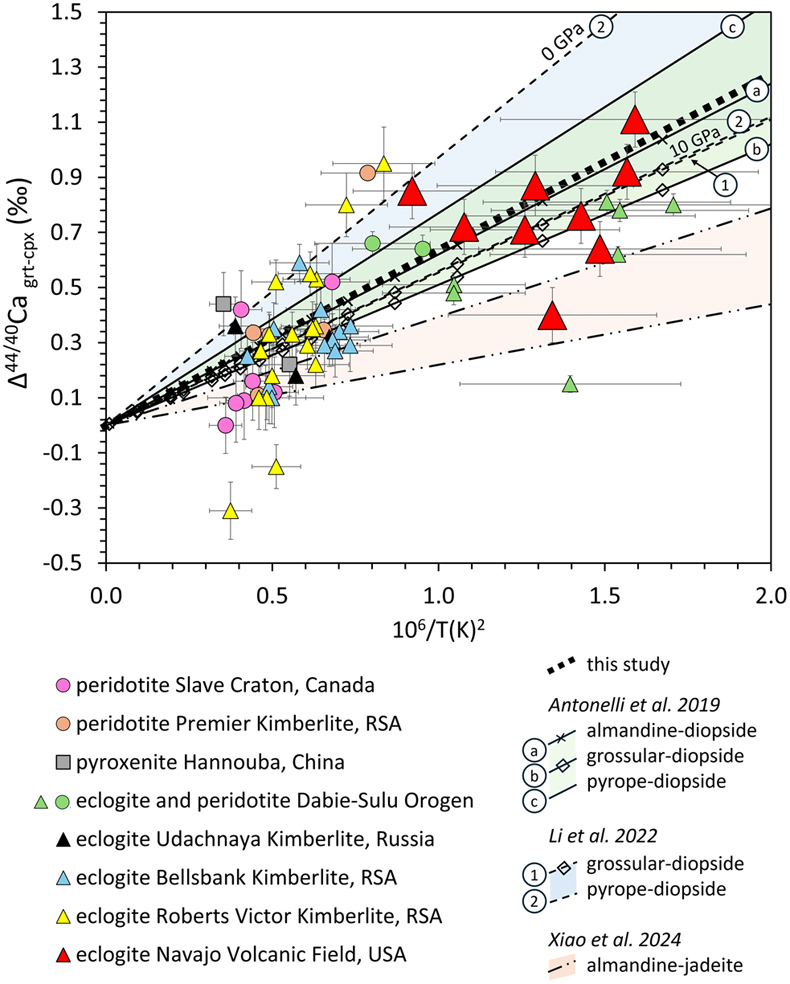
Figure 1 Δ44/40Cagrt-cpx plotted against 1/T2 for the samples in this study and previous work (see text). Natural data for eclogites (triangles), peridotites (circles) and pyroxenites (squares) are compared to DFT models by Antonelli et al. (2019)
Antonelli, M.A., Schiller, M., Schauble, E.A., Mittal, T., DePaolo, D.J., Chacko, T., Grew, E.S., Tripoli, B. (2019) Kinetic and equilibrium Ca isotope effects in high-T rocks and minerals. Earth and Planetary Science Letters 517, 71–82. https://doi.org/10.1016/j.epsl.2019.04.013
, Li et al. (2022)Li, Y., Wu, Z., Huang, S., Wang, W. (2022) Pressure and concentration effects on intermineral calcium isotope fractionation involving garnet. Chemical Geology 591, 120722. https://doi.org/10.1016/j.chemgeo.2022.120722
and Xiao et al. (2022)Xiao, Z.-C., Zhou, C., Kang, J.-T., Wu, Z.-Q., Huang, F. (2022) The factors controlling equilibrium inter-mineral Ca isotope fractionation: Insights from first-principles calculations. Geochimica et Cosmochimica Acta 333, 373–389. https://doi.org/10.1016/j.gca.2022.07.021
. All temperatures recalculated following the protocol described in Supplementary Information. Error bars represent 2 s.e., some are smaller than symbols. The Li et al. (2022)Li, Y., Wu, Z., Huang, S., Wang, W. (2022) Pressure and concentration effects on intermineral calcium isotope fractionation involving garnet. Chemical Geology 591, 120722. https://doi.org/10.1016/j.chemgeo.2022.120722
grossular-diopside and 10 GPa pyrope-diopside lines overlap.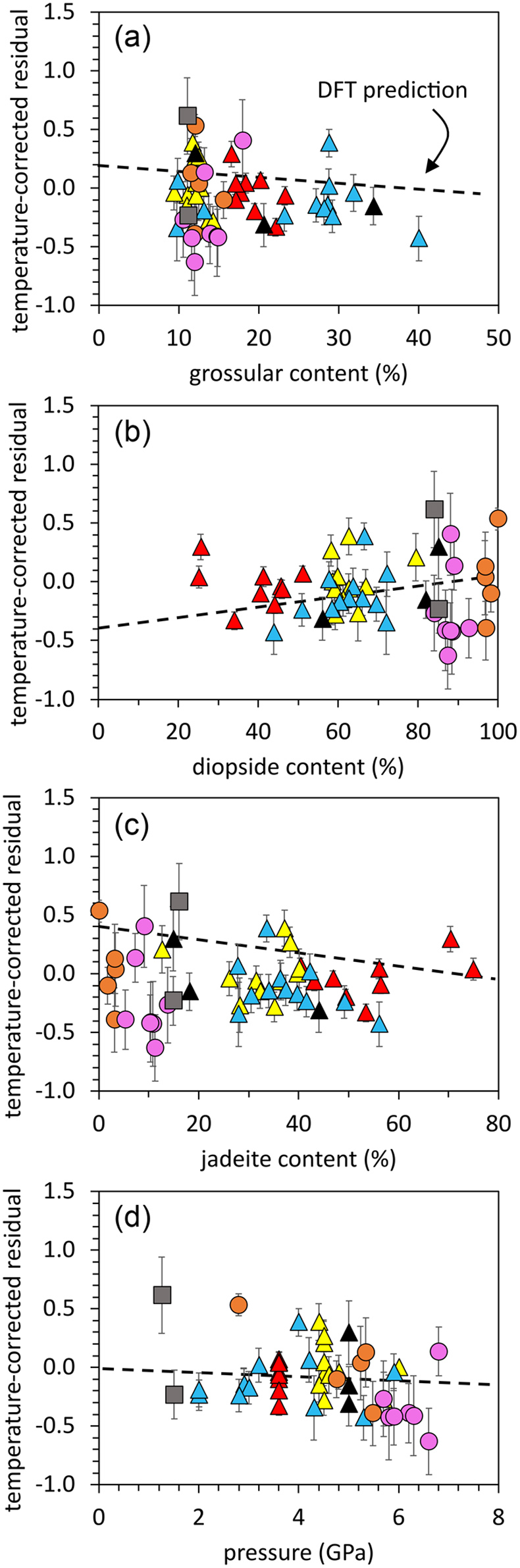
Figure 2 Plots of temperature-corrected Δ44/40Cagrt-cpx residuals against (a) garnet grossular content, (b) pyroxene diopside content, (c) pyroxene jadeite content, and (d) pressure estimates. Symbols as for Figure 1.
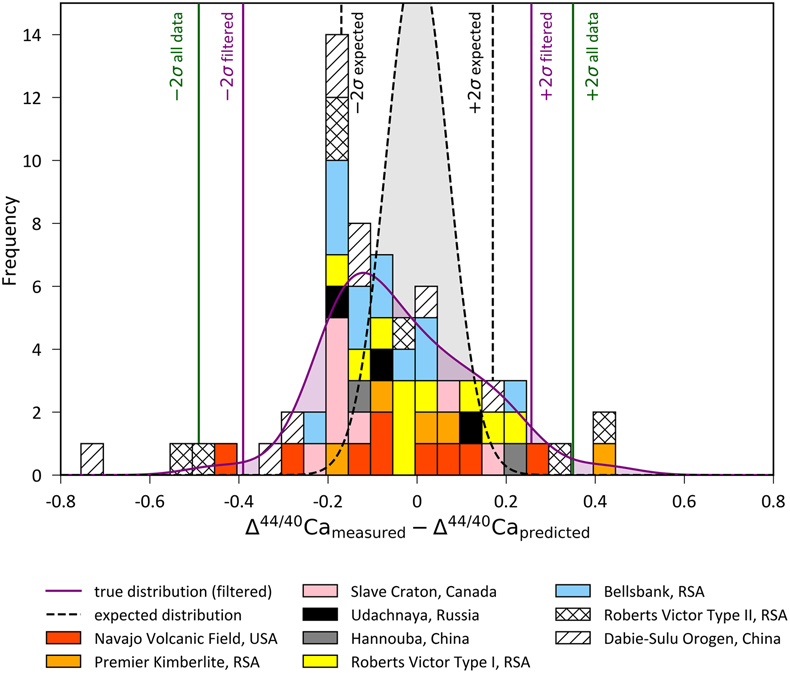
Figure 3 Histogram of Δ44/40Cagrt-cpx residuals, and error distribution expected from the predicted Δ44/40Cagrt-cpx and 1/T2 uncertainty (dashed lines) compared to the actual distribution of filtered residuals (purple lines; excluded Dabie-Sulu or Roberts Victor Type II).
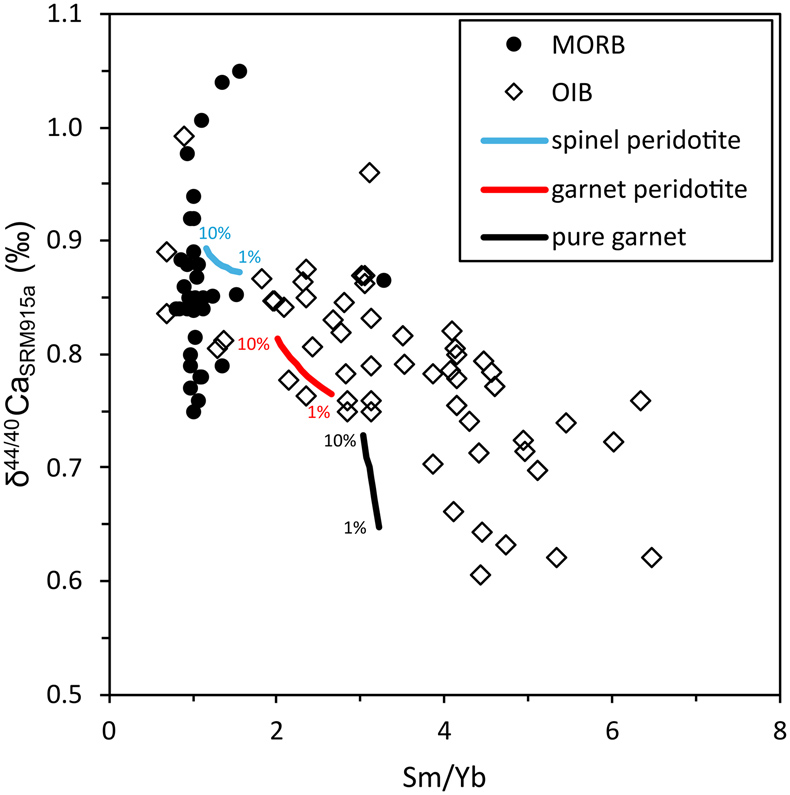
Figure 4 Comparison of δ44/40Ca versus Sm/Yb for MORB (Erikson and Jacobsen, 2022
Eriksen, Z.T., Jacobsen, S.B. (2022) Calcium isotope constraints on OIB and MORB petrogenesis: The importance of melt mixing. Earth and Planetary Science Letters 593, 117665. https://doi.org/10.1016/j.epsl.2022.117665
) and OIB (Eriksen et al., 2024Eriksen, Z.T., Jacobsen, S.B., Day, J.M.D., White, W.M. (2024) Calcium isotope variability among ocean islands reveals the physical and lithological controls on mantle partial melting. Geochimica et Cosmochimica Acta 373, 326–341. https://doi.org/10.1016/j.gca.2024.02.011
). Lines represent batch melting of a spinel peridotite, garnet peridotite or pure garnet source, with 1 to 10 % partial melting.