



Continental crust had fully emerged by the end of the Paleoproterozoic
Affiliations | Corresponding Author | Cite as | Funding information
Published by the European Association of Geochemistry
under Creative Commons License CC BY-NC-ND 4.0
Keywords: seawater, oxygen isotopes, continental crust, continental emergence, zircon


- Share this article


-
Article views:1,442Cumulative count of HTML views and PDF downloads.
- Download Citation
- Rights & Permissions

top
Abstract
Figures
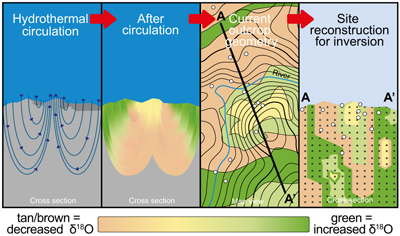 Figure 1 Tracer mass balance inverse approach. When water circulates through rock (leftmost panel), as at a mid-ocean ridge, that circulation causes exchange of O isotopes between water and rock in a well understood, temperature dependent manner (centre left panel). The geometry of patterns of O isotopes produced during circulation may be changed as the rock section ages, undergoes uplift, etc. (centre right panel). We then sample across modern outcrops/drill cores, attempt to reconstruct the original geometry, and use this approximation of original isotope and temperature patterns as the basis for inversion (rightmost panel). | 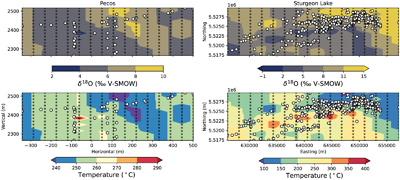 Figure 2 Contoured cross sections of oxygen isotope and alteration temperature for Pecos, NM, USA and Sturgeon Lake, Ontario, Canada. Samples are shown in white circles, grid used in inversion is outlined by the black stars. Cross sections are reconstructed from outcrop and drill core samples to approximate the full hydrothermal cell. | 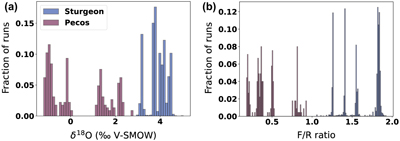 Figure 3 Histograms of ‘leave-one-out’ inversions showing both estimated initial (a) fluid δ18O, and (b) fluid-rock ratio. Inversions are performed the same number of times as there are samples at a given location, removing a random sample each time to constrain uncertainty, for a series of iterations at each site spanning temperature and/or starting rock δ18O values. | 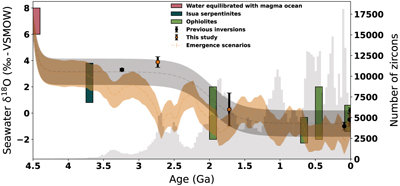 Figure 4 Estimates of seawater δ18O from altered ocean crust (green rectangles; Gregory, 1991; Holmden and Muehlenbachs, 1993; Pope et al., 2012) previous (black circles, Johnson and Wing, 2020), and this study’s, tracer mass balance inversion estimates (orange circles). Also shown are abundance of detrital zircon ages in 30 Myr time bins (Puetz et al., 2024) and two seawater δ18O evolution curves (Muehlenbachs, 1998): (1) continuous crustal growth and emergence (gray dashed line), and (2) punctuated curve driven by zircon abundance (orange dashed line). Seawater evolution curves are shown with ±1 ‰ envelopes, equivalent to observed changes in the δ18OSW during Pleistocene glaciations (Schrag et al., 2002). |
| Figure 1 | Figure 2 | Figure 3 | Figure 4 |
top
Introduction
Earth is unique among our planetary neighbours, including the presence of bimodal crust. Dense, oceanic crust underlies large ocean basins today. Buoyant, felsic continental crust is mostly emergent above sea level, giving Earth bimodal hypsometry. Both the presence of substantial felsic crust and its position above sea level exert feedbacks on a planetary scale. Emergent continental crust provides nutrients to the oceans (Large et al., 2018
Large, R.R., Mukherjee, I., Zhukova, I., Corkrey, R., Stepanov, A., Danyushevsky, L.V. (2018) Role of upper-most crustal composition in the evolution of the Precambrian ocean–atmosphere system. Earth and Planetary Science Letters 487, 44–53. https://doi.org/10.1016/j.epsl.2018.01.019
), modulates climate via weathering (Walker et al., 1981Walker, J.C.G., Hays, P.B., Kasting, J.F. (1981) A negative feedback mechanism for the long‐term stabilization of Earth’s surface temperature. Journal of Geophysical Research: Oceans 86, 9776–9782. https://doi.org/10.1029/JC086iC10p09776
), and could be an evolutionary driver for life (Zhu et al., 2022Zhu, Z., Campbell, I.H., Allen, C.M., Brocks, J.J., Chen, B. (2022) The temporal distribution of Earth’s supermountains and their potential link to the rise of atmospheric oxygen and biological evolution. Earth and Planetary Science Letters 580, 117391. https://doi.org/10.1016/j.epsl.2022.117391
).Determining the tempo and extent of subaerial emergence globally, however, is challenging. While there is a long history of inquiry surrounding the generation of felsic continental crust (Hawkesworth et al., 2024
Hawkesworth, C., Cawood, P.A., Dhuime, B., Kemp, T. (2024) Tectonic processes and the evolution of the continental crust. Journal of the Geological Society 181, jgs2024-027. https://doi.org/10.1144/jgs2024-027
), subaerial emergence is an intertwined, but slightly distinct process. Further, geologic and existing geochemical records of emergence vary widely both in spatial scale and temporal resolution. Limited subaerial emergence, with the Earth resembling a “water world”, has been suggested for the early Archean based on water cycle modelling (Korenaga, 2021Korenaga, J. (2021) Was There Land on the Early Earth? Life 11, 1142. https://doi.org/10.3390/life11111142
) and the oxygen isotope value of seawater (δ18OSW)1 preserved in rocks and minerals (Pope et al., 2012Pope, E.C., Bird, D.K., Rosing, M.T. (2012) Isotope composition and volume of Earth’s early oceans. Proceedings of the National Academy of Sciences 109, 4371–4376. https://doi.org/10.1073/pnas.1115705109
; Bindeman et al., 2018Bindeman, I.N., Zakharov, D.O., Palandri, J., Greber, N.D., Dauphas, N., Retallack, G.J., Hofmann, A., Lackey, J.S., Bekker, A. (2018) Rapid emergence of subaerial landmasses and onset of a modern hydrologic cycle 2.5 billion years ago. Nature 557, 545–548. https://doi.org/10.1038/s41586-018-0131-1
; Johnson and Wing, 2020Johnson, B.W., Wing, B.A. (2020) Limited Archaean continental emergence reflected in an early Archaean 18O-enriched ocean. Nature Geoscience 13, 243–248. https://doi.org/10.1038/s41561-020-0538-9
). Geologic evidence from Archean cratons suggests localised emergence, including ∼3.5 Ga angular unconformities (Buick et al., 1995Buick, R., Thornett, J.R., McNaughton, N.J., Smith, J.B., Barley, M.E., Savage, M. (1995) Record of emergent continental crust ∼3.5 billion years ago in the Pilbara craton of Australia. Nature 375, 574–577. https://doi.org/10.1038/375574a0
) and ∼3.2 Ga river/beach deposits (Heubeck and Lowe, 1994Heubeck, C., Lowe, D.R. (1994) Depositional and tectonic setting of the Archean Moodies Group, Barberton Greenstone Belt, South Africa. Precambrian Research 68, 257–290. https://doi.org/10.1016/0301-9268(94)90033-7
). More widespread emergence at ∼2.7 Ga is suggested by large scale passive margin deposits (Bradley, 2008Bradley, D.C. (2008) Passive margins through earth history. Earth-Science Reviews 91, 1–26. https://doi.org/10.1016/j.earscirev.2008.08.001
). Mantle thermal modelling, however, suggests that any emergence before the Neoproterozoic was limited to active mountain building regions (Lee et al., 2018Lee, C.-T.A., Caves, J., Jiang, H., Cao, W., Lenardic, A., McKenzie, N.R., Shorttle, O., Yin, Q.-z., Dyer, B. (2018) Deep mantle roots and continental emergence: implications for whole-Earth elemental cycling, long-term climate, and the Cambrian explosion. International Geology Review 60, 431–448. https://doi.org/10.1080/00206814.2017.1340853
). Both crustal and ocean volume contribute to emergence (Korenaga, 2021Korenaga, J. (2021) Was There Land on the Early Earth? Life 11, 1142. https://doi.org/10.3390/life11111142
). To address this uncertainty, we build on previous work using sections of hydrothermally altered ocean crust as a record of δ18OSW as a proxy for continental emergence (Johnson and Wing, 2020Johnson, B.W., Wing, B.A. (2020) Limited Archaean continental emergence reflected in an early Archaean 18O-enriched ocean. Nature Geoscience 13, 243–248. https://doi.org/10.1038/s41561-020-0538-9
).δ18OSW is buffered over million year time scales by water-rock reactions (Gregory, 1991
Gregory, R. (1991) Oxygen isotope history of seawater revisited: Timescales for boundary event changes in the oxygen isotope composition of seawater. In: Taylor Jr., H.P., O’Neil, J.R., Kaplan, I.R. (Eds.) Stable Isotope Geochemistry: A Tribute to Samuel Epstein. Geochemical Society, San Antonio, 65–76. https://geochemsoc.org/application/files/6917/5333/2164/SP-3_065-076_Gregory.pdf
; Muehlenbachs, 1998Muehlenbachs, K. (1998) The oxygen isotopic composition of the oceans, sediments and the seafloor. Chemical Geology 145, 263–273. https://doi.org/10.1016/S0009-2541(97)00147-2
). Low temperature interactions, both in continental and oceanic crust, move 18O from water to rock, which in turn decreases δ18OSW. High temperature alteration of oceanic crust transfers 18O from rock to water, which would lower δ18OSW. Today, the proportion of low to high temperature alteration in oceanic crust is about equal (Muehlenbachs, 1998Muehlenbachs, K. (1998) The oxygen isotopic composition of the oceans, sediments and the seafloor. Chemical Geology 145, 263–273. https://doi.org/10.1016/S0009-2541(97)00147-2
), and based on observations of ancient ophiolites and oceanic crust, this proportion was likely similar in the deep past (Holmden and Muehlenbachs, 1993Holmden, C., Muehlenbachs, K. (1993) The 18O/16O Ratio of 2-Billion-Year-Old Seawater Inferred from Ancient Oceanic Crust. Science 259, 1733–1736. https://doi.org/10.1126/science.259.5102.1733
; Johnson and Wing, 2020Johnson, B.W., Wing, B.A. (2020) Limited Archaean continental emergence reflected in an early Archaean 18O-enriched ocean. Nature Geoscience 13, 243–248. https://doi.org/10.1038/s41561-020-0538-9
). Subaerial weathering, in contrast, does not have a high temperature component, so only acts as a sink for 18O. If no crust is emergent, we would expect higher δ18OSW than if significant crust was emergent. Thus, the proportion of emergent crust, with associated subaerial weathering, should be reflected in variable δ18OSW over time. We can measure the δ18O value of sections of hydrothermally altered crust, apply a tracer mass balance inversion approach (Johnson and Wing, 2020Johnson, B.W., Wing, B.A. (2020) Limited Archaean continental emergence reflected in an early Archaean 18O-enriched ocean. Nature Geoscience 13, 243–248. https://doi.org/10.1038/s41561-020-0538-9
), and determine the δ18OSW of the original seawater as a proxy for crustal emergence.Current proxies for δ18OSW come mostly from chemical sediments, including carbonates, chert, phosphates and, since 1.7 Ga, Fe oxides (Isson and Rauzi, 2024
Isson, T., Rauzi, S. (2024) Oxygen isotope ensemble reveals Earth’s seawater, temperature, and carbon cycle history. Science 383, 666–670. https://doi.org/10.1126/science.adg1366
). All these records show a secular increase in mineral δ18O values through time, which has been interpreted to reflect an increase in δ18OSW from the Proterozoic onwards or a decrease in seawater temperature through time. Estimates of δ18OSW from the altered ocean crust record suggests a decrease in δ18OSW from the Paleoarchean to the mid-Proterozoic, or perhaps even as early as the Neoarchean, with little to no change afterwards (Holmden and Muehlenbachs, 1993Holmden, C., Muehlenbachs, K. (1993) The 18O/16O Ratio of 2-Billion-Year-Old Seawater Inferred from Ancient Oceanic Crust. Science 259, 1733–1736. https://doi.org/10.1126/science.259.5102.1733
; Muehlenbachs et al., 2003Muehlenbachs, K., Furnes, H., Fonneland, H.C., Hellevang, B. (2003) Ophiolites as faithful records of the oxygen isotope ratio of ancient seawater: the Solund-Stavfjord Ophiolite Complex as a Late Ordovician example. In: Dilek, Y., Robinson, P.T. (Eds.) Ophiolites in Earth History. Geological Society, London, 401–414. https://doi.org/10.1144/GSL.SP.2003.218.01.20
; Pope et al., 2012Pope, E.C., Bird, D.K., Rosing, M.T. (2012) Isotope composition and volume of Earth’s early oceans. Proceedings of the National Academy of Sciences 109, 4371–4376. https://doi.org/10.1073/pnas.1115705109
; Zakharov and Bindeman, 2019Zakharov, D.O., Bindeman, I.N. (2019) Triple oxygen and hydrogen isotopic study of hydrothermally altered rocks from the 2.43–2.41 Ga Vetreny belt, Russia: An insight into the early Paleoproterozoic seawater. Geochimica et Cosmochimica Acta 248, 185–209. https://doi.org/10.1016/j.gca.2019.01.014
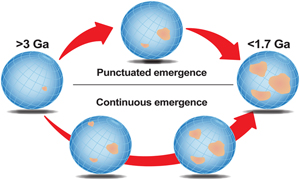
).In this contribution, we estimated δ18OSW from two locations: Sturgeon Lake, Canada (∼2735 Ma) and the Pecos Greenstone Belt, USA (∼1720 Ma). Both sites are associated with volcanogenic massive sulfide (VMS) deposits, which are produced via hydrothermal circulation of seawater through oceanic crust. We used bulk rock δ18O measurements from each site (402 at Sturgeon Lake, 45 at Pecos) along with estimates of alteration temperature (Mg in chlorite for Pecos and O isotopes from Sturgeon) in an inverse model to estimate δ18OSW. We find that δ18OSW decreased from approximately +3 to +4 ‰ at 2735 Ma to a near-modern value of −0.2 ‰ by ∼1720 Ma. We discuss two scenarios that could drive such a shift: continuous or punctuated continental emergence.
top
Estimating δ18OSW via Inversion of Hydrothermal Systems
Hydrothermal alteration of oceanic crust is a well understood process (Seyfried and Mottl, 1982
Seyfried Jr., W.E., Mottl, M.J. (1982) Hydrothermal alteration of basalt by seawater under seawater-dominated conditions. Geochimica et Cosmochimica Acta 46, 985–1002. https://doi.org/10.1016/0016-7037(82)90054-0
). The interaction of water and rock at temperatures ranging from bottom water (>2 °C) to peak temperatures of approximately 350–400 °C in oceanic crust causes mineralogical changes, redistribution of elements, and exchange of oxygen isotopes between water and rock (Muehlenbachs, 1998Muehlenbachs, K. (1998) The oxygen isotopic composition of the oceans, sediments and the seafloor. Chemical Geology 145, 263–273. https://doi.org/10.1016/S0009-2541(97)00147-2
). At low temperatures and shallow crustal depths, 18O is preferentially transferred from water to rock, while for temperatures above 275–300 °C at deep crustal depths, 18O is transferred from rock to water (Cole et al., 1987Cole, D.R., Mottl, M.J., Ohmoto, H. (1987) Isotopic exchange in mineral-fluid systems. II. Oxygen and hydrogen isotopic investigation of the experimental basalt-seawater system. Geochimica et Cosmochimica Acta 51, 1523–1538. https://doi.org/10.1016/0016-7037(87)90334-6
). The transformation of whole rock δ18O from an initial value to an altered value is a function of temperature. Therefore, given independent temperature estimates, we can perform a tracer mass balance inversion calculation to estimate the alteration fluid’s initial δ18O (Johnson and Wing, 2020Johnson, B.W., Wing, B.A. (2020) Limited Archaean continental emergence reflected in an early Archaean 18O-enriched ocean. Nature Geoscience 13, 243–248. https://doi.org/10.1038/s41561-020-0538-9
).This approach proceeds stepwise. We collect samples from across the hydrothermal cell, targeting downwelling and upwelling zones spanning hydrothermal circulation. Discharge zones are assumed to be structurally beneath VMS deposits, while recharge zones are typically 0.5–1 km along strike away from the VMS deposit (Slack et al., 2009
Slack, J.F., Grenne, T., Bekker, A. (2009) Seafloor-hydrothermal Si-Fe-Mn exhalites in the Pecos greenstone belt, New Mexico, and the redox state of ca. 1720 Ma deep seawater. Geosphere 5, 302–314. https://doi.org/10.1130/GES00220.1
). Then, a ∼2 D cross section is constructed of each hydrothermal system by extrapolating between irregularly spaced samples into a regularly spaced grid (Figs. 1, 2). The goal is to approximate the original geometry of the active hydrothermal system, with the contours capturing the full horizontal and vertical distribution of the sample set. We contour both whole rock δ18O and alteration temperature. Temperatures of alteration are estimated either by geothermometry (Mg chlorite; Pecos, see Supplementary Information - SI) or linking distribution of specific mineral phases/mineral pair O isotopes to associated formation temperatures (Sturgeon Lake, see SI).Figure 1 Tracer mass balance inverse approach. When water circulates through rock (leftmost panel), as at a mid-ocean ridge, that circulation causes exchange of O isotopes between water and rock in a well understood, temperature dependent manner (centre left panel). The geometry of patterns of O isotopes produced during circulation may be changed as the rock section ages, undergoes uplift, etc. (centre right panel). We then sample across modern outcrops/drill cores, attempt to reconstruct the original geometry, and use this approximation of original isotope and temperature patterns as the basis for inversion (rightmost panel).
Figure 2 Contoured cross sections of oxygen isotope and alteration temperature for Pecos, NM, USA and Sturgeon Lake, Ontario, Canada. Samples are shown in white circles, grid used in inversion is outlined by the black stars. Cross sections are reconstructed from outcrop and drill core samples to approximate the full hydrothermal cell.
Then, using δ18O and temperature inputs, we apply standard linear regression inversion techniques, applying total fluid and oxygen mass balance, to estimate the total fluid required to produce alteration. We use the estimate of total fluid to calculate a fluid/rock ratio (F/R) for the hydrothermal system (see Johnson and Wing, 2020
Johnson, B.W., Wing, B.A. (2020) Limited Archaean continental emergence reflected in an early Archaean 18O-enriched ocean. Nature Geoscience 13, 243–248. https://doi.org/10.1038/s41561-020-0538-9
). Key inputs into the inversion include temperature of alteration and initial rock δ18O (δ18Oi). Initial rock δ18O value is based either on geologic setting (e.g., mantle derived melts are ∼5.5 ‰) or on analyses of the least altered samples, determined petrographically. Using the estimate of fluid/rock (F/R) ratio from the inversion, we calculate the fluid’s initial δ18O value (δFi):
where δRf and δRi are the final and initial rock δ18O values averaged over the cross section. ΔR−F is the average temperature of alteration (Taylor, 1977
Taylor Jr., H.P. (1977) Water/rock interactions and the origin of H2O in granitic batholiths: Thirtieth William Smith lecture. Journal of the Geological Society 133, 509–558. https://doi.org/10.1144/gsjgs.133.6.0509
). This approach was tuned and validated by Johnson and Wing (2020)Johnson, B.W., Wing, B.A. (2020) Limited Archaean continental emergence reflected in an early Archaean 18O-enriched ocean. Nature Geoscience 13, 243–248. https://doi.org/10.1038/s41561-020-0538-9
on Cenozoic sites of known seawater and forward models. We run the inversion the same number of times as there are samples, removing a random sample each time (“leave-one-out”) to estimate uncertainty. While we assume isotopic equilibrium, during original method development we also inverted model results that assumed kinetic equilibrium (Johnson and Wing, 2020Johnson, B.W., Wing, B.A. (2020) Limited Archaean continental emergence reflected in an early Archaean 18O-enriched ocean. Nature Geoscience 13, 243–248. https://doi.org/10.1038/s41561-020-0538-9
). In both equilibrium and kinetic cases, the inversion reproduced incoming fluid δ18O. This approach is purely retrospective. It estimates total fluid required for alteration based on the average conditions over the lifetime of the hydrothermal cell.top
Sample Sites and Results
Sturgeon Lake. The Sturgeon Lake caldera, ∼2735 Ma, is located in the Sturgeon Lake greenstone belt, a central part of the Wabigoon sub-province in the Archean Superior Province (Fig. S-1; SI). Caldera rocks are primarily felsic, quartz-rich pyroclastic flows with associated VMS deposits. Although the area underwent greenschist-lower amphibolite facies metamorphism, oxygen isotope values retain primary information related to initial hydrothermal alteration (Holk et al., 2008
Holk, G.J., Taylor, B.E., Galley, A.G. (2008) Oxygen isotope mapping of the Archean Sturgeon Lake caldera complex and VMS-related hydrothermal system, Northwestern Ontario, Canada. Mineralium Deposita 43, 623–640. https://doi.org/10.1007/s00126-008-0185-3
). Isotope contours define the direction of fluid flow during hydrothermal alteration.We use oxygen isotope data and temperature estimates centred on the Biedelman Bay intrusive complex (Holk et al., 2008
Holk, G.J., Taylor, B.E., Galley, A.G. (2008) Oxygen isotope mapping of the Archean Sturgeon Lake caldera complex and VMS-related hydrothermal system, Northwestern Ontario, Canada. Mineralium Deposita 43, 623–640. https://doi.org/10.1007/s00126-008-0185-3
). The δ18Oi at Sturgeon Lake has been estimated between 6–8 ‰, based on analyses of δ18O in zircons (SI). Whole rock δ18O values range from 1.2 to 17.9 ‰, with a precision of 0.2 ‰. Temperatures of alteration were estimated using mineral pair fractionations with modelled bulk rock for basalt and rhyolite (Holk et al., 2008Holk, G.J., Taylor, B.E., Galley, A.G. (2008) Oxygen isotope mapping of the Archean Sturgeon Lake caldera complex and VMS-related hydrothermal system, Northwestern Ontario, Canada. Mineralium Deposita 43, 623–640. https://doi.org/10.1007/s00126-008-0185-3
). This approach produces temperature estimates that are either low (130–240 °C) or high (175–300 °C), depending on model assumptions.To account for uncertainty in temperature and initial rock δ18O, we performed the tracer mass balance inversion in four iterations: low (6 ‰) and high (8 ‰) δ18Oi with either low or high alteration temperature estimates. In each iteration, we still perform “leave-one-out”, running the inversion the same number of times as there are samples and removing a random sample each time. We then took the mean and standard deviation from all four iterations, and suggest that seawater δ18O was and 3.8 ± 0.4 ‰ (1σ) (Fig. 2).
Pecos. The Pecos greenstone belt occupies the southern end of 1.8–1.7 Ga Precambrian supracrustal rocks that extend into Colorado and Wyoming, USA (Slack et al., 2009
Slack, J.F., Grenne, T., Bekker, A. (2009) Seafloor-hydrothermal Si-Fe-Mn exhalites in the Pecos greenstone belt, New Mexico, and the redox state of ca. 1720 Ma deep seawater. Geosphere 5, 302–314. https://doi.org/10.1130/GES00220.1
). The greenstone belt, comprised of bimodal metavolcanics and metasedimentary rocks regionally metamorphosed to greenschist-lower amphibolite facies (Slack et al., 2009Slack, J.F., Grenne, T., Bekker, A. (2009) Seafloor-hydrothermal Si-Fe-Mn exhalites in the Pecos greenstone belt, New Mexico, and the redox state of ca. 1720 Ma deep seawater. Geosphere 5, 302–314. https://doi.org/10.1130/GES00220.1
), occupies a ∼650 km2 area northeast of Santa Fe and is bounded in the west by the north-northeast running Picuris-Pecos fault.We focused on a sample site near the Pecos mine that preserves strong evidence of hydrothermal activity. The area, Willow Creek, comprises a bimodal suite of volcanic rocks (80 % basalt–20 % rhyolite) that likely represent the remnant of a back arc basin or evolved island arc emplaced at ∼1.72 Ga (Slack et al., 2009
Slack, J.F., Grenne, T., Bekker, A. (2009) Seafloor-hydrothermal Si-Fe-Mn exhalites in the Pecos greenstone belt, New Mexico, and the redox state of ca. 1720 Ma deep seawater. Geosphere 5, 302–314. https://doi.org/10.1130/GES00220.1
). Syn-volcanic hydrothermal circulation produced VMS deposits, including at the Pecos mine site. We collected a series of outcrop and drill core samples from the New Mexico Geological Survey for oxygen isotope analyses and chlorite geothermometry (Fig. S-1, SI).Whole rock δ18O values were measured using laser fluorination at the Center for Stable Isotopes at the University of New Mexico (Sharp, 1990
Sharp, Z.D. (1990) A laser-based microanalytical method for the in situ determination of oxygen isotope ratios of silicates and oxides. Geochimica et Cosmochimica Acta 54, 1353–1357. https://doi.org/10.1016/0016-7037(90)90160-M
). Measured whole rock oxygen isotope values range from 2.2 to 9.3 ‰, with a precision of ±0.6 ‰ based on repeat analyses of an olivine standard (SCO; SI). We assumed initial rock δ18O to be 7.1 ‰, which was the measured value of the least altered sample, determined petrographically. Alteration temperatures were determined for a subset of samples using Mg in chlorite geothermometry (Jowett, 2021Jowett, E.C. (2021) Fitting Iron and Magnesium into the Hydrothermal Chlorite Geothermometer. SSRN Electronic Journal. https://doi.org/10.2139/ssrn.3863523
), using the Electron Microprobe facility at the University of Wisconsin Madison (SI). Temperatures determined using chlorite thermometry ranged from 350–375 °C, with uncertainty of ±20 °C (1σ). As with Sturgeon Lake, we assigned an estimated alteration temperature for each sample based on observed correlation between δ18O and Mg in chlorite temperatures (SI).To account for analytical uncertainty in these samples, we performed the tracer mass balance inversion (with “leave-one-out”) for five iterations, all assuming δ18Oi = 7.1 ‰: (1) nominal, with mean values for all sample δ18O and Mg chlorite temperatures, (2) upper estimate (i.e. mean plus uncertainty) sample δ18O, and Mg chlorite temperatures, (3) lower sample (i.e. mean minus uncertainty) δ18O and Mg chlorite temperatures, (4) upper δ18O and lower Mg chlorite temperatures, and (5) lower δ18O and upper Mg chlorite temperatures. As with the previous section, we report the mean seawater δ18O from these five iterations, which we find to be 0.3 ± 1.2 ‰ (1σ) (Fig. 2). The uncertainty at Pecos is higher than at Sturgeon Lake primarily due to lower sample numbers.
top
Near-Modern Emergence by the Paleoproterozoic
Previous work estimated δ18OSW at ∼3240 Ma to be 3.3 ± 0.1 ‰ (Johnson and Wing, 2020
Johnson, B.W., Wing, B.A. (2020) Limited Archaean continental emergence reflected in an early Archaean 18O-enriched ocean. Nature Geoscience 13, 243–248. https://doi.org/10.1038/s41561-020-0538-9
). We find a similar value at Sturgeon Lake, with δ18OSW of 3.8 ± 0.4 ‰ at ∼2735 Ma, and a near-modern value at Pecos (∼1720 Ma) of 0.3 ± 1.2 ‰ (Fig. 3). This decrease can be explained by the emergence of continental crust with associated weathering and sequestration of 18O (Johnson and Wing, 2020Johnson, B.W., Wing, B.A. (2020) Limited Archaean continental emergence reflected in an early Archaean 18O-enriched ocean. Nature Geoscience 13, 243–248. https://doi.org/10.1038/s41561-020-0538-9
). The timing of widespread emergence suggested by our results is consistent with estimates from O isotope composition of shales (Bindeman et al., 2018Bindeman, I.N., Zakharov, D.O., Palandri, J., Greber, N.D., Dauphas, N., Retallack, G.J., Hofmann, A., Lackey, J.S., Bekker, A. (2018) Rapid emergence of subaerial landmasses and onset of a modern hydrologic cycle 2.5 billion years ago. Nature 557, 545–548. https://doi.org/10.1038/s41586-018-0131-1
), the presence of large passive margins (Bradley, 2008Bradley, D.C. (2008) Passive margins through earth history. Earth-Science Reviews 91, 1–26. https://doi.org/10.1016/j.earscirev.2008.08.001
), and calculation of heat production in Archean lithosphere (Reimink and Smye, 2024Reimink, J.R., Smye, A.J. (2024) Subaerial weathering drove stabilization of continents. Nature 629, 609–615. https://doi.org/10.1038/s41586-024-07307-1
).Figure 3 Histograms of ‘leave-one-out’ inversions showing both estimated initial (a) fluid δ18O, and (b) fluid-rock ratio. Inversions are performed the same number of times as there are samples at a given location, removing a random sample each time to constrain uncertainty, for a series of iterations at each site spanning temperature and/or starting rock δ18O values.
To investigate how emergence could cause changes in δ18OSW, we calculated two potential evolutionary curves of δ18OSW based on a steady state model (Muehlenbachs, 1998
Muehlenbachs, K. (1998) The oxygen isotopic composition of the oceans, sediments and the seafloor. Chemical Geology 145, 263–273. https://doi.org/10.1016/S0009-2541(97)00147-2
). This steady state model estimates total water-rock fluxes and associated isotopic fractionations based on the modern Earth, and includes high and low temperature alteration, subaerial weathering, effects during continental growth, and water recycling into and out of the mantle. We used water flux and fractionation values directly from the original manuscript except we increased fractionation during subaerial weathering (12 ‰) to produce a modern, ice free ocean at -1 ‰ (Johnson and Wing, 2020Johnson, B.W., Wing, B.A. (2020) Limited Archaean continental emergence reflected in an early Archaean 18O-enriched ocean. Nature Geoscience 13, 243–248. https://doi.org/10.1038/s41561-020-0538-9
). We assume no change in the proportion of high to low temperature submarine alteration over time (SI).We then run this steady state model without any continental fluxes initially, then increase them over Earth history. We produce two scenarios of continental emergence (Fig. 4): (1) relatively smooth, continuous growth of continental crust and implied emergence from between 3 to 1 Ga (Reimink et al., 2023
Reimink, J.R., Davies, J.H.F.L., Moyen, J.-F., Pearson, D.G. (2023) A whole-lithosphere view of continental growth. Geochemical Perspectives Letters 26, 45–49. https://doi.org/10.7185/geochemlet.2324
; Reimink and Smye, 2024Reimink, J.R., Smye, A.J. (2024) Subaerial weathering drove stabilization of continents. Nature 629, 609–615. https://doi.org/10.1038/s41586-024-07307-1
), or (2) a punctuated model with weathering fluxes normalised to the abundance of detrital zircon ages over time (zircon ages from Puetz et al., 2024Puetz, S.J., Spencer, C.J., Condie, K.C., Roberts, N.M.W. (2024) Enhanced U-Pb detrital zircon, Lu-Hf zircon, δ18O zircon, and Sm-Nd whole rock global databases. Scientific Data 11, 56. https://doi.org/10.1038/s41597-023-02902-9
). We detail our steady state model calculations in the SI. Zircon abundances have been de-trended, assuming 97 % survival rate per 30 Myr time bin (Puetz et al., 2024Puetz, S.J., Spencer, C.J., Condie, K.C., Roberts, N.M.W. (2024) Enhanced U-Pb detrital zircon, Lu-Hf zircon, δ18O zircon, and Sm-Nd whole rock global databases. Scientific Data 11, 56. https://doi.org/10.1038/s41597-023-02902-9
).Figure 4 Estimates of seawater δ18O from altered ocean crust (green rectangles; Gregory, 1991
Gregory, R. (1991) Oxygen isotope history of seawater revisited: Timescales for boundary event changes in the oxygen isotope composition of seawater. In: Taylor Jr., H.P., O’Neil, J.R., Kaplan, I.R. (Eds.) Stable Isotope Geochemistry: A Tribute to Samuel Epstein. Geochemical Society, San Antonio, 65–76. https://geochemsoc.org/application/files/6917/5333/2164/SP-3_065-076_Gregory.pdf
; Holmden and Muehlenbachs, 1993Holmden, C., Muehlenbachs, K. (1993) The 18O/16O Ratio of 2-Billion-Year-Old Seawater Inferred from Ancient Oceanic Crust. Science 259, 1733–1736. https://doi.org/10.1126/science.259.5102.1733
; Pope et al., 2012Pope, E.C., Bird, D.K., Rosing, M.T. (2012) Isotope composition and volume of Earth’s early oceans. Proceedings of the National Academy of Sciences 109, 4371–4376. https://doi.org/10.1073/pnas.1115705109
) previous (black circles, Johnson and Wing, 2020Johnson, B.W., Wing, B.A. (2020) Limited Archaean continental emergence reflected in an early Archaean 18O-enriched ocean. Nature Geoscience 13, 243–248. https://doi.org/10.1038/s41561-020-0538-9
), and this study’s, tracer mass balance inversion estimates (orange circles). Also shown are abundance of detrital zircon ages in 30 Myr time bins (Puetz et al., 2024Puetz, S.J., Spencer, C.J., Condie, K.C., Roberts, N.M.W. (2024) Enhanced U-Pb detrital zircon, Lu-Hf zircon, δ18O zircon, and Sm-Nd whole rock global databases. Scientific Data 11, 56. https://doi.org/10.1038/s41597-023-02902-9
) and two seawater δ18O evolution curves (Muehlenbachs, 1998Muehlenbachs, K. (1998) The oxygen isotopic composition of the oceans, sediments and the seafloor. Chemical Geology 145, 263–273. https://doi.org/10.1016/S0009-2541(97)00147-2
): (1) continuous crustal growth and emergence (gray dashed line), and (2) punctuated curve driven by zircon abundance (orange dashed line). Seawater evolution curves are shown with ±1 ‰ envelopes, equivalent to observed changes in the δ18OSW during Pleistocene glaciations (Schrag et al., 2002Schrag, D.P., Adkins, J.F., McIntyre, K., Alexander, J.L., Hodell, D.A., Charles, C.D., McManus, J.F. (2002) The oxygen isotopic composition of seawater during the Last Glacial Maximum. Quaternary Science Reviews 21, 331–342. https://doi.org/10.1016/S0277-3791(01)00110-X
).Both scenarios (continuous emergence, punctuated) are consistent with relatively high δ18OSW in the Archean, until about 3 Ga. High δ18OSW is maintained by limited continental weathering. The δ18OSW then decreases in both scenarios, although at slightly different times. The continuous model decreases between 3 to 1 Ga, while the punctuated model decreases towards modern δ18OSW between 3–2.7 Ga, increases to ∼2 ‰ between 2.7–2.3 Ga, and then decreased in an oscillatory pattern towards modern values by 0.8 Ga.
If δ18OSW followed either of these evolutionary pathways, modern values were present by the Mesoproterozoic. Approximately 25–35 % of the modern sedimentary rock volume would be a sufficient sink for 18O to cause ∼4 ‰ decrease between the Archean and end of the Proterozoic (Johnson and Wing, 2020
Johnson, B.W., Wing, B.A. (2020) Limited Archaean continental emergence reflected in an early Archaean 18O-enriched ocean. Nature Geoscience 13, 243–248. https://doi.org/10.1038/s41561-020-0538-9
). The two scenarios differ in δ18OSW in the late Archean. Perhaps the first peaks in the detrital zircon record reflect continental crust growth that was not associated with emergence and weathering. That is, continental growth and weathering were not coupled until the end of the Archean and throughout the Proterozoic. While growth is a prerequisite for emergence, they may not necessarily occur at the same time.top
Conclusions
We used tracer mass balance inverse modelling of sections of altered ocean crust to estimate δ18OSW during the Neoarchean through Paleoproterozoic. By analysing data from Sturgeon Lake, Ontario, Canada and Pecos, NM, USA, we estimate that OISW decreased from +3 ‰ to +4 ‰ to ∼0 ‰ between 2.7 and 1.72 Ga.
This decrease could be caused by emergence of landforms, with associated weathering and sequestration of 18O into weathered continental crust. We demonstrate, through an δ18OSW steady state model, that such a mechanism can indeed cause the observed drop in δ18OSW. We present two potential δ18OSW evolutionary curves, continuous and punctuated. These curves are driven either by steady crustal growth and emergence or growth and emergence that varies, as reflected in the detrital zircon record. These two reconstructions suggest, when compared with tracer mass balance estimates, decoupled continental growth and emergence until the end of the Archean and throughout the Proterozoic. Only after substantial crustal growth has occurred is emergence likely, reflected in the decrease in δ18OSW.
1δ18O (‰) = [(
top
Acknowledgements
We thank Zachary Sharp and the Center for Stable Isotopes at the University of New Mexico for δ18O analyses and three anonymous reviewers for constructive feedback. We also thank Annabelle Lopez at New Mexico Tech for facilitating drill core sampling and metadata.
Editor: Gavin Foster
top
References
Bindeman, I.N., Zakharov, D.O., Palandri, J., Greber, N.D., Dauphas, N., Retallack, G.J., Hofmann, A., Lackey, J.S., Bekker, A. (2018) Rapid emergence of subaerial landmasses and onset of a modern hydrologic cycle 2.5 billion years ago. Nature 557, 545–548. https://doi.org/10.1038/s41586-018-0131-1
 Show in context
 Limited subaerial emergence, with the Earth resembling a “water world”, has been suggested for the early Archean based on water cycle modelling (Korenaga, 2021) and the oxygen isotope value of seawater (δ18OSW)1 preserved in rocks and minerals (Pope et al., 2012; Bindeman et al., 2018; Johnson and Wing, 2020).
View in article
The timing of widespread emergence suggested by our results is consistent with estimates from O isotope composition of shales (Bindeman et al., 2018), the presence of large passive margins (Bradley, 2008), and calculation of heat production in Archean lithosphere (Reimink and Smye, 2024).
View in article
Bradley, D.C. (2008) Passive margins through earth history. Earth-Science Reviews 91, 1–26. https://doi.org/10.1016/j.earscirev.2008.08.001
Show in context More widespread emergence at ∼2.7 Ga is suggested by large scale passive margin deposits (Bradley, 2008).
View in article
The timing of widespread emergence suggested by our results is consistent with estimates from O isotope composition of shales (Bindeman et al., 2018), the presence of large passive margins (Bradley, 2008), and calculation of heat production in Archean lithosphere (Reimink and Smye, 2024).
View in article
Buick, R., Thornett, J.R., McNaughton, N.J., Smith, J.B., Barley, M.E., Savage, M. (1995) Record of emergent continental crust ∼3.5 billion years ago in the Pilbara craton of Australia. Nature 375, 574–577. https://doi.org/10.1038/375574a0
Show in context Geologic evidence from Archean cratons suggests localised emergence, including ∼3.5 Ga angular unconformities (Buick et al., 1995) and ∼3.2 Ga river/beach deposits (Heubeck and Lowe, 1994).
View in article
Cole, D.R., Mottl, M.J., Ohmoto, H. (1987) Isotopic exchange in mineral-fluid systems. II. Oxygen and hydrogen isotopic investigation of the experimental basalt-seawater system. Geochimica et Cosmochimica Acta 51, 1523–1538. https://doi.org/10.1016/0016-7037(87)90334-6
Show in context At low temperatures and shallow crustal depths, 18O is preferentially transferred from water to rock, while for temperatures above 275–300 °C at deep crustal depths, 18O is transferred from rock to water (Cole et al., 1987).
View in article
Gregory, R. (1991) Oxygen isotope history of seawater revisited: Timescales for boundary event changes in the oxygen isotope composition of seawater. In: Taylor Jr., H.P., O’Neil, J.R., Kaplan, I.R. (Eds.) Stable Isotope Geochemistry: A Tribute to Samuel Epstein. Geochemical Society, San Antonio, 65–76. https://geochemsoc.org/application/files/6917/5333/2164/SP-3_065-076_Gregory.pdf
Show in context δ18OSW is buffered over million year time scales by water-rock reactions (Gregory, 1991; Muehlenbachs, 1998).
View in article
Estimates of seawater δ18O from altered ocean crust (green rectangles; Gregory, 1991; Holmden and Muehlenbachs, 1993; Pope et al., 2012) previous (black circles, Johnson and Wing, 2020), and this study’s, tracer mass balance inversion estimates (orange circles).
View in article
Hawkesworth, C., Cawood, P.A., Dhuime, B., Kemp, T. (2024) Tectonic processes and the evolution of the continental crust. Journal of the Geological Society 181, jgs2024-027. https://doi.org/10.1144/jgs2024-027
Show in context While there is a long history of inquiry surrounding the generation of felsic continental crust (Hawkesworth et al., 2024), subaerial emergence is an intertwined, but slightly distinct process.
View in article
Heubeck, C., Lowe, D.R. (1994) Depositional and tectonic setting of the Archean Moodies Group, Barberton Greenstone Belt, South Africa. Precambrian Research 68, 257–290. https://doi.org/10.1016/0301-9268(94)90033-7
Show in context Geologic evidence from Archean cratons suggests localised emergence, including ∼3.5 Ga angular unconformities (Buick et al., 1995) and ∼3.2 Ga river/beach deposits (Heubeck and Lowe, 1994).
View in article
Holk, G.J., Taylor, B.E., Galley, A.G. (2008) Oxygen isotope mapping of the Archean Sturgeon Lake caldera complex and VMS-related hydrothermal system, Northwestern Ontario, Canada. Mineralium Deposita 43, 623–640. https://doi.org/10.1007/s00126-008-0185-3
Show in context Although the area underwent greenschist-lower amphibolite facies metamorphism, oxygen isotope values retain primary information related to initial hydrothermal alteration (Holk et al., 2008).
View in article
We use oxygen isotope data and temperature estimates centred on the Biedelman Bay intrusive complex (Holk et al., 2008).
View in article
Temperatures of alteration were estimated using mineral pair fractionations with modelled bulk rock for basalt and rhyolite (Holk et al., 2008).
View in article
Holmden, C., Muehlenbachs, K. (1993) The 18O/16O Ratio of 2-Billion-Year-Old Seawater Inferred from Ancient Oceanic Crust. Science 259, 1733–1736. https://doi.org/10.1126/science.259.5102.1733
Show in context Today, the proportion of low to high temperature alteration in oceanic crust is about equal (Muehlenbachs, 1998), and based on observations of ancient ophiolites and oceanic crust, this proportion was likely similar in the deep past (Holmden and Muehlenbachs, 1993; Johnson and Wing, 2020).
View in article
Estimates of δ18OSW from the altered ocean crust record suggests a decrease in δ18OSW from the Paleoarchean to the mid-Proterozoic, or perhaps even as early as the Neoarchean, with little to no change afterwards (Holmden and Muehlenbachs, 1993; Muehlenbachs et al., 2003; Pope et al., 2012; Zakharov and Bindeman, 2019).
View in article
Estimates of seawater δ18O from altered ocean crust (green rectangles; Gregory, 1991; Holmden and Muehlenbachs, 1993; Pope et al., 2012) previous (black circles, Johnson and Wing, 2020), and this study’s, tracer mass balance inversion estimates (orange circles).
View in article
Isson, T., Rauzi, S. (2024) Oxygen isotope ensemble reveals Earth’s seawater, temperature, and carbon cycle history. Science 383, 666–670. https://doi.org/10.1126/science.adg1366
Show in context Current proxies for δ18OSW come mostly from chemical sediments, including carbonates, chert, phosphates and, since 1.7 Ga, Fe oxides (Isson and Rauzi, 2024).
View in article
Johnson, B.W., Wing, B.A. (2020) Limited Archaean continental emergence reflected in an early Archaean 18O-enriched ocean. Nature Geoscience 13, 243–248. https://doi.org/10.1038/s41561-020-0538-9
Show in context Limited subaerial emergence, with the Earth resembling a “water world”, has been suggested for the early Archean based on water cycle modelling (Korenaga, 2021) and the oxygen isotope value of seawater (δ18OSW)1 preserved in rocks and minerals (Pope et al., 2012; Bindeman et al., 2018; Johnson and Wing, 2020).
View in article
To address this uncertainty, we build on previous work using sections of hydrothermally altered ocean crust as a record of δ18OSW as a proxy for continental emergence (Johnson and Wing, 2020).
View in article
Today, the proportion of low to high temperature alteration in oceanic crust is about equal (Muehlenbachs, 1998), and based on observations of ancient ophiolites and oceanic crust, this proportion was likely similar in the deep past (Holmden and Muehlenbachs, 1993; Johnson and Wing, 2020).
View in article
We can measure the δ18O value of sections of hydrothermally altered crust, apply a tracer mass balance inversion approach (Johnson and Wing, 2020), and determine the δ18OSW of the original seawater as a proxy for crustal emergence.
View in article
Therefore, given independent temperature estimates, we can perform a tracer mass balance inversion calculation to estimate the alteration fluid’s initial δ18O (Johnson and Wing, 2020).
View in article
We use the estimate of total fluid to calculate a fluid/rock ratio (F/R) for the hydrothermal system (see Johnson and Wing, 2020).
View in article
This approach was tuned and validated by Johnson and Wing (2020) on Cenozoic sites of known seawater and forward models.
View in article
While we assume isotopic equilibrium, during original method development we also inverted model results that assumed kinetic equilibrium (Johnson and Wing, 2020).
View in article
Previous work estimated δ18OSW at ∼3240 Ma to be 3.3 ± 0.1 ‰ (Johnson and Wing, 2020).
View in article
This decrease can be explained by the emergence of continental crust with associated weathering and sequestration of 18O (Johnson and Wing, 2020).
View in article
We used water flux and fractionation values directly from the original manuscript except we increased fractionation during subaerial weathering (12 ‰) to produce a modern, ice free ocean at -1 ‰ (Johnson and Wing, 2020).
View in article
Estimates of seawater δ18O from altered ocean crust (green rectangles; Gregory, 1991; Holmden and Muehlenbachs, 1993; Pope et al., 2012) previous (black circles, Johnson and Wing, 2020), and this study’s, tracer mass balance inversion estimates (orange circles).
View in article
Approximately 25–35 % of the modern sedimentary rock volume would be a sufficient sink for 18O to cause ∼4 ‰ decrease between the Archean and end of the Proterozoic (Johnson and Wing, 2020).
View in article
Jowett, E.C. (2021) Fitting Iron and Magnesium into the Hydrothermal Chlorite Geothermometer. SSRN Electronic Journal. https://doi.org/10.2139/ssrn.3863523
Show in context Alteration temperatures were determined for a subset of samples using Mg in chlorite geothermometry (Jowett, 2021), using the Electron Microprobe facility at the University of Wisconsin Madison (SI).
View in article
Korenaga, J. (2021) Was There Land on the Early Earth? Life 11, 1142. https://doi.org/10.3390/life11111142
Show in context Limited subaerial emergence, with the Earth resembling a “water world”, has been suggested for the early Archean based on water cycle modelling (Korenaga, 2021) and the oxygen isotope value of seawater (δ18OSW)1 preserved in rocks and minerals (Pope et al., 2012; Bindeman et al., 2018; Johnson and Wing, 2020).
View in article
Both crustal and ocean volume contribute to emergence (Korenaga, 2021).
View in article
Large, R.R., Mukherjee, I., Zhukova, I., Corkrey, R., Stepanov, A., Danyushevsky, L.V. (2018) Role of upper-most crustal composition in the evolution of the Precambrian ocean–atmosphere system. Earth and Planetary Science Letters 487, 44–53. https://doi.org/10.1016/j.epsl.2018.01.019
Show in context Emergent continental crust provides nutrients to the oceans (Large et al., 2018), modulates climate via weathering (Walker et al., 1981), and could be an evolutionary driver for life (Zhu et al., 2022).
View in article
Lee, C.-T.A., Caves, J., Jiang, H., Cao, W., Lenardic, A., McKenzie, N.R., Shorttle, O., Yin, Q.-z., Dyer, B. (2018) Deep mantle roots and continental emergence: implications for whole-Earth elemental cycling, long-term climate, and the Cambrian explosion. International Geology Review 60, 431–448. https://doi.org/10.1080/00206814.2017.1340853
Show in context Mantle thermal modelling, however, suggests that any emergence before the Neoproterozoic was limited to active mountain building regions (Lee et al., 2018).
View in article
Muehlenbachs, K. (1998) The oxygen isotopic composition of the oceans, sediments and the seafloor. Chemical Geology 145, 263–273. https://doi.org/10.1016/S0009-2541(97)00147-2
Show in context δ18OSW is buffered over million year time scales by water-rock reactions (Gregory, 1991; Muehlenbachs, 1998).
View in article
Today, the proportion of low to high temperature alteration in oceanic crust is about equal (Muehlenbachs, 1998), and based on observations of ancient ophiolites and oceanic crust, this proportion was likely similar in the deep past (Holmden and Muehlenbachs, 1993; Johnson and Wing, 2020).
View in article
The interaction of water and rock at temperatures ranging from bottom water (>2 °C) to peak temperatures of approximately 350–400 °C in oceanic crust causes mineralogical changes, redistribution of elements, and exchange of oxygen isotopes between water and rock (Muehlenbachs, 1998).
View in article
To investigate how emergence could cause changes in δ18OSW, we calculated two potential evolutionary curves of δ18OSW based on a steady state model (Muehlenbachs, 1998).
View in article
Also shown are abundance of detrital zircon ages in 30 Myr time bins (Puetz et al., 2024) and two seawater δ18O evolution curves (Muehlenbachs, 1998): (1) continuous crustal growth and emergence (gray dashed line), and (2) punctuated curve driven by zircon abundance (orange dashed line).
View in article
Muehlenbachs, K., Furnes, H., Fonneland, H.C., Hellevang, B. (2003) Ophiolites as faithful records of the oxygen isotope ratio of ancient seawater: the Solund-Stavfjord Ophiolite Complex as a Late Ordovician example. In: Dilek, Y., Robinson, P.T. (Eds.) Ophiolites in Earth History. Geological Society, London, 401–414. https://doi.org/10.1144/GSL.SP.2003.218.01.20
Show in context Estimates of δ18OSW from the altered ocean crust record suggests a decrease in δ18OSW from the Paleoarchean to the mid-Proterozoic, or perhaps even as early as the Neoarchean, with little to no change afterwards (Holmden and Muehlenbachs, 1993; Muehlenbachs et al., 2003; Pope et al., 2012; Zakharov and Bindeman, 2019).
View in article
Pope, E.C., Bird, D.K., Rosing, M.T. (2012) Isotope composition and volume of Earth’s early oceans. Proceedings of the National Academy of Sciences 109, 4371–4376. https://doi.org/10.1073/pnas.1115705109
Show in context Limited subaerial emergence, with the Earth resembling a “water world”, has been suggested for the early Archean based on water cycle modelling (Korenaga, 2021) and the oxygen isotope value of seawater (δ18OSW)1 preserved in rocks and minerals (Pope et al., 2012; Bindeman et al., 2018; Johnson and Wing, 2020).
View in article
Estimates of δ18OSW from the altered ocean crust record suggests a decrease in δ18OSW from the Paleoarchean to the mid-Proterozoic, or perhaps even as early as the Neoarchean, with little to no change afterwards (Holmden and Muehlenbachs, 1993; Muehlenbachs et al., 2003; Pope et al., 2012; Zakharov and Bindeman, 2019).
View in article
Estimates of seawater δ18O from altered ocean crust (green rectangles; Gregory, 1991; Holmden and Muehlenbachs, 1993; Pope et al., 2012) previous (black circles, Johnson and Wing, 2020), and this study’s, tracer mass balance inversion estimates (orange circles).
View in article
Puetz, S.J., Spencer, C.J., Condie, K.C., Roberts, N.M.W. (2024) Enhanced U-Pb detrital zircon, Lu-Hf zircon, δ18O zircon, and Sm-Nd whole rock global databases. Scientific Data 11, 56. https://doi.org/10.1038/s41597-023-02902-9
Show in context We produce two scenarios of continental emergence (Fig. 4): (1) relatively smooth, continuous growth of continental crust and implied emergence from between 3 to 1 Ga (Reimink et al., 2023; Reimink and Smye, 2024), or (2) a punctuated model with weathering fluxes normalised to the abundance of detrital zircon ages over time (zircon ages from Puetz et al., 2024).
View in article
We detail our steady state model calculations in the SI. Zircon abundances have been de-trended, assuming 97 % survival rate per 30 Myr time bin (Puetz et al., 2024).
View in article
Also shown are abundance of detrital zircon ages in 30 Myr time bins (Puetz et al., 2024) and two seawater δ18O evolution curves (Muehlenbachs, 1998): (1) continuous crustal growth and emergence (gray dashed line), and (2) punctuated curve driven by zircon abundance (orange dashed line).
View in article
Reimink, J.R., Smye, A.J. (2024) Subaerial weathering drove stabilization of continents. Nature 629, 609–615. https://doi.org/10.1038/s41586-024-07307-1
Show in context The timing of widespread emergence suggested by our results is consistent with estimates from O isotope composition of shales (Bindeman et al., 2018), the presence of large passive margins (Bradley, 2008), and calculation of heat production in Archean lithosphere (Reimink and Smye, 2024).
View in article
We produce two scenarios of continental emergence (Fig. 4): (1) relatively smooth, continuous growth of continental crust and implied emergence from between 3 to 1 Ga (Reimink et al., 2023; Reimink and Smye, 2024), or (2) a punctuated model with weathering fluxes normalised to the abundance of detrital zircon ages over time (zircon ages from Puetz et al., 2024).
View in article
Reimink, J.R., Davies, J.H.F.L., Moyen, J.-F., Pearson, D.G. (2023) A whole-lithosphere view of continental growth. Geochemical Perspectives Letters 26, 45–49. https://doi.org/10.7185/geochemlet.2324
Show in context We produce two scenarios of continental emergence (Fig. 4): (1) relatively smooth, continuous growth of continental crust and implied emergence from between 3 to 1 Ga (Reimink et al., 2023; Reimink and Smye, 2024), or (2) a punctuated model with weathering fluxes normalised to the abundance of detrital zircon ages over time (zircon ages from Puetz et al., 2024).
View in article
Schrag, D.P., Adkins, J.F., McIntyre, K., Alexander, J.L., Hodell, D.A., Charles, C.D., McManus, J.F. (2002) The oxygen isotopic composition of seawater during the Last Glacial Maximum. Quaternary Science Reviews 21, 331–342. https://doi.org/10.1016/S0277-3791(01)00110-X
Show in context Seawater evolution curves are shown with ±1 ‰ envelopes, equivalent to observed changes in the δ18OSW during Pleistocene glaciations (Schrag et al., 2002).
View in article
Seyfried Jr., W.E., Mottl, M.J. (1982) Hydrothermal alteration of basalt by seawater under seawater-dominated conditions. Geochimica et Cosmochimica Acta 46, 985–1002. https://doi.org/10.1016/0016-7037(82)90054-0
Show in context Hydrothermal alteration of oceanic crust is a well understood process (Seyfried and Mottl, 1982).
View in article
Sharp, Z.D. (1990) A laser-based microanalytical method for the in situ determination of oxygen isotope ratios of silicates and oxides. Geochimica et Cosmochimica Acta 54, 1353–1357. https://doi.org/10.1016/0016-7037(90)90160-M
Show in context Whole rock δ18O values were measured using laser fluorination at the Center for Stable Isotopes at the University of New Mexico (Sharp, 1990).
View in article
Slack, J.F., Grenne, T., Bekker, A. (2009) Seafloor-hydrothermal Si-Fe-Mn exhalites in the Pecos greenstone belt, New Mexico, and the redox state of ca. 1720 Ma deep seawater. Geosphere 5, 302–314. https://doi.org/10.1130/GES00220.1
Show in context Discharge zones are assumed to be structurally beneath VMS deposits, while recharge zones are typically 0.5–1 km along strike away from the VMS deposit (Slack et al., 2009).
View in article
The Pecos greenstone belt occupies the southern end of 1.8–1.7 Ga Precambrian supracrustal rocks that extend into Colorado and Wyoming, USA (Slack et al., 2009).
View in article
The greenstone belt, comprised of bimodal metavolcanics and metasedimentary rocks regionally metamorphosed to greenschist-lower amphibolite facies (Slack et al., 2009), occupies a ∼650 km2 area northeast of Santa Fe and is bounded in the west by the north-northeast running Picuris-Pecos fault.
View in article
The area, Willow Creek, comprises a bimodal suite of volcanic rocks (80 % basalt–20 % rhyolite) that likely represent the remnant of a back arc basin or evolved island arc emplaced at ∼1.72 Ga (Slack et al., 2009).
View in article
Taylor Jr., H.P. (1977) Water/rock interactions and the origin of H2O in granitic batholiths: Thirtieth William Smith lecture. Journal of the Geological Society 133, 509–558. https://doi.org/10.1144/gsjgs.133.6.0509
Show in context ΔR−F is the average temperature of alteration (Taylor, 1977).
View in article
Walker, J.C.G., Hays, P.B., Kasting, J.F. (1981) A negative feedback mechanism for the long‐term stabilization of Earth’s surface temperature. Journal of Geophysical Research: Oceans 86, 9776–9782. https://doi.org/10.1029/JC086iC10p09776
Show in context Emergent continental crust provides nutrients to the oceans (Large et al., 2018), modulates climate via weathering (Walker et al., 1981), and could be an evolutionary driver for life (Zhu et al., 2022).
View in article
Zakharov, D.O., Bindeman, I.N. (2019) Triple oxygen and hydrogen isotopic study of hydrothermally altered rocks from the 2.43–2.41 Ga Vetreny belt, Russia: An insight into the early Paleoproterozoic seawater. Geochimica et Cosmochimica Acta 248, 185–209. https://doi.org/10.1016/j.gca.2019.01.014
Show in context Estimates of δ18OSW from the altered ocean crust record suggests a decrease in δ18OSW from the Paleoarchean to the mid-Proterozoic, or perhaps even as early as the Neoarchean, with little to no change afterwards (Holmden and Muehlenbachs, 1993; Muehlenbachs et al., 2003; Pope et al., 2012; Zakharov and Bindeman, 2019).
View in article
Zhu, Z., Campbell, I.H., Allen, C.M., Brocks, J.J., Chen, B. (2022) The temporal distribution of Earth’s supermountains and their potential link to the rise of atmospheric oxygen and biological evolution. Earth and Planetary Science Letters 580, 117391. https://doi.org/10.1016/j.epsl.2022.117391
Show in context Emergent continental crust provides nutrients to the oceans (Large et al., 2018), modulates climate via weathering (Walker et al., 1981), and could be an evolutionary driver for life (Zhu et al., 2022).
View in article
top
Supplementary Information
The Supplementary Information includes:
- Geologic Setting and Sample Descriptions
- Geochemical Methods
- Tracer Mass-balance Inverse Model
- Steady State Seawater Isotope Modelling
- Table S-1
- Figures S-1 to S-4
- Data Files S-1 to S-4
- Python Files S-1 to S-4
Download the Supplementary Information (PDF)
Download Data S-1 (.xlsx)
Download Data S-2 (.xlsx)
Download Data S-3 (.xlsx)
Download Data S-4 (.xlsx)
Download Python file S-1
Download Python file S-2
Download Python file S-3
Download Python file S-4
Figures
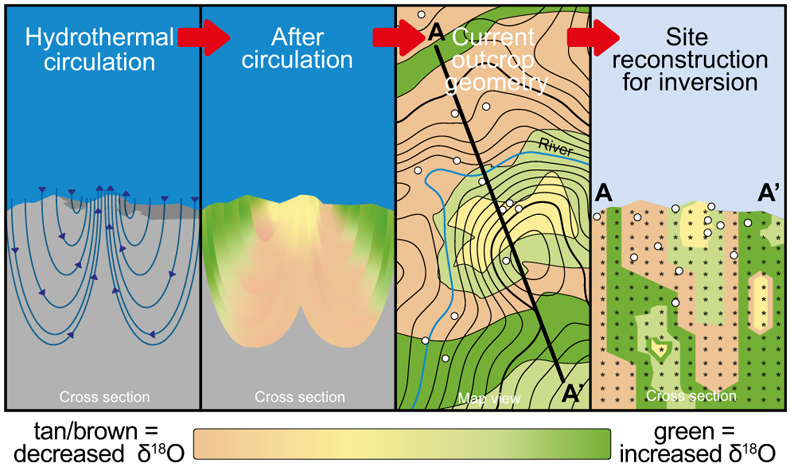
Figure 1 Tracer mass balance inverse approach. When water circulates through rock (leftmost panel), as at a mid-ocean ridge, that circulation causes exchange of O isotopes between water and rock in a well understood, temperature dependent manner (centre left panel). The geometry of patterns of O isotopes produced during circulation may be changed as the rock section ages, undergoes uplift, etc. (centre right panel). We then sample across modern outcrops/drill cores, attempt to reconstruct the original geometry, and use this approximation of original isotope and temperature patterns as the basis for inversion (rightmost panel).
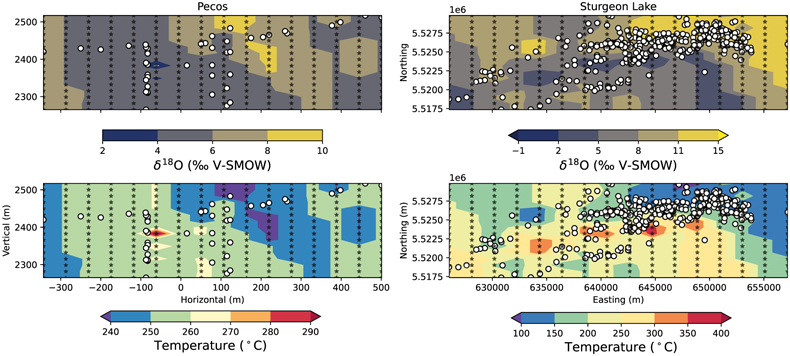
Figure 2 Contoured cross sections of oxygen isotope and alteration temperature for Pecos, NM, USA and Sturgeon Lake, Ontario, Canada. Samples are shown in white circles, grid used in inversion is outlined by the black stars. Cross sections are reconstructed from outcrop and drill core samples to approximate the full hydrothermal cell.
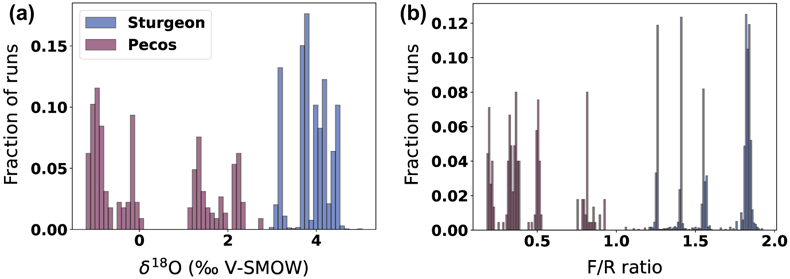
Figure 3 Histograms of ‘leave-one-out’ inversions showing both estimated initial (a) fluid δ18O, and (b) fluid-rock ratio. Inversions are performed the same number of times as there are samples at a given location, removing a random sample each time to constrain uncertainty, for a series of iterations at each site spanning temperature and/or starting rock δ18O values.
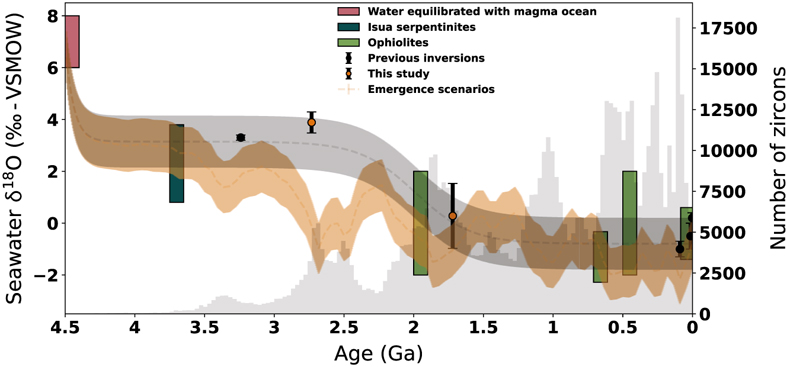
Figure 4 Estimates of seawater δ18O from altered ocean crust (green rectangles; Gregory, 1991
Gregory, R. (1991) Oxygen isotope history of seawater revisited: Timescales for boundary event changes in the oxygen isotope composition of seawater. In: Taylor Jr., H.P., O’Neil, J.R., Kaplan, I.R. (Eds.) Stable Isotope Geochemistry: A Tribute to Samuel Epstein. Geochemical Society, San Antonio, 65–76. https://geochemsoc.org/application/files/6917/5333/2164/SP-3_065-076_Gregory.pdf
; Holmden and Muehlenbachs, 1993Holmden, C., Muehlenbachs, K. (1993) The 18O/16O Ratio of 2-Billion-Year-Old Seawater Inferred from Ancient Oceanic Crust. Science 259, 1733–1736. https://doi.org/10.1126/science.259.5102.1733
; Pope et al., 2012Pope, E.C., Bird, D.K., Rosing, M.T. (2012) Isotope composition and volume of Earth’s early oceans. Proceedings of the National Academy of Sciences 109, 4371–4376. https://doi.org/10.1073/pnas.1115705109
) previous (black circles, Johnson and Wing, 2020Johnson, B.W., Wing, B.A. (2020) Limited Archaean continental emergence reflected in an early Archaean 18O-enriched ocean. Nature Geoscience 13, 243–248. https://doi.org/10.1038/s41561-020-0538-9
), and this study’s, tracer mass balance inversion estimates (orange circles). Also shown are abundance of detrital zircon ages in 30 Myr time bins (Puetz et al., 2024Puetz, S.J., Spencer, C.J., Condie, K.C., Roberts, N.M.W. (2024) Enhanced U-Pb detrital zircon, Lu-Hf zircon, δ18O zircon, and Sm-Nd whole rock global databases. Scientific Data 11, 56. https://doi.org/10.1038/s41597-023-02902-9
) and two seawater δ18O evolution curves (Muehlenbachs, 1998Muehlenbachs, K. (1998) The oxygen isotopic composition of the oceans, sediments and the seafloor. Chemical Geology 145, 263–273. https://doi.org/10.1016/S0009-2541(97)00147-2
): (1) continuous crustal growth and emergence (gray dashed line), and (2) punctuated curve driven by zircon abundance (orange dashed line). Seawater evolution curves are shown with ±1 ‰ envelopes, equivalent to observed changes in the δ18OSW during Pleistocene glaciations (Schrag et al., 2002Schrag, D.P., Adkins, J.F., McIntyre, K., Alexander, J.L., Hodell, D.A., Charles, C.D., McManus, J.F. (2002) The oxygen isotopic composition of seawater during the Last Glacial Maximum. Quaternary Science Reviews 21, 331–342. https://doi.org/10.1016/S0277-3791(01)00110-X
).