



Earth’s foundational geological events stored in the fundamental mantle source of hotspots
Affiliations | Corresponding Author | Cite as | Funding information
Published by the European Association of Geochemistry
under Creative Commons License CC BY 4.0
Keywords: mantle geochemistry, intraplate volcanism, short-lived radiogenic isotopes, early Earth history


- Share this article


-
Article views:1,383Cumulative count of HTML views and PDF downloads.
- Download Citation
- Rights & Permissions

top
Abstract
Figures
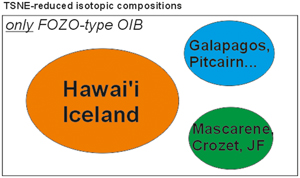
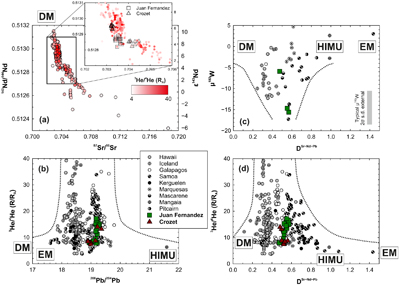 Figure 1 Long (He-Sr-143Nd-206Pb) and short lived (182W) isotopic compositions of global ocean island basalts. The value of DSr-Nd-Pb parameter refers to the deviation of sample isotopic compositions from a reference depleted composition (≡0) as defined in Jackson et al. (2020). Long lived radiogenic isotope data from GEOROC; W isotopic data from Mundl-Petermeier et al. (2020) and Herret et al. (2023). Dotted lines show approximate limits of present database. | 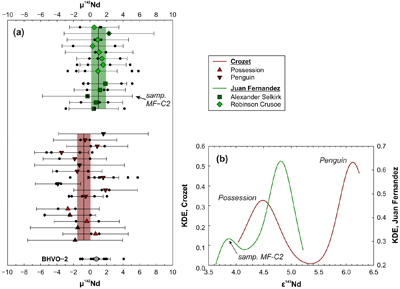 Figure 2 Neodymium isotopic compositions of ocean island basalts measured in this study. Small circles represent individual measurements, larger coloured symbols and error bars represent sample averages and 95 % confidence intervals, respectively. Vertical lines and coloured fields represent the average and 95 % confidence intervals of each hotspot. Values of ɛ143Nd represented as a kernel density estimate (KDE). | 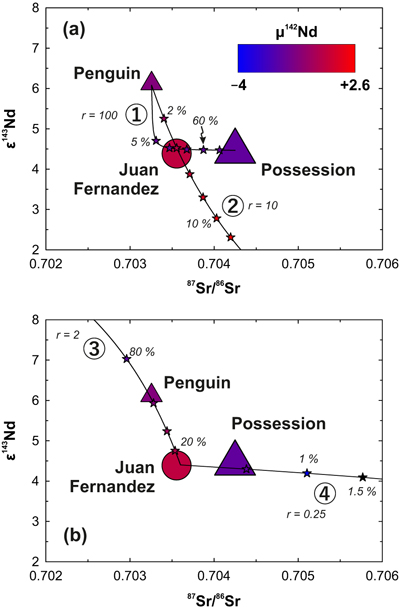 Figure 3 Mixing models (labelled by circled numbers as described in the text) for Sr-Nd isotopic compositions of studied ocean island basalts. Stars represent regular intervals of mixing as defined on each mixing curve; the colour of each curve corresponds to the μ142Nd composition of the mixing interval as defined by the colour bar in panel (a). The symbol size for each island covers the full range of its Sr-143Nd isotopic compositions. Model inputs are summarised in Table S-2. | 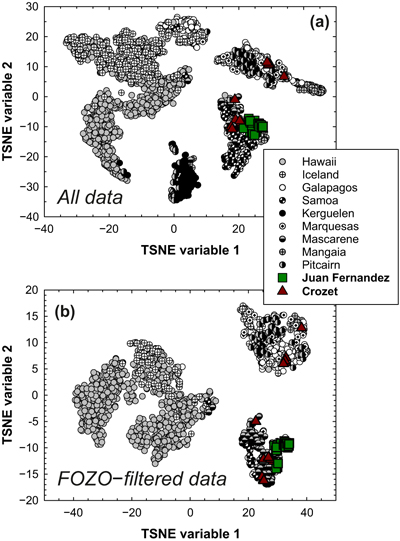 Figure 4 TSNE-reduced Sr-143Nd-Pb isotopic data for selected hotspots using (a) all data for each hotspot or (b) data filtered FOZO-like isotopic compositions according to a K-means cluster model. See text and Supplementary Information for model details. |
| Figure 1 | Figure 2 | Figure 3 | Figure 4 |
top
Introduction
The emergence of complex biogeochemical cycles on Earth is largely owed to the development of plate tectonics, yet it is also tectonics that has almost entirely destroyed Earth’s geochemical record of its origins. For example, the zircon age record implies that nearly half of Earth’s total crust was produced more than 2.5 Gyr ago (Korenaga, 2018
Korenaga, J. (2018) Estimating the formation age distribution of continental crust by unmixing zircon ages. Earth and Planetary Science Letters 482, 388–395. https://doi.org/10.1016/j.epsl.2017.11.039
), yet only ∼5 % of Earth’s modern surface is older than this age (Goodwin, 1996Goodwin, A.M. (1996) Principles of Precambrian Geology. Academic Press, London.
). This means that our knowledge of Earth’s formational geological processes is fundamentally limited. There has been profitable research aimed at understanding Earth’s development through intensive study of these remnants of ancient geological material (Wilde et al., 2001Wilde, S.A., Valley, J.W., Peck, W.H., Graham, C.M. (2001) Evidence from detrital zircons for the existence of continental crust and oceans on the Earth 4.4 Gyr ago. Nature 409, 175–178. https://doi.org/10.1038/35051550
; Bennett et al., 2007Bennett, V.C., Brandon, A.D., Nutman, A.P. (2007) Coupled 142Nd-143Nd Isotopic Evidence for Hadean Mantle Dynamics. Science 318, 1907–1910. https://doi.org/10.1126/science.1145928
; Reimink et al., 2014Reimink, J.R., Chacko, T., Stern, R.A., Heaman, L.M. (2014) Earth’s earliest evolved crust generated in an Iceland-like setting. Nature Geoscience 7, 529–533. https://doi.org/10.1038/ngeo2170
); however, it is unknown whether these results present a complete perspective on Earth’s evolution.Earth’s volcanic hotspots may represent a complementary view on early Earth processes that can partially remedy this preservation issue. It has long been recognised that the geochemical fingerprints of volcanic hotspots are among the most diverse of any terrestrial rock group. Some geochemical components of different volcanic hotspots have well constrained origins and may be more than 2.5 Gyr old, and therefore potential records of Earth’s geological conditions before the emergence of complex life. The origins of one potential reservoir, variably termed the ‘focus zone’ (FOZO, used preferentially here; cf. Hart et al., 1992
Hart, S.R., Hauri, E.H., Oschmann, L.A., Whitehead, J.A. (1992) Mantle Plumes and Entrainment: Isotopic Evidence. Science 256, 517–520. https://doi.org/10.1126/science.256.5056.517
), ‘common component’ (C), or ‘prevalent mantle’ (PREMA), have evaded conclusive agreement, but FOZO-like reservoirs have some remarkable geochemical characteristics. First, they have a geochemical signature that reflects less magmatic processing than the bulk upper mantle, but more magmatic processing than a theoretical chondritic primitive mantle—thus, FOZO reservoirs are said to be ‘moderately depleted’. Second, nearly all volcanic hotspots appear to tap some form of FOZO, while other geochemical components are unique to one or more hotspots; thus, it has been hypothesised that FOZO reservoirs are widespread in the deep mantle sources of volcanic hotspots. Finally, only hotspot lavas (collectively termed ocean island basalts: OIBs) with geochemical affinity for FOZO reservoirs are known to possess elevated 3He/4He ratios (Class and Goldstein, 2005Class, C., Goldstein, S.L. (2005) Evolution of helium isotopes in the Earth’s mantle. Nature 436, 1107–1112. https://doi.org/10.1038/nature03930
; Jackson et al., 2007Jackson, M., Kurz, M., Hart, S., Workman, R. (2007) New Samoan lavas from Ofu Island reveal a hemispherically heterogeneous high 3He/4He mantle. Earth and Planetary Science Letters 264, 360–374. https://doi.org/10.1016/j.epsl.2007.09.023
) (Fig. 1) compared to young mid-ocean ridge basalts (MORBs). Such elevated 3He/4He ratios are a primary signature of ancient geological material (Class and Goldstein, 2005Class, C., Goldstein, S.L. (2005) Evolution of helium isotopes in the Earth’s mantle. Nature 436, 1107–1112. https://doi.org/10.1038/nature03930
). Thus, it is possible that these FOZO reservoirs are older than any other geochemical component of hotspot volcanism.Figure 1 Long (He-Sr-143Nd-206Pb) and short lived (182W) isotopic compositions of global ocean island basalts. The value of DSr-Nd-Pb parameter refers to the deviation of sample isotopic compositions from a reference depleted composition (≡0) as defined in Jackson et al. (2020)
Jackson, M.G., Blichert-Toft, J., Halldorsson, S.A., Mundl-Petermeier, A., Bizimis, M., Kurz, M.D., Price, A.A., Harethardottir, S., Willhite, L.N., Breddam, K., Becker, T.W., Fischer, R.A. (2020) Ancient helium and tungsten isotopic signatures preserved in mantle domains least modified by crustal recycling. Proceedings National Academy Sciences USA 117, 30993–31001. https://doi.org/10.1073/pnas.2009663117
. Long lived radiogenic isotope data from GEOROC; W isotopic data from Mundl-Petermeier et al. (2020)Mundl-Petermeier, A., Walker, R.J., Fischer, R.A., Lekic, V., Jackson, M.G., Kurz, M.D. (2020) Anomalous 182W in high 3He/4He ocean island basalts: Fingerprints of Earth’s core? Geochimica et Cosmochimica Acta 271, 194–211. https://doi.org/10.1016/j.gca.2019.12.020
and Herret et al. (2023)Herret, M.T., Peters, B.J., Kim, D., Castillo, P.R., Mundl-Petermeier, A. (2023) Decoupling of short-lived radiogenic and helium isotopes in the Marquesas hotspot. Chemical Geology 640, 121727. https://doi.org/10.1016/j.chemgeo.2023.121727
. Dotted lines show approximate limits of present database.Some of these unique geochemical characteristics have recently been linked to short-lived radiogenic isotope systems, which record the effects of early geological processes. Only OIBs with moderately depleted isotopic signatures preserve deficits in 182W, which must have been generated in the first 1 % of Earth’s history (≳4.5 Gyr ago), compared to the bulk Earth (Fig. 1c). Similarly, heterogeneous 142Nd compositions, which were generated in the first 10 % of Earth’s history (≳4.0 Gyr ago), are primarily observed in OIB samples with moderately depleted isotopic signatures (Horan et al., 2018
Horan, M.F., Carlson, R.W., Walker, R.J., Jackson, M., Garçon, M., Norman, M. (2018) Tracking Hadean processes in modern basalts with 142-Neodymium. Earth and Planetary Science Letters 484, 184–191. https://doi.org/10.1016/j.epsl.2017.12.017
; Peters et al., 2018Peters, B.J., Carlson, R.W., Day, J.M.D., Horan, M.F. (2018) Hadean silicate differentiation preserved by anomalous (142)Nd/(144)Nd ratios in the Reunion hotspot source. Nature 555, 89–93. https://doi.org/10.1038/nature25754
). However, the high precision 142Nd database for global hotspots remains relatively small and, thus, small scale 142Nd heterogeneity in modern ocean island basalts may remain undetected. The convergence of global OIBs toward a moderately depleted isotopic signature, as well as the selectivity of this signature for predicting elevated 3He/4He ratios and heterogeneous 142Nd and 182W signatures, have led to the common conclusion that FOZO is a singular, ancient reservoir in Earth’s deep mantle. This interpretation is particularly attractive when attempting to reconcile an ancient FOZO with the presence of two discrete large low shear velocity provinces (LLSVPs) identified in Earth’s lower mantle. Despite this, evidence for the existence of multiple mantle components with elevated 3He/4He has been found both within single hotspots (Willhite et al., 2019Willhite, L.N., Jackson, M.G., Blichert‐Toft, J., Bindeman, I., Kurz, M.D., Halldórsson, S.A., Harðardóttir, S., Gazel, E., Price, A.A., Byerly, B.L. (2019) Hot and Heterogenous High‐3He/4He Components: New Constraints From Proto‐Iceland Plume Lavas From Baffin Island. Geochemistry, Geophysics, Geosystems 20, 5939–5967. https://doi.org/10.1029/2019GC008654
) and between global volcanic hotspots (Jackson et al., 2007Jackson, M., Kurz, M., Hart, S., Workman, R. (2007) New Samoan lavas from Ofu Island reveal a hemispherically heterogeneous high 3He/4He mantle. Earth and Planetary Science Letters 264, 360–374. https://doi.org/10.1016/j.epsl.2007.09.023
). Further, many hotspots that are spatially associated with different LLSVPs share common correlations between He and W isotopic compositions, implying that they have a shared ancient heritage that is independent of LLSVPs. Further, the lack of global correlations between 142Nd and either short (182W) or long lived (4He, 87Sr, 143Nd, 187Os, 206Pb) isotopic tracers has complicated interpretations of Hadean-aged processes preserved in both geologically young and ancient rocks. Thus, the timing and nature of the evolution of moderately depleted isotopic signatures akin to FOZO, as well as their global extent, remains unclear.top
The μ142Nd Signatures of FOZO-Type Lavas From Volcanic Hotspots
We measured the μ142Nd compositions (parts per million deviation of the 142Nd/144Nd ratio of a sample from that of the terrestrial standard) of OIBs from the Crozet (3He/4He ≤ 14 RA, n = 17) and Juan Fernandez (3He/4He ≤ 17 RA, n = 13) archipelagos, which display FOZO-like isotopic compositions and elevated 3He/4He ratios, and lack geochemical influence from non-FOZO end members. Notably, only hotspots that show clear geochemical influence from geochemical end member reservoirs, such as enriched mantle (EM), depleted mantle (DM), or high μ (high 238U/204Pb, HIMU), in addition to influence from FOZO, display very high 3He/4He (>30 RA; e.g., Jackson et al., 2017
Jackson, M.G., Konter, J.G., Becker, T.W. (2017) Primordial helium entrained by the hottest mantle plumes. Nature 542, 340–343. https://doi.org/10.1038/nature21023
). Our strategy was instead to focus on hotspot islands that display tightly distributed Sr-143Nd-Pb isotopic compositions that lie near the convergence point of global OIB isotopic arrays, without showing geochemical influence from any non-FOZO end member (Fig. 1; cf. Stracke et al., 2005Stracke, A., Hofmann, A.W., Hart, S.R. (2005) FOZO, HIMU, and the rest of the mantle zoo. Geochemistry, Geophysics, Geosystems 6, Q05007. https://doi.org/10.1029/2004GC000824
, for different definitions of FOZO). We used high precision analytical methods (adapted from Garçon et al., 2018Garçon, M., Boyet, M., Carlson, R.W., Horan, M.F., Auclair, D., Mock, T.D. (2018) Factors influencing the precision and accuracy of Nd isotope measurements by thermal ionization mass spectrometry. Chemical Geology 476, 493–514. https://doi.org/10.1016/j.chemgeo.2017.12.003
; Wang and Carlson, 2022Wang, D., Carlson, R.W. (2022) Tandem-column extraction chromatography for Nd separation: minimizing mass-independent isotope fractionation for ultrahigh-precision Nd isotope-ratio analysis. Journal of Analytical Atomic Spectrometry 37, 185–193. https://doi.org/10.1039/D1JA00365H
) designed to resolve very small scale μ142Nd heterogeneity, since observed variations in μ142Nd values are very small among post-Archean rocks (Horan et al., 2018Horan, M.F., Carlson, R.W., Walker, R.J., Jackson, M., Garçon, M., Norman, M. (2018) Tracking Hadean processes in modern basalts with 142-Neodymium. Earth and Planetary Science Letters 484, 184–191. https://doi.org/10.1016/j.epsl.2017.12.017
; Hyung and Jacobsen, 2020Hyung, E., Jacobsen, S.B. (2020) The 142Nd/144Nd variations in mantle-derived rocks provide constraints on the stirring rate of the mantle from the Hadean to the present. Proceedings National Academy Sciences USA 117, 14738–14744. https://doi.org/10.1073/pnas.2006950117
). We relied on intensive sample replication (more than 80 individual, high precision analyses) to constrain the μ142Nd compositions of the two hotspots.Samples from both studied islands of the Juan Fernandez hotspot samples display homogeneous μ142Nd compositions with an average of μ142Nd = +1.0 ± 0.9 (all uncertainties represent 95 % c.i., n = 13; Fig. 2, Tables S-1, S-2). Among Crozet hotspot OIBs, samples from Penguin Island similarly display homogeneous compositions (μ142Nd = −0.6 ± 0.9, n = 11), whereas samples from Possession Island have somewhat more heterogeneous and negative μ142Nd values (μ142Nd = −1.4 ± 1.7, n = 6), producing a hotspot average μ142Nd of −0.8 ± 0.8 (Fig. 2). The μ142Nd compositions of Crozet and Juan Fernandez OIBs are thus resolved at the 95 % confidence level and pass a t-test for the statistical resolution of their sample means (p = 0.006). Importantly, statistical resolution of μ142Nd compositions between individual samples or between sample groups requires that these samples or groups recorded distinct Hadean-aged histories even when no samples or sample groups are statistically resolved from the JNdi-1 terrestrial standard (cf. Horan et al., 2018
Horan, M.F., Carlson, R.W., Walker, R.J., Jackson, M., Garçon, M., Norman, M. (2018) Tracking Hadean processes in modern basalts with 142-Neodymium. Earth and Planetary Science Letters 484, 184–191. https://doi.org/10.1016/j.epsl.2017.12.017
). Further, the presence of statistically resolvable μ142Nd values in modern rocks implies that their mantle sources previously preserved much greater μ142Nd heterogeneity, since this tends to be erased by mantle convection over time (e.g., Hyung and Jacobsen, 2020Hyung, E., Jacobsen, S.B. (2020) The 142Nd/144Nd variations in mantle-derived rocks provide constraints on the stirring rate of the mantle from the Hadean to the present. Proceedings National Academy Sciences USA 117, 14738–14744. https://doi.org/10.1073/pnas.2006950117
).Figure 2 Neodymium isotopic compositions of ocean island basalts measured in this study. Small circles represent individual measurements, larger coloured symbols and error bars represent sample averages and 95 % confidence intervals, respectively. Vertical lines and coloured fields represent the average and 95 % confidence intervals of each hotspot. Values of ɛ143Nd represented as a kernel density estimate (KDE).
Although the Sr-143Nd isotopic compositions of Crozet and Juan Fernandez OIBs fall into a global FOZO-type compositional range (Breton et al., 2013
Breton, T., Nauret, F., Pichat, S., Moine, B., Moreira, M., Rose-Koga, E.F., Auclair, D., Bosq, C., Wavrant, L.-M. (2013) Geochemical heterogeneities within the Crozet hotspot. Earth and Planetary Science Letters 376, 126–136. https://doi.org/10.1016/j.epsl.2013.06.020
; Truong et al., 2018Truong, T.B., Castillo, P.R., Hilton, D.R., Day, J.M.D. (2018) The trace element and Sr-Nd-Pb isotope geochemistry of Juan Fernandez lavas reveal variable contributions from a high-3He/4He mantle plume. Chemical Geology 476, 280–291. https://doi.org/10.1016/j.chemgeo.2017.11.024
) (Fig. 1), there are also observable differences between the compositions of the two hotspots (Figs. 2b and 3). In particular, the Sr-143Nd isotopic compositions of Penguin and Possession Island OIBs (Crozet) bracket those of both studied islands of Juan Fernandez, meaning that the Sr-142,143Nd isotopic compositions of the islands could potentially be attributed to discrete, shared compositional domains that are variably mixed into the sources of these islands. We tested this possibility using several binary mixing models (Fig. 3). Model 1 assumes that Penguin and Possession represent unmixed FOZO-like components, and that Juan Fernandez OIBs represent an intermediate mixture of these components. This model can explain the Sr-143Nd isotopic compositions of Juan Fernandez OIBs, albeit at comparatively extreme trace element abundances (Table S-3). However, mixing two components (Penguin and Possession) that both possess negative μ142Nd values cannot produce an intermediate composition (Juan Fernandez) with a positive μ142Nd value. Mixing model 2 instead assumes that Penguin Island represents a discrete FOZO component and that the isotopic compositions of Juan Fernandez and Possession OIB are explained by minor admixing of an EM component (cf. Breton et al., 2013Breton, T., Nauret, F., Pichat, S., Moine, B., Moreira, M., Rose-Koga, E.F., Auclair, D., Bosq, C., Wavrant, L.-M. (2013) Geochemical heterogeneities within the Crozet hotspot. Earth and Planetary Science Letters 376, 126–136. https://doi.org/10.1016/j.epsl.2013.06.020
). This model can successfully reproduce the Sr-142,143Nd compositions of Juan Fernandez lavas assuming that the EM end member possesses a μ142Nd value of ≳ + 8. However, this assumption cannot simultaneously explain the negative μ142Nd compositions of Possession OIBs, which would require the EM end member to have μ142Nd ≲ –5. Further, there is no independent evidence that 1) such an EM component exists in Juan Fernandez lavas (Truong et al., 2018Truong, T.B., Castillo, P.R., Hilton, D.R., Day, J.M.D. (2018) The trace element and Sr-Nd-Pb isotope geochemistry of Juan Fernandez lavas reveal variable contributions from a high-3He/4He mantle plume. Chemical Geology 476, 280–291. https://doi.org/10.1016/j.chemgeo.2017.11.024
), and 2) that this EM component would possess a resolvable positive or negative μ142Nd value.Figure 3 Mixing models (labelled by circled numbers as described in the text) for Sr-Nd isotopic compositions of studied ocean island basalts. Stars represent regular intervals of mixing as defined on each mixing curve; the colour of each curve corresponds to the μ142Nd composition of the mixing interval as defined by the colour bar in panel (a). The symbol size for each island covers the full range of its Sr-143Nd isotopic compositions. Model inputs are summarised in Table S-2.
Mixing models 3 and 4 take the alternative perspective that Juan Fernandez OIBs represent a discrete FOZO component, and that Penguin and Possession lavas reflect admixing of a depleted MORB mantle (DMM) or an EM component, respectively. These models can successfully reproduce the Sr-142,143Nd isotopic compositions of both Penguin and Possession lavas; however, they require that the bulk DMM has μ142Nd ≲ −4 and the Possession EM component has μ142Nd < −100 (Table S-3). Although there is evidence that global MORBs possess slightly negative μ142Nd values (ca. μ142Nd = −1 to −2; Peters et al., 2024
Peters, D., Rizo, H., O’Neil, J., Hamelin, C., Shirey, S.B. (2024) Comparative 142Nd and 182W study of MORBs and the 4.5 Gyr evolution of the upper mantle. Geochemical Perspectives Letters 29, 51–56. https://doi.org/10.7185/geochemlet.2412
), there is no indication that the bulk DMM systematically possesses more negative μ142Nd compositions. Similarly, there is no evidence that EM components have μ142Nd compositions significantly more extreme than what has been observed in the Archean rock record (ca. −20 to +20). Thus, we infer that the μ142Nd compositions of Crozet and Juan Fernandez OIBs cannot be reconciled by binary mixing processes. Instead, they must be explained by the existence of multiple mantle domains with similar, FOZO-like long lived isotopic compositions but heterogeneous μ142Nd signatures. This conclusion expands the long held view of FOZO as a diffuse component without the clear, singular end member compositions exhibited by EM and HIMU (Hart et al., 1992Hart, S.R., Hauri, E.H., Oschmann, L.A., Whitehead, J.A. (1992) Mantle Plumes and Entrainment: Isotopic Evidence. Science 256, 517–520. https://doi.org/10.1126/science.256.5056.517
; Stracke et al., 2005Stracke, A., Hofmann, A.W., Hart, S.R. (2005) FOZO, HIMU, and the rest of the mantle zoo. Geochemistry, Geophysics, Geosystems 6, Q05007. https://doi.org/10.1029/2004GC000824
).top
The Hadean-Aged Heritage of FOZO
The short half-life of the 146Sm-142Nd system (recently updated to 92 ± 3 Ma; Chiera et al., 2024
Chiera, N.M., Sprung, P., Amelin, Y., Dressler, R., Schumann, D., Talip, Z. (2024) The 146Sm half-life re-measured: consolidating the chronometer for events in the early Solar System. Science Reports 14, 17436. https://doi.org/10.1038/s41598-024-64104-6
) requires that detectible μ142Nd heterogeneity was generated before ca. 4 Ga ago, during the Hadean Eon. This means that the differing μ142Nd compositions of Crozet and Juan Fernandez OIBs reflect distinct FOZO domains that experienced different geochemical histories during the first ca. 10 % of Earth’s history. This finding implies that FOZO is not a singular component, but rather reflects different silicate differentiation histories that began in the Hadean Eon and have been partially preserved until the present. This result is particularly striking given the long lived isotopic characteristics of Crozet and Juan Fernandez OIBs. In particular, the 3He/4He ratios of lavas from both archipelagos do not extend to the very high values observed in other hotspots (Jackson et al., 2017Jackson, M.G., Konter, J.G., Becker, T.W. (2017) Primordial helium entrained by the hottest mantle plumes. Nature 542, 340–343. https://doi.org/10.1038/nature21023
). However, the He-Pb isotopic characteristics of Crozet and Juan Fernandez OIBs overlap with the trend toward high 3He/4He ratios defined by Galápagos and Samoa OIBs, implying that they have primitive components with comparable origins (cf. Jackson et al., 2007Jackson, M., Kurz, M., Hart, S., Workman, R. (2007) New Samoan lavas from Ofu Island reveal a hemispherically heterogeneous high 3He/4He mantle. Earth and Planetary Science Letters 264, 360–374. https://doi.org/10.1016/j.epsl.2007.09.023
) (Fig. 1b). Further, Juan Fernandez lavas record some of the lowest known 182W/184W ratios among OIBs, well below OIBs from other hotspots with similar or higher 3He/4He ratios, such as Samoa (Mundl-Petermeier et al., 2020Mundl-Petermeier, A., Walker, R.J., Fischer, R.A., Lekic, V., Jackson, M.G., Kurz, M.D. (2020) Anomalous 182W in high 3He/4He ocean island basalts: Fingerprints of Earth’s core? Geochimica et Cosmochimica Acta 271, 194–211. https://doi.org/10.1016/j.gca.2019.12.020
). Identifying hotspots with shared ancient heritage is therefore clearly complicated, and a better view may be obtained by combining multi-dimensional isotopic data to explore isotopic heterogeneity within FOZO-type OIBs. A baseline analysis, utilising the normalisation scheme of Jackson et al. (2020)Jackson, M.G., Blichert-Toft, J., Halldorsson, S.A., Mundl-Petermeier, A., Bizimis, M., Kurz, M.D., Price, A.A., Harethardottir, S., Willhite, L.N., Breddam, K., Becker, T.W., Fischer, R.A. (2020) Ancient helium and tungsten isotopic signatures preserved in mantle domains least modified by crustal recycling. Proceedings National Academy Sciences USA 117, 30993–31001. https://doi.org/10.1073/pnas.2009663117
(Fig. 1d) for the combined long lived radiogenic (He-Sr-143Nd-206Pb) compositions of global OIBs, suggests that there are at least three distinct trends to high 3He/4He values. Some hotspots, such as Iceland, appear to transverse multiple trends. This raises the possibility that primitive mantle domains are not discrete and may rather be unique to each hotspot system.We developed a machine learning model to approach the challenge of visualising and interpreting multi-dimensional isotopic data in this context. We initially compiled He-Sr-143Nd-Pb isotopic and trace element data from 33 hotspots using the individual pre-compiled files available on the GEOROC database (DIGIS, Geoscience Centre Göttingen). Due to the requirement of machine learning models for relatively large datasets, the small amount of available 142Nd and 182W data precluded their direct inclusion in our model. We used the t-distributed stochastic neighbor embedding (TSNE) method to reduce the dimensionality of the data to produce simpler visual representations of the multi-dimensional data (e.g., Fig. S-1). We found that the inclusion of He isotopic or trace element compositions made geological interpretation significantly more complex (Supplementary Information), and so we focused on the interpretation of results for Sr-143Nd-Pb isotopic data alone. We used the initial findings for all compiled hotspots to guide the development of a refined K-means cluster analysis for nine hotspots with the greatest data availability, plus Juan Fernandez and Crozet. This resulted in the appearance of clusters with clear association to established mantle end member compositions, such as EM and HIMU (Fig. 4a; e.g., White et al., 2025
White, W.M., Jackson, M.G., Hardardottir, S. (2025) Insights Into Mantle Plume Geochemistry From Machine Learning. Geochemistry, Geophysics, Geosystems 26, e2024GC011870. https://doi.org/10.1029/2024GC011870
). We then used this cluster analysis as an objective criterion to filter out samples that represented significantly depleted or enriched isotopic compositions relative to FOZO, and subsequently repeated the TSNE dimensionality reduction on the filtered data alone. For a full overview of the model development, see the Supplementary Information.Figure 4 TSNE-reduced Sr-143Nd-Pb isotopic data for selected hotspots using (a) all data for each hotspot or (b) data filtered FOZO-like isotopic compositions according to a K-means cluster model. See text and Supplementary Information for model details.
Among the FOZO-filtered dataset, at least three visually resolved groups are apparent (Fig. 4b). One is comprised of nearly all Hawaii and a majority of Iceland OIBs, which show strong overlap and are distinct from other hotspots. A second group is comprised primarily of the remaining Iceland and Hawaii lavas, along with Galápagos, Pitcairn and most Marquesas lavas, along with all but one sample from Penguin Island (Crozet). The final group is comprised of a few Iceland lavas along with Mascarene (Réunion), Samoa, Juan Fernandez and the remaining Marquesas and Crozet lavas. Although these groups are clearly distinct from one another, they each include OIBs that have differing compositions on binary isotope plots alone (Fig. 1). For example, the Sr-143Nd-Pb and He-W isotopic systematics of Galápagos OIBs appear to be unlike those of Pitcairn or Marquesas OIBs; however, in the filtered TSNE analysis (Fig. 4b) these three hotspots mainly occupy the same cluster. Further, the TSNE analysis preserves apparent compositional differences between Penguin and Possession Island OIBs. However, Penguin Island lavas are not associated with either Juan Fernandez or Mascarene lavas, which share their FOZO-like Sr-143Nd-Pb and moderately elevated 3He/4He compositions. Likewise, the association of Juan Fernandez and Possession OIBs, which have distinct μ142Nd compositions, highlights that there must also be multiple independent geological histories preserved within a single TSNE group, since the TSNE reduction was done using only long lived isotopic compositions. One exception to these associations is lavas from Hawaii and Iceland OIBs, which were previously noted to have similar isotopic signatures (e.g., Jackson et al., 2007
Jackson, M., Kurz, M., Hart, S., Workman, R. (2007) New Samoan lavas from Ofu Island reveal a hemispherically heterogeneous high 3He/4He mantle. Earth and Planetary Science Letters 264, 360–374. https://doi.org/10.1016/j.epsl.2007.09.023
) and likewise have strongly overlapping TSNE compositions for a variety of multi-dimensional analyses, among them those including He isotopic compositions (Figs. 4, S-2), despite their geographic distance and association with different LLSVP.Given these results, it is clear that the geological interpretation of machine learning models is not straightforward (cf. Stracke et al., 2022
Stracke, A., Willig, M., Genske, F., Béguelin, P., Todd, E. (2022) Chemical Geodynamics Insights From a Machine Learning Approach. Geochemistry, Geophysics, Geosystems 23, e2022GC010606. https://doi.org/10.1029/2022GC010606
; White et al., 2025White, W.M., Jackson, M.G., Hardardottir, S. (2025) Insights Into Mantle Plume Geochemistry From Machine Learning. Geochemistry, Geophysics, Geosystems 26, e2024GC011870. https://doi.org/10.1029/2024GC011870
). In particular, given that the model associates OIBs with differing μ142Nd compositions, the observed sample grouping must represent a minimum number of discrete FOZO components present in the mantle. Further, the presence of heterogeneous μ142Nd values in a single TSNE cluster implies that Hadean-aged heterogeneity could be present throughout global OIBs and more high precision data is required in order to detect it. Our results thus highlight an opportunity for further tests of the geochemical relationship between potential common components of global hotspots. Given the lack of clear association between FOZO compositional clusters and geographic position of LLSVPs, further spatial analysis is required to understand where Hadean-aged components are stored and protected within the mantle. Further, as the 142Nd and 182W datasets for modern OIBs are expanded (Mundl-Petermeier et al., 2020Mundl-Petermeier, A., Walker, R.J., Fischer, R.A., Lekic, V., Jackson, M.G., Kurz, M.D. (2020) Anomalous 182W in high 3He/4He ocean island basalts: Fingerprints of Earth’s core? Geochimica et Cosmochimica Acta 271, 194–211. https://doi.org/10.1016/j.gca.2019.12.020
), the Hadean origins of modern volcanism can be better understood through multi-dimensional analysis and the geological processes responsible for Earth’s development can be scrutinised more closely.top
Acknowledgements
This project was supported by ETH Zürich/Marie Skłodowska-Curie Actions COFUND (18-1 FEL-28 to BJP) and the Swiss National Science Foundation (PZ00P2_186064 to BJP). The authors thank editor Raúl Fonseca for editorial handling and for thoughtful reviews from Catherine Chauvel, Bill White, and Erik Scherer, which helped improve the manuscript.
Editor: Raúl O.C. Fonseca
top
Data Availability Statement
All data generated in this study are available in the Supplementary Tables and have also been archived in the EarthChem database at https://doi.org/10.60520/IEDA/113771.
top
References
Bennett, V.C., Brandon, A.D., Nutman, A.P. (2007) Coupled 142Nd-143Nd Isotopic Evidence for Hadean Mantle Dynamics. Science 318, 1907–1910. https://doi.org/10.1126/science.1145928
 Show in context
 There has been profitable research aimed at understanding Earth’s development through intensive study of these remnants of ancient geological material (Wilde et al., 2001; Bennett et al., 2007; Reimink et al., 2014); however, it is unknown whether these results present a complete perspective on Earth’s evolution.
View in article
Breton, T., Nauret, F., Pichat, S., Moine, B., Moreira, M., Rose-Koga, E.F., Auclair, D., Bosq, C., Wavrant, L.-M. (2013) Geochemical heterogeneities within the Crozet hotspot. Earth and Planetary Science Letters 376, 126–136. https://doi.org/10.1016/j.epsl.2013.06.020
Show in context Although the Sr-143Nd isotopic compositions of Crozet and Juan Fernandez OIBs fall into a global FOZO-type compositional range (Breton et al., 2013; Truong et al., 2018) (Fig. 1), there are also observable differences between the compositions of the two hotspots (Figs. 2b and 3).
View in article
Mixing model 2 instead assumes that Penguin Island represents a discrete FOZO component and that the isotopic compositions of Juan Fernandez and Possession OIB are explained by minor admixing of an EM component (cf. Breton et al., 2013).
View in article
Chiera, N.M., Sprung, P., Amelin, Y., Dressler, R., Schumann, D., Talip, Z. (2024) The 146Sm half-life re-measured: consolidating the chronometer for events in the early Solar System. Science Reports 14, 17436. https://doi.org/10.1038/s41598-024-64104-6
Show in context The short half-life of the 146Sm-142Nd system (recently updated to 92 ± 3 Ma; Chiera et al., 2024) requires that detectible μ142Nd heterogeneity was generated before ca. 4 Ga ago, during the Hadean Eon.
View in article
Class, C., Goldstein, S.L. (2005) Evolution of helium isotopes in the Earth’s mantle. Nature 436, 1107–1112. https://doi.org/10.1038/nature03930
Show in context Finally, only hotspot lavas (collectively termed ocean island basalts: OIBs) with geochemical affinity for FOZO reservoirs are known to possess elevated 3He/4He ratios (Class and Goldstein, 2005; Jackson et al., 2007) (Fig. 1) compared to young mid-ocean ridge basalts (MORBs).
View in article
Such elevated 3He/4He ratios are a primary signature of ancient geological material (Class and Goldstein, 2005).
View in article
Garçon, M., Boyet, M., Carlson, R.W., Horan, M.F., Auclair, D., Mock, T.D. (2018) Factors influencing the precision and accuracy of Nd isotope measurements by thermal ionization mass spectrometry. Chemical Geology 476, 493–514. https://doi.org/10.1016/j.chemgeo.2017.12.003
Show in context We used high precision analytical methods (adapted from Garçon et al., 2018; Wang and Carlson, 2022) designed to resolve very small scale μ142Nd heterogeneity, since observed variations in μ142Nd values are very small among post-Archean rocks (Horan et al., 2018; Hyung and Jacobsen, 2020).
View in article
Goodwin, A.M. (1996) Principles of Precambrian Geology. Academic Press, London.
Show in context For example, the zircon age record implies that nearly half of Earth’s total crust was produced more than 2.5 Gyr ago (Korenaga, 2018), yet only ∼5 % of Earth’s modern surface is older than this age (Goodwin, 1996).
View in article
Hart, S.R., Hauri, E.H., Oschmann, L.A., Whitehead, J.A. (1992) Mantle Plumes and Entrainment: Isotopic Evidence. Science 256, 517–520. https://doi.org/10.1126/science.256.5056.517
Show in context The origins of one potential reservoir, variably termed the ‘focus zone’ (FOZO, used preferentially here; cf. Hart et al., 1992), ‘common component’ (C), or ‘prevalent mantle’ (PREMA), have evaded conclusive agreement, but FOZO-like reservoirs have some remarkable geochemical characteristics.
View in article
This conclusion expands the long held view of FOZO as a diffuse component without the clear, singular end member compositions exhibited by EM and HIMU (Hart et al., 1992; Stracke et al., 2005).
View in article
Herret, M.T., Peters, B.J., Kim, D., Castillo, P.R., Mundl-Petermeier, A. (2023) Decoupling of short-lived radiogenic and helium isotopes in the Marquesas hotspot. Chemical Geology 640, 121727. https://doi.org/10.1016/j.chemgeo.2023.121727
Show in context Long lived radiogenic isotope data from GEOROC; W isotopic data from Mundl-Petermeier et al. (2020) and Herret et al. (2023). Dotted lines show approximate limits of present database.
View in article
Horan, M.F., Carlson, R.W., Walker, R.J., Jackson, M., Garçon, M., Norman, M. (2018) Tracking Hadean processes in modern basalts with 142-Neodymium. Earth and Planetary Science Letters 484, 184–191. https://doi.org/10.1016/j.epsl.2017.12.017
Show in context Similarly, heterogeneous 142Nd compositions, which were generated in the first 10 % of Earth’s history (≳4.0 Gyr ago), are primarily observed in OIB samples with moderately depleted isotopic signatures (Horan et al., 2018; Peters et al., 2018).
View in article
We used high precision analytical methods (adapted from Garçon et al., 2018; Wang and Carlson, 2022) designed to resolve very small scale μ142Nd heterogeneity, since observed variations in μ142Nd values are very small among post-Archean rocks (Horan et al., 2018; Hyung and Jacobsen, 2020).
View in article
Importantly, statistical resolution of μ142Nd compositions between individual samples or between sample groups requires that these samples or groups recorded distinct Hadean-aged histories even when no samples or sample groups are statistically resolved from the JNdi-1 terrestrial standard (cf. Horan et al., 2018).
View in article
Hyung, E., Jacobsen, S.B. (2020) The 142Nd/144Nd variations in mantle-derived rocks provide constraints on the stirring rate of the mantle from the Hadean to the present. Proceedings National Academy Sciences USA 117, 14738–14744. https://doi.org/10.1073/pnas.2006950117
Show in context We used high precision analytical methods (adapted from Garçon et al., 2018; Wang and Carlson, 2022) designed to resolve very small scale μ142Nd heterogeneity, since observed variations in μ142Nd values are very small among post-Archean rocks (Horan et al., 2018; Hyung and Jacobsen, 2020).
View in article
Further, the presence of statistically resolvable μ142Nd values in modern rocks implies that their mantle sources previously preserved much greater μ142Nd heterogeneity, since this tends to be erased by mantle convection over time (e.g., Hyung and Jacobsen, 2020).
View in article
Jackson, M., Kurz, M., Hart, S., Workman, R. (2007) New Samoan lavas from Ofu Island reveal a hemispherically heterogeneous high 3He/4He mantle. Earth and Planetary Science Letters 264, 360–374. https://doi.org/10.1016/j.epsl.2007.09.023
Show in context Finally, only hotspot lavas (collectively termed ocean island basalts: OIBs) with geochemical affinity for FOZO reservoirs are known to possess elevated 3He/4He ratios (Class and Goldstein, 2005; Jackson et al., 2007) (Fig. 1) compared to young mid-ocean ridge basalts (MORBs).
View in article
Despite this, evidence for the existence of multiple mantle components with elevated 3He/4He has been found both within single hotspots (Willhite et al., 2019) and between global volcanic hotspots (Jackson et al., 2007).
View in article
However, the He-Pb isotopic characteristics of Crozet and Juan Fernandez OIBs overlap with the trend toward high 3He/4He ratios defined by Galápagos and Samoa OIBs, implying that they have primitive components with comparable origins (cf. Jackson et al., 2007) (Fig. 1b).
View in article
One exception to these associations is lavas from Hawaii and Iceland OIBs, which were previously noted to have similar isotopic signatures (e.g., Jackson et al., 2007) and likewise have strongly overlapping TSNE compositions for a variety of multi-dimensional analyses, among them those including He isotopic compositions (Figs. 4, S-2), despite their geographic distance and association with different LLSVP.
View in article
Jackson, M.G., Konter, J.G., Becker, T.W. (2017) Primordial helium entrained by the hottest mantle plumes. Nature 542, 340–343. https://doi.org/10.1038/nature21023
Show in context Notably, only hotspots that show clear geochemical influence from geochemical end member reservoirs, such as enriched mantle (EM), depleted mantle (DM), or high μ (high 238U/204Pb, HIMU), in addition to influence from FOZO, display very high 3He/4He (>30 RA; e.g., Jackson et al., 2017).
View in article
In particular, the 3He/4He ratios of lavas from both archipelagos do not extend to the very high values observed in other hotspots (Jackson et al., 2017).
View in article
Jackson, M.G., Blichert-Toft, J., Halldorsson, S.A., Mundl-Petermeier, A., Bizimis, M., Kurz, M.D., Price, A.A., Harethardottir, S., Willhite, L.N., Breddam, K., Becker, T.W., Fischer, R.A. (2020) Ancient helium and tungsten isotopic signatures preserved in mantle domains least modified by crustal recycling. Proceedings National Academy Sciences USA 117, 30993–31001. https://doi.org/10.1073/pnas.2009663117
Show in context The value of DSr-Nd-Pb parameter refers to the deviation of sample isotopic compositions from a reference depleted composition (≡0) as defined in Jackson et al. (2020).
View in article
A baseline analysis, utilising the normalisation scheme of Jackson et al. (2020) (Fig. 1d) for the combined long lived radiogenic (He-Sr-143Nd-206Pb) compositions of global OIBs, suggests that there are at least three distinct trends to high 3He/4He values.
View in article
Korenaga, J. (2018) Estimating the formation age distribution of continental crust by unmixing zircon ages. Earth and Planetary Science Letters 482, 388–395. https://doi.org/10.1016/j.epsl.2017.11.039
Show in context For example, the zircon age record implies that nearly half of Earth’s total crust was produced more than 2.5 Gyr ago (Korenaga, 2018), yet only ∼5 % of Earth’s modern surface is older than this age (Goodwin, 1996).
View in article
Mundl-Petermeier, A., Walker, R.J., Fischer, R.A., Lekic, V., Jackson, M.G., Kurz, M.D. (2020) Anomalous 182W in high 3He/4He ocean island basalts: Fingerprints of Earth’s core? Geochimica et Cosmochimica Acta 271, 194–211. https://doi.org/10.1016/j.gca.2019.12.020
Show in context Long lived radiogenic isotope data from GEOROC; W isotopic data from Mundl-Petermeier et al. (2020) and Herret et al. (2023). Dotted lines show approximate limits of present database.
View in article
Further, Juan Fernandez lavas record some of the lowest known 182W/184W ratios among OIBs, well below OIBs from other hotspots with similar or higher 3He/4He ratios, such as Samoa (Mundl-Petermeier et al., 2020).
View in article
Further, as the 142Nd and 182W datasets for modern OIBs are expanded (Mundl-Petermeier et al., 2020), the Hadean origins of modern volcanism can be better understood through multi-dimensional analysis and the geological processes responsible for Earth’s development can be scrutinised more closely.
View in article
Peters, B.J., Carlson, R.W., Day, J.M.D., Horan, M.F. (2018) Hadean silicate differentiation preserved by anomalous (142)Nd/(144)Nd ratios in the Reunion hotspot source. Nature 555, 89–93. https://doi.org/10.1038/nature25754
Show in context Similarly, heterogeneous 142Nd compositions, which were generated in the first 10 % of Earth’s history (≳4.0 Gyr ago), are primarily observed in OIB samples with moderately depleted isotopic signatures (Horan et al., 2018; Peters et al., 2018).
View in article
Peters, D., Rizo, H., O’Neil, J., Hamelin, C., Shirey, S.B. (2024) Comparative 142Nd and 182W study of MORBs and the 4.5 Gyr evolution of the upper mantle. Geochemical Perspectives Letters 29, 51–56. https://doi.org/10.7185/geochemlet.2412
Show in context Although there is evidence that global MORBs possess slightly negative μ142Nd values (ca. μ142Nd = −1 to −2; Peters et al., 2024), there is no indication that the bulk DMM systematically possesses more negative μ142Nd compositions.
View in article
Reimink, J.R., Chacko, T., Stern, R.A., Heaman, L.M. (2014) Earth’s earliest evolved crust generated in an Iceland-like setting. Nature Geoscience 7, 529–533. https://doi.org/10.1038/ngeo2170
Show in context There has been profitable research aimed at understanding Earth’s development through intensive study of these remnants of ancient geological material (Wilde et al., 2001; Bennett et al., 2007; Reimink et al., 2014); however, it is unknown whether these results present a complete perspective on Earth’s evolution.
View in article
Stracke, A., Hofmann, A.W., Hart, S.R. (2005) FOZO, HIMU, and the rest of the mantle zoo. Geochemistry, Geophysics, Geosystems 6, Q05007. https://doi.org/10.1029/2004GC000824
Show in context Our strategy was instead to focus on hotspot islands that display tightly distributed Sr-143Nd-Pb isotopic compositions that lie near the convergence point of global OIB isotopic arrays, without showing geochemical influence from any non-FOZO end member (Fig. 1; cf. Stracke et al., 2005, for different definitions of FOZO).
View in article
This conclusion expands the long held view of FOZO as a diffuse component without the clear, singular end member compositions exhibited by EM and HIMU (Hart et al., 1992; Stracke et al., 2005).
View in article
Stracke, A., Willig, M., Genske, F., Béguelin, P., Todd, E. (2022) Chemical Geodynamics Insights From a Machine Learning Approach. Geochemistry, Geophysics, Geosystems 23, e2022GC010606. https://doi.org/10.1029/2022GC010606
Show in context Given these results, it is clear that the geological interpretation of machine learning models is not straightforward (cf. Stracke et al., 2022; White et al., 2025).
View in article
Truong, T.B., Castillo, P.R., Hilton, D.R., Day, J.M.D. (2018) The trace element and Sr-Nd-Pb isotope geochemistry of Juan Fernandez lavas reveal variable contributions from a high-3He/4He mantle plume. Chemical Geology 476, 280–291. https://doi.org/10.1016/j.chemgeo.2017.11.024
Show in context Although the Sr-143Nd isotopic compositions of Crozet and Juan Fernandez OIBs fall into a global FOZO-type compositional range (Breton et al., 2013; Truong et al., 2018) (Fig. 1), there are also observable differences between the compositions of the two hotspots (Figs. 2b and 3).
View in article
Further, there is no independent evidence that 1) such an EM component exists in Juan Fernandez lavas (Truong et al., 2018), and 2) that this EM component would possess a resolvable positive or negative μ142Nd value.
View in article
Wang, D., Carlson, R.W. (2022) Tandem-column extraction chromatography for Nd separation: minimizing mass-independent isotope fractionation for ultrahigh-precision Nd isotope-ratio analysis. Journal of Analytical Atomic Spectrometry 37, 185–193. https://doi.org/10.1039/D1JA00365H
Show in context We used high precision analytical methods (adapted from Garçon et al., 2018; Wang and Carlson, 2022) designed to resolve very small scale μ142Nd heterogeneity, since observed variations in μ142Nd values are very small among post-Archean rocks (Horan et al., 2018; Hyung and Jacobsen, 2020).
View in article
White, W.M., Jackson, M.G., Hardardottir, S. (2025) Insights Into Mantle Plume Geochemistry From Machine Learning. Geochemistry, Geophysics, Geosystems 26, e2024GC011870. https://doi.org/10.1029/2024GC011870
Show in context This resulted in the appearance of clusters with clear association to established mantle end member compositions, such as EM and HIMU (Fig. 4a; e.g., White et al., 2025).
View in article
Given these results, it is clear that the geological interpretation of machine learning models is not straightforward (cf. Stracke et al., 2022; White et al., 2025).
View in article
Wilde, S.A., Valley, J.W., Peck, W.H., Graham, C.M. (2001) Evidence from detrital zircons for the existence of continental crust and oceans on the Earth 4.4 Gyr ago. Nature 409, 175–178. https://doi.org/10.1038/35051550
Show in context There has been profitable research aimed at understanding Earth’s development through intensive study of these remnants of ancient geological material (Wilde et al., 2001; Bennett et al., 2007; Reimink et al., 2014); however, it is unknown whether these results present a complete perspective on Earth’s evolution.
View in article
Willhite, L.N., Jackson, M.G., Blichert‐Toft, J., Bindeman, I., Kurz, M.D., Halldórsson, S.A., Harðardóttir, S., Gazel, E., Price, A.A., Byerly, B.L. (2019) Hot and Heterogenous High‐3He/4He Components: New Constraints From Proto‐Iceland Plume Lavas From Baffin Island. Geochemistry, Geophysics, Geosystems 20, 5939–5967. https://doi.org/10.1029/2019GC008654
Show in context Despite this, evidence for the existence of multiple mantle components with elevated 3He/4He has been found both within single hotspots (Willhite et al., 2019) and between global volcanic hotspots (Jackson et al., 2007).
View in article
top
Supplementary Information
The Supplementary Information includes:
- Supplementary Materials and Methods Information
- Supplementary Information Regarding the Machine Learning Model
- Tables S-1 to S-6
- Figures S-1 to S-7
- Supplementary Information References
Download the Supplementary Information (PDF)
Download Tables S-1 to S-6 (.xlsx)
Figures
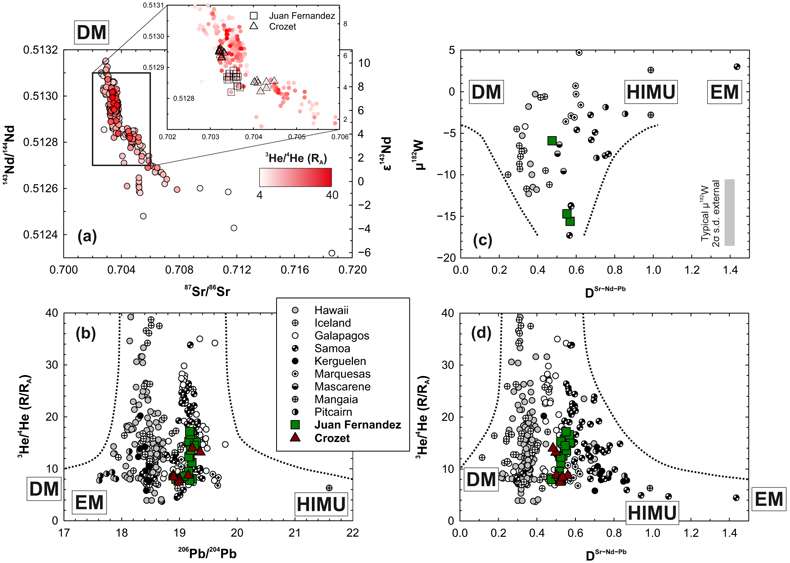
Figure 1 Long (He-Sr-143Nd-206Pb) and short lived (182W) isotopic compositions of global ocean island basalts. The value of DSr-Nd-Pb parameter refers to the deviation of sample isotopic compositions from a reference depleted composition (≡0) as defined in Jackson et al. (2020)
Jackson, M.G., Blichert-Toft, J., Halldorsson, S.A., Mundl-Petermeier, A., Bizimis, M., Kurz, M.D., Price, A.A., Harethardottir, S., Willhite, L.N., Breddam, K., Becker, T.W., Fischer, R.A. (2020) Ancient helium and tungsten isotopic signatures preserved in mantle domains least modified by crustal recycling. Proceedings National Academy Sciences USA 117, 30993–31001. https://doi.org/10.1073/pnas.2009663117
. Long lived radiogenic isotope data from GEOROC; W isotopic data from Mundl-Petermeier et al. (2020)Mundl-Petermeier, A., Walker, R.J., Fischer, R.A., Lekic, V., Jackson, M.G., Kurz, M.D. (2020) Anomalous 182W in high 3He/4He ocean island basalts: Fingerprints of Earth’s core? Geochimica et Cosmochimica Acta 271, 194–211. https://doi.org/10.1016/j.gca.2019.12.020
and Herret et al. (2023)Herret, M.T., Peters, B.J., Kim, D., Castillo, P.R., Mundl-Petermeier, A. (2023) Decoupling of short-lived radiogenic and helium isotopes in the Marquesas hotspot. Chemical Geology 640, 121727. https://doi.org/10.1016/j.chemgeo.2023.121727
. Dotted lines show approximate limits of present database.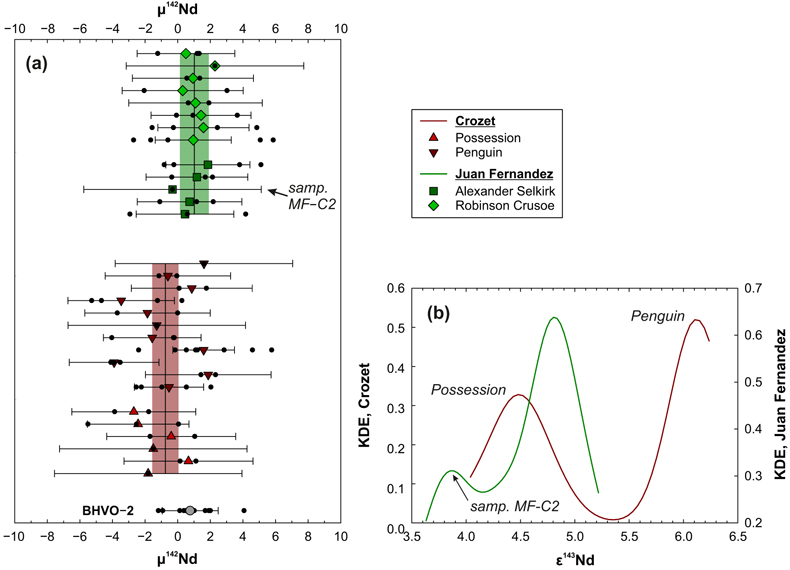
Figure 2 Neodymium isotopic compositions of ocean island basalts measured in this study. Small circles represent individual measurements, larger coloured symbols and error bars represent sample averages and 95 % confidence intervals, respectively. Vertical lines and coloured fields represent the average and 95 % confidence intervals of each hotspot. Values of ɛ143Nd represented as a kernel density estimate (KDE).
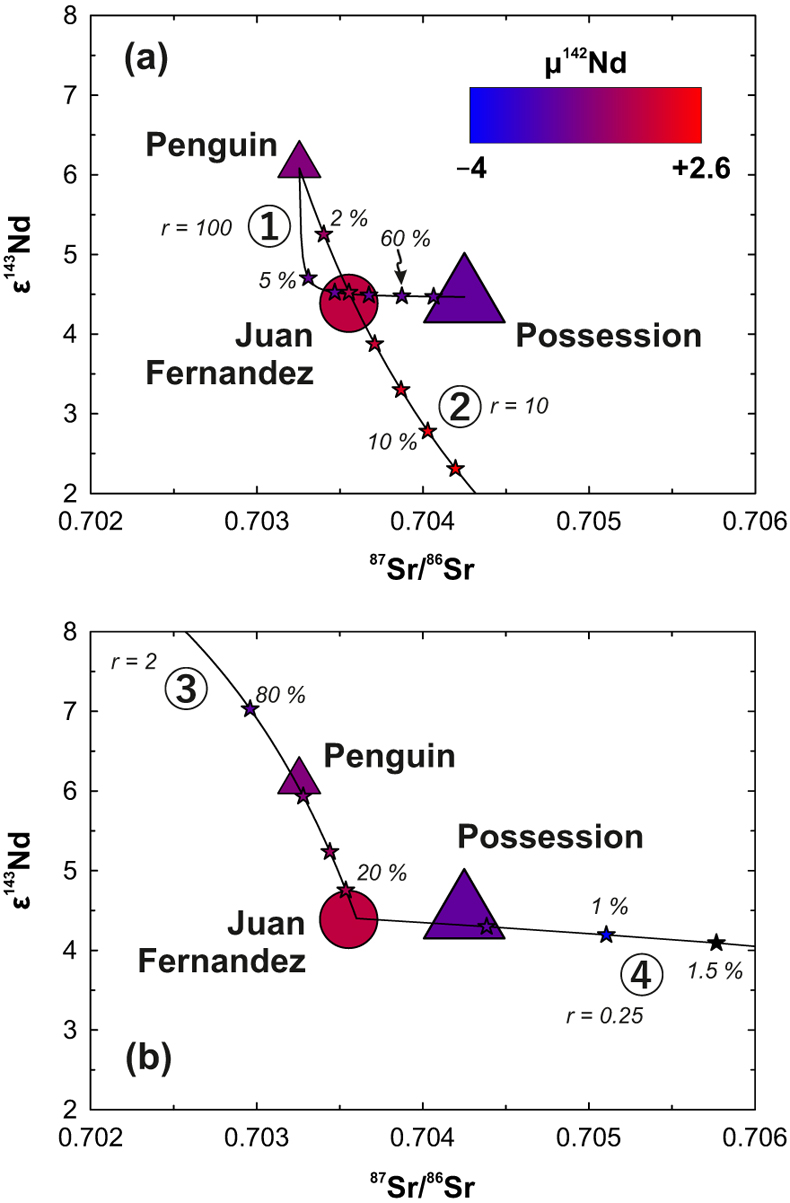
Figure 3 Mixing models (labelled by circled numbers as described in the text) for Sr-Nd isotopic compositions of studied ocean island basalts. Stars represent regular intervals of mixing as defined on each mixing curve; the colour of each curve corresponds to the μ142Nd composition of the mixing interval as defined by the colour bar in panel (a). The symbol size for each island covers the full range of its Sr-143Nd isotopic compositions. Model inputs are summarised in Table S-2.
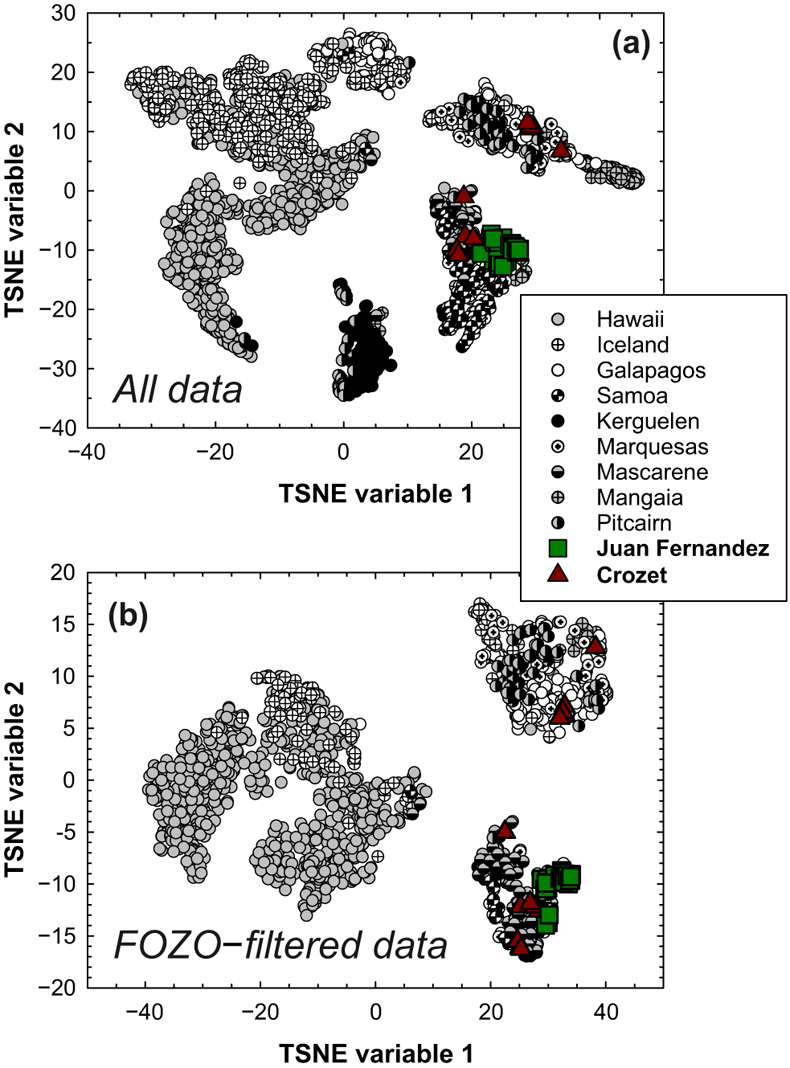
Figure 4 TSNE-reduced Sr-143Nd-Pb isotopic data for selected hotspots using (a) all data for each hotspot or (b) data filtered FOZO-like isotopic compositions according to a K-means cluster model. See text and Supplementary Information for model details.