



Dominant monosulfide solid solution fractionation causes Cu deficit in continental crust
Affiliations | Corresponding Author | Cite as | Funding information
Published by the European Association of Geochemistry
under Creative Commons License CC BY 4.0
Keywords: monosulfide solid solution, Cu depletion, continental crust, Cu isotopes


- Share this article


-
Article views:1,258Cumulative count of HTML views and PDF downloads.
- Download Citation
- Rights & Permissions

top
Abstract
Figures
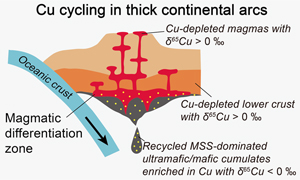
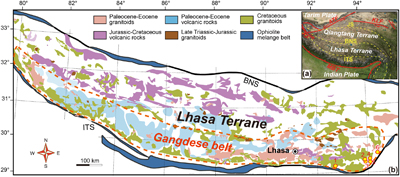 Figure 1 Geological map of the Gangdese continental arc and sampling locations. (a) Simplified geologic map of the Tibetan Plateau. (b) Tectonic framework of the Lhasa terrane, showing distribution of Gangdese arc magmas; JS = Jinsha suture, BNS = Bangong-Nujiang suture, ITS = Indus-Yarlung-Tsangpo suture, MBT = Main Boundary Thrust, ATF = Altyn Tagh fault, KF = Karakorum fault, KLF = Kunlun fault. Sampling locations: 1 = Cuijiu, 2 = Jinba, 3 = Sengbo, 4 = Zhangxiraodeng, 5 = Milin, 6 = Milin meta-gabbro. | 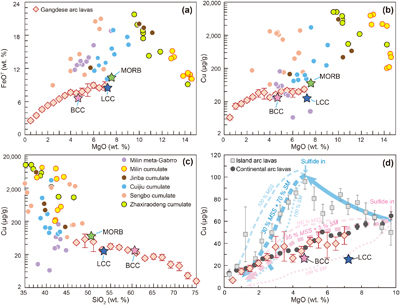 Figure 2 Elemental variations of the lower crustal cumulates and arc magmas from the Gangdese arc. (a) FeOT versus MgO, (b) Cu versus MgO, (c) Cu versus SiO2, and (d) Observed vs. modelled Cu evolution trends in island, continental and Gangdese arc lavas. Individual symbols of Gangdese arc lava in (a), (b), and (d) represent FeOT and Cu contents of 0.5 wt. % of MgO intervals; the Gangdese arc lava individual symbols in (c) represent Cu contents at 2 wt. % at SiO2 intervals. In (d), the curves show quantitative modelling results based on crystallisation experiments on hydrous arc magmas (Nandedkar et al., 2014) and experimentally constrained partitioning of Cu between sulfide phases and silicate melt (Li and Audétat, 2015), reflecting ideal equilibrium behaviour. The blue solid line with an arrow represents Cu evolution before sulfide saturation, whereas the blue dashed lines represent that sulfide saturation occurs at ∼4.8 wt. % MgO, followed by sulfide precipitation. The thick blue dashed line shows sulfide composition of 30 % MSS + 70 % SM, whereas the thin blue dashed line represents 100 % MSS, and the thin blue dotted line represents 100 % SM. The thick pink dashed line displays the precipitating sulfide at beginning with 95 % MSS and 5 % SM, with the thin pink dashed line representing 100 % MSS, and the thin pink dotted line representing 100 % SM. (See Supplementary Information for numerical modelling details). Error bars on the data points represent 2 standard deviations (s.d.). Data for global island and continental arc volcanic rocks (Cascades, Andes, and Mexico) are from the PetDB (https://search.earthchem.org/) and GEOROC databases (https://georoc.eu/georoc/). The average MORB, bulk continental crust (BCC), and lower continental crust (LCC) value are from Gale et al. (2013) and Rudnick and Gao (2003), respectively. MSS = monosulfide solid solution, SM = sulfide melt. | 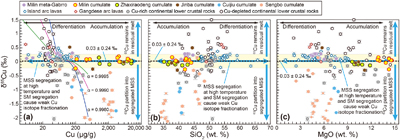 Figure 3 The δ65Cu variation of Gangdese lower crustal cumulates. (a) δ65Cu versus Cu, (b) δ65Cu versus SiO2, (c) δ65Cu versus MgO. Data for global island and Gangdese arc lavas, and continental lower crustal rocks are shown for comparison (Liu et al., 2015, 2023; Wang et al., 2019). The horizontal dashed line and yellow shaded area in each panel represent the δ65Cu range of non-metasomatised mantle (δ65Cu = +0.03 ‰ ± 0.24 ‰). Error bars on the data points represent 2 standard deviations (s.d.). The isotope fractionation factors (αsulfide -silicate magma) were assigned at 0.9995, 0.9990 and 0.9980, respectively; MSS = monosulfide solid solution, SM = sulfide melt. | 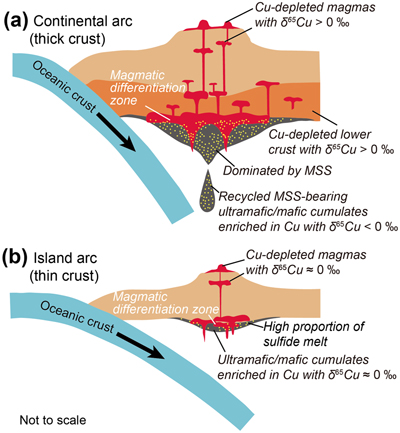 Figure 4 Cartoon showing intracrustal sulfide fractionation in continental arcs vs. island arcs. Continental arcs with thicker crust induce abundant MSS crystallisation but suppress sulfide melt fractionation, leading to earlier yet more gradual Cu depletion during differentiation compared with island arc magmas. Fractionation of MSS also results in enrichment of the lighter Cu isotopes in continental arc cumulates, leaving behind differentiated magmas characterised by low Cu content and high δ65Cu. In contrast, sulfide melt fractionation is unable to induce significant Cu isotope fractionation in island arcs. Co-segregation of sulfides, mafic minerals and Fe oxides at the roots of continental arcs removes Cu, Mg and Fe from the magmas. Foundering of dense, Cu-rich mafic/ultramafic cumulates drives the continental crust toward a silicic bulk composition deficit in Cu. |
| Figure 1 | Figure 2 | Figure 3 | Figure 4 |
top
Introduction
Present day continental crust on the Earth, thought to form mainly from mantle derived magmas at subduction zones, has a unique silicic bulk composition compared with other rocky planets in the inner Solar System (Rudnick, 1995
Rudnick, R.L. (1995) Making continental crust. Nature 378, 571–578. http://doi.org/10.1038/378571a0
). How such a silicic crust was generated from mantle derived magmas, which are primarily basaltic, remains enigmatic. Apart from Mg and Fe, the continental crust is also depleted in chalcophile elements (Cu, Ni, PGE, and S) relative to the primitive basaltic magmas (Rudnick and Gao, 2003Rudnick, R., Gao, S. (2003) Composition of the Continental Crust. Treatise Geochem 3:1–64. Treatise on Geochemistry 3, 1–64. http://doi.org/10.1016/B0-08-043751-6/03016-4
; Park et al., 2015Park, J.-W., Campbell, I.H., Kim, J., Moon, J.-W. (2015) The Role of Late Sulfide Saturation in the Formation of a Cu- and Au-rich Magma: Insights from the Platinum Group Element Geochemistry of Niuatahi–Motutahi Lavas, Tonga Rear Arc. Journal of Petrology 56, 59–81. http://doi.org/10.1093/petrology/egu071
). This coupled depletion suggests that chalcophile elements and their isotopes could hold crucial clues about the origin and evolution of the continental crust. In recent years, the foundering of sulfide-bearing mafic lower crust has been proposed to lead to the formation of a silicic continental crust depleted in chalcophile elements (Lee et al., 2012Lee, C.-T.A., Luffi, P., Chin, E.J., Bouchet, R., Dasgupta, R., Morton, D.M., Le Roux, V., Yin, Q.-Z., Jin, D. (2012) Copper Systematics in Arc Magmas and Implications for Crust-Mantle Differentiation. Science 336, 64–68. http://doi.org/10.1126/science.1217313
; Chiaradia, 2014Chiaradia, M. (2014) Copper enrichment in arc magmas controlled by overriding plate thickness. Nature Geoscience 7, 43–46. http://doi.org/10.1038/ngeo2028
; Jenner, 2017Jenner, F.E. (2017) Cumulate causes for the low contents of sulfide-loving elements in the continental crust. Nature Geoscience 10, 524–529. http://doi.org/10.1038/ngeo2965
). Notably, the decrease of Cu content in continental arc magmas, induced by sulfide segregation with differentiation, occurs earlier but proceeds more gradually than in island arc magmas (Chiaradia, 2014Chiaradia, M. (2014) Copper enrichment in arc magmas controlled by overriding plate thickness. Nature Geoscience 7, 43–46. http://doi.org/10.1038/ngeo2028
; Lee and Tang, 2020Lee, C.-T.A., Tang, M. (2020) How to make porphyry copper deposits. Earth and Planetary Science Letters 529, 115868. http://doi.org/10.1016/j.epsl.2019.115868
; Li et al., 2021Li, Y., Audétat, A., Liu, Z., Wang, F. (2021) Chalcophile element partitioning between Cu-rich sulfide phases and silicate melt and implications for the formation of Earth’s continental crust. Geochimica et Cosmochimica Acta 302, 61–82. http://doi.org/10.1016/j.gca.2021.03.020
). This implies that the processes responsible for Cu depletion in continental arcs may differ from those in island arcs, a phenomenon that remains poorly understood.Copper isotopes can be fractionated during a variety of high temperature geological processes, including source metasomatism, partial melting, magmatic differentiation, and fluid-rock interaction (Liu et al., 2015
Liu, S.-A., Huang, J., Liu, J., Wörner, G., Yang, W., Tang, Y.-J., Chen, Y., Tang, L., Zheng, J., Li, S. (2015) Copper isotopic composition of the silicate Earth. Earth and Planetary Science Letters 427, 95–103. http://doi.org/10.1016/j.epsl.2015.06.061
, 2023Liu, S.-A., Rudnick, R.L., Liu, W.-R., Teng, F.-Z., Wu, T.-H., Wang, Z.-Z. (2023) Copper isotope evidence for sulfide fractionation and lower crustal foundering in making continental crust. Science Advances 9, eadg6995. http://doi.org/10.1126/sciadv.adg6995
; Luo et al., 2023Luo, C.H., Wang, R., Zhao, Y., Huang, J., Evans, N.J. (2023) Mobilization of Cu in the continental lower crust: A perspective from Cu isotopes. Geoscience Frontiers 14, 101590. http://doi.org/10.1016/j.gsf.2023.101590
; Wang et al., 2024Wang, X.H., Lang, X.H., Turlin, F., Deng, Y.L., Xie, F.W., He, Q., Moritz, R. (2024) Copper behavior in arc-back-arc systems: Insights into the porphyry Cu metallogeny of the Gangdese belt, southern Tibet. Mineralium Deposita 59, 133–154. http://doi.org/10.1007/s00126-023-01199-3
). Because Cu is a strongly chalcophile element, its isotopic fractionation is highly sensitive to sulfide-related processes such as sulfide saturation, segregation, and decomposition. Meanwhile, substantial variations in Cu isotope compositions have been observed in continental arc magmas, continental crustal rocks, and cumulates (Moynier et al., 2017Moynier, F., Vance, D., Fujii, T., Savage, P. (2017) The Isotope Geochemistry of Zinc and Copper. Reviews in Mineralogy and Geochemistry 82, 543–600. http://doi.org/10.2138/rmg.2017.82.13
; Liu et al., 2023Liu, S.-A., Rudnick, R.L., Liu, W.-R., Teng, F.-Z., Wu, T.-H., Wang, Z.-Z. (2023) Copper isotope evidence for sulfide fractionation and lower crustal foundering in making continental crust. Science Advances 9, eadg6995. http://doi.org/10.1126/sciadv.adg6995
), in contrast to the relatively homogeneous values of the non-metasomatised mantle, island arc magmas, and mid-ocean ridge basalts (MORBs) (Liu et al., 2015Liu, S.-A., Huang, J., Liu, J., Wörner, G., Yang, W., Tang, Y.-J., Chen, Y., Tang, L., Zheng, J., Li, S. (2015) Copper isotopic composition of the silicate Earth. Earth and Planetary Science Letters 427, 95–103. http://doi.org/10.1016/j.epsl.2015.06.061
). This distinction suggests that Cu isotopes can offer valuable insight into the process of sulfide segregation during the differentiation of continental arc magmas. When combined with Cu contents, they may provide direct constraints on the mechanism responsible for chalcophile element deficiency in the continental crust, thereby yielding new perspectives on its origin and differentiation.The Gangdese magmatic arc in southern Tibet (Fig. 1) was a typical Andean-type continental arc prior to the India-Asia collision (Zhu et al., 2011
Zhu, D.-C., Zhao, Z.-D., Niu, Y., Mo, X.-X., Chung, S.-L., Hou, Z.-Q., Wang, L.-Q., Wu, F.-Y. (2011) The Lhasa Terrane: Record of a microcontinent and its histories of drift and growth. Earth and Planetary Science Letters 301, 241–255. http://doi.org/10.1016/j.epsl.2010.11.005
). In its eastern segment, the lower crustal section is exposed as Mesozoic amphibolite to granulite facies, mafic-ultramafic metamorphic rocks, including meta-gabbros and hornblendites. The meta-gabbros are generally regarded as parental basaltic arc magmas, whereas hornblendites with cumulate textures represent the products of intracrustal differentiation (Xu et al., 2019Xu, W., Zhu, D.-C., Wang, Q., Weinberg, R.F., Wang, R., Li, S.-M., Zhang, L.-L., Zhao, Z.-D. (2019) Constructing the Early Mesozoic Gangdese Crust in Southern Tibet by Hornblende-dominated Magmatic Differentiation. Journal of Petrology 60, 515–552. http://doi.org/10.1093/petrology/egz005
; Z. Zhang et al., 2022Zhang, Z.M., Ding, H.X., Dong, X., Tian, Z.L., Palin, R.M., Santosh, M., Chen, Y.F., Jiang, Y.Y., Qin, S.K., Kang, D.Y., Li, W.T. (2022) The Mesozoic magmatic, metamorphic, and tectonic evolution of the eastern Gangdese magmatic arc, southern Tibet. GSA Bulletin 134, 1721–1740. http://doi.org/10.1130/B36134.1
). These cumulates have variable but in many cases elevated Cu contents (commonly >200 μg/g), potentially acting as a complementary Cu-rich reservoir to the Cu-depleted bulk continental crust. The co-existence of parental arc magmas and their lower crustal cumulates makes the Gangdese arc an ideal natural laboratory for studying the origin and differentiation of continental crust from the perspective of its Cu systematics.Figure 1 Geological map of the Gangdese continental arc and sampling locations. (a) Simplified geologic map of the Tibetan Plateau. (b) Tectonic framework of the Lhasa terrane, showing distribution of Gangdese arc magmas; JS = Jinsha suture, BNS = Bangong-Nujiang suture, ITS = Indus-Yarlung-Tsangpo suture, MBT = Main Boundary Thrust, ATF = Altyn Tagh fault, KF = Karakorum fault, KLF = Kunlun fault. Sampling locations: 1 = Cuijiu, 2 = Jinba, 3 = Sengbo, 4 = Zhangxiraodeng, 5 = Milin, 6 = Milin meta-gabbro.
top
Discussion
Copper isotope fractionation in continental lower crustal cumulates. The most notable finding of this study is that the Cuijiu and Sengbo lower crustal cumulates in the Gangdese arc have very light Cu isotope compositions, whereas the Milin, Zhaxiraodeng, and Jinba counterparts have compositions similar to the bulk silicate Earth (Fig. S-3). The samples were collected from newly excavated railway tunnels and are pristine, showing no signs of secondary sulfides or oxides replacing primary sulfides (Fig. S-1), thereby preventing potential effects from the surface weathering and alteration.
Copper isotope compositions of the lower crust can also be modified by metasomatism or partial melting. In sulfate-rich fluids/melts, Cu2+ dominates and exhibits positive δ65Cu; metasomatism by such agents, accompanied by the formation of secondary sulfides, would cause the lower crust to inherit heavy isotope signatures (Luo et al., 2023
Luo, C.H., Wang, R., Zhao, Y., Huang, J., Evans, N.J. (2023) Mobilization of Cu in the continental lower crust: A perspective from Cu isotopes. Geoscience Frontiers 14, 101590. http://doi.org/10.1016/j.gsf.2023.101590
), inconsistent with the light Cu isotope enrichment observed in the Cuijiu and Sengbo cumulates. Alternatively, if oxidised fluids/melts dissolved primary sulfides in the lower crust during metasomatism, 65Cu would be preferentially released as Cu2+, resulting in a residue enriched in light Cu isotopes (G. Zhang et al., 2022Zhang, G.L., Liu, Y.S., Moynier, F., Hu, Z.C., Zhu, Y.T., Jiang, X., Li, M. (2022) Copper mobilization in the lower continental crust beneath cratonic margins, a Cu isotope perspective. Geochimica et Cosmochimica Acta 322, 43–57. http://doi.org/10.1016/j.gca.2022.01.031
; Luo et al., 2023Luo, C.H., Wang, R., Zhao, Y., Huang, J., Evans, N.J. (2023) Mobilization of Cu in the continental lower crust: A perspective from Cu isotopes. Geoscience Frontiers 14, 101590. http://doi.org/10.1016/j.gsf.2023.101590
). However, no evidence of dissolution or oxidation is present along sulfide grain boundaries or fractures (Fig. S-1), and the Cuijiu and Sengbo samples with negative δ65Cu values are also Cu-rich (Fig. 3a), both of which argue against this process as the primary control. Partial melting of sulfide-rich lower crust likewise fails to explain the data: preferential partitioning of 63Cu into the extracted sulfide melt which would leave the residue with elevated δ65Cu (Luo et al., 2023Luo, C.H., Wang, R., Zhao, Y., Huang, J., Evans, N.J. (2023) Mobilization of Cu in the continental lower crust: A perspective from Cu isotopes. Geoscience Frontiers 14, 101590. http://doi.org/10.1016/j.gsf.2023.101590
), opposite to that observed in the Cuijiu and Sengbo cumulates.Globally, non-metasomatised mantle and various types of basalts (continental basalts, arc basalts, MORBs, and OIBs) exhibit broadly similar and homogeneous δ65Cu values (Fig. S-3), indicating that Cu isotopes are little fractionated during mantle partial melting (Liu et al., 2015
Liu, S.-A., Huang, J., Liu, J., Wörner, G., Yang, W., Tang, Y.-J., Chen, Y., Tang, L., Zheng, J., Li, S. (2015) Copper isotopic composition of the silicate Earth. Earth and Planetary Science Letters 427, 95–103. http://doi.org/10.1016/j.epsl.2015.06.061
; Huang et al., 2017Huang, J., Huang, F., Wang, Z., Zhang, X., Yu, H. (2017) Copper isotope fractionation during partial melting and melt percolation in the upper mantle: Evidence from massif peridotites in Ivrea-Verbano Zone, Italian Alps. Geochimica et Cosmochimica Acta 211, 48–63. http://doi.org/10.1016/j.gca.2017.05.007
; Wang et al., 2019Wang, Z., Park, J.-W., Wang, X., Zou, Z., Kim, J., Zhang, P., Li, M. (2019) Evolution of copper isotopes in arc systems: Insights from lavas and molten sulfur in Niuatahi volcano, Tonga rear arc. Geochimica et Cosmochimica Acta 250, 18–33. http://doi.org/10.1016/j.gca.2019.01.040
). Therefore, arc magmas may directly inherit their Cu isotope signatures from the mantle source. However, while metasomatised mantle peridotites show significant δ65Cu heterogeneity (−0.64 ‰ to +1.82 ‰) (Liu et al., 2015Liu, S.-A., Huang, J., Liu, J., Wörner, G., Yang, W., Tang, Y.-J., Chen, Y., Tang, L., Zheng, J., Li, S. (2015) Copper isotopic composition of the silicate Earth. Earth and Planetary Science Letters 427, 95–103. http://doi.org/10.1016/j.epsl.2015.06.061
; Huang et al., 2017Huang, J., Huang, F., Wang, Z., Zhang, X., Yu, H. (2017) Copper isotope fractionation during partial melting and melt percolation in the upper mantle: Evidence from massif peridotites in Ivrea-Verbano Zone, Italian Alps. Geochimica et Cosmochimica Acta 211, 48–63. http://doi.org/10.1016/j.gca.2017.05.007
), this range does not reach the strongly negative δ65Cu observed in our samples (Fig. S-3). Furthermore, all cumulate samples analysed here have similar whole rock Sr-Nd isotopic compositions (Fig. S-5), indicating a shared mantle source. Meanwhile, the Milin meta-gabbros, which represent parental magmas, show relatively homogeneous δ65Cu values similar to those of the Milin, Zhaxiraodeng, and Jinba cumulates, and comparable to values for non-metasomatised mantle (Liu et al., 2015Liu, S.-A., Huang, J., Liu, J., Wörner, G., Yang, W., Tang, Y.-J., Chen, Y., Tang, L., Zheng, J., Li, S. (2015) Copper isotopic composition of the silicate Earth. Earth and Planetary Science Letters 427, 95–103. http://doi.org/10.1016/j.epsl.2015.06.061
) (Fig. S-3). Consequently, the pronounced negative δ65Cu of the Cuijiu and Sengbo cumulates is unlikely to reflect mantle inheritance.With alternative mechanisms excluded, sulfide segregation during magmatic differentiation emerges as the most likely process governing the observed Cu isotope signatures. In the Gangdese cumulates, the positive correlation between Cu and S contents indicates that Cu occurs predominantly in sulfides (Fig. S-2b), consistent with Cu enrichment through sulfide accumulation. Although sulfides are known to preferentially incorporate 63Cu during segregation, thereby enriching the cumulates in light isotopes (Liu et al., 2023
Liu, S.-A., Rudnick, R.L., Liu, W.-R., Teng, F.-Z., Wu, T.-H., Wang, Z.-Z. (2023) Copper isotope evidence for sulfide fractionation and lower crustal foundering in making continental crust. Science Advances 9, eadg6995. http://doi.org/10.1126/sciadv.adg6995
), the key controlling factors remain unclear. Experimental data show that Cu isotopes are only slightly fractionated during high Ni sulfide (∼25 wt. % Ni in sulfide) segregation, but experience significant fractionation during the segregation of low Ni sulfides (0.1 to 1.2 wt. % Ni in sulfide), prompting the interpretation that Ni content exerts primary control (Xia et al., 2019Xia, Y., Kiseeva, E.S., Wade, J., Huang, F. (2019) The effect of core segregation on the Cu and Zn isotope composition of the silicate Moon. Geochemical Perspectives Letters 12, 12–17. http://doi.org/10.7185/geochemlet.1928
). In the case of Gangdese cumulates, sulfides typically contain <2.0 wt. % Ni (Table S-2), falling within the low Ni category defined by Xia et al. (2019)Xia, Y., Kiseeva, E.S., Wade, J., Huang, F. (2019) The effect of core segregation on the Cu and Zn isotope composition of the silicate Moon. Geochemical Perspectives Letters 12, 12–17. http://doi.org/10.7185/geochemlet.1928
. Yet, not all of these samples display negative δ65Cu (Fig. 3), challenging this interpretation. A similar inconsistency is evident in island arc systems.Sulfide inclusions in Kohistan cumulates, representative of island arc lower crust, primarily consist of sulfide melts with Ni contents usually <2.0 wt. % (J. Zhang et al., 2022
Zhang, J., Wang, R., Hong, J. (2022) Amphibole fractionation and its potential redox effect on arc crust: Evidence from the Kohistan arc cumulates. American Mineralogist 107, 1779–1788. http://doi.org/10.2138/am-2022-8141
) (Table S-2). If segregation of low Ni sulfide genuinely drove 63Cu enrichment, then differentiated island arc magmas should display positive δ65Cu. Instead, observations show that their δ65Cu values cluster around zero, comparable to those of MORBs and non-metasomatised mantle (Liu et al., 2015Liu, S.-A., Huang, J., Liu, J., Wörner, G., Yang, W., Tang, Y.-J., Chen, Y., Tang, L., Zheng, J., Li, S. (2015) Copper isotopic composition of the silicate Earth. Earth and Planetary Science Letters 427, 95–103. http://doi.org/10.1016/j.epsl.2015.06.061
; Wang et al., 2019Wang, Z., Park, J.-W., Wang, X., Zou, Z., Kim, J., Zhang, P., Li, M. (2019) Evolution of copper isotopes in arc systems: Insights from lavas and molten sulfur in Niuatahi volcano, Tonga rear arc. Geochimica et Cosmochimica Acta 250, 18–33. http://doi.org/10.1016/j.gca.2019.01.040
) (Fig. S-3). This means that intense Cu isotope fractionation is not controlled by the Ni content of the segregated sulfide, but is likely caused by other factors.Sulfur in basaltic melt is saturated as immiscible sulfide melt and/or MSS. In the experiments of Xia et al. (2019)
Xia, Y., Kiseeva, E.S., Wade, J., Huang, F. (2019) The effect of core segregation on the Cu and Zn isotope composition of the silicate Moon. Geochemical Perspectives Letters 12, 12–17. http://doi.org/10.7185/geochemlet.1928
, high Ni sulfides were mainly sulfide melt, whereas low Ni sulfides were dominated by MSS (Fig. S-4). A more plausible explanation, therefore, is that the significant Cu isotope fractionation observed in those experimental products could be attributed to the segregation of MSS at relatively lower temperatures, whereas MSS segregation at higher temperatures or sulfide melt segregation alone induces only limited fractionation. This framework explains the lack of pronounced Cu isotope variation in island arc systems (Fig. S-3), where sulfide melt segregation dominates despite low Ni contents (J. Zhang et al., 2022Zhang, J., Wang, R., Hong, J. (2022) Amphibole fractionation and its potential redox effect on arc crust: Evidence from the Kohistan arc cumulates. American Mineralogist 107, 1779–1788. http://doi.org/10.2138/am-2022-8141
); it is also consistent with the Cu isotope characteristics of the Gangdese continental arc. As shown in Figure S-4, the primary segregated sulfide in the Gangdese cumulates is MSS. The Cuijiu and Sengbo samples have markedly lower MgO contents (Fig. 2) and predominantly fall on the third segment of the Z-shaped cumulate line (Fig. S-2a), along with lower amphibole crystallisation temperatures (Fig. S-6), indicating crystallisation from more evolved, lower temperature parental magmas. At relatively lower temperatures, the segregation of MSS led to substantial Cu isotope fractionation, enriching the cumulates in light Cu isotopes (Fig. 3), as well as driving the differentiated Gangdese arc magmas toward positive δ65Cu (Liu et al., 2023Liu, S.-A., Rudnick, R.L., Liu, W.-R., Teng, F.-Z., Wu, T.-H., Wang, Z.-Z. (2023) Copper isotope evidence for sulfide fractionation and lower crustal foundering in making continental crust. Science Advances 9, eadg6995. http://doi.org/10.1126/sciadv.adg6995
; Wang et al., 2024Wang, X.H., Lang, X.H., Turlin, F., Deng, Y.L., Xie, F.W., He, Q., Moritz, R. (2024) Copper behavior in arc-back-arc systems: Insights into the porphyry Cu metallogeny of the Gangdese belt, southern Tibet. Mineralium Deposita 59, 133–154. http://doi.org/10.1007/s00126-023-01199-3
). In contrast, the Milin, Zhaxiraodeng, and Jinba cumulates, which mainly occupy the second segment of the Z-shaped trend, crystallised from more primitive magmas at higher temperatures, producing only weak Cu isotope fractionation during MSS segregation.The capacity of MSS to fractionate Cu isotopes arises from its preferential incorporation of Cu+, which drives a redistribution of Cu+ and Cu2+ between the segregated MSS and the residual silicate melt. Such a process is analogous to redox reaction, a mechanism well known to strongly induce Cu isotope fractionation (Mathur et al., 2009
Mathur, R., Titley, S., Barra, F., Brantley, S., Wilson, M., Phillips, A., Munizaga, F., Maksaev, V., Vervoort, J., Hart, G. (2009) Exploration potential of Cu isotope fractionation in porphyry copper deposits. Journal of Geochemical Exploration 102, 1–6. http://doi.org/10.1016/j.gexplo.2008.09.004
). When magmatic differentiation occurs at relatively lower temperatures, 63Cu would tend to concentrate in Cu+-rich MSS, yielding a negative δ65Cu signature in the cumulates. This mechanism has been confirmed in magmatic Ni-Cu deposits, where Cu isotope variations of up to 2 ‰ were recorded during MSS sulfide melt fractionation in the Tulaergen deposit, Xinjiang, China (Zhao et al., 2017Zhao, Y., Xue, C., Liu, S.-A., Symons, D.T.A., Zhao, X., Yang, Y., Ke, J. (2017) Copper isotope fractionation during sulfide-magma differentiation in the Tulaergen magmatic Ni–Cu deposit, NW China. Lithos 286-287, 206–215. http://doi.org/10.1016/j.lithos.2017.06.007
).Implications for origin of Cu-depleted silicic continents. About 80–95 % of the continental crust is thought to have formed in subduction zones through the accretion of arc magmas (Rudnick, 1995
Rudnick, R.L. (1995) Making continental crust. Nature 378, 571–578. http://doi.org/10.1038/378571a0
). Relative to primitive basaltic arc magmas, the andesitic continental crust is depleted in Mg, Fe, and Cu, suggesting extensive differentiation. Owing to the high sulfide/silicate melt partition coefficients (Dsulfide melt/silicate melt = 1100–8400, DMSS/silicate melt = 530–1700) (Li et al., 2021Li, Y., Audétat, A., Liu, Z., Wang, F. (2021) Chalcophile element partitioning between Cu-rich sulfide phases and silicate melt and implications for the formation of Earth’s continental crust. Geochimica et Cosmochimica Acta 302, 61–82. http://doi.org/10.1016/j.gca.2021.03.020
), Cu would be stripped away from the magma and sequestered into segregated sulfides as differentiation proceeds. Thus, in the Gangdese arc, the systematic Cu depletion in intermediate-felsic magmas relative to basaltic magmas (Fig. 2b-d) indicates the extensive development of Cu-rich mafic-ultramafic cumulates in the lower crust (Xu et al., 2019Xu, W., Zhu, D.-C., Wang, Q., Weinberg, R.F., Wang, R., Li, S.-M., Zhang, L.-L., Zhao, Z.-D. (2019) Constructing the Early Mesozoic Gangdese Crust in Southern Tibet by Hornblende-dominated Magmatic Differentiation. Journal of Petrology 60, 515–552. http://doi.org/10.1093/petrology/egz005
; Z. Zhang et al., 2022Zhang, Z.M., Ding, H.X., Dong, X., Tian, Z.L., Palin, R.M., Santosh, M., Chen, Y.F., Jiang, Y.Y., Qin, S.K., Kang, D.Y., Li, W.T. (2022) The Mesozoic magmatic, metamorphic, and tectonic evolution of the eastern Gangdese magmatic arc, southern Tibet. GSA Bulletin 134, 1721–1740. http://doi.org/10.1130/B36134.1
). Similarly, a depletion in Cu is also characteristic of differentiated arc magmas globally (Chiaradia, 2014Chiaradia, M. (2014) Copper enrichment in arc magmas controlled by overriding plate thickness. Nature Geoscience 7, 43–46. http://doi.org/10.1038/ngeo2028
; Jenner, 2017Jenner, F.E. (2017) Cumulate causes for the low contents of sulfide-loving elements in the continental crust. Nature Geoscience 10, 524–529. http://doi.org/10.1038/ngeo2965
), implying that the formation of Cu-rich cumulates is a pervasive process in the lower crust of both continental and island arcs (Lee et al., 2012Lee, C.-T.A., Luffi, P., Chin, E.J., Bouchet, R., Dasgupta, R., Morton, D.M., Le Roux, V., Yin, Q.-Z., Jin, D. (2012) Copper Systematics in Arc Magmas and Implications for Crust-Mantle Differentiation. Science 336, 64–68. http://doi.org/10.1126/science.1217313
; Lee and Tang, 2020Lee, C.-T.A., Tang, M. (2020) How to make porphyry copper deposits. Earth and Planetary Science Letters 529, 115868. http://doi.org/10.1016/j.epsl.2019.115868
).Figure 2 Elemental variations of the lower crustal cumulates and arc magmas from the Gangdese arc. (a) FeOT versus MgO, (b) Cu versus MgO, (c) Cu versus SiO2, and (d) Observed vs. modelled Cu evolution trends in island, continental and Gangdese arc lavas. Individual symbols of Gangdese arc lava in (a), (b), and (d) represent FeOT and Cu contents of 0.5 wt. % of MgO intervals; the Gangdese arc lava individual symbols in (c) represent Cu contents at 2 wt. % at SiO2 intervals. In (d), the curves show quantitative modelling results based on crystallisation experiments on hydrous arc magmas (Nandedkar et al., 2014
Nandedkar, R.H., Ulmer, P., Müntener, O. (2014) Fractional crystallization of primitive, hydrous arc magmas: an experimental study at 0.7 GPa. Contributions to Mineralogy and Petrology 167, 1015. http://doi.org/10.1007/s00410-014-1015-5
) and experimentally constrained partitioning of Cu between sulfide phases and silicate melt (Li and Audétat, 2015Li, Y., Audétat, A. (2015) Effects of temperature, silicate melt composition, and oxygen fugacity on the partitioning of V, Mn, Co, Ni, Cu, Zn, As, Mo, Ag, Sn, Sb, W, Au, Pb, and Bi between sulfide phases and silicate melt. Geochimica et Cosmochimica Acta 162, 25–45. http://doi.org/10.1016/j.gca.2015.04.036
), reflecting ideal equilibrium behaviour. The blue solid line with an arrow represents Cu evolution before sulfide saturation, whereas the blue dashed lines represent that sulfide saturation occurs at ∼4.8 wt. % MgO, followed by sulfide precipitation. The thick blue dashed line shows sulfide composition of 30 % MSS + 70 % SM, whereas the thin blue dashed line represents 100 % MSS, and the thin blue dotted line represents 100 % SM. The thick pink dashed line displays the precipitating sulfide at beginning with 95 % MSS and 5 % SM, with the thin pink dashed line representing 100 % MSS, and the thin pink dotted line representing 100 % SM. (See Supplementary Information for numerical modelling details). Error bars on the data points represent 2 standard deviations (s.d.). Data for global island and continental arc volcanic rocks (Cascades, Andes, and Mexico) are from the PetDB (https://search.earthchem.org/) and GEOROC databases (https://georoc.eu/georoc/). The average MORB, bulk continental crust (BCC), and lower continental crust (LCC) value are from Gale et al. (2013)Gale, A., Dalton, C.A., Langmuir, C.H., Su, Y., Schilling, J.-G. (2013) The mean composition of ocean ridge basalts. Geochemistry, Geophysics, Geosystems 14, 489–518. http://doi.org/10.1029/2012GC004334
and Rudnick and Gao (2003)Rudnick, R., Gao, S. (2003) Composition of the Continental Crust. Treatise Geochem 3:1–64. Treatise on Geochemistry 3, 1–64. http://doi.org/10.1016/B0-08-043751-6/03016-4
, respectively. MSS = monosulfide solid solution, SM = sulfide melt.Figure 3 The δ65Cu variation of Gangdese lower crustal cumulates. (a) δ65Cu versus Cu, (b) δ65Cu versus SiO2, (c) δ65Cu versus MgO. Data for global island and Gangdese arc lavas, and continental lower crustal rocks are shown for comparison (Liu et al., 2015
Liu, S.-A., Huang, J., Liu, J., Wörner, G., Yang, W., Tang, Y.-J., Chen, Y., Tang, L., Zheng, J., Li, S. (2015) Copper isotopic composition of the silicate Earth. Earth and Planetary Science Letters 427, 95–103. http://doi.org/10.1016/j.epsl.2015.06.061
, 2023Liu, S.-A., Rudnick, R.L., Liu, W.-R., Teng, F.-Z., Wu, T.-H., Wang, Z.-Z. (2023) Copper isotope evidence for sulfide fractionation and lower crustal foundering in making continental crust. Science Advances 9, eadg6995. http://doi.org/10.1126/sciadv.adg6995
; Wang et al., 2019Wang, Z., Park, J.-W., Wang, X., Zou, Z., Kim, J., Zhang, P., Li, M. (2019) Evolution of copper isotopes in arc systems: Insights from lavas and molten sulfur in Niuatahi volcano, Tonga rear arc. Geochimica et Cosmochimica Acta 250, 18–33. http://doi.org/10.1016/j.gca.2019.01.040
). The horizontal dashed line and yellow shaded area in each panel represent the δ65Cu range of non-metasomatised mantle (δ65Cu = +0.03 ‰ ± 0.24 ‰). Error bars on the data points represent 2 standard deviations (s.d.). The isotope fractionation factors (αsulfide -silicate magma) were assigned at 0.9995, 0.9990 and 0.9980, respectively; MSS = monosulfide solid solution, SM = sulfide melt.Although variables such as oxygen fugacity and H2O content may influence sulfide saturation (Wang et al., 2024
Wang, X.H., Lang, X.H., Turlin, F., Deng, Y.L., Xie, F.W., He, Q., Moritz, R. (2024) Copper behavior in arc-back-arc systems: Insights into the porphyry Cu metallogeny of the Gangdese belt, southern Tibet. Mineralium Deposita 59, 133–154. http://doi.org/10.1007/s00126-023-01199-3
), the decrease of Cu with magmatic differentiation occurs systematically earlier in continental arcs with thick crust than in island arcs with thin crust (Fig. 2d), implicating pressure as a first order control. Increased pressure not only directly reduces sulfur solubility in silica melts (Maréchal et al., 1999Maréchal, C.N., Télouk, P., Albarède, F. (1999) Precise analysis of copper and zinc isotopic compositions by plasma-source mass spectrometry. Chemical Geology 156, 251–273. http://doi.org/10.1016/S0009-2541(98)00191-0
), but also indirectly favours sulfide saturation by promoting the fractionation of mafic minerals (e.g., garnet) and Fe oxides, which leads to simultaneous Fe depletion and magma reduction (Jenner et al., 2010Jenner, F.E., O’Neill, H.S.T.C., Arculus, R.J., Mavrogenes, J.A. (2010) The Magnetite Crisis in the Evolution of Arc-related Magmas and the Initial Concentration of Au, Ag and Cu. Journal of Petrology 51, 2445–2464. http://doi.org/10.1093/petrology/egq063
; Lee and Tang, 2020Lee, C.-T.A., Tang, M. (2020) How to make porphyry copper deposits. Earth and Planetary Science Letters 529, 115868. http://doi.org/10.1016/j.epsl.2019.115868
; Tang et al., 2020Tang, M., Lee, C.-T.A., Ji, W.Q., Wang, R., Costin, G. (2020) Crustal thickening and endogenic oxidation of magmatic sulfur. Science Advances. American Association for the Advancement of Science 6, eaba6342. http://doi.org/10.1126/sciadv.aba6342
). Specifically, under otherwise equivalent conditions, increased pressure facilitates the crystallisation of MSS but suppresses sulfide melt exsolution (Bockrath et al., 2004Bockrath, C., Ballhaus, C., Holzheid, A. (2004) Fractionation of the Platinum-Group Elements During Mantle Melting. Science 305, 1951–1953. http://doi.org/doi:10.1126/science.1100160
). This could be the major reason why MSS and sulfide melt are dominant in the lower crust of continental and island arcs, respectively, as inferred from the compositions of Cu isotopes and of hosted magmatic sulfide inclusions (Figs. 3, S-4). Since the partition coefficient of Cu in MSS is lower than that in sulfide melt (Li et al., 2021Li, Y., Audétat, A., Liu, Z., Wang, F. (2021) Chalcophile element partitioning between Cu-rich sulfide phases and silicate melt and implications for the formation of Earth’s continental crust. Geochimica et Cosmochimica Acta 302, 61–82. http://doi.org/10.1016/j.gca.2021.03.020
), the MSS dominated fractionation would cause Cu contents in continental arc magmas to decrease more gradually, despite earlier saturation, than in island arc magmas (Fig. 2d). This inference is supported by the Cu content of sulfide inclusions found within the continental lower crustal cumulates from the Gangdese arc and the North China Craton, which exhibit an average Cu content of 4.0 wt. %, markedly lower than the 23.5 wt. % average observed in those from the Kohistan island arc (Fig. S-4, Table S-2).In the deep roots of thick continental arcs, the simultaneous separation of MSS dominated sulfides, mafic minerals, and Fe oxides results in the enrichment of Mg, Fe, and Cu, as well as light Cu isotope compositions, in the lower crustal cumulates. The complementary overlying crustal sections, by contrast, are depleted in Cu and display positive δ65Cu values (Liu et al., 2023
Liu, S.-A., Rudnick, R.L., Liu, W.-R., Teng, F.-Z., Wu, T.-H., Wang, Z.-Z. (2023) Copper isotope evidence for sulfide fractionation and lower crustal foundering in making continental crust. Science Advances 9, eadg6995. http://doi.org/10.1126/sciadv.adg6995
). With continued crustal thickening, the mafic-ultramafic cumulates at the base of continental arcs are progressively metamorphosed into eclogite or garnet-bearing amphibolite. Such eclogitised lower crust, together with the subcontinental mantle, is denser than the underlying peridotitic mantle and is thought to eventually founder en masse into the convecting mantle. This process would drive the continental crust toward a silica-rich and Cu-depleted bulk composition (Fig. 4).Figure 4 Cartoon showing intracrustal sulfide fractionation in continental arcs vs. island arcs. Continental arcs with thicker crust induce abundant MSS crystallisation but suppress sulfide melt fractionation, leading to earlier yet more gradual Cu depletion during differentiation compared with island arc magmas. Fractionation of MSS also results in enrichment of the lighter Cu isotopes in continental arc cumulates, leaving behind differentiated magmas characterised by low Cu content and high δ65Cu. In contrast, sulfide melt fractionation is unable to induce significant Cu isotope fractionation in island arcs. Co-segregation of sulfides, mafic minerals and Fe oxides at the roots of continental arcs removes Cu, Mg and Fe from the magmas. Foundering of dense, Cu-rich mafic/ultramafic cumulates drives the continental crust toward a silicic bulk composition deficit in Cu.
top
Acknowledgements
This work was financially supported by the National Natural Science Foundation of China (Grant No. U2344204, 42022014), the National Key Research and Development Program of China (Grant No. 2019YFA0708602), and Fundamental Research Funds for the Central Universities (Grant No. 2652023001).
Editor: Horst R. Marschall
top
Open Research
The data supporting the findings of this study are also available at the figshare data repository.
top
References
Bockrath, C., Ballhaus, C., Holzheid, A. (2004) Fractionation of the Platinum-Group Elements During Mantle Melting. Science 305, 1951–1953. http://doi.org/doi:10.1126/science.1100160
 Show in context
 Specifically, under otherwise equivalent conditions, increased pressure facilitates the crystallisation of MSS but suppresses sulfide melt exsolution (Bockrath et al., 2004).
View in article
Chiaradia, M. (2014) Copper enrichment in arc magmas controlled by overriding plate thickness. Nature Geoscience 7, 43–46. http://doi.org/10.1038/ngeo2028
Show in context In recent years, the foundering of sulfide-bearing mafic lower crust has been proposed to lead to the formation of a silicic continental crust depleted in chalcophile elements (Lee et al., 2012; Chiaradia, 2014; Jenner, 2017).
View in article
Notably, the decrease of Cu content in continental arc magmas, induced by sulfide segregation with differentiation, occurs earlier but proceeds more gradually than in island arc magmas (Chiaradia, 2014; Lee and Tang, 2020; Li et al., 2021).
View in article
Similarly, a depletion in Cu is also characteristic of differentiated arc magmas globally (Chiaradia, 2014; Jenner, 2017), implying that the formation of Cu-rich cumulates is a pervasive process in the lower crust of both continental and island arcs (Lee et al., 2012; Lee and Tang, 2020).
View in article
Gale, A., Dalton, C.A., Langmuir, C.H., Su, Y., Schilling, J.-G. (2013) The mean composition of ocean ridge basalts. Geochemistry, Geophysics, Geosystems 14, 489–518. http://doi.org/10.1029/2012GC004334
Show in context The average MORB, bulk continental crust (BCC), and lower continental crust (LCC) value are from Gale et al. (2013) and Rudnick and Gao (2003), respectively.
View in article
Huang, J., Huang, F., Wang, Z., Zhang, X., Yu, H. (2017) Copper isotope fractionation during partial melting and melt percolation in the upper mantle: Evidence from massif peridotites in Ivrea-Verbano Zone, Italian Alps. Geochimica et Cosmochimica Acta 211, 48–63. http://doi.org/10.1016/j.gca.2017.05.007
Show in context Globally, non-metasomatised mantle and various types of basalts (continental basalts, arc basalts, MORBs, and OIBs) exhibit broadly similar and homogeneous δ65Cu values (Fig. S-3), indicating that Cu isotopes are little fractionated during mantle partial melting (Liu et al., 2015; Huang et al., 2017; Wang et al., 2019).
View in article
However, while metasomatised mantle peridotites show significant δ65Cu heterogeneity (−0.64 ‰ to +1.82 ‰) (Liu et al., 2015; Huang et al., 2017), this range does not reach the strongly negative δ65Cu observed in our samples (Fig. S-3).
View in article
Jenner, F.E. (2017) Cumulate causes for the low contents of sulfide-loving elements in the continental crust. Nature Geoscience 10, 524–529. http://doi.org/10.1038/ngeo2965
Show in context In recent years, the foundering of sulfide-bearing mafic lower crust has been proposed to lead to the formation of a silicic continental crust depleted in chalcophile elements (Lee et al., 2012; Chiaradia, 2014; Jenner, 2017).
View in article
Similarly, a depletion in Cu is also characteristic of differentiated arc magmas globally (Chiaradia, 2014; Jenner, 2017), implying that the formation of Cu-rich cumulates is a pervasive process in the lower crust of both continental and island arcs (Lee et al., 2012; Lee and Tang, 2020).
View in article
Jenner, F.E., O’Neill, H.S.T.C., Arculus, R.J., Mavrogenes, J.A. (2010) The Magnetite Crisis in the Evolution of Arc-related Magmas and the Initial Concentration of Au, Ag and Cu. Journal of Petrology 51, 2445–2464. http://doi.org/10.1093/petrology/egq063
Show in context Increased pressure not only directly reduces sulfur solubility in silica melts (Maréchal et al., 1999), but also indirectly favours sulfide saturation by promoting the fractionation of mafic minerals (e.g., garnet) and Fe oxides, which leads to simultaneous Fe depletion and magma reduction (Jenner et al., 2010; Lee and Tang, 2020; Tang et al., 2020).
View in article
Lee, C.-T.A., Tang, M. (2020) How to make porphyry copper deposits. Earth and Planetary Science Letters 529, 115868. http://doi.org/10.1016/j.epsl.2019.115868
Show in context Notably, the decrease of Cu content in continental arc magmas, induced by sulfide segregation with differentiation, occurs earlier but proceeds more gradually than in island arc magmas (Chiaradia, 2014; Lee and Tang, 2020; Li et al., 2021).
View in article
Similarly, a depletion in Cu is also characteristic of differentiated arc magmas globally (Chiaradia, 2014; Jenner, 2017), implying that the formation of Cu-rich cumulates is a pervasive process in the lower crust of both continental and island arcs (Lee et al., 2012; Lee and Tang, 2020).
View in article
Increased pressure not only directly reduces sulfur solubility in silica melts (Maréchal et al., 1999), but also indirectly favours sulfide saturation by promoting the fractionation of mafic minerals (e.g., garnet) and Fe oxides, which leads to simultaneous Fe depletion and magma reduction (Jenner et al., 2010; Lee and Tang, 2020; Tang et al., 2020).
View in article
Lee, C.-T.A., Luffi, P., Chin, E.J., Bouchet, R., Dasgupta, R., Morton, D.M., Le Roux, V., Yin, Q.-Z., Jin, D. (2012) Copper Systematics in Arc Magmas and Implications for Crust-Mantle Differentiation. Science 336, 64–68. http://doi.org/10.1126/science.1217313
Show in context In recent years, the foundering of sulfide-bearing mafic lower crust has been proposed to lead to the formation of a silicic continental crust depleted in chalcophile elements (Lee et al., 2012; Chiaradia, 2014; Jenner, 2017).
View in article
Similarly, a depletion in Cu is also characteristic of differentiated arc magmas globally (Chiaradia, 2014; Jenner, 2017), implying that the formation of Cu-rich cumulates is a pervasive process in the lower crust of both continental and island arcs (Lee et al., 2012; Lee and Tang, 2020).
View in article
Li, Y., Audétat, A. (2015) Effects of temperature, silicate melt composition, and oxygen fugacity on the partitioning of V, Mn, Co, Ni, Cu, Zn, As, Mo, Ag, Sn, Sb, W, Au, Pb, and Bi between sulfide phases and silicate melt. Geochimica et Cosmochimica Acta 162, 25–45. http://doi.org/10.1016/j.gca.2015.04.036
Show in context In (d), the curves show quantitative modelling results based on crystallisation experiments on hydrous arc magmas (Nandedkar et al., 2014) and experimentally constrained partitioning of Cu between sulfide phases and silicate melt (Li and Audétat, 2015), reflecting ideal equilibrium behaviour.
View in article
Li, Y., Audétat, A., Liu, Z., Wang, F. (2021) Chalcophile element partitioning between Cu-rich sulfide phases and silicate melt and implications for the formation of Earth’s continental crust. Geochimica et Cosmochimica Acta 302, 61–82. http://doi.org/10.1016/j.gca.2021.03.020
Show in context Notably, the decrease of Cu content in continental arc magmas, induced by sulfide segregation with differentiation, occurs earlier but proceeds more gradually than in island arc magmas (Chiaradia, 2014; Lee and Tang, 2020; Li et al., 2021).
View in article
Owing to the high sulfide/silicate melt partition coefficients (Dsulfide melt/silicate melt = 1100–8400, DMSS/silicate melt = 530–1700) (Li et al., 2021), Cu would be stripped away from the magma and sequestered into segregated sulfides as differentiation proceeds.
View in article
Since the partition coefficient of Cu in MSS is lower than that in sulfide melt (Li et al., 2021), the MSS dominated fractionation would cause Cu contents in continental arc magmas to decrease more gradually, despite earlier saturation, than in island arc magmas (Fig. 2d).
View in article
Liu, S.-A., Huang, J., Liu, J., Wörner, G., Yang, W., Tang, Y.-J., Chen, Y., Tang, L., Zheng, J., Li, S. (2015) Copper isotopic composition of the silicate Earth. Earth and Planetary Science Letters 427, 95–103. http://doi.org/10.1016/j.epsl.2015.06.061
Show in context Copper isotopes can be fractionated during a variety of high temperature geological processes, including source metasomatism, partial melting, magmatic differentiation, and fluid-rock interaction (Liu et al., 2015, 2023; Luo et al., 2023; Wang et al., 2024).
View in article
Meanwhile, substantial variations in Cu isotope compositions have been observed in continental arc magmas, continental crustal rocks, and cumulates (Moynier et al., 2017; Liu et al., 2023), in contrast to the relatively homogeneous values of the non-metasomatised mantle, island arc magmas, and mid-ocean ridge basalts (MORBs) (Liu et al., 2015).
View in article
Globally, non-metasomatised mantle and various types of basalts (continental basalts, arc basalts, MORBs, and OIBs) exhibit broadly similar and homogeneous δ65Cu values (Fig. S-3), indicating that Cu isotopes are little fractionated during mantle partial melting (Liu et al., 2015; Huang et al., 2017; Wang et al., 2019).
View in article
However, while metasomatised mantle peridotites show significant δ65Cu heterogeneity (−0.64 ‰ to +1.82 ‰) (Liu et al., 2015; Huang et al., 2017), this range does not reach the strongly negative δ65Cu observed in our samples (Fig. S-3).
View in article
Meanwhile, the Milin meta-gabbros, which represent parental magmas, show relatively homogeneous δ65Cu values similar to those of the Milin, Zhaxiraodeng, and Jinba cumulates, and comparable to values for non-metasomatised mantle (Liu et al., 2015) (Fig. S-3).
View in article
Instead, observations show that their δ65Cu values cluster around zero, comparable to those of MORBs and non-metasomatised mantle (Liu et al., 2015; Wang et al., 2019) (Fig. S-3).
View in article
(a) δ65Cu versus Cu, (b) δ65Cu versus SiO2, (c) δ65Cu versus MgO. Data for global island and Gangdese arc lavas, and continental lower crustal rocks are shown for comparison (Liu et al., 2015, 2023; Wang et al., 2019).
View in article
Liu, S.-A., Rudnick, R.L., Liu, W.-R., Teng, F.-Z., Wu, T.-H., Wang, Z.-Z. (2023) Copper isotope evidence for sulfide fractionation and lower crustal foundering in making continental crust. Science Advances 9, eadg6995. http://doi.org/10.1126/sciadv.adg6995
Show in context Copper isotopes can be fractionated during a variety of high temperature geological processes, including source metasomatism, partial melting, magmatic differentiation, and fluid-rock interaction (Liu et al., 2015, 2023; Luo et al., 2023; Wang et al., 2024).
View in article
Meanwhile, substantial variations in Cu isotope compositions have been observed in continental arc magmas, continental crustal rocks, and cumulates (Moynier et al., 2017; Liu et al., 2023), in contrast to the relatively homogeneous values of the non-metasomatised mantle, island arc magmas, and mid-ocean ridge basalts (MORBs) (Liu et al., 2015).
View in article
Although sulfides are known to preferentially incorporate 63Cu during segregation, thereby enriching the cumulates in light isotopes (Liu et al., 2023), the key controlling factors remain unclear.
View in article
At relatively lower temperatures, the segregation of MSS led to substantial Cu isotope fractionation, enriching the cumulates in light Cu isotopes (Fig. 3), as well as driving the differentiated Gangdese arc magmas toward positive δ65Cu (Liu et al., 2023; Wang et al., 2024).
View in article
(a) δ65Cu versus Cu, (b) δ65Cu versus SiO2, (c) δ65Cu versus MgO. Data for global island and Gangdese arc lavas, and continental lower crustal rocks are shown for comparison (Liu et al., 2015, 2023; Wang et al., 2019).
View in article
The complementary overlying crustal sections, by contrast, are depleted in Cu and display positive δ65Cu values (Liu et al., 2023).
View in article
Luo, C.H., Wang, R., Zhao, Y., Huang, J., Evans, N.J. (2023) Mobilization of Cu in the continental lower crust: A perspective from Cu isotopes. Geoscience Frontiers 14, 101590. http://doi.org/10.1016/j.gsf.2023.101590
Show in context Copper isotopes can be fractionated during a variety of high temperature geological processes, including source metasomatism, partial melting, magmatic differentiation, and fluid-rock interaction (Liu et al., 2015, 2023; Luo et al., 2023; Wang et al., 2024).
View in article
In sulfate-rich fluids/melts, Cu2+ dominates and exhibits positive δ65Cu; metasomatism by such agents, accompanied by the formation of secondary sulfides, would cause the lower crust to inherit heavy isotope signatures (Luo et al., 2023), inconsistent with the light Cu isotope enrichment observed in the Cuijiu and Sengbo cumulates.
View in article
Alternatively, if oxidised fluids/melts dissolved primary sulfides in the lower crust during metasomatism, 65Cu would be preferentially released as Cu2+, resulting in a residue enriched in light Cu isotopes (G. Zhang et al., 2022; Luo et al., 2023).
View in article
Partial melting of sulfide-rich lower crust likewise fails to explain the data: preferential partitioning of 63Cu into the extracted sulfide melt which would leave the residue with elevated δ65Cu (Luo et al., 2023), opposite to that observed in the Cuijiu and Sengbo cumulates.
View in article
Maréchal, C.N., Télouk, P., Albarède, F. (1999) Precise analysis of copper and zinc isotopic compositions by plasma-source mass spectrometry. Chemical Geology 156, 251–273. http://doi.org/10.1016/S0009-2541(98)00191-0
Show in context Increased pressure not only directly reduces sulfur solubility in silica melts (Maréchal et al., 1999), but also indirectly favours sulfide saturation by promoting the fractionation of mafic minerals (e.g., garnet) and Fe oxides, which leads to simultaneous Fe depletion and magma reduction (Jenner et al., 2010; Lee and Tang, 2020; Tang et al., 2020).
View in article
Mathur, R., Titley, S., Barra, F., Brantley, S., Wilson, M., Phillips, A., Munizaga, F., Maksaev, V., Vervoort, J., Hart, G. (2009) Exploration potential of Cu isotope fractionation in porphyry copper deposits. Journal of Geochemical Exploration 102, 1–6. http://doi.org/10.1016/j.gexplo.2008.09.004
Show in context Such a process is analogous to redox reaction, a mechanism well known to strongly induce Cu isotope fractionation (Mathur et al., 2009).
View in article
Moynier, F., Vance, D., Fujii, T., Savage, P. (2017) The Isotope Geochemistry of Zinc and Copper. Reviews in Mineralogy and Geochemistry 82, 543–600. http://doi.org/10.2138/rmg.2017.82.13
Show in context Meanwhile, substantial variations in Cu isotope compositions have been observed in continental arc magmas, continental crustal rocks, and cumulates (Moynier et al., 2017; Liu et al., 2023), in contrast to the relatively homogeneous values of the non-metasomatised mantle, island arc magmas, and mid-ocean ridge basalts (MORBs) (Liu et al., 2015).
View in article
Nandedkar, R.H., Ulmer, P., Müntener, O. (2014) Fractional crystallization of primitive, hydrous arc magmas: an experimental study at 0.7 GPa. Contributions to Mineralogy and Petrology 167, 1015. http://doi.org/10.1007/s00410-014-1015-5
Show in context In (d), the curves show quantitative modelling results based on crystallisation experiments on hydrous arc magmas (Nandedkar et al., 2014) and experimentally constrained partitioning of Cu between sulfide phases and silicate melt (Li and Audétat, 2015), reflecting ideal equilibrium behaviour.
View in article
Park, J.-W., Campbell, I.H., Kim, J., Moon, J.-W. (2015) The Role of Late Sulfide Saturation in the Formation of a Cu- and Au-rich Magma: Insights from the Platinum Group Element Geochemistry of Niuatahi–Motutahi Lavas, Tonga Rear Arc. Journal of Petrology 56, 59–81. http://doi.org/10.1093/petrology/egu071
Show in context Apart from Mg and Fe, the continental crust is also depleted in chalcophile elements (Cu, Ni, PGE, and S) relative to the primitive basaltic magmas (Rudnick and Gao, 2003; Park et al., 2015).
View in article
Rudnick, R., Gao, S. (2003) Composition of the Continental Crust. Treatise Geochem 3:1–64. Treatise on Geochemistry 3, 1–64. http://doi.org/10.1016/B0-08-043751-6/03016-4
Show in context Apart from Mg and Fe, the continental crust is also depleted in chalcophile elements (Cu, Ni, PGE, and S) relative to the primitive basaltic magmas (Rudnick and Gao, 2003; Park et al., 2015).
View in article
The average MORB, bulk continental crust (BCC), and lower continental crust (LCC) value are from Gale et al. (2013) and Rudnick and Gao (2003), respectively.
View in article
Rudnick, R.L. (1995) Making continental crust. Nature 378, 571–578. http://doi.org/10.1038/378571a0
Show in context Present day continental crust on the Earth, thought to form mainly from mantle derived magmas at subduction zones, has a unique silicic bulk composition compared with other rocky planets in the inner Solar System (Rudnick, 1995).
View in article
About 80–95 % of the continental crust is thought to have formed in subduction zones through the accretion of arc magmas (Rudnick, 1995).
View in article
Tang, M., Lee, C.-T.A., Ji, W.Q., Wang, R., Costin, G. (2020) Crustal thickening and endogenic oxidation of magmatic sulfur. Science Advances. American Association for the Advancement of Science 6, eaba6342. http://doi.org/10.1126/sciadv.aba6342
Show in context Increased pressure not only directly reduces sulfur solubility in silica melts (Maréchal et al., 1999), but also indirectly favours sulfide saturation by promoting the fractionation of mafic minerals (e.g., garnet) and Fe oxides, which leads to simultaneous Fe depletion and magma reduction (Jenner et al., 2010; Lee and Tang, 2020; Tang et al., 2020).
View in article
Wang, X.H., Lang, X.H., Turlin, F., Deng, Y.L., Xie, F.W., He, Q., Moritz, R. (2024) Copper behavior in arc-back-arc systems: Insights into the porphyry Cu metallogeny of the Gangdese belt, southern Tibet. Mineralium Deposita 59, 133–154. http://doi.org/10.1007/s00126-023-01199-3
Show in context Copper isotopes can be fractionated during a variety of high temperature geological processes, including source metasomatism, partial melting, magmatic differentiation, and fluid-rock interaction (Liu et al., 2015, 2023; Luo et al., 2023; Wang et al., 2024).
View in article
At relatively lower temperatures, the segregation of MSS led to substantial Cu isotope fractionation, enriching the cumulates in light Cu isotopes (Fig. 3), as well as driving the differentiated Gangdese arc magmas toward positive δ65Cu (Liu et al., 2023; Wang et al., 2024).
View in article
Although variables such as oxygen fugacity and H2O content may influence sulfide saturation (Wang et al., 2024), the decrease of Cu with magmatic differentiation occurs systematically earlier in continental arcs with thick crust than in island arcs with thin crust (Fig. 2d), implicating pressure as a first order control.
View in article
Wang, Z., Park, J.-W., Wang, X., Zou, Z., Kim, J., Zhang, P., Li, M. (2019) Evolution of copper isotopes in arc systems: Insights from lavas and molten sulfur in Niuatahi volcano, Tonga rear arc. Geochimica et Cosmochimica Acta 250, 18–33. http://doi.org/10.1016/j.gca.2019.01.040
Show in context Globally, non-metasomatised mantle and various types of basalts (continental basalts, arc basalts, MORBs, and OIBs) exhibit broadly similar and homogeneous δ65Cu values (Fig. S-3), indicating that Cu isotopes are little fractionated during mantle partial melting (Liu et al., 2015; Huang et al., 2017; Wang et al., 2019).
View in article
Instead, observations show that their δ65Cu values cluster around zero, comparable to those of MORBs and non-metasomatised mantle (Liu et al., 2015; Wang et al., 2019) (Fig. S-3).
View in article
(a) δ65Cu versus Cu, (b) δ65Cu versus SiO2, (c) δ65Cu versus MgO. Data for global island and Gangdese arc lavas, and continental lower crustal rocks are shown for comparison (Liu et al., 2015, 2023; Wang et al., 2019).
View in article
Xia, Y., Kiseeva, E.S., Wade, J., Huang, F. (2019) The effect of core segregation on the Cu and Zn isotope composition of the silicate Moon. Geochemical Perspectives Letters 12, 12–17. http://doi.org/10.7185/geochemlet.1928
Show in context Experimental data show that Cu isotopes are only slightly fractionated during high Ni sulfide (∼25 wt. % Ni in sulfide) segregation, but experience significant fractionation during the segregation of low Ni sulfides (0.1 to 1.2 wt. % Ni in sulfide), prompting the interpretation that Ni content exerts primary control (Xia et al., 2019).
View in article
In the case of Gangdese cumulates, sulfides typically contain <2.0 wt. % Ni (Table S-2), falling within the low Ni category defined by Xia et al. (2019).
View in article
Sulfur in basaltic melt is saturated as immiscible sulfide melt and/or MSS. In the experiments of Xia et al. (2019), high Ni sulfides were mainly sulfide melt, whereas low Ni sulfides were dominated by MSS (Fig. S-4).
View in article
Xu, W., Zhu, D.-C., Wang, Q., Weinberg, R.F., Wang, R., Li, S.-M., Zhang, L.-L., Zhao, Z.-D. (2019) Constructing the Early Mesozoic Gangdese Crust in Southern Tibet by Hornblende-dominated Magmatic Differentiation. Journal of Petrology 60, 515–552. http://doi.org/10.1093/petrology/egz005
Show in context The meta-gabbros are generally regarded as parental basaltic arc magmas, whereas hornblendites with cumulate textures represent the products of intracrustal differentiation (Xu et al., 2019; Z. Zhang et al., 2022).
View in article
Thus, in the Gangdese arc, the systematic Cu depletion in intermediate-felsic magmas relative to basaltic magmas (Fig. 2b-d) indicates the extensive development of Cu-rich mafic-ultramafic cumulates in the lower crust (Xu et al., 2019; Z. Zhang et al., 2022).
View in article
Zhang, G.L., Liu, Y.S., Moynier, F., Hu, Z.C., Zhu, Y.T., Jiang, X., Li, M. (2022) Copper mobilization in the lower continental crust beneath cratonic margins, a Cu isotope perspective. Geochimica et Cosmochimica Acta 322, 43–57. http://doi.org/10.1016/j.gca.2022.01.031
Show in context Alternatively, if oxidised fluids/melts dissolved primary sulfides in the lower crust during metasomatism, 65Cu would be preferentially released as Cu2+, resulting in a residue enriched in light Cu isotopes (G. Zhang et al., 2022; Luo et al., 2023).
View in article
Zhang, J., Wang, R., Hong, J. (2022) Amphibole fractionation and its potential redox effect on arc crust: Evidence from the Kohistan arc cumulates. American Mineralogist 107, 1779–1788. http://doi.org/10.2138/am-2022-8141
Show in context Sulfide inclusions in Kohistan cumulates, representative of island arc lower crust, primarily consist of sulfide melts with Ni contents usually <2.0 wt. % (J. Zhang et al., 2022) (Table S-2).
View in article
This framework explains the lack of pronounced Cu isotope variation in island arc systems (Fig. S-3), where sulfide melt segregation dominates despite low Ni contents (J. Zhang et al., 2022); it is also consistent with the Cu isotope characteristics of the Gangdese continental arc.
View in article
Zhang, Z.M., Ding, H.X., Dong, X., Tian, Z.L., Palin, R.M., Santosh, M., Chen, Y.F., Jiang, Y.Y., Qin, S.K., Kang, D.Y., Li, W.T. (2022) The Mesozoic magmatic, metamorphic, and tectonic evolution of the eastern Gangdese magmatic arc, southern Tibet. GSA Bulletin 134, 1721–1740. http://doi.org/10.1130/B36134.1
Show in context The meta-gabbros are generally regarded as parental basaltic arc magmas, whereas hornblendites with cumulate textures represent the products of intracrustal differentiation (Xu et al., 2019; Z. Zhang et al., 2022).
View in article
Thus, in the Gangdese arc, the systematic Cu depletion in intermediate-felsic magmas relative to basaltic magmas (Fig. 2b-d) indicates the extensive development of Cu-rich mafic-ultramafic cumulates in the lower crust (Xu et al., 2019; Z. Zhang et al., 2022).
View in article
Zhao, Y., Xue, C., Liu, S.-A., Symons, D.T.A., Zhao, X., Yang, Y., Ke, J. (2017) Copper isotope fractionation during sulfide-magma differentiation in the Tulaergen magmatic Ni–Cu deposit, NW China. Lithos 286-287, 206–215. http://doi.org/10.1016/j.lithos.2017.06.007
Show in context This mechanism has been confirmed in magmatic Ni-Cu deposits, where Cu isotope variations of up to 2 ‰ were recorded during MSS sulfide melt fractionation in the Tulaergen deposit, Xinjiang, China (Zhao et al., 2017).
View in article
Zhu, D.-C., Zhao, Z.-D., Niu, Y., Mo, X.-X., Chung, S.-L., Hou, Z.-Q., Wang, L.-Q., Wu, F.-Y. (2011) The Lhasa Terrane: Record of a microcontinent and its histories of drift and growth. Earth and Planetary Science Letters 301, 241–255. http://doi.org/10.1016/j.epsl.2010.11.005
Show in context The Gangdese magmatic arc in southern Tibet (Fig. 1) was a typical Andean-type continental arc prior to the India-Asia collision (Zhu et al., 2011).
View in article
top
Supplementary Information
The Supplementary Information includes:
- Geological Setting and Samples
- Methods
- Results
- Tables S-1 and S-2
- Figures S-1 to S-6
- Supplementary Information References
Download the Supplementary Information (PDF)
Figures
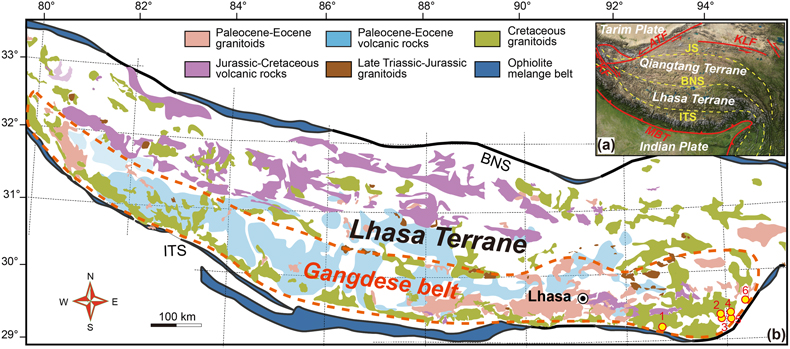
Figure 1 Geological map of the Gangdese continental arc and sampling locations. (a) Simplified geologic map of the Tibetan Plateau. (b) Tectonic framework of the Lhasa terrane, showing distribution of Gangdese arc magmas; JS = Jinsha suture, BNS = Bangong-Nujiang suture, ITS = Indus-Yarlung-Tsangpo suture, MBT = Main Boundary Thrust, ATF = Altyn Tagh fault, KF = Karakorum fault, KLF = Kunlun fault. Sampling locations: 1 = Cuijiu, 2 = Jinba, 3 = Sengbo, 4 = Zhangxiraodeng, 5 = Milin, 6 = Milin meta-gabbro.
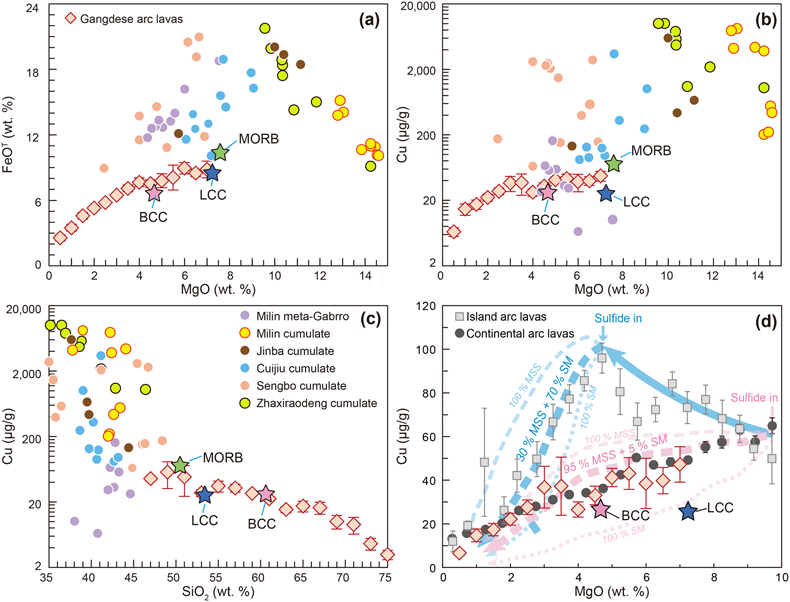
Figure 2 Elemental variations of the lower crustal cumulates and arc magmas from the Gangdese arc. (a) FeOT versus MgO, (b) Cu versus MgO, (c) Cu versus SiO2, and (d) Observed vs. modelled Cu evolution trends in island, continental and Gangdese arc lavas. Individual symbols of Gangdese arc lava in (a), (b), and (d) represent FeOT and Cu contents of 0.5 wt. % of MgO intervals; the Gangdese arc lava individual symbols in (c) represent Cu contents at 2 wt. % at SiO2 intervals. In (d), the curves show quantitative modelling results based on crystallisation experiments on hydrous arc magmas (Nandedkar et al., 2014
Nandedkar, R.H., Ulmer, P., Müntener, O. (2014) Fractional crystallization of primitive, hydrous arc magmas: an experimental study at 0.7 GPa. Contributions to Mineralogy and Petrology 167, 1015. http://doi.org/10.1007/s00410-014-1015-5
) and experimentally constrained partitioning of Cu between sulfide phases and silicate melt (Li and Audétat, 2015Li, Y., Audétat, A. (2015) Effects of temperature, silicate melt composition, and oxygen fugacity on the partitioning of V, Mn, Co, Ni, Cu, Zn, As, Mo, Ag, Sn, Sb, W, Au, Pb, and Bi between sulfide phases and silicate melt. Geochimica et Cosmochimica Acta 162, 25–45. http://doi.org/10.1016/j.gca.2015.04.036
), reflecting ideal equilibrium behaviour. The blue solid line with an arrow represents Cu evolution before sulfide saturation, whereas the blue dashed lines represent that sulfide saturation occurs at ∼4.8 wt. % MgO, followed by sulfide precipitation. The thick blue dashed line shows sulfide composition of 30 % MSS + 70 % SM, whereas the thin blue dashed line represents 100 % MSS, and the thin blue dotted line represents 100 % SM. The thick pink dashed line displays the precipitating sulfide at beginning with 95 % MSS and 5 % SM, with the thin pink dashed line representing 100 % MSS, and the thin pink dotted line representing 100 % SM. (See Supplementary Information for numerical modelling details). Error bars on the data points represent 2 standard deviations (s.d.). Data for global island and continental arc volcanic rocks (Cascades, Andes, and Mexico) are from the PetDB (https://search.earthchem.org/) and GEOROC databases (https://georoc.eu/georoc/). The average MORB, bulk continental crust (BCC), and lower continental crust (LCC) value are from Gale et al. (2013)Gale, A., Dalton, C.A., Langmuir, C.H., Su, Y., Schilling, J.-G. (2013) The mean composition of ocean ridge basalts. Geochemistry, Geophysics, Geosystems 14, 489–518. http://doi.org/10.1029/2012GC004334
and Rudnick and Gao (2003)Rudnick, R., Gao, S. (2003) Composition of the Continental Crust. Treatise Geochem 3:1–64. Treatise on Geochemistry 3, 1–64. http://doi.org/10.1016/B0-08-043751-6/03016-4
, respectively. MSS = monosulfide solid solution, SM = sulfide melt.
Figure 3 The δ65Cu variation of Gangdese lower crustal cumulates. (a) δ65Cu versus Cu, (b) δ65Cu versus SiO2, (c) δ65Cu versus MgO. Data for global island and Gangdese arc lavas, and continental lower crustal rocks are shown for comparison (Liu et al., 2015
Liu, S.-A., Huang, J., Liu, J., Wörner, G., Yang, W., Tang, Y.-J., Chen, Y., Tang, L., Zheng, J., Li, S. (2015) Copper isotopic composition of the silicate Earth. Earth and Planetary Science Letters 427, 95–103. http://doi.org/10.1016/j.epsl.2015.06.061
, 2023Liu, S.-A., Rudnick, R.L., Liu, W.-R., Teng, F.-Z., Wu, T.-H., Wang, Z.-Z. (2023) Copper isotope evidence for sulfide fractionation and lower crustal foundering in making continental crust. Science Advances 9, eadg6995. http://doi.org/10.1126/sciadv.adg6995
; Wang et al., 2019Wang, Z., Park, J.-W., Wang, X., Zou, Z., Kim, J., Zhang, P., Li, M. (2019) Evolution of copper isotopes in arc systems: Insights from lavas and molten sulfur in Niuatahi volcano, Tonga rear arc. Geochimica et Cosmochimica Acta 250, 18–33. http://doi.org/10.1016/j.gca.2019.01.040
). The horizontal dashed line and yellow shaded area in each panel represent the δ65Cu range of non-metasomatised mantle (δ65Cu = +0.03 ‰ ± 0.24 ‰). Error bars on the data points represent 2 standard deviations (s.d.). The isotope fractionation factors (αsulfide -silicate magma) were assigned at 0.9995, 0.9990 and 0.9980, respectively; MSS = monosulfide solid solution, SM = sulfide melt.
Figure 4 Cartoon showing intracrustal sulfide fractionation in continental arcs vs. island arcs. Continental arcs with thicker crust induce abundant MSS crystallisation but suppress sulfide melt fractionation, leading to earlier yet more gradual Cu depletion during differentiation compared with island arc magmas. Fractionation of MSS also results in enrichment of the lighter Cu isotopes in continental arc cumulates, leaving behind differentiated magmas characterised by low Cu content and high δ65Cu. In contrast, sulfide melt fractionation is unable to induce significant Cu isotope fractionation in island arcs. Co-segregation of sulfides, mafic minerals and Fe oxides at the roots of continental arcs removes Cu, Mg and Fe from the magmas. Foundering of dense, Cu-rich mafic/ultramafic cumulates drives the continental crust toward a silicic bulk composition deficit in Cu.