



Nitrogen isotopic variations in the early Solar System recorded by pallasites
Affiliations | Corresponding Author | Cite as | Funding information
Published by the European Association of Geochemistry
under Creative Commons License CC BY-NC-ND 4.0
Keywords: nitrogen, pallasites, noble gases, mass spectrometry, protoplanetary disk


- Share this article


-
Article views:1,588Cumulative count of HTML views and PDF downloads.
- Download Citation
- Rights & Permissions

top
Abstract
Figures
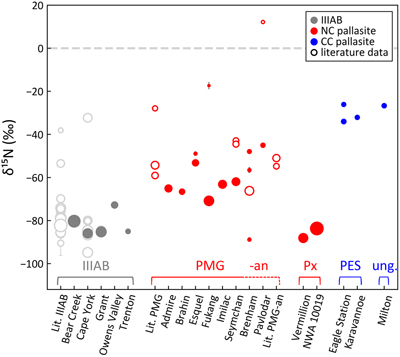 Figure 1 δ15N of metal from pallasites and IIIAB iron meteorites. Symbol sizes are correlated to the N abundances extracted per mass. Uncertainties are 1σ, and error bars are, in most cases, smaller than symbol sizes. Literature data sources are listed in Table S-5. | 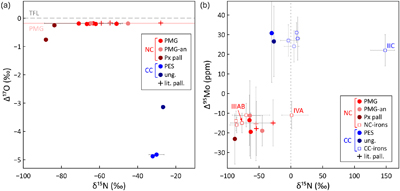 Figure 2 (a) Oxygen isotopic anomalies (Δ17O = δ17O − 0.52 × δ18O, i.e. the deviation from the terrestrial fractionation line in a δ17O versus δ18O diagram) and (b) Mo nucleosynthetic anomalies (Δ95Mo = (ɛ95Mo − 0.596 × ɛ94Mo) × 100; Spitzer et al., 2020) of pallasites and iron meteorites versus their N isotopic compositions. Iron meteorite data points represent average values for each group originating from specific parent bodies, while pallasite data points correspond to average values of individual meteorites. Meteorites and groups from the NC and CC reservoirs are shown in different shades of red and blue, respectively. The dashed line in (a) marks the terrestrial fractionation line (TFL), and the dotted line in (b) indicates δ15N = 0 ‰. Error bars for δ15N represent the range of values for both pallasites and iron meteorites. For pallasites, error bars for Δ17O and Δ95Mo similarly represent the range of literature data, including the large 1σ uncertainties for Δ95Mo. For iron meteorites, Δ95Mo values are taken from Spitzer et al. (2020), with uncertainties corresponding to the 95 % confidence intervals. Literature data sources are listed in Table S-5. |
| Figure 1 | Figure 2 |
top
Introduction
Non-carbonaceous (NC) and carbonaceous (CC) chondrites, whose parent bodies accreted in the inner and outer Solar System, respectively, are distinguished by characteristic nucleosynthetic isotope anomalies (e.g., ɛ54Cr and ɛ50Ti; Trinquier et al., 2009
Trinquier, A., Elliott, T., Ulfbeck, D., Coath, C., Krot, A.N., Bizzarro, M. (2009) Origin of Nucleosynthetic Isotope Heterogeneity in the Solar Protoplanetary Disk. Science 324, 374–376. https://doi.org/10.1126/science.1168221
; Warren, 2011Warren, P.H. (2011) Stable-isotopic anomalies and the accretionary assemblage of the Earth and Mars: A subordinate role for carbonaceous chondrites. Earth and Planetary Science Letters 311, 93–100. https://doi.org/10.1016/j.epsl.2011.08.047
). However, their δ15N values (defined as the per mille deviation from the modern atmospheric 15N/14N ratio of 3.6765 × 10⁻³; Nier, 1950Nier, A.O. (1950) A Redetermination of the Relative Abundances of the Isotopes of Carbon, Nitrogen, Oxygen, Argon, and Potassium. Physical Review 77, 789–793. https://doi.org/10.1103/PhysRev.77.789
) largely overlap (−57.3 ‰ to +39.3 ‰ for NC chondrites, excluding two outliers, and −45.0 ‰ to +76.2 ‰ for CC chondrites, excluding the 15N-rich CR chondrites and other atypical 15N-rich chondrites such as CB, CH, or Bells; based on a compilation of previous work available at Füri and Lastes (2025)Füri, E., Lastes, A. (2025) Compilation of nitrogen isotope ratios and abundances in chondrites. OTELo Research Data Repository, ORDaR. https://doi.org/10.24396/ORDAR-190
. In contrast, magmatic iron meteorites show clearer differences in N isotopic compositions between those linked to inner and outer Solar System parent bodies. NC-type irons predominantly record negative δ15N values (although they show an overall range from −95.8 ‰ to +46.7 ‰), while CC irons record mostly positive δ15N values (−16.3 ‰ to +155.6 ‰; based on a compilation of previous work available at Füri and Gamblin (2025)Füri, E., Gamblin, J. (2025) Compilation of nitrogen isotope ratios and abundances in iron meteorites determined by step-heating or secondary ion mass spectrometry (SIMS). OTELo Research Data Repository, ORDaR. https://doi.org/10.24396/ORDAR-185
; Table S-5).Magmatic iron meteorites originate from the cores of the earliest formed planetesimals, which accreted within the first Myr after calcium-aluminium-rich inclusion (CAI) formation (Spitzer et al., 2021
Spitzer, F., Burkhardt, C., Nimmo, F., Kleine, T. (2021) Nucleosynthetic Pt isotope anomalies and the Hf-W chronology of core formation in inner and outer solar system planetesimals. Earth and Planetary Science Letters 576, 117211. https://doi.org/10.1016/j.epsl.2021.117211
). Since N isotopes are not significantly fractionated between metal and silicate during planetary differentiation (only a few per mille; Grewal et al., 2022Grewal, D.S., Sun, T., Aithala, S., Hough, T., Dasgupta, R., Yeung, L.Y., Schauble, E.A. (2022) Limited nitrogen isotopic fractionation during core-mantle differentiation in rocky protoplanets and planets. Geochimica et Cosmochimica Acta 338, 347–364. https://doi.org/10.1016/j.gca.2022.10.025
) and between solid and liquid metal during core crystallisation (≤1.2 ‰; Grewal et al., 2025Grewal, D.S., Bhattacharjee, S., Mardaru, G.-D., Asimow, P.D. (2025) Tracing the origin of volatiles on Earth using nitrogen isotope ratios in iron meteorites. Geochimica et Cosmochimica Acta 388, 34–47. https://doi.org/10.1016/j.gca.2024.11.011
), the N isotopic compositions of most magmatic irons reflect those of their parent bodies at the time of differentiation. By that stage, thermal metamorphism could already have altered the initial N isotopic compositions. However, since both NC and CC irons record the end stage of thermal evolution, their different δ15N values suggest that their parent bodies — the earliest planetesimals in the inner and outer protoplanetary disk — accreted N carriers with distinct isotopic compositions (Grewal et al., 2021Grewal, D.S., Dasgupta, R., Marty, B. (2021) A very early origin of isotopically distinct nitrogen in inner Solar System protoplanets. Nature Astronomy 5, 356–364. https://doi.org/10.1038/s41550-020-01283-y
, 2025Grewal, D.S., Bhattacharjee, S., Mardaru, G.-D., Asimow, P.D. (2025) Tracing the origin of volatiles on Earth using nitrogen isotope ratios in iron meteorites. Geochimica et Cosmochimica Acta 388, 34–47. https://doi.org/10.1016/j.gca.2024.11.011
). The metal phase of meteorites is particularly well suited for tracking these N isotopic signatures, as N is siderophile under the redox conditions estimated for the differentiation of the parent bodies of iron meteorites (Grewal et al., 2021Grewal, D.S., Dasgupta, R., Hough, T., Farnell, A. (2021) Rates of protoplanetary accretion and differentiation set nitrogen budget of rocky planets. Nature Geoscience 14, 369–376. https://doi.org/10.1038/s41561-021-00733-0
, 2024Grewal, D.S., Nie, N.X., Zhang, B., Izidoro, A., Asimow, P.D. (2024) Accretion of the earliest inner Solar System planetesimals beyond the water snowline. Nature Astronomy 8, 290–297. https://doi.org/10.1038/s41550-023-02172-w
) and pallasites (Righter et al., 1990Righter, K., Arculus, R.J., Delano, J.W., Paslick, C. (1990) Electrochemical measurements and thermodynamic calculations of redox equilibria in pallasite meteorites: Implications for the eucrite parent body. Geochimica et Cosmochimica Acta 54, 1803–1815. https://doi.org/10.1016/0016-7037(90)90409-E
, 2016Righter, K., Sutton, S.R., Danielson, L., Pando, K., Newville, M. (2016) Redox variations in the inner solar system with new constraints from vanadium XANES in spinels. American Mineralogist 101, 1928–1942. https://doi.org/10.2138/am-2016-5638
). Since pallasites may be genetically linked with irons (particularly the main group pallasites, hereon PMG, with IIIAB irons), they can provide additional insights into N isotopic variations within the protoplanetary disk during the earliest stages of Solar System history.Pallasites are stony iron meteorites mainly composed of Fe-Ni metal and silicates (olivine ± pyroxene). While generally considered mixtures of core- and mantle-derived material, their formation process remains debated. Proposed models suggest formation at the core-mantle interface or at shallower depths within a differentiated planetesimal (e.g., Boesenberg et al., 2012
Boesenberg, J.S., Delaney, J.S., Hewins, R.H. (2012) A petrological and chemical reexamination of Main Group pallasite formation. Geochimica et Cosmochimica Acta 89, 134–158. https://doi.org/10.1016/j.gca.2012.04.037
; Teplyakova et al., 2022Teplyakova, S.N., Lorenz, C.A., Ivanova, M.A., Humayun, M., Kononkova, N.N., Borisovsky, S.E., Korochantsev, A.V., Franchi, I.A., Zinovieva, N.G. (2022) Karavannoe: Mineralogy, trace element geochemistry, and origin of Eagle Station group pallasites. Meteoritics & Planetary Science 57, 1158–1173. https://doi.org/10.1111/maps.13814
), or through impact mixing of core metal with mantle olivines from two distinct planetesimals (e.g., Yang et al., 2010Yang, J., Goldstein, J.I., Scott, E.R.D. (2010) Main-group pallasites: Thermal history, relationship to IIIAB irons, and origin. Geochimica et Cosmochimica Acta 74, 4471–4492. https://doi.org/10.1016/j.gca.2010.04.016
; Windmill et al., 2022Windmill, R.J., Franchi, I.A., Hellmann, J.L., Schneider, J.M., Spitzer, F., Kleine, T., Greenwood, R.C., Anand, M. (2022) Isotopic evidence for pallasite formation by impact mixing of olivine and metal during the first 10 million years of the Solar System. PNAS Nexus 1, pgac015. https://doi.org/10.1093/pnasnexus/pgac015
). These processes may have occurred multiple times in different regions of the Solar System, as indicated by variations in O isotopic compositions that point to distinct pallasite parent bodies (Fig. S-1; Boesenberg et al., 2012Boesenberg, J.S., Delaney, J.S., Hewins, R.H. (2012) A petrological and chemical reexamination of Main Group pallasite formation. Geochimica et Cosmochimica Acta 89, 134–158. https://doi.org/10.1016/j.gca.2012.04.037
). Some pallasites are linked to the inner Solar System and the NC reservoir, while others are associated with the outer Solar System and the CC reservoir (Warren, 2011Warren, P.H. (2011) Stable-isotopic anomalies and the accretionary assemblage of the Earth and Mars: A subordinate role for carbonaceous chondrites. Earth and Planetary Science Letters 311, 93–100. https://doi.org/10.1016/j.epsl.2011.08.047
; Boesenberg et al., 2016Boesenberg, J.S., Mayne, R.G., Humayun, M., Silver, A.P., Greenwood, R.C., Franchi, I.A. (2016) Pyroxene-Plagioclase Pallasite Northwest Africa 10019: Where Does It Belong? 47th Lunar and Planetary Science Conference, 2297.
; Hilton et al., 2019Hilton, C.D., Bermingham, K.R., Walker, R.J., McCoy, T.J. (2019) Genetics, crystallization sequence, and age of the South Byron Trio iron meteorites: New insights to carbonaceous chondrite (CC) type parent bodies. Geochimica et Cosmochimica Acta 251, 217–228. https://doi.org/10.1016/j.gca.2019.02.035
; Kruijer et al., 2022Kruijer, T.S., Burkhardt, C., Borg, L.E., Kleine, T. (2022) Tungsten and molybdenum isotopic evidence for an impact origin of pallasites. Earth and Planetary Science Letters 584, 117440. https://doi.org/10.1016/j.epsl.2022.117440
). Like iron meteorites, their metal phases are interpreted to trace N isotopic variations between these reservoirs. However, δ15N measurements of pallasites remain scarce (Prombo and Clayton, 1993Prombo, C.A., Clayton, R.N. (1993) Nitrogen isotopic compositions of iron meteorites. Geochimica et Cosmochimica Acta 57, 3749–3761. https://doi.org/10.1016/0016-7037(93)90153-N
; Mathew et al., 2000Mathew, K.J., Palma, R.L., Marti, K., Lavielle, B. (2000) Isotopic signatures and origin of nitrogen in IIE and IVA iron meteorites. Geochimica et Cosmochimica Acta 64, 545–557. https://doi.org/10.1016/S0016-7037(99)00316-6
) and do not encompass all pallasite groups or types. In particular, δ15N data for the metal phase of CC pallasites and pyroxene-rich pallasites are currently lacking. This study aims to provide a comprehensive overview of the N isotopic composition of NC and CC pallasites to better constrain the N isotopic distribution and evolution in the early protoplanetary disk.top
Material and Methods
Thirteen pallasites were analysed for this study (see details in Supplementary Information). These include eight PMG (NC reservoir): six typical PMG (Admire, Brahin, Esquel, Fukang, Imilac, and Seymchan) and two with anomalous metal compositions (PMG–am, for anomalous metal; Brenham and Pavlodar). The sample suite also comprises two Eagle Station pallasites (PES; Eagle Station and Karavannoe; CC reservoir), two pyroxene pallasites (Px pall.; Vermillion and NWA 10019; NC reservoir), and one ungrouped pallasite associated with the CC reservoir (Milton). These pallasites likely originate from four or five different parent bodies — two or three from the NC reservoir and two from the CC reservoir. Five IIIAB magmatic iron meteorites (Bear Creek, Cape York, Grant, Owens Valley, and Trenton) were also analysed to investigate their possible genetic link to PMG. To ensure accurate analysis, pure metal fragments were carefully selected, with surface oxidation removed via acid treatment, while olivine grains free of other phases, inclusions, and alteration were also isolated. Descriptions of each analysed pallasite and IIIAB iron meteorite, along with details of the sample preparation, are provided in the SI.
Nitrogen was extracted from metal fragments and pure olivine separates by stepped CO2 laser-heating, and its abundances and isotope ratios were analysed with a Noblesse-HR noble gas mass spectrometer at the noble gas facility of the Centre de Recherches Pétrographiques et Géochimiques (CRPG). Notably, 15Ncosm is produced from 16O by cosmic ray-induced spallation during space exposure (e.g., Mathew and Murty, 1993
Mathew, K.J., Murty, S.V.S. (1993) Cosmic ray produced nitrogen in extra terrestrial matter. Journal of Earth System Science 102, 415–437. https://doi.org/10.1007/BF02841731
). Since oxygen is virtually absent in the metal phase of pallasites and in magmatic iron meteorites, the cosmogenic contribution to the measured δ15N in metals is negligible. However, this contribution can significantly modify the δ15N values of silicates. To address this, noble gas (Ne and Ar) abundances and isotope ratios were analysed alongside N to quantify any cosmogenic nuclide contributions, estimate the cosmic ray exposure (CRE) ages of the meteorites based on Ne isotopes, and correct the δ15N of olivines for cosmogenic 15N contributions. Detailed descriptions of the analytical procedure, data treatment, and correction for cosmogenic 15N are provided in the SI. A limitation of the applied method is that the metal fragments could not be melted by the laser heating, potentially influencing the efficiency of N and noble gas extraction. Consequently, concentrations for the metal phases may not have been quantitatively constrained. Thus, the following discussion primarily focuses on the isotope ratios of N (-Ne-Ar).top
Results
Neon extracted from metal fragments and olivine separates of pallasites in this study, as well as in previous studies (e.g., Schultz and Franke, 2004
Schultz, L., Franke, L. (2004) Helium, neon, and argon in meteorites: A data collection. Meteoritics & Planetary Science 39, 1889–1890. https://doi.org/10.1111/j.1945-5100.2004.tb00083.x
), is predominantly cosmogenic, as indicated by 20Ne/22Ne and 21Ne/22Ne ratios close to unity (Fig. S-5). No solar Ne contributions were detected. The extracted Ar is also predominantly cosmogenic, with 36Ar/38Ar ratios mostly ranging between 0.63 and 0.72. The amount of 21Ne released from the olivine separates suggests CRE ages ranging from 3 Myr to ∼174 Myr (Table S-3). Spallation reactions induced by galactic cosmic rays have thus significantly modified the N isotopic compositions of the silicate phases (Table S-4), in clear contrast to the metal phases, whose δ15N remained unaffected by cosmogenic 15N (see details in the SI). Consequently, the δ15N values of olivines will not be discussed further, and this study focuses on the N isotopic compositions of metal.Figure 1 displays the δ15N values measured in the metal phases of pallasites and IIIAB iron meteorites. While Figure S-4 shows the results of all individual extraction steps, Figure 1 presents the abundance-weighted averages, providing a single δ15N value for each analysed fragment. Symbol sizes scale with the N abundances extracted per mass and are comparable to concentrations reported in the literature, indicating efficient N extraction from the samples. No correlation is observed between N yield and δ15N values. The N abundances extracted per mass from CC pallasite samples fall within the range measured for NC pallasites. A wide range of δ15N values is observed in pallasites, with distinct values for the different pallasite groups, all significantly higher than the solar nebula value (−383 ± 8 ‰; Marty et al., 2011
Marty, B., Chaussidon, M., Wiens, R.C., Jurewicz, A.J.G., Burnett, D.S. (2011) A 15 N-Poor isotopic composition for the Solar System as shown by Genesis solar wind samples. Science 332, 1533–1536. https://doi.org/10.1126/science.1204656
). The measured values are consistent with literature data, demonstrating that any incomplete N extraction did not result in significant isotopic fractionation. The δ15N values of PMG range from –88.86 ± 0.90 ‰ for Brenham to –17.38 ± 1.44 ‰ for Fukang. However, the highest value measured in Fukang may be considered an outlier. Only a small amount of N was extracted from this fragment, and analysis of a second metal fragment yielded a value more consistent with the other PMG (–70.86 ± 1.02 ‰), suggesting that the elevated value resulted from significant blank contribution that was not fully corrected. The PMG-am Brenham shows significant isotopic variations among the three fragments analysed (–47.94 ± 0.96 ‰, –56.57 ± 1.19 ‰, and –88.86 ± 0.90 ‰). Since this sample was particularly weathered, the elevated δ15N values may result from incomplete removal of surface weathering (Fig. S-2). Excluding the Fukang outlier, the δ15N values of the “normal” PMG fall within a narrower range, from –70.86 ± 1.02 ‰ to –48.94 ± 0.89 ‰, consistent with most literature values. Interestingly, PMG generally exhibit higher δ15N values than IIIAB (–85.97 ± 0.59 ‰ to –72.81 ± 0.62‰), which are also in agreement with previous data (see references in Table S-5). The δ15N variations within the PMG group and the IIIAB group may reflect N isotopic heterogeneities among the small fragments analysed, possibly caused by minor inclusions within the metal.Figure 1 δ15N of metal from pallasites and IIIAB iron meteorites. Symbol sizes are correlated to the N abundances extracted per mass. Uncertainties are 1σ, and error bars are, in most cases, smaller than symbol sizes. Literature data sources are listed in Table S-5.
Pyroxene pallasites are depleted in 15N compared to “normal” PMG, with δ15N values of –88.11 ± 1.02 ‰ for Vermillion and –83.67 ± 0.92 ‰ for NWA 10019. Surprisingly, they have similar N isotopic compositions, whereas their different O isotopic compositions indicate an origin from distinct parent bodies (Fig. S-1; Boesenberg et al., 2016
Boesenberg, J.S., Mayne, R.G., Humayun, M., Silver, A.P., Greenwood, R.C., Franchi, I.A. (2016) Pyroxene-Plagioclase Pallasite Northwest Africa 10019: Where Does It Belong? 47th Lunar and Planetary Science Conference, 2297.
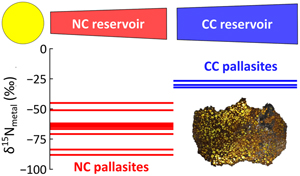
). These values fall within the range of IIIAB meteorites analysed in this study. In contrast, the PES group is enriched in 15N compared to both PMG and pyroxene pallasites, with δ15N values ranging from –34.03 ± 0.69 ‰ to –26.12 ± 0.64 ‰. Milton’s δ15N value also falls within this range (–26.67 ± 0.71 ‰). Overall, the new results reveal that CC pallasites (–34.03 ± 0.69 ‰ to –26.12 ± 0.64 ‰) have higher δ15N values compared to NC pallasites (–88.86 ± 0.90 ‰ to –45.04 ± 0.91 ‰).top
Discussion
Like iron meteorites, pallasite metals are thought to preserve the N isotopic composition of their bulk parent bodies at the time of differentiation. This inference is based on experimental evidence showing that neither core-mantle differentiation (Grewal et al., 2022
Grewal, D.S., Sun, T., Aithala, S., Hough, T., Dasgupta, R., Yeung, L.Y., Schauble, E.A. (2022) Limited nitrogen isotopic fractionation during core-mantle differentiation in rocky protoplanets and planets. Geochimica et Cosmochimica Acta 338, 347–364. https://doi.org/10.1016/j.gca.2022.10.025
) nor fractional crystallisation of liquid metal (Grewal et al., 2025Grewal, D.S., Bhattacharjee, S., Mardaru, G.-D., Asimow, P.D. (2025) Tracing the origin of volatiles on Earth using nitrogen isotope ratios in iron meteorites. Geochimica et Cosmochimica Acta 388, 34–47. https://doi.org/10.1016/j.gca.2024.11.011
) significantly alters N isotope ratios, as outlined in the Introduction. Prior to melting and differentiation, thermal metamorphism can preferentially remove 15N-rich components from planetesimals (Grewal et al., 2025Grewal, D.S., Bhattacharjee, S., Mardaru, G.-D., Asimow, P.D. (2025) Tracing the origin of volatiles on Earth using nitrogen isotope ratios in iron meteorites. Geochimica et Cosmochimica Acta 388, 34–47. https://doi.org/10.1016/j.gca.2024.11.011
). However, as for iron meteorites, the metals of both NC and CC pallasites represent the end stage products of thermal evolution. Because their parent bodies experienced similarly high temperatures at which N carrier phases were largely decomposed and melted, the observed δ15N differences between NC and CC pallasites cannot be attributed to selective destruction or preservation of different N carriers during thermal metamorphism. Aqueous alteration may also have occurred in pallasite parent bodies prior to differentiation. The marginally higher oxidation state of PES (IW +0.5; Righter et al., 1990Righter, K., Arculus, R.J., Delano, J.W., Paslick, C. (1990) Electrochemical measurements and thermodynamic calculations of redox equilibria in pallasite meteorites: Implications for the eucrite parent body. Geochimica et Cosmochimica Acta 54, 1803–1815. https://doi.org/10.1016/0016-7037(90)90409-E
) compared to PMG (IW −1 to −0.5; Righter et al., 2016Righter, K., Sutton, S.R., Danielson, L., Pando, K., Newville, M. (2016) Redox variations in the inner solar system with new constraints from vanadium XANES in spinels. American Mineralogist 101, 1928–1942. https://doi.org/10.2138/am-2016-5638
) may indicate greater water-ice accretion on the PES parent body, increasing the potential for such processing. However, aqueous alteration of undifferentiated material typically leads to preferential removal of 15N (Broadley et al., 2023Broadley, M.W. et al. (2023) The noble gas and nitrogen relationship between Ryugu and carbonaceous chondrites. Geochimica et Cosmochimica Acta 345, 62–74. https://doi.org/10.1016/j.gca.2023.01.020
), which contrasts with observations in pallasites, where the most oxidised parent body shows a higher δ15N.Another possibility is that the pallasite formation process itself affected the δ15N values. This process remains debated, with some models suggesting it involved impact related disruption of a differentiated body (e.g., Yang et al., 2010
Yang, J., Goldstein, J.I., Scott, E.R.D. (2010) Main-group pallasites: Thermal history, relationship to IIIAB irons, and origin. Geochimica et Cosmochimica Acta 74, 4471–4492. https://doi.org/10.1016/j.gca.2010.04.016
). If N isotope fractionation had occurred through evaporation or degassing of molten metal during impact events, it should have been accompanied by a loss of volatile siderophile elements such as Ge and Ga, together with preferential loss of the lighter 14N isotope. Such a process would therefore be expected to produce a negative correlation between δ15N values and Ge and Ga concentrations in metal samples originating from the same parent body — particularly within the PMG and IIIAB groups, or when comparing PMG to IIIAB. However, no such correlation is observed (Fig. S-7), indicating that degassing did not significantly affect δ15N values. Consequently, thermal metamorphism, aqueous alteration, and impact processes are unlikely to account for the δ15N differences observed between NC and CC pallasites, strongly supporting the interpretation that these variations reflect distinct primary reservoir signatures rather than secondary effects. Pallasite parent bodies in the NC and CC reservoirs are therefore inferred to have accreted isotopically distinct N-bearing phases, supporting the idea — first proposed based on iron meteorites (Grewal et al., 2021Grewal, D.S., Dasgupta, R., Marty, B. (2021) A very early origin of isotopically distinct nitrogen in inner Solar System protoplanets. Nature Astronomy 5, 356–364. https://doi.org/10.1038/s41550-020-01283-y
, 2025Grewal, D.S., Bhattacharjee, S., Mardaru, G.-D., Asimow, P.D. (2025) Tracing the origin of volatiles on Earth using nitrogen isotope ratios in iron meteorites. Geochimica et Cosmochimica Acta 388, 34–47. https://doi.org/10.1016/j.gca.2024.11.011
) — that isotopic heterogeneity in N existed between the inner and outer regions of the protoplanetary disk.Figure 2 shows O isotopic anomalies in pallasite silicates and Mo nucleosynthetic anomalies in both pallasite metal and magmatic iron meteorite groups as a function of their N isotopic compositions measured in metal. These anomalies, along with others (e.g., Cr, Ti, Ru), have been key in distinguishing between the NC and CC reservoirs (e.g., Warren, 2011
Warren, P.H. (2011) Stable-isotopic anomalies and the accretionary assemblage of the Earth and Mars: A subordinate role for carbonaceous chondrites. Earth and Planetary Science Letters 311, 93–100. https://doi.org/10.1016/j.epsl.2011.08.047
; Kruijer et al., 2017Kruijer, T.S., Burkhardt, C., Budde, G., Kleine, T. (2017) Age of Jupiter inferred from the distinct genetics and formation times of meteorites. Proceedings of the National Academy of Sciences 114, 6712–6716. https://doi.org/10.1073/pnas.1704461114
, 2022Kruijer, T.S., Burkhardt, C., Borg, L.E., Kleine, T. (2022) Tungsten and molybdenum isotopic evidence for an impact origin of pallasites. Earth and Planetary Science Letters 584, 117440. https://doi.org/10.1016/j.epsl.2022.117440
). Molybdenum, a moderately siderophile and refractory element, is particularly useful because it is readily measurable in metal and exhibits a well resolved isotopic dichotomy between the two reservoirs (Spitzer et al., 2020Spitzer, F., Burkhardt, C., Budde, G., Kruijer, T.S., Morbidelli, A., Kleine, T. (2020) Isotopic Evolution of the Inner Solar System Inferred from Molybdenum Isotopes in Meteorites. The Astrophysical Journal Letters 898, L2. https://doi.org/10.3847/2041-8213/ab9e6a
). In Figure 2b, pallasites and irons from the NC and CC reservoirs are clearly separated by their Δ95Mo values, while their δ15N values show partial overlap, with NC samples extending to more 15N depleted values and CC samples to higher δ15N values. A wide range of δ15N values is observed among the different parent bodies within each reservoir. Whereas the 14N depletion of the NC iron group IVA could reflect impact induced fractionation (Grewal et al., 2025Grewal, D.S., Bhattacharjee, S., Mardaru, G.-D., Asimow, P.D. (2025) Tracing the origin of volatiles on Earth using nitrogen isotope ratios in iron meteorites. Geochimica et Cosmochimica Acta 388, 34–47. https://doi.org/10.1016/j.gca.2024.11.011
), the overall variations likely result from isotopic heterogeneity in the N carrier phase(s) within each reservoir. These variations could arise from i) temporal or spatial evolution in the δ15N of a single phase (e.g., organic matter), and/or ii) the coexistence of multiple isotopically distinct N carriers (including organics, nitrides, ammonia ice), whose relative abundances were controlled by disk physicochemical conditions and were accreted in varying proportions by planetesimals. Notably, CC pallasites do not align with CC iron meteorites (Fig. 2b). The two parent bodies of the CC pallasites show very similar δ15N values, as do the four parent bodies of the CC iron meteorites (excluding the particularly 15N-rich IIC parent body), but CC pallasites display negative δ15N values — distinct from the predominantly positive values of CC iron meteorites — while retaining similar Mo nucleosynthetic anomalies. This implies that CC pallasites and CC irons originated from distinct parent bodies that may have accreted in separate locations and/or at different times in the outer Solar System. The more oxidising conditions recorded by PES (IW +0.5; Righter et al., 1990Righter, K., Arculus, R.J., Delano, J.W., Paslick, C. (1990) Electrochemical measurements and thermodynamic calculations of redox equilibria in pallasite meteorites: Implications for the eucrite parent body. Geochimica et Cosmochimica Acta 54, 1803–1815. https://doi.org/10.1016/0016-7037(90)90409-E
) compared to CC irons (IW −2 to IW −1; Grewal et al., 2024Grewal, D.S., Nie, N.X., Zhang, B., Izidoro, A., Asimow, P.D. (2024) Accretion of the earliest inner Solar System planetesimals beyond the water snowline. Nature Astronomy 8, 290–297. https://doi.org/10.1038/s41550-023-02172-w
) could indicate that the PES parent body accreted more water ice, possibly farther from the Sun, supporting this hypothesis. Determining the relative accretion times and locations of the parent bodies of CC pallasites and CC iron meteorites will be key to confirming this. Currently, the parent body of the Eagle Station pallasite is believed to have differentiated within the first 4 Myr after CAI formation (Luu et al., 2014Luu, T.-H., Chaussidon, M., Birck, J.-L. (2014) Timing of metal–silicate differentiation in the Eagle Station pallasite parent body. Comptes Rendus Geoscience 346, 75–81. https://doi.org/10.1016/j.crte.2014.03.004
), though its precise accretion time remains poorly constrained and may have spanned several million years. In comparison, the parent bodies of CC iron meteorites are thought to have differentiated between 3 and 4 Myr after CAI formation (Spitzer et al., 2021Spitzer, F., Burkhardt, C., Nimmo, F., Kleine, T. (2021) Nucleosynthetic Pt isotope anomalies and the Hf-W chronology of core formation in inner and outer solar system planetesimals. Earth and Planetary Science Letters 576, 117211. https://doi.org/10.1016/j.epsl.2021.117211
), and may have accreted either as early as the parent bodies of NC iron meteorites (within the first Myr after CAI formation; Spitzer et al., 2021Spitzer, F., Burkhardt, C., Nimmo, F., Kleine, T. (2021) Nucleosynthetic Pt isotope anomalies and the Hf-W chronology of core formation in inner and outer solar system planetesimals. Earth and Planetary Science Letters 576, 117211. https://doi.org/10.1016/j.epsl.2021.117211
) or slightly later (Grewal et al., 2024Grewal, D.S., Nie, N.X., Zhang, B., Izidoro, A., Asimow, P.D. (2024) Accretion of the earliest inner Solar System planetesimals beyond the water snowline. Nature Astronomy 8, 290–297. https://doi.org/10.1038/s41550-023-02172-w
). In contrast, NC pallasites and NC iron meteorites exhibit consistent Mo nucleosynthetic anomalies as well as overlapping N isotopic compositions. Their δ15N variations may also reflect isotopic heterogeneity in the N-bearing phases within the NC reservoir. However, unlike the parent bodies from the CC reservoir, there is no evidence that the parent bodies of NC pallasites and NC iron meteorites accreted distinctly different N carrier phases, or that they formed in clearly separate locations and/or at different times.Figure 2 (a) Oxygen isotopic anomalies (Δ17O = δ17O − 0.52 × δ18O, i.e. the deviation from the terrestrial fractionation line in a δ17O versus δ18O diagram) and (b) Mo nucleosynthetic anomalies (Δ95Mo = (ɛ95Mo − 0.596 × ɛ94Mo) × 100; Spitzer et al., 2020
Spitzer, F., Burkhardt, C., Budde, G., Kruijer, T.S., Morbidelli, A., Kleine, T. (2020) Isotopic Evolution of the Inner Solar System Inferred from Molybdenum Isotopes in Meteorites. The Astrophysical Journal Letters 898, L2. https://doi.org/10.3847/2041-8213/ab9e6a
) of pallasites and iron meteorites versus their N isotopic compositions. Iron meteorite data points represent average values for each group originating from specific parent bodies, while pallasite data points correspond to average values of individual meteorites. Meteorites and groups from the NC and CC reservoirs are shown in different shades of red and blue, respectively. The dashed line in (a) marks the terrestrial fractionation line (TFL), and the dotted line in (b) indicates δ15N = 0 ‰. Error bars for δ15N represent the range of values for both pallasites and iron meteorites. For pallasites, error bars for Δ17O and Δ95Mo similarly represent the range of literature data, including the large 1σ uncertainties for Δ95Mo. For iron meteorites, Δ95Mo values are taken from Spitzer et al. (2020)Spitzer, F., Burkhardt, C., Budde, G., Kruijer, T.S., Morbidelli, A., Kleine, T. (2020) Isotopic Evolution of the Inner Solar System Inferred from Molybdenum Isotopes in Meteorites. The Astrophysical Journal Letters 898, L2. https://doi.org/10.3847/2041-8213/ab9e6a
, with uncertainties corresponding to the 95 % confidence intervals. Literature data sources are listed in Table S-5.top
Acknowledgements
This work was funded by the European Union (ERC, IRONIS, 101087562, awarded to EF). Views and opinions expressed are however those of the author(s) only and do not necessarily reflect those of the European Union or the European Research Council. Neither the European Union nor the granting authority can be held responsible for them. We thank the various museums and meteorite sellers cited in Table S-1 for providing the samples for this study, as well as Bouchaïb Tibari and Allan Bauer for their assistance with the noble gas analyses at CRPG. We are also grateful for the constructive reviews provided by Seann McKibbin and Conel Alexander, and to Francis McCubbin for editorial handling. This is CRPG contribution 2881.
Editor: Francis McCubbin
top
References
Boesenberg, J.S., Delaney, J.S., Hewins, R.H. (2012) A petrological and chemical reexamination of Main Group pallasite formation. Geochimica et Cosmochimica Acta 89, 134–158. https://doi.org/10.1016/j.gca.2012.04.037
 Show in context
 Proposed models suggest formation at the core-mantle interface or at shallower depths within a differentiated planetesimal (e.g., Boesenberg et al., 2012; Teplyakova et al., 2022), or through impact mixing of core metal with mantle olivines from two distinct planetesimals (e.g., Yang et al., 2010; Windmill et al., 2022).
View in article
These processes may have occurred multiple times in different regions of the Solar System, as indicated by variations in O isotopic compositions that point to distinct pallasite parent bodies (Fig. S-1; Boesenberg et al., 2012).
View in article
Boesenberg, J.S., Mayne, R.G., Humayun, M., Silver, A.P., Greenwood, R.C., Franchi, I.A. (2016) Pyroxene-Plagioclase Pallasite Northwest Africa 10019: Where Does It Belong? 47th Lunar and Planetary Science Conference, 2297.
Show in context Some pallasites are linked to the inner Solar System and the NC reservoir, while others are associated with the outer Solar System and the CC reservoir (Warren, 2011; Boesenberg et al., 2016; Hilton et al., 2019; Kruijer et al., 2022).
View in article
Surprisingly, they have similar N isotopic compositions, whereas their different O isotopic compositions indicate an origin from distinct parent bodies (Fig. S-1; Boesenberg et al., 2016).
View in article
Broadley, M.W. et al. (2023) The noble gas and nitrogen relationship between Ryugu and carbonaceous chondrites. Geochimica et Cosmochimica Acta 345, 62–74. https://doi.org/10.1016/j.gca.2023.01.020
Show in context The marginally higher oxidation state of PES (IW +0.5; Righter et al., 1990) compared to PMG (IW −1 to −0.5; Righter et al., 2016) may indicate greater water-ice accretion on the PES parent body, increasing the potential for such processing. However, aqueous alteration of undifferentiated material typically leads to preferential removal of 15N (Broadley et al., 2023), which contrasts with observations in pallasites, where the most oxidised parent body shows a higher δ15N.
View in article
Buseck, P.R., Goldstein, J.I. (1969) Olivine Compositions and Cooling Rates of Pallasitic Meteorites. Geological Society of America Bulletin 80, 2141. https://doi.org/10.1130/0016-7606(1969)80[2141:OCACRO]2.0.CO;2
Füri, E., Gamblin, J. (2025) Compilation of nitrogen isotope ratios and abundances in iron meteorites determined by step-heating or secondary ion mass spectrometry (SIMS). OTELo Research Data Repository, ORDaR. https://doi.org/10.24396/ORDAR-185
Show in context NC-type irons predominantly record negative δ15N values (although they show an overall range from −95.8 ‰ to +46.7 ‰), while CC irons record mostly positive δ15N values (−16.3 ‰ to +155.6 ‰; based on a compilation of previous work available at Füri and Gamblin (2025); Table S-5).
View in article
Füri, E., Lastes, A. (2025) Compilation of nitrogen isotope ratios and abundances in chondrites. OTELo Research Data Repository, ORDaR. https://doi.org/10.24396/ORDAR-190
Show in context However, their δ15N values (defined as the per mille deviation from the modern atmospheric 15N/14N ratio of 3.6765 × 10⁻³; Nier, 1950) largely overlap (−57.3 ‰ to +39.3 ‰ for NC chondrites, excluding two outliers, and −45.0 ‰ to +76.2 ‰ for CC chondrites, excluding the 15N-rich CR chondrites and other atypical 15N-rich chondrites such as CB, CH, or Bells; based on a compilation of previous work available at Füri and Lastes (2025).
View in article
Greenwood, R.C., Burbine, T.H., Miller, M.F., Franchi, Ian. A. (2017) Melting and differentiation of early-formed asteroids: The perspective from high precision oxygen isotope studies. Geochemistry 77, 1–43. https://doi.org/10.1016/j.chemer.2016.09.005
Grewal, D.S., Dasgupta, R., Marty, B. (2021) A very early origin of isotopically distinct nitrogen in inner Solar System protoplanets. Nature Astronomy 5, 356–364. https://doi.org/10.1038/s41550-020-01283-y
Show in context However, since both NC and CC irons record the end stage of thermal evolution, their different δ15N values suggest that their parent bodies — the earliest planetesimals in the inner and outer protoplanetary disk — accreted N carriers with distinct isotopic compositions (Grewal et al., 2021, 2025).
View in article
Pallasite parent bodies in the NC and CC reservoirs are therefore inferred to have accreted isotopically distinct N-bearing phases, supporting the idea — first proposed based on iron meteorites (Grewal et al., 2021, 2025) — that isotopic heterogeneity in N existed between the inner and outer regions of the protoplanetary disk.
View in article
Grewal, D.S., Dasgupta, R., Hough, T., Farnell, A. (2021) Rates of protoplanetary accretion and differentiation set nitrogen budget of rocky planets. Nature Geoscience 14, 369–376. https://doi.org/10.1038/s41561-021-00733-0
Show in context The metal phase of meteorites is particularly well suited for tracking these N isotopic signatures, as N is siderophile under the redox conditions estimated for the differentiation of the parent bodies of iron meteorites (Grewal et al., 2021, 2024) and pallasites (Righter et al., 1990, 2016).
View in article
Grewal, D.S., Sun, T., Aithala, S., Hough, T., Dasgupta, R., Yeung, L.Y., Schauble, E.A. (2022) Limited nitrogen isotopic fractionation during core-mantle differentiation in rocky protoplanets and planets. Geochimica et Cosmochimica Acta 338, 347–364. https://doi.org/10.1016/j.gca.2022.10.025
Show in context Since N isotopes are not significantly fractionated between metal and silicate during planetary differentiation (only a few per mille; Grewal et al., 2022) and between solid and liquid metal during core crystallisation (≤1.2 ‰; Grewal et al., 2025), the N isotopic compositions of most magmatic irons reflect those of their parent bodies at the time of differentiation.
View in article
This inference is based on experimental evidence showing that neither core-mantle differentiation (Grewal et al., 2022) nor fractional crystallisation of liquid metal (Grewal et al., 2025) significantly alters N isotope ratios, as outlined in the Introduction.
View in article
Grewal, D.S., Nie, N.X., Zhang, B., Izidoro, A., Asimow, P.D. (2024) Accretion of the earliest inner Solar System planetesimals beyond the water snowline. Nature Astronomy 8, 290–297. https://doi.org/10.1038/s41550-023-02172-w
Show in context The metal phase of meteorites is particularly well suited for tracking these N isotopic signatures, as N is siderophile under the redox conditions estimated for the differentiation of the parent bodies of iron meteorites (Grewal et al., 2021, 2024) and pallasites (Righter et al., 1990, 2016).
View in article
This implies that CC pallasites and CC irons originated from distinct parent bodies that may have accreted in separate locations and/or at different times in the outer Solar System. The more oxidising conditions recorded by PES (IW +0.5; Righter et al., 1990) compared to CC irons (IW −2 to IW −1; Grewal et al., 2024) could indicate that the PES parent body accreted more water ice, possibly farther from the Sun, supporting this hypothesis.
View in article
In comparison, the parent bodies of CC iron meteorites are thought to have differentiated between 3 and 4 Myr after CAI formation (Spitzer et al., 2021), and may have accreted either as early as the parent bodies of NC iron meteorites (within the first Myr after CAI formation; Spitzer et al., 2021) or slightly later (Grewal et al., 2024).
View in article
Grewal, D.S., Bhattacharjee, S., Mardaru, G.-D., Asimow, P.D. (2025) Tracing the origin of volatiles on Earth using nitrogen isotope ratios in iron meteorites. Geochimica et Cosmochimica Acta 388, 34–47. https://doi.org/10.1016/j.gca.2024.11.011
Show in context Since N isotopes are not significantly fractionated between metal and silicate during planetary differentiation (only a few per mille; Grewal et al., 2022) and between solid and liquid metal during core crystallisation (≤1.2 ‰; Grewal et al., 2025), the N isotopic compositions of most magmatic irons reflect those of their parent bodies at the time of differentiation.
View in article
However, since both NC and CC irons record the end stage of thermal evolution, their different δ15N values suggest that their parent bodies — the earliest planetesimals in the inner and outer protoplanetary disk — accreted N carriers with distinct isotopic compositions (Grewal et al., 2021, 2025).
View in article
This inference is based on experimental evidence showing that neither core-mantle differentiation (Grewal et al., 2022) nor fractional crystallisation of liquid metal (Grewal et al., 2025) significantly alters N isotope ratios, as outlined in the Introduction.
View in article
Prior to melting and differentiation, thermal metamorphism can preferentially remove 15N-rich components from planetesimals (Grewal et al., 2025).
View in article
Pallasite parent bodies in the NC and CC reservoirs are therefore inferred to have accreted isotopically distinct N-bearing phases, supporting the idea — first proposed based on iron meteorites (Grewal et al., 2021, 2025) — that isotopic heterogeneity in N existed between the inner and outer regions of the protoplanetary disk.
View in article
Whereas the 14N depletion of the NC iron group IVA could reflect impact induced fractionation (Grewal et al., 2025), the overall variations likely result from isotopic heterogeneity in the N carrier phase(s) within each reservoir.
View in article
Hilton, C.D., Bermingham, K.R., Walker, R.J., McCoy, T.J. (2019) Genetics, crystallization sequence, and age of the South Byron Trio iron meteorites: New insights to carbonaceous chondrite (CC) type parent bodies. Geochimica et Cosmochimica Acta 251, 217–228. https://doi.org/10.1016/j.gca.2019.02.035
Show in context Some pallasites are linked to the inner Solar System and the NC reservoir, while others are associated with the outer Solar System and the CC reservoir (Warren, 2011; Boesenberg et al., 2016; Hilton et al., 2019; Kruijer et al., 2022).
View in article
Kruijer, T.S., Burkhardt, C., Budde, G., Kleine, T. (2017) Age of Jupiter inferred from the distinct genetics and formation times of meteorites. Proceedings of the National Academy of Sciences 114, 6712–6716. https://doi.org/10.1073/pnas.1704461114
Show in context These anomalies, along with others (e.g., Cr, Ti, Ru), have been key in distinguishing between the NC and CC reservoirs (e.g., Warren, 2011; Kruijer et al., 2017, 2022).
View in article
Kruijer, T.S., Burkhardt, C., Borg, L.E., Kleine, T. (2022) Tungsten and molybdenum isotopic evidence for an impact origin of pallasites. Earth and Planetary Science Letters 584, 117440. https://doi.org/10.1016/j.epsl.2022.117440
Show in context Some pallasites are linked to the inner Solar System and the NC reservoir, while others are associated with the outer Solar System and the CC reservoir (Warren, 2011; Boesenberg et al., 2016; Hilton et al., 2019; Kruijer et al., 2022).
View in article
These anomalies, along with others (e.g., Cr, Ti, Ru), have been key in distinguishing between the NC and CC reservoirs (e.g., Warren, 2011; Kruijer et al., 2017, 2022).
View in article
Luu, T.-H., Chaussidon, M., Birck, J.-L. (2014) Timing of metal–silicate differentiation in the Eagle Station pallasite parent body. Comptes Rendus Geoscience 346, 75–81. https://doi.org/10.1016/j.crte.2014.03.004
Show in context Currently, the parent body of the Eagle Station pallasite is believed to have differentiated within the first 4 Myr after CAI formation (Luu et al., 2014), though its precise accretion time remains poorly constrained and may have spanned several million years.
View in article
Mathew, K.J., Murty, S.V.S. (1993) Cosmic ray produced nitrogen in extra terrestrial matter. Journal of Earth System Science 102, 415–437. https://doi.org/10.1007/BF02841731
Show in context Notably, 15Ncosm is produced from 16O by cosmic ray-induced spallation during space exposure (e.g., Mathew and Murty, 1993).
View in article
Mathew, K.J., Palma, R.L., Marti, K., Lavielle, B. (2000) Isotopic signatures and origin of nitrogen in IIE and IVA iron meteorites. Geochimica et Cosmochimica Acta 64, 545–557. https://doi.org/10.1016/S0016-7037(99)00316-6
Show in context Like iron meteorites, their metal phases are interpreted to trace N isotopic variations between these reservoirs. However, δ15N measurements of pallasites remain scarce (Prombo and Clayton, 1993; Mathew et al., 2000) and do not encompass all pallasite groups or types.
View in article
Marty, B., Chaussidon, M., Wiens, R.C., Jurewicz, A.J.G., Burnett, D.S. (2011) A 15 N-Poor isotopic composition for the Solar System as shown by Genesis solar wind samples. Science 332, 1533–1536. https://doi.org/10.1126/science.1204656
Show in context A wide range of δ15N values is observed in pallasites, with distinct values for the different pallasite groups, all significantly higher than the solar nebula value (−383 ± 8 ‰; Marty et al., 2011).
View in article
Nier, A.O. (1950) A Redetermination of the Relative Abundances of the Isotopes of Carbon, Nitrogen, Oxygen, Argon, and Potassium. Physical Review 77, 789–793. https://doi.org/10.1103/PhysRev.77.789
Show in context However, their δ15N values (defined as the per mille deviation from the modern atmospheric 15N/14N ratio of 3.6765 × 10⁻³; Nier, 1950) largely overlap (−57.3 ‰ to +39.3 ‰ for NC chondrites, excluding two outliers, and −45.0 ‰ to +76.2 ‰ for CC chondrites, excluding the 15N-rich CR chondrites and other atypical 15N-rich chondrites such as CB, CH, or Bells; based on a compilation of previous work available at Füri and Lastes (2025).
View in article
Prombo, C.A., Clayton, R.N. (1993) Nitrogen isotopic compositions of iron meteorites. Geochimica et Cosmochimica Acta 57, 3749–3761. https://doi.org/10.1016/0016-7037(93)90153-N
Show in context Like iron meteorites, their metal phases are interpreted to trace N isotopic variations between these reservoirs. However, δ15N measurements of pallasites remain scarce (Prombo and Clayton, 1993; Mathew et al., 2000) and do not encompass all pallasite groups or types.
View in article
Righter, K., Arculus, R.J., Delano, J.W., Paslick, C. (1990) Electrochemical measurements and thermodynamic calculations of redox equilibria in pallasite meteorites: Implications for the eucrite parent body. Geochimica et Cosmochimica Acta 54, 1803–1815. https://doi.org/10.1016/0016-7037(90)90409-E
Show in context The metal phase of meteorites is particularly well suited for tracking these N isotopic signatures, as N is siderophile under the redox conditions estimated for the differentiation of the parent bodies of iron meteorites (Grewal et al., 2021, 2024) and pallasites (Righter et al., 1990, 2016).
View in article
The marginally higher oxidation state of PES (IW +0.5; Righter et al., 1990) compared to PMG (IW −1 to −0.5; Righter et al., 2016) may indicate greater water-ice accretion on the PES parent body, increasing the potential for such processing. However, aqueous alteration of undifferentiated material typically leads to preferential removal of 15N (Broadley et al., 2023), which contrasts with observations in pallasites, where the most oxidised parent body shows a higher δ15N.
View in article
This implies that CC pallasites and CC irons originated from distinct parent bodies that may have accreted in separate locations and/or at different times in the outer Solar System. The more oxidising conditions recorded by PES (IW +0.5; Righter et al., 1990) compared to CC irons (IW −2 to IW −1; Grewal et al., 2024) could indicate that the PES parent body accreted more water ice, possibly farther from the Sun, supporting this hypothesis.
View in article
Righter, K., Sutton, S.R., Danielson, L., Pando, K., Newville, M. (2016) Redox variations in the inner solar system with new constraints from vanadium XANES in spinels. American Mineralogist 101, 1928–1942. https://doi.org/10.2138/am-2016-5638
Show in context The metal phase of meteorites is particularly well suited for tracking these N isotopic signatures, as N is siderophile under the redox conditions estimated for the differentiation of the parent bodies of iron meteorites (Grewal et al., 2021, 2024) and pallasites (Righter et al., 1990, 2016).
View in article
The marginally higher oxidation state of PES (IW +0.5; Righter et al., 1990) compared to PMG (IW −1 to −0.5; Righter et al., 2016) may indicate greater water-ice accretion on the PES parent body, increasing the potential for such processing. However, aqueous alteration of undifferentiated material typically leads to preferential removal of 15N (Broadley et al., 2023), which contrasts with observations in pallasites, where the most oxidised parent body shows a higher δ15N.
View in article
Schultz, L., Franke, L. (2004) Helium, neon, and argon in meteorites: A data collection. Meteoritics & Planetary Science 39, 1889–1890. https://doi.org/10.1111/j.1945-5100.2004.tb00083.x
Show in context Neon extracted from metal fragments and olivine separates of pallasites in this study, as well as in previous studies (e.g., Schultz and Franke, 2004), is predominantly cosmogenic, as indicated by 20Ne/22Ne and 21Ne/22Ne ratios close to unity (Fig. S-5).
View in article
Scott, E.R.D. (1977) Pallasites—metal composition, classification and relationships with iron meteorites. Geochimica et Cosmochimica Acta 41, 349–360. https://doi.org/10.1016/0016-7037(77)90262-9
Spitzer, F., Burkhardt, C., Budde, G., Kruijer, T.S., Morbidelli, A., Kleine, T. (2020) Isotopic Evolution of the Inner Solar System Inferred from Molybdenum Isotopes in Meteorites. The Astrophysical Journal Letters 898, L2. https://doi.org/10.3847/2041-8213/ab9e6a
Show in context Molybdenum, a moderately siderophile and refractory element, is particularly useful because it is readily measurable in metal and exhibits a well resolved isotopic dichotomy between the two reservoirs (Spitzer et al., 2020).
View in article
(a) Oxygen isotopic anomalies (Δ17O = δ17O − 0.52 × δ18O, i.e. the deviation from the terrestrial fractionation line in a δ17O versus δ18O diagram) and (b) Mo nucleosynthetic anomalies (Δ95Mo = (ɛ95Mo − 0.596 × ɛ94Mo) × 100; Spitzer et al., 2020) of pallasites and iron meteorites versus their N isotopic compositions.
View in article
For pallasites, error bars for Δ17O and Δ95Mo similarly represent the range of literature data, including the large 1σ uncertainties for Δ95Mo. For iron meteorites, Δ95Mo values are taken from Spitzer et al. (2020), with uncertainties corresponding to the 95 % confidence intervals. Literature data sources are listed in Table S-5
View in article
Spitzer, F., Burkhardt, C., Nimmo, F., Kleine, T. (2021) Nucleosynthetic Pt isotope anomalies and the Hf-W chronology of core formation in inner and outer solar system planetesimals. Earth and Planetary Science Letters 576, 117211. https://doi.org/10.1016/j.epsl.2021.117211
Show in context Magmatic iron meteorites originate from the cores of the earliest formed planetesimals, which accreted within the first Myr after calcium-aluminium-rich inclusion (CAI) formation (Spitzer et al., 2021).
View in article
In comparison, the parent bodies of CC iron meteorites are thought to have differentiated between 3 and 4 Myr after CAI formation (Spitzer et al., 2021), and may have accreted either as early as the parent bodies of NC iron meteorites (within the first Myr after CAI formation; Spitzer et al., 2021) or slightly later (Grewal et al., 2024).
View in article
Teplyakova, S.N., Lorenz, C.A., Ivanova, M.A., Humayun, M., Kononkova, N.N., Borisovsky, S.E., Korochantsev, A.V., Franchi, I.A., Zinovieva, N.G. (2022) Karavannoe: Mineralogy, trace element geochemistry, and origin of Eagle Station group pallasites. Meteoritics & Planetary Science 57, 1158–1173. https://doi.org/10.1111/maps.13814
Show in context Proposed models suggest formation at the core-mantle interface or at shallower depths within a differentiated planetesimal (e.g., Boesenberg et al., 2012; Teplyakova et al., 2022), or through impact mixing of core metal with mantle olivines from two distinct planetesimals (e.g., Yang et al., 2010; Windmill et al., 2022).
View in article
Trinquier, A., Elliott, T., Ulfbeck, D., Coath, C., Krot, A.N., Bizzarro, M. (2009) Origin of Nucleosynthetic Isotope Heterogeneity in the Solar Protoplanetary Disk. Science 324, 374–376. https://doi.org/10.1126/science.1168221
Show in context Non-carbonaceous (NC) and carbonaceous (CC) chondrites, whose parent bodies accreted in the inner and outer Solar System, respectively, are distinguished by characteristic nucleosynthetic isotope anomalies (e.g., ɛ54Cr and ɛ50Ti; Trinquier et al., 2009; Warren, 2011).
View in article
Warren, P.H. (2011) Stable-isotopic anomalies and the accretionary assemblage of the Earth and Mars: A subordinate role for carbonaceous chondrites. Earth and Planetary Science Letters 311, 93–100. https://doi.org/10.1016/j.epsl.2011.08.047
Show in context Non-carbonaceous (NC) and carbonaceous (CC) chondrites, whose parent bodies accreted in the inner and outer Solar System, respectively, are distinguished by characteristic nucleosynthetic isotope anomalies (e.g., ɛ54Cr and ɛ50Ti; Trinquier et al., 2009; Warren, 2011).
View in article
Some pallasites are linked to the inner Solar System and the NC reservoir, while others are associated with the outer Solar System and the CC reservoir (Warren, 2011; Boesenberg et al., 2016; Hilton et al., 2019; Kruijer et al., 2022).
View in article
These anomalies, along with others (e.g., Cr, Ti, Ru), have been key in distinguishing between the NC and CC reservoirs (e.g., Warren, 2011; Kruijer et al., 2017, 2022).
View in article
Windmill, R.J., Franchi, I.A., Hellmann, J.L., Schneider, J.M., Spitzer, F., Kleine, T., Greenwood, R.C., Anand, M. (2022) Isotopic evidence for pallasite formation by impact mixing of olivine and metal during the first 10 million years of the Solar System. PNAS Nexus 1, pgac015. https://doi.org/10.1093/pnasnexus/pgac015
Show in context Proposed models suggest formation at the core-mantle interface or at shallower depths within a differentiated planetesimal (e.g., Boesenberg et al., 2012; Teplyakova et al., 2022), or through impact mixing of core metal with mantle olivines from two distinct planetesimals (e.g., Yang et al., 2010; Windmill et al., 2022).
View in article
Yang, J., Goldstein, J.I., Scott, E.R.D. (2010) Main-group pallasites: Thermal history, relationship to IIIAB irons, and origin. Geochimica et Cosmochimica Acta 74, 4471–4492. https://doi.org/10.1016/j.gca.2010.04.016
Show in context Proposed models suggest formation at the core-mantle interface or at shallower depths within a differentiated planetesimal (e.g., Boesenberg et al., 2012; Teplyakova et al., 2022), or through impact mixing of core metal with mantle olivines from two distinct planetesimals (e.g., Yang et al., 2010; Windmill et al., 2022).
View in article
This process remains debated, with some models suggesting it involved impact related disruption of a differentiated body (e.g., Yang et al., 2010).
View in article
top
Supplementary Information
- Pallasite and Iron Meteorite Samples
- Detailed Methodology
- Correction for the Cosmogenic 15N Contribution
- Tables S-1 to S-5
- Figures S-1 to S-7
- Supplementary Information References
Download the Supplementary Information (PDF)
Figures
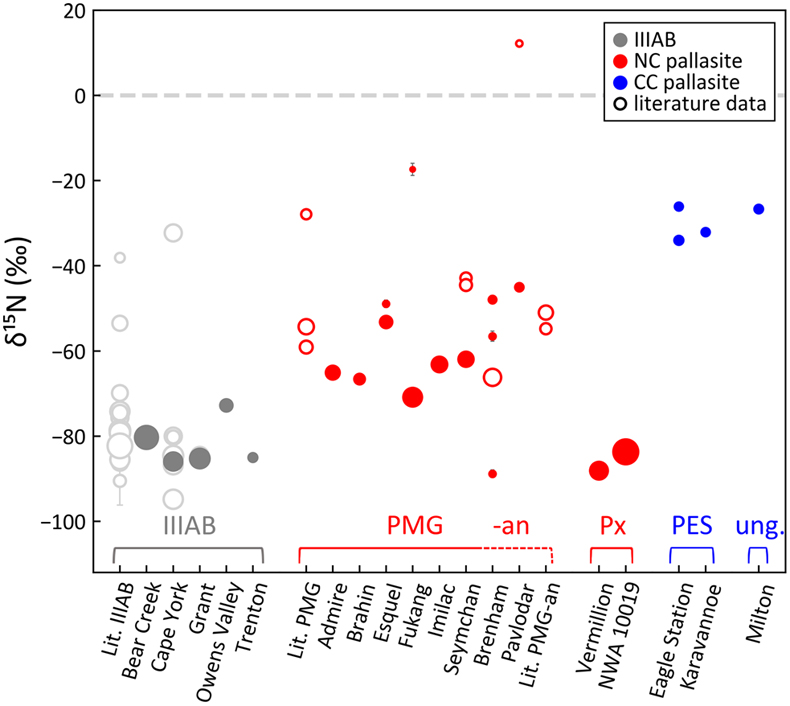
Figure 1 δ15N of metal from pallasites and IIIAB iron meteorites. Symbol sizes are correlated to the N abundances extracted per mass. Uncertainties are 1σ, and error bars are, in most cases, smaller than symbol sizes. Literature data sources are listed in Table S-5.
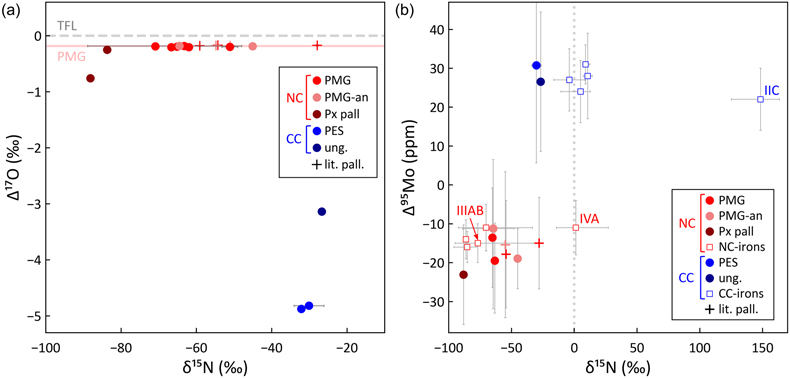
Figure 2 (a) Oxygen isotopic anomalies (Δ17O = δ17O − 0.52 × δ18O, i.e. the deviation from the terrestrial fractionation line in a δ17O versus δ18O diagram) and (b) Mo nucleosynthetic anomalies (Δ95Mo = (ɛ95Mo − 0.596 × ɛ94Mo) × 100; Spitzer et al., 2020
Spitzer, F., Burkhardt, C., Budde, G., Kruijer, T.S., Morbidelli, A., Kleine, T. (2020) Isotopic Evolution of the Inner Solar System Inferred from Molybdenum Isotopes in Meteorites. The Astrophysical Journal Letters 898, L2. https://doi.org/10.3847/2041-8213/ab9e6a
) of pallasites and iron meteorites versus their N isotopic compositions. Iron meteorite data points represent average values for each group originating from specific parent bodies, while pallasite data points correspond to average values of individual meteorites. Meteorites and groups from the NC and CC reservoirs are shown in different shades of red and blue, respectively. The dashed line in (a) marks the terrestrial fractionation line (TFL), and the dotted line in (b) indicates δ15N = 0 ‰. Error bars for δ15N represent the range of values for both pallasites and iron meteorites. For pallasites, error bars for Δ17O and Δ95Mo similarly represent the range of literature data, including the large 1σ uncertainties for Δ95Mo. For iron meteorites, Δ95Mo values are taken from Spitzer et al. (2020)Spitzer, F., Burkhardt, C., Budde, G., Kruijer, T.S., Morbidelli, A., Kleine, T. (2020) Isotopic Evolution of the Inner Solar System Inferred from Molybdenum Isotopes in Meteorites. The Astrophysical Journal Letters 898, L2. https://doi.org/10.3847/2041-8213/ab9e6a
, with uncertainties corresponding to the 95 % confidence intervals. Literature data sources are listed in Table S-5.