



Silicified seafloor contribution to TTG formation: insights from zircon O and Si isotopes
Affiliations | Corresponding Author | Cite as | Funding information
Published by the European Association of Geochemistry
under Creative Commons License CC BY-NC-ND 4.0
Keywords: Oxygen isotope, Silicon isotope, silicified seafloor, subduction, TTG, Zircon


- Share this article


-
Article views:1,619Cumulative count of HTML views and PDF downloads.
- Download Citation
- Rights & Permissions

top
Abstract
Figures
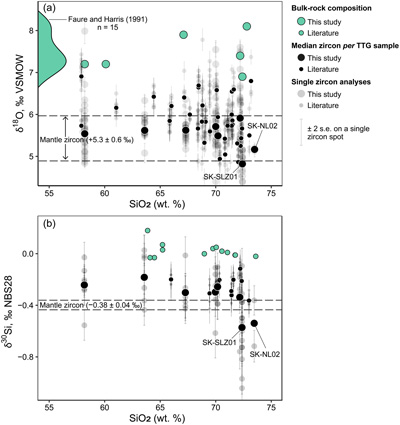 Figure 1 Oxygen and silicon isotopic composition of bulk rock and zircon samples from the BGGT plotted against bulk rock SiO2 concentration. Error bars are 2 s.e. uncertainty for every spot. Density curve in (a) presents δ18Owr values in 15 samples from the Kaap Valley pluton (BGGT) from Faure and Harris (1991). Other Barberton TTG data sources: δ18Ozrc in (a) (Valley et al., 2005; Wang et al., 2022; Lei et al., 2023), and whole rock δ30Siwr in (b) (André et al., 2019; Deng et al., 2019), δ30Sizrc (Guitreau et al., 2022; Lei et al., 2023). The ‘mantle zircon’ range represents δ18Ozrc and δ30Sizrc values of zircons from peridotites and kimberlites (Trail et al., 2018). | 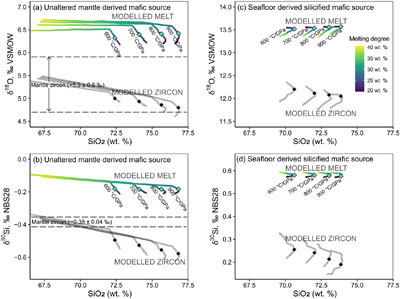 Figure 2 Modelled melt and zircon isotopic compositions reflecting partial melting of an unaltered mafic source and a silicified source along different P-T paths. We considered melting degrees between 20 and 40 wt. % (able to produce TTG-like melts) (Laurie and Stevens, 2012). Plotted SiO2 concentrations are calculated on an anhydrous basis. Diamonds represent conditions where partial melting of a basaltic source generates a melt with TTG-like major element composition. In (c) we only considered an average δ18Owr of +13.5 ‰ for a silicified mafic source (overlooking the full δ18Owr variation shown in Fig. 3 for simplicity). | 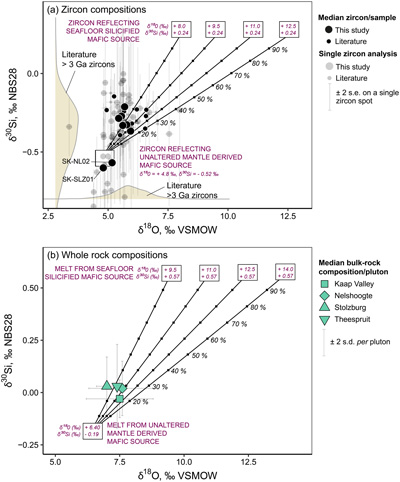 Figure 3 Mixing model explaining the origin of oxygen and silicon isotopic compositions of (a) BGGT TTG zircon and (b) whole rock samples. Density curves in (a) are distributions of δ18Ozrc and δ30Sizrc in other Paleoarchean or older zircons (references in Table S-5). The two end member source signatures considered in the mixing calculations result from our numerical model. Zircon compositions on mixing curves represent the calculated isotopic composition of zircon crystallised from modelled liquids (end member or mixed). Average δ18Owr temporal variation in Onverwacht silicified lavas (Kitoga et al., 2024) is considered. |
| Figure 1 | Figure 2 | Figure 3 |
top
Introduction
Geochemical signatures of buried seafloor lithologies in Archean TTGs (tonalite-trondhjemite-granodiorite) are critical for constraining seafloor alteration and burial processes on the early Earth (Trail et al., 2018
Trail, D., Boehnke, P., Savage, P.S., Liu, M.C., Miller, M.L., Bindeman, I. (2018) Origin and significance of Si and O isotope heterogeneities in Phanerozoic, Archean, and Hadean zircon. Proceedings of the National Academy of Sciences of the United States of America 115, 10287–10292. https://doi.org/10.1073/pnas.1808335115
; André et al., 2019André, L., Abraham, K., Hofmann, A., Monin, L., Kleinhanns, I.C., Foley, S. (2019) Early continental crust generated by reworking of basalts variably silicified by seawater. Nature Geoscience. https://doi.org/10.1038/s41561-019-0408-5
; Deng et al., 2019Deng, Z., Chaussidon, M., Guitreau, M., Puchtel, I.S., Dauphas, N. (2019) An oceanic subduction origin for Archean granitoids revealed by silicon isotopes. Nature Geoscience 12, 774–779. https://doi.org/10.1038/s41561-019-0407-6
). TTGs are the oldest available granitic lithologies and formed by partial melting of hydrated mafic crust (Condie, 2013Condie, K.C. (2013) How to Make a Continent: Thirty-five Years of TTG Research. In: Dilek, Y., Furnes, H. (Eds.) Evolution of Archean crust and early life. Springer, 179–193. https://doi.org/10.1007/978-94-007-7615-9
). Because TTG source regions likely comprised altered lithologies derived from the surface (André et al., 2019André, L., Abraham, K., Hofmann, A., Monin, L., Kleinhanns, I.C., Foley, S. (2019) Early continental crust generated by reworking of basalts variably silicified by seawater. Nature Geoscience. https://doi.org/10.1038/s41561-019-0408-5
; Deng et al., 2019Deng, Z., Chaussidon, M., Guitreau, M., Puchtel, I.S., Dauphas, N. (2019) An oceanic subduction origin for Archean granitoids revealed by silicon isotopes. Nature Geoscience 12, 774–779. https://doi.org/10.1038/s41561-019-0407-6
), TTGs offer a unique opportunity to investigate surface alteration processes on the early Earth. Most TTGs still contain pristine magmatic zircons, minimally affected by post-crystallisation alteration, that are texturally and compositionally distinct from zircons crystallised or modified during late stage processes (e.g., metamorphism) (Guitreau et al., 2022Guitreau, M., Gannoun, A., Deng, Z., Chaussidon, M., Moynier, F., Barbarin, B., Marin-Carbonne, J. (2022) Stable isotope geochemistry of silicon in granitoid zircon. Geochimica et Cosmochimica Acta 316, 273–294. https://doi.org/10.1016/j.gca.2021.09.029
). These magmatic zircons typically serve as proxy for primary TTG melts (Trail et al., 2018Trail, D., Boehnke, P., Savage, P.S., Liu, M.C., Miller, M.L., Bindeman, I. (2018) Origin and significance of Si and O isotope heterogeneities in Phanerozoic, Archean, and Hadean zircon. Proceedings of the National Academy of Sciences of the United States of America 115, 10287–10292. https://doi.org/10.1073/pnas.1808335115
; Moreira et al., 2020Moreira, H., Storey, C., Fowler, M., Seixas, L., Dunlop, J. (2020) Petrogenetic processes at the tipping point of plate tectonics: Hf-O isotope ternary modelling of Earth’s last TTG to sanukitoid transition. Earth and Planetary Science Letters 551. https://doi.org/10.1016/j.epsl.2020.116558
; Guitreau et al., 2022Guitreau, M., Gannoun, A., Deng, Z., Chaussidon, M., Moynier, F., Barbarin, B., Marin-Carbonne, J. (2022) Stable isotope geochemistry of silicon in granitoid zircon. Geochimica et Cosmochimica Acta 316, 273–294. https://doi.org/10.1016/j.gca.2021.09.029
; Wang et al., 2022Wang, X., Tang, M., Moyen, J., Wang, D., Kröner, A., Xia, X., Xie, H., Anhaeusser, C., Hofmann, A., Li, J., Li, L. (2022) The onset of deep recycling of supracrustal materials at the Paleo-Mesoarchean boundary. National Science Review 9, 1–9. https://doi.org/10.1093/nsr/nwab136
).TTG zircon oxygen and silicon isotopic compositions are particularly powerful for tracing the reworking of Archean altered seafloor lithologies (Trail et al., 2018
Trail, D., Boehnke, P., Savage, P.S., Liu, M.C., Miller, M.L., Bindeman, I. (2018) Origin and significance of Si and O isotope heterogeneities in Phanerozoic, Archean, and Hadean zircon. Proceedings of the National Academy of Sciences of the United States of America 115, 10287–10292. https://doi.org/10.1073/pnas.1808335115
; Wang et al., 2022Wang, X., Tang, M., Moyen, J., Wang, D., Kröner, A., Xia, X., Xie, H., Anhaeusser, C., Hofmann, A., Li, J., Li, L. (2022) The onset of deep recycling of supracrustal materials at the Paleo-Mesoarchean boundary. National Science Review 9, 1–9. https://doi.org/10.1093/nsr/nwab136
; Guitreau et al., 2022Guitreau, M., Gannoun, A., Deng, Z., Chaussidon, M., Moynier, F., Barbarin, B., Marin-Carbonne, J. (2022) Stable isotope geochemistry of silicon in granitoid zircon. Geochimica et Cosmochimica Acta 316, 273–294. https://doi.org/10.1016/j.gca.2021.09.029
; Lei et al., 2023Lei, K., Wang, H., Wang, X., Zhang, Q., Li, X. (2023) Decoupled Zircon Si–O Isotopes Tracing the Supracrustal Silicification and Komatiitic‐Derived Fluids in the Source of TTGs. Geophysical Research Letters 50, 1–9. https://doi.org/10.1029/2023GL104002
). This is because, compared to unaltered (mantle derived) mafic rocks exhibiting a narrow range of oxygen and silicon isotopic compositions (δ18Owr = +5.6 ± 0.6 ‰; Eiler et al., 2000Eiler, J.M., Crawford, A., Elliott, T., Farley, K.A., Valley, J.W., Stolper, E.M. (2000) Oxygen isotope geochemistry of oceanic-arc lavas. Journal of Petrology 41, 229–256. https://doi.org/10.1093/petrology/41.2.229
, and δ30Siwr = −0.29 ± 0.06‰; Savage et al., 2010Savage, P.S., Georg, R.B., Armytage, R.M.G., Williams, H.M., Halliday, A.N. (2010) Silicon isotope homogeneity in the mantle. Earth and Planetary Science Letters 295, 139–146. https://doi.org/10.1016/j.epsl.2010.03.035
), altered seafloor rocks display variable oxygen and silicon isotopic compositions due to low temperature seawater-rock interactions (Abraham et al., 2011Abraham, K., Hofmann, A., Foley, S.F., Cardinal, D., Harris, C., Barth, M.G., Andre, L. (2011) Coupled silicon-oxygen isotope fractionation traces Archaean silicification. Earth and Planetary Science Letters 301, 222–230. https://doi.org/10.1016/j.epsl.2010.11.002
; André et al., 2022André, L., Monin, L., Hofmann, A. (2022) The origin of early continental crust: New clues from coupling Ge/Si ratios with silicon isotopes. Earth and Planetary Science Letters 582. https://doi.org/10.1016/j.epsl.2022.117415
). Particularly, sediments and basalts that were hydrothermally silicified on the Archean seafloor (hereafter silicified seafloor lithologies) exhibit elevated δ18Owr (+8 to +16 ‰) and δ30Siwr (0 to +1.5 ‰) (Abraham et al., 2011Abraham, K., Hofmann, A., Foley, S.F., Cardinal, D., Harris, C., Barth, M.G., Andre, L. (2011) Coupled silicon-oxygen isotope fractionation traces Archaean silicification. Earth and Planetary Science Letters 301, 222–230. https://doi.org/10.1016/j.epsl.2010.11.002
; Hofmann and Harris, 2008Hofmann, A., Harris, C. (2008) Silica alteration zones in the Barberton greenstone belt: A window into subseafloor processes 3.5-3.3 Ga ago. Chemical Geology 257, 224–242. https://doi.org/10.1016/j.chemgeo.2008.09.015
). If such silicified seafloor lithologies partially melted to generate felsic liquids, the latter must have inherited their unique O and Si isotopic compositions. Thus, felsic melt extraction from buried silicified seafloor lithologies to Archean TTGs can be traced by bulk rock and zircon O and Si isotope compositions in TTGs (Trail et al., 2018Trail, D., Boehnke, P., Savage, P.S., Liu, M.C., Miller, M.L., Bindeman, I. (2018) Origin and significance of Si and O isotope heterogeneities in Phanerozoic, Archean, and Hadean zircon. Proceedings of the National Academy of Sciences of the United States of America 115, 10287–10292. https://doi.org/10.1073/pnas.1808335115
; André et al., 2019André, L., Abraham, K., Hofmann, A., Monin, L., Kleinhanns, I.C., Foley, S. (2019) Early continental crust generated by reworking of basalts variably silicified by seawater. Nature Geoscience. https://doi.org/10.1038/s41561-019-0408-5
). Generally, if located within the δ18Ozrc range of +5.3 ± 0.6 ‰ and δ30Sizrc range of −0.38 ± 0.04 ‰ characterising “mantle zircons” (or zircon potentially crystallised in the mantle and hosted in kimberlites; Valley et al., 1998Valley, J.W., Kinny, P.D., Schulze, D.J., Spicuzza, M.J. (1998) Zircon megacrysts from kimberlite: Oxygen isotope variability among mantle melts. Contributions to Mineralogy and Petrology 133, 1–11. https://doi.org/10.1007/s004100050432
; Trail et al., 2018Trail, D., Boehnke, P., Savage, P.S., Liu, M.C., Miller, M.L., Bindeman, I. (2018) Origin and significance of Si and O isotope heterogeneities in Phanerozoic, Archean, and Hadean zircon. Proceedings of the National Academy of Sciences of the United States of America 115, 10287–10292. https://doi.org/10.1073/pnas.1808335115
), δ18Ozrc and δ30Sizrc values of TTG hosted zircons are interpreted to evidence zircon crystallisation from felsic liquids generated by partial melting of unaltered (mantle derived) mafic rocks. Contrastingly, δ18Ozrc and δ30Sizrc outside this “mantle zircon” range are generally ascribed to partial melting of altered mafic lithologies or sediments, or an input of fluids from the surface (Valley et al., 2005Valley, J.W., Lackey, J.S., Cavosie, A.J., Clechenko, C.C., Spicuzza, M.J., Basei, M.A.S., Bindeman, I.N., Ferreira, V.P., Sial, A.N., King, E.M., Peck, W.H., Sinha, A.K., Wei, C.S. (2005) 4.4 billion years of crustal maturation: Oxygen isotope ratios of magmatic zircon. Contributions to Mineralogy and Petrology 150, 561–580. https://doi.org/10.1007/s00410-005-0025-8
; Moreira et al., 2020Moreira, H., Storey, C., Fowler, M., Seixas, L., Dunlop, J. (2020) Petrogenetic processes at the tipping point of plate tectonics: Hf-O isotope ternary modelling of Earth’s last TTG to sanukitoid transition. Earth and Planetary Science Letters 551. https://doi.org/10.1016/j.epsl.2020.116558
; Lei et al., 2023Lei, K., Wang, H., Wang, X., Zhang, Q., Li, X. (2023) Decoupled Zircon Si–O Isotopes Tracing the Supracrustal Silicification and Komatiitic‐Derived Fluids in the Source of TTGs. Geophysical Research Letters 50, 1–9. https://doi.org/10.1029/2023GL104002
). However, the mantle zircon range was originally constrained by analysing zircons from kimberlites and peridotites (Valley et al., 1998Valley, J.W., Kinny, P.D., Schulze, D.J., Spicuzza, M.J. (1998) Zircon megacrysts from kimberlite: Oxygen isotope variability among mantle melts. Contributions to Mineralogy and Petrology 133, 1–11. https://doi.org/10.1007/s004100050432
; Trail et al., 2018Trail, D., Boehnke, P., Savage, P.S., Liu, M.C., Miller, M.L., Bindeman, I. (2018) Origin and significance of Si and O isotope heterogeneities in Phanerozoic, Archean, and Hadean zircon. Proceedings of the National Academy of Sciences of the United States of America 115, 10287–10292. https://doi.org/10.1073/pnas.1808335115
), neglecting mineral-melt O and Si isotope fractionations during partial melting and crystallisation processes (Lackey et al., 2008Lackey, J.S., Valley, J.W., Chen, J.H., Stockli, D.F. (2008) Dynamic magma systems, crustal recycling, and alteration in the Central Sierra Nevada batholith: The oxygen isotope record. Journal of Petrology 49, 1397–1426. https://doi.org/10.1093/petrology/egn030
; Guitreau et al., 2022Guitreau, M., Gannoun, A., Deng, Z., Chaussidon, M., Moynier, F., Barbarin, B., Marin-Carbonne, J. (2022) Stable isotope geochemistry of silicon in granitoid zircon. Geochimica et Cosmochimica Acta 316, 273–294. https://doi.org/10.1016/j.gca.2021.09.029
; Murphy et al., 2024Murphy, M.E., Macdonald, J.E., Fischer, S., Gardiner, N.J., White, R.W., Savage, P.S. (2024) Silicon isotopes in an Archaean migmatite confirm seawater silicification of TTG sources. Geochimica et Cosmochimica Acta 368, 34–49. https://doi.org/10.1016/j.gca.2024.01.018
). Considering these fractionations can improve the determination of TTG source lithologies from bulk rock and zircon O and Si isotope analyses and the detection of altered seafloor lithology signatures in TTGs and zircons. This is important because such signatures are critical for understanding surface alteration conditions (André et al., 2019André, L., Abraham, K., Hofmann, A., Monin, L., Kleinhanns, I.C., Foley, S. (2019) Early continental crust generated by reworking of basalts variably silicified by seawater. Nature Geoscience. https://doi.org/10.1038/s41561-019-0408-5
) and geodynamic processes that potentially transported altered rocks towards deeper melting regions (Deng et al., 2019Deng, Z., Chaussidon, M., Guitreau, M., Puchtel, I.S., Dauphas, N. (2019) An oceanic subduction origin for Archean granitoids revealed by silicon isotopes. Nature Geoscience 12, 774–779. https://doi.org/10.1038/s41561-019-0407-6
). These processes remain debated between 1) burial below thick volcanic successions (Hernández-Uribe, 2024Hernández-Uribe, D. (2024) Generation of Archaean oxidizing and wet magmas from mafic crustal overthickening. Nature Geoscience 8–10. https://doi.org/10.1038/s41561-024-01489-z
), 2) burial due to density driven vertical movements (Smithies et al., 2021Smithies, R.H., Lu, Y., Kirkland, C.L., Johnson, T.E., Mole, D.R., Champion, D.C., Martin, L., Jeon, H., Wingate, M.T.D., Johnson, S.P. (2021) Oxygen isotopes trace the origins of Earth’s earliest continental crust. Nature 592. https://doi.org/10.1038/s41586-021-03337-1
), and 3) burial due to horizontal motions linked to modern-like subduction (Deng et al., 2019Deng, Z., Chaussidon, M., Guitreau, M., Puchtel, I.S., Dauphas, N. (2019) An oceanic subduction origin for Archean granitoids revealed by silicon isotopes. Nature Geoscience 12, 774–779. https://doi.org/10.1038/s41561-019-0407-6
). Integrating isotopic data with stratigraphic and metamorphic constrains on burial depth of reworked seafloor rocks can improve the understanding of Archean geodynamic processes.This study aims to 1) trace the signature of silicified seafloor rocks in Archean TTG source regions using zircon O and Si isotope compositions, and 2) integrate isotopic data with knowledge of regional geology to discuss geodynamic processes that transported seafloor lithologies towards melting regions. For these purposes, we present new O and Si isotope data for magmatic zircons and new O isotope data for bulk rock samples from 3.45 and 3.22 Ga TTGs occurring in the Barberton Granitoid-Greenstone Terrain (BGGT, South Africa) (Table S-1 and Fig. S-1). These new data are combined with previously published O and Si isotopic compositions of bulk rock samples and zircons from Barberton TTG (Faure and Harris, 1991
Faure, K., Harris, C. (1991) Oxygen and carbon isotope geochemistry of the 3. 2 Ga Kaap Valley tonalite, Barberton greenstone belt, South Africa. Precambrian Research 52, 301–319.
; Valley et al., 2005Valley, J.W., Lackey, J.S., Cavosie, A.J., Clechenko, C.C., Spicuzza, M.J., Basei, M.A.S., Bindeman, I.N., Ferreira, V.P., Sial, A.N., King, E.M., Peck, W.H., Sinha, A.K., Wei, C.S. (2005) 4.4 billion years of crustal maturation: Oxygen isotope ratios of magmatic zircon. Contributions to Mineralogy and Petrology 150, 561–580. https://doi.org/10.1007/s00410-005-0025-8
; André et al., 2019André, L., Abraham, K., Hofmann, A., Monin, L., Kleinhanns, I.C., Foley, S. (2019) Early continental crust generated by reworking of basalts variably silicified by seawater. Nature Geoscience. https://doi.org/10.1038/s41561-019-0408-5
; Deng et al., 2019Deng, Z., Chaussidon, M., Guitreau, M., Puchtel, I.S., Dauphas, N. (2019) An oceanic subduction origin for Archean granitoids revealed by silicon isotopes. Nature Geoscience 12, 774–779. https://doi.org/10.1038/s41561-019-0407-6
; Guitreau et al., 2022Guitreau, M., Gannoun, A., Deng, Z., Chaussidon, M., Moynier, F., Barbarin, B., Marin-Carbonne, J. (2022) Stable isotope geochemistry of silicon in granitoid zircon. Geochimica et Cosmochimica Acta 316, 273–294. https://doi.org/10.1016/j.gca.2021.09.029
; Wang et al., 2022Wang, X., Tang, M., Moyen, J., Wang, D., Kröner, A., Xia, X., Xie, H., Anhaeusser, C., Hofmann, A., Li, J., Li, L. (2022) The onset of deep recycling of supracrustal materials at the Paleo-Mesoarchean boundary. National Science Review 9, 1–9. https://doi.org/10.1093/nsr/nwab136
; Lei et al., 2023Lei, K., Wang, H., Wang, X., Zhang, Q., Li, X. (2023) Decoupled Zircon Si–O Isotopes Tracing the Supracrustal Silicification and Komatiitic‐Derived Fluids in the Source of TTGs. Geophysical Research Letters 50, 1–9. https://doi.org/10.1029/2023GL104002
). We also present a petrological model simulating the O and Si isotope compositions of TTG melts and zircons that reflect the reworking of unaltered mafic lithologies and silicified seafloor mafic lithologies in the TTG source region.top
Results
The δ18Ozrc, δ30Sizrc, δ18Owr values, major element compositions of Barberton TTG samples and images of zircons analysed in this study (Tables S-1 to S-4 and Figs. S-1 to S-3) are provided in Supplementary Information. The TTG SiO2 content ranges between 58.2 and 73.5 wt. % and covers a large compositional spectrum from tonalite to trondhjemite (Fig. S-4), with a K2O/Na2O ratios of 0.22 to 0.38. Bulk δ18Owr values for the studied TTG samples range between +6.9 and +8.1 ‰, consistent with previously published δ18Owr values for Barberton TTGs (Fig. 1a) (Faure and Harris, 1991
Faure, K., Harris, C. (1991) Oxygen and carbon isotope geochemistry of the 3. 2 Ga Kaap Valley tonalite, Barberton greenstone belt, South Africa. Precambrian Research 52, 301–319.
). For zircon, median δ18Ozrc and δ30Sizrc values per analysed TTG sample range respectively from +4.8 ± 0.59 to +5.91 ± 0.96 ‰ and from −0.21 ± 0.34 to −0.60 ± 0.57 ‰ (Fig. 1a,b). Significant δ18Ozrc and δ30Sizrc variation appear between crystals of the same sample with 2 s.d. values up to ±0.96 ‰ for δ18Ozrc and ±0.57 ‰ for δ30Sizrc (Fig. 1, Tables S-1 to S-3). Important variations occur also between samples of the same pluton (e.g., Nelshoogte and Stolzburg samples in Table S-1). Although samples SK-NL02 and SK-SLZ01 with the highest SiO2 contents show the lowest zircon δ18Ozrc and δ30Sizrc median values, no continuous correlation is observed between bulk rock major element features like SiO2 content (Fig. 1a) and inter-sample or intra-pluton variations of δ18Ozrc and δ30Sizrc.Figure 1 Oxygen and silicon isotopic composition of bulk rock and zircon samples from the BGGT plotted against bulk rock SiO2 concentration. Error bars are 2 s.e. uncertainty for every spot. Density curve in (a) presents δ18Owr values in 15 samples from the Kaap Valley pluton (BGGT) from Faure and Harris (1991)
Faure, K., Harris, C. (1991) Oxygen and carbon isotope geochemistry of the 3. 2 Ga Kaap Valley tonalite, Barberton greenstone belt, South Africa. Precambrian Research 52, 301–319.
. Other Barberton TTG data sources: δ18Ozrc in (a) (Valley et al., 2005Valley, J.W., Lackey, J.S., Cavosie, A.J., Clechenko, C.C., Spicuzza, M.J., Basei, M.A.S., Bindeman, I.N., Ferreira, V.P., Sial, A.N., King, E.M., Peck, W.H., Sinha, A.K., Wei, C.S. (2005) 4.4 billion years of crustal maturation: Oxygen isotope ratios of magmatic zircon. Contributions to Mineralogy and Petrology 150, 561–580. https://doi.org/10.1007/s00410-005-0025-8
; Wang et al., 2022Wang, X., Tang, M., Moyen, J., Wang, D., Kröner, A., Xia, X., Xie, H., Anhaeusser, C., Hofmann, A., Li, J., Li, L. (2022) The onset of deep recycling of supracrustal materials at the Paleo-Mesoarchean boundary. National Science Review 9, 1–9. https://doi.org/10.1093/nsr/nwab136
; Lei et al., 2023Lei, K., Wang, H., Wang, X., Zhang, Q., Li, X. (2023) Decoupled Zircon Si–O Isotopes Tracing the Supracrustal Silicification and Komatiitic‐Derived Fluids in the Source of TTGs. Geophysical Research Letters 50, 1–9. https://doi.org/10.1029/2023GL104002
), and whole rock δ30Siwr in (b) (André et al., 2019André, L., Abraham, K., Hofmann, A., Monin, L., Kleinhanns, I.C., Foley, S. (2019) Early continental crust generated by reworking of basalts variably silicified by seawater. Nature Geoscience. https://doi.org/10.1038/s41561-019-0408-5
; Deng et al., 2019Deng, Z., Chaussidon, M., Guitreau, M., Puchtel, I.S., Dauphas, N. (2019) An oceanic subduction origin for Archean granitoids revealed by silicon isotopes. Nature Geoscience 12, 774–779. https://doi.org/10.1038/s41561-019-0407-6
), δ30Sizrc (Guitreau et al., 2022Guitreau, M., Gannoun, A., Deng, Z., Chaussidon, M., Moynier, F., Barbarin, B., Marin-Carbonne, J. (2022) Stable isotope geochemistry of silicon in granitoid zircon. Geochimica et Cosmochimica Acta 316, 273–294. https://doi.org/10.1016/j.gca.2021.09.029
; Lei et al., 2023Lei, K., Wang, H., Wang, X., Zhang, Q., Li, X. (2023) Decoupled Zircon Si–O Isotopes Tracing the Supracrustal Silicification and Komatiitic‐Derived Fluids in the Source of TTGs. Geophysical Research Letters 50, 1–9. https://doi.org/10.1029/2023GL104002
). The ‘mantle zircon’ range represents δ18Ozrc and δ30Sizrc values of zircons from peridotites and kimberlites (Trail et al., 2018Trail, D., Boehnke, P., Savage, P.S., Liu, M.C., Miller, M.L., Bindeman, I. (2018) Origin and significance of Si and O isotope heterogeneities in Phanerozoic, Archean, and Hadean zircon. Proceedings of the National Academy of Sciences of the United States of America 115, 10287–10292. https://doi.org/10.1073/pnas.1808335115
).In the thermodynamic model (modelling methods and additional results given in SI), partial melting of an average unaltered Onverwacht basalt at 700–800 °C and 0.8–1.3 GPa along different geothermal gradients (600–900 °C/GPa) provides a liquid that is similar in major element composition to primary melts of TTGs obtained experimentally (Laurie and Stevens, 2012
Laurie, A., Stevens, G. (2012) Water-present eclogite melting to produce Earth’s early felsic crust. Chemical Geology 314–317, 83–95. https://doi.org/10.1016/j.chemgeo.2012.05.001
) and calculated empirically from compiled Barberton TTG compositions (Laurent et al., 2020Laurent, O., Björnsen, J., Wotzlaw, J.-F., Bretscher, S., Pimenta Silva, M., Moyen, J.-F., Ulmer, P., Bachmann, O. (2020) Earth’s earliest granitoids are crystal-rich magma reservoirs tapped by silicic eruptions. Nature Geoscience 13, 163–169. https://doi.org/10.1038/s41561-019-0520-6
) (e.g., K2O/Na2O ratio of ∼0.25) (Fig. S-5). At the same P-T conditions, partial melting of the average silicified basalt produces a more potassic liquid (K2O/Na2O = 3.1 to 3.3) (Fig. S-5). Considering the proportion of residual mineral phases (Fig. S-6) and mineral/liquid fractionation coefficients (Table S-4), we modelled δ18O values of +6.4 ‰ and δ30Si values of −0.19 ‰ for TTG-like liquids generated by partial melting of unaltered Onverwacht basalt (or unaltered mafic source) (Fig. 2). For the liquid formed by partial melting of silicified mafic source, we obtained δ18Owr values of +9.5 to +14.0 ‰ (considering average δ18Owr variation between +10.0 and +14.5 ‰ in Onverwacht silicified rocks; Kitoga et al., 2024Kitoga, L.S., Zakharov, D., Marin-Carbonne, J., Boyet, M., Moyen, J.-F., Di Rocco, T., Pack, A., Olivier, N., Stevens, G. (2024) Oxygen and silicon isotopic compositions of Archean silicified lava and cherts of the Onverwacht Group: Implication for seafloor hydrothermalism and the nature of recycled components in the source of granitoids. Chemical Geology, 122407. https://doi.org/10.1016/j.chemgeo.2024.122407
) and δ30Siwr values of +0.58 to +0.56 ‰ (Fig. 2). For magmatic zircons crystallised in the melt derived from partial melting of an unaltered mafic source, we obtained δ18Ozrc values of +4.8 to +5.0 ‰ and δ30Sizrc values of −0.50 to −0.60 ‰, considering zircon/liquid empirical fractionation coefficients (Lackey et al., 2008Lackey, J.S., Valley, J.W., Chen, J.H., Stockli, D.F. (2008) Dynamic magma systems, crustal recycling, and alteration in the Central Sierra Nevada batholith: The oxygen isotope record. Journal of Petrology 49, 1397–1426. https://doi.org/10.1093/petrology/egn030
; Guitreau et al., 2022Guitreau, M., Gannoun, A., Deng, Z., Chaussidon, M., Moynier, F., Barbarin, B., Marin-Carbonne, J. (2022) Stable isotope geochemistry of silicon in granitoid zircon. Geochimica et Cosmochimica Acta 316, 273–294. https://doi.org/10.1016/j.gca.2021.09.029
). Much higher δ18Ozrc values of +8.0 to +12.5 ‰ and δ30Sizrc of +0.19 to +0.26 ‰ are obtained for zircons crystallised in equilibrium with the melt derived from silicified source (Fig. 2).Figure 2 Modelled melt and zircon isotopic compositions reflecting partial melting of an unaltered mafic source and a silicified source along different P-T paths. We considered melting degrees between 20 and 40 wt. % (able to produce TTG-like melts) (Laurie and Stevens, 2012
Laurie, A., Stevens, G. (2012) Water-present eclogite melting to produce Earth’s early felsic crust. Chemical Geology 314–317, 83–95. https://doi.org/10.1016/j.chemgeo.2012.05.001
). Plotted SiO2 concentrations are calculated on an anhydrous basis. Diamonds represent conditions where partial melting of a basaltic source generates a melt with TTG-like major element composition. In (c) we only considered an average δ18Owr of +13.5 ‰ for a silicified mafic source (overlooking the full δ18Owr variation shown in Fig. 3 for simplicity).top
Discussion
Silicified seafloor lithologies in Barberton TTG source. Oxygen and silicon isotopic compositions of TTGs and their zircons are important for identifying altered seafloor lithology inputs into the TTG source regions (Trail et al., 2018
Trail, D., Boehnke, P., Savage, P.S., Liu, M.C., Miller, M.L., Bindeman, I. (2018) Origin and significance of Si and O isotope heterogeneities in Phanerozoic, Archean, and Hadean zircon. Proceedings of the National Academy of Sciences of the United States of America 115, 10287–10292. https://doi.org/10.1073/pnas.1808335115
; André et al., 2019André, L., Abraham, K., Hofmann, A., Monin, L., Kleinhanns, I.C., Foley, S. (2019) Early continental crust generated by reworking of basalts variably silicified by seawater. Nature Geoscience. https://doi.org/10.1038/s41561-019-0408-5
; Deng et al., 2019Deng, Z., Chaussidon, M., Guitreau, M., Puchtel, I.S., Dauphas, N. (2019) An oceanic subduction origin for Archean granitoids revealed by silicon isotopes. Nature Geoscience 12, 774–779. https://doi.org/10.1038/s41561-019-0407-6
). Bulk rock and zircon δ18O and δ30Si values measured in Barberton TTGs (Fig. 1) (except in zircons from samples SK-SLZ01 and SK-NL02) are higher than isotopic values obtained in our model for felsic liquids issued by partial melting of an unaltered mantle derived mafic source and for zircon crystallised from these felsic melts (Fig. 2c). Variations of δ18O and δ30Si in bulk rock samples and zircons do not show a continuous correlation with bulk rock SiO2 concentrations (Fig. 1). Such a continuous correlation typically reflects isotopic variation due to magmatic differentiation of a primary melt and/or crust assimilation (Lackey et al., 2008Lackey, J.S., Valley, J.W., Chen, J.H., Stockli, D.F. (2008) Dynamic magma systems, crustal recycling, and alteration in the Central Sierra Nevada batholith: The oxygen isotope record. Journal of Petrology 49, 1397–1426. https://doi.org/10.1093/petrology/egn030
; Savage et al., 2011Savage, P.S., Georg, R.B., Williams, H.M., Burton, K.W., Halliday, A.N. (2011) Silicon isotope fractionation during magmatic differentiation. Geochimica et Cosmochimica Acta 75, 6124–6139. https://doi.org/10.1016/j.gca.2011.07.043
; Guitreau et al., 2022Guitreau, M., Gannoun, A., Deng, Z., Chaussidon, M., Moynier, F., Barbarin, B., Marin-Carbonne, J. (2022) Stable isotope geochemistry of silicon in granitoid zircon. Geochimica et Cosmochimica Acta 316, 273–294. https://doi.org/10.1016/j.gca.2021.09.029
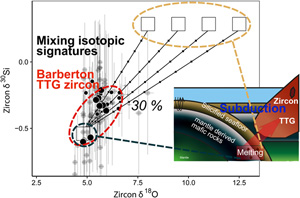
). The lack of continuous correlation between isotopic compositions and SiO2 in Barberton TTGs (Fig. 1) precludes an important control of magmatic differentiation on measured isotopic compositions.In δ18O versus δ30Si diagram (Fig. 3), Barberton TTGs and their zircons plot on mixing curves between end member isotopic signatures reflecting partial melting of an unaltered mafic source and a silicified seafloor source. Mixing unaltered mafic lithologies with up to ∼30 % of silicified seafloor rocks in the melting region accounts for the measured isotopic compositions, consistent with estimates of André et al. (2019)
André, L., Abraham, K., Hofmann, A., Monin, L., Kleinhanns, I.C., Foley, S. (2019) Early continental crust generated by reworking of basalts variably silicified by seawater. Nature Geoscience. https://doi.org/10.1038/s41561-019-0408-5
. We note, however, that the lowest δ18Ozrc and δ30Sizrc values observed in samples SK-SLZ01 and SK-NL02 mimic the modelled zircon end member composition reflecting partial melting of an unaltered mafic lithology (Fig. 3). These particular zircons (and others displaying similar δ18Ozrc values in the literature, e.g., Moreira et al., 2020Moreira, H., Storey, C., Fowler, M., Seixas, L., Dunlop, J. (2020) Petrogenetic processes at the tipping point of plate tectonics: Hf-O isotope ternary modelling of Earth’s last TTG to sanukitoid transition. Earth and Planetary Science Letters 551. https://doi.org/10.1016/j.epsl.2020.116558
; Smithies et al., 2021Smithies, R.H., Lu, Y., Kirkland, C.L., Johnson, T.E., Mole, D.R., Champion, D.C., Martin, L., Jeon, H., Wingate, M.T.D., Johnson, S.P. (2021) Oxygen isotopes trace the origins of Earth’s earliest continental crust. Nature 592. https://doi.org/10.1038/s41586-021-03337-1
) likely reflect a so far undocumented end member for Archean magmatic zircons crystallised in felsic liquids generated mainly by partial melting of an unaltered mafic lithology. This interpretation is also consistent with sample SK-SLZ01 showing the lowest whole rock δ18Owr of our dataset, although bulk rock compositions generally do not preserve this end member signature in Barberton TTGs.Figure 3 Mixing model explaining the origin of oxygen and silicon isotopic compositions of (a) BGGT TTG zircon and (b) whole rock samples. Density curves in (a) are distributions of δ18Ozrc and δ30Sizrc in other Paleoarchean or older zircons (references in Table S-5). The two end member source signatures considered in the mixing calculations result from our numerical model. Zircon compositions on mixing curves represent the calculated isotopic composition of zircon crystallised from modelled liquids (end member or mixed). Average δ18Owr temporal variation in Onverwacht silicified lavas (Kitoga et al., 2024
Kitoga, L.S., Zakharov, D., Marin-Carbonne, J., Boyet, M., Moyen, J.-F., Di Rocco, T., Pack, A., Olivier, N., Stevens, G. (2024) Oxygen and silicon isotopic compositions of Archean silicified lava and cherts of the Onverwacht Group: Implication for seafloor hydrothermalism and the nature of recycled components in the source of granitoids. Chemical Geology, 122407. https://doi.org/10.1016/j.chemgeo.2024.122407
) is considered.Recently, a controversy on Barberton TTG source lithologies arose from interpretations of δ18O and δ30Si values of their bulk rock samples and zircons. Wang et al. (2022)
Wang, X., Tang, M., Moyen, J., Wang, D., Kröner, A., Xia, X., Xie, H., Anhaeusser, C., Hofmann, A., Li, J., Li, L. (2022) The onset of deep recycling of supracrustal materials at the Paleo-Mesoarchean boundary. National Science Review 9, 1–9. https://doi.org/10.1093/nsr/nwab136
interpreted 3.45 Ga Barberton TTG zircons with δ18Ozrc signatures within the range of mantle zircons as demonstrating the absence of silicified seafloor rocks in the TTG source region. Conversely, δ30Sizrc (Guitreau et al., 2022Guitreau, M., Gannoun, A., Deng, Z., Chaussidon, M., Moynier, F., Barbarin, B., Marin-Carbonne, J. (2022) Stable isotope geochemistry of silicon in granitoid zircon. Geochimica et Cosmochimica Acta 316, 273–294. https://doi.org/10.1016/j.gca.2021.09.029
; Lei et al., 2023Lei, K., Wang, H., Wang, X., Zhang, Q., Li, X. (2023) Decoupled Zircon Si–O Isotopes Tracing the Supracrustal Silicification and Komatiitic‐Derived Fluids in the Source of TTGs. Geophysical Research Letters 50, 1–9. https://doi.org/10.1029/2023GL104002
) and δ30Siwr values (André et al., 2019André, L., Abraham, K., Hofmann, A., Monin, L., Kleinhanns, I.C., Foley, S. (2019) Early continental crust generated by reworking of basalts variably silicified by seawater. Nature Geoscience. https://doi.org/10.1038/s41561-019-0408-5
; Deng et al., 2019Deng, Z., Chaussidon, M., Guitreau, M., Puchtel, I.S., Dauphas, N. (2019) An oceanic subduction origin for Archean granitoids revealed by silicon isotopes. Nature Geoscience 12, 774–779. https://doi.org/10.1038/s41561-019-0407-6
) within the same Barberton TTGs were ascribed to the presence of silicified seafloor lithologies in the source regions. These contradictory interpretations result from considering that zircons with δ18Ozrc of +5.3 ± 0.6 ‰ and δ30Sizrc of −0.38 ± 0.04 ‰ (mantle zircon ranges; Fig. 1b), necessarily crystallised from melts formed by partial melting of unaltered mafic lithologies. Our model reveals that zircons reflecting an unaltered mantle derived source for TTGs are restricted to a δ18Ozrc of +4.8 to +5.0 ‰ and δ30Sizrc of −0.5 to −0.6‰ (Fig. 2). When modelled end member compositions are mixed, δ18Ozrc and δ30Sizrc appear to be well coupled in Barberton TTGs and reflect a contribution of silicified seafloor lithologies to the TTG melt (Fig. 3). Our dataset shows no δ18Ozrc variation over time, although Wang et al. (2022)Wang, X., Tang, M., Moyen, J., Wang, D., Kröner, A., Xia, X., Xie, H., Anhaeusser, C., Hofmann, A., Li, J., Li, L. (2022) The onset of deep recycling of supracrustal materials at the Paleo-Mesoarchean boundary. National Science Review 9, 1–9. https://doi.org/10.1093/nsr/nwab136
observed an increase of δ18Ozrc at ∼3.23 Ga in Barberton TTGs. The highest δ18Ozrc (exceeding 5.9 ‰) were measured only in post-3.23 Ga Honingklip, Eerstehoek and Uitgevonden bodies (Fig. S-1) by Wang et al. (2022)Wang, X., Tang, M., Moyen, J., Wang, D., Kröner, A., Xia, X., Xie, H., Anhaeusser, C., Hofmann, A., Li, J., Li, L. (2022) The onset of deep recycling of supracrustal materials at the Paleo-Mesoarchean boundary. National Science Review 9, 1–9. https://doi.org/10.1093/nsr/nwab136
(not analysed here), and may reflect incorporation of silicified seafloor lithologies with a higher δ18O value, by the source region of these specific plutons (Kitoga et al., 2024Kitoga, L.S., Zakharov, D., Marin-Carbonne, J., Boyet, M., Moyen, J.-F., Di Rocco, T., Pack, A., Olivier, N., Stevens, G. (2024) Oxygen and silicon isotopic compositions of Archean silicified lava and cherts of the Onverwacht Group: Implication for seafloor hydrothermalism and the nature of recycled components in the source of granitoids. Chemical Geology, 122407. https://doi.org/10.1016/j.chemgeo.2024.122407
). Unlike that proposed by Wang et al. (2022)Wang, X., Tang, M., Moyen, J., Wang, D., Kröner, A., Xia, X., Xie, H., Anhaeusser, C., Hofmann, A., Li, J., Li, L. (2022) The onset of deep recycling of supracrustal materials at the Paleo-Mesoarchean boundary. National Science Review 9, 1–9. https://doi.org/10.1093/nsr/nwab136
, these high δ18Ozrc values do not date the onset of seafloor recycling at ∼3.23 Ga because seafloor derived rocks were also present in the source region of ∼3.45 Ga old Stolzburg and Theespruit TTGs as well as 3.28–3.23 Ga old Kaap Valley and Nelshoogte TTGs investigated here (Fig. 3).More importantly, our results demonstrate that Paleoarchean TTG zircons with δ18Ozrc or δ30Sizrc values within the range of mantle zircon do not necessarily reflect an unaltered mafic source for TTG melts. Interestingly, the δ18Ozrc and δ30Sizrc values previously published for ≥ 3.0 Ga TTG hosted and detrital zircons in the Pilbara Craton, Saglek, North China Craton and Coorg block (Fig. 3; references listed in Table S-5) are also generally higher than signatures reflecting the partial melting of an unaltered mafic source. Consequently, partial melting of silicified seafloor rocks potentially contributed to Paleoarchean TTG melts worldwide.
Evidence of Paleoarchean subduction-like processes in the Barberton area. The presence of silicified rocks in TTG source regions complements evidence from Nd-Hf isotopes that the mafic source of Barberton TTGs was extracted from the mantle less than 0.3 Ga before being reworked (Moyen et al., 2019
Moyen, J.-F., Stevens, G., Kisters, A.F.M., Belcher, R.W., Lemirre, B. (2019) TTG Plutons of the Barberton Granitoid-Greenstone Terrain, South Africa. Earth’s Oldest Rocks, Elsevier, 607–667. https://doi.org/10.1016/b978-0-444-63901-1.00025-3
). These observations collectively support 3.5–3.2 Ga old rocks of the Onverwacht Group as proxies of lithologies melted to form 3.45 and 3.22 Ga Barberton TTGs (André et al., 2022André, L., Monin, L., Hofmann, A. (2022) The origin of early continental crust: New clues from coupling Ge/Si ratios with silicon isotopes. Earth and Planetary Science Letters 582. https://doi.org/10.1016/j.epsl.2022.117415
; Kitoga et al., 2024Kitoga, L.S., Zakharov, D., Marin-Carbonne, J., Boyet, M., Moyen, J.-F., Di Rocco, T., Pack, A., Olivier, N., Stevens, G. (2024) Oxygen and silicon isotopic compositions of Archean silicified lava and cherts of the Onverwacht Group: Implication for seafloor hydrothermalism and the nature of recycled components in the source of granitoids. Chemical Geology, 122407. https://doi.org/10.1016/j.chemgeo.2024.122407
). Thus, to constrain geodynamic processes that may have buried silicified seafloor lithologies into melting regions, we interpret our isotopic constrains in light of geological information on the stratigraphic burial and regional metamorphism of Onverwacht silicified rocks before episodes of TTG magmatism (Hofmann and Harris, 2008Hofmann, A., Harris, C. (2008) Silica alteration zones in the Barberton greenstone belt: A window into subseafloor processes 3.5-3.3 Ga ago. Chemical Geology 257, 224–242. https://doi.org/10.1016/j.chemgeo.2008.09.015
; Byerly et al., 2019Byerly, G.R., Lowe, D.R., Heubeck, C. (2019) Geologic Evolution of the Barberton Greenstone Belt—A Unique Record of Crustal Development, Surface Processes, and Early Life 3.55–3.20 Ga. Earth’s Oldest Rocks, Elsevier, 569–613. https://doi.org/10.1016/b978-0-444-63901-1.00024-1
).Within the BGGT and surrounding Paleoarchean terranes (Byerly et al., 2019
Byerly, G.R., Lowe, D.R., Heubeck, C. (2019) Geologic Evolution of the Barberton Greenstone Belt—A Unique Record of Crustal Development, Surface Processes, and Early Life 3.55–3.20 Ga. Earth’s Oldest Rocks, Elsevier, 569–613. https://doi.org/10.1016/b978-0-444-63901-1.00024-1
), there is no evidence (e.g., particularly thick stratigraphic layers) of an important volcanic and/or sedimentary event capable of burying the silicified rocks to the depth (>20km) required for their partial melting ∼3.45 and ∼3.2 Ga ago, as would be needed in a stagnant crust scenario (Moyen et al., 2019Moyen, J.-F., Stevens, G., Kisters, A.F.M., Belcher, R.W., Lemirre, B. (2019) TTG Plutons of the Barberton Granitoid-Greenstone Terrain, South Africa. Earth’s Oldest Rocks, Elsevier, 607–667. https://doi.org/10.1016/b978-0-444-63901-1.00025-3
). This precludes partial melting of altered basalts at the base of an over-thickened volcano-sedimentary succession (Hernández-Uribe, 2024Hernández-Uribe, D. (2024) Generation of Archaean oxidizing and wet magmas from mafic crustal overthickening. Nature Geoscience 8–10. https://doi.org/10.1038/s41561-024-01489-z
) as a viable explanation for the formation of BGGT TTGs. At the time of TTG magmatism in the BGGT, the silicified seafloor lithologies of the Onverwacht Group were not stratigraphically buried deeper than 10 km below the surface by younger volcanic or sedimentary piles. Thus, vertical movements of delamination or dripping (Van Kranendonk et al., 2014Van Kranendonk, M.J., Kröner, A., Hoffman, J.E., Nagel, T., Anhaeusser, C.R. (2014) Just another drip: Re-analysis of a proposed mesoarchean suture from the Barberton mountain land, South Africa. Precambrian Research 254, 19–35. https://doi.org/10.1016/j.precamres.2014.07.022
) are also unlikely to explain their transport towards TTG source regions as these vertical movements should preferentially mobilise lower crustal material. In addition, if overturn movements proposed by Schmitz and Heubeck (2021)Schmitz, M., Heubeck, C. (2021) Constraints on deformation mechanisms of the Barberton Greenstone Belt from regional stratigraphic and structural data of the synorogenic Moodies Group. Precambrian Research 362, 106177. https://doi.org/10.1016/j.precamres.2021.106177
controlled the recycling of silicified rocks into the TTG source region, at 3.48 to 3.20 Ga, a 10 km thick volcano-sedimentary succession would not be as continuously preserved with greenschist metamorphic facies, as it actually is in Barberton (Byerly et al., 2019Byerly, G.R., Lowe, D.R., Heubeck, C. (2019) Geologic Evolution of the Barberton Greenstone Belt—A Unique Record of Crustal Development, Surface Processes, and Early Life 3.55–3.20 Ga. Earth’s Oldest Rocks, Elsevier, 569–613. https://doi.org/10.1016/b978-0-444-63901-1.00024-1
).Discarding alternatives favours subduction-like processes (Stevens et al., 2002
Stevens, G., Droop, G.T.R., Armstrong, R.A., Anhaeusser, C.R. (2002) Amphibolite facies metamorphism in the Schapenburg schist belt: A record of the mid-crustal response to ∼3.23 Ga terrane accretion in the Barberton greenston belt.pdf. South African Journal of Geology 105, 271–284.
; Moyen et al., 2006Moyen, J.F., Stevens, G., Kisters, A. (2006) Record of mid-Archaean subduction from metamorphism in the Barberton terrain, South Africa. Nature 442, 559–562. https://doi.org/10.1038/nature04972
) to explain the reworking of seafloor silicified rocks in the Barberton TTG source regions. A horizontally mobile portion of the Paleoarchean crust was likely subducted below a relatively stagnant (and therefore more easily preserved) portion of the same crust due to vigorous mantle convection. This model accounts for both geochemical evidence of reworked silicified seafloor, preservation of a ∼10 km thick, continuous volcano-sedimentary succession that has never exceeded greenschist facies in northern BGGT, and rapid subduction of sediments proposed around 3.2 Ga ago by petro-chronological analyses in southern BGGT (Stevens et al., 2002Stevens, G., Droop, G.T.R., Armstrong, R.A., Anhaeusser, C.R. (2002) Amphibolite facies metamorphism in the Schapenburg schist belt: A record of the mid-crustal response to ∼3.23 Ga terrane accretion in the Barberton greenston belt.pdf. South African Journal of Geology 105, 271–284.
; Moyen et al., 2006Moyen, J.F., Stevens, G., Kisters, A. (2006) Record of mid-Archaean subduction from metamorphism in the Barberton terrain, South Africa. Nature 442, 559–562. https://doi.org/10.1038/nature04972
). It is, however, important to note that this proposed localised subduction does not necessarily imply global subduction worldwide in the Paleoarchean. In fact, in other Paleoarchean terrains such as the Pilbara craton, density driven vertical transportation was proposed as the most likely geodynamic scenario by both geological and isotopic data (Smithies et al., 2019Smithies, R.H., Lu, Y., Johnson, T.E., Kirkland, C.L., Cassidy, K.F., Champion, D.C., Mole, D.R., Zibra, I., Gessner, K., Sapkota, J., De Paoli, M.C., Poujol, M. (2019) No evidence for high-pressure melting of Earth’s crust in the Archean. Nature Communications 10. https://doi.org/10.1038/s41467-019-13547-x
). Co-occurrence of different reworking processes on the Paleoarchean Earth remains a possibility.top
Acknowledgement
The study benefited from financial support of CNRS, the South-African NRF under the international BUCOMO project, and French Agence Nationale de la Recherche (ANR-10-LABX-0006). Doctoral funding was also awarded to LSK by CNRS. We thank M.V. Leandro for companionship in the field, Clara Gorce, Syro Lacerda and Thomas Bovay for help during sample preparation, Emmy Voyer for technical expertise during CL imaging and Mareli Grobbelaar for assistance with major element analyses. Benita Putlitz and Torsten Vennemann are thanked for facilitating whole rock oxygen isotope measurements. We also sincerely thank Jean-Baptiste Combaz, Oscar Laurent, Emilie Bruand and Prof. Luc André for insightful discussions during the preparation of this manuscript. We thank the editor, Romain Tartèse, and the two anonymous reviewers for their comments and recommendations that allowed improving this manuscript. This is contribution no. 743 of the ClerVolc program of the International Research Center for Disaster Sciences and Sustainable Development of the University of Clermont Auvergne.
Editor: Romain Tartèse
top
References
Abraham, K., Hofmann, A., Foley, S.F., Cardinal, D., Harris, C., Barth, M.G., Andre, L. (2011) Coupled silicon-oxygen isotope fractionation traces Archaean silicification. Earth and Planetary Science Letters 301, 222–230. https://doi.org/10.1016/j.epsl.2010.11.002
 Show in context
This is because, compared to unaltered (mantle derived) mafic rocks exhibiting a narrow range of oxygen and silicon isotopic compositions (δ18Owr = +5.6 ± 0.6 ‰; Eiler et al., 2000, and δ30Siwr = −0.29 ± 0.06‰; Savage et al., 2010), altered seafloor rocks display variable oxygen and silicon isotopic compositions due to low temperature seawater-rock interactions (Abraham et al., 2011; André et al., 2022).
View in article
Particularly, sediments and basalts that were hydrothermally silicified on the Archean seafloor (hereafter silicified seafloor lithologies) exhibit elevated δ18Owr (+8 to +16 ‰) and δ30Siwr (0 to +1.5 ‰) (Abraham et al., 2011; Hofmann and Harris, 2008).
View in article
André, L., Abraham, K., Hofmann, A., Monin, L., Kleinhanns, I.C., Foley, S. (2019) Early continental crust generated by reworking of basalts variably silicified by seawater. Nature Geoscience. https://doi.org/10.1038/s41561-019-0408-5
Show in context Geochemical signatures of buried seafloor lithologies in Archean TTGs (tonalite-trondhjemite-granodiorite) are critical for constraining seafloor alteration and burial processes on the early Earth (Trail et al., 2018; André et al., 2019; Deng et al., 2019).
View in article
Because TTG source regions likely comprised altered lithologies derived from the surface (André et al., 2019; Deng et al., 2019), TTGs offer a unique opportunity to investigate surface alteration processes on the early Earth.
View in article
Thus, felsic melt extraction from buried silicified seafloor lithologies to Archean TTGs can be traced by bulk rock and zircon O and Si isotope compositions in TTGs (Trail et al., 2018; André et al., 2019).
View in article
This is important because such signatures are critical for understanding surface alteration conditions (André et al., 2019) and geodynamic processes that potentially transported altered rocks towards deeper melting regions (Deng et al., 2019).
View in article
These new data are combined with previously published O and Si isotopic compositions of bulk rock samples and zircons from Barberton TTG (Faure and Harris, 1991; Valley et al., 2005; André et al., 2019; Deng et al., 2019; Guitreau et al., 2022; Wang et al., 2022; Lei et al., 2023).
View in article
Other Barberton TTG data sources: δ18Ozrc in (a) (Valley et al., 2005; Wang et al., 2022; Lei et al., 2023), and whole rock δ30Siwr in (b) (André et al., 2019; Deng et al., 2019), δ30Sizrc (Guitreau et al., 2022; Lei et al., 2023).
View in article
Oxygen and silicon isotopic compositions of TTGs and their zircons are important for identifying altered seafloor lithology inputs into the TTG source regions (Trail et al., 2018; André et al., 2019; Deng et al., 2019).
View in article
Mixing unaltered mafic lithologies with up to ∼30 % of silicified seafloor rocks in the melting region accounts for the measured isotopic compositions, consistent with estimates of André et al. (2019).
View in article
Conversely, δ30Sizrc (Guitreau et al., 2022; Lei et al., 2023) and δ30Siwr values (André et al., 2019; Deng et al., 2019) within the same Barberton TTGs were ascribed to the presence of silicified seafloor lithologies in the source regions.
View in article
André, L., Monin, L., Hofmann, A. (2022) The origin of early continental crust: New clues from coupling Ge/Si ratios with silicon isotopes. Earth and Planetary Science Letters 582. https://doi.org/10.1016/j.epsl.2022.117415
Show in context This is because, compared to unaltered (mantle derived) mafic rocks exhibiting a narrow range of oxygen and silicon isotopic compositions (δ18Owr = +5.6 ± 0.6 ‰; Eiler et al., 2000, and δ30Siwr = −0.29 ± 0.06‰; Savage et al., 2010), altered seafloor rocks display variable oxygen and silicon isotopic compositions due to low temperature seawater-rock interactions (Abraham et al., 2011; André et al., 2022).
View in article
These observations collectively support 3.5–3.2 Ga old rocks of the Onverwacht Group as proxies of lithologies melted to form 3.45 and 3.22 Ga Barberton TTGs (André et al., 2022; Kitoga et al., 2024).
View in article
Byerly, G.R., Lowe, D.R., Heubeck, C. (2019) Geologic Evolution of the Barberton Greenstone Belt—A Unique Record of Crustal Development, Surface Processes, and Early Life 3.55–3.20 Ga. Earth’s Oldest Rocks, Elsevier, 569–613. https://doi.org/10.1016/b978-0-444-63901-1.00024-1
Show in context Thus, to constrain geodynamic processes that may have buried silicified seafloor lithologies into melting regions, we interpret our isotopic constrains in light of geological information on the stratigraphic burial and regional metamorphism of Onverwacht silicified rocks before episodes of TTG magmatism (Hofmann and Harris, 2008; Byerly et al., 2019).
View in article
Within the BGGT and surrounding Paleoarchean terranes (Byerly et al., 2019), there is no evidence (e.g., particularly thick stratigraphic layers) of an important volcanic and/or sedimentary event capable of burying the silicified rocks to the depth (>20km) required for their partial melting ∼3.45 and ∼3.2 Ga ago, as would be needed in a stagnant crust scenario (Moyen et al., 2019).
View in article
In addition, if overturn movements proposed by Schmitz and Heubeck (2021) controlled the recycling of silicified rocks into the TTG source region, at 3.48 to 3.20 Ga, a 10 km thick volcano-sedimentary succession would not be as continuously preserved with greenschist metamorphic facies, as it actually is in Barberton (Byerly et al., 2019).
View in article
Condie, K.C. (2013) How to Make a Continent: Thirty-five Years of TTG Research. In: Dilek, Y., Furnes, H. (Eds.) Evolution of Archean crust and early life. Springer, 179–193. https://doi.org/10.1007/978-94-007-7615-9
Show in context TTGs are the oldest available granitic lithologies and formed by partial melting of hydrated mafic crust (Condie, 2013).
View in article
Deng, Z., Chaussidon, M., Guitreau, M., Puchtel, I.S., Dauphas, N. (2019) An oceanic subduction origin for Archean granitoids revealed by silicon isotopes. Nature Geoscience 12, 774–779. https://doi.org/10.1038/s41561-019-0407-6
Show in context
Geochemical signatures of buried seafloor lithologies in Archean TTGs (tonalite-trondhjemite-granodiorite) are critical for constraining seafloor alteration and burial processes on the early Earth (Trail et al., 2018; André et al., 2019; Deng et al., 2019).
View in article
Because TTG source regions likely comprised altered lithologies derived from the surface (André et al., 2019; Deng et al., 2019), TTGs offer a unique opportunity to investigate surface alteration processes on the early Earth.
View in article
This is important because such signatures are critical for understanding surface alteration conditions (André et al., 2019) and geodynamic processes that potentially transported altered rocks towards deeper melting regions (Deng et al., 2019).
View in article
These processes remain debated between 1) burial below thick volcanic successions (Hernández-Uribe, 2024), 2) burial due to density driven vertical movements (Smithies et al., 2021), and 3) burial due to horizontal motions linked to modern-like subduction (Deng et al., 2019).
View in article
These new data are combined with previously published O and Si isotopic compositions of bulk rock samples and zircons from Barberton TTG (Faure and Harris, 1991; Valley et al., 2005; André et al., 2019; Deng et al., 2019; Guitreau et al., 2022; Wang et al., 2022; Lei et al., 2023).
View in article
Other Barberton TTG data sources: δ18Ozrc in (a) (Valley et al., 2005; Wang et al., 2022; Lei et al., 2023), and whole rock δ30Siwr in (b) (André et al., 2019; Deng et al., 2019), δ30Sizrc (Guitreau et al., 2022; Lei et al., 2023).
View in article
Oxygen and silicon isotopic compositions of TTGs and their zircons are important for identifying altered seafloor lithology inputs into the TTG source regions (Trail et al., 2018; André et al., 2019; Deng et al., 2019).
View in article
Conversely, δ30Sizrc (Guitreau et al., 2022; Lei et al., 2023) and δ30Siwr values (André et al., 2019; Deng et al., 2019) within the same Barberton TTGs were ascribed to the presence of silicified seafloor lithologies in the source regions.
View in article
Eiler, J.M., Crawford, A., Elliott, T., Farley, K.A., Valley, J.W., Stolper, E.M. (2000) Oxygen isotope geochemistry of oceanic-arc lavas. Journal of Petrology 41, 229–256. https://doi.org/10.1093/petrology/41.2.229
Show in context This is because, compared to unaltered (mantle derived) mafic rocks exhibiting a narrow range of oxygen and silicon isotopic compositions (δ18Owr = +5.6 ± 0.6 ‰; Eiler et al., 2000, and δ30Siwr = −0.29 ± 0.06‰; Savage et al., 2010), altered seafloor rocks display variable oxygen and silicon isotopic compositions due to low temperature seawater-rock interactions (Abraham et al., 2011; André et al., 2022).
View in article
Faure, K., Harris, C. (1991) Oxygen and carbon isotope geochemistry of the 3. 2 Ga Kaap Valley tonalite, Barberton greenstone belt, South Africa. Precambrian Research 52, 301–319.
Show in context These new data are combined with previously published O and Si isotopic compositions of bulk rock samples and zircons from Barberton TTG (Faure and Harris, 1991; Valley et al., 2005; André et al., 2019; Deng et al., 2019; Guitreau et al., 2022; Wang et al., 2022; Lei et al., 2023).
View in article
The TTG SiO2 content ranges between 58.2 and 73.5 wt. % and covers a large compositional spectrum from tonalite to trondhjemite (Fig. S-4), with a K2O/Na2O ratios of 0.22 to 0.38. Bulk δ18Owr values for the studied TTG samples range between +6.9 and +8.1 ‰, consistent with previously published δ18Owr values for Barberton TTGs (Fig. 1a) (Faure and Harris, 1991).
View in article
Density curve in (a) presents δ18Owr values in 15 samples from the Kaap Valley pluton (BGGT) from Faure and Harris (1991).
View in article
Guitreau, M., Gannoun, A., Deng, Z., Chaussidon, M., Moynier, F., Barbarin, B., Marin-Carbonne, J. (2022) Stable isotope geochemistry of silicon in granitoid zircon. Geochimica et Cosmochimica Acta 316, 273–294. https://doi.org/10.1016/j.gca.2021.09.029
Show in context Most TTGs still contain pristine magmatic zircons, minimally affected by post-crystallisation alteration, that are texturally and compositionally distinct from zircons crystallised or modified during late stage processes (e.g., metamorphism) (Guitreau et al., 2022).
View in article
These magmatic zircons typically serve as proxy for primary TTG melts (Trail et al., 2018; Moreira et al., 2020; Guitreau et al., 2022; Wang et al., 2022).
View in article
TTG zircon oxygen and silicon isotopic compositions are particularly powerful for tracing the reworking of Archean altered seafloor lithologies (Trail et al., 2018; Wang et al., 2022; Guitreau et al., 2022; Lei et al., 2023).
View in article
However, the mantle zircon range was originally constrained by analysing zircons from kimberlites and peridotites (Valley et al., 1998; Trail et al., 2018), neglecting mineral-melt O and Si isotope fractionations during partial melting and crystallisation processes (Lackey et al., 2008; Guitreau et al., 2022; Murphy et al., 2024).
View in article
These new data are combined with previously published O and Si isotopic compositions of bulk rock samples and zircons from Barberton TTG (Faure and Harris, 1991; Valley et al., 2005; André et al., 2019; Deng et al., 2019; Guitreau et al., 2022; Wang et al., 2022; Lei et al., 2023).
View in article
Other Barberton TTG data sources: δ18Ozrc in (a) (Valley et al., 2005; Wang et al., 2022; Lei et al., 2023), and whole rock δ30Siwr in (b) (André et al., 2019; Deng et al., 2019), δ30Sizrc (Guitreau et al., 2022; Lei et al., 2023).
View in article
For magmatic zircons crystallised in the melt derived from partial melting of an unaltered mafic source, we obtained δ18Ozrc values of +4.8 to +5.0 ‰ and δ30Sizrc values of −0.50 to −0.60 ‰, considering zircon/liquid empirical fractionation coefficients (Lackey et al., 2008; Guitreau et al., 2022).
View in article
Such a continuous correlation typically reflects isotopic variation due to magmatic differentiation of a primary melt and/or crust assimilation (Lackey et al., 2008; Savage et al., 2011; Guitreau et al., 2022).
View in article
Conversely, δ30Sizrc (Guitreau et al., 2022; Lei et al., 2023) and δ30Siwr values (André et al., 2019; Deng et al., 2019) within the same Barberton TTGs were ascribed to the presence of silicified seafloor lithologies in the source regions.
View in article
Hernández-Uribe, D. (2024) Generation of Archaean oxidizing and wet magmas from mafic crustal overthickening. Nature Geoscience 8–10. https://doi.org/10.1038/s41561-024-01489-z
Show in context These processes remain debated between 1) burial below thick volcanic successions (Hernández-Uribe, 2024), 2) burial due to density driven vertical movements (Smithies et al., 2021), and 3) burial due to horizontal motions linked to modern-like subduction (Deng et al., 2019).
View in article
This precludes partial melting of altered basalts at the base of an over-thickened volcano-sedimentary succession (Hernández-Uribe, 2024) as a viable explanation for the formation of BGGT TTGs.
View in article
Hofmann, A., Harris, C. (2008) Silica alteration zones in the Barberton greenstone belt: A window into subseafloor processes 3.5-3.3 Ga ago. Chemical Geology 257, 224–242. https://doi.org/10.1016/j.chemgeo.2008.09.015
Show in context Particularly, sediments and basalts that were hydrothermally silicified on the Archean seafloor (hereafter silicified seafloor lithologies) exhibit elevated δ18Owr (+8 to +16 ‰) and δ30Siwr (0 to +1.5 ‰) (Abraham et al., 2011; Hofmann and Harris, 2008).
View in article
Thus, to constrain geodynamic processes that may have buried silicified seafloor lithologies into melting regions, we interpret our isotopic constrains in light of geological information on the stratigraphic burial and regional metamorphism of Onverwacht silicified rocks before episodes of TTG magmatism (Hofmann and Harris, 2008; Byerly et al., 2019).
View in article
Kitoga, L.S., Zakharov, D., Marin-Carbonne, J., Boyet, M., Moyen, J.-F., Di Rocco, T., Pack, A., Olivier, N., Stevens, G. (2024) Oxygen and silicon isotopic compositions of Archean silicified lava and cherts of the Onverwacht Group: Implication for seafloor hydrothermalism and the nature of recycled components in the source of granitoids. Chemical Geology, 122407. https://doi.org/10.1016/j.chemgeo.2024.122407
Show in context For the liquid formed by partial melting of silicified mafic source, we obtained δ18Owr values of +9.5 to +14.0 ‰ (considering average δ18Owr variation between +10.0 and +14.5 ‰ in Onverwacht silicified rocks; Kitoga et al., 2024) and δ30Siwr values of +0.58 to +0.56 ‰ (Fig. 2).
View in article
Average δ18Owr temporal variation in Onverwacht silicified lavas (Kitoga et al., 2024) is considered.
View in article
The highest δ18Ozrc (exceeding 5.9 ‰) were measured only in post-3.23 Ga Honingklip, Eerstehoek and Uitgevonden bodies (Fig. S-1) by Wang et al. (2022) (not analysed here), and may reflect incorporation of silicified seafloor lithologies with a higher δ18O value, by the source region of these specific plutons (Kitoga et al., 2024).
View in article
These observations collectively support 3.5–3.2 Ga old rocks of the Onverwacht Group as proxies of lithologies melted to form 3.45 and 3.22 Ga Barberton TTGs (André et al., 2022; Kitoga et al., 2024).
View in article
Lackey, J.S., Valley, J.W., Chen, J.H., Stockli, D.F. (2008) Dynamic magma systems, crustal recycling, and alteration in the Central Sierra Nevada batholith: The oxygen isotope record. Journal of Petrology 49, 1397–1426. https://doi.org/10.1093/petrology/egn030
Show in context However, the mantle zircon range was originally constrained by analysing zircons from kimberlites and peridotites (Valley et al., 1998; Trail et al., 2018), neglecting mineral-melt O and Si isotope fractionations during partial melting and crystallisation processes (Lackey et al., 2008; Guitreau et al., 2022; Murphy et al., 2024).
View in article
For magmatic zircons crystallised in the melt derived from partial melting of an unaltered mafic source, we obtained δ18Ozrc values of +4.8 to +5.0 ‰ and δ30Sizrc values of −0.50 to −0.60 ‰, considering zircon/liquid empirical fractionation coefficients (Lackey et al., 2008; Guitreau et al., 2022).
View in article
Such a continuous correlation typically reflects isotopic variation due to magmatic differentiation of a primary melt and/or crust assimilation (Lackey et al., 2008; Savage et al., 2011; Guitreau et al., 2022).
View in article
Laurent, O., Björnsen, J., Wotzlaw, J.-F., Bretscher, S., Pimenta Silva, M., Moyen, J.-F., Ulmer, P., Bachmann, O. (2020) Earth’s earliest granitoids are crystal-rich magma reservoirs tapped by silicic eruptions. Nature Geoscience 13, 163–169. https://doi.org/10.1038/s41561-019-0520-6
Show in context In the thermodynamic model (modelling methods and additional results given in SI), partial melting of an average unaltered Onverwacht basalt at 700–800 °C and 0.8–1.3 GPa along different geothermal gradients (600–900 °C/GPa) provides a liquid that is similar in major element composition to primary melts of TTGs obtained experimentally (Laurie and Stevens, 2012) and calculated empirically from compiled Barberton TTG compositions (Laurent et al., 2020) (e.g., K2O/Na2O ratio of ∼0.25) (Fig. S-5).
View in article
Laurie, A., Stevens, G. (2012) Water-present eclogite melting to produce Earth’s early felsic crust. Chemical Geology 314–317, 83–95. https://doi.org/10.1016/j.chemgeo.2012.05.001
Show in context In the thermodynamic model (modelling methods and additional results given in SI), partial melting of an average unaltered Onverwacht basalt at 700–800 °C and 0.8–1.3 GPa along different geothermal gradients (600–900 °C/GPa) provides a liquid that is similar in major element composition to primary melts of TTGs obtained experimentally (Laurie and Stevens, 2012) and calculated empirically from compiled Barberton TTG compositions (Laurent et al., 2020) (e.g., K2O/Na2O ratio of ∼0.25) (Fig. S-5).
View in article
Modelled melt and zircon isotopic compositions reflecting partial melting of an unaltered mafic source and a silicified source along different P-T paths. We considered melting degrees between 20 and 40 wt. % (able to produce TTG-like melts) (Laurie and Stevens, 2012).
View in article
Lei, K., Wang, H., Wang, X., Zhang, Q., Li, X. (2023) Decoupled Zircon Si–O Isotopes Tracing the Supracrustal Silicification and Komatiitic‐Derived Fluids in the Source of TTGs. Geophysical Research Letters 50, 1–9. https://doi.org/10.1029/2023GL104002
Show in context TTG zircon oxygen and silicon isotopic compositions are particularly powerful for tracing the reworking of Archean altered seafloor lithologies (Trail et al., 2018; Wang et al., 2022; Guitreau et al., 2022; Lei et al., 2023).
View in article
Contrastingly, δ18Ozrc and δ30Sizrc outside this “mantle zircon” range are generally ascribed to partial melting of altered mafic lithologies or sediments, or an input of fluids from the surface (Valley et al., 2005; Moreira et al., 2020; Lei et al., 2023).
View in article
These new data are combined with previously published O and Si isotopic compositions of bulk rock samples and zircons from Barberton TTG (Faure and Harris, 1991; Valley et al., 2005; André et al., 2019; Deng et al., 2019; Guitreau et al., 2022; Wang et al., 2022; Lei et al., 2023).
View in article
Other Barberton TTG data sources: δ18Ozrc in (a) (Valley et al., 2005; Wang et al., 2022; Lei et al., 2023), and whole rock δ30Siwr in (b) (André et al., 2019; Deng et al., 2019), δ30Sizrc (Guitreau et al., 2022; Lei et al., 2023).
View in article
Conversely, δ30Sizrc (Guitreau et al., 2022; Lei et al., 2023) and δ30Siwr values (André et al., 2019; Deng et al., 2019) within the same Barberton TTGs were ascribed to the presence of silicified seafloor lithologies in the source regions.
View in article
Moreira, H., Storey, C., Fowler, M., Seixas, L., Dunlop, J. (2020) Petrogenetic processes at the tipping point of plate tectonics: Hf-O isotope ternary modelling of Earth’s last TTG to sanukitoid transition. Earth and Planetary Science Letters 551. https://doi.org/10.1016/j.epsl.2020.116558
Show in context These magmatic zircons typically serve as proxy for primary TTG melts (Trail et al., 2018; Moreira et al., 2020; Guitreau et al., 2022; Wang et al., 2022).
View in article
Contrastingly, δ18Ozrc and δ30Sizrc outside this “mantle zircon” range are generally ascribed to partial melting of altered mafic lithologies or sediments, or an input of fluids from the surface (Valley et al., 2005; Moreira et al., 2020; Lei et al., 2023).
View in article
These particular zircons (and others displaying similar δ18Ozrc values in the literature, e.g., Moreira et al., 2020; Smithies et al., 2021) likely reflect a so far undocumented end member for Archean magmatic zircons crystallised in felsic liquids generated mainly by partial melting of an unaltered mafic lithology.
View in article
Moyen, J.-F., Stevens, G., Kisters, A.F.M., Belcher, R.W., Lemirre, B. (2019) TTG Plutons of the Barberton Granitoid-Greenstone Terrain, South Africa. Earth’s Oldest Rocks, Elsevier, 607–667. https://doi.org/10.1016/b978-0-444-63901-1.00025-3
Show in context The presence of silicified rocks in TTG source regions complements evidence from Nd-Hf isotopes that the mafic source of Barberton TTGs was extracted from the mantle less than 0.3 Ga before being reworked (Moyen et al., 2019).
View in article
Within the BGGT and surrounding Paleoarchean terranes (Byerly et al., 2019), there is no evidence (e.g., particularly thick stratigraphic layers) of an important volcanic and/or sedimentary event capable of burying the silicified rocks to the depth (>20km) required for their partial melting ∼3.45 and ∼3.2 Ga ago, as would be needed in a stagnant crust scenario (Moyen et al., 2019).
View in article
Moyen, J.F., Stevens, G., Kisters, A. (2006) Record of mid-Archaean subduction from metamorphism in the Barberton terrain, South Africa. Nature 442, 559–562. https://doi.org/10.1038/nature04972
Show in context Discarding alternatives favours subduction-like processes (Stevens et al., 2002; Moyen et al., 2006) to explain the reworking of seafloor silicified rocks in the Barberton TTG source regions.
View in article
This model accounts for both geochemical evidence of reworked silicified seafloor, preservation of a ∼10 km thick, continuous volcano-sedimentary succession that has never exceeded greenschist facies in northern BGGT, and rapid subduction of sediments proposed around 3.2 Ga ago by petro-chronological analyses in southern BGGT (Stevens et al., 2002; Moyen et al., 2006).
View in article
Murphy, M.E., Macdonald, J.E., Fischer, S., Gardiner, N.J., White, R.W., Savage, P.S. (2024) Silicon isotopes in an Archaean migmatite confirm seawater silicification of TTG sources. Geochimica et Cosmochimica Acta 368, 34–49. https://doi.org/10.1016/j.gca.2024.01.018
Show in context However, the mantle zircon range was originally constrained by analysing zircons from kimberlites and peridotites (Valley et al., 1998; Trail et al., 2018), neglecting mineral-melt O and Si isotope fractionations during partial melting and crystallisation processes (Lackey et al., 2008; Guitreau et al., 2022; Murphy et al., 2024).
View in article
Savage, P.S., Georg, R.B., Armytage, R.M.G., Williams, H.M., Halliday, A.N. (2010) Silicon isotope homogeneity in the mantle. Earth and Planetary Science Letters 295, 139–146. https://doi.org/10.1016/j.epsl.2010.03.035
Show in context This is because, compared to unaltered (mantle derived) mafic rocks exhibiting a narrow range of oxygen and silicon isotopic compositions (δ18Owr = +5.6 ± 0.6 ‰; Eiler et al., 2000, and δ30Siwr = −0.29 ± 0.06‰; Savage et al., 2010), altered seafloor rocks display variable oxygen and silicon isotopic compositions due to low temperature seawater-rock interactions (Abraham et al., 2011; André et al., 2022).
View in article
Savage, P.S., Georg, R.B., Williams, H.M., Burton, K.W., Halliday, A.N. (2011) Silicon isotope fractionation during magmatic differentiation. Geochimica et Cosmochimica Acta 75, 6124–6139. https://doi.org/10.1016/j.gca.2011.07.043
Show in context Such a continuous correlation typically reflects isotopic variation due to magmatic differentiation of a primary melt and/or crust assimilation (Lackey et al., 2008; Savage et al., 2011; Guitreau et al., 2022).
View in article
Schmitz, M., Heubeck, C. (2021) Constraints on deformation mechanisms of the Barberton Greenstone Belt from regional stratigraphic and structural data of the synorogenic Moodies Group. Precambrian Research 362, 106177. https://doi.org/10.1016/j.precamres.2021.106177
Show in context In addition, if overturn movements proposed by Schmitz and Heubeck (2021) controlled the recycling of silicified rocks into the TTG source region, at 3.48 to 3.20 Ga, a 10 km thick volcano-sedimentary succession would not be as continuously preserved with greenschist metamorphic facies, as it actually is in Barberton (Byerly et al., 2019).
View in article
Smithies, R.H., Lu, Y., Johnson, T.E., Kirkland, C.L., Cassidy, K.F., Champion, D.C., Mole, D.R., Zibra, I., Gessner, K., Sapkota, J., De Paoli, M.C., Poujol, M. (2019) No evidence for high-pressure melting of Earth’s crust in the Archean. Nature Communications 10. https://doi.org/10.1038/s41467-019-13547-x
Show in context In fact, in other Paleoarchean terrains such as the Pilbara craton, density driven vertical transportation was proposed as the most likely geodynamic scenario by both geological and isotopic data (Smithies et al., 2019).
View in article
Smithies, R.H., Lu, Y., Kirkland, C.L., Johnson, T.E., Mole, D.R., Champion, D.C., Martin, L., Jeon, H., Wingate, M.T.D., Johnson, S.P. (2021) Oxygen isotopes trace the origins of Earth’s earliest continental crust. Nature 592. https://doi.org/10.1038/s41586-021-03337-1
Show in context These processes remain debated between 1) burial below thick volcanic successions (Hernández-Uribe, 2024), 2) burial due to density driven vertical movements (Smithies et al., 2021), and 3) burial due to horizontal motions linked to modern-like subduction (Deng et al., 2019).
View in article
These particular zircons (and others displaying similar δ18Ozrc values in the literature, e.g., Moreira et al., 2020; Smithies et al., 2021) likely reflect a so far undocumented end member for Archean magmatic zircons crystallised in felsic liquids generated mainly by partial melting of an unaltered mafic lithology.
View in article
Stevens, G., Droop, G.T.R., Armstrong, R.A., Anhaeusser, C.R. (2002) Amphibolite facies metamorphism in the Schapenburg schist belt: A record of the mid-crustal response to ∼3.23 Ga terrane accretion in the Barberton greenston belt.pdf. South African Journal of Geology 105, 271–284.
Show in context Discarding alternatives favours subduction-like processes (Stevens et al., 2002; Moyen et al., 2006) to explain the reworking of seafloor silicified rocks in the Barberton TTG source regions.
View in article
This model accounts for both geochemical evidence of reworked silicified seafloor, preservation of a ∼10 km thick, continuous volcano-sedimentary succession that has never exceeded greenschist facies in northern BGGT, and rapid subduction of sediments proposed around 3.2 Ga ago by petro-chronological analyses in southern BGGT (Stevens et al., 2002; Moyen et al., 2006).
View in article
Trail, D., Boehnke, P., Savage, P.S., Liu, M.C., Miller, M.L., Bindeman, I. (2018) Origin and significance of Si and O isotope heterogeneities in Phanerozoic, Archean, and Hadean zircon. Proceedings of the National Academy of Sciences of the United States of America 115, 10287–10292. https://doi.org/10.1073/pnas.1808335115
Show in context Geochemical signatures of buried seafloor lithologies in Archean TTGs (tonalite-trondhjemite-granodiorite) are critical for constraining seafloor alteration and burial processes on the early Earth (Trail et al., 2018; André et al., 2019; Deng et al., 2019).
View in article
These magmatic zircons typically serve as proxy for primary TTG melts (Trail et al., 2018; Moreira et al., 2020; Guitreau et al., 2022; Wang et al., 2022).
View in article
TTG zircon oxygen and silicon isotopic compositions are particularly powerful for tracing the reworking of Archean altered seafloor lithologies (Trail et al., 2018; Wang et al., 2022; Guitreau et al., 2022; Lei et al., 2023).
View in article
Thus, felsic melt extraction from buried silicified seafloor lithologies to Archean TTGs can be traced by bulk rock and zircon O and Si isotope compositions in TTGs (Trail et al., 2018; André et al., 2019).
View in article
Generally, if located within the δ18Ozrc range of +5.3 ± 0.6 ‰ and δ30Sizrc range of −0.38 ± 0.04 ‰ characterising “mantle zircons” (or zircon potentially crystallised in the mantle and hosted in kimberlites; Valley et al., 1998; Trail et al., 2018), δ18Ozrc and δ30Sizrc values of TTG hosted zircons are interpreted to evidence zircon crystallisation from felsic liquids generated by partial melting of unaltered (mantle derived) mafic rocks.
View in article
However, the mantle zircon range was originally constrained by analysing zircons from kimberlites and peridotites (Valley et al., 1998; Trail et al., 2018), neglecting mineral-melt O and Si isotope fractionations during partial melting and crystallisation processes (Lackey et al., 2008; Guitreau et al., 2022; Murphy et al., 2024).
View in article
The ‘mantle zircon’ range represents δ18Ozrc and δ30Sizrc values of zircons from peridotites and kimberlites (Trail et al., 2018).
View in article
Oxygen and silicon isotopic compositions of TTGs and their zircons are important for identifying altered seafloor lithology inputs into the TTG source regions (Trail et al., 2018; André et al., 2019; Deng et al., 2019).
View in article
Valley, J.W., Kinny, P.D., Schulze, D.J., Spicuzza, M.J. (1998) Zircon megacrysts from kimberlite: Oxygen isotope variability among mantle melts. Contributions to Mineralogy and Petrology 133, 1–11. https://doi.org/10.1007/s004100050432
Show in context Generally, if located within the δ18Ozrc range of +5.3 ± 0.6 ‰ and δ30Sizrc range of −0.38 ± 0.04 ‰ characterising “mantle zircons” (or zircon potentially crystallised in the mantle and hosted in kimberlites; Valley et al., 1998; Trail et al., 2018), δ18Ozrc and δ30Sizrc values of TTG hosted zircons are interpreted to evidence zircon crystallisation from felsic liquids generated by partial melting of unaltered (mantle derived) mafic rocks.
View in article
However, the mantle zircon range was originally constrained by analysing zircons from kimberlites and peridotites (Valley et al., 1998; Trail et al., 2018), neglecting mineral-melt O and Si isotope fractionations during partial melting and crystallisation processes (Lackey et al., 2008; Guitreau et al., 2022; Murphy et al., 2024).
View in article
Valley, J.W., Lackey, J.S., Cavosie, A.J., Clechenko, C.C., Spicuzza, M.J., Basei, M.A.S., Bindeman, I.N., Ferreira, V.P., Sial, A.N., King, E.M., Peck, W.H., Sinha, A.K., Wei, C.S. (2005) 4.4 billion years of crustal maturation: Oxygen isotope ratios of magmatic zircon. Contributions to Mineralogy and Petrology 150, 561–580. https://doi.org/10.1007/s00410-005-0025-8
Show in context Contrastingly, δ18Ozrc and δ30Sizrc outside this “mantle zircon” range are generally ascribed to partial melting of altered mafic lithologies or sediments, or an input of fluids from the surface (Valley et al., 2005; Moreira et al., 2020; Lei et al., 2023).
View in article
These new data are combined with previously published O and Si isotopic compositions of bulk rock samples and zircons from Barberton TTG (Faure and Harris, 1991; Valley et al., 2005; André et al., 2019; Deng et al., 2019; Guitreau et al., 2022; Wang et al., 2022; Lei et al., 2023).
View in article
Other Barberton TTG data sources: δ18Ozrc in (a) (Valley et al., 2005; Wang et al., 2022; Lei et al., 2023), and whole rock δ30Siwr in (b) (André et al., 2019; Deng et al., 2019), δ30Sizrc (Guitreau et al., 2022; Lei et al., 2023).
View in article
Van Kranendonk, M.J., Kröner, A., Hoffman, J.E., Nagel, T., Anhaeusser, C.R. (2014) Just another drip: Re-analysis of a proposed mesoarchean suture from the Barberton mountain land, South Africa. Precambrian Research 254, 19–35. https://doi.org/10.1016/j.precamres.2014.07.022
Show in context Thus, vertical movements of delamination or dripping (Van Kranendonk et al., 2014) are also unlikely to explain their transport towards TTG source regions as these vertical movements should preferentially mobilise lower crustal material.
View in article
Wang, X., Tang, M., Moyen, J., Wang, D., Kröner, A., Xia, X., Xie, H., Anhaeusser, C., Hofmann, A., Li, J., Li, L. (2022) The onset of deep recycling of supracrustal materials at the Paleo-Mesoarchean boundary. National Science Review 9, 1–9. https://doi.org/10.1093/nsr/nwab136
Show in context These magmatic zircons typically serve as proxy for primary TTG melts (Trail et al., 2018; Moreira et al., 2020; Guitreau et al., 2022; Wang et al., 2022).
View in article
TTG zircon oxygen and silicon isotopic compositions are particularly powerful for tracing the reworking of Archean altered seafloor lithologies (Trail et al., 2018; Wang et al., 2022; Guitreau et al., 2022; Lei et al., 2023).
View in article
These new data are combined with previously published O and Si isotopic compositions of bulk rock samples and zircons from Barberton TTG (Faure and Harris, 1991; Valley et al., 2005; André et al., 2019; Deng et al., 2019; Guitreau et al., 2022; Wang et al., 2022; Lei et al., 2023).
View in article
Other Barberton TTG data sources: δ18Ozrc in (a) (Valley et al., 2005; Wang et al., 2022; Lei et al., 2023), and whole rock δ30Siwr in (b) (André et al., 2019; Deng et al., 2019), δ30Sizrc (Guitreau et al., 2022; Lei et al., 2023).
View in article
Wang et al. (2022) interpreted 3.45 Ga Barberton TTG zircons with δ18Ozrc signatures within the range of mantle zircons as demonstrating the absence of silicified seafloor rocks in the TTG source region.
View in article
Our dataset shows no δ18Ozrc variation over time, although Wang et al. (2022) observed an increase of δ18Ozrc at ∼3.23 Ga in Barberton TTGs.
View in article
The highest δ18Ozrc (exceeding 5.9 ‰) were measured only in post-3.23 Ga Honingklip, Eerstehoek and Uitgevonden bodies (Fig. S-1) by Wang et al. (2022) (not analysed here), and may reflect incorporation of silicified seafloor lithologies with a higher δ18O value, by the source region of these specific plutons (Kitoga et al., 2024).
View in article
Unlike that proposed by Wang et al. (2022), these high δ18Ozrc values do not date the onset of seafloor recycling at ∼3.23 Ga because seafloor derived rocks were also present in the source region of ∼3.45 Ga old Stolzburg and Theespruit TTGs as well as 3.28–3.23 Ga old Kaap Valley and Nelshoogte TTGs investigated here (Fig. 3).
View in article
top
Supplementary Information
The Supplementary Information includes:
- Geological setting and samples
- Analytical methods (Sample preparation, Cathodoluminescence imaging, SIMS analysis of zircon oxygen isotope compositions, LA-ICP-MS measurements of zircon silicon isotope compositions, laser-fluorination analysis of bulk-rock O isotope composition, XRF analysis of bulk-rock major element composition)
- Numerical modelling (Thermodynamic phase equilibrium modelling, modelling melt’s O and Si isotope composition, Calculation of the O and Si isotopic composition of theoretical magmatic zircons)
- Tables S-1 to S-5
- Figures S-1 to S-6
- Supplementary Information References
Download the Supplementary Information (PDF)
Figures
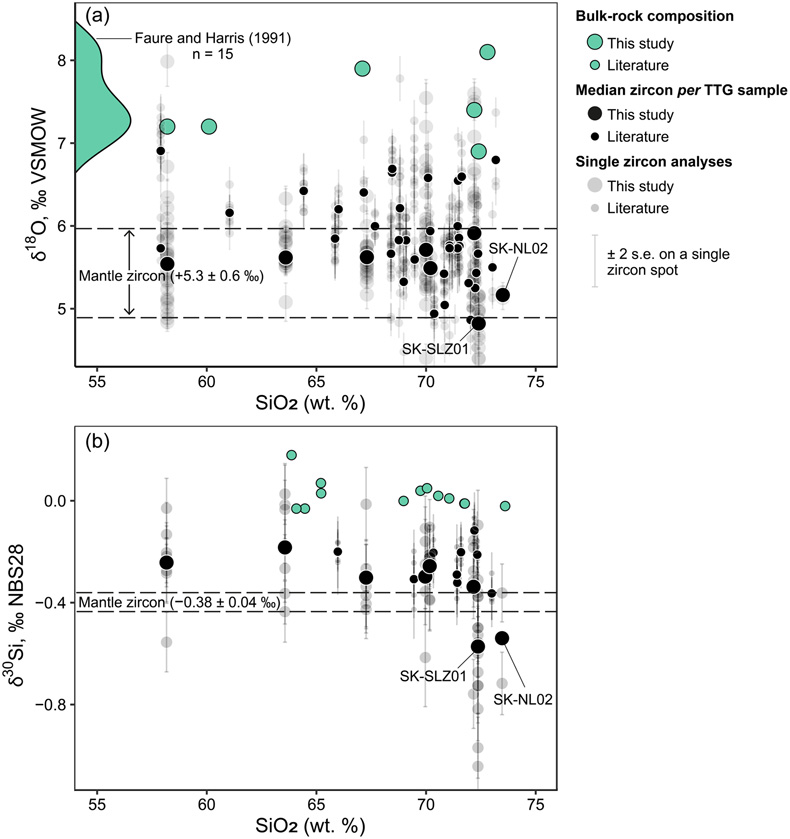
Figure 1 Oxygen and silicon isotopic composition of bulk rock and zircon samples from the BGGT plotted against bulk rock SiO2 concentration. Error bars are 2 s.e. uncertainty for every spot. Density curve in (a) presents δ18Owr values in 15 samples from the Kaap Valley pluton (BGGT) from Faure and Harris (1991)
Faure, K., Harris, C. (1991) Oxygen and carbon isotope geochemistry of the 3. 2 Ga Kaap Valley tonalite, Barberton greenstone belt, South Africa. Precambrian Research 52, 301–319.
. Other Barberton TTG data sources: δ18Ozrc in (a) (Valley et al., 2005Valley, J.W., Lackey, J.S., Cavosie, A.J., Clechenko, C.C., Spicuzza, M.J., Basei, M.A.S., Bindeman, I.N., Ferreira, V.P., Sial, A.N., King, E.M., Peck, W.H., Sinha, A.K., Wei, C.S. (2005) 4.4 billion years of crustal maturation: Oxygen isotope ratios of magmatic zircon. Contributions to Mineralogy and Petrology 150, 561–580. https://doi.org/10.1007/s00410-005-0025-8
; Wang et al., 2022Wang, X., Tang, M., Moyen, J., Wang, D., Kröner, A., Xia, X., Xie, H., Anhaeusser, C., Hofmann, A., Li, J., Li, L. (2022) The onset of deep recycling of supracrustal materials at the Paleo-Mesoarchean boundary. National Science Review 9, 1–9. https://doi.org/10.1093/nsr/nwab136
; Lei et al., 2023Lei, K., Wang, H., Wang, X., Zhang, Q., Li, X. (2023) Decoupled Zircon Si–O Isotopes Tracing the Supracrustal Silicification and Komatiitic‐Derived Fluids in the Source of TTGs. Geophysical Research Letters 50, 1–9. https://doi.org/10.1029/2023GL104002
), and whole rock δ30Siwr in (b) (André et al., 2019André, L., Abraham, K., Hofmann, A., Monin, L., Kleinhanns, I.C., Foley, S. (2019) Early continental crust generated by reworking of basalts variably silicified by seawater. Nature Geoscience. https://doi.org/10.1038/s41561-019-0408-5
; Deng et al., 2019Deng, Z., Chaussidon, M., Guitreau, M., Puchtel, I.S., Dauphas, N. (2019) An oceanic subduction origin for Archean granitoids revealed by silicon isotopes. Nature Geoscience 12, 774–779. https://doi.org/10.1038/s41561-019-0407-6
), δ30Sizrc (Guitreau et al., 2022Guitreau, M., Gannoun, A., Deng, Z., Chaussidon, M., Moynier, F., Barbarin, B., Marin-Carbonne, J. (2022) Stable isotope geochemistry of silicon in granitoid zircon. Geochimica et Cosmochimica Acta 316, 273–294. https://doi.org/10.1016/j.gca.2021.09.029
; Lei et al., 2023Lei, K., Wang, H., Wang, X., Zhang, Q., Li, X. (2023) Decoupled Zircon Si–O Isotopes Tracing the Supracrustal Silicification and Komatiitic‐Derived Fluids in the Source of TTGs. Geophysical Research Letters 50, 1–9. https://doi.org/10.1029/2023GL104002
). The ‘mantle zircon’ range represents δ18Ozrc and δ30Sizrc values of zircons from peridotites and kimberlites (Trail et al., 2018Trail, D., Boehnke, P., Savage, P.S., Liu, M.C., Miller, M.L., Bindeman, I. (2018) Origin and significance of Si and O isotope heterogeneities in Phanerozoic, Archean, and Hadean zircon. Proceedings of the National Academy of Sciences of the United States of America 115, 10287–10292. https://doi.org/10.1073/pnas.1808335115
).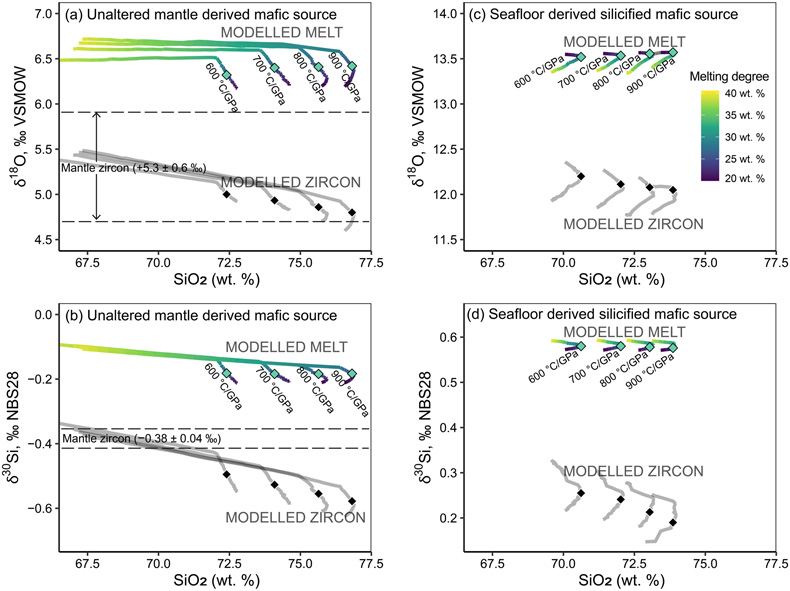
Figure 2 Modelled melt and zircon isotopic compositions reflecting partial melting of an unaltered mafic source and a silicified source along different P-T paths. We considered melting degrees between 20 and 40 wt. % (able to produce TTG-like melts) (Laurie and Stevens, 2012
Laurie, A., Stevens, G. (2012) Water-present eclogite melting to produce Earth’s early felsic crust. Chemical Geology 314–317, 83–95. https://doi.org/10.1016/j.chemgeo.2012.05.001
). Plotted SiO2 concentrations are calculated on an anhydrous basis. Diamonds represent conditions where partial melting of a basaltic source generates a melt with TTG-like major element composition. In (c) we only considered an average δ18Owr of +13.5 ‰ for a silicified mafic source (overlooking the full δ18Owr variation shown in Fig. 3 for simplicity).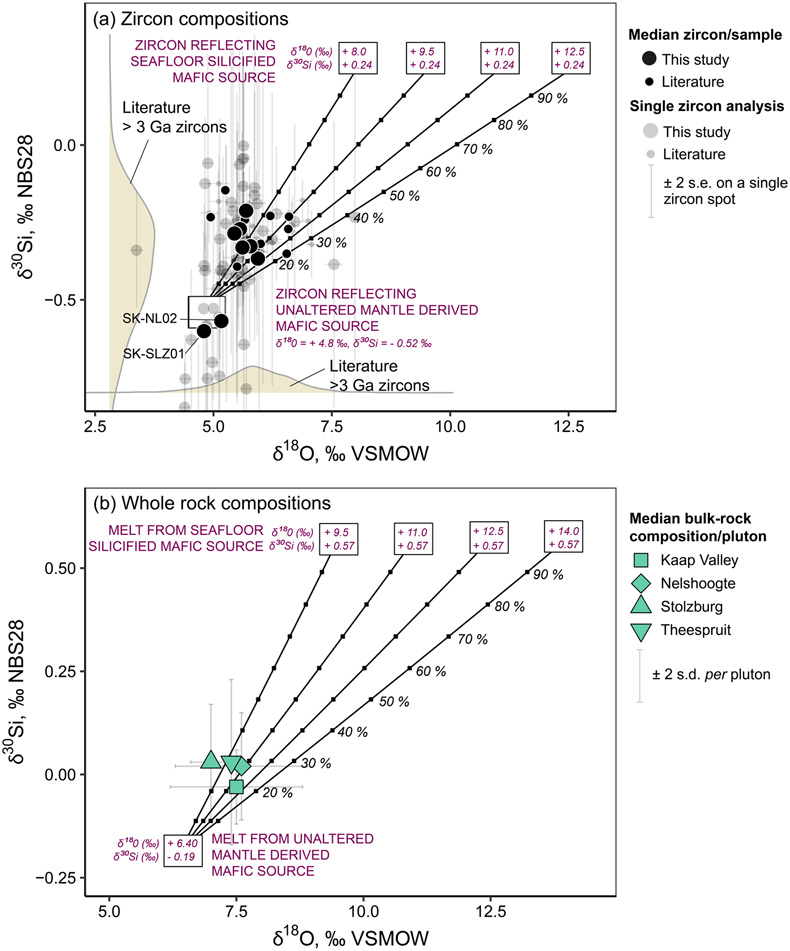
Figure 3 Mixing model explaining the origin of oxygen and silicon isotopic compositions of (a) BGGT TTG zircon and (b) whole rock samples. Density curves in (a) are distributions of δ18Ozrc and δ30Sizrc in other Paleoarchean or older zircons (references in Table S-5). The two end member source signatures considered in the mixing calculations result from our numerical model. Zircon compositions on mixing curves represent the calculated isotopic composition of zircon crystallised from modelled liquids (end member or mixed). Average δ18Owr temporal variation in Onverwacht silicified lavas (Kitoga et al., 2024
Kitoga, L.S., Zakharov, D., Marin-Carbonne, J., Boyet, M., Moyen, J.-F., Di Rocco, T., Pack, A., Olivier, N., Stevens, G. (2024) Oxygen and silicon isotopic compositions of Archean silicified lava and cherts of the Onverwacht Group: Implication for seafloor hydrothermalism and the nature of recycled components in the source of granitoids. Chemical Geology, 122407. https://doi.org/10.1016/j.chemgeo.2024.122407
) is considered.