



Cerium isotopic constraints on oceanic redox conditions: Insights from first-principles calculations
Affiliations | Corresponding Author | Cite as | Funding information
Published by the European Association of Geochemistry
under Creative Commons License CC BY-NC-ND 4.0
Keywords: First-principles calculations, Ce in calcite, Ce isotopes, equilibrium isotope fractionation factors


- Share this article


-
Article views:1,258Cumulative count of HTML views and PDF downloads.
- Download Citation
- Rights & Permissions

top
Abstract
Figures
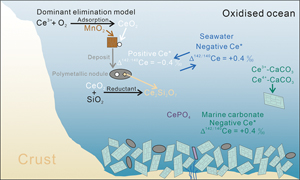
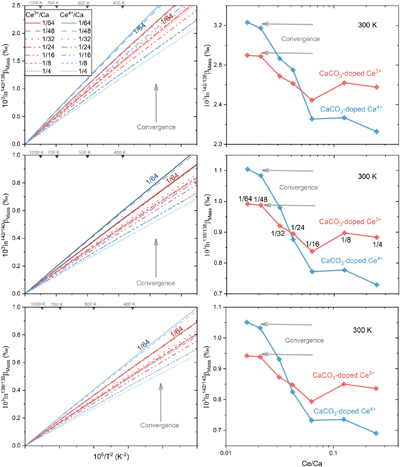 Figure 1 103lnβ versus 106/T2 (left panels) and Ce/Ca (right panels) in Ce-bearing calcites. In Ce3+-doped calcites and Ce4+-doped calcites, 103ln142/136βMass, 103ln138/136βMass, and 103ln142/140βMass values increase as Ce/Ca decreases from 1/4 to 1/48, then converge as Ce/Ca further decreases from 1/48 to 1/64. | 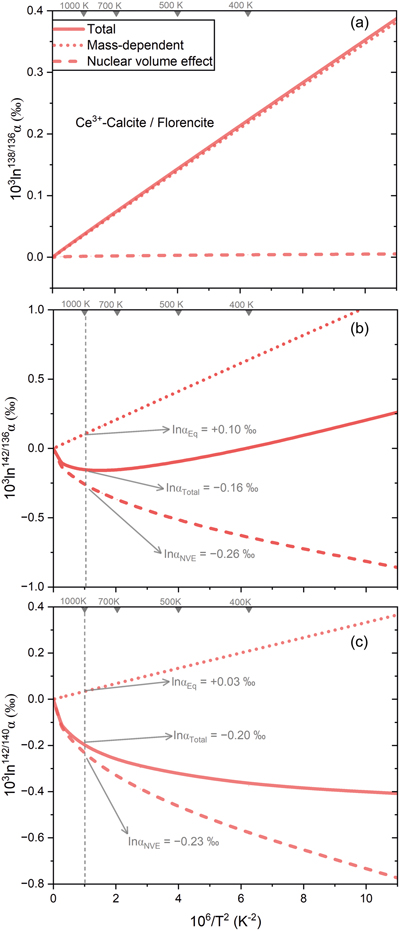 Figure 2 The effect of nuclear volume on Ce isotope fractionations between minerals. Mass-dependent, mass-independent, and total equilibrium Ce isotope fractionation factors of 103ln142/136α, 103ln138/136α and 103ln142/140α between Ce3+-calcite and florencite are compared as a case study. | 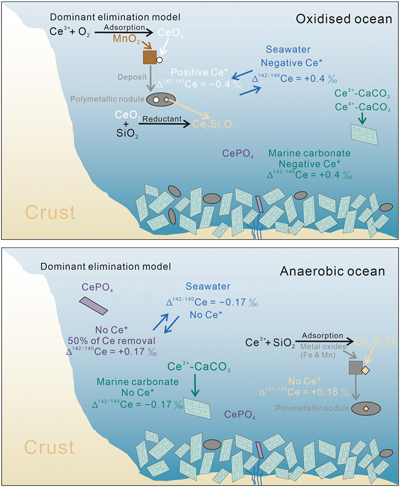 Figure 3 Schematic diagrams of Ce isotope variations in oxidised and anaerobic ocean domains. The initial Ce isotope composition (δ142/140Ce) of seawater is assumed to be 0.0 ‰. We assumed that Ce flux (ca. 90 %) is primarily controlled by the precipitation of manganese oxides in oxidised oceans, but is governed by phosphate precipitation (ca. 50 %) in anaerobic oceans. Under seawater conditions at pH 8, the Ce isotope fractionation factors between seawater and minerals are shown in Table S-3. Deposition of manganese oxides can increase δ142/140Ce values in seawater, which are otherwise decreased by the deposition of phosphates. Calcite can therefore reflect the δ142/140Ce value of seawater with limited Ce isotope fractionation at pH 8. | 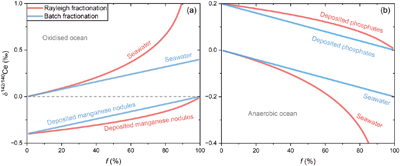 Figure 4 The Ce isotope variation model as Ce is eliminated from (a) oxidised and (b) anaerobic oceans. The initial Ce isotope composition (δ142/140Ce) of seawater is assumed to be 0.0 ‰. The equilibrium Ce isotope fractionation factors between seawater and manganese oxide, and between seawater and phosphates are set to +0.4 ‰ and −0.19 ‰, respectively, based on this study and prior experimental results (Nakada et al., 2013; Bonnand et al., 2023). The proportion of Ce removal is represented as f (%). The Ce isotope fractionation factors between minerals calculated herein were used for Rayleigh and batch isotope fractionation models at 300 K. |
| Figure 1 | Figure 2 | Figure 3 | Figure 4 |
top
Introduction
Oceanic redox conditions critically impacted palaeoclimate, palaeoenvironment and life evolution throughout the Earth’s history (Bellefroid et al., 2018
Bellefroid, E.J., Hood, A.v.S., Hoffman, P.F., Thomas, M.D., Reinhard, C.T., Planavsky, N.J. (2018) Constraints on Paleoproterozoic atmospheric oxygen levels. Proceedings of the National Academy of Sciences 115, 8104–8109. https://doi.org/10.1073/pnas.1806216115
). Cerium (Ce) has been used as a sensitive proxy for redox conditions because Ce4+ distinguishes itself from other trivalent rare earth elements (REEs) during precipitation processes in oxidised oceans, shifting Ce concentrations relative to those of neighbouring elements (known as the Ce anomaly; Tostevin, 2021Tostevin, R. (2021) Cerium Anomalies and Paleoredox. Cambridge University Press. https://doi.org/10.1017/9781108847223
; Zhang and Shields, 2022Zhang, K., Shields, G.A. (2022) Sedimentary Ce anomalies: Secular change and implications for paleoenvironmental evolution. Earth-Science Reviews 229, 104015. https://doi.org/10.1016/j.earscirev.2022.104015
). Specifically, trivalent Ce cations in the ocean are oxidised to tetravalent Ce by adsorption onto iron and manganese oxides, and Ce is eliminated from seawater via manganese oxide precipitation (Ohta and Kawabe, 2001Ohta, A., Kawabe, I. (2001) REE(III) adsorption onto Mn dioxide (δ-MnO2) and Fe oxyhydroxide: Ce(III) oxidation by δ-MnO2. Geochimica et Cosmochimica Acta 65, 695–703. https://doi.org/10.1016/S0016-7037(00)00578-0
). This process produces a positive Ce anomaly in the deposited oxides and seawater preserves a negative anomaly (Nozaki and Alibo, 2003Nozaki, Y., Alibo, D.S. (2003) Importance of vertical geochemical processes in controlling the oceanic profiles of dissolved rare earth elements in the northeastern Indian Ocean. Earth and Planetary Science Letters 205, 155–172. https://doi.org/10.1016/S0012-821X(02)01027-0
). Subsequently, seawater REE features, including negative Ce anomalies, can be recorded in marine calcites because of their comparable partitioning coefficients when incorporated into the calcite lattice (Voigt et al., 2017Voigt, M., Mavromatis, V., Oelkers, E.H. (2017) The experimental determination of REE partition coefficients in the water-calcite system. Chemical Geology 462, 30–43. https://doi.org/10.1016/j.chemgeo.2017.04.024
). This framework is one of the foundations for understanding palaeo-ocean redox conditions from marine carbonates (e.g., Kamber et al., 2004Kamber, B.S., Bolhar, R., Webb, G.E. (2004) Geochemistry of late Archaean stromatolites from Zimbabwe: evidence for microbial life in restricted epicontinental seas. Precambrian Research 132, 379–399. https://doi.org/10.1016/j.precamres.2004.03.006
; Tostevin, 2021Tostevin, R. (2021) Cerium Anomalies and Paleoredox. Cambridge University Press. https://doi.org/10.1017/9781108847223
; Zhang and Shields, 2023Zhang, K., Shields, G.A. (2023) Early diagenetic mobilization of rare earth elements and implications for the Ce anomaly as a redox proxy. Chemical Geology 635, 121619. https://doi.org/10.1016/j.chemgeo.2023.121619
).Negative Ce anomalies in ferromanganese nodules can be ascribed to the input of hydrothermal REEs during diagenetic processes (Elderfield and Greaves, 1981
Elderfield, H., Greaves, M.J. (1981) Negative cerium anomalies in the rare earth element patterns of oceanic ferromanganese nodules. Earth and Planetary Science Letters 55, 163–170. https://doi.org/10.1016/0012-821X(81)90095-9
); siderophores and other organic ligands can also produce Ce anomalies via bio-mediated Ce oxidation under anaerobic conditions (Kraemer and Bau, 2022Kraemer, D., Bau, M. (2022) Siderophores and the formation of cerium anomalies in anoxic environments. Geochemical Perspectives Letters 22, 50–55. https://doi.org/10.7185/geochemlet.2227
). Meanwhile, positive Ce anomalies can be imprinted in marine carbonates by porewaters, masking primary seawater values (Zhang and Shields, 2023Zhang, K., Shields, G.A. (2023) Early diagenetic mobilization of rare earth elements and implications for the Ce anomaly as a redox proxy. Chemical Geology 635, 121619. https://doi.org/10.1016/j.chemgeo.2023.121619
). These results indicate that Ce anomalies are not always linked to the oxidation state during oxidative weathering (e.g., Li et al., 2023Li, W., Liu, X.-M., Nakada, R., Takahashi, Y., Hu, Y., Shakouri, M., Zhang, Z., Okumura, T., Yamada, S. (2023) The cerium isotope fingerprints of redox fluctuation in bauxites. Earth and Planetary Science Letters 602, 117962. https://doi.org/10.1016/j.epsl.2022.117962
; Bai et al., 2024Bai, J., Wu, C., Wu, H., Wang, Z., Zhang, L., Zhong, S., Ma, J., Wei, G. (2024) δ142Ce minus δ146Nd value as a redox indicator in Earth’s surface environments. Earth Planetary Science Letters 629, 118597. https://doi.org/10.1016/j.epsl.2024.118597
) and that a change in oxidation state does not necessarily generate Ce anomalies in ferromanganese oxides (Nakada et al., 2017Nakada, R., Tanaka, M., Tanimizu, M., Takahashi, Y. (2017) Aqueous speciation is likely to control the stable isotopic fractionation of cerium at varying pH. Geochimica et Cosmochimica Acta 218, 273–290. https://doi.org/10.1016/j.gca.2017.09.019
). Additionally, redox-independent Ce anomalies have been observed in banded iron formations (e.g., Bonnand et al., 2023Bonnand, P., Boyet, M., Bosq, C. (2023) Stable cerium isotopes as a tracer of oxidation reactions. Geochemical Perspectives Letters 28, 27–30. https://doi.org/10.7185/geochemlet.2340
), complicating the relationship between Ce anomalies and oxidation state. Thus, utilising Ce anomalies to reconstruct the palaeo-oceanic environment requires additional constraints.Cerium isotopes can be a powerful tool for tracking redox conditions because they are significantly fractionated during oxidative adsorption on ferromanganese oxides (Nakada et al., 2013
Nakada, R., Takahashi, Y., Tanimizu, M. (2013) Isotopic and speciation study on cerium during its solid–water distribution with implication for Ce stable isotope as a paleo-redox proxy. Geochimica et Cosmochimica Acta 103, 49–62. https://doi.org/10.1016/j.gca.2012.10.045
). Under ambient conditions, Ce isotopes are only slightly fractionated during spontaneous precipitation and ferric oxide adsorption, but significant fractionations occur during manganese oxide adsorption (Nakada et al., 2013Nakada, R., Takahashi, Y., Tanimizu, M. (2013) Isotopic and speciation study on cerium during its solid–water distribution with implication for Ce stable isotope as a paleo-redox proxy. Geochimica et Cosmochimica Acta 103, 49–62. https://doi.org/10.1016/j.gca.2012.10.045
, 2017Nakada, R., Tanaka, M., Tanimizu, M., Takahashi, Y. (2017) Aqueous speciation is likely to control the stable isotopic fractionation of cerium at varying pH. Geochimica et Cosmochimica Acta 218, 273–290. https://doi.org/10.1016/j.gca.2017.09.019
) and ferromanganese oxide formation in hot springs (Nakada et al., 2016Nakada, R., Takahashi, Y., Tanimizu, M. (2016) Cerium stable isotope ratios in ferromanganese deposits and their potential as a paleo-redox proxy. Geochimica et Cosmochimica Acta 181, 89–100. https://doi.org/10.1016/j.gca.2016.02.025
). Although Ce isotope compositions in weathering profiles correlate with the average Ce valence state, there is no correlation between the Ce anomaly and average valence state (Li et al., 2023Li, W., Liu, X.-M., Nakada, R., Takahashi, Y., Hu, Y., Shakouri, M., Zhang, Z., Okumura, T., Yamada, S. (2023) The cerium isotope fingerprints of redox fluctuation in bauxites. Earth and Planetary Science Letters 602, 117962. https://doi.org/10.1016/j.epsl.2022.117962
; Bai et al., 2024Bai, J., Wu, C., Wu, H., Wang, Z., Zhang, L., Zhong, S., Ma, J., Wei, G. (2024) δ142Ce minus δ146Nd value as a redox indicator in Earth’s surface environments. Earth Planetary Science Letters 629, 118597. https://doi.org/10.1016/j.epsl.2024.118597
), indicating that it may be more straightforward to use Ce isotopes to trace redox conditions. However, the mechanism of Ce isotope fractionation in Ce-bearing minerals, such as calcite, has not been investigated, limiting our understanding of palaeo-ocean environments.Many stable isotopes undergo mass-dependent fractionations, whereas Ce isotopes also undergo mass-independent fractionations (Schauble, 2023
Schauble, E.A. (2023) Nuclear volume isotope fractionation of europium and other lanthanide elements. Geochemical Journal 57, 118–133. https://doi.org/10.2343/geochemj.GJ23010
). Mass-independent Ce isotope fractionations mainly result from the nuclear volume effect (NVE) because the anharmonic vibration and Born-Oppenheimer approximation are negligible for heavy elements (Bigeleisen, 1996Bigeleisen, J. (1996) Nuclear Size and Shape Effects in Chemical Reactions. Isotope Chemistry of the Heavy Elements. Journal of the American Chemical Society 118, 3676–3680. https://doi.org/10.1021/ja954076k
). First-principles calculations are a powerful tool for estimating mass-dependent equilibrium isotope fractionation factors between complex minerals, fluids and melts (e.g., Rabin et al., 2023Rabin, S., Blanchard, M., Pinilla, C., Poitrasson, F., Grégoire, M. (2023) Iron and silicon isotope fractionation in silicate melts using first-principles molecular dynamics. Geochimica et Cosmochimica Acta 343, 212–233. https://doi.org/10.1016/j.gca.2022.11.017
; Duan and Huang, 2024Duan, H., Huang, F. (2024) Equilibrium indium isotope fractionation between indium-bearing minerals: Insights from first-principles calculations. Geochimica et Cosmochimica Acta 369, 51–61. https://doi.org/10.1016/j.gca.2024.01.031
). All-electron molecular Dirac-Hartree-Fock calculations have been used to explore relativistic electron configurations and determine the impact of the NVE on Hg, Tl and Pb isotope fractionations in cluster models (Schauble, 2007Schauble, E.A. (2007) Role of nuclear volume in driving equilibrium stable isotope fractionation of mercury, thallium, and other very heavy elements. Geochimica et Cosmochimica Acta 71, 2170–2189. https://doi.org/10.1016/j.gca.2007.02.004
). Here, we use a methodology developed for periodic boundary conditions to understand the impact of the NVE on Ce isotope fractionations between minerals (Schauble, 2013Schauble, E.A. (2013) Modeling nuclear volume isotope effects in crystals. Proceedings of the National Academy of Sciences 110, 17714–17719. https://doi.org/10.1073/pnas.1216216110
).In this study, we calculated the mass-dependent and mass-independent equilibrium Ce isotope fractionation factors (103lnαMass and 103lnαNVE) between marine authigenic minerals to construct how Ce isotopes respond to marine redox changes. Cerium removal from oxidised oceans is dominated by the precipitation of manganese oxides. On these surfaces, aqueous Ce species are oxidised to form CeO2 (Ohta and Kawabe, 2001
Ohta, A., Kawabe, I. (2001) REE(III) adsorption onto Mn dioxide (δ-MnO2) and Fe oxyhydroxide: Ce(III) oxidation by δ-MnO2. Geochimica et Cosmochimica Acta 65, 695–703. https://doi.org/10.1016/S0016-7037(00)00578-0
; Marcus et al., 2018Marcus, M., Toner, B., Takahashi, Y. (2018) Forms and distribution of Ce in a ferromanganese nodule. Marine Chemistry 202, 58–66. https://doi.org/10.1016/j.marchem.2018.03.005
). Cerium removal from anaerobic oceans is controlled by the crystallisation of phosphates, such as monazite and florencite (Manceau et al., 2025Manceau, A., Gaillot, A., Liao, J., Li, Y., Mathon, O., Lomachenko, K., Glatzel, P., Simionovici, A., Balvay, M., Paul, S., Koschinsky, A., Steinmann, S. (2025) Cerium occurs as cerium-phosphate clusters around bioapatite nanocrystals in deep-sea sediments. Communications Earth and Environment 6, 466. https://doi.org/10.1038/s43247-025-02439-2
). Although calcite is not the primary mineral influencing Ce fluxes, the trace amounts of Ce found in various carbonate rocks can indicate the characteristics of Ce isotopes in seawater. Ce is a trace element in carbonates and may be incorporated into calcite in the same manner as boron (Phillips et al., 2023Phillips, B., Chen, Z., Rasbury, E. (2023) Boron coprecipitation with calcite: distinguishing calcite-hosted B by NMR spectroscopy. ACS Earth and Space Chemistry 7, 2430–2443. https://doi.org/10.1021/acsearthspacechem.3c00198
). We investigated Ce incorporation in calcite using (Ce3+ + Na+)–2 Ca2+ and Ce4+–2 Ca2+ configurations with Ce/Ca ratios ranging from 1/4 to 1/64 (Fig. S-1). We calculated equilibrium Ce isotope fractionation factors between Ce3+- and Ce4+-doped calcites, cerianite (CeO2), percleveite (Ce2Si2O7), monazite (CePO4) and florencite (CeAl3(PO4)2(OH)6) to explore the impact of redox conditions on Ce isotope compositions in oceans.top
Results and Discussion
The effect of Ce concentration on 103lnβ. The chemical composition can influence reduced partition function ratios (103lnβMass) by altering the concentration, bond length, coordination number and electronegativity of substituted elements (Méheut et al., 2009
Méheut, M., Lazzeri, M., Balan, E., Mauri, F. (2009) Structural control over equilibrium silicon and oxygen isotopic fractionation: A first-principles density-functional theory study. Chemical Geology 258, 28–37. https://doi.org/10.1016/j.chemgeo.2008.06.051
). Since Ce is a trace element in calcite, we need to examine concentration and isotope effects of Ce/Ca on 103lnβMass. In Ce3+-doped calcites, 103ln138/136β, 103ln142/140β and 103ln142/136β increase as Ce/Ca decreases from 1/4 to 1/48, but they converge to 0.99, 0.94 and 2.90 ‰, respectively, when Ce/Ca decreases from 1/48 to 1/64 (Fig. 1). The discrepancies in calculated 103ln138/136β, 103ln142/140β and 103ln142/136β values between Ce/Ca = 1/48 and 1/64 are less than 0.01 ‰, which is significantly lower than the analytical errors on natural samples. Therefore, the effect of Ce concentrations on these 103lnβMass value in Ce3+-doped calcites is negligible when Ce/Ca < 1/48. The Ce4+-doped calcites exhibit a similar relationship between 103lnβMass and Ce/Ca, with a limited difference of 0.06 ‰ between Ce/Ca = 1/48 and 1/64. Meanwhile, Ce–O bond lengths also stabilise at certain values as the Ce/Ca decreases to 1/48 and 1/64 in Ce3+- and Ce4+-doped calcites (Table S-1). Hence, the 103lnβMass values in Ce3+- and Ce4+-doped calcites with Ce/Ca = 1/64 can represent Ce dilution in natural calcites. This concentration and isotope effect implies that for trace elements in minerals, we should calculate isotope fractionation factors in supercells until the fluctuation of 103lnβMass is smaller than the measurement uncertainty.Figure 1 103lnβ versus 106/T2 (left panels) and Ce/Ca (right panels) in Ce-bearing calcites. In Ce3+-doped calcites and Ce4+-doped calcites, 103ln142/136βMass, 103ln138/136βMass, and 103ln142/140βMass values increase as Ce/Ca decreases from 1/4 to 1/48, then converge as Ce/Ca further decreases from 1/48 to 1/64.
Nuclear volume effect on 103lnα. The equilibrium Ce isotope fractionation factors between minerals and florencite are composed of mass-dependent and mass-independent parts (103lnαTotal = 103lnαMass + 103lnαNVE). The values of 103ln138/136αMass, 103ln142/140αMass and 103ln142/136αMass decrease in the following sequence: Ce4+-doped calcite, Ce3+-doped calcite, percleveite, monazite and cerianite (Fig. S-5a–c). Additionally, 103ln142/136αMass is larger than 103ln138/136αMass in the same mineral, whereas 103ln142/140αMass is similar to 103ln138/136αMass. This is consistent with the prediction of mass-dependent isotope fractionation theory based on the mass difference between Ce isotopes (Urey, 1947
Urey, H.C. (1947) The thermodynamic properties of isotopic substances. Journal of the Chemical Society (Resumed), 562–581. https://doi.org/10.1039/jr9470000562
). In contrast, there is no common consensus across the 138Ce/136Ce, 142Ce/140Ce and 142Ce/136Ce nuclide ratios for mass-independent equilibrium Ce isotope fractionation factors. For example, at 300 K, 103ln142/140αNVE and 103ln142/136αNVE have approximately the same negative values and decrease in the following sequence: monazite, percleveite, cerianite, Ce4+-doped calcite and Ce3+-doped calcite. However, 103ln138/136αNVE values are limited to the range 0.001 to 0.005 ‰ and decrease in the opposite sequence (Fig. S-5d–f). This result indicates that, unlike those in 142Ce/140Ce and 142Ce/136Ce pairs, the Ce isotope fractionation factors in the 138Ce/136Ce pair are unaffected by the NVE (Fig. 2a). The difference in the mean-squared nuclear radii ([r]2) between the 138Ce and 136Ce nuclides is −0.002 Å2, whereas those between 142Ce and 140Ce nuclides and between 142Ce and 136Ce nuclides are +0.281 and +0.312 Å2, respectively. Because 103lnαNVE depends on the electron density around the nucleus and [r]2 (Bigeleisen, 1996Bigeleisen, J. (1996) Nuclear Size and Shape Effects in Chemical Reactions. Isotope Chemistry of the Heavy Elements. Journal of the American Chemical Society 118, 3676–3680. https://doi.org/10.1021/ja954076k
; Schauble, 2013Schauble, E.A. (2013) Modeling nuclear volume isotope effects in crystals. Proceedings of the National Academy of Sciences 110, 17714–17719. https://doi.org/10.1073/pnas.1216216110
), the difference in [r]2 dominates the difference among 103ln138/136αNVE, 103ln142/140αNVE and 103ln142/136αNVE.Figure 2 The effect of nuclear volume on Ce isotope fractionations between minerals. Mass-dependent, mass-independent, and total equilibrium Ce isotope fractionation factors of 103ln142/136α, 103ln138/136α and 103ln142/140α between Ce3+-calcite and florencite are compared as a case study.
At 300 K, the 103ln142/136αMass and 103ln142/136αNVE values of Ce3+-doped calcite are +1.13 and −0.86 ‰, respectively, implying that the absolute value of 103ln142/136αTotal is smaller than those of 103ln142/136αMass and 103ln142/136αNVE because of their opposite isotope fractionation directions. At 300 K, the 103ln142/140αMass and 103ln142/140αNVE values of Ce3+-doped calcite are +0.37 and −0.78 ‰, respectively, implying that the NVE is about twice as significant as the mass-dependent fractionation and dominates the Ce isotope fractionation directions. These results indicate that the NVE impact on Ce isotope fractionation factors cannot be neglected, especially under high-temperature conditions (Fig. 2b,c). Overall, the measurable Ce isotope fractionation between Ce-bearing minerals indicates that Ce isotopes recorded in stratigraphic profiles can be used to reconstruct redox conditions of palaeo-oceans.
Implications for palaeo-seawater redox conditions. Cerium fluctuations in seawater are influenced by specific minerals precipitating. The Ce flux in oxidised oceans is predominantly regulated by manganese oxide precipitation because Ce3+ can be oxidised and adsorbed onto the surface of manganese oxides to form tetravalent Ce oxides (CeO2) (Takahashi et al., 2000
Takahashi, Y., Shimizu, H., Usui, A., Kagi, H., Nomura, M. (2000) Direct observation of tetravalent cerium in ferromanganese nodules and crusts by X-ray-absorption near-edge structure (XANES). Geochimica et Cosmochimica Acta 64, 2929–2935. https://doi.org/10.1016/S0016-7037(00)00403-8
; Nakada et al., 2013Nakada, R., Takahashi, Y., Tanimizu, M. (2013) Isotopic and speciation study on cerium during its solid–water distribution with implication for Ce stable isotope as a paleo-redox proxy. Geochimica et Cosmochimica Acta 103, 49–62. https://doi.org/10.1016/j.gca.2012.10.045
), removing Ce and producing negative Ce anomalies in seawater (Fig. 3). Because REEs do not fractionate significantly during incorporation into calcite (Voigt et al., 2017Voigt, M., Mavromatis, V., Oelkers, E.H. (2017) The experimental determination of REE partition coefficients in the water-calcite system. Chemical Geology 462, 30–43. https://doi.org/10.1016/j.chemgeo.2017.04.024
), calcite precipitates capture the negative Ce anomalies of oxidised oceans. In contrast, phosphate precipitation dominates the Ce flux in anaerobic oceans because Ce cations and CePO4 clusters can be incorporated into phosphatic lattices (Manceau et al., 2025Manceau, A., Gaillot, A., Liao, J., Li, Y., Mathon, O., Lomachenko, K., Glatzel, P., Simionovici, A., Balvay, M., Paul, S., Koschinsky, A., Steinmann, S. (2025) Cerium occurs as cerium-phosphate clusters around bioapatite nanocrystals in deep-sea sediments. Communications Earth and Environment 6, 466. https://doi.org/10.1038/s43247-025-02439-2
), which does not produce Ce anomalies in calcites. These processes can lead to significant differences in Ce isotope compositions between seawater, manganese oxides, carbonates and phosphates, which may provide a promising tool for investigating oceanic redox conditions (e.g., Nakada et al., 2013Nakada, R., Takahashi, Y., Tanimizu, M. (2013) Isotopic and speciation study on cerium during its solid–water distribution with implication for Ce stable isotope as a paleo-redox proxy. Geochimica et Cosmochimica Acta 103, 49–62. https://doi.org/10.1016/j.gca.2012.10.045
; Bonnand et al., 2023Bonnand, P., Boyet, M., Bosq, C. (2023) Stable cerium isotopes as a tracer of oxidation reactions. Geochemical Perspectives Letters 28, 27–30. https://doi.org/10.7185/geochemlet.2340
; Li et al., 2023Li, W., Liu, X.-M., Nakada, R., Takahashi, Y., Hu, Y., Shakouri, M., Zhang, Z., Okumura, T., Yamada, S. (2023) The cerium isotope fingerprints of redox fluctuation in bauxites. Earth and Planetary Science Letters 602, 117962. https://doi.org/10.1016/j.epsl.2022.117962
; Bai et al., 2024Bai, J., Wu, C., Wu, H., Wang, Z., Zhang, L., Zhong, S., Ma, J., Wei, G. (2024) δ142Ce minus δ146Nd value as a redox indicator in Earth’s surface environments. Earth Planetary Science Letters 629, 118597. https://doi.org/10.1016/j.epsl.2024.118597
). However, quantitative Ce isotope fractionation factors have not yet been investigated for these processes. This study shows that the 103ln142/140αTotal values of manganese oxides (CeO2), phosphates (CePO4) and Ce3+- and Ce4+-doped calcites are −0.55, +0.04, −0.41, and −0.24 ‰, respectively (Table S-2), providing a theoretical foundation for tracing redox conditions.Figure 3 Schematic diagrams of Ce isotope variations in oxidised and anaerobic ocean domains. The initial Ce isotope composition (δ142/140Ce) of seawater is assumed to be 0.0 ‰. We assumed that Ce flux (ca. 90 %) is primarily controlled by the precipitation of manganese oxides in oxidised oceans, but is governed by phosphate precipitation (ca. 50 %) in anaerobic oceans. Under seawater conditions at pH 8, the Ce isotope fractionation factors between seawater and minerals are shown in Table S-3. Deposition of manganese oxides can increase δ142/140Ce values in seawater, which are otherwise decreased by the deposition of phosphates. Calcite can therefore reflect the δ142/140Ce value of seawater with limited Ce isotope fractionation at pH 8.
To construct oceanic redox models, we developed a series of models to simulate changing δ142/140Ce values under different redox conditions by Rayleigh and batch isotope fractionations (Wang et al., 2021
Wang, W., Li, C.-H., Brodholt, J.P., Huang, S., Walter, M.J., Li, M., Wu, Z., Huang, F., Wang, S.-J. (2021) Sulfur isotopic signature of Earth established by planetesimal volatile evaporation. Nature Geosciences 14, 806–811. https://doi.org/10.1038/s41561-021-00838-6
). Variations of δ142/140Ce in seawater during mineral precipitation can be described by Rayleigh fractionation as:Eq. 1

Variations of δ142/140Ce in seawater during mineral precipitation can also be described by batch fractionation as:
Eq. 2

In Equations (1) and (2), δ142/140CeSW and δ142/140CeSW0 represent the Ce isotope compositions in instantaneous and initial seawater, respectively. Phase A and B represent precipitated minerals and seawater, respectively. The δ142/140CeSW0 value is assumed to be 0.0 ‰. The 103ln142/140αTotal value of cerianite (CeO2) can be considered a substitute for that of manganese oxides because CeO2 is the primary form of Ce absorbed onto manganese oxides. At 300 K, the difference between the 103ln142/140αTotal values of monazite (CePO4) and florencite (CeAl3(PO4)2(OH)6) is limited to +0.04 ‰ (Table S-2); therefore we use the 103ln142/140αTotal value of CePO4 to represent that for phosphates. The metal species present in fluids significantly influence isotope fractionations between minerals and fluids (Duan and Huang, 2025
Duan, H., Huang, F. (2025) Equilibrium indium isotope fractionation in chloride-rich aqueous solutions using first-principles calculations. Geochimica et Cosmochimica Acta 393, 304–317. https://doi.org/10.1016/j.gca.2025.01.026
). The abundance of aqueous Ce species, including Ce3+, Ce(OH)2+, Ce(CO3)+ and Ce(CO3)2 −, changes with seawater pH (e.g., Nakada et al., 2013Nakada, R., Takahashi, Y., Tanimizu, M. (2013) Isotopic and speciation study on cerium during its solid–water distribution with implication for Ce stable isotope as a paleo-redox proxy. Geochimica et Cosmochimica Acta 103, 49–62. https://doi.org/10.1016/j.gca.2012.10.045
, 2017Nakada, R., Tanaka, M., Tanimizu, M., Takahashi, Y. (2017) Aqueous speciation is likely to control the stable isotopic fractionation of cerium at varying pH. Geochimica et Cosmochimica Acta 218, 273–290. https://doi.org/10.1016/j.gca.2017.09.019
). Ce3+ is the dominant species at a pH of ca. 5; under these conditions, the 103ln142/140αTotal value between seawater and manganese oxides is about +0.4 ‰ (Nakada et al., 2017Nakada, R., Tanaka, M., Tanimizu, M., Takahashi, Y. (2017) Aqueous speciation is likely to control the stable isotopic fractionation of cerium at varying pH. Geochimica et Cosmochimica Acta 218, 273–290. https://doi.org/10.1016/j.gca.2017.09.019
). Based on the relationship of calculated 103ln142/140αTotal values between phosphates and manganese oxides, 103ln142/140αTotal values between seawater and phosphates are about −0.19 ‰ (Fig. 4). These Ce isotope fractionation factors and Ce isotope compositions of seawater throughout geological history can be adjusted appropriately to consider different pH conditions, dominant species and compositional values in future works.Figure 4 The Ce isotope variation model as Ce is eliminated from (a) oxidised and (b) anaerobic oceans. The initial Ce isotope composition (δ142/140Ce) of seawater is assumed to be 0.0 ‰. The equilibrium Ce isotope fractionation factors between seawater and manganese oxide, and between seawater and phosphates are set to +0.4 ‰ and −0.19 ‰, respectively, based on this study and prior experimental results (Nakada et al., 2013
Nakada, R., Takahashi, Y., Tanimizu, M. (2013) Isotopic and speciation study on cerium during its solid–water distribution with implication for Ce stable isotope as a paleo-redox proxy. Geochimica et Cosmochimica Acta 103, 49–62. https://doi.org/10.1016/j.gca.2012.10.045
; Bonnand et al., 2023Bonnand, P., Boyet, M., Bosq, C. (2023) Stable cerium isotopes as a tracer of oxidation reactions. Geochemical Perspectives Letters 28, 27–30. https://doi.org/10.7185/geochemlet.2340
). The proportion of Ce removal is represented as f (%). The Ce isotope fractionation factors between minerals calculated herein were used for Rayleigh and batch isotope fractionation models at 300 K.These simulations demonstrate that manganese oxide precipitation increases seawater δ142/140Ce values, whereas phosphate precipitation reduces seawater δ142/140Ce values (Fig. 4). If precipitated particles are suspended in the euphotic zone for an extended period of time and reach equilibrium with seawater, the batch fractionation model should control the Ce isotope fractionation between deposited phosphate or manganese particles and seawater. In the batch isotope fractionation model, the respective δ142/140Ce values of seawater and deposited manganese nodules increase from 0.0 and −0.4 ‰ to +0.4 and 0.0 ‰. Similarly, the respective δ142/140Ce values of seawater and deposited phosphates decrease from 0.0 ‰ to −0.2 ‰ and +0.2 ‰ to 0.0 ‰. These findings imply that Δ142/140Ce between seawater and precipitated particles is consistent with their 103ln142/140αTotal values and is unrelated to the proportion of Ce removal (f). In contrast, if precipitated particles are rapidly removed from surface seawater, the change of seawater δ142/140Ce values should be controlled by Rayleigh fractionation. When f is less than 50 %, the δ142/140Ce values of seawater and deposited minerals in the Rayleigh fractionation model are similar to those in the batch fractionation model. However, when f is larger than 50 %, the δ142/140Ce value of seawater may increase to +1.0 ‰ or decrease to −0.5 ‰ with the precipitation of uniquely manganese oxides or uniquely phosphates, respectively. Hence, it is essential to consider the proportion of Ce removal and 103ln142/140αTotal during precipitation when assessing δ142/140Ce variations in seawater.
Finally, we explore another isotope box model based on actual seawater conditions, assuming a pH of 8 and δ142/140CeSW0 = 0 ‰. Ce(CO3)+ and Ce(CO3)2− are major aqueous Ce species, and the 103ln142/140αTotal value between seawater and manganese oxides is about +0.25 ‰ in this condition (Nakada et al., 2017
Nakada, R., Tanaka, M., Tanimizu, M., Takahashi, Y. (2017) Aqueous speciation is likely to control the stable isotopic fractionation of cerium at varying pH. Geochimica et Cosmochimica Acta 218, 273–290. https://doi.org/10.1016/j.gca.2017.09.019
). Based on our calculated 103ln142/140αTotal values in Ce-bearing minerals, the 103ln142/140αTotal value between seawater and phosphates is about −0.34 ‰; the 103ln142/140αTotal values between seawater and Ce3+-doped calcites and between seawater and Ce4+-doped calcites are about +0.11 and −0.07 ‰, respectively (Table S-3). Whereas the distribution of Ce oxidation states in calcites remains unknown, the Ce isotope fractionation between seawater and calcites with a dominant tetravalent or trivalent form has been constrained. In well-oxygenated oceans (as at present), manganese oxides precipitate out of the ocean, removing almost all soluble Ce by CeO2 adsorption (f > 90 %; Nozaki and Alibo, 2003Nozaki, Y., Alibo, D.S. (2003) Importance of vertical geochemical processes in controlling the oceanic profiles of dissolved rare earth elements in the northeastern Indian Ocean. Earth and Planetary Science Letters 205, 155–172. https://doi.org/10.1016/S0012-821X(02)01027-0
; Nakada et al., 2017Nakada, R., Tanaka, M., Tanimizu, M., Takahashi, Y. (2017) Aqueous speciation is likely to control the stable isotopic fractionation of cerium at varying pH. Geochimica et Cosmochimica Acta 218, 273–290. https://doi.org/10.1016/j.gca.2017.09.019
). Based on batch fractionation models, the deposited manganese oxides have δ142/140Ce ≈ 0.0 ‰, similar to initial seawater compositions. The δ142/140Ce value of seawater should increase to + 0.4 ‰, and deposited calcites can record such high δ142/140Ce signatures and negative Ce anomalies because of limited Ce isotope fractionation between seawater and calcite (Fig. 3). In anaerobic oceans, Ce removal is dominated by phosphate precipitation. If we assume that 50 % of the Ce is removed from seawater through phosphate precipitation, then the deposited phosphates and seawater exhibit δ142/140Ce values of +0.17 and −0.17 ‰, respectively. Hence, deposited calcites in anaerobic oceans can record low δ142/140Ce signatures of −0.17 ‰ without any Ce anomaly. These findings show that the δ142/140Ce values of deposited calcites, phosphates, and manganese oxides are significantly different in oxidised or anaerobic oceans, implying that a shift of δ142/140Ce values in stratigraphic profiles may be utilised to signal the redox conditions of the ocean. The pH and Ce species in seawater should be considered in different conditions, as they will affect assessments of the Ce isotope fractionation factors between minerals and seawater. Importantly, mineralogical analyses of sedimentary rocks, particularly the ratios of carbonate to phosphate and manganese oxide, are the foundation for the application of Ce isotopes to infer marine redox conditions.top
Acknowledgements
The Supercomputing Center at the University of Science and Technology of China and Hefei Advanced Computing Center provided resources to enable computations. This work is supported by the National Natural Science Foundation of China (grants 42494854, 42303030 and 42330101) and the International Postdoctoral Exchange Fellowship (YJ20220411) of the Office of China Postdoc Council. We appreciate editorial handling by Claudine Stirling and thank our anonymous reviewers for their constructive suggestions.
Editor: Claudine Stirling
top
References
Bai, J., Wu, C., Wu, H., Wang, Z., Zhang, L., Zhong, S., Ma, J., Wei, G. (2024) δ142Ce minus δ146Nd value as a redox indicator in Earth’s surface environments. Earth Planetary Science Letters 629, 118597. https://doi.org/10.1016/j.epsl.2024.118597
 Show in context
 These results indicate that Ce anomalies are not always linked to the oxidation state during oxidative weathering (e.g., Li et al., 2023; Bai et al., 2024) and that a change in oxidation state does not necessarily generate Ce anomalies in ferromanganese oxides (Nakada et al., 2017).
View in article
Although Ce isotope compositions in weathering profiles correlate with the average Ce valence state, there is no correlation between the Ce anomaly and average valence state (Li et al., 2023; Bai et al., 2024), indicating that it may be more straightforward to use Ce isotopes to trace redox conditions.
View in article
These processes can lead to significant differences in Ce isotope compositions between seawater, manganese oxides, carbonates and phosphates, which may provide a promising tool for investigating oceanic redox conditions (e.g., Nakada et al., 2013; Bonnand et al., 2023; Li et al., 2023; Bai et al., 2024).
View in article
Bellefroid, E.J., Hood, A.v.S., Hoffman, P.F., Thomas, M.D., Reinhard, C.T., Planavsky, N.J. (2018) Constraints on Paleoproterozoic atmospheric oxygen levels. Proceedings of the National Academy of Sciences 115, 8104–8109. https://doi.org/10.1073/pnas.1806216115
Show in context Oceanic redox conditions critically impacted palaeoclimate, palaeoenvironment and life evolution throughout the Earth’s history (Bellefroid et al., 2018).
View in article
Bigeleisen, J. (1996) Nuclear Size and Shape Effects in Chemical Reactions. Isotope Chemistry of the Heavy Elements. Journal of the American Chemical Society 118, 3676–3680. https://doi.org/10.1021/ja954076k
Show in context Mass-independent Ce isotope fractionations mainly result from the nuclear volume effect (NVE) because the anharmonic vibration and Born-Oppenheimer approximation are negligible for heavy elements (Bigeleisen, 1996).
View in article
The difference in the mean-squared nuclear radii ([r]2) between the 138Ce and 136Ce nuclides is −0.002 Å2, whereas those between 142Ce and 140Ce nuclides and between 142Ce and 136Ce nuclides are +0.281 and +0.312 Å2, respectively. Because 103lnαNVE depends on the electron density around the nucleus and [r]2 (Bigeleisen, 1996; Schauble, 2013), the difference in [r]2 dominates the difference among 103ln138/136αNVE, 103ln142/140αNVE and 103ln142/136αNVE
View in article
Bonnand, P., Boyet, M., Bosq, C. (2023) Stable cerium isotopes as a tracer of oxidation reactions. Geochemical Perspectives Letters 28, 27–30. https://doi.org/10.7185/geochemlet.2340
Show in context Additionally, redox-independent Ce anomalies have been observed in banded iron formations (e.g., Bonnand et al., 2023), complicating the relationship between Ce anomalies and oxidation state.
View in article
These processes can lead to significant differences in Ce isotope compositions between seawater, manganese oxides, carbonates and phosphates, which may provide a promising tool for investigating oceanic redox conditions (e.g., Nakada et al., 2013; Bonnand et al., 2023; Li et al., 2023; Bai et al., 2024).
View in article
The equilibrium Ce isotope fractionation factors between seawater and manganese oxide, and between seawater and phosphates are set to +0.4 ‰ and −0.19 ‰, respectively, based on this study and prior experimental results (Nakada et al., 2013; Bonnand et al., 2023).
View in article
Duan, H., Huang, F. (2024) Equilibrium indium isotope fractionation between indium-bearing minerals: Insights from first-principles calculations. Geochimica et Cosmochimica Acta 369, 51–61. https://doi.org/10.1016/j.gca.2024.01.031
Show in context First-principles calculations are a powerful tool for estimating mass-dependent equilibrium isotope fractionation factors between complex minerals, fluids and melts (e.g., Rabin et al., 2023; Duan and Huang, 2024).
View in article
Duan, H., Huang, F. (2025) Equilibrium indium isotope fractionation in chloride-rich aqueous solutions using first-principles calculations. Geochimica et Cosmochimica Acta 393, 304–317. https://doi.org/10.1016/j.gca.2025.01.026
Show in context The metal species present in fluids significantly influence isotope fractionations between minerals and fluids (Duan and Huang, 2025).
View in article
Elderfield, H., Greaves, M.J. (1981) Negative cerium anomalies in the rare earth element patterns of oceanic ferromanganese nodules. Earth and Planetary Science Letters 55, 163–170. https://doi.org/10.1016/0012-821X(81)90095-9
Show in context Negative Ce anomalies in ferromanganese nodules can be ascribed to the input of hydrothermal REEs during diagenetic processes (Elderfield and Greaves, 1981); siderophores and other organic ligands can also produce Ce anomalies via bio-mediated Ce oxidation under anaerobic conditions (Kraemer and Bau, 2022).
View in article
Kamber, B.S., Bolhar, R., Webb, G.E. (2004) Geochemistry of late Archaean stromatolites from Zimbabwe: evidence for microbial life in restricted epicontinental seas. Precambrian Research 132, 379–399. https://doi.org/10.1016/j.precamres.2004.03.006
Show in context This framework is one of the foundations for understanding palaeo-ocean redox conditions from marine carbonates (e.g., Kamber et al., 2004; Tostevin, 2021; Zhang and Shields, 2023).
View in article
Kraemer, D., Bau, M. (2022) Siderophores and the formation of cerium anomalies in anoxic environments. Geochemical Perspectives Letters 22, 50–55. https://doi.org/10.7185/geochemlet.2227
Show in context Negative Ce anomalies in ferromanganese nodules can be ascribed to the input of hydrothermal REEs during diagenetic processes (Elderfield and Greaves, 1981); siderophores and other organic ligands can also produce Ce anomalies via bio-mediated Ce oxidation under anaerobic conditions (Kraemer and Bau, 2022).
View in article
Li, W., Liu, X.-M., Nakada, R., Takahashi, Y., Hu, Y., Shakouri, M., Zhang, Z., Okumura, T., Yamada, S. (2023) The cerium isotope fingerprints of redox fluctuation in bauxites. Earth and Planetary Science Letters 602, 117962. https://doi.org/10.1016/j.epsl.2022.117962
Show in context These results indicate that Ce anomalies are not always linked to the oxidation state during oxidative weathering (e.g., Li et al., 2023; Bai et al., 2024) and that a change in oxidation state does not necessarily generate Ce anomalies in ferromanganese oxides (Nakada et al., 2017).
View in article
Although Ce isotope compositions in weathering profiles correlate with the average Ce valence state, there is no correlation between the Ce anomaly and average valence state (Li et al., 2023; Bai et al., 2024), indicating that it may be more straightforward to use Ce isotopes to trace redox conditions.
View in article
These processes can lead to significant differences in Ce isotope compositions between seawater, manganese oxides, carbonates and phosphates, which may provide a promising tool for investigating oceanic redox conditions (e.g., Nakada et al., 2013; Bonnand et al., 2023; Li et al., 2023; Bai et al., 2024).
View in article
Marcus, M., Toner, B., Takahashi, Y. (2018) Forms and distribution of Ce in a ferromanganese nodule. Marine Chemistry 202, 58–66. https://doi.org/10.1016/j.marchem.2018.03.005
Show in context On these surfaces, aqueous Ce species are oxidised to form CeO2 (Ohta and Kawabe, 2001; Marcus et al., 2018).
View in article
Manceau, A., Gaillot, A., Liao, J., Li, Y., Mathon, O., Lomachenko, K., Glatzel, P., Simionovici, A., Balvay, M., Paul, S., Koschinsky, A., Steinmann, S. (2025) Cerium occurs as cerium-phosphate clusters around bioapatite nanocrystals in deep-sea sediments. Communications Earth and Environment 6, 466. https://doi.org/10.1038/s43247-025-02439-2
Show in context Cerium removal from anaerobic oceans is controlled by the crystallisation of phosphates, such as monazite and florencite (Manceau et al., 2025).
View in article
In contrast, phosphate precipitation dominates the Ce flux in anaerobic oceans because Ce cations and CePO4 clusters can be incorporated into phosphatic lattices (Manceau et al., 2025), which does not produce Ce anomalies in calcites.
View in article
Méheut, M., Lazzeri, M., Balan, E., Mauri, F. (2009) Structural control over equilibrium silicon and oxygen isotopic fractionation: A first-principles density-functional theory study. Chemical Geology 258, 28–37. https://doi.org/10.1016/j.chemgeo.2008.06.051
Show in context The chemical composition can influence reduced partition function ratios (103lnβMass) by altering the concentration, bond length, coordination number and electronegativity of substituted elements (Méheut et al., 2009).
View in article
Nakada, R., Takahashi, Y., Tanimizu, M. (2013) Isotopic and speciation study on cerium during its solid–water distribution with implication for Ce stable isotope as a paleo-redox proxy. Geochimica et Cosmochimica Acta 103, 49–62. https://doi.org/10.1016/j.gca.2012.10.045
Show in context Cerium isotopes can be a powerful tool for tracking redox conditions because they are significantly fractionated during oxidative adsorption on ferromanganese oxides (Nakada et al., 2013).
View in article
Under ambient conditions, Ce isotopes are only slightly fractionated during spontaneous precipitation and ferric oxide adsorption, but significant fractionations occur during manganese oxide adsorption (Nakada et al., 2013, 2017) and ferromanganese oxide formation in hot springs (Nakada et al., 2016).
View in article
The Ce flux in oxidised oceans is predominantly regulated by manganese oxide precipitation because Ce3+ can be oxidised and adsorbed onto the surface of manganese oxides to form tetravalent Ce oxides (CeO2) (Takahashi et al., 2000; Nakada et al., 2013), removing Ce and producing negative Ce anomalies in seawater (Fig. 3).
View in article
These processes can lead to significant differences in Ce isotope compositions between seawater, manganese oxides, carbonates and phosphates, which may provide a promising tool for investigating oceanic redox conditions (e.g., Nakada et al., 2013; Bonnand et al., 2023; Li et al., 2023; Bai et al., 2024).
View in article
The abundance of aqueous Ce species, including Ce3+, Ce(OH)2+, Ce(CO3)+ and Ce(CO3)2 −, changes with seawater pH (e.g., Nakada et al., 2013, 2017).
View in article
The equilibrium Ce isotope fractionation factors between seawater and manganese oxide, and between seawater and phosphates are set to +0.4 ‰ and −0.19 ‰, respectively, based on this study and prior experimental results (Nakada et al., 2013; Bonnand et al., 2023).
View in article
Nakada, R., Takahashi, Y., Tanimizu, M. (2016) Cerium stable isotope ratios in ferromanganese deposits and their potential as a paleo-redox proxy. Geochimica et Cosmochimica Acta 181, 89–100. https://doi.org/10.1016/j.gca.2016.02.025
Show in context Under ambient conditions, Ce isotopes are only slightly fractionated during spontaneous precipitation and ferric oxide adsorption, but significant fractionations occur during manganese oxide adsorption (Nakada et al., 2013, 2017) and ferromanganese oxide formation in hot springs (Nakada et al., 2016).
View in article
Nakada, R., Tanaka, M., Tanimizu, M., Takahashi, Y. (2017) Aqueous speciation is likely to control the stable isotopic fractionation of cerium at varying pH. Geochimica et Cosmochimica Acta 218, 273–290. https://doi.org/10.1016/j.gca.2017.09.019
Show in context These results indicate that Ce anomalies are not always linked to the oxidation state during oxidative weathering (e.g., Li et al., 2023; Bai et al., 2024) and that a change in oxidation state does not necessarily generate Ce anomalies in ferromanganese oxides (Nakada et al., 2017).
View in article
Under ambient conditions, Ce isotopes are only slightly fractionated during spontaneous precipitation and ferric oxide adsorption, but significant fractionations occur during manganese oxide adsorption (Nakada et al., 2013, 2017) and ferromanganese oxide formation in hot springs (Nakada et al., 2016).
View in article
The abundance of aqueous Ce species, including Ce3+, Ce(OH)2+, Ce(CO3)+ and Ce(CO3)2 −, changes with seawater pH (e.g., Nakada et al., 2013, 2017).
View in article
Ce3+ is the dominant species at a pH of ca. 5; under these conditions, the 103ln142/140αTotal value between seawater and manganese oxides is about +0.4 ‰ (Nakada et al., 2017).
View in article
Finally, we explore another isotope box model based on actual seawater conditions, assuming a pH of 8 and δ142/140CeSW0 = 0 ‰. Ce(CO3)+ and Ce(CO3)2 − are major aqueous Ce species, and the 103ln142/140αTotal value between seawater and manganese oxides is about +0.25 ‰ in this condition (Nakada et al., 2017).
View in article
In well-oxygenated oceans (as at present), manganese oxides precipitate out of the ocean, removing almost all soluble Ce by CeO2 adsorption (f > 90 %; Nozaki and Alibo, 2003; Nakada et al., 2017).
View in article
Nozaki, Y., Alibo, D.S. (2003) Importance of vertical geochemical processes in controlling the oceanic profiles of dissolved rare earth elements in the northeastern Indian Ocean. Earth and Planetary Science Letters 205, 155–172. https://doi.org/10.1016/S0012-821X(02)01027-0
Show in context This process produces a positive Ce anomaly in the deposited oxides and seawater preserves a negative anomaly (Nozaki and Alibo, 2003).
View in article
In well-oxygenated oceans (as at present), manganese oxides precipitate out of the ocean, removing almost all soluble Ce by CeO2 adsorption (f > 90 %; Nozaki and Alibo, 2003; Nakada et al., 2017).
View in article
Ohta, A., Kawabe, I. (2001) REE(III) adsorption onto Mn dioxide (δ-MnO2) and Fe oxyhydroxide: Ce(III) oxidation by δ-MnO2. Geochimica et Cosmochimica Acta 65, 695–703. https://doi.org/10.1016/S0016-7037(00)00578-0
Show in context Specifically, trivalent Ce cations in the ocean are oxidised to tetravalent Ce by adsorption onto iron and manganese oxides, and Ce is eliminated from seawater via manganese oxide precipitation (Ohta and Kawabe, 2001).
View in article
On these surfaces, aqueous Ce species are oxidised to form CeO2 (Ohta and Kawabe, 2001; Marcus et al., 2018).
View in article
Phillips, B., Chen, Z., Rasbury, E. (2023) Boron coprecipitation with calcite: distinguishing calcite-hosted B by NMR spectroscopy. ACS Earth and Space Chemistry 7, 2430–2443. https://doi.org/10.1021/acsearthspacechem.3c00198
Show in context Although calcite is not the primary mineral influencing Ce fluxes, the trace amounts of Ce found in various carbonate rocks can indicate the characteristics of Ce isotopes in seawater. Ce is a trace element in carbonates and may be incorporated into calcite in the same manner as boron (Phillips et al., 2023).
View in article
Rabin, S., Blanchard, M., Pinilla, C., Poitrasson, F., Grégoire, M. (2023) Iron and silicon isotope fractionation in silicate melts using first-principles molecular dynamics. Geochimica et Cosmochimica Acta 343, 212–233. https://doi.org/10.1016/j.gca.2022.11.017
Show in context First-principles calculations are a powerful tool for estimating mass-dependent equilibrium isotope fractionation factors between complex minerals, fluids and melts (e.g., Rabin et al., 2023; Duan and Huang, 2024).
View in article
Schauble, E.A. (2007) Role of nuclear volume in driving equilibrium stable isotope fractionation of mercury, thallium, and other very heavy elements. Geochimica et Cosmochimica Acta 71, 2170–2189. https://doi.org/10.1016/j.gca.2007.02.004
Show in context All-electron molecular Dirac-Hartree-Fock calculations have been used to explore relativistic electron configurations and determine the impact of the NVE on Hg, Tl and Pb isotope fractionations in cluster models (Schauble, 2007).
View in article
Schauble, E.A. (2013) Modeling nuclear volume isotope effects in crystals. Proceedings of the National Academy of Sciences 110, 17714–17719. https://doi.org/10.1073/pnas.1216216110
Show in context Here, we use a methodology developed for periodic boundary conditions to understand the impact of the NVE on Ce isotope fractionations between minerals (Schauble, 2013).
View in article
The difference in the mean-squared nuclear radii ([r]2) between the 138Ce and 136Ce nuclides is −0.002 Å2, whereas those between 142Ce and 140Ce nuclides and between 142Ce and 136Ce nuclides are +0.281 and +0.312 Å2, respectively. Because 103lnαNVE depends on the electron density around the nucleus and [r]2 (Bigeleisen, 1996; Schauble, 2013), the difference in [r]2 dominates the difference among 103ln138/136αNVE, 103ln142/140αNVE and 103ln142/136αNVE
View in article
Schauble, E.A. (2023) Nuclear volume isotope fractionation of europium and other lanthanide elements. Geochemical Journal 57, 118–133. https://doi.org/10.2343/geochemj.GJ23010
Show in context Many stable isotopes undergo mass-dependent fractionations, whereas Ce isotopes also undergo mass-independent fractionations (Schauble, 2023).
View in article
Takahashi, Y., Shimizu, H., Usui, A., Kagi, H., Nomura, M. (2000) Direct observation of tetravalent cerium in ferromanganese nodules and crusts by X-ray-absorption near-edge structure (XANES). Geochimica et Cosmochimica Acta 64, 2929–2935. https://doi.org/10.1016/S0016-7037(00)00403-8
Show in context The Ce flux in oxidised oceans is predominantly regulated by manganese oxide precipitation because Ce3+ can be oxidised and adsorbed onto the surface of manganese oxides to form tetravalent Ce oxides (CeO2) (Takahashi et al., 2000; Nakada et al., 2013), removing Ce and producing negative Ce anomalies in seawater (Fig. 3).
View in article
Tostevin, R. (2021) Cerium Anomalies and Paleoredox. Cambridge University Press. https://doi.org/10.1017/9781108847223
Show in context Cerium (Ce) has been used as a sensitive proxy for redox conditions because Ce4+ distinguishes itself from other trivalent rare earth elements (REEs) during precipitation processes in oxidised oceans, shifting Ce concentrations relative to those of neighbouring elements (known as the Ce anomaly; Tostevin, 2021; Zhang and Shields, 2022).
View in article
This framework is one of the foundations for understanding palaeo-ocean redox conditions from marine carbonates (e.g., Kamber et al., 2004; Tostevin, 2021; Zhang and Shields, 2023).
View in article
Urey, H.C. (1947) The thermodynamic properties of isotopic substances. Journal of the Chemical Society (Resumed), 562–581. https://doi.org/10.1039/jr9470000562
Show in context This is consistent with the prediction of mass-dependent isotope fractionation theory based on the mass difference between Ce isotopes (Urey, 1947).
View in article
Voigt, M., Mavromatis, V., Oelkers, E.H. (2017) The experimental determination of REE partition coefficients in the water-calcite system. Chemical Geology 462, 30–43. https://doi.org/10.1016/j.chemgeo.2017.04.024
Show in context Subsequently, seawater REE features, including negative Ce anomalies, can be recorded in marine calcites because of their comparable partitioning coefficients when incorporated into the calcite lattice (Voigt et al., 2017).
View in article
Because REEs do not fractionate significantly during incorporation into calcite (Voigt et al., 2017), calcite precipitates capture the negative Ce anomalies of oxidised oceans.
View in article
Wang, W., Li, C.-H., Brodholt, J.P., Huang, S., Walter, M.J., Li, M., Wu, Z., Huang, F., Wang, S.-J. (2021) Sulfur isotopic signature of Earth established by planetesimal volatile evaporation. Nature Geosciences 14, 806–811. https://doi.org/10.1038/s41561-021-00838-6
Show in context To construct oceanic redox models, we developed a series of models to simulate changing δ142/140Ce values under different redox conditions by Rayleigh and batch isotope fractionations (Wang et al., 2021).
View in article
Zhang, K., Shields, G.A. (2022) Sedimentary Ce anomalies: Secular change and implications for paleoenvironmental evolution. Earth-Science Reviews 229, 104015. https://doi.org/10.1016/j.earscirev.2022.104015
Show in context Cerium (Ce) has been used as a sensitive proxy for redox conditions because Ce4+ distinguishes itself from other trivalent rare earth elements (REEs) during precipitation processes in oxidised oceans, shifting Ce concentrations relative to those of neighbouring elements (known as the Ce anomaly; Tostevin, 2021; Zhang and Shields, 2022).
View in article
Zhang, K., Shields, G.A. (2023) Early diagenetic mobilization of rare earth elements and implications for the Ce anomaly as a redox proxy. Chemical Geology 635, 121619. https://doi.org/10.1016/j.chemgeo.2023.121619
Show in context This framework is one of the foundations for understanding palaeo-ocean redox conditions from marine carbonates (e.g., Kamber et al., 2004; Tostevin, 2021; Zhang and Shields, 2023).
View in article
Meanwhile, positive Ce anomalies can be imprinted in marine carbonates by porewaters, masking primary seawater values (Zhang and Shields, 2023).
View in article
top
Supplementary Information
The Supplementary Information includes:
- Theoretical Equilibrium Isotope Fractionation
- Static First-principles Calculations
- Optimised Mineral Structures
- Mass-dependent Isotope Fractionation Factors
- Mass-independent Isotope Fractionation Factors
- Tables S-1 to S-3
- Figures S-1 to S-6
- Supplementary Information References
Download the Supplementary Information (PDF)
Figures
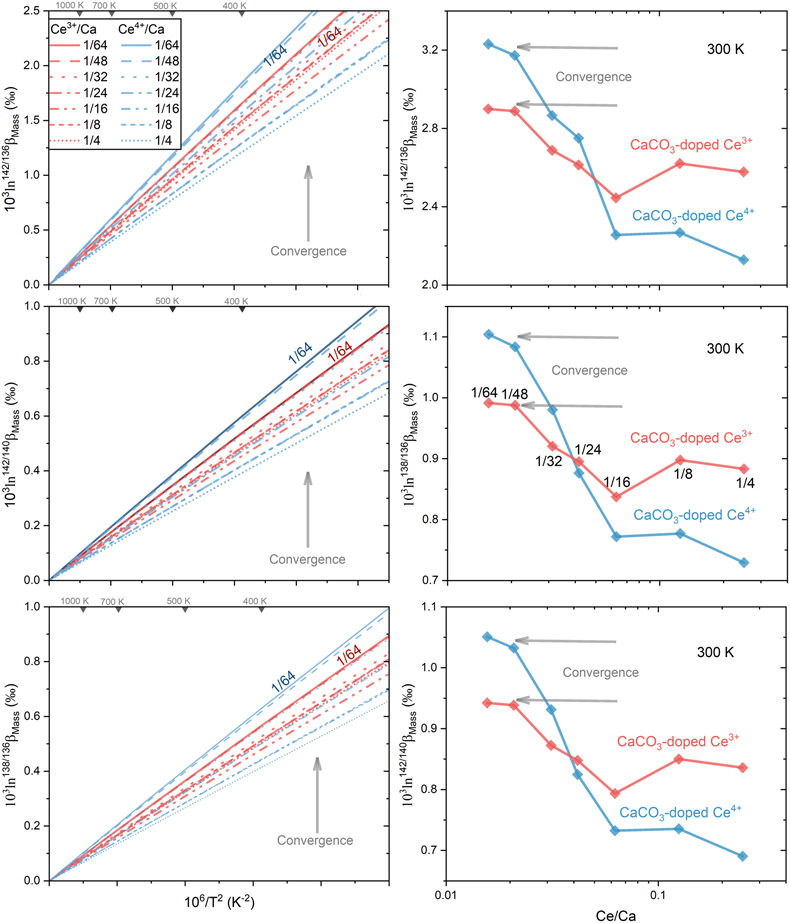
Figure 1 103lnβ versus 106/T2 (left panels) and Ce/Ca (right panels) in Ce-bearing calcites. In Ce3+-doped calcites and Ce4+-doped calcites, 103ln142/136βMass, 103ln138/136βMass, and 103ln142/140βMass values increase as Ce/Ca decreases from 1/4 to 1/48, then converge as Ce/Ca further decreases from 1/48 to 1/64.
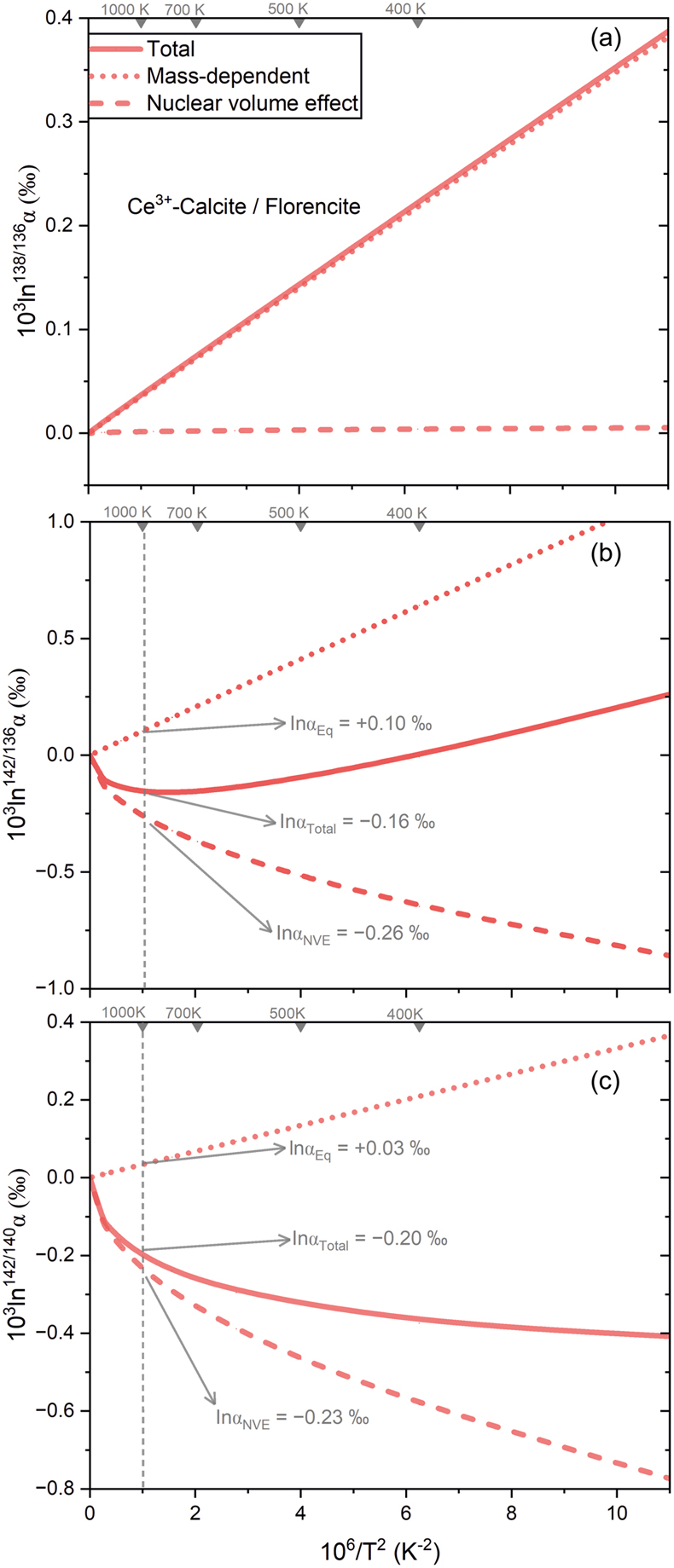
Figure 2 The effect of nuclear volume on Ce isotope fractionations between minerals. Mass-dependent, mass-independent, and total equilibrium Ce isotope fractionation factors of 103ln142/136α, 103ln138/136α and 103ln142/140α between Ce3+-calcite and florencite are compared as a case study.
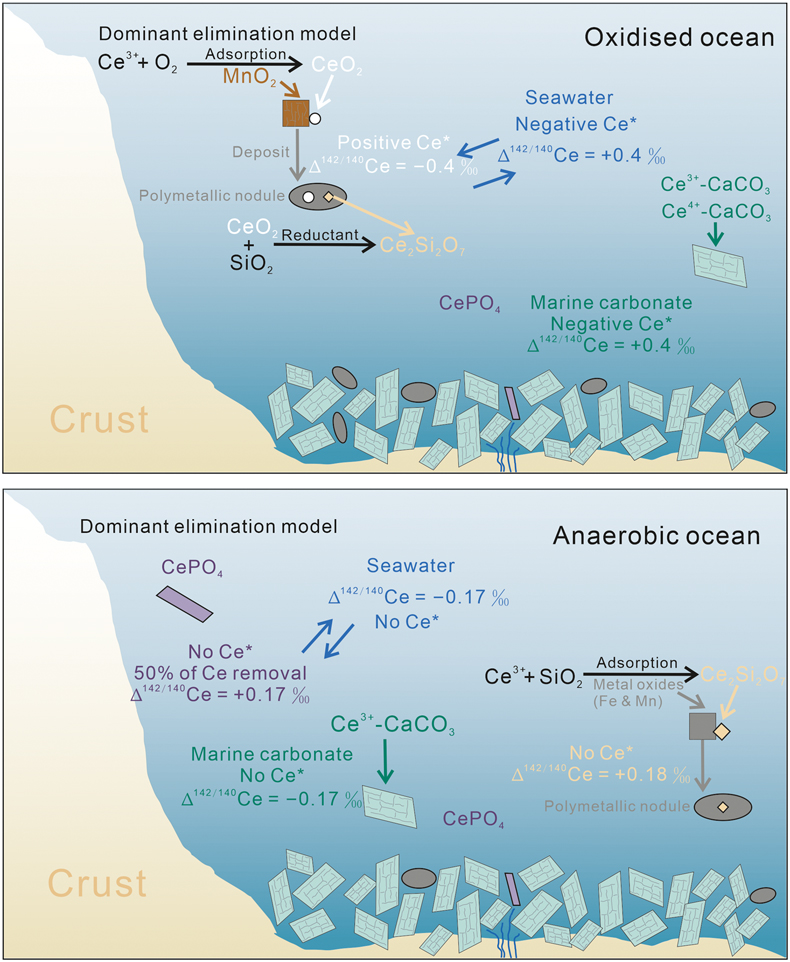
Figure 3 Schematic diagrams of Ce isotope variations in oxidised and anaerobic ocean domains. The initial Ce isotope composition (δ142/140Ce) of seawater is assumed to be 0.0 ‰. We assumed that Ce flux (ca. 90 %) is primarily controlled by the precipitation of manganese oxides in oxidised oceans, but is governed by phosphate precipitation (ca. 50 %) in anaerobic oceans. Under seawater conditions at pH 8, the Ce isotope fractionation factors between seawater and minerals are shown in Table S-3. Deposition of manganese oxides can increase δ142/140Ce values in seawater, which are otherwise decreased by the deposition of phosphates. Calcite can therefore reflect the δ142/140Ce value of seawater with limited Ce isotope fractionation at pH 8.
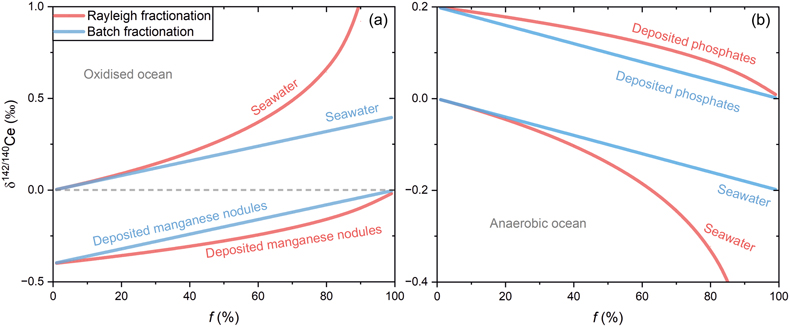
Figure 4 The Ce isotope variation model as Ce is eliminated from (a) oxidised and (b) anaerobic oceans. The initial Ce isotope composition (δ142/140Ce) of seawater is assumed to be 0.0 ‰. The equilibrium Ce isotope fractionation factors between seawater and manganese oxide, and between seawater and phosphates are set to +0.4 ‰ and −0.19 ‰, respectively, based on this study and prior experimental results (Nakada et al., 2013
Nakada, R., Takahashi, Y., Tanimizu, M. (2013) Isotopic and speciation study on cerium during its solid–water distribution with implication for Ce stable isotope as a paleo-redox proxy. Geochimica et Cosmochimica Acta 103, 49–62. https://doi.org/10.1016/j.gca.2012.10.045
; Bonnand et al., 2023Bonnand, P., Boyet, M., Bosq, C. (2023) Stable cerium isotopes as a tracer of oxidation reactions. Geochemical Perspectives Letters 28, 27–30. https://doi.org/10.7185/geochemlet.2340
). The proportion of Ce removal is represented as f (%). The Ce isotope fractionation factors between minerals calculated herein were used for Rayleigh and batch isotope fractionation models at 300 K.