



On the oxidation state of arc magmas
Affiliations | Corresponding Author | Cite as | Funding information
Published by the European Association of Geochemistry
under Creative Commons License CC BY-NC-ND 4.0
Keywords: oxygen fugacity, XANES, melt inclusions, redox, mantle, subduction


- Share this article


-
Article views:1,187Cumulative count of HTML views and PDF downloads.
- Download Citation
- Rights & Permissions

top
Abstract
Figures
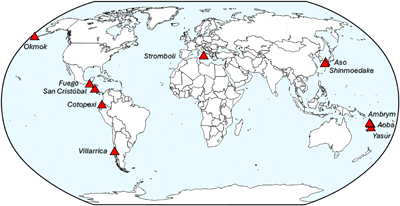 Figure 1 World map showing the locations of arc volcanoes investigated in this study, namely Yasur, Aoba/Ambae, Ambrym, Shinmoedake, Aso, Fuego, San Cristóbal, Cotopaxi, Villarrica, Okmok and Stromboli. | 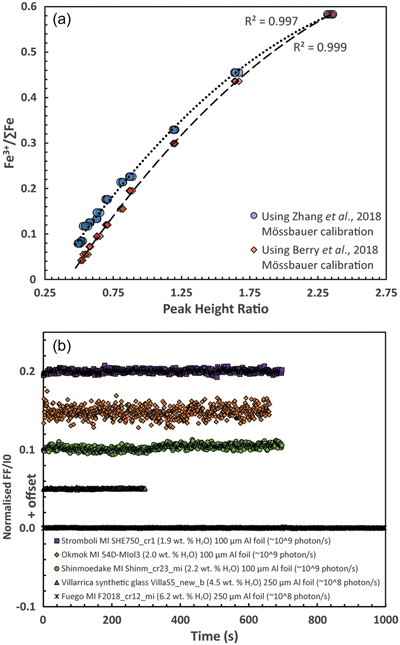 Figure 2 (a) Calibration line of the peak height ratio determined by XANES compared with Fe3+/∑Fe ratios determined by Mössbauer spectroscopy in basaltic standard glasses from the Smithsonian NMNH (Mössbauer Fe3+/∑Fe values from Zhang et al., 2018 and Berry et al., 2018 are shown). (b) Time series of normalised fluoresced intensity (FF) over I0 at 7114 eV integrated over 1 s intervals the five natural melt inclusions and synthetic glasses used for beam damage assessment. The Villarrica, Shinmoedake, Okmok and Stromboli glasses FF/I0 are offset by 0.05, 0.1, 0.15 and 0.2, respectively, for visibility. The variation in scatter between measurements is a function of the detector position which was adjusted between each sample. | 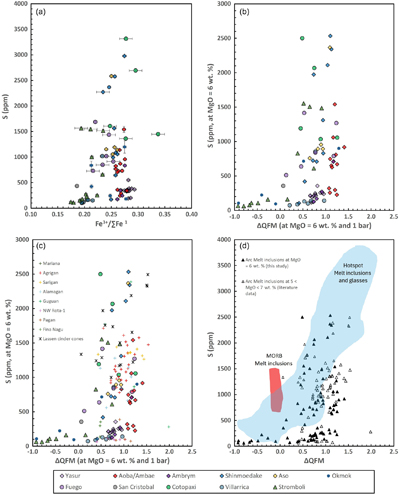 Figure 3 (a) Sulfur content versus oxidation state of melt inclusions plotted as Fe3+/∑Fe calculated using the Mössbauer Fe3+/∑Fe values from Zhang et al. (2018). Error bars show 1σ. (b) Sulfur content versus oxidation state (plotted as deviation from the QFM buffer using the equation of Kress and Carmichael, 1991) of melt inclusions after reversing fractional crystallisation to a common value of MgO = 6 wt. %. (c) Same as (b) with the addition of melt inclusions (and pillow glasses) data from the Marianna arc (Kelley and Cottrell, 2012; Brounce et al., 2014, 2016) and Lassen cinder cones (Muth and Wallace, 2021), all with MgO contents between 5 and 7 wt. %. (d) Comparison between the sulfur content versus oxidation state fields recorded by melt inclusions, embayments and matrix glasses from arc volcanoes (same data set as in (c)), hotspot volcanoes (from Fig. 7 in Moussallam et al., 2019) and mid-ocean ridge volcanoes (data set of Moussallam et al., 2023) from the Southwest Indian Ridge). Note that Hotspot melt inclusions and glasses in the database used to draw the field are on average at MgO = 6.1 ± 1.0 wt. % while MORB Melt inclusions are on average at MgO = 6.4 ± 1.3 wt. % (1σ). |
| Figure 1 | Figure 2 | Figure 3 |
top
Introduction
Constraining the oxidation state of arc magmas has long been of interest to petrologists and geochemists because the initial oxidation state of a melt plays a critical role in the sequence of phases that crystallise from it (e.g., Osborn, 1959
Osborn, E.F. (1959) Role of Oxygen Pressure in the Crystallization and Differentiation of Basaltic Magma. American Journal of Science 257, 609–647. https://doi.org/10.2475/ajs.257.9.609
). Determining the oxidation state of the mantle source of these melts is in turn of interest for understanding the cycling of multiple valence state elements between the Earth’s interior and exterior via subduction zones. Three main sample types have been used to constrain the oxidation state of arc magmas: (i) erupted lavas and tephra (e.g., Carmichael, 1991Carmichael, I.S.E. (1991) The redox states of basic and silicic magmas: a reflection of their source regions? Contributions to Mineralogy and Petrology 106, 129–141. https://doi.org/10.1007/BF00306429
), (ii) xenoliths carried in arc magmas (e.g., Parkinson and Arculus, 1999Parkinson, I.J., Arculus, R.J. (1999) The redox state of subduction zones: insights from arc-peridotites. Chemical Geology 160, 409–423. https://doi.org/10.1016/S0009-2541(99)00110-2
), and (iii) crystal hosted melt inclusions (e.g., Kelley and Cottrell, 2012Kelley, K.A., Cottrell, E. (2012) The influence of magmatic differentiation on the oxidation state of Fe in a basaltic arc magma. Earth and Planetary Science Letters 329–330, 109–121. https://doi.org/10.1016/j.epsl.2012.02.010
).However, while measurements of erupted products and xenoliths have been made for arc magmas around the world (e.g., Hu et al., 2024
Hu, F., Jiang, H., Wan, B., Ducea, M.N., Gao, L., Wu, F.-Y. (2024) Latitude-dependent oxygen fugacity in arc magmas. Nature Communications 15, 6050. https://doi.org/10.1038/s41467-024-50337-6
), measurements of crystal hosted melt inclusions (MIs) for arc lavas almost exclusively derive from a single site, the Mariana Arc (Brounce et al., 2014Brounce, M.N., Kelley, K.A., Cottrell, E. (2014) Variations in Fe3+/∑Fe of Mariana Arc Basalts and Mantle Wedge fO2. Journal of Petrology 55, 2513–2536. https://doi.org/10.1093/petrology/egu065
; Kelley and Cottrell, 2009Kelley, K.A., Cottrell, E. (2009) Water and the Oxidation State of Subduction Zone Magmas. Science 325, 605–607. https://doi.org/10.1126/science.1174156
, 2012Kelley, K.A., Cottrell, E. (2012) The influence of magmatic differentiation on the oxidation state of Fe in a basaltic arc magma. Earth and Planetary Science Letters 329–330, 109–121. https://doi.org/10.1016/j.epsl.2012.02.010
). One reason for the paucity of data of the latter type, in addition to challenging sample preparation, is that X-ray absorption near-edge structure (XANES) measurements of the valence state of Fe and S in water-rich silicate glasses are often compromised by beam damage (e.g., Cottrell et al., 2009Cottrell, E., Kelley, K.A., Lanzirotti, A., Fischer, R.A. (2009) High-precision determination of iron oxidation state in silicate glasses using XANES. Chemical Geology 268, 167–179. https://doi.org/10.1016/j.chemgeo.2009.08.008
, 2018Cottrell, E., Lanzirotti, A., Mysen, B., Birner, S., Kelley, K.A., Botcharnikov, R., Davis, F.A., Newville, M. (2018) A Mössbauer-based XANES calibration for hydrous basalt glasses reveals radiation-induced oxidation of Fe. American Mineralogist 103, 489–501. https://doi.org/10.2138/am-2018-6268
; Shorttle et al., 2015Shorttle, O., Moussallam, Y., Hartley, M.E., Maclennan, J., Edmonds, M., Murton, B.J. (2015) Fe-XANES analyses of Reykjanes Ridge basalts: Implications for oceanic crust’s role in the solid Earth oxygen cycle. Earth and Planetary Science Letters 427, 272–285. https://doi.org/10.1016/j.epsl.2015.07.017
; Moussallam et al., 2014Moussallam, Y., Oppenheimer, C., Scaillet, B., Gaillard, F., Kyle, P., Peters, N., Hartley, M., Berlo, K., Donovan, A. (2014) Tracking the changing oxidation state of Erebus magmas, from mantle to surface, driven by magma ascent and degassing. Earth and Planetary Science Letters 393, 200–209. https://doi.org/10.1016/j.epsl.2014.02.055
, 2016Moussallam, Y., Edmonds, M., Scaillet, B., Peters, N., Gennaro, E., Sides, I., Oppenheimer, C. (2016) The impact of degassing on the oxidation state of basaltic magmas: A case study of Kīlauea volcano. Earth and Planetary Science Letters 450, 317–325. https://doi.org/10.1016/j.epsl.2016.06.031
, 2019Moussallam, Y., Longpré, M.-A., McCammon, C., Gomez-Ulla, A., Rose-Koga, E.F., Scaillet, B., Peters, N., Gennaro, E., Paris, R., Oppenheimer, C. (2019) Mantle plumes are oxidised. Earth and Planetary Science Letters 527, 115798. https://doi.org/10.1016/j.epsl.2019.115798
, 2023Moussallam, Y., Georgeais, G., Rose-Koga, E.F., Koga, K.T., Hartley, M.E., Scaillet, B., Oppenheimer, C., Peters, N. (2023) CO2-Undersaturated Melt Inclusions From the South West Indian Ridge Record Surprisingly Uniform Redox Conditions. Geochemistry, Geophysics, Geosystems 24, e2023GC011235. https://doi.org/10.1029/2023GC011235
). Yet these are the only measurements that directly measure the oxidation state of Fe and S (the most important multiple valence state elements) in the melt as opposed to reliance on proxies. Here we report Fe3+/ΣFe measurements in melt inclusions from eleven arc volcanoes obtained by XANES spectroscopy at the iron K-edge, together with their volatile and major element concentrations.top
Samples and Methods
Sample sites were chosen because of the relatively mafic composition of their magmas (Fig. 1). They include Yasur, Aoba/Ambae, and Ambrym in Vanuatu, Shinmoedake and Aso in Japan, Okmok in Alaska, Fuego in Guatemala, San Cristóbal in Nicaragua, Cotopaxi in Ecuador, Villarrica in Chile, and Stromboli in Italy. Detailed sample description and processing is provided in the Supplementary Information, together with details of the Fourier Transform Infrared Spectroscopy and electron probe microanalyses.
Figure 1 World map showing the locations of arc volcanoes investigated in this study, namely Yasur, Aoba/Ambae, Ambrym, Shinmoedake, Aso, Fuego, San Cristóbal, Cotopaxi, Villarrica, Okmok and Stromboli.
XANES analyses. We performed Fe K-edge XANES spectroscopy at beamline I18 at the Diamond Light Source (DLS), UK. X-rays were focused with Kirkpatrick-Baez mirrors to a beam size of 5 μm (horizontal) × 5 μm (vertical). The beamline uses a liquid nitrogen cooled double crystal monochromator with silicon crystals and the Si (333) reflection was used to maximise the energy resolution. The measurements were performed in fluorescence mode. We used an energy dispersive Vortex ME-4 silicon drift detector positioned at 90° to the incident beam. The sample was positioned so that the normal to the sample surface was at 45° to the incident X-ray beam. Standard analytical conditions for XANES at I18 yield a photon flux of 1010 photon/s by attenuating (using a combination of aluminium foils and a slit) a 1012 photon/s primary beam upstream of the ion chamber. The beam can then be further attenuated (using Al foil).
We performed a series of tests to tune analytical conditions so as to avoid beam damage in our samples. We used:
- A natural melt inclusion from Stromboli volcano (SHE750_cr1) containing 1.9 wt. % H2O.
- A natural melt inclusion from Okmok volcano (54D-MIol3) containing 2.0 wt. % H2O.
- A natural melt inclusion from Shinmoedake volcano (Shinm_cr23_mi) containing 2.2 wt. % H2O.
- A synthetic hydrated experimental glass of Villarrica 2015 composition (VillaS5_new_b) containing 4.5 wt. % H2O.
- A natural melt inclusion from Fuego volcano (F2018_cr12_mi) containing 6.2 wt. % H2O.
We positioned the monochromator at a fixed energy of 7114 eV, corresponding to the oxidised peak of the pre-edge region. We then opened the shutter and counted the fluoresced X-rays every second for 660 to 1000 s (approx. 10 to 17 min) (Fig. 2). Tests were performed attenuating the beam with either 100 μm or 250 μm Al plates, resulting in attenuation to about 16 % and 1 % of the original flux respectively (equivalent to ∼109 and ∼108 photon/s respectively or ∼108 and 107 photon/s/μm2 respectively) (Moussallam et al., 2019
Moussallam, Y., Longpré, M.-A., McCammon, C., Gomez-Ulla, A., Rose-Koga, E.F., Scaillet, B., Peters, N., Gennaro, E., Paris, R., Oppenheimer, C. (2019) Mantle plumes are oxidised. Earth and Planetary Science Letters 527, 115798. https://doi.org/10.1016/j.epsl.2019.115798
). We found that with 250 μm Al plates, henceforth referred to as the “high attenuation” setup, even a glass containing 6.2 wt. % H2O could be analysed without beam damage under our analytical conditions. These conditions are similar to those of Moussallam et al. (2019)Moussallam, Y., Longpré, M.-A., McCammon, C., Gomez-Ulla, A., Rose-Koga, E.F., Scaillet, B., Peters, N., Gennaro, E., Paris, R., Oppenheimer, C. (2019) Mantle plumes are oxidised. Earth and Planetary Science Letters 527, 115798. https://doi.org/10.1016/j.epsl.2019.115798
who showed that at the same beamline under the same analytical conditions no beam damage was occurring when analysing a glass with 5.2 wt. % H2O. We found that with a 100 μm Al plate, conditions similar to those used by Moussallam et al. (2016Moussallam, Y., Edmonds, M., Scaillet, B., Peters, N., Gennaro, E., Sides, I., Oppenheimer, C. (2016) The impact of degassing on the oxidation state of basaltic magmas: A case study of Kīlauea volcano. Earth and Planetary Science Letters 450, 317–325. https://doi.org/10.1016/j.epsl.2016.06.031
, 2023Moussallam, Y., Georgeais, G., Rose-Koga, E.F., Koga, K.T., Hartley, M.E., Scaillet, B., Oppenheimer, C., Peters, N. (2023) CO2-Undersaturated Melt Inclusions From the South West Indian Ridge Record Surprisingly Uniform Redox Conditions. Geochemistry, Geophysics, Geosystems 24, e2023GC011235. https://doi.org/10.1029/2023GC011235
), henceforth referred to as the “moderate attenuation” setup, glasses with up to 2.2 wt. % H2O could be analysed without beam damage under our analytical conditions. All MIs containing more than 2.2 wt. % H2O were therefore analysed using the high attenuation setup while the other melt inclusions, and all matrix glasses were analysed using the moderate attenuation setup. Because the high attenuation setup leads to fewer fluorescent photon counts and hence lower quality spectra, dwell time at each energy step was increased (energy step sizes and dwell times given in Table S-1) and three to four scans were acquired per melt inclusion and co-added. Spectra showing any structure in the edge and post-edge region were rejected (see Fig. S-6 in Moussallam et al., 2014Moussallam, Y., Oppenheimer, C., Scaillet, B., Gaillard, F., Kyle, P., Peters, N., Hartley, M., Berlo, K., Donovan, A. (2014) Tracking the changing oxidation state of Erebus magmas, from mantle to surface, driven by magma ascent and degassing. Earth and Planetary Science Letters 393, 200–209. https://doi.org/10.1016/j.epsl.2014.02.055
, for an example of contaminated spectra).Figure 2 (a) Calibration line of the peak height ratio determined by XANES compared with Fe3+/∑Fe ratios determined by Mössbauer spectroscopy in basaltic standard glasses from the Smithsonian NMNH (Mössbauer Fe3+/∑Fe values from Zhang et al., 2018
Zhang, H.L., Cottrell, E., Solheid, P.A., Kelley, K.A., Hirschmann, M.M. (2018) Determination of Fe3+/ΣFe of XANES basaltic glass standards by Mössbauer spectroscopy and its application to the oxidation state of iron in MORB. Chemical Geology 479, 166–175. https://doi.org/10.1016/j.chemgeo.2018.01.006
and Berry et al., 2018Berry, A.J., Stewart, G.A., O’Neill, H.St.C., Mallmann, G., Mosselmans, J.F.W. (2018) A re-assessment of the oxidation state of iron in MORB glasses. Earth and Planetary Science Letters 483, 114–123. https://doi.org/10.1016/j.epsl.2017.11.032
are shown). (b) Time series of normalised fluoresced intensity (FF) over I0 at 7114 eV integrated over 1 s intervals the five natural melt inclusions and synthetic glasses used for beam damage assessment. The Villarrica, Shinmoedake, Okmok and Stromboli glasses FF/I0 are offset by 0.05, 0.1, 0.15 and 0.2, respectively, for visibility. The variation in scatter between measurements is a function of the detector position which was adjusted between each sample.The pre-edge region (7110–7118 eV) was fitted using a combination of a linear function and a damped harmonic oscillator function to fit the baseline and fitted by a combination of two gaussian functions. The relative intensity at the ∼7112.2 eV and ∼7114.0 eV peaks was then used to calibrate the spectra to the published Fe3+/∑Fe ratios of the NMNH 117393 basalt reference glasses (Cottrell et al., 2009
Cottrell, E., Kelley, K.A., Lanzirotti, A., Fischer, R.A. (2009) High-precision determination of iron oxidation state in silicate glasses using XANES. Chemical Geology 268, 167–179. https://doi.org/10.1016/j.chemgeo.2009.08.008
) provided by the Smithsonian Institution National Museum of Natural History and using both the Fe3+/∑Fe values reported in Zhang et al. (2018)Zhang, H.L., Cottrell, E., Solheid, P.A., Kelley, K.A., Hirschmann, M.M. (2018) Determination of Fe3+/ΣFe of XANES basaltic glass standards by Mössbauer spectroscopy and its application to the oxidation state of iron in MORB. Chemical Geology 479, 166–175. https://doi.org/10.1016/j.chemgeo.2018.01.006
and Berry et al. (2018)Berry, A.J., Stewart, G.A., O’Neill, H.St.C., Mallmann, G., Mosselmans, J.F.W. (2018) A re-assessment of the oxidation state of iron in MORB glasses. Earth and Planetary Science Letters 483, 114–123. https://doi.org/10.1016/j.epsl.2017.11.032
(Fig. 2). Repeat measurements (n = 39) on the twelve standards (all analysed using moderate attenuation) yielded a standard deviation of ±0.003 on the measured Fe3+/∑Fe ratios (relative error) which translate to a standard deviation of ±0.04 on the calculated fO2. Standard deviation using the high attenuation setup with two co-added spectra was determined as ±0.012 by Moussallam et al. (2019)Moussallam, Y., Longpré, M.-A., McCammon, C., Gomez-Ulla, A., Rose-Koga, E.F., Scaillet, B., Peters, N., Gennaro, E., Paris, R., Oppenheimer, C. (2019) Mantle plumes are oxidised. Earth and Planetary Science Letters 527, 115798. https://doi.org/10.1016/j.epsl.2019.115798
(which translates to a standard deviation of ±0.14 on the calculated fO2). We report this error here but note that in the present study we co-added three to four spectra each time so the error should be smaller. The absolute error is linked to the interpretation of the NMNH 117393 basalt reference glasses Mössbauer spectra and we show the calibrations resulting from both interpretations (Zhang et al., 2018Zhang, H.L., Cottrell, E., Solheid, P.A., Kelley, K.A., Hirschmann, M.M. (2018) Determination of Fe3+/ΣFe of XANES basaltic glass standards by Mössbauer spectroscopy and its application to the oxidation state of iron in MORB. Chemical Geology 479, 166–175. https://doi.org/10.1016/j.chemgeo.2018.01.006
; Berry et al., 2018Berry, A.J., Stewart, G.A., O’Neill, H.St.C., Mallmann, G., Mosselmans, J.F.W. (2018) A re-assessment of the oxidation state of iron in MORB glasses. Earth and Planetary Science Letters 483, 114–123. https://doi.org/10.1016/j.epsl.2017.11.032
) here.Reverse fractional crystallisation calculation. To assess the effect of pre-entrapment crystallisation on Fe3+/∑Fe (e.g., Sun and Lee, 2022
Sun, C., Lee, C.-T.A. (2022) Redox evolution of crystallizing magmas with C-H-O-S volatiles and its implications for atmospheric oxygenation. Geochimica et Cosmochimica Acta 338, 302–321. https://doi.org/10.1016/j.gca.2022.09.044
), we modelled reverse crystallisation paths for our melt inclusions using Petrolog3 (Danyushevsky and Plechov, 2011Danyushevsky, L.V., Plechov, P. (2011) Petrolog3: Integrated software for modeling crystallization processes. Geochemistry, Geophysics, Geosystems 12, Q07021. https://doi.org/10.1029/2011GC003516
). We used the model of Ford et al. (1983)Ford, C.E., Russell, D.G., Craven, J.A., Fisk, M.R. (1983) Olivine-Liquid Equilibria: Temperature, Pressure and Composition Dependence of the Crystal/Liquid Cation Partition Coefficients for Mg, Fe2+, Ca and Mn. Journal of Petrology 24, 256–266. https://doi.org/10.1093/petrology/24.3.256
for olivine, the model of Ariskin et al. (1993)Ariskin, A.A., Frenkel, M.Ya., Barmina, G.S., Nielsen, R.L. (1993) Comagmat: a Fortran program to model magma differentiation processes. Computers & Geosciences 19, 1155–1170. https://doi.org/10.1016/0098-3004(93)90020-6
for plagioclase and the model of Ariskin et al. (1988)Ariskin, A.A., Barmina, G.S., Frenkel, M.Y., Yaroshevskiy, A.A. (1988) Simulating low-pressure tholeiite-magma crystallization. Geochemistry International 25, 21–37.
for clinopyroxene. This combination was used as it yielded reverse fractional crystallisation paths that most closely reproduced the trend in CaO vs. MgO observed in the natural melt inclusions and matrix glasses data (Fig. S-4). Note that these models assume a fully incompatible behaviour for Fe3+ in the olivine, clinopyroxene and plagioclase phases. Reverse fractional crystallisation calculations, which yield restored values of Fe3+/∑Fe, volatile contents, and major element compositions, were performed until the melt reached a value of 6 wt. % MgO, the highest value recorded in the data set (Fig. S-4). An alternative, empirical, modelling approach is presented in the SI. Post-entrapment crystallisation (PEC) for olivine hosted inclusions was calculated using Petrolog3 assuming a closed system for oxygen. The resulting PEC estimates range from −21 to +3 %, with an average of −2 % and standard deviation of ±3 %. Given these results we did not modify the MI compositions from their measured values.top
Results and Discussion
We determined the Fe3+/∑Fe ratio of 81 melt inclusions and 70 matrix glasses using XANES. The raw data for melt inclusions and matrix glasses are presented in Tables S-2 to S-6. We found that matrix glasses, clear of any visible alteration, exhibited a wide range of Fe3+/∑Fe ratios, even within single samples. For instance, for Okmok glasses, Fe3+/∑Fe ratios ranged from 0.19 to 0.54 (Tables S-5 and S-6). Most matrix glasses were significantly more oxidised than melt inclusions, with extreme values reaching up to QFM +5, uncorrelated with major or volatile element composition and with large variations in oxidation state recorded between areas of glass fragments located only a few millimetres apart. Based on these observations we consider that a significant proportion of our matrix glass Fe3+/∑Fe measurements are unlikely to be representative of the original melt, and we consider that they reflect variable degrees of oxidation due to partial re-equilibration with erupted gas and/or the atmosphere during eruption. Consequently, we did not consider matrix glasses further in this study.
Raw melt inclusion Fe3+/∑Fe ratios show no correlation with major or volatile (Fig. 3a) element compositions, with all r2 values below 0.4. However, the analysed melt inclusions span a wide compositional range (46.8 < SiO2 < 62.8 wt. %; Table S-3), partly reflecting variable degrees of differentiation. To account for this effect and compare melt inclusions at a common differentiation stage, we modelled reverse crystallisation paths using Petrolog3 (Danyushevsky and Plechov, 2011
Danyushevsky, L.V., Plechov, P. (2011) Petrolog3: Integrated software for modeling crystallization processes. Geochemistry, Geophysics, Geosystems 12, Q07021. https://doi.org/10.1029/2011GC003516
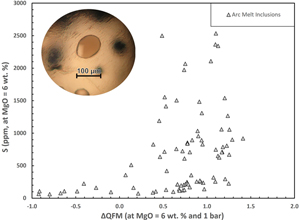
), back to MgO = 6 wt. % (results reported in Table S-7). After this restoration, a trend emerges between the oxidation state of melt inclusions and their S content (Fig. 3b,c). Melt inclusions with higher S contents are consistently more oxidised than those with lower S contents. On average, melt inclusions with S > 2000 ppm have an oxidation state of QFM +1.0 (±0.2, 1σ; n = 6), while those with S < 100 ppm have an oxidation state of QFM −0.2 (±0.6, 1σ; n = 7). Melt fO2 is calculated from Fe3+/∑Fe using Equation (7) from Kress and Carmichael (1991)Kress, V.C., Carmichael, I.S.E. (1991) The compressibility of silicate liquids containing Fe2O3 and the effect of composition, temperature, oxygen fugacity and pressure on their redox states. Contributions to Mineralogy and Petrology 108, 82–92. https://doi.org/10.1007/BF00307328
at 1 bar and using the Petrolog3 calculated equilibrium temperature; QFM refers to the Quartz-Magnetite-Fayalite mineral redox buffer as reported in Frost (1991)Frost, B.R. (1991) Introduction to oxygen fugacity and its petrologic importance. Reviews in Mineralogy and Geochemistry 25, 1–9. https://doi.org/10.1515/9781501508684-004
.Figure 3 (a) Sulfur content versus oxidation state of melt inclusions plotted as Fe3+/∑Fe calculated using the Mössbauer Fe3+/∑Fe values from Zhang et al. (2018)
Zhang, H.L., Cottrell, E., Solheid, P.A., Kelley, K.A., Hirschmann, M.M. (2018) Determination of Fe3+/ΣFe of XANES basaltic glass standards by Mössbauer spectroscopy and its application to the oxidation state of iron in MORB. Chemical Geology 479, 166–175. https://doi.org/10.1016/j.chemgeo.2018.01.006
. Error bars show 1σ. (b) Sulfur content versus oxidation state (plotted as deviation from the QFM buffer using the equation of Kress and Carmichael, 1991Kress, V.C., Carmichael, I.S.E. (1991) The compressibility of silicate liquids containing Fe2O3 and the effect of composition, temperature, oxygen fugacity and pressure on their redox states. Contributions to Mineralogy and Petrology 108, 82–92. https://doi.org/10.1007/BF00307328
) of melt inclusions after reversing fractional crystallisation to a common value of MgO = 6 wt. %. (c) Same as (b) with the addition of melt inclusions (and pillow glasses) data from the Marianna arc (Kelley and Cottrell, 2012Kelley, K.A., Cottrell, E. (2012) The influence of magmatic differentiation on the oxidation state of Fe in a basaltic arc magma. Earth and Planetary Science Letters 329–330, 109–121. https://doi.org/10.1016/j.epsl.2012.02.010
; Brounce et al., 2014Brounce, M.N., Kelley, K.A., Cottrell, E. (2014) Variations in Fe3+/∑Fe of Mariana Arc Basalts and Mantle Wedge fO2. Journal of Petrology 55, 2513–2536. https://doi.org/10.1093/petrology/egu065
, 2016Brounce, M., Kelley, K.A., Stern, R., Martinez, F., Cottrell, E. (2016) The Fina Nagu volcanic complex: Unusual submarine arc volcanism in the rapidly deforming southern Mariana margin. Geochemistry, Geophysics, Geosystems 17, 4078–4091. https://doi.org/10.1002/2016GC006457
) and Lassen cinder cones (Muth and Wallace, 2021Muth, M.J., Wallace, P.J. (2021) Slab-derived sulfate generates oxidized basaltic magmas in the southern Cascade arc (California, USA). Geology 49, 1177–1181. https://doi.org/10.1130/G48759.1
), all with MgO contents between 5 and 7 wt. %. (d) Comparison between the sulfur content versus oxidation state fields recorded by melt inclusions, embayments and matrix glasses from arc volcanoes (same data set as in (c)), hotspot volcanoes (from Fig. 7 in Moussallam et al., 2019Moussallam, Y., Longpré, M.-A., McCammon, C., Gomez-Ulla, A., Rose-Koga, E.F., Scaillet, B., Peters, N., Gennaro, E., Paris, R., Oppenheimer, C. (2019) Mantle plumes are oxidised. Earth and Planetary Science Letters 527, 115798. https://doi.org/10.1016/j.epsl.2019.115798
) and mid-ocean ridge volcanoes (data set of Moussallam et al., 2023Moussallam, Y., Georgeais, G., Rose-Koga, E.F., Koga, K.T., Hartley, M.E., Scaillet, B., Oppenheimer, C., Peters, N. (2023) CO2-Undersaturated Melt Inclusions From the South West Indian Ridge Record Surprisingly Uniform Redox Conditions. Geochemistry, Geophysics, Geosystems 24, e2023GC011235. https://doi.org/10.1029/2023GC011235
) from the Southwest Indian Ridge). Note that Hotspot melt inclusions and glasses in the database used to draw the field are on average at MgO = 6.1 ± 1.0 wt. % while MORB Melt inclusions are on average at MgO = 6.4 ± 1.3 wt. % (1σ).We can compare these results with other studies that have determined the oxidation state of melt inclusions (and pillow glasses) in arc magmas by XANES spectroscopy at the Fe K-edge. These include studies in the Mariana arc (Kelley and Cottrell, 2012
Kelley, K.A., Cottrell, E. (2012) The influence of magmatic differentiation on the oxidation state of Fe in a basaltic arc magma. Earth and Planetary Science Letters 329–330, 109–121. https://doi.org/10.1016/j.epsl.2012.02.010
; Brounce et al., 2014Brounce, M.N., Kelley, K.A., Cottrell, E. (2014) Variations in Fe3+/∑Fe of Mariana Arc Basalts and Mantle Wedge fO2. Journal of Petrology 55, 2513–2536. https://doi.org/10.1093/petrology/egu065
, 2016Brounce, M., Kelley, K.A., Stern, R., Martinez, F., Cottrell, E. (2016) The Fina Nagu volcanic complex: Unusual submarine arc volcanism in the rapidly deforming southern Mariana margin. Geochemistry, Geophysics, Geosystems 17, 4078–4091. https://doi.org/10.1002/2016GC006457
) and a study of cinder cones in the Lassen region (California, USA) (Muth and Wallace, 2021Muth, M.J., Wallace, P.J. (2021) Slab-derived sulfate generates oxidized basaltic magmas in the southern Cascade arc (California, USA). Geology 49, 1177–1181. https://doi.org/10.1130/G48759.1
). For the comparison with our data, corrected to MgO = 6 wt. %, to be meaningful, we only report in Figure 3c literature data from Mariannas and Lassen with MgO contents between 5 and 7 wt. % (i.e. directly comparable to our MgO = 6 wt. % data). The distributions of our new data points and existing ones coincide and overlap, mostly falling within the same range in oxidation state at a given S content. The observed trend between the sulfur content of melt inclusions and their oxidation state is strengthened by the addition of literature data extending the trend to slightly higher oxidation states. It therefore appears that, as previously demonstrated for hotspot volcanoes (Moussallam et al., 2014Moussallam, Y., Oppenheimer, C., Scaillet, B., Gaillard, F., Kyle, P., Peters, N., Hartley, M., Berlo, K., Donovan, A. (2014) Tracking the changing oxidation state of Erebus magmas, from mantle to surface, driven by magma ascent and degassing. Earth and Planetary Science Letters 393, 200–209. https://doi.org/10.1016/j.epsl.2014.02.055
, 2016Moussallam, Y., Edmonds, M., Scaillet, B., Peters, N., Gennaro, E., Sides, I., Oppenheimer, C. (2016) The impact of degassing on the oxidation state of basaltic magmas: A case study of Kīlauea volcano. Earth and Planetary Science Letters 450, 317–325. https://doi.org/10.1016/j.epsl.2016.06.031
, 2019Moussallam, Y., Longpré, M.-A., McCammon, C., Gomez-Ulla, A., Rose-Koga, E.F., Scaillet, B., Peters, N., Gennaro, E., Paris, R., Oppenheimer, C. (2019) Mantle plumes are oxidised. Earth and Planetary Science Letters 527, 115798. https://doi.org/10.1016/j.epsl.2019.115798
; Brounce et al., 2017Brounce, M., Stolper, E., Eiler, J. (2017) Redox variations in Mauna Kea lavas, the oxygen fugacity of the Hawaiian plume, and the role of volcanic gases in Earth’s oxygenation. Proceedings of the National Academy of Sciences 114, 8997–9002. https://doi.org/10.1073/pnas.1619527114
), sulfur degassing in arc volcanoes is accompanied by a reduction of the melt oxidation state. In the SI we explore how available gas-melt equilibrium degassing models compare to the observed trend.We note that our observations reconcile an apparent discrepancy in the literature regarding the oxidation states of arc magmas. Most estimates of the oxygen fugacities of the sub-arc mantle, from mineral oxybarometry in xenoliths and lavas (e.g., Cottrell et al., 2021
Cottrell, E., Birner, S., Brounce, M., Davis, F., Waters, L., Kelley, K. (2021) Oxygen fugacity across tectonic settings. In: Moretti, R., Neuville, D.R. (Eds.) Magma Redox Geochemistry. American Geophysical Union, Hoboken, 33–61. https://doi.org/10.1002/9781119473206.ch3
and references therein) or trace element systematics in arc lavas (e.g., Zhao et al., 2022Zhao, S.-Y., Yang, A.Y., Langmuir, C.H., Zhao, T.-P. (2022) Oxidized primary arc magmas: Constraints from Cu/Zr systematics in global arc volcanics. Science Advances 8, eabk0718. https://doi.org/10.1126/sciadv.abk0718
) cluster around QFM +1, while those from the 'restoration’ of volcanic gases of arc volcanoes to magmatic temperatures cluster around QFM (Moussallam et al., 2024Moussallam, Y., Oppenheimer, C., Scaillet, B. (2024) A novel approach to volcano surveillance using gas geochemistry. Comptes Rendus. Géoscience 356, 71–84. https://doi.org/10.5802/crgeos.158
). The one log unit difference in oxidation state can be readily explained by degassing (Fig. 3).Another interesting result is that, at similar degrees of differentiation (MgO ≈ 6 wt. %) and sulfur contents (∼2500 ppm), arc magmas are not more oxidised than their hotspot counterparts. Hotspot magmas record oxidation states around QFM +1.2 under these conditions and even more oxidised conditions at higher sulfur contents, taken as evidence of recycled oxidised crustal material brought out of the deep earth by mantle plumes (Moussallam et al., 2019
Moussallam, Y., Longpré, M.-A., McCammon, C., Gomez-Ulla, A., Rose-Koga, E.F., Scaillet, B., Peters, N., Gennaro, E., Paris, R., Oppenheimer, C. (2019) Mantle plumes are oxidised. Earth and Planetary Science Letters 527, 115798. https://doi.org/10.1016/j.epsl.2019.115798
) (Fig. 3d). In fact, there is a significant overlap between the arc and hotspot data sets (Fig. 3d). However, the reducing trend with sulfur degassing differs between hotspot and arc magmas, showing a constant slope for hotspot magmas and a hockey stick trend for arc magmas. This difference is likely due to the significant variation in water content between the two magma types. In contrast, the oxidation state of melt inclusions in mid-ocean ridge magmas shows no change in oxidation state with sulfur content (e.g., Moussallam et al., 2023Moussallam, Y., Georgeais, G., Rose-Koga, E.F., Koga, K.T., Hartley, M.E., Scaillet, B., Oppenheimer, C., Peters, N. (2023) CO2-Undersaturated Melt Inclusions From the South West Indian Ridge Record Surprisingly Uniform Redox Conditions. Geochemistry, Geophysics, Geosystems 24, e2023GC011235. https://doi.org/10.1029/2023GC011235
) (Fig. 3d). The sulfur content of MORB is thought to be primarily controlled by equilibrium with sulfide (e.g., Mathez, 1976Mathez, E.A. (1976) Sulfur solubility and magmatic sulfides in submarine basalt glass. Journal of Geophysical Research: Solid Earth and Planets 81, 4269–4276. https://doi.org/10.1029/JB081i023p04269
), such that sulfur degassing in MORBs is an uncommon, yet documented, process (e.g., Shorttle et al., 2015Shorttle, O., Moussallam, Y., Hartley, M.E., Maclennan, J., Edmonds, M., Murton, B.J. (2015) Fe-XANES analyses of Reykjanes Ridge basalts: Implications for oceanic crust’s role in the solid Earth oxygen cycle. Earth and Planetary Science Letters 427, 272–285. https://doi.org/10.1016/j.epsl.2015.07.017
).top
Conclusions
We have analysed the oxidation states of arc magmas from eleven volcanic systems by measuring Fe3+/∑Fe ratios along with major and volatile elements in olivine and plagioclase hosted melt inclusions. Once corrected for the effect of fractional crystallisation, we found that arc magmas define a trend of decreasing oxidation state with decreasing sulfur content. Thus, both degassing and differentiation can influence redox conditions of arc magmas to a comparable magnitude yet potentially in opposing directions (reducing and oxidising, respectively). When compared at similar degrees of differentiation and sulfur contents, the oxidation states of arc magmas can be similar to those of hotspot volcanoes.
top
Acknowledgements
Analytical work was carried out at Diamond Light Source using beamline I18 (proposal number SP36021-1) with invaluable support from Susan Nehzati and Konstantin Ignatyev. EFR-K thank Dr Akira Yoshiasa, and Dr. Toshiaki Hasenaka for their help on the field during the 2020 sampling campaign in Japan. We are very grateful to Marco Pistolesi for providing samples from Stromboli. We are grateful to Ery Hughes and two anonymous reviewers for providing valuable comments improving the quality of the manuscript.
Editor: Helen Williams
top
Open Research
Raw X-ray absorption near-edge structure spectra at the iron K-edge are archived on https://figshare.com/ [Moussallam, Y. (2025) ARC XANES SPECTRA RAW. figshare, dataset. https://doi.org/10.6084/m9.figshare.29509223.v1]. Raw FTIR data and PyIRoGlass outputs are archived on https://figshare.com/ [Moussallam, Y. (2025) ARC FTIR Spectra and Fit. figshare, dataset. https://doi.org/10.6084/m9.figshare.30657611.v1].
top
References
Ariskin, A.A., Barmina, G.S., Frenkel, M.Y., Yaroshevskiy, A.A. (1988) Simulating low-pressure tholeiite-magma crystallization. Geochemistry International 25, 21–37.
 Show in context
 We used the model of Ford et al. (1983) for olivine, the model of Ariskin et al. (1993) for plagioclase and the model of Ariskin et al. (1988) for clinopyroxene.
View in article
Ariskin, A.A., Frenkel, M.Ya., Barmina, G.S., Nielsen, R.L. (1993) Comagmat: a Fortran program to model magma differentiation processes. Computers & Geosciences 19, 1155–1170. https://doi.org/10.1016/0098-3004(93)90020-6
Show in context We used the model of Ford et al. (1983) for olivine, the model of Ariskin et al. (1993) for plagioclase and the model of Ariskin et al. (1988) for clinopyroxene.
View in article
Berry, A.J., Stewart, G.A., O’Neill, H.St.C., Mallmann, G., Mosselmans, J.F.W. (2018) A re-assessment of the oxidation state of iron in MORB glasses. Earth and Planetary Science Letters 483, 114–123. https://doi.org/10.1016/j.epsl.2017.11.032
Show in context (a) Calibration line of the peak height ratio determined by XANES compared with Fe3+/∑Fe ratios determined by Mössbauer spectroscopy in basaltic standard glasses from the Smithsonian NMNH (Mössbauer Fe3+/∑Fe values from Zhang et al., 2018 and Berry et al., 2018 are shown).
View in article
The relative intensity at the ∼7112.2 eV and ∼7114.0 eV peaks was then used to calibrate the spectra to the published Fe3+/∑Fe ratios of the NMNH 117393 basalt reference glasses (Cottrell et al., 2009) provided by the Smithsonian Institution National Museum of Natural History and using both the Fe3+/∑Fe values reported in Zhang et al. (2018) and Berry et al. (2018) (Fig. 2).
View in article
The absolute error is linked to the interpretation of the NMNH 117393 basalt reference glasses Mössbauer spectra and we show the calibrations resulting from both interpretations (Zhang et al., 2018; Berry et al., 2018) here.
View in article
Brounce, M.N., Kelley, K.A., Cottrell, E. (2014) Variations in Fe3+/∑Fe of Mariana Arc Basalts and Mantle Wedge fO2. Journal of Petrology 55, 2513–2536. https://doi.org/10.1093/petrology/egu065
Show in context However, while measurements of erupted products and xenoliths have been made for arc magmas around the world (e.g., Hu et al., 2024), measurements of crystal hosted melt inclusions (MIs) for arc lavas almost exclusively derive from a single site, the Mariana Arc (Brounce et al., 2014; Kelley and Cottrell, 2009, 2012).
View in article
(c) Same as (b) with the addition of melt inclusions (and pillow glasses) data from the Marianna arc (Kelley and Cottrell, 2012; Brounce et al., 2014, 2016) and Lassen cinder cones (Muth and Wallace, 2021), all with MgO contents between 5 and 7 wt. %.
View in article
These include studies in the Mariana arc (Kelley and Cottrell, 2012; Brounce et al., 2014, 2016) and a study of cinder cones in the Lassen region (California, USA) (Muth and Wallace, 2021).
View in article
Brounce, M., Kelley, K.A., Stern, R., Martinez, F., Cottrell, E. (2016) The Fina Nagu volcanic complex: Unusual submarine arc volcanism in the rapidly deforming southern Mariana margin. Geochemistry, Geophysics, Geosystems 17, 4078–4091. https://doi.org/10.1002/2016GC006457
Show in context (c) Same as (b) with the addition of melt inclusions (and pillow glasses) data from the Marianna arc (Kelley and Cottrell, 2012; Brounce et al., 2014, 2016) and Lassen cinder cones (Muth and Wallace, 2021), all with MgO contents between 5 and 7 wt. %.
View in article
These include studies in the Mariana arc (Kelley and Cottrell, 2012; Brounce et al., 2014, 2016) and a study of cinder cones in the Lassen region (California, USA) (Muth and Wallace, 2021).
View in article
Brounce, M., Stolper, E., Eiler, J. (2017) Redox variations in Mauna Kea lavas, the oxygen fugacity of the Hawaiian plume, and the role of volcanic gases in Earth’s oxygenation. Proceedings of the National Academy of Sciences 114, 8997–9002. https://doi.org/10.1073/pnas.1619527114
Show in context It therefore appears that, as previously demonstrated for hotspot volcanoes (Moussallam et al., 2014, 2016, 2019; Brounce et al., 2017), sulfur degassing in arc volcanoes is accompanied by a reduction of the melt oxidation state.
View in article
Carmichael, I.S.E. (1991) The redox states of basic and silicic magmas: a reflection of their source regions? Contributions to Mineralogy and Petrology 106, 129–141. https://doi.org/10.1007/BF00306429
Show in context Three main sample types have been used to constrain the oxidation state of arc magmas: (i) erupted lavas and tephra (e.g., Carmichael, 1991), (ii) xenoliths carried in arc magmas (e.g., Parkinson and Arculus, 1999), and (iii) crystal hosted melt inclusions (e.g., Kelley and Cottrell, 2012).
View in article
Cottrell, E., Kelley, K.A., Lanzirotti, A., Fischer, R.A. (2009) High-precision determination of iron oxidation state in silicate glasses using XANES. Chemical Geology 268, 167–179. https://doi.org/10.1016/j.chemgeo.2009.08.008
Show in context One reason for the paucity of data of the latter type, in addition to challenging sample preparation, is that X-ray absorption near-edge structure (XANES) measurements of the valence state of Fe and S in water-rich silicate glasses are often compromised by beam damage (e.g., Cottrell et al., 2009, 2018; Shorttle et al., 2015; Moussallam et al., 2014, 2016, 2019, 2023).
View in article
The relative intensity at the ∼7112.2 eV and ∼7114.0 eV peaks was then used to calibrate the spectra to the published Fe3+/∑Fe ratios of the NMNH 117393 basalt reference glasses (Cottrell et al., 2009) provided by the Smithsonian Institution National Museum of Natural History and using both the Fe3+/∑Fe values reported in Zhang et al. (2018) and Berry et al. (2018) (Fig. 2).
View in article
Cottrell, E., Lanzirotti, A., Mysen, B., Birner, S., Kelley, K.A., Botcharnikov, R., Davis, F.A., Newville, M. (2018) A Mössbauer-based XANES calibration for hydrous basalt glasses reveals radiation-induced oxidation of Fe. American Mineralogist 103, 489–501. https://doi.org/10.2138/am-2018-6268
Show in context One reason for the paucity of data of the latter type, in addition to challenging sample preparation, is that X-ray absorption near-edge structure (XANES) measurements of the valence state of Fe and S in water-rich silicate glasses are often compromised by beam damage (e.g., Cottrell et al., 2009, 2018; Shorttle et al., 2015; Moussallam et al., 2014, 2016, 2019, 2023).
View in article
Cottrell, E., Birner, S., Brounce, M., Davis, F., Waters, L., Kelley, K. (2021) Oxygen fugacity across tectonic settings. In: Moretti, R., Neuville, D.R. (Eds.) Magma Redox Geochemistry. American Geophysical Union, Hoboken, 33–61. https://doi.org/10.1002/9781119473206.ch3
Show in context We note that our observations reconcile an apparent discrepancy in the literature regarding the oxidation states of arc magmas. Most estimates of the oxygen fugacities of the sub-arc mantle, from mineral oxybarometry in xenoliths and lavas (e.g., Cottrell et al., 2021 and references therein) or trace element systematics in arc lavas (e.g., Zhao et al., 2022) cluster around QFM +1, while those from the 'restoration’ of volcanic gases of arc volcanoes to magmatic temperatures cluster around QFM (Moussallam et al., 2024).
View in article
Danyushevsky, L.V., Plechov, P. (2011) Petrolog3: Integrated software for modeling crystallization processes. Geochemistry, Geophysics, Geosystems 12, Q07021. https://doi.org/10.1029/2011GC003516
Show in context To assess the effect of pre-entrapment crystallisation on Fe3+/∑Fe (e.g., Sun and Lee, 2022), we modelled reverse crystallisation paths for our melt inclusions using Petrolog3 (Danyushevsky and Plechov, 2011).
View in article
To account for this effect and compare melt inclusions at a common differentiation stage, we modelled reverse crystallisation paths using Petrolog3 (Danyushevsky and Plechov, 2011), back to MgO = 6 wt. % (results reported in Table S-7).
View in article
Ford, C.E., Russell, D.G., Craven, J.A., Fisk, M.R. (1983) Olivine-Liquid Equilibria: Temperature, Pressure and Composition Dependence of the Crystal/Liquid Cation Partition Coefficients for Mg, Fe2+, Ca and Mn. Journal of Petrology 24, 256–266. https://doi.org/10.1093/petrology/24.3.256
Show in context We used the model of Ford et al. (1983) for olivine, the model of Ariskin et al. (1993) for plagioclase and the model of Ariskin et al. (1988) for clinopyroxene.
View in article
Frost, B.R. (1991) Introduction to oxygen fugacity and its petrologic importance. Reviews in Mineralogy and Geochemistry 25, 1–9. https://doi.org/10.1515/9781501508684-004
Show in context Melt fO2 is calculated from Fe3+/∑Fe using Equation (7) from Kress and Carmichael (1991) at 1 bar and using the Petrolog3 calculated equilibrium temperature; QFM refers to the Quartz-Magnetite-Fayalite mineral redox buffer as reported in Frost (1991).
View in article
Hu, F., Jiang, H., Wan, B., Ducea, M.N., Gao, L., Wu, F.-Y. (2024) Latitude-dependent oxygen fugacity in arc magmas. Nature Communications 15, 6050. https://doi.org/10.1038/s41467-024-50337-6
Show in context However, while measurements of erupted products and xenoliths have been made for arc magmas around the world (e.g., Hu et al., 2024), measurements of crystal hosted melt inclusions (MIs) for arc lavas almost exclusively derive from a single site, the Mariana Arc (Brounce et al., 2014; Kelley and Cottrell, 2009, 2012).
View in article
Kelley, K.A., Cottrell, E. (2009) Water and the Oxidation State of Subduction Zone Magmas. Science 325, 605–607. https://doi.org/10.1126/science.1174156
Show in context However, while measurements of erupted products and xenoliths have been made for arc magmas around the world (e.g., Hu et al., 2024), measurements of crystal hosted melt inclusions (MIs) for arc lavas almost exclusively derive from a single site, the Mariana Arc (Brounce et al., 2014; Kelley and Cottrell, 2009, 2012).
View in article
Kelley, K.A., Cottrell, E. (2012) The influence of magmatic differentiation on the oxidation state of Fe in a basaltic arc magma. Earth and Planetary Science Letters 329–330, 109–121. https://doi.org/10.1016/j.epsl.2012.02.010
Show in context Three main sample types have been used to constrain the oxidation state of arc magmas: (i) erupted lavas and tephra (e.g., Carmichael, 1991), (ii) xenoliths carried in arc magmas (e.g., Parkinson and Arculus, 1999), and (iii) crystal hosted melt inclusions (e.g., Kelley and Cottrell, 2012).
View in article
However, while measurements of erupted products and xenoliths have been made for arc magmas around the world (e.g., Hu et al., 2024), measurements of crystal hosted melt inclusions (MIs) for arc lavas almost exclusively derive from a single site, the Mariana Arc (Brounce et al., 2014; Kelley and Cottrell, 2009, 2012).
View in article
(c) Same as (b) with the addition of melt inclusions (and pillow glasses) data from the Marianna arc (Kelley and Cottrell, 2012; Brounce et al., 2014, 2016) and Lassen cinder cones (Muth and Wallace, 2021), all with MgO contents between 5 and 7 wt. %.
View in article
These include studies in the Mariana arc (Kelley and Cottrell, 2012; Brounce et al., 2014, 2016) and a study of cinder cones in the Lassen region (California, USA) (Muth and Wallace, 2021).
View in article
Kress, V.C., Carmichael, I.S.E. (1991) The compressibility of silicate liquids containing Fe2O3 and the effect of composition, temperature, oxygen fugacity and pressure on their redox states. Contributions to Mineralogy and Petrology 108, 82–92. https://doi.org/10.1007/BF00307328
Show in context Melt fO2 is calculated from Fe3+/∑Fe using Equation (7) from Kress and Carmichael (1991) at 1 bar and using the Petrolog3 calculated equilibrium temperature; QFM refers to the Quartz-Magnetite-Fayalite mineral redox buffer as reported in Frost (1991).
View in article
(b) Sulfur content versus oxidation state (plotted as deviation from the QFM buffer using the equation of Kress and Carmichael, 1991) of melt inclusions after reversing fractional crystallisation to a common value of MgO = 6 wt. %.
View in article
Mathez, E.A. (1976) Sulfur solubility and magmatic sulfides in submarine basalt glass. Journal of Geophysical Research: Solid Earth and Planets 81, 4269–4276. https://doi.org/10.1029/JB081i023p04269
Show in context The sulfur content of MORB is thought to be primarily controlled by equilibrium with sulfide (e.g., Mathez, 1976), such that sulfur degassing in MORBs is an uncommon, yet documented, process (e.g., Shorttle et al., 2015).
View in article
Moussallam, Y., Oppenheimer, C., Scaillet, B., Gaillard, F., Kyle, P., Peters, N., Hartley, M., Berlo, K., Donovan, A. (2014) Tracking the changing oxidation state of Erebus magmas, from mantle to surface, driven by magma ascent and degassing. Earth and Planetary Science Letters 393, 200–209. https://doi.org/10.1016/j.epsl.2014.02.055
Show in context One reason for the paucity of data of the latter type, in addition to challenging sample preparation, is that X-ray absorption near-edge structure (XANES) measurements of the valence state of Fe and S in water-rich silicate glasses are often compromised by beam damage (e.g., Cottrell et al., 2009, 2018; Shorttle et al., 2015; Moussallam et al., 2014, 2016, 2019, 2023).
View in article
Spectra showing any structure in the edge and post-edge region were rejected (see Fig. S-6 in Moussallam et al., 2014, for an example of contaminated spectra).
View in article
It therefore appears that, as previously demonstrated for hotspot volcanoes (Moussallam et al., 2014, 2016, 2019; Brounce et al., 2017), sulfur degassing in arc volcanoes is accompanied by a reduction of the melt oxidation state.
View in article
Moussallam, Y., Edmonds, M., Scaillet, B., Peters, N., Gennaro, E., Sides, I., Oppenheimer, C. (2016) The impact of degassing on the oxidation state of basaltic magmas: A case study of Kīlauea volcano. Earth and Planetary Science Letters 450, 317–325. https://doi.org/10.1016/j.epsl.2016.06.031
Show in context One reason for the paucity of data of the latter type, in addition to challenging sample preparation, is that X-ray absorption near-edge structure (XANES) measurements of the valence state of Fe and S in water-rich silicate glasses are often compromised by beam damage (e.g., Cottrell et al., 2009, 2018; Shorttle et al., 2015; Moussallam et al., 2014, 2016, 2019, 2023).
View in article
We found that with a 100 μm Al plate, conditions similar to those used by Moussallam et al. (2016, 2023), henceforth referred to as the “moderate attenuation” setup, glasses with up to 2.2 wt. % H2O could be analysed without beam damage under our analytical conditions.
View in article
It therefore appears that, as previously demonstrated for hotspot volcanoes (Moussallam et al., 2014, 2016, 2019; Brounce et al., 2017), sulfur degassing in arc volcanoes is accompanied by a reduction of the melt oxidation state.
View in article
Moussallam, Y., Longpré, M.-A., McCammon, C., Gomez-Ulla, A., Rose-Koga, E.F., Scaillet, B., Peters, N., Gennaro, E., Paris, R., Oppenheimer, C. (2019) Mantle plumes are oxidised. Earth and Planetary Science Letters 527, 115798. https://doi.org/10.1016/j.epsl.2019.115798
Show in context One reason for the paucity of data of the latter type, in addition to challenging sample preparation, is that X-ray absorption near-edge structure (XANES) measurements of the valence state of Fe and S in water-rich silicate glasses are often compromised by beam damage (e.g., Cottrell et al., 2009, 2018; Shorttle et al., 2015; Moussallam et al., 2014, 2016, 2019, 2023).
View in article
Tests were performed attenuating the beam with either 100 μm or 250 μm Al plates, resulting in attenuation to about 16 % and 1 % of the original flux respectively (equivalent to ∼109 and ∼108 photon/s respectively or ∼108 and 107 photon/s/μm2 respectively) (Moussallam et al., 2019).
View in article
These conditions are similar to those of Moussallam et al. (2019) who showed that at the same beamline under the same analytical conditions no beam damage was occurring when analysing a glass with 5.2 wt. % H2O.
View in article
Standard deviation using the high attenuation setup with two co-added spectra was determined as ±0.012 by Moussallam et al. (2019) (which translates to a standard deviation of ±0.14 on the calculated fO2).
View in article
(d) Comparison between the sulfur content versus oxidation state fields recorded by melt inclusions, embayments and matrix glasses from arc volcanoes (same data set as in (c)), hotspot volcanoes (from Fig. 7 in Moussallam et al., 2019) and mid-ocean ridge volcanoes (data set of Moussallam et al., 2023) from the Southwest Indian Ridge).
View in article
It therefore appears that, as previously demonstrated for hotspot volcanoes (Moussallam et al., 2014, 2016, 2019; Brounce et al., 2017), sulfur degassing in arc volcanoes is accompanied by a reduction of the melt oxidation state.
View in article
Hotspot magmas record oxidation states around QFM +1.2 under these conditions and even more oxidised conditions at higher sulfur contents, taken as evidence of recycled oxidised crustal material brought out of the deep earth by mantle plumes (Moussallam et al., 2019) (Fig. 3d).
View in article
Moussallam, Y., Georgeais, G., Rose-Koga, E.F., Koga, K.T., Hartley, M.E., Scaillet, B., Oppenheimer, C., Peters, N. (2023) CO2-Undersaturated Melt Inclusions From the South West Indian Ridge Record Surprisingly Uniform Redox Conditions. Geochemistry, Geophysics, Geosystems 24, e2023GC011235. https://doi.org/10.1029/2023GC011235
Show in context One reason for the paucity of data of the latter type, in addition to challenging sample preparation, is that X-ray absorption near-edge structure (XANES) measurements of the valence state of Fe and S in water-rich silicate glasses are often compromised by beam damage (e.g., Cottrell et al., 2009, 2018; Shorttle et al., 2015; Moussallam et al., 2014, 2016, 2019, 2023).
View in article
We found that with a 100 μm Al plate, conditions similar to those used by Moussallam et al. (2016, 2023), henceforth referred to as the “moderate attenuation” setup, glasses with up to 2.2 wt. % H2O could be analysed without beam damage under our analytical conditions.
View in article
(d) Comparison between the sulfur content versus oxidation state fields recorded by melt inclusions, embayments and matrix glasses from arc volcanoes (same data set as in (c)), hotspot volcanoes (from Fig. 7 in Moussallam et al., 2019) and mid-ocean ridge volcanoes (data set of Moussallam et al., 2023) from the Southwest Indian Ridge).
View in article
In contrast, the oxidation state of melt inclusions in mid-ocean ridge magmas shows no change in oxidation state with sulfur content (e.g., Moussallam et al., 2023) (Fig. 3d).
View in article
Moussallam, Y., Oppenheimer, C., Scaillet, B. (2024) A novel approach to volcano surveillance using gas geochemistry. Comptes Rendus. Géoscience 356, 71–84. https://doi.org/10.5802/crgeos.158
Show in context We note that our observations reconcile an apparent discrepancy in the literature regarding the oxidation states of arc magmas. Most estimates of the oxygen fugacities of the sub-arc mantle, from mineral oxybarometry in xenoliths and lavas (e.g., Cottrell et al., 2021 and references therein) or trace element systematics in arc lavas (e.g., Zhao et al., 2022) cluster around QFM +1, while those from the 'restoration’ of volcanic gases of arc volcanoes to magmatic temperatures cluster around QFM (Moussallam et al., 2024).
View in article
Muth, M.J., Wallace, P.J. (2021) Slab-derived sulfate generates oxidized basaltic magmas in the southern Cascade arc (California, USA). Geology 49, 1177–1181. https://doi.org/10.1130/G48759.1
Show in context (c) Same as (b) with the addition of melt inclusions (and pillow glasses) data from the Marianna arc (Kelley and Cottrell, 2012; Brounce et al., 2014, 2016) and Lassen cinder cones (Muth and Wallace, 2021), all with MgO contents between 5 and 7 wt. %.
View in article
These include studies in the Mariana arc (Kelley and Cottrell, 2012; Brounce et al., 2014, 2016) and a study of cinder cones in the Lassen region (California, USA) (Muth and Wallace, 2021).
View in article
Osborn, E.F. (1959) Role of Oxygen Pressure in the Crystallization and Differentiation of Basaltic Magma. American Journal of Science 257, 609–647. https://doi.org/10.2475/ajs.257.9.609
Show in context Constraining the oxidation state of arc magmas has long been of interest to petrologists and geochemists because the initial oxidation state of a melt plays a critical role in the sequence of phases that crystallise from it (e.g., Osborn, 1959).
View in article
Parkinson, I.J., Arculus, R.J. (1999) The redox state of subduction zones: insights from arc-peridotites. Chemical Geology 160, 409–423. https://doi.org/10.1016/S0009-2541(99)00110-2
Show in context Three main sample types have been used to constrain the oxidation state of arc magmas: (i) erupted lavas and tephra (e.g., Carmichael, 1991), (ii) xenoliths carried in arc magmas (e.g., Parkinson and Arculus, 1999), and (iii) crystal hosted melt inclusions (e.g., Kelley and Cottrell, 2012).
View in article
Shorttle, O., Moussallam, Y., Hartley, M.E., Maclennan, J., Edmonds, M., Murton, B.J. (2015) Fe-XANES analyses of Reykjanes Ridge basalts: Implications for oceanic crust’s role in the solid Earth oxygen cycle. Earth and Planetary Science Letters 427, 272–285. https://doi.org/10.1016/j.epsl.2015.07.017
Show in context One reason for the paucity of data of the latter type, in addition to challenging sample preparation, is that X-ray absorption near-edge structure (XANES) measurements of the valence state of Fe and S in water-rich silicate glasses are often compromised by beam damage (e.g., Cottrell et al., 2009, 2018; Shorttle et al., 2015; Moussallam et al., 2014, 2016, 2019, 2023).
View in article
The sulfur content of MORB is thought to be primarily controlled by equilibrium with sulfide (e.g., Mathez, 1976), such that sulfur degassing in MORBs is an uncommon, yet documented, process (e.g., Shorttle et al., 2015).
View in article
Sun, C., Lee, C.-T.A. (2022) Redox evolution of crystallizing magmas with C-H-O-S volatiles and its implications for atmospheric oxygenation. Geochimica et Cosmochimica Acta 338, 302–321. https://doi.org/10.1016/j.gca.2022.09.044
Show in context To assess the effect of pre-entrapment crystallisation on Fe3+/∑Fe (e.g., Sun and Lee, 2022), we modelled reverse crystallisation paths for our melt inclusions using Petrolog3 (Danyushevsky and Plechov, 2011).
View in article
Zhang, H.L., Cottrell, E., Solheid, P.A., Kelley, K.A., Hirschmann, M.M. (2018) Determination of Fe3+/ΣFe of XANES basaltic glass standards by Mössbauer spectroscopy and its application to the oxidation state of iron in MORB. Chemical Geology 479, 166–175. https://doi.org/10.1016/j.chemgeo.2018.01.006
Show in context (a) Calibration line of the peak height ratio determined by XANES compared with Fe3+/∑Fe ratios determined by Mössbauer spectroscopy in basaltic standard glasses from the Smithsonian NMNH (Mössbauer Fe3+/∑Fe values from Zhang et al., 2018 and Berry et al., 2018 are shown).
View in article
The relative intensity at the ∼7112.2 eV and ∼7114.0 eV peaks was then used to calibrate the spectra to the published Fe3+/∑Fe ratios of the NMNH 117393 basalt reference glasses (Cottrell et al., 2009) provided by the Smithsonian Institution National Museum of Natural History and using both the Fe3+/∑Fe values reported in Zhang et al. (2018) and Berry et al. (2018) (Fig. 2).
View in article
The absolute error is linked to the interpretation of the NMNH 117393 basalt reference glasses Mössbauer spectra and we show the calibrations resulting from both interpretations (Zhang et al., 2018; Berry et al., 2018) here.
View in article
(a) Sulfur content versus oxidation state of melt inclusions plotted as Fe3+/∑Fe calculated using the Mössbauer Fe3+/∑Fe values from Zhang et al. (2018). Error bars show 1σ.
View in article
Zhao, S.-Y., Yang, A.Y., Langmuir, C.H., Zhao, T.-P. (2022) Oxidized primary arc magmas: Constraints from Cu/Zr systematics in global arc volcanics. Science Advances 8, eabk0718. https://doi.org/10.1126/sciadv.abk0718
Show in context We note that our observations reconcile an apparent discrepancy in the literature regarding the oxidation states of arc magmas. Most estimates of the oxygen fugacities of the sub-arc mantle, from mineral oxybarometry in xenoliths and lavas (e.g., Cottrell et al., 2021 and references therein) or trace element systematics in arc lavas (e.g., Zhao et al., 2022) cluster around QFM +1, while those from the 'restoration’ of volcanic gases of arc volcanoes to magmatic temperatures cluster around QFM (Moussallam et al., 2024).
View in article
top
Supplementary Information
The Supplementary Information includes:
- Supplementary Text
- EPMA Standards
- Model Outputs
- Tables S-1 to S-7
- Figures S-1 to S-9
- Supplementary Information References
Download the Supplementary Information (PDF)
Download Tables S-2 to S-7 (xlsx)
Download EPMA standards (xlsx)
Download All model outputs (xlsx)
Figures

Figure 1 World map showing the locations of arc volcanoes investigated in this study, namely Yasur, Aoba/Ambae, Ambrym, Shinmoedake, Aso, Fuego, San Cristóbal, Cotopaxi, Villarrica, Okmok and Stromboli.
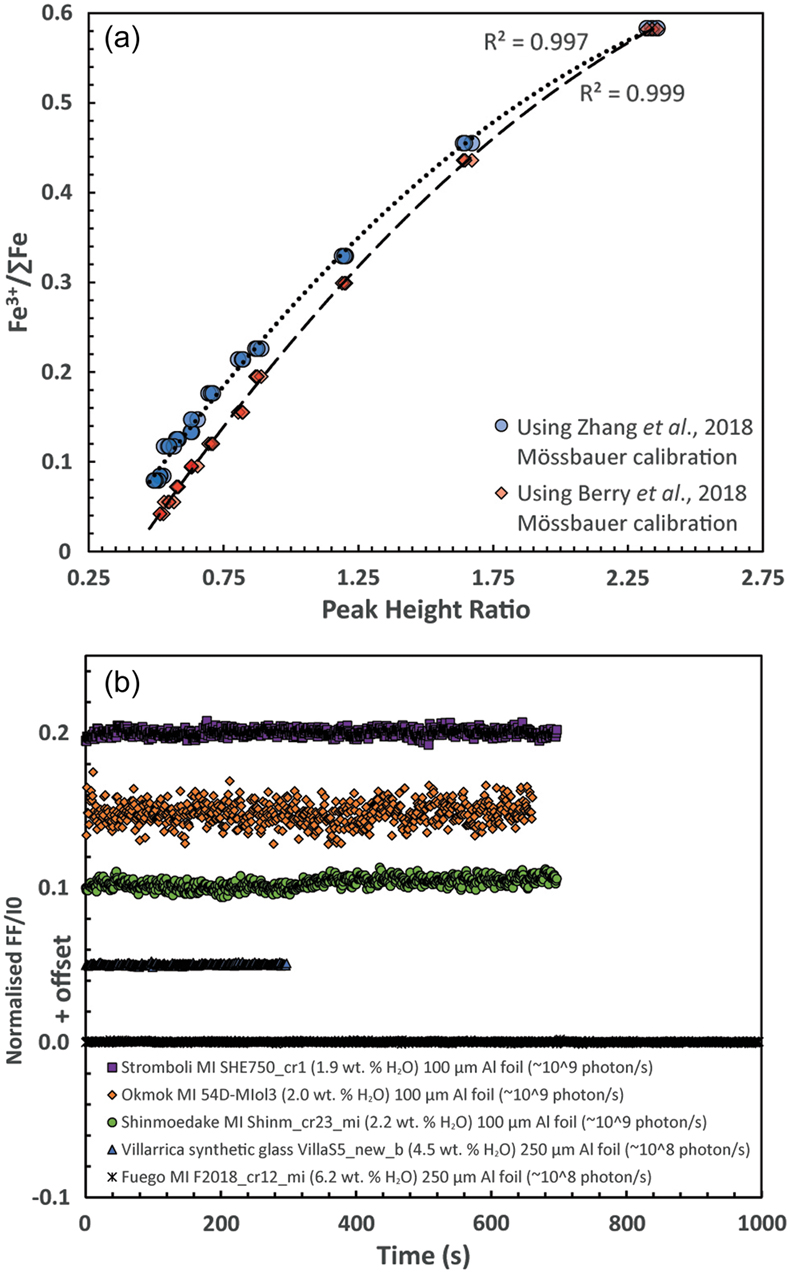
Figure 2 (a) Calibration line of the peak height ratio determined by XANES compared with Fe3+/∑Fe ratios determined by Mössbauer spectroscopy in basaltic standard glasses from the Smithsonian NMNH (Mössbauer Fe3+/∑Fe values from Zhang et al., 2018
Zhang, H.L., Cottrell, E., Solheid, P.A., Kelley, K.A., Hirschmann, M.M. (2018) Determination of Fe3+/ΣFe of XANES basaltic glass standards by Mössbauer spectroscopy and its application to the oxidation state of iron in MORB. Chemical Geology 479, 166–175. https://doi.org/10.1016/j.chemgeo.2018.01.006
and Berry et al., 2018Berry, A.J., Stewart, G.A., O’Neill, H.St.C., Mallmann, G., Mosselmans, J.F.W. (2018) A re-assessment of the oxidation state of iron in MORB glasses. Earth and Planetary Science Letters 483, 114–123. https://doi.org/10.1016/j.epsl.2017.11.032
are shown). (b) Time series of normalised fluoresced intensity (FF) over I0 at 7114 eV integrated over 1 s intervals the five natural melt inclusions and synthetic glasses used for beam damage assessment. The Villarrica, Shinmoedake, Okmok and Stromboli glasses FF/I0 are offset by 0.05, 0.1, 0.15 and 0.2, respectively, for visibility. The variation in scatter between measurements is a function of the detector position which was adjusted between each sample.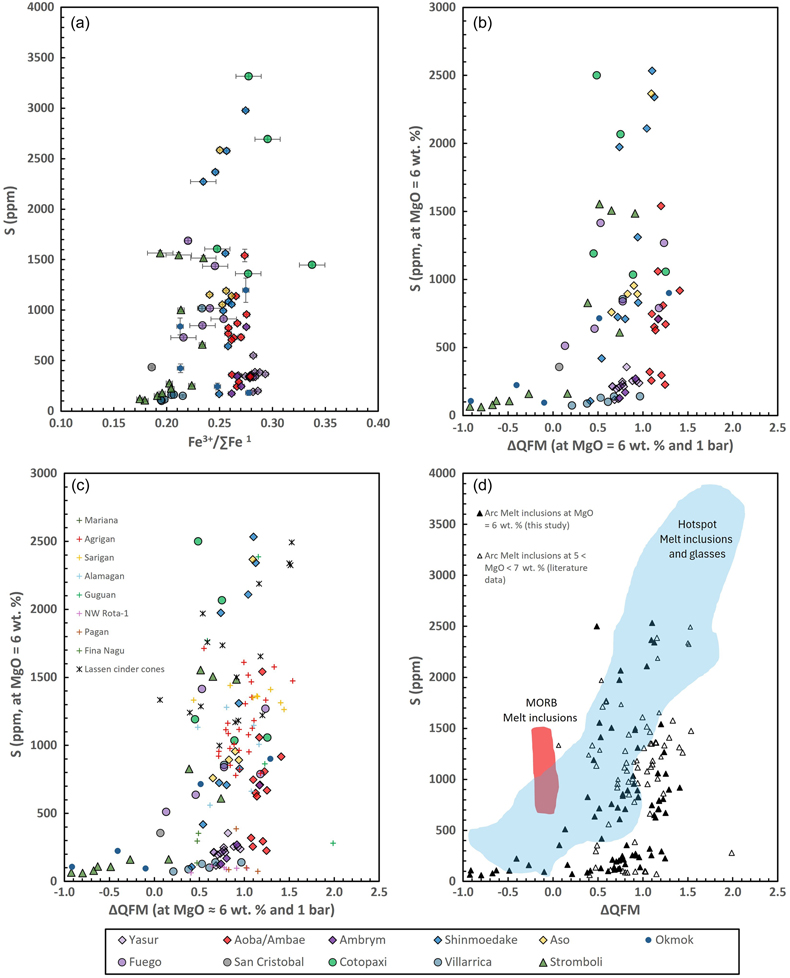
Figure 3 (a) Sulfur content versus oxidation state of melt inclusions plotted as Fe3+/∑Fe calculated using the Mössbauer Fe3+/∑Fe values from Zhang et al. (2018)
Zhang, H.L., Cottrell, E., Solheid, P.A., Kelley, K.A., Hirschmann, M.M. (2018) Determination of Fe3+/ΣFe of XANES basaltic glass standards by Mössbauer spectroscopy and its application to the oxidation state of iron in MORB. Chemical Geology 479, 166–175. https://doi.org/10.1016/j.chemgeo.2018.01.006
. Error bars show 1σ. (b) Sulfur content versus oxidation state (plotted as deviation from the QFM buffer using the equation of Kress and Carmichael, 1991Kress, V.C., Carmichael, I.S.E. (1991) The compressibility of silicate liquids containing Fe2O3 and the effect of composition, temperature, oxygen fugacity and pressure on their redox states. Contributions to Mineralogy and Petrology 108, 82–92. https://doi.org/10.1007/BF00307328
) of melt inclusions after reversing fractional crystallisation to a common value of MgO = 6 wt. %. (c) Same as (b) with the addition of melt inclusions (and pillow glasses) data from the Marianna arc (Kelley and Cottrell, 2012Kelley, K.A., Cottrell, E. (2012) The influence of magmatic differentiation on the oxidation state of Fe in a basaltic arc magma. Earth and Planetary Science Letters 329–330, 109–121. https://doi.org/10.1016/j.epsl.2012.02.010
; Brounce et al., 2014Brounce, M.N., Kelley, K.A., Cottrell, E. (2014) Variations in Fe3+/∑Fe of Mariana Arc Basalts and Mantle Wedge fO2. Journal of Petrology 55, 2513–2536. https://doi.org/10.1093/petrology/egu065
, 2016Brounce, M., Kelley, K.A., Stern, R., Martinez, F., Cottrell, E. (2016) The Fina Nagu volcanic complex: Unusual submarine arc volcanism in the rapidly deforming southern Mariana margin. Geochemistry, Geophysics, Geosystems 17, 4078–4091. https://doi.org/10.1002/2016GC006457
) and Lassen cinder cones (Muth and Wallace, 2021Muth, M.J., Wallace, P.J. (2021) Slab-derived sulfate generates oxidized basaltic magmas in the southern Cascade arc (California, USA). Geology 49, 1177–1181. https://doi.org/10.1130/G48759.1
), all with MgO contents between 5 and 7 wt. %. (d) Comparison between the sulfur content versus oxidation state fields recorded by melt inclusions, embayments and matrix glasses from arc volcanoes (same data set as in (c)), hotspot volcanoes (from Fig. 7 in Moussallam et al., 2019Moussallam, Y., Longpré, M.-A., McCammon, C., Gomez-Ulla, A., Rose-Koga, E.F., Scaillet, B., Peters, N., Gennaro, E., Paris, R., Oppenheimer, C. (2019) Mantle plumes are oxidised. Earth and Planetary Science Letters 527, 115798. https://doi.org/10.1016/j.epsl.2019.115798
) and mid-ocean ridge volcanoes (data set of Moussallam et al., 2023Moussallam, Y., Georgeais, G., Rose-Koga, E.F., Koga, K.T., Hartley, M.E., Scaillet, B., Oppenheimer, C., Peters, N. (2023) CO2-Undersaturated Melt Inclusions From the South West Indian Ridge Record Surprisingly Uniform Redox Conditions. Geochemistry, Geophysics, Geosystems 24, e2023GC011235. https://doi.org/10.1029/2023GC011235
) from the Southwest Indian Ridge). Note that Hotspot melt inclusions and glasses in the database used to draw the field are on average at MgO = 6.1 ± 1.0 wt. % while MORB Melt inclusions are on average at MgO = 6.4 ± 1.3 wt. % (1σ).