



Light calcium isotope anomaly in the Pitcairn mantle plume: a signal of pyroxenite melting
Affiliations | Corresponding Author | Cite as | Funding information
Published by the European Association of Geochemistry
under Creative Commons License CC BY-NC-ND 4.0
Keywords: calcium isotopes, Pitcairn mantle plume, recycled carbonate, pyroxenite melting, residual garnet


- Share this article


-
Article views:1,246Cumulative count of HTML views and PDF downloads.
- Download Citation
- Rights & Permissions

top
Abstract
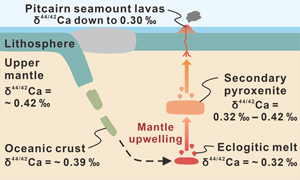
Figures
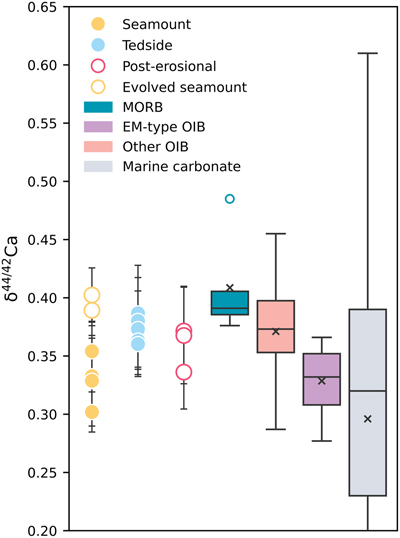 Figure 1 δ44/42Ca for Pitcairn basalts. MORB, EM-type OIBs (EM-1/EM-2; enriched radiogenic isotopes), other OIBs and marine carbonates are shown for comparison. MORB and OIB data are from Eriksen and Jacobsen (2022) and Eriksen et al. (2024); marine carbonate data are from Fantle and Tipper (2014). | 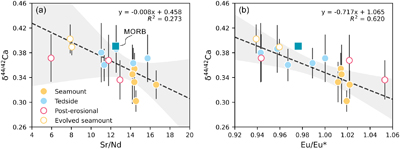 Figure 2 δ44/42Ca versus (a) Sr/Nb and (b) Eu/Eu* for Pitcairn basalts. Eu/Eu* = EuN/(SmN × GdN)0.5, where the subscript ‘N’ denotes chondrite-normalised values (Sun and McDonough, 1989). Trace element data are from Woodhead and McCulloch (1989) and Woodhead and Devey (1993). Filled symbols, Tedside + seamount samples with MgO ≥ 3.8 wt. % (used in fits); open symbols, post-erosional and evolved samples with MgO < 3.8 wt. % (excluded). Black line, linear regression fit to Tedside + seamount samples (MgO ≥ 3.8 wt. %); grey band, 95 % CI. MORB δ44/42Ca values are from Eriksen and Jacobsen (2022). Pitcairn trace elements are corrected for olivine accumulation following Nebel et al. (2019) (Table S-4), except for those with MgO < 3.8 wt. %, for which an effective clinopyroxene correction is unavailable. | 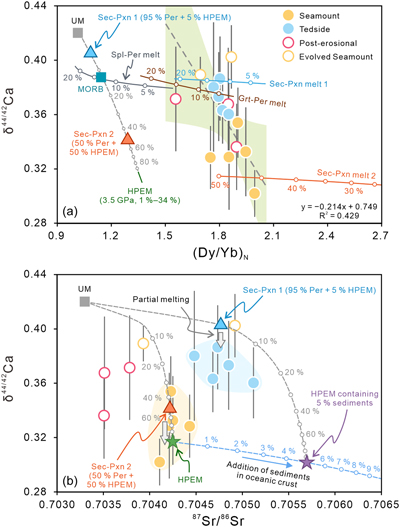 Figure 3 Model illustrating the origin of Ca isotope variations in the Pitcairn mantle plume. δ44/42Ca versus (a) (Dy/Yb)N and (b) 87Sr/86Sr. Symbols and regression band are as in Figure 2. In (a), grey and brown solid curves represent partial melting of spinel- and garnet-bearing peridotite, respectively, whereas blue and orange curves represent melting of two secondary pyroxenite end members. In (b), the blue dashed line illustrates the effects of adding carbonate-bearing sediments to recycled oceanic crust to generate HPEM. In both panels, grey dashed lines represent the formation of secondary pyroxenites through interaction between HPEM and ambient peridotite at different proportions; blue and orange triangles indicate the resulting secondary pyroxenite end members. Abbreviations: Spl-Per, spinel peridotite; Grt-Per, garnet peridotite; Sec-Pxn, secondary pyroxenite; HPEM, high pressure eclogite-derived melt; UM, upper mantle. Modelling details are provided in the Supplementary Information and Tables S-5–S-10. | 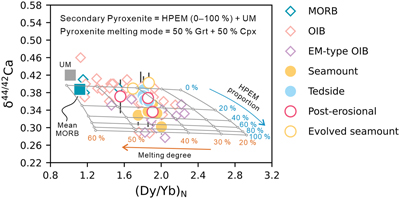 Figure 4 δ44/42Ca versus (Dy/Yb)N for global OIBs. Literature data are from Eriksen and Jacobsen (2022) and Eriksen et al. (2024). Symbols are as in Figure 2. Upper mantle and MORB δ44/42Ca references are as in Figure 3. The black grid represents our modelling of REEs and δ44/42Ca; see the Supplementary Information for details. |
| Figure 1 | Figure 2 | Figure 3 | Figure 4 |
top
Introduction
Ocean island basalts (OIBs), as melting products of upwelling mantle plumes, provide critical insights into mantle heterogeneity. In recent decades, calcium (Ca) isotopes have shown great potential for tracing recycled carbonates and lithological diversity in the deep mantle. A light Ca isotope anomaly was first observed in Hawaiian basalts and was attributed to recycled ancient carbonates, which have significantly higher CaO contents and lighter Ca isotopic compositions than the upper mantle (Huang et al., 2011
Huang, S., Farkaš, J., Jacobsen, S.B. (2011) Stable calcium isotopic compositions of Hawaiian shield lavas: Evidence for recycling of ancient marine carbonates into the mantle. Geochimica et Cosmochimica Acta 75, 4987–4997. https://doi.org/10.1016/j.gca.2011.06.010
). Similar light Ca isotope anomalies identified in mantle-derived magmas have been suggested to be related to source hybridisation by subducted carbonates (Liu et al., 2017Liu, F., Li, X., Wang, G., Liu, Y., Zhu, H., Kang, J., Huang, F., Sun, W., Xia, X., Zhang, Z. (2017) Marine Carbonate Component in the Mantle Beneath the Southeastern Tibetan Plateau: Evidence From Magnesium and Calcium Isotopes. Journal of Geophysical Research: Solid Earth 122, 9729–9744. https://doi.org/10.1002/2017JB014206
; He et al., 2023He, D., Liu, Y., Moynier, F., Foley, S.F., Chen, C., Zhu, Y., Lü, X., Zhang, G., Zong, K. (2023) Tightly coupled Ca-Zn-Sr isotope co-variations in basalts caused by recycled calcium carbonate in the mantle source. Chemical Geology 637, 121678. https://doi.org/10.1016/j.chemgeo.2023.121678
; Wang et al., 2023Wang, Y., Meng, X., He, Y., Huang, J., Lu, W.-N., Shi, Q., Ke, S., Tang, Y.-J., Huang, S., Li, S. (2023) Light calciumisotope anomaly observed in continental basaltic lavas: A mixed signal of recycled carbonate and fractionation during melting. Lithos 456–457, 107307. https://doi.org/10.1016/j.lithos.2023.107307
), and have now been observed in many more hotspots such as Pitcairn, Tristan da Cunha, and Kerguelen (enriched mantle-1, EM-1), Samoa, Society (enriched mantle-2, EM-2) and the Canaries (high-238U/204Pb, HIMU), confirming substantial Ca isotope variations as a common phenomenon among global OIBs (Eriksen and Jacobsen, 2022Eriksen, Z.T., Jacobsen, S.B. (2022) Calcium isotope constraints on OIB and MORB petrogenesis: The importance of melt mixing. Earth and Planetary Science Letters 593, 117665. https://doi.org/10.1016/j.epsl.2022.117665
; Eriksen et al., 2024Eriksen, Z.T., Jacobsen, S.B., Day, J.M.D., White, W.M. (2024) Calcium isotope variability among ocean islands reveals the physical and lithological controls on mantle partial melting. Geochimica et Cosmochimica Acta 373, 326–341 https://doi.org/10.1016/j.gca.2024.02.011
). A number of recent studies favour a lithological control on Ca isotopic composition and invoke isotopic fractionation during melting of garnet-rich pyroxenites (Eriksen and Jacobsen, 2022Eriksen, Z.T., Jacobsen, S.B. (2022) Calcium isotope constraints on OIB and MORB petrogenesis: The importance of melt mixing. Earth and Planetary Science Letters 593, 117665. https://doi.org/10.1016/j.epsl.2022.117665
; Eriksen et al., 2024Eriksen, Z.T., Jacobsen, S.B., Day, J.M.D., White, W.M. (2024) Calcium isotope variability among ocean islands reveals the physical and lithological controls on mantle partial melting. Geochimica et Cosmochimica Acta 373, 326–341 https://doi.org/10.1016/j.gca.2024.02.011
), as garnet is rich in both Ca and heavy Ca isotopes compared with other mantle minerals (Wang et al., 2019Wang, Y., He, Y., Wu, H., Zhu, C., Huang, S., Huang, J. (2019) Calcium isotope fractionation during crustal melting and magma differentiation: Granitoid and mineral-pair perspectives. Geochimica et Cosmochimica Acta 259, 37–52. https://doi.org/10.1016/j.gca.2019.05.030
; Antonelli et al., 2021aAntonelli, M.A., Kendrick, J., Yakymchuk, C., Guitreau, M., Mittal, T., Moynier, F. (2021a) Calcium isotope evidence for early Archaean carbonates and subduction of oceanic crust. Nature Communications 12, 2534. https://doi.org/10.1038/s41467-021-22748-2
). Nevertheless, independent evidence (including carbonatitic inclusions in olivine phenocrysts, the presence of associated carbonatite, trace element patterns typical of carbonatitic metasomatism in the source, enriched Sr-Nd-Pb isotopic compositions, as well as light Mg and heavy Zn isotope anomalies) suggests that recycled components, possibly containing carbonates, are prevalent in the sources of OIBs with light Ca isotope compositions (e.g., Eisele et al., 2002Eisele, J., Sharma, M., Galer, S.J.G., Blichert-Toft, J., Devey, C.W., Hofmann, A.W. (2002) The role of sediment recycling in EM-1 inferred from Os, Pb, Hf, Nd, Sr isotope and trace element systematics of the Pitcairn hotspot. Earth and Planetary Science Letters 196, 197–212. https://doi.org/10.1016/S0012-821X(01)00601-X
; Castillo, 2015Castillo, P.R. (2015) The recycling of marine carbonates and sources of HIMU and FOZO ocean island basalts. Lithos 216–217, 254–263. https://doi.org/10.1016/j.lithos.2014.12.005
; Wang et al., 2018Wang, X.-J., Chen, L.-H., Hofmann, A.W., Hanyu, T., Kawabata, H., et al. (2018) Recycled ancient ghost carbonate in the Pitcairn mantle plume. Proceedings of the National Academy of Sciences 115, 8682–8687. https://doi.org/10.1073/pnas.1719570115
; Zhang et al., 2022Zhang, X.-Y, Chen, L.-H., Wang, X.-J., Hanyu, T., Hofmann, A.W., Komiya, T., Nakamura, K., Kato, Y., Zeng, G., Gou, W.-X., Li, W.-Q. (2022) Zinc isotopic evidence for recycled carbonate in the deep mantle. Nature Communications 13, 6085. https://doi.org/10.1038/s41467-022-33789-6
). Therefore, it remains a subject of debate as to what extent recycling of isotopically light Ca crustal components (e.g., carbonates) and isotopic fractionation during melting of garnet-bearing lithologies contribute to Ca isotope variations in OIBs.Here we examine this puzzle by measuring a suite of well-characterised lavas from the Pitcairn mantle plume, which exhibits significant chemical and isotopic variability ranging from a typical EM-1 end member to a markedly depleted one (Woodhead and McCulloch, 1989
Woodhead, J.D., McCulloch, M.T. (1989) Ancient seafloor signals in Pitcairn Island lavas and evidence for large amplitude, small length-scale mantle heterogeneities. Earth and Planetary Science Letters 94, 257–273. https://doi.org/10.1016/0012-821X(89)90145-3
; Woodhead and Devey, 1993Woodhead, J.D., Devey, C.W. (1993) Geochemistry of the Pitcairn seamounts, I: source character and temporal trends. Earth and Planetary Science Letters 116, 81–99. https://doi.org/10.1016/0012-821X(93)90046-C
). The EM-1 component is typically defined by high 87Sr/86Sr, low 143Nd/144Nd and unradiogenic Pb isotopic compositions (Zindler and Hart, 1986Zindler, A., Hart, S. (1986) Chemical Geodynamics. Annual Reviews of Earth and Planetary Sciences 14, 493–571. https://doi.org/10.1146/annurev.ea.14.050186.002425
). This sample diversity in a single plume enables us to distinguish between the contributions of recycled carbonate sediments and isotopic fractionation during partial melting to the Ca isotope variation. Our results identify a Ca isotope variation almost as large as that found in global OIBs. Combined with published data, we show that the isotopically light end member of Pitcairn lavas is akin to recycling of the lower (gabbroic) oceanic crust and suggest a dominant role of isotopic fractionation during multi-stage pyroxenite melting in its source (e.g., Nebel et al., 2019Nebel, O., Sossi, P.A., Bénard, A., Arculus, R.J., Yaxley, G.M., Woodhead, J.D., Davies, D.R., Ruttor, S. (2019) Reconciling petrological and isotopic mixing mechanisms in the Pitcairn mantle plume using stable Fe isotopes. Earth and Planetary Science Letters 521, 60–67. https://doi.org/10.1016/j.epsl.2019.05.037
).top
Samples and Analytical Method
The samples measured in this study include five Tedside shield-building basalts and three post-erosional basalts from Pitcairn Island (Woodhead and McCulloch, 1989
Woodhead, J.D., McCulloch, M.T. (1989) Ancient seafloor signals in Pitcairn Island lavas and evidence for large amplitude, small length-scale mantle heterogeneities. Earth and Planetary Science Letters 94, 257–273. https://doi.org/10.1016/0012-821X(89)90145-3
) and seven seamount lavas from Volcano 2 erupted on the adjacent ocean floor (Woodhead and Devey, 1993Woodhead, J.D., Devey, C.W. (1993) Geochemistry of the Pitcairn seamounts, I: source character and temporal trends. Earth and Planetary Science Letters 116, 81–99. https://doi.org/10.1016/0012-821X(93)90046-C
). Phenocrysts primarily consist of olivine, clinopyroxene, and plagioclase. The CaO-MgO diagram suggests that olivine was the dominant liquidus phase during early differentiation (e.g., MgO ≥ 3.8 wt. %), transitioning to clinopyroxene dominance in more evolved lavas (Fig. S-1). Al2O3 behaves as an incompatible element until MgO content drops below ∼1 wt. % (Fig. S-1), suggesting limited plagioclase control on the samples analysed here (i.e. all have MgO ≥ 1.18 wt. %). Tedside samples are characterised by notably high 87Sr/86Sr, low 143Nd/144Nd and low 206Pb/204Pb ratios, whereas the post-erosional and seamount samples exhibit variable degrees of depletion in Sr-Nd-Pb isotopic compositions, suggesting mixing between an enriched EM-1 component and a more depleted component (Fig. S-1; Woodhead and Devey, 1993Woodhead, J.D., Devey, C.W. (1993) Geochemistry of the Pitcairn seamounts, I: source character and temporal trends. Earth and Planetary Science Letters 116, 81–99. https://doi.org/10.1016/0012-821X(93)90046-C
; Eisele et al., 2002Eisele, J., Sharma, M., Galer, S.J.G., Blichert-Toft, J., Devey, C.W., Hofmann, A.W. (2002) The role of sediment recycling in EM-1 inferred from Os, Pb, Hf, Nd, Sr isotope and trace element systematics of the Pitcairn hotspot. Earth and Planetary Science Letters 196, 197–212. https://doi.org/10.1016/S0012-821X(01)00601-X
).Calcium isotope analyses followed He et al. (2017)
He, Y., Wang, Y., Zhu, C., Huang, S., Li, S. (2017) Mass‐Independent and Mass‐Dependent Ca Isotopic Compositions of Thirteen Geological Reference Materials Measured by Thermal Ionisation Mass Spectrometry. Geostandards and Geoanalytical Research 41, 283–302. https://doi.org/10.1111/ggr.12153
and were performed at the Isotope Geochemistry Laboratory, China University of Geosciences, Beijing. Stable Ca isotopic compositions and radiogenic 40Ca excesses/deficits are reported in δ and ɛ notations, respectively, relative to SRM915a, with ɛ40/44Ca calculated from δ44/40Ca and δ44/42Ca using the exponential law (Farkaš et al., 2011Farkaš, J., Déjeant, A., Novák, M., Jacobsen, S.B. (2011) Calcium isotope constraints on the uptake and sources of Ca2+ in a base-poor forest: A new concept of combining stable (δ44/42Ca) and radiogenic (ɛCa) signals. Geochimica et Cosmochimica Acta 75, 7031–7046. https://doi.org/10.1016/j.gca.2011.09.021
; He et al., 2017He, Y., Wang, Y., Zhu, C., Huang, S., Li, S. (2017) Mass‐Independent and Mass‐Dependent Ca Isotopic Compositions of Thirteen Geological Reference Materials Measured by Thermal Ionisation Mass Spectrometry. Geostandards and Geoanalytical Research 41, 283–302. https://doi.org/10.1111/ggr.12153
). To minimise possible effects of radiogenic 40Ca, we discuss stable Ca isotopes primarily in terms of δ44/42Ca. Analytical procedures and full datasets for samples and reference materials are given in the Supplementary Information and Tables S-1 and S-2.top
Results
The Pitcairn samples exhibit a δ44/42Ca range from a mid-ocean ridge basalt (MORB)-like value of 0.40 ± 0.02 ‰ to as low as 0.30 ± 0.03 ‰ (δ44/40Ca = 0.68 ± 0.08 ‰ to 0.84 ± 0.04 ‰; Fig. 1; Table S-1). Five enriched Tedside samples, characterised by high 87Sr/86Sr and low 143Nd/144Nd ratios indicative of EM-1 mantle components (Woodhead and McCulloch, 1989
Woodhead, J.D., McCulloch, M.T. (1989) Ancient seafloor signals in Pitcairn Island lavas and evidence for large amplitude, small length-scale mantle heterogeneities. Earth and Planetary Science Letters 94, 257–273. https://doi.org/10.1016/0012-821X(89)90145-3
), have a mean δ44/42Ca value of 0.37 ± 0.02 ‰ (2 s.d., n = 5). No systematic correlations are observed between δ44/42Ca and Sr-Nd-Pb isotopic ratios or differentiation indices such as MgO and CaO (Figs. S-2 and S-3; Table S-3). ɛ40/44Ca values range from −1.3 ± 0.5 to +0.4 ± 0.3 (Table S-1). ɛ40/44Ca values in the Tedside samples are systematically higher than the BSE value (e.g., −1.2; Antonelli et al., 2021bAntonelli, M.A., DePaolo, D.J., Christensen, J.N., Wotzlaw, J.-F., Pester, N.J., Bachmann, O. (2021b) Radiogenic 40Ca in Seawater: Implications for Modern and Ancient Ca Cycles. ACS Earth and Space Chemistry 5, 2481–2492. https://doi.org/10.1021/acsearthspacechem.1c00179
), likely reflecting the contribution of a recycled component within the Pitcairn mantle plume (Fig. S-4). Detailed discussion of these results is provided in the Supplementary Information, and our subsequent discussion focuses on stable Ca isotopes (δ44/42Ca).Figure 1 δ44/42Ca for Pitcairn basalts. MORB, EM-type OIBs (EM-1/EM-2; enriched radiogenic isotopes), other OIBs and marine carbonates are shown for comparison. MORB and OIB data are from Eriksen and Jacobsen (2022)
Eriksen, Z.T., Jacobsen, S.B. (2022) Calcium isotope constraints on OIB and MORB petrogenesis: The importance of melt mixing. Earth and Planetary Science Letters 593, 117665. https://doi.org/10.1016/j.epsl.2022.117665
and Eriksen et al. (2024)Eriksen, Z.T., Jacobsen, S.B., Day, J.M.D., White, W.M. (2024) Calcium isotope variability among ocean islands reveals the physical and lithological controls on mantle partial melting. Geochimica et Cosmochimica Acta 373, 326–341 https://doi.org/10.1016/j.gca.2024.02.011
; marine carbonate data are from Fantle and Tipper (2014)Fantle, M.S., Tipper, E.T. (2014) Calcium isotopes in the global biogeochemical Ca cycle: Implications for development of a Ca isotope proxy. Earth-Science Reviews 129, 148–177. https://doi.org/10.1016/j.earscirev.2013.10.004
.top
Role of post-extraction processes
All Pitcairn samples analysed in this study are fresh (LOI < 0.5 wt. %), indicating negligible post-eruption alteration. However, these samples have undergone varying degrees of magmatic differentiation. During early differentiation, olivine was the dominant crystallising phase (Fig. S-1), which likely had little effect on the δ44/42Ca values of samples with MgO ≥ 3.8 wt. % (Fig. S-4). Three more-evolved lavas (P1, 45DS1, and 51DS4), with MgO < 3.8 wt. %, underwent substantial clinopyroxene crystallisation. Because clinopyroxene has slightly higher δ44/42Ca values than its co-existing melt (Zhang et al., 2018
Zhang, H., Wang, Y., He, Y., Teng, F., Jacobsen, S.B., Helz, R.T., Marsh, B.D., Huang, S. (2018) No Measurable Calcium Isotopic Fractionation During Crystallization of Kilauea Iki Lava Lake. Geochemistry, Geophysics, Geosystems 19, 3128–3139. https://doi.org/10.1029/2018GC007506
; Eriksen and Jacobsen, 2022Eriksen, Z.T., Jacobsen, S.B. (2022) Calcium isotope constraints on OIB and MORB petrogenesis: The importance of melt mixing. Earth and Planetary Science Letters 593, 117665. https://doi.org/10.1016/j.epsl.2022.117665
), its crystallisation may have led to a minor decrease in the δ44/42Ca value of the remaining melt (Zhang et al., 2018Zhang, H., Wang, Y., He, Y., Teng, F., Jacobsen, S.B., Helz, R.T., Marsh, B.D., Huang, S. (2018) No Measurable Calcium Isotopic Fractionation During Crystallization of Kilauea Iki Lava Lake. Geochemistry, Geophysics, Geosystems 19, 3128–3139. https://doi.org/10.1029/2018GC007506
; Wang et al., 2023Wang, Y., Meng, X., He, Y., Huang, J., Lu, W.-N., Shi, Q., Ke, S., Tang, Y.-J., Huang, S., Li, S. (2023) Light calciumisotope anomaly observed in continental basaltic lavas: A mixed signal of recycled carbonate and fractionation during melting. Lithos 456–457, 107307. https://doi.org/10.1016/j.lithos.2023.107307
). Nevertheless, relatively heavy δ44/42Ca values are observed in these three evolved samples, suggesting slightly higher primary δ44/42Ca values than measured. Negative correlations of δ44/42Ca with Sr/Nd and Eu/Eu* may suggest a role for plagioclase crystallisation (Fig. 2; Table S-4); however, this can be ruled out by the incompatible behaviour of Al2O3 during differentiation of the Pitcairn lavas measured here (Fig. S-1). Thus, the decreased δ44/42Ca values in Pitcairn samples are not a consequence of magmatic differentiation but most likely reflects primary source characteristics.Figure 2 δ44/42Ca versus (a) Sr/Nb and (b) Eu/Eu* for Pitcairn basalts. Eu/Eu* = EuN/(SmN × GdN)0.5, where the subscript ‘N’ denotes chondrite-normalised values (Sun and McDonough, 1989
Sun, S.-s., McDonough, W.F. (1989) Chemical and isotopic systematics of oceanic basalts: implications for mantle composition and processes. Geological Society, London, Special Publications 42, 313–345. https://doi.org/10.1144/GSL.SP.1989.042.01.19
). Trace element data are from Woodhead and McCulloch (1989)Woodhead, J.D., McCulloch, M.T. (1989) Ancient seafloor signals in Pitcairn Island lavas and evidence for large amplitude, small length-scale mantle heterogeneities. Earth and Planetary Science Letters 94, 257–273. https://doi.org/10.1016/0012-821X(89)90145-3
and Woodhead and Devey (1993)Woodhead, J.D., Devey, C.W. (1993) Geochemistry of the Pitcairn seamounts, I: source character and temporal trends. Earth and Planetary Science Letters 116, 81–99. https://doi.org/10.1016/0012-821X(93)90046-C
. Filled symbols, Tedside + seamount samples with MgO ≥ 3.8 wt. % (used in fits); open symbols, post-erosional and evolved samples with MgO < 3.8 wt. % (excluded). Black line, linear regression fit to Tedside + seamount samples (MgO ≥ 3.8 wt. %); grey band, 95 % CI. MORB δ44/42Ca values are from Eriksen and Jacobsen (2022)Eriksen, Z.T., Jacobsen, S.B. (2022) Calcium isotope constraints on OIB and MORB petrogenesis: The importance of melt mixing. Earth and Planetary Science Letters 593, 117665. https://doi.org/10.1016/j.epsl.2022.117665
. Pitcairn trace elements are corrected for olivine accumulation following Nebel et al. (2019)Nebel, O., Sossi, P.A., Bénard, A., Arculus, R.J., Yaxley, G.M., Woodhead, J.D., Davies, D.R., Ruttor, S. (2019) Reconciling petrological and isotopic mixing mechanisms in the Pitcairn mantle plume using stable Fe isotopes. Earth and Planetary Science Letters 521, 60–67. https://doi.org/10.1016/j.epsl.2019.05.037
(Table S-4), except for those with MgO < 3.8 wt. %, for which an effective clinopyroxene correction is unavailable.top
Origin of light Ca isotope anomaly among Pitcairn lavas
Low MgO (<3.8 wt. %) samples may be at risk of having experienced significant fractional crystallisation (Fig. S-1) and three post-erosional samples (erupted ∼0.3 Myr after Tedside) do not follow the main Sr-Nd isotopic trend (Woodhead and McCulloch, 1989
Woodhead, J.D., McCulloch, M.T. (1989) Ancient seafloor signals in Pitcairn Island lavas and evidence for large amplitude, small length-scale mantle heterogeneities. Earth and Planetary Science Letters 94, 257–273. https://doi.org/10.1016/0012-821X(89)90145-3
). We therefore focus our discussion of the origin of the Pitcairn source primarily on the ten Tedside and seamount samples with MgO ≥ 3.8 wt. % in order to minimise the influence of late stage processes and source heterogeneity, although these samples define the same trends in δ44/42Ca versus Sr/Nd and Eu/Eu* plots. Accordingly, because (i) the early crystallising (MgO ≥ 3.8 wt. %) assemblage is dominated by olivine ± clinopyroxene with no plagioclase involvement (Fig. S-1) and (ii) melting occurred at garnet-facies pressures where plagioclase is unstable, the observed Sr/Nd and Eu/Eu* variations record source metasomatism by at least two groups of crustal components, rather than magmatic processes. One group has sub-chondritic Sr/Nd and Eu/Eu* < 1, akin to sediments and the differentiated upper oceanic crust that has undergone plagioclase crystallisation. The other has high Sr/Nd and Eu/Eu* > 1, similar to gabbros in the lower oceanic crust that have experienced plagioclase accumulation (Fig. S-5). The involvement of surface crustal materials in the Pitcairn plume source has been independently inferred from low δ26Mg values (Wang et al., 2018Wang, X.-J., Chen, L.-H., Hofmann, A.W., Hanyu, T., Kawabata, H., et al. (2018) Recycled ancient ghost carbonate in the Pitcairn mantle plume. Proceedings of the National Academy of Sciences 115, 8682–8687. https://doi.org/10.1073/pnas.1719570115
) and mass independent Hg isotope fractionations (Moynier et al., 2021Moynier, F., Jackson, M.G., Zhang, K., Cai, H., Halldórsson, S.A., Pik, R., Day, J.M.D., Chen, J. (2021) The Mercury Isotopic Composition of Earth’s Mantle and the Use of Mass Independently Fractionated Hg to Test for Recycled Crust. Geophysical Research Letters 48, e2021GL094301. https://doi.org/10.1029/2021GL094301
). Nevertheless, samples with the lowest Sr/Nd and Eu/Eu* values and enriched radiogenic isotopes display MORB-like δ44/42Ca values, whereas light Ca isotope anomalies are observed in the depleted end member (Fig. 2; Fig. S-2). These puzzling trends are inconsistent with incorporation of low δ44/42Ca recycled sediments, and require an alternative mechanism to explain the low δ44/42Ca values in Pitcairn OIBs.Unlike surface crustal materials with fractionated δ44/42Ca values, the gabbroic lower oceanic crust has a mean δ44/42Ca value comparable to that of the upper mantle (Fig. S-6). Therefore, the low δ44/42Ca magma end member cannot result from simple binary mixing between gabbroic lower oceanic crust and upper mantle but instead reflects Ca isotope fractionation during mantle metasomatism and late partial melting. Partial melting of pyroxenites with abundant residual garnet provides a plausible mechanism for generating melts with low δ44/42Ca values (Wang et al., 2019
Wang, Y., He, Y., Wu, H., Zhu, C., Huang, S., Huang, J. (2019) Calcium isotope fractionation during crustal melting and magma differentiation: Granitoid and mineral-pair perspectives. Geochimica et Cosmochimica Acta 259, 37–52. https://doi.org/10.1016/j.gca.2019.05.030
, 2023Wang, Y., Meng, X., He, Y., Huang, J., Lu, W.-N., Shi, Q., Ke, S., Tang, Y.-J., Huang, S., Li, S. (2023) Light calciumisotope anomaly observed in continental basaltic lavas: A mixed signal of recycled carbonate and fractionation during melting. Lithos 456–457, 107307. https://doi.org/10.1016/j.lithos.2023.107307
; Eriksen and Jacobsen, 2022Eriksen, Z.T., Jacobsen, S.B. (2022) Calcium isotope constraints on OIB and MORB petrogenesis: The importance of melt mixing. Earth and Planetary Science Letters 593, 117665. https://doi.org/10.1016/j.epsl.2022.117665
).To quantitatively evaluate isotopic fractionation during partial melting, we perform incremental non-modal batch melting modelling for various mantle lithologies, including spinel- and garnet-bearing peridotite, recycled MORB (i.e. eclogite), and secondary pyroxenites generated by reaction between eclogite-derived melts and peridotite. The initial δ44/42Ca values for mantle peridotite and eclogite were set at 0.42 ‰ (Kang et al., 2017
Kang, J.-T., Ionov, D.A., Liu, F., Zhang, C.-L., Golovin, A.V., Qin, L.-P., Zhang, Z.-F., Huang, F. (2017) Calcium isotopic fractionation in mantle peridotites by melting and metasomatism and Ca isotope composition of the Bulk Silicate Earth. Earth and Planetary Science Letters 474, 128–137. https://doi.org/10.1016/j.epsl.2017.05.035
) and 0.39 ‰ (Eriksen and Jacobsen, 2022Eriksen, Z.T., Jacobsen, S.B. (2022) Calcium isotope constraints on OIB and MORB petrogenesis: The importance of melt mixing. Earth and Planetary Science Letters 593, 117665. https://doi.org/10.1016/j.epsl.2022.117665
), respectively. Melting conditions and modes were based on relevant experimental studies. Details of the modelling calculation are provided in the Supplementary Information and Tables S-5 to S-10.Our results suggest that Ca isotope fractionation is limited during partial melting of peridotites and secondary pyroxenites in which garnet, if present, is less abundant (Fig. 3a), mainly due to the buffering effect of Ca-rich clinopyroxene, which has only slightly heavier Ca isotopic compositions than co-existing melts (Zhang et al., 2018
Zhang, H., Wang, Y., He, Y., Teng, F., Jacobsen, S.B., Helz, R.T., Marsh, B.D., Huang, S. (2018) No Measurable Calcium Isotopic Fractionation During Crystallization of Kilauea Iki Lava Lake. Geochemistry, Geophysics, Geosystems 19, 3128–3139. https://doi.org/10.1029/2018GC007506
; Eriksen and Jacobsen, 2022Eriksen, Z.T., Jacobsen, S.B. (2022) Calcium isotope constraints on OIB and MORB petrogenesis: The importance of melt mixing. Earth and Planetary Science Letters 593, 117665. https://doi.org/10.1016/j.epsl.2022.117665
). Partial melting of either garnet peridotite or secondary pyroxenite with a mantle-like δ44/42Ca value can account for the heavy δ44/42Ca magma end member but fails to explain both the lightest δ44/42Ca values and the steep slope of Pitcairn basalts in δ44/42Ca versus (Dy/Yb)N space (Fig. 3a). The involvement of abundant partial melts of recycled oceanic crust has been suggested for the source of the isotopically light seamount lavas (Woodhead and Devey, 1993Woodhead, J.D., Devey, C.W. (1993) Geochemistry of the Pitcairn seamounts, I: source character and temporal trends. Earth and Planetary Science Letters 116, 81–99. https://doi.org/10.1016/0012-821X(93)90046-C
; Eisele et al., 2002Eisele, J., Sharma, M., Galer, S.J.G., Blichert-Toft, J., Devey, C.W., Hofmann, A.W. (2002) The role of sediment recycling in EM-1 inferred from Os, Pb, Hf, Nd, Sr isotope and trace element systematics of the Pitcairn hotspot. Earth and Planetary Science Letters 196, 197–212. https://doi.org/10.1016/S0012-821X(01)00601-X
; Delavault et al., 2016Delavault, H., Chauvel, C., Thomassot, E., Devey, C.W., Dazas, B. (2016) Sulfur and lead isotopic evidence of relic Archean sediments in the Pitcairn mantle plume. Proceedings of the National Academy of Sciences 113, 12952–12956. https://doi.org/10.1073/pnas.1523805113
). Partial melting of eclogite at high pressure (e.g., 3–5 GPa; Sobolev et al., 2005Sobolev, A.V., Hofmann, A.W., Sobolev, S.V., Nikogosian, I.K. (2005) An olivine-free mantle source of Hawaiian shield basalts. Nature 434, 590–597. https://doi.org/10.1038/nature03411
) in the deep mantle can generate melts with much lower δ44/42Ca values around 0.31 ‰, as garnet is abundant in the residua and minimally involved in the melting process (Table S-7). However, the proportion of eclogite-derived melts directly contributing to OIBs is likely limited (Sobolev et al., 2007Sobolev, A.V., Hofmann, A.W., Kuzmin, D.V., Yaxley, G.M., Arndt, N.T., et al. (2007) The Amount of Recycled Crust in Sources of Mantle-Derived Melts. Science 316, 412–417. https://doi.org/10.1126/science.1138113
), and modelling calculations show that the trace element compositions (e.g., (Dy/Yb)N) do not match the characteristics of Pitcairn basalts (Fig. 3a). Instead, hybridisation of peridotite with high proportions of high pressure eclogite-derived melts (HPEMs) can produce secondary pyroxenites with lower δ44/42Ca and (Dy/Yb)N values. For example, mixing peridotite and HPEM in a 1:1 ratio (similar to Koolau lavas in Hawaii; Sobolev et al., 2005Sobolev, A.V., Hofmann, A.W., Sobolev, S.V., Nikogosian, I.K. (2005) An olivine-free mantle source of Hawaiian shield basalts. Nature 434, 590–597. https://doi.org/10.1038/nature03411
) yields a secondary pyroxenite with δ44/42Ca ≈ 0.34 ‰ and (Dy/Yb)N ≈ 1.29 (Table S-8). High degrees of partial melting of such lithologies can resemble both the δ44/42Ca and (Dy/Yb)N values of the low δ44/42Ca magma end member among Pitcairn lavas (Fig. 3a).Figure 3 Model illustrating the origin of Ca isotope variations in the Pitcairn mantle plume. δ44/42Ca versus (a) (Dy/Yb)N and (b) 87Sr/86Sr. Symbols and regression band are as in Figure 2. In (a), grey and brown solid curves represent partial melting of spinel- and garnet-bearing peridotite, respectively, whereas blue and orange curves represent melting of two secondary pyroxenite end members. In (b), the blue dashed line illustrates the effects of adding carbonate-bearing sediments to recycled oceanic crust to generate HPEM. In both panels, grey dashed lines represent the formation of secondary pyroxenites through interaction between HPEM and ambient peridotite at different proportions; blue and orange triangles indicate the resulting secondary pyroxenite end members. Abbreviations: Spl-Per, spinel peridotite; Grt-Per, garnet peridotite; Sec-Pxn, secondary pyroxenite; HPEM, high pressure eclogite-derived melt; UM, upper mantle. Modelling details are provided in the Supplementary Information and Tables S-5–S-10.
Olivine and whole-rock compositions also suggest the contribution of pyroxenite sources to Pitcairn lavas (e.g., Delavault et al., 2015
Delavault, H., Chauvel, C., Sobolev, A., Batanova, V. (2015) Combined petrological, geochemical and isotopic modeling of a plume source: Example of Gambier Island, Pitcairn chain. Earth and Planetary Science Letters 426, 23–35. https://doi.org/10.1016/j.epsl.2015.06.013
; Garapić et al., 2015Garapić, G., Jackson, M.G., Hauri, E.H., Hart, S.R., Farley, K.A., Blusztajn, J.S., Woodhead, J.D. (2015) A radiogenic isotopic (He-Sr-Nd-Pb-Os) study of lavas from the Pitcairn hotspot: Implications for the origin of EM-1 (enriched mantle 1). Lithos 228–229, 1–11. https://doi.org/10.1016/j.lithos.2015.04.010
). Pyroxenite in the source of Pitcairn lavas with MORB-like δ44/42Ca values may form either from low HPEM proportions (e.g., ∼5 %; Fig. 3) or by mechanical mixing between recycled eclogite and mantle peridotite (Fig. S-6c). Our model illustrates a simple binary mixing scenario between melts derived from two secondary pyroxenites that differ in HPEM proportion. The MORB-like δ44/42Ca end member is derived from a secondary pyroxenite formed by ∼5 % HPEM. To reproduce the enriched 87Sr/86Sr of the Tedside lavas, ∼5 % carbonate-bearing sediments are included in the recycled oceanic crust generating the HPEM component. Because sediments contain much higher Sr concentrations than oceanic crust, this addition strongly influences 87Sr/86Sr but has only a negligible effect on δ44/42Ca (Fig. 3b; see the Supplementary Information). In contrast, the low δ44/42Ca end member, derived from a secondary pyroxenite containing ∼50 % HPEM, displays higher Eu/Eu* and lower 87Sr/86Sr, pointing to recycled lower oceanic crust with less sediments (Fig. 3b). Binary mixing between melts from these two pyroxenites reproduces the observed δ44/42Ca variations with trace element ratios (Figs. 2 and 3a) and radiogenic isotope ratios (Fig. 3b). Accordingly, secondary pyroxenite formed through interaction between HPEM and ambient mantle peridotite is likely a key control on the Ca isotopic variations of Pitcairn basalts. Whereas carbonatite melting can lower δ44/42Ca values in principle (Antonelli et al., 2023Antonelli, M.A., Sartori, G., Giuliani, A., Schauble, E.A., Hoffmann, J., Schmidt, M.W. (2023) Calcium isotope fractionation during melt immiscibility and carbonatite petrogenesis. Geochemical Perspectives Letters 28, 13–19. https://doi.org/10.7185/geochemlet.2338
), our Pitcairn lavas show no geochemical evidence for carbonatite involvement (e.g., low CaO/Al2O3 and Ba/Nb, Fig. S-7), and the observed δ44/42Ca variations are fully explained by multi-stage melting and mixing among secondary pyroxenite melts at ∼1400 °C. We therefore consider any carbonatite contribution to be minor at most and not required here.Our study reaffirms the role of pyroxenite melting at pressures >3.0 GPa in generating metasomatic agents with low δ44/42Ca values but moderate (Dy/Yb)N ratios (Fig. 3). The Tedside basalts, representing the EM-1 end member, display higher δ44/42Ca values of 0.36–0.39 ‰, whereas the depleted seamount basalts exhibit notably lower δ44/42Ca values of 0.30–0.35 ‰. The lightest δ44/42Ca end member among the Pitcairn lavas shows geochemical signatures associated with the recycling of lower oceanic crust, which typically contains little sediment and altered carbonate. Negative correlations with Sr/Nd and Eu/Eu* further indicate that this isotopically light Ca end member can be attributed to the recycling of lower gabbroic oceanic crust and isotopic fractionation during multi-stage pyroxenite melting. This study demonstrates that the lightest δ44/42Ca OIBs can be generated by partial melting of a mantle source involving a pyroxenitic component in the Pitcairn plume, rather than by contributions from recycled carbonate-bearing sediments. More broadly, the Pitcairn trend in δ44/42Ca versus (Dy/Yb)N space closely resembles the compositional range of global OIBs at the high (Dy/Yb)N end (Fig. 4), suggesting that similar processes involving HPEM and partial melting of its derivative secondary pyroxenite may also contribute to the origin of low δ44/42Ca signatures in other OIBs (Eriksen and Jacobsen, 2022
Eriksen, Z.T., Jacobsen, S.B. (2022) Calcium isotope constraints on OIB and MORB petrogenesis: The importance of melt mixing. Earth and Planetary Science Letters 593, 117665. https://doi.org/10.1016/j.epsl.2022.117665
; Eriksen et al., 2024Eriksen, Z.T., Jacobsen, S.B., Day, J.M.D., White, W.M. (2024) Calcium isotope variability among ocean islands reveals the physical and lithological controls on mantle partial melting. Geochimica et Cosmochimica Acta 373, 326–341 https://doi.org/10.1016/j.gca.2024.02.011
). This implies that interpretations of low δ44/42Ca signatures in OIBs as direct evidence for recycled carbonate-bearing sediments should be approached with caution (e.g., Wang et al., 2023Wang, Y., Meng, X., He, Y., Huang, J., Lu, W.-N., Shi, Q., Ke, S., Tang, Y.-J., Huang, S., Li, S. (2023) Light calciumisotope anomaly observed in continental basaltic lavas: A mixed signal of recycled carbonate and fractionation during melting. Lithos 456–457, 107307. https://doi.org/10.1016/j.lithos.2023.107307
).Figure 4 δ44/42Ca versus (Dy/Yb)N for global OIBs. Literature data are from Eriksen and Jacobsen (2022)
Eriksen, Z.T., Jacobsen, S.B. (2022) Calcium isotope constraints on OIB and MORB petrogenesis: The importance of melt mixing. Earth and Planetary Science Letters 593, 117665. https://doi.org/10.1016/j.epsl.2022.117665
and Eriksen et al. (2024)Eriksen, Z.T., Jacobsen, S.B., Day, J.M.D., White, W.M. (2024) Calcium isotope variability among ocean islands reveals the physical and lithological controls on mantle partial melting. Geochimica et Cosmochimica Acta 373, 326–341 https://doi.org/10.1016/j.gca.2024.02.011
. Symbols are as in Figure 2. Upper mantle and MORB δ44/42Ca references are as in Figure 3. The black grid represents our modelling of REEs and δ44/42Ca; see the Supplementary Information for details.top
Acknowledgements
We sincerely thank editor Helen Williams, reviewer Zack Eriksen, and an anonymous reviewer for their insightful comments that greatly improved this manuscript. This work was financially supported by the National Key Research and Development Project of China (2023YFF0804100), the National Natural Science Foundation of China (Nos. 42288201, 42103010, and 42122019), Fundamental Research Funds for the Central Universities (2652023001, 2652023005), and State Key Laboratory of Geological Processes and Mineral Resources. ON acknowledges support by the DFG (Heisenberg grant no. 533104367).
Editor: Helen Williams
top
References
Antonelli, M.A., Kendrick, J., Yakymchuk, C., Guitreau, M., Mittal, T., Moynier, F. (2021a) Calcium isotope evidence for early Archaean carbonates and subduction of oceanic crust. Nature Communications 12, 2534. https://doi.org/10.1038/s41467-021-22748-2
 Show in context
 A number of recent studies favour a lithological control on Ca isotopic composition and invoke isotopic fractionation during melting of garnet-rich pyroxenites (Eriksen and Jacobsen, 2022; Eriksen et al., 2024), as garnet is rich in both Ca and heavy Ca isotopes compared with other mantle minerals (Wang et al., 2019; Antonelli et al., 2021a).
View in article
Antonelli, M.A., DePaolo, D.J., Christensen, J.N., Wotzlaw, J.-F., Pester, N.J., Bachmann, O. (2021b) Radiogenic 40Ca in Seawater: Implications for Modern and Ancient Ca Cycles. ACS Earth and Space Chemistry 5, 2481–2492. https://doi.org/10.1021/acsearthspacechem.1c00179
Show in context ɛ40/44Ca values range from −1.3 ± 0.5 to +0.4 ± 0.3 (Table S-1). ɛ40/44Ca values in the Tedside samples are systematically higher than the BSE value (e.g., −1.2; Antonelli et al., 2021b), likely reflecting the contribution of a recycled component within the Pitcairn mantle plume (Fig. S-4).
View in article
Antonelli, M.A., Sartori, G., Giuliani, A., Schauble, E.A., Hoffmann, J., Schmidt, M.W. (2023) Calcium isotope fractionation during melt immiscibility and carbonatite petrogenesis. Geochemical Perspectives Letters 28, 13–19. https://doi.org/10.7185/geochemlet.2338
Show in context Whereas carbonatite melting can lower δ44/42Ca values in principle (Antonelli et al., 2023), our Pitcairn lavas show no geochemical evidence for carbonatite involvement (e.g., low CaO/Al2O3 and Ba/Nb, Fig. S-7), and the observed δ44/42Ca variations are fully explained by multi-stage melting and mixing among secondary pyroxenite melts at ∼1400 °C.
View in article
Castillo, P.R. (2015) The recycling of marine carbonates and sources of HIMU and FOZO ocean island basalts. Lithos 216–217, 254–263. https://doi.org/10.1016/j.lithos.2014.12.005
Show in context Nevertheless, independent evidence (including carbonatitic inclusions in olivine phenocrysts, the presence of associated carbonatite, trace element patterns typical of carbonatitic metasomatism in the source, enriched Sr-Nd-Pb isotopic compositions, as well as light Mg and heavy Zn isotope anomalies) suggests that recycled components, possibly containing carbonates, are prevalent in the sources of OIBs with light Ca isotope compositions (e.g., Eisele et al., 2002; Castillo, 2015; Wang et al., 2018; Zhang et al., 2022).
View in article
Delavault, H., Chauvel, C., Sobolev, A., Batanova, V. (2015) Combined petrological, geochemical and isotopic modeling of a plume source: Example of Gambier Island, Pitcairn chain. Earth and Planetary Science Letters 426, 23–35. https://doi.org/10.1016/j.epsl.2015.06.013
Show in context Olivine and whole-rock compositions also suggest the contribution of pyroxenite sources to Pitcairn lavas (e.g., Delavault et al., 2015; Garapić et al., 2015).
View in article
Delavault, H., Chauvel, C., Thomassot, E., Devey, C.W., Dazas, B. (2016) Sulfur and lead isotopic evidence of relic Archean sediments in the Pitcairn mantle plume. Proceedings of the National Academy of Sciences 113, 12952–12956. https://doi.org/10.1073/pnas.1523805113
Show in context The involvement of abundant partial melts of recycled oceanic crust has been suggested for the source of the isotopically light seamount lavas (Woodhead and Devey, 1993; Eisele et al., 2002; Delavault et al., 2016).
View in article
Eisele, J., Sharma, M., Galer, S.J.G., Blichert-Toft, J., Devey, C.W., Hofmann, A.W. (2002) The role of sediment recycling in EM-1 inferred from Os, Pb, Hf, Nd, Sr isotope and trace element systematics of the Pitcairn hotspot. Earth and Planetary Science Letters 196, 197–212. https://doi.org/10.1016/S0012-821X(01)00601-X
Show in context Nevertheless, independent evidence (including carbonatitic inclusions in olivine phenocrysts, the presence of associated carbonatite, trace element patterns typical of carbonatitic metasomatism in the source, enriched Sr-Nd-Pb isotopic compositions, as well as light Mg and heavy Zn isotope anomalies) suggests that recycled components, possibly containing carbonates, are prevalent in the sources of OIBs with light Ca isotope compositions (e.g., Eisele et al., 2002; Castillo, 2015; Wang et al., 2018; Zhang et al., 2022).
View in article
Tedside samples are characterised by notably high 87Sr/86Sr, low 143Nd/144Nd and low 206Pb/204Pb ratios, whereas the post-erosional and seamount samples exhibit variable degrees of depletion in Sr-Nd-Pb isotopic compositions, suggesting mixing between an enriched EM-1 component and a more depleted component (Fig. S-1; Woodhead and Devey, 1993; Eisele et al., 2002).
View in article
The involvement of abundant partial melts of recycled oceanic crust has been suggested for the source of the isotopically light seamount lavas (Woodhead and Devey, 1993; Eisele et al., 2002; Delavault et al., 2016).
View in article
Eriksen, Z.T., Jacobsen, S.B. (2022) Calcium isotope constraints on OIB and MORB petrogenesis: The importance of melt mixing. Earth and Planetary Science Letters 593, 117665. https://doi.org/10.1016/j.epsl.2022.117665
Show in context Similar light Ca isotope anomalies identified in mantle-derived magmas have been suggested to be related to source hybridisation by subducted carbonates (Liu et al., 2017; He et al., 2023; Wang et al., 2023), and have now been observed in many more hotspots such as Pitcairn, Tristan da Cunha, and Kerguelen (enriched mantle-1, EM-1), Samoa, Society (enriched mantle-2, EM-2) and the Canaries (high-238U/204Pb, HIMU), confirming substantial Ca isotope variations as a common phenomenon among global OIBs (Eriksen and Jacobsen, 2022; Eriksen et al., 2024).
View in article
A number of recent studies favour a lithological control on Ca isotopic composition and invoke isotopic fractionation during melting of garnet-rich pyroxenites (Eriksen and Jacobsen, 2022; Eriksen et al., 2024), as garnet is rich in both Ca and heavy Ca isotopes compared with other mantle minerals (Wang et al., 2019; Antonelli et al., 2021a).
View in article
δ44/42Ca for Pitcairn basalts. MORB, EM-type OIBs (EM-1/EM-2; enriched radiogenic isotopes), other OIBs and marine carbonates are shown for comparison. MORB and OIB data are from Eriksen and Jacobsen (2022) and Eriksen et al. (2024); marine carbonate data are from Fantle and Tipper (2014).
View in article
Three more-evolved lavas (P1, 45DS1, and 51DS4), with MgO < 3.8 wt. %, underwent substantial clinopyroxene crystallisation. Because clinopyroxene has slightly higher δ44/42Ca values than its co-existing melt (Zhang et al., 2018; Eriksen and Jacobsen, 2022), its crystallisation may have led to a minor decrease in the δ44/42Ca value of the remaining melt (Zhang et al., 2018; Wang et al., 2023).
View in article
Black line, linear regression fit to Tedside + seamount samples (MgO ≥ 3.8 wt. %); grey band, 95 % CI. MORB δ44/42Ca values are from Eriksen and Jacobsen (2022).
View in article
Partial melting of pyroxenites with abundant residual garnet provides a plausible mechanism for generating melts with low δ44/42Ca values (Wang et al., 2019, 2023; Eriksen and Jacobsen, 2022).
View in article
The initial δ44/42Ca values for mantle peridotite and eclogite were set at 0.42 ‰ (Kang et al., 2017) and 0.39 ‰ (Eriksen and Jacobsen, 2022), respectively.
View in article
Our results suggest that Ca isotope fractionation is limited during partial melting of peridotites and secondary pyroxenites in which garnet, if present, is less abundant (Fig. 3a), mainly due to the buffering effect of Ca-rich clinopyroxene, which has only slightly heavier Ca isotopic compositions than co-existing melts (Zhang et al., 2018; Eriksen and Jacobsen, 2022).
View in article
More broadly, the Pitcairn trend in δ44/42Ca versus (Dy/Yb)N space closely resembles the compositional range of global OIBs at the high (Dy/Yb)N end (Fig. 4), suggesting that similar processes involving HPEM and partial melting of its derivative secondary pyroxenite may also contribute to the origin of low δ44/42Ca signatures in other OIBs (Eriksen and Jacobsen, 2022; Eriksen et al., 2024).
View in article
Literature data are from Eriksen and Jacobsen (2022) and Eriksen et al. (2024).
View in article
Eriksen, Z.T., Jacobsen, S.B., Day, J.M.D., White, W.M. (2024) Calcium isotope variability among ocean islands reveals the physical and lithological controls on mantle partial melting. Geochimica et Cosmochimica Acta 373, 326–341 https://doi.org/10.1016/j.gca.2024.02.011
Show in context Similar light Ca isotope anomalies identified in mantle-derived magmas have been suggested to be related to source hybridisation by subducted carbonates (Liu et al., 2017; He et al., 2023; Wang et al., 2023), and have now been observed in many more hotspots such as Pitcairn, Tristan da Cunha, and Kerguelen (enriched mantle-1, EM-1), Samoa, Society (enriched mantle-2, EM-2) and the Canaries (high-238U/204Pb, HIMU), confirming substantial Ca isotope variations as a common phenomenon among global OIBs (Eriksen and Jacobsen, 2022; Eriksen et al., 2024).
View in article
A number of recent studies favour a lithological control on Ca isotopic composition and invoke isotopic fractionation during melting of garnet-rich pyroxenites (Eriksen and Jacobsen, 2022; Eriksen et al., 2024), as garnet is rich in both Ca and heavy Ca isotopes compared with other mantle minerals (Wang et al., 2019; Antonelli et al., 2021a).
View in article
δ44/42Ca for Pitcairn basalts. MORB, EM-type OIBs (EM-1/EM-2; enriched radiogenic isotopes), other OIBs and marine carbonates are shown for comparison. MORB and OIB data are from Eriksen and Jacobsen (2022) and Eriksen et al. (2024); marine carbonate data are from Fantle and Tipper (2014).
View in article
More broadly, the Pitcairn trend in δ44/42Ca versus (Dy/Yb)N space closely resembles the compositional range of global OIBs at the high (Dy/Yb)N end (Fig. 4), suggesting that similar processes involving HPEM and partial melting of its derivative secondary pyroxenite may also contribute to the origin of low δ44/42Ca signatures in other OIBs (Eriksen and Jacobsen, 2022; Eriksen et al., 2024).
View in article
Literature data are from Eriksen and Jacobsen (2022) and Eriksen et al. (2024).
View in article
Fantle, M.S., Tipper, E.T. (2014) Calcium isotopes in the global biogeochemical Ca cycle: Implications for development of a Ca isotope proxy. Earth-Science Reviews 129, 148–177. https://doi.org/10.1016/j.earscirev.2013.10.004
Show in context δ44/42Ca for Pitcairn basalts. MORB, EM-type OIBs (EM-1/EM-2; enriched radiogenic isotopes), other OIBs and marine carbonates are shown for comparison. MORB and OIB data are from Eriksen and Jacobsen (2022) and Eriksen et al. (2024); marine carbonate data are from Fantle and Tipper (2014).
View in article
Farkaš, J., Déjeant, A., Novák, M., Jacobsen, S.B. (2011) Calcium isotope constraints on the uptake and sources of Ca2+ in a base-poor forest: A new concept of combining stable (δ44/42Ca) and radiogenic (ɛCa) signals. Geochimica et Cosmochimica Acta 75, 7031–7046. https://doi.org/10.1016/j.gca.2011.09.021
Show in context Stable Ca isotopic compositions and radiogenic 40Ca excesses/deficits are reported in δ and ɛ notations, respectively, relative to SRM915a, with ɛ40/44Ca calculated from δ44/40Ca and δ44/42Ca using the exponential law (Farkaš et al., 2011; He et al., 2017).
View in article
Garapić, G., Jackson, M.G., Hauri, E.H., Hart, S.R., Farley, K.A., Blusztajn, J.S., Woodhead, J.D. (2015) A radiogenic isotopic (He-Sr-Nd-Pb-Os) study of lavas from the Pitcairn hotspot: Implications for the origin of EM-1 (enriched mantle 1). Lithos 228–229, 1–11. https://doi.org/10.1016/j.lithos.2015.04.010
Show in context Olivine and whole-rock compositions also suggest the contribution of pyroxenite sources to Pitcairn lavas (e.g., Delavault et al., 2015; Garapić et al., 2015).
View in article
He, Y., Wang, Y., Zhu, C., Huang, S., Li, S. (2017) Mass‐Independent and Mass‐Dependent Ca Isotopic Compositions of Thirteen Geological Reference Materials Measured by Thermal Ionisation Mass Spectrometry. Geostandards and Geoanalytical Research 41, 283–302. https://doi.org/10.1111/ggr.12153
Show in context Calcium isotope analyses followed He et al. (2017) and were performed at the Isotope Geochemistry Laboratory, China University of Geosciences, Beijing.
View in article
Stable Ca isotopic compositions and radiogenic 40Ca excesses/deficits are reported in δ and ɛ notations, respectively, relative to SRM915a, with ɛ40/44Ca calculated from δ44/40Ca and δ44/42Ca using the exponential law (Farkaš et al., 2011; He et al., 2017).
View in article
He, D., Liu, Y., Moynier, F., Foley, S.F., Chen, C., Zhu, Y., Lü, X., Zhang, G., Zong, K. (2023) Tightly coupled Ca-Zn-Sr isotope co-variations in basalts caused by recycled calcium carbonate in the mantle source. Chemical Geology 637, 121678. https://doi.org/10.1016/j.chemgeo.2023.121678
Show in context Similar light Ca isotope anomalies identified in mantle-derived magmas have been suggested to be related to source hybridisation by subducted carbonates (Liu et al., 2017; He et al., 2023; Wang et al., 2023), and have now been observed in many more hotspots such as Pitcairn, Tristan da Cunha, and Kerguelen (enriched mantle-1, EM-1), Samoa, Society (enriched mantle-2, EM-2) and the Canaries (high-238U/204Pb, HIMU), confirming substantial Ca isotope variations as a common phenomenon among global OIBs (Eriksen and Jacobsen, 2022; Eriksen et al., 2024).
View in article
Huang, S., Farkaš, J., Jacobsen, S.B. (2011) Stable calcium isotopic compositions of Hawaiian shield lavas: Evidence for recycling of ancient marine carbonates into the mantle. Geochimica et Cosmochimica Acta 75, 4987–4997. https://doi.org/10.1016/j.gca.2011.06.010
Show in context A light Ca isotope anomaly was first observed in Hawaiian basalts and was attributed to recycled ancient carbonates, which have significantly higher CaO contents and lighter Ca isotopic compositions than the upper mantle (Huang et al., 2011).
View in article
Kang, J.-T., Ionov, D.A., Liu, F., Zhang, C.-L., Golovin, A.V., Qin, L.-P., Zhang, Z.-F., Huang, F. (2017) Calcium isotopic fractionation in mantle peridotites by melting and metasomatism and Ca isotope composition of the Bulk Silicate Earth. Earth and Planetary Science Letters 474, 128–137. https://doi.org/10.1016/j.epsl.2017.05.035
Show in context The initial δ44/42Ca values for mantle peridotite and eclogite were set at 0.42 ‰ (Kang et al., 2017) and 0.39 ‰ (Eriksen and Jacobsen, 2022), respectively.
View in article
Liu, F., Li, X., Wang, G., Liu, Y., Zhu, H., Kang, J., Huang, F., Sun, W., Xia, X., Zhang, Z. (2017) Marine Carbonate Component in the Mantle Beneath the Southeastern Tibetan Plateau: Evidence From Magnesium and Calcium Isotopes. Journal of Geophysical Research: Solid Earth 122, 9729–9744. https://doi.org/10.1002/2017JB014206
Show in context Similar light Ca isotope anomalies identified in mantle-derived magmas have been suggested to be related to source hybridisation by subducted carbonates (Liu et al., 2017; He et al., 2023; Wang et al., 2023), and have now been observed in many more hotspots such as Pitcairn, Tristan da Cunha, and Kerguelen (enriched mantle-1, EM-1), Samoa, Society (enriched mantle-2, EM-2) and the Canaries (high-238U/204Pb, HIMU), confirming substantial Ca isotope variations as a common phenomenon among global OIBs (Eriksen and Jacobsen, 2022; Eriksen et al., 2024).
View in article
Moynier, F., Jackson, M.G., Zhang, K., Cai, H., Halldórsson, S.A., Pik, R., Day, J.M.D., Chen, J. (2021) The Mercury Isotopic Composition of Earth’s Mantle and the Use of Mass Independently Fractionated Hg to Test for Recycled Crust. Geophysical Research Letters 48, e2021GL094301. https://doi.org/10.1029/2021GL094301
Show in context The involvement of surface crustal materials in the Pitcairn plume source has been independently inferred from low δ26Mg values (Wang et al., 2018) and mass independent Hg isotope fractionations (Moynier et al., 2021).
View in article
Nebel, O., Sossi, P.A., Bénard, A., Arculus, R.J., Yaxley, G.M., Woodhead, J.D., Davies, D.R., Ruttor, S. (2019) Reconciling petrological and isotopic mixing mechanisms in the Pitcairn mantle plume using stable Fe isotopes. Earth and Planetary Science Letters 521, 60–67. https://doi.org/10.1016/j.epsl.2019.05.037
Show in context Combined with published data, we show that the isotopically light end member of Pitcairn lavas is akin to recycling of the lower (gabbroic) oceanic crust and suggest a dominant role of isotopic fractionation during multi-stage pyroxenite melting in its source (e.g., Nebel et al., 2019).
View in article
Pitcairn trace elements are corrected for olivine accumulation following Nebel et al. (2019) (Table S-4), except for those with MgO < 3.8 wt. %, for which an effective clinopyroxene correction is unavailable.
View in article
Sobolev, A.V., Hofmann, A.W., Sobolev, S.V., Nikogosian, I.K. (2005) An olivine-free mantle source of Hawaiian shield basalts. Nature 434, 590–597. https://doi.org/10.1038/nature03411
Show in context The involvement of abundant partial melts of recycled oceanic crust has been suggested for the source of the isotopically light seamount lavas (Woodhead and Devey, 1993; Eisele et al., 2002; Delavault et al., 2016).
View in article
Partial melting of eclogite at high pressure (e.g., 3–5 GPa; Sobolev et al., 2005) in the deep mantle can generate melts with much lower δ44/42Ca values around 0.31 ‰, as garnet is abundant in the residua and minimally involved in the melting process (Table S-7).
View in article
For example, mixing peridotite and HPEM in a 1:1 ratio (similar to Koolau lavas in Hawaii; Sobolev et al., 2005) yields a secondary pyroxenite with δ44/42Ca ≈ 0.34 ‰ and (Dy/Yb)N ≈ 1.29 (Table S-8).
View in article
Sobolev, A.V., Hofmann, A.W., Kuzmin, D.V., Yaxley, G.M., Arndt, N.T., et al. (2007) The Amount of Recycled Crust in Sources of Mantle-Derived Melts. Science 316, 412–417. https://doi.org/10.1126/science.1138113
Show in context However, the proportion of eclogite-derived melts directly contributing to OIBs is likely limited (Sobolev et al., 2007), and modelling calculations show that the trace element compositions (e.g., (Dy/Yb)N) do not match the characteristics of Pitcairn basalts (Fig. 3a).
View in article
Sun, S.-s., McDonough, W.F. (1989) Chemical and isotopic systematics of oceanic basalts: implications for mantle composition and processes. Geological Society, London, Special Publications 42, 313–345. https://doi.org/10.1144/GSL.SP.1989.042.01.19
Show in context δ44/42Ca versus (a) Sr/Nb and (b) Eu/Eu* for Pitcairn basalts. Eu/Eu* = EuN/(SmN × GdN)0.5, where the subscript ‘N’ denotes chondrite-normalised values (Sun and McDonough, 1989).
View in article
Wang, X.-J., Chen, L.-H., Hofmann, A.W., Hanyu, T., Kawabata, H., et al. (2018) Recycled ancient ghost carbonate in the Pitcairn mantle plume. Proceedings of the National Academy of Sciences 115, 8682–8687. https://doi.org/10.1073/pnas.1719570115
Show in context Nevertheless, independent evidence (including carbonatitic inclusions in olivine phenocrysts, the presence of associated carbonatite, trace element patterns typical of carbonatitic metasomatism in the source, enriched Sr-Nd-Pb isotopic compositions, as well as light Mg and heavy Zn isotope anomalies) suggests that recycled components, possibly containing carbonates, are prevalent in the sources of OIBs with light Ca isotope compositions (e.g., Eisele et al., 2002; Castillo, 2015; Wang et al., 2018; Zhang et al., 2022).
View in article
The involvement of surface crustal materials in the Pitcairn plume source has been independently inferred from low δ26Mg values (Wang et al., 2018) and mass independent Hg isotope fractionations (Moynier et al., 2021).
View in article
Wang, Y., He, Y., Wu, H., Zhu, C., Huang, S., Huang, J. (2019) Calcium isotope fractionation during crustal melting and magma differentiation: Granitoid and mineral-pair perspectives. Geochimica et Cosmochimica Acta 259, 37–52. https://doi.org/10.1016/j.gca.2019.05.030
Show in context A number of recent studies favour a lithological control on Ca isotopic composition and invoke isotopic fractionation during melting of garnet-rich pyroxenites (Eriksen and Jacobsen, 2022; Eriksen et al., 2024), as garnet is rich in both Ca and heavy Ca isotopes compared with other mantle minerals (Wang et al., 2019; Antonelli et al., 2021a).
View in article
Partial melting of pyroxenites with abundant residual garnet provides a plausible mechanism for generating melts with low δ44/42Ca values (Wang et al., 2019, 2023; Eriksen and Jacobsen, 2022).
View in article
Wang, Y., Meng, X., He, Y., Huang, J., Lu, W.-N., Shi, Q., Ke, S., Tang, Y.-J., Huang, S., Li, S. (2023) Light calciumisotope anomaly observed in continental basaltic lavas: A mixed signal of recycled carbonate and fractionation during melting. Lithos 456–457, 107307. https://doi.org/10.1016/j.lithos.2023.107307
Show in context Similar light Ca isotope anomalies identified in mantle-derived magmas have been suggested to be related to source hybridisation by subducted carbonates (Liu et al., 2017; He et al., 2023; Wang et al., 2023), and have now been observed in many more hotspots such as Pitcairn, Tristan da Cunha, and Kerguelen (enriched mantle-1, EM-1), Samoa, Society (enriched mantle-2, EM-2) and the Canaries (high-238U/204Pb, HIMU), confirming substantial Ca isotope variations as a common phenomenon among global OIBs (Eriksen and Jacobsen, 2022; Eriksen et al., 2024).
View in article
Three more-evolved lavas (P1, 45DS1, and 51DS4), with MgO < 3.8 wt. %, underwent substantial clinopyroxene crystallisation. Because clinopyroxene has slightly higher δ44/42Ca values than its co-existing melt (Zhang et al., 2018; Eriksen and Jacobsen, 2022), its crystallisation may have led to a minor decrease in the δ44/42Ca value of the remaining melt (Zhang et al., 2018; Wang et al., 2023).
View in article
Partial melting of pyroxenites with abundant residual garnet provides a plausible mechanism for generating melts with low δ44/42Ca values (Wang et al., 2019, 2023; Eriksen and Jacobsen, 2022).
View in article
This implies that interpretations of low δ44/42Ca signatures in OIBs as direct evidence for recycled carbonate-bearing sediments should be approached with caution (e.g., Wang et al., 2023).
View in article
Woodhead, J.D., Devey, C.W. (1993) Geochemistry of the Pitcairn seamounts, I: source character and temporal trends. Earth and Planetary Science Letters 116, 81–99. https://doi.org/10.1016/0012-821X(93)90046-C
Show in context Here we examine this puzzle by measuring a suite of well-characterised lavas from the Pitcairn mantle plume, which exhibits significant chemical and isotopic variability ranging from a typical EM-1 end member to a markedly depleted one (Woodhead and McCulloch, 1989; Woodhead and Devey, 1993).
View in article
The samples measured in this study include five Tedside shield-building basalts and three post-erosional basalts from Pitcairn Island (Woodhead and McCulloch, 1989) and seven seamount lavas from Volcano 2 erupted on the adjacent ocean floor (Woodhead and Devey, 1993).
View in article
Tedside samples are characterised by notably high 87Sr/86Sr, low 143Nd/144Nd and low 206Pb/204Pb ratios, whereas the post-erosional and seamount samples exhibit variable degrees of depletion in Sr-Nd-Pb isotopic compositions, suggesting mixing between an enriched EM-1 component and a more depleted component (Fig. S-1; Woodhead and Devey, 1993; Eisele et al., 2002).
View in article
Trace element data are from Woodhead and McCulloch (1989) and Woodhead and Devey (1993).
View in article
The involvement of abundant partial melts of recycled oceanic crust has been suggested for the source of the isotopically light seamount lavas (Woodhead and Devey, 1993; Eisele et al., 2002; Delavault et al., 2016).
View in article
Woodhead, J.D., McCulloch, M.T. (1989) Ancient seafloor signals in Pitcairn Island lavas and evidence for large amplitude, small length-scale mantle heterogeneities. Earth and Planetary Science Letters 94, 257–273. https://doi.org/10.1016/0012-821X(89)90145-3
Show in context Here we examine this puzzle by measuring a suite of well-characterised lavas from the Pitcairn mantle plume, which exhibits significant chemical and isotopic variability ranging from a typical EM-1 end member to a markedly depleted one (Woodhead and McCulloch, 1989; Woodhead and Devey, 1993).
View in article
The samples measured in this study include five Tedside shield-building basalts and three post-erosional basalts from Pitcairn Island (Woodhead and McCulloch, 1989) and seven seamount lavas from Volcano 2 erupted on the adjacent ocean floor (Woodhead and Devey, 1993).
View in article
Five enriched Tedside samples, characterised by high 87Sr/86Sr and low 143Nd/144Nd ratios indicative of EM-1 mantle components (Woodhead and McCulloch, 1989), have a mean δ44/42Ca value of 0.37 ± 0.02 ‰ (2 s.d., n = 5).
View in article
Trace element data are from Woodhead and McCulloch (1989) and Woodhead and Devey (1993).
View in article
Low MgO (<3.8 wt. %) samples may be at risk of having experienced significant fractional crystallisation (Fig. S-1) and three post-erosional samples (erupted ∼0.3 Myr after Tedside) do not follow the main Sr-Nd isotopic trend (Woodhead and McCulloch, 1989).
View in article
Zhang, H., Wang, Y., He, Y., Teng, F., Jacobsen, S.B., Helz, R.T., Marsh, B.D., Huang, S. (2018) No Measurable Calcium Isotopic Fractionation During Crystallization of Kilauea Iki Lava Lake. Geochemistry, Geophysics, Geosystems 19, 3128–3139. https://doi.org/10.1029/2018GC007506
Show in context Three more-evolved lavas (P1, 45DS1, and 51DS4), with MgO < 3.8 wt. %, underwent substantial clinopyroxene crystallisation. Because clinopyroxene has slightly higher δ44/42Ca values than its co-existing melt (Zhang et al., 2018; Eriksen and Jacobsen, 2022), its crystallisation may have led to a minor decrease in the δ44/42Ca value of the remaining melt (Zhang et al., 2018; Wang et al., 2023).
View in article
Our results suggest that Ca isotope fractionation is limited during partial melting of peridotites and secondary pyroxenites in which garnet, if present, is less abundant (Fig. 3a), mainly due to the buffering effect of Ca-rich clinopyroxene, which has only slightly heavier Ca isotopic compositions than co-existing melts (Zhang et al., 2018; Eriksen and Jacobsen, 2022).
View in article
Zhang, X.-Y, Chen, L.-H., Wang, X.-J., Hanyu, T., Hofmann, A.W., Komiya, T., Nakamura, K., Kato, Y., Zeng, G., Gou, W.-X., Li, W.-Q. (2022) Zinc isotopic evidence for recycled carbonate in the deep mantle. Nature Communications 13, 6085. https://doi.org/10.1038/s41467-022-33789-6
Show in context Nevertheless, independent evidence (including carbonatitic inclusions in olivine phenocrysts, the presence of associated carbonatite, trace element patterns typical of carbonatitic metasomatism in the source, enriched Sr-Nd-Pb isotopic compositions, as well as light Mg and heavy Zn isotope anomalies) suggests that recycled components, possibly containing carbonates, are prevalent in the sources of OIBs with light Ca isotope compositions (e.g., Eisele et al., 2002; Castillo, 2015; Wang et al., 2018; Zhang et al., 2022).
View in article
Zindler, A., Hart, S. (1986) Chemical Geodynamics. Annual Reviews of Earth and Planetary Sciences 14, 493–571. https://doi.org/10.1146/annurev.ea.14.050186.002425
Show in context The EM-1 component is typically defined by high 87Sr/86Sr, low 143Nd/144Nd and unradiogenic Pb isotopic compositions (Zindler and Hart, 1986).
View in article
top
Supplementary Information
The Supplementary Information includes:
- Ca Isotope Analysis Method
- Radiogenic Ca Isotope Variation in Pitcairn Lavas
- Modelling the Ca Isotope Composition of Melts in This Study
- Tables S-1 to S-10
- Figures S-1 to S-7
- Supplementary Information References
Download the Supplementary Information (PDF)
Download Tables S-1 to S-10 (xlsx)
Figures
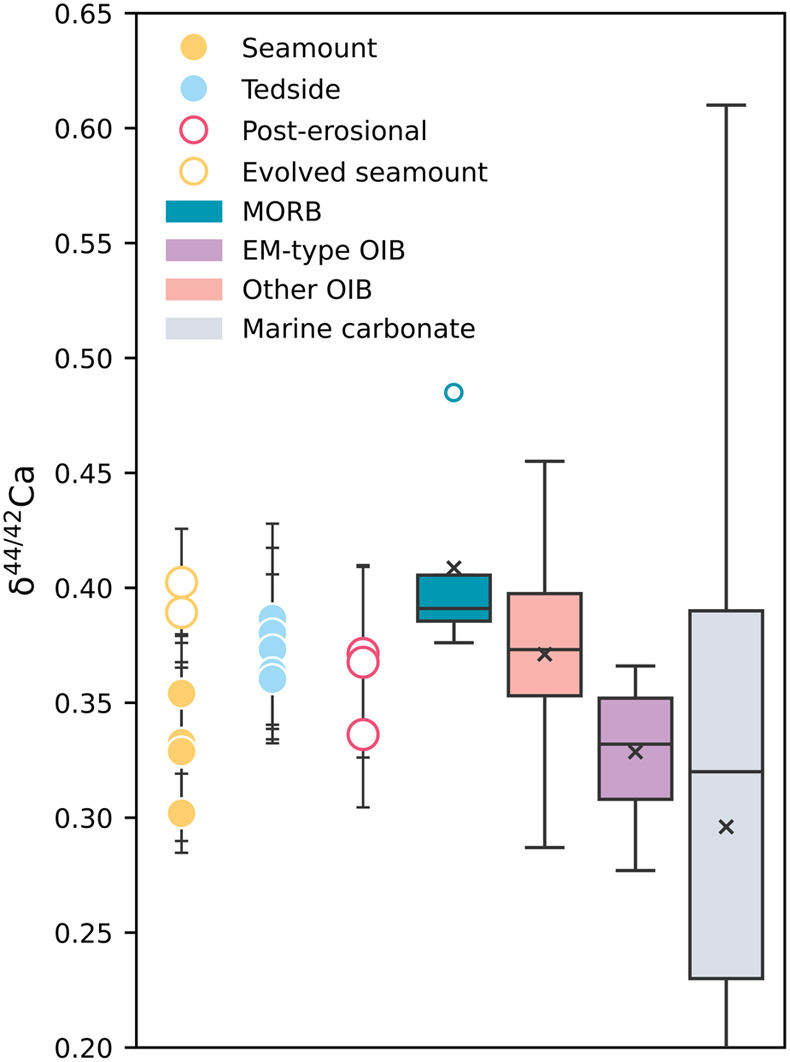
Figure 1 δ44/42Ca for Pitcairn basalts. MORB, EM-type OIBs (EM-1/EM-2; enriched radiogenic isotopes), other OIBs and marine carbonates are shown for comparison. MORB and OIB data are from Eriksen and Jacobsen (2022)
Eriksen, Z.T., Jacobsen, S.B. (2022) Calcium isotope constraints on OIB and MORB petrogenesis: The importance of melt mixing. Earth and Planetary Science Letters 593, 117665. https://doi.org/10.1016/j.epsl.2022.117665
and Eriksen et al. (2024)Eriksen, Z.T., Jacobsen, S.B., Day, J.M.D., White, W.M. (2024) Calcium isotope variability among ocean islands reveals the physical and lithological controls on mantle partial melting. Geochimica et Cosmochimica Acta 373, 326–341 https://doi.org/10.1016/j.gca.2024.02.011
; marine carbonate data are from Fantle and Tipper (2014)Fantle, M.S., Tipper, E.T. (2014) Calcium isotopes in the global biogeochemical Ca cycle: Implications for development of a Ca isotope proxy. Earth-Science Reviews 129, 148–177. https://doi.org/10.1016/j.earscirev.2013.10.004
.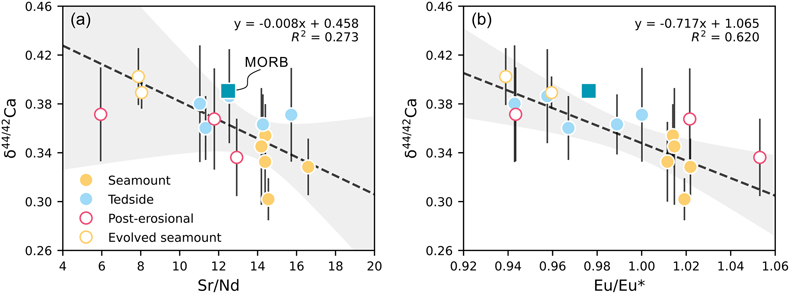
Figure 2 δ44/42Ca versus (a) Sr/Nb and (b) Eu/Eu* for Pitcairn basalts. Eu/Eu* = EuN/(SmN × GdN)0.5, where the subscript ‘N’ denotes chondrite-normalised values (Sun and McDonough, 1989
Sun, S.-s., McDonough, W.F. (1989) Chemical and isotopic systematics of oceanic basalts: implications for mantle composition and processes. Geological Society, London, Special Publications 42, 313–345. https://doi.org/10.1144/GSL.SP.1989.042.01.19
). Trace element data are from Woodhead and McCulloch (1989)Woodhead, J.D., McCulloch, M.T. (1989) Ancient seafloor signals in Pitcairn Island lavas and evidence for large amplitude, small length-scale mantle heterogeneities. Earth and Planetary Science Letters 94, 257–273. https://doi.org/10.1016/0012-821X(89)90145-3
and Woodhead and Devey (1993)Woodhead, J.D., Devey, C.W. (1993) Geochemistry of the Pitcairn seamounts, I: source character and temporal trends. Earth and Planetary Science Letters 116, 81–99. https://doi.org/10.1016/0012-821X(93)90046-C
. Filled symbols, Tedside + seamount samples with MgO ≥ 3.8 wt. % (used in fits); open symbols, post-erosional and evolved samples with MgO < 3.8 wt. % (excluded). Black line, linear regression fit to Tedside + seamount samples (MgO ≥ 3.8 wt. %); grey band, 95 % CI. MORB δ44/42Ca values are from Eriksen and Jacobsen (2022)Eriksen, Z.T., Jacobsen, S.B. (2022) Calcium isotope constraints on OIB and MORB petrogenesis: The importance of melt mixing. Earth and Planetary Science Letters 593, 117665. https://doi.org/10.1016/j.epsl.2022.117665
. Pitcairn trace elements are corrected for olivine accumulation following Nebel et al. (2019)Nebel, O., Sossi, P.A., Bénard, A., Arculus, R.J., Yaxley, G.M., Woodhead, J.D., Davies, D.R., Ruttor, S. (2019) Reconciling petrological and isotopic mixing mechanisms in the Pitcairn mantle plume using stable Fe isotopes. Earth and Planetary Science Letters 521, 60–67. https://doi.org/10.1016/j.epsl.2019.05.037
(Table S-4), except for those with MgO < 3.8 wt. %, for which an effective clinopyroxene correction is unavailable.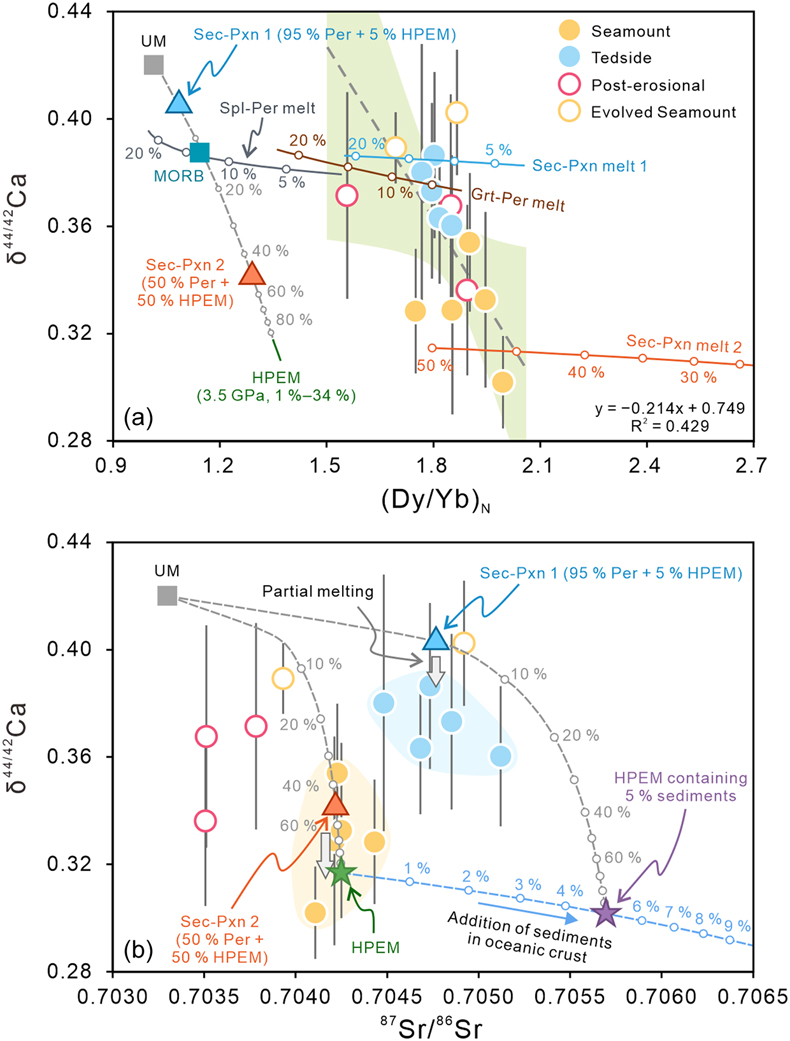
Figure 3 Model illustrating the origin of Ca isotope variations in the Pitcairn mantle plume. δ44/42Ca versus (a) (Dy/Yb)N and (b) 87Sr/86Sr. Symbols and regression band are as in Figure 2. In (a), grey and brown solid curves represent partial melting of spinel- and garnet-bearing peridotite, respectively, whereas blue and orange curves represent melting of two secondary pyroxenite end members. In (b), the blue dashed line illustrates the effects of adding carbonate-bearing sediments to recycled oceanic crust to generate HPEM. In both panels, grey dashed lines represent the formation of secondary pyroxenites through interaction between HPEM and ambient peridotite at different proportions; blue and orange triangles indicate the resulting secondary pyroxenite end members. Abbreviations: Spl-Per, spinel peridotite; Grt-Per, garnet peridotite; Sec-Pxn, secondary pyroxenite; HPEM, high pressure eclogite-derived melt; UM, upper mantle. Modelling details are provided in the Supplementary Information and Tables S-5–S-10.
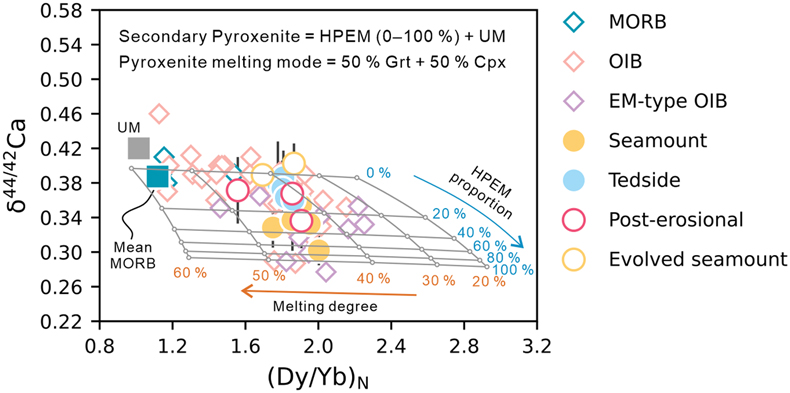
Figure 4 δ44/42Ca versus (Dy/Yb)N for global OIBs. Literature data are from Eriksen and Jacobsen (2022)
Eriksen, Z.T., Jacobsen, S.B. (2022) Calcium isotope constraints on OIB and MORB petrogenesis: The importance of melt mixing. Earth and Planetary Science Letters 593, 117665. https://doi.org/10.1016/j.epsl.2022.117665
and Eriksen et al. (2024)Eriksen, Z.T., Jacobsen, S.B., Day, J.M.D., White, W.M. (2024) Calcium isotope variability among ocean islands reveals the physical and lithological controls on mantle partial melting. Geochimica et Cosmochimica Acta 373, 326–341 https://doi.org/10.1016/j.gca.2024.02.011
. Symbols are as in Figure 2. Upper mantle and MORB δ44/42Ca references are as in Figure 3. The black grid represents our modelling of REEs and δ44/42Ca; see the Supplementary Information for details.