



Supra-subduction zone ophiolites retain hydrogen generation potential after 300 Myr
Affiliations | Corresponding Author | Cite as | Funding information
Published by the European Association of Geochemistry
under Creative Commons License CC BY 4.0
Keywords: natural hydrogen exploration, chromitite, ophiolites, low-temperature serpentinization, Kempirsay, geological hydrogen systems


- Share this article


-
Article views:1,515Cumulative count of HTML views and PDF downloads.
- Download Citation
- Rights & Permissions

top
Abstract
Figures and Tables
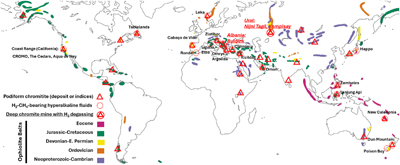 Figure 1 Global distribution of Neoproterozoic and Phanerozoic ophiolite belts, modified after Vaughan and Scarrow (2003). Supra-subduction zone ophiolites that host podiform chromitites and reduced H2-CH4-rich fluids discussed in this study are highlighted, including the Kempirsay massif in the Urals (Kazakhstan), the Bulqizë ophiolite (Albania) and other chromitite-bearing peridotite massifs cited in the text. | 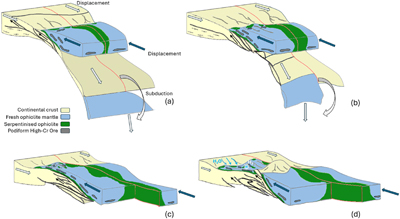 Figure 2 Conceptual 3 D model for the tectonic and hydrological evolution of chromitite-bearing SSZ ophiolites and their long lived hydrogen systems. (a) Continental subduction beneath supra-subduction zone oceanic lithosphere. An inherited transform- or detachment-related fault (red) cuts the mantle wedge and localises hydration and serpentinisation along a narrow damage corridor (green), while a panel of weakly serpentinised harzburgite-dunite (light blue) with podiform chromitite lenses (dark grey) remains comparatively intact. (b–c) Subduction choking, exhumation and lateral transport. Under-thrusting of buoyant continental crust jams the subduction zone and drives uplift and translation of the ophiolite toward the foreland, while strain and fluid flow remain focused within the serpentinite corridor. The chromitite-bearing mantle panel is transported as a coherent block to shallow crustal levels with limited internal disruption. (d) Final obduction and present day configuration. The ophiolite slab is emplaced on the continental margin, with weakly serpentinised mantle panels flanking a narrow, highly serpentinised corridor. Reactivation of inherited fault networks, including the main high permeability corridor and secondary structures, by meteoric water circulation reconnects chromitite bodies to fresh fluids and sustains low temperature H2 generation in preserved Fe2+-rich mantle domains (adapted from Agard et al., 2023). | 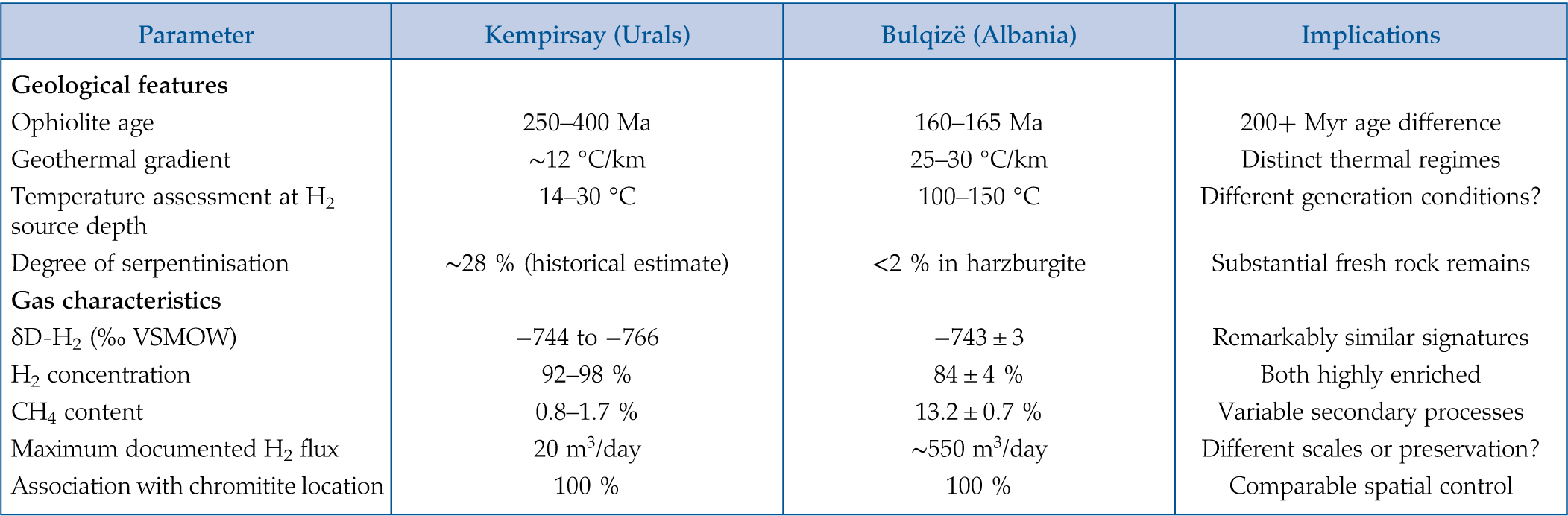 Table 1 Comparative characteristics of H2-producing ophiolitic systems (references for the values are provided in the text). |
| Figure 1 | Figure 2 | Table 1 |
top
Introduction
Recent mining accidents in Kazakhstan’s chromite mines have brought renewed attention to the persistent hydrogen hazard in these ancient geological formations. In February and May 2025, fires at the “Bolashak” mine injured several workers and forced temporary suspension of operations, highlighting a phenomenon that has affected these mines for decades (ISSSource, 2025
ISSSource (2025) Mine work suspended after hydrogen fire. Available at https://www.isssource.com/mine-work-suspended-after-hydrogen-fire/. Accessed 5 March, 2026.
). These incidents echo observations dating back to 1979 from the same mining district, when hydrogen-rich gas ignited underground, creating what miners described as “calm flames over 12 m high” (Ukhanov et al., 1987Ukhanov, A.V., Devirtz, A.L., Ivanov, N.D. (1987) Isotopically light hydrogen at Kempirsay (South Urals). Doklady Akademii Nauk SSSR 293, 700–703.
). The first documented observations of H2-rich gas (66.5–81 % H2) in Ural mines date from 1925–1931 (Bohdanowicz, 1934Bohdanowicz, C. (1934) Natural gas occurrences in Russia (USSR). AAPG Bulletin 18, 746–759. https://doi.org/10.1306/3d932c3c-16b1-11d7-8645000102c1865d
; Lidin et al., 1982Lidin, G.D., Matvienko, N.G., Zimakov, B.M., Gagauz, F.G., Vardoiani, E.F., Pereverzov, V.V. (1982) New data on natural hydrogen gas emissions from ultrabasic rocks. Doklady Akademii Nauk SSSR 264, 1222–1225.
) in the Nizhny Tagil dunite massif during drilling at ∼600 m depth. Soviet research, often overlooked in Western literature, also showed that hydrogen emissions at the Kempirsay massif occurred exclusively within 300 m of chromitite bodies and were never reported in barren ultramafic units (Lidin et al., 1982Lidin, G.D., Matvienko, N.G., Zimakov, B.M., Gagauz, F.G., Vardoiani, E.F., Pereverzov, V.V. (1982) New data on natural hydrogen gas emissions from ultrabasic rocks. Doklady Akademii Nauk SSSR 264, 1222–1225.
).The persistence of hydrogen degassing from Palaeozoic ophiolites in the Ural Mountains highlights gaps in our understanding of natural hydrogen systems. Despite their geological age, 250–400 Ma, these ultramafic complexes release hydrogen at rates comparable to much younger systems. These observations closely parallel those from the Bulqizë mine, hosted in a Jurassic ophiolite approximately 170 Ma old, where active hydrogen seeps persist within chromitite-bearing peridotites (Truche et al., 2024
Truche, L., Donzé, F.V., Goskolli, E., Muceku, B., Loisy, C., Monnin, C., Dutoit, H., Cerepi, A. (2024) A deep reservoir for hydrogen drives intense degassing in the Bulqizë ophiolite. Science 383, 618–621. https://doi.org/10.1126/science.adk9099
, 2025Truche, L., Donzé, F.V., Muceku, B., Sivan, M., Röckmann, T., Levy, D., Moreira, M., Loisy, C., Cerepi, A., Quéméneur, M., Tisserand, D., Dutoit, H., Vujevíc, I., Yao, Y., Lefeuvre, N., Lavoué, A., Monnin, C., Goskolli, E. (2025) A dynamic H2 system with multi-source methane in chromitite-rich ophiolitic settings. Geochimica et Cosmochimica Acta 409, 281–307, https://doi.org/10.1016/j.gca.2025.09.039
; Yao et al., 2025Yao, Y., Donzé, F.V., Persem, M., Truche, L., Muceku, B., Garambois, S., Vujevíc, I., Lefeuvre, N., Goskolli, E. (2025) Magnetotellurics point to serpentinization as a potential source of hydrogen in the Bulqizë ophiolite. Journal of Geophysical Research: Solid Earth 130, e2025JB031898. https://doi.org/10.1029/2025JB031898
). The fact that these ophiolites, spanning a Palaeozoic to Mesozoic age range, display similar degassing patterns suggests a common underlying control, raising the question of whether podiform chromitites play a fundamental role in natural H2 systems of chromitite-bearing SSZ ophiolites worldwide. Without ruling out the possibility that part of the present day hydrogen emissions reflect older serpentinisation events that are no longer active, we address this question by examining several features of these ophiolites that may support long lived and still active H2 systems. A first order observation is that both Kempirsay and Bulqizë share a common geological heritage: they are supra-subduction ophiolites that host abundant podiform chromitites. Podiform chromitites form in such settings during high degree partial melting of the mantle wedge, and concentrate chromium-rich minerals. Similar associations between chromitite bodies and hyperalkaline H2-CH4 fluids have been documented in several other chromitite-bearing ophiolites worldwide (Donzé et al., 2024Donzé, F.V., Lefeuvre, N., Truche, L., Yao, Y., Vujevíc, I., Dutoit, H. (2024) Natural hydrogen exploration within Western European and the eastern Mediterranean ophiolites and ultramafic complexes. Geochemistry: Exploration, Environment, Analysis 24, geochem2024-043. https://doi.org/10.1144/geochem2024-043
; Pappalardo et al., 2025Pappalardo, L., Buono, G., Procesi, M., Etiope, G. (2025) The link between ophiolitic chromitites, natural hydrogen and methane: Insights from 3D microtomography. Chemical Geology 676, 122575. https://doi.org/10.1016/j.chemgeo.2024.122575
), suggesting that chromitite-bearing ophiolites of this type may represent a coherent class of natural hydrogen systems. Here we use a comparative analysis of the Kempirsay and Bulqizë ophiolites to document this class and to discuss its implications for natural hydrogen generation and exploration.top
Geological Setting and Hydrogen Occurrences in Ural and Bulqizë Chromite Mines
The Ural Mountains exhibit numerous ophiolitic complexes that originate from the oceanic lithosphere formed during the Palaeozoic evolution of the Uralian Ocean between 400–250 Ma (Puchkov, 2009
Puchkov, V.N. (2009) The evolution of the Uralian orogen. Geological Society, London, Special Publications 327, 161–195. https://doi.org/10.1144/SP327.9
). These complexes were obducted during the Late Devonian-Early Carboniferous collision between the Baltica and Siberia-Kazakhstan continents. Among these, the Kempirsay massif in Kazakhstan stands out as one of Earth’s largest exposed ultramafic complexes, covering over 900 km2. Within the Sakmara allochthon, it represents fore-arc lithosphere formed along the Devonian Magnitogorsk Island arc (Savelieva et al., 1997Savelieva, G.N., Sharaskin, A.Y., Saveliev, A.A., Spadea, P., Gaggero, L. (1997) Ophiolites of the southern Uralides adjacent to the East European continental margin. Tectonophysics 276, 117–137. https://doi.org/10.1016/S0040-1951(97)00053-X
). To understand the significance of hydrogen emissions from such ancient rocks, we can compare them with the much younger Bulqizë ophiolite in Albania (Table 1). This Jurassic complex formed 160–165 million years ago in a Neo-Tethyan setting (Beccaluva et al., 1994Beccaluva, L., Coltorti, M., Premti, I., Saccani, E., Siena, F., Zeda, O. (1994) Mid-ocean ridge and supra-subduction affinities in the ophiolitic belts of Albania. Ofioliti 19, 77–96.
), providing an interesting contrast.Table 1 Comparative characteristics of H2-producing ophiolitic systems (references for the values are provided in the text).
| Parameter | Kempirsay (Urals) | Bulqizë (Albania) | Implications |
| Geological features | |||
| Ophiolite age | 250–400 Ma | 160–165 Ma | 200+ Myr age difference |
| Geothermal gradient | ∼12 °C/km | 25–30 °C/km | Distinct thermal regimes |
| Temperature assessment at H2 source depth | 14–30 °C | 100–150 °C | Different generation conditions? |
| Degree of serpentinisation | ∼28 % (historical estimate) | <2 % in harzburgite | Substantial fresh rock remains |
| Gas characteristics | |||
| δD-H2 (‰ VSMOW) | −744 to −766 | −743 ± 3 | Remarkably similar signatures |
| H2 concentration | 92–98 % | 84 ± 4 % | Both highly enriched |
| CH4 content | 0.8–1.7 % | 13.2 ± 0.7 % | Variable secondary processes |
| Maximum documented H2 flux | 20 m3/day | ∼550 m3/day | Different scales or preservation? |
| Association with chromitite location | 100 % | 100 % | Comparable spatial control |
Kempirsay and Bulqizë share similarities with both hosting large podiform chromitites surrounded by dunite envelopes (Melcher et al., 1997
Melcher, F., Grum, W., Simon, G., Thalhammer, T.V., Stumpfl, E.F. (1997) Petrogenesis of the ophiolitic giant chromite deposits of Kempirsai, Kazakhstan: a study of solid and fluid inclusions in chromite. Journal of Petrology 38, 1419–1458. https://doi.org/10.1093/petroj/38.10.1419
; Truche et al., 2024Truche, L., Donzé, F.V., Goskolli, E., Muceku, B., Loisy, C., Monnin, C., Dutoit, H., Cerepi, A. (2024) A deep reservoir for hydrogen drives intense degassing in the Bulqizë ophiolite. Science 383, 618–621. https://doi.org/10.1126/science.adk9099
). They both display persistent H2 outgassing, with gas compositions >80 % H2. However, they differ on some other points. Firstly, the Kempirsay ophiolitic massif exhibits exceptionally low surface heat flow values of 25–35 mW m−2, well below the global continental average of ∼65 mW m−2 (Kukkonen et al., 1997Kukkonen, I.T., Golovanova, I.V., Khachay, Y.V., Druzhinin, V.S., Kosarev, A.M., Schapov, V.A. (1997) Low geothermal heat flow of the Urals fold belt—implication of low heat production, fluid circulation or palaeoclimate? Tectonophysics 276, 63–85. https://doi.org/10.1016/S0040-1951(97)00048-6
). Temperature-depth profiles indicate a present day crustal gradient of ∼12 °C km−1 in the upper 2 km. By contrast, measurements inside the Bulqizë mine show gradients of 25–30 °C km−1 in the upper 2–3 km, implying temperatures above 100 °C at depths of a few kilometres (Yao et al., 2025Yao, Y., Donzé, F.V., Persem, M., Truche, L., Muceku, B., Garambois, S., Vujevíc, I., Lefeuvre, N., Goskolli, E. (2025) Magnetotellurics point to serpentinization as a potential source of hydrogen in the Bulqizë ophiolite. Journal of Geophysical Research: Solid Earth 130, e2025JB031898. https://doi.org/10.1029/2025JB031898
). Secondly, the degree of serpentinisation also differs. Historical work, based on limited sampling from mine galleries, suggested that ∼28 % of the Kempirsay peridotite was serpentinised (Lidin et al., 1982Lidin, G.D., Matvienko, N.G., Zimakov, B.M., Gagauz, F.G., Vardoiani, E.F., Pereverzov, V.V. (1982) New data on natural hydrogen gas emissions from ultrabasic rocks. Doklady Akademii Nauk SSSR 264, 1222–1225.
), but later drilling and bulk rock LOI (“Loss On Ignition”) measurements indicate that the uppermost kilometre is now almost completely hydrated (70–100 %, LOI = 10–17 wt. %), with fresh lherzolite restricted to depths >1 km (Saveliev et al., 2022Saveliev, D.E., Makatov, D.K., Rakhimov, I.R., Gataullin, R.A., Shilovskikh, V.V. (2022) Silicates from Lherzolites in the South-Eastern Part of the Kempirsay Massif as the Source for Giant Chromitite Deposits (the Southern Urals, Kazakhstan). Minerals 12, 1061. https://doi.org/10.3390/min12081061
). At Bulqizë, most harzburgite and dunite remain largely unaltered (<2 % serpentine) over the first kilometre, with hydration focused in chromitite-bearing fault corridors (Xiong et al., 2015Xiong, F., Yang, J., Robinson, P.T., Xu, X., Liu, Z., Li, Y., Li, J., Chen, S. (2015) Origin of podiform chromitite, a new model based on the Luobusa ophiolite, Tibet. Gondwana Research 27, 525–542. https://doi.org/10.1016/j.gr.2014.04.008
). Inside these corridors, the alteration intensity rises from dunite envelopes to massive chromitite, reflecting multiple serpentinisation pulses and late fluid percolation.The spatial distribution of hydrogen emissions provides insights into the controlling factors of these ancient systems. At the Kempirsay massif, underground mapping by Soviet geologists documented a clear pattern: all hydrogen occurrences cluster in the immediate vicinity of chromitite ore bodies (Lidin et al., 1982
Lidin, G.D., Matvienko, N.G., Zimakov, B.M., Gagauz, F.G., Vardoiani, E.F., Pereverzov, V.V. (1982) New data on natural hydrogen gas emissions from ultrabasic rocks. Doklady Akademii Nauk SSSR 264, 1222–1225.
). The Molodezhnaya mine exemplifies this relationship, with sustained flows reaching 20 m3 day−1 from fractures adjacent to chromitite lenses. Gas composition shows extreme hydrogen enrichment (92–98 %) with minor methane (0.8–1.7 %) and nitrogen (0.4–0.6 %), plus trace helium, similar to the 84 % H2 observed at Bulqizë (Truche et al., 2025Truche, L., Donzé, F.V., Muceku, B., Sivan, M., Röckmann, T., Levy, D., Moreira, M., Loisy, C., Cerepi, A., Quéméneur, M., Tisserand, D., Dutoit, H., Vujevíc, I., Yao, Y., Lefeuvre, N., Lavoué, A., Monnin, C., Goskolli, E. (2025) A dynamic H2 system with multi-source methane in chromitite-rich ophiolitic settings. Geochimica et Cosmochimica Acta 409, 281–307, https://doi.org/10.1016/j.gca.2025.09.039
) despite the large differences in age and temperature.Strong support for low temperature generation comes from Soviet experimental work that has received little attention in recent literature. Devirtz et al. (1992)
Devirtz, A.L., Gagauz, F.G., Grinenko, V.A., Lagutina, E.P., Pereverzov, V.V., Shukolyukov, Y.A. (1992) On the origin of hydrogen in ultrabasic rocks of the Kempirsay massif. Geokhimiya 8, 1084–1093.
reacted crushed dunite from the Kempirsay mines with controlled additions of water in sealed glass reactors and quantified H2 in the headspace at both 100 °C and 17–24 °C, documenting concurrent Fe(II) oxidation consistent with water reduction by ferrous iron. Although low temperature serpentinisation experiments are subject to considerable rate variability and potential artefacts (Barbier et al., 2020Barbier, S., Huang, F., Andreani, M., Tao, R., Hao, J., Eleish, A., Prabhu, A., Aubaud, C., Liu, H., Faure, K. (2020) A review of H2, CH4, and hydrocarbon generation in experimental serpentinization using network analysis. Frontiers in Earth Science 8, 209. https://doi.org/10.3389/feart.2020.00209
), the Devirtz et al. (1992)Devirtz, A.L., Gagauz, F.G., Grinenko, V.A., Lagutina, E.P., Pereverzov, V.V., Shukolyukov, Y.A. (1992) On the origin of hydrogen in ultrabasic rocks of the Kempirsay massif. Geokhimiya 8, 1084–1093.
results are internally consistent across independent lines of evidence (H2 yields, Fe2+/Fe3+ budgets, thermodynamic feasibility, and isotopic fractionation). Similar low temperature hydrogen generation has been reported from other serpentinising systems (Ellison et al., 2021Ellison, E.T., Templeton, A.S., Zeigler, S.D., Mayhew, L.E., Kelemen, P.B., Matter, J.M., Oman Drilling Project Science Party (2021) Low‐temperature hydrogen formation during aqueous alteration of serpentinized peridotite in the Samail ophiolite. Journal of Geophysical Research: Solid Earth 126, e2021JB021981. https://doi.org/10.1029/2021JB021981
), although the specific role of chromitites as catalytic enhancers remains underexplored. Radiocarbon measurements on methane from Bulqizë (Truche et al., 2025Truche, L., Donzé, F.V., Muceku, B., Sivan, M., Röckmann, T., Levy, D., Moreira, M., Loisy, C., Cerepi, A., Quéméneur, M., Tisserand, D., Dutoit, H., Vujevíc, I., Yao, Y., Lefeuvre, N., Lavoué, A., Monnin, C., Goskolli, E. (2025) A dynamic H2 system with multi-source methane in chromitite-rich ophiolitic settings. Geochimica et Cosmochimica Acta 409, 281–307, https://doi.org/10.1016/j.gca.2025.09.039
) provide an additional constraint on the time scales of these systems. A value of 3.76 ± 0.06 pMC, corresponding to an apparent age of ∼26,000 years, shows that at least part of the CH4 inventory is renewed on 104 year time scales rather than the 106 year scales occasionally discussed for ophiolitic systems (e.g., Etiope and Schoell, 2014Etiope, G., Schoell, M. (2014) Abiotic gas: Atypical, but not rare. Elements 10, 291–296. https://doi.org/10.2113/gselements.10.4.291
). The young age of CH4 implies that the associated H2 required for its synthesis must also be recently produced, indicating active hydrogen generation rather than simple release of ancient gas reservoirs. This suggests that chromitite-bearing SSZ ophiolites may play a more dynamic role in the global carbon and hydrogen cycles than previously recognised.These observations are consistent with the idea that low temperature serpentinisation can sustain hydrogen generation under appropriate geochemical conditions, but they do not by themselves explain why active seeps in both massifs are strictly confined to the vicinity of chromitite ore bodies; this is the question we now address in the following discussion.
top
The Chromitite Catalytic Factory
The association between hydrogen emissions and chromitite bodies at Kempirsay and Bulqizë is supported by converging spatial, geochemical, and mineralogical evidence. In both massifs, all documented H2-rich seeps are located within a few hundred metres of podiform chromitite. This spatial pattern suggests that chromitites and their surrounding damage zones play a central role in both H2 production and migration. Chromitite-bearing peridotites provide favourable redox and catalytic conditions for hydrogen generation. Dunite and harzburgite surrounding chromitite ore bodies supply the Fe2+ and reducing capacity required for H2 generation. At the mineral-fluid interface, Fe(II)-rich spinel surfaces (chromite, magnetite) can catalyse hydrogen generation by transferring electrons from structural and adsorbed Fe(II) to water molecules and protons adsorbed on the spinel surface, thereby reducing water to H2 while oxidising Fe(II) to Fe(III) (Mayhew et al., 2013
Mayhew, L.E., Ellison, E.T., McCollom, T.M., Trainor, T.P., Templeton, A.S. (2013) Hydrogen generation from low-temperature water–rock reactions. Nature Geoscience 6, 478–484. https://doi.org/10.1038/ngeo1825
).Similar associations have been reported in other chromitite-bearing ophiolites (Fig. 1). In several Neoproterozoic and Phanerozoic belts, podiform chromitites occur together with hyperalkaline H2-CH4-rich fluids and occluded gases trapped within chromitite samples (Pappalardo et al., 2025
Pappalardo, L., Buono, G., Procesi, M., Etiope, G. (2025) The link between ophiolitic chromitites, natural hydrogen and methane: Insights from 3D microtomography. Chemical Geology 676, 122575. https://doi.org/10.1016/j.chemgeo.2024.122575
). In many cases, CH4 is interpreted as a secondary product of Fischer-Tropsch-type reactions fuelled by H2, further emphasising the importance of chromitite-hosted catalytic interfaces. This recurrent association suggests that the link between chromitites and reduced fluids is not restricted to Kempirsay and Bulqizë, but may be a general feature of chromitite-bearing SSZ ophiolites. However, to our knowledge, only these two massifs have been surveyed in enough detail to quantify the spatial relationship between active H2 seeps and mapped podiform chromitite bodies at the 102–103 m scale.Figure 1 Global distribution of Neoproterozoic and Phanerozoic ophiolite belts, modified after Vaughan and Scarrow (2003)
Vaughan, A.P.M., Scarrow, J.H. (2003) Ophiolite obduction pulses as a proxy indicator of superplume events? Earth and Planetary Science Letters 213, 407–416. https://doi.org/10.1016/S0012-821X(03)00330-3
. Supra-subduction zone ophiolites that host podiform chromitites and reduced H2-CH4-rich fluids discussed in this study are highlighted, including the Kempirsay massif in the Urals (Kazakhstan), the Bulqizë ophiolite (Albania) and other chromitite-bearing peridotite massifs cited in the text.Beyond this first order picture, several features of podiform chromitites may further enhance hydrogen generation. Chromitites are enriched in platinum group elements by one to two orders of magnitude relative to surrounding peridotites (Melcher et al., 1997
Melcher, F., Grum, W., Simon, G., Thalhammer, T.V., Stumpfl, E.F. (1997) Petrogenesis of the ophiolitic giant chromite deposits of Kempirsai, Kazakhstan: a study of solid and fluid inclusions in chromite. Journal of Petrology 38, 1419–1458. https://doi.org/10.1093/petroj/38.10.1419
), creating metal-rich interfaces where catalytic water reduction and Fischer-Tropsch-type reactions may be promoted (Truche et al., 2025Truche, L., Donzé, F.V., Muceku, B., Sivan, M., Röckmann, T., Levy, D., Moreira, M., Loisy, C., Cerepi, A., Quéméneur, M., Tisserand, D., Dutoit, H., Vujevíc, I., Yao, Y., Lefeuvre, N., Lavoué, A., Monnin, C., Goskolli, E. (2025) A dynamic H2 system with multi-source methane in chromitite-rich ophiolitic settings. Geochimica et Cosmochimica Acta 409, 281–307, https://doi.org/10.1016/j.gca.2025.09.039
). Quantifying the contribution of these mineralogical and catalytic effects, however, will require dedicated experimental and field studies beyond the scope of this work.Other mineral phases, such as awaruite, native iron, and Fe-Ni alloys, have also been discussed as potential catalysts for H2 generation and Fischer-Tropsch-type synthesis in serpentinising systems (Foustoukos and Seyfried, 2004
Foustoukos, D.I., Seyfried, W.E. (2004) Hydrocarbons in hydrothermal vent fluids: The role of chromium-bearing catalysts. Science 304, 1002–1005. https://doi.org/10.1126/science.1096033
). While we do not claim that chromitite is the only catalytic phase involved, the striking spatial association between all documented H2-rich seeps and mapped podiform chromitite bodies in both case studies, combined with the catalytic, redox, and structural functions of chromitite-bearing damage zones, supports podiform chromitites as a robust exploration marker for natural hydrogen in SSZ ophiolites.Chromitite bodies thus operate as local catalytic and hydraulic hubs. Their role can be understood within the broader framework of supra-subduction zone ophiolites, whose inherited architecture controls both the early localisation of serpentinisation and the long term preservation of reactive mantle domains.
top
Mineralogical and Structural Drivers of Chromite-Hydrogen Coupling in SSZ Ophiolites
Supra-subduction zone (SSZ) ophiolites create a distinctive mantle architecture in which podiform chromitites, strongly depleted peridotites and inherited permeability structures are closely linked (Dilek and Furnes, 2011
Dilek, Y., Furnes, H. (2011) Ophiolite genesis and global tectonics: Geochemical and tectonic fingerprinting of ancient oceanic lithosphere. Geological Society of America Bulletin 123, 387–411. https://doi.org/10.1130/B30446.1
). High degree melting in fore-arc settings produces harzburgite-dunite domains that are both olivine dominated and Fe2+-bearing, providing a chemically favourable substrate for H2-producing reactions once hydration occurs. At the same time, SSZ magmatism focuses Cr-rich melts into deforming peridotite to form podiform chromitites, while faulting and dyke emplacement create a heterogeneous network of fractures and magmatic contacts that control seawater penetration into the mantle (Dilek and Furnes, 2011Dilek, Y., Furnes, H. (2011) Ophiolite genesis and global tectonics: Geochemical and tectonic fingerprinting of ancient oceanic lithosphere. Geological Society of America Bulletin 123, 387–411. https://doi.org/10.1130/B30446.1
). In this configuration, serpentinisation is expected to be localised along a subset of these high permeability structures rather than proceeding uniformly throughout the mantle section (Mével, 2003Mével, C. (2003) Serpentinization of abyssal peridotites at mid-ocean ridges. Comptes Rendus Geoscience 335, 825–852. https://doi.org/10.1016/j.crte.2003.08.006
). Early hydration along faults, shear zones, gabbro-peridotite contacts and dyke swarms, creates serpentinite corridors that become mechanically weak and highly permeable, concentrating both deformation and fluid flow during subsequent intra-oceanic subduction and obduction. Within these corridors, chromitite bodies behave as mechanically stiff inclusions that focus fracturing and maintain damage zones in the more deformable serpentinite matrix (Albers et al., 2019Albers, E., Bach, W., Klein, F., Menzies, C.D., Lucassen, F., Teagle, D.A.H. (2019) Fluid–rock interactions in the shallow Mariana forearc: Carbon cycling and redox conditions. Geochemistry, Geophysics, Geosystems 20, 4361–4382 https://doi.org/10.5194/se-10-907-2019
). These local damage zones provide the permeability needed to connect chromitite bodies to the massif-scale fault network, creating a two scale hydraulic architecture in which regional faults supply meteoric water to local chromitite-centred reaction sites. By contrast, intervening blocks of harzburgite-dunite and gabbro that remain less fractured and only weakly hydrated behave as more competent panels and can be translated upward largely as coherent blocks, with limited additional serpentinisation during exhumation (Dilek and Furnes, 2011Dilek, Y., Furnes, H. (2011) Ophiolite genesis and global tectonics: Geochemical and tectonic fingerprinting of ancient oceanic lithosphere. Geological Society of America Bulletin 123, 387–411. https://doi.org/10.1130/B30446.1
).Once obducted and exposed at shallow crustal levels, these preserved olivine-rich blocks are reconnected to meteoric water through fault networks inherited from the same tectonic history (Dilek and Furnes, 2011
Dilek, Y., Furnes, H. (2011) Ophiolite genesis and global tectonics: Geochemical and tectonic fingerprinting of ancient oceanic lithosphere. Geological Society of America Bulletin 123, 387–411. https://doi.org/10.1130/B30446.1
). At this late stage, large volumes of Fe2+-bearing peridotite that escaped pervasive hydration during subduction become available for renewed low temperature serpentinisation and chromitite catalysed water reduction. Combined with the thick, permeable architecture typical of obducted SSZ mantle slabs, this interplay of early localisation of serpentinisation, mechanical partitioning of strain, and long term preservation of reactive mantle domains makes these ophiolites particularly effective natural systems for sustaining hydrogen generation potential over hundreds of millions of years.top
Implications for Natural Hydrogen Systems
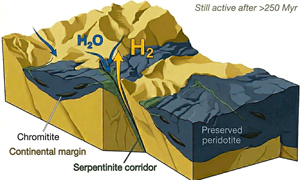
Chromitite-bearing SSZ ophiolites behave as poly-stage hydrogen systems. At oceanic spreading centres, mantle exhumation and seawater penetration along detachments, transform and normal faults initiate serpentinisation (Fig. 2). During active subduction, hydration of the mantle wedge along inherited faults and shear zones in the fore-arc further localises serpentinisation and the production of reduced fluids. The Mariana fore-arc provides a modern analogue: serpentinite mud volcanoes there are fed by slab-derived fluids and discharge high pH (up to 12.5) fluids enriched in abiotic H2, CH4 and higher hydrocarbons (Fryer et al., 2020
Fryer, P., Wheat, C.G., Williams, T, Kelley, C., Johnson, K. et al. (2020) Mariana serpentinite mud volcanism exhumes subducted seamount materials: implications for the origin of life. Philosophical Transactions of the Royal Society A 378, 20180425. https://doi.org/10.1098/rsta.2018.0425
). These reduced gases are attributed to serpentinisation-driven hydrogen production coupled with abiotic methane synthesis. Similar fore-arc processes likely operated during the SSZ stage of ophiolite formation, when podiform chromitites and their harzburgite-dunite hosts formed in the mantle wedge.Figure 2 Conceptual 3 D model for the tectonic and hydrological evolution of chromitite-bearing SSZ ophiolites and their long lived hydrogen systems. (a) Continental subduction beneath supra-subduction zone oceanic lithosphere. An inherited transform- or detachment-related fault (red) cuts the mantle wedge and localises hydration and serpentinisation along a narrow damage corridor (green), while a panel of weakly serpentinised harzburgite-dunite (light blue) with podiform chromitite lenses (dark grey) remains comparatively intact. (b–c) Subduction choking, exhumation and lateral transport. Under-thrusting of buoyant continental crust jams the subduction zone and drives uplift and translation of the ophiolite toward the foreland, while strain and fluid flow remain focused within the serpentinite corridor. The chromitite-bearing mantle panel is transported as a coherent block to shallow crustal levels with limited internal disruption. (d) Final obduction and present day configuration. The ophiolite slab is emplaced on the continental margin, with weakly serpentinised mantle panels flanking a narrow, highly serpentinised corridor. Reactivation of inherited fault networks, including the main high permeability corridor and secondary structures, by meteoric water circulation reconnects chromitite bodies to fresh fluids and sustains low temperature H2 generation in preserved Fe2+-rich mantle domains (adapted from Agard et al., 2023
Agard, P., Soret, M., Bonnet, G., Ninkabou, D., Plunder, A., Prigent, C., Yamato, P. (2023) Subduction and obduction processes: The fate of oceanic lithosphere revealed by blueschists, eclogites, and ophiolites. In: Catlos, E.J., Çemen, İ. (Eds.) Compressional Tectonics: Plate Convergence to Mountain Building. American Geophysical Union Geophysical Monograph 277. John Wiley & Sons, Inc., Hoboken, 21–45. https://doi.org/10.1002/9781119773856.ch2
).Once obducted and emplaced on continental margins, these SSZ ophiolites evolve into long lived, low temperature hydrogen systems. Their inherited architecture, with highly serpentinised, high permeability corridors flanked by thick panels of relatively weakly serpentinised, chromitite-bearing harzburgite-dunite, allows large volumes of Fe2+-bearing peridotite to remain reactive for hundreds of millions of years. Where meteoric water circulates along reactivated fault zones and fracture networks, hydrogen generation and leakage can be sustained over at least 300 Myr, provided that fracture permeability is maintained or periodically reactivated and that fresh dunite, harzburgite and chromitite bodies remain available. This behaviour is consistent with thermodynamic constraints on low temperature continental serpentinisation fluids (Leong and Shock, 2020
Leong, J.A.M., Shock, E.L. (2020) Thermodynamic constraints on the geochemistry of low-temperature, continental, serpentinization-generated fluids. American Journal of Science 320, 185–235. https://doi.org/10.2475/03.2020.01
) and with observations of sustained H2 production in partially hydrated peridotites in the Samail ophiolite, Oman (Templeton et al., 2024Templeton, A.S., Ellison, E.T., Kelemen, P.B., Leong, J., Boyd, E.S., Colman, D.R., Matter, J.M. (2024) Low-temperature hydrogen production and consumption in partially-hydrated peridotites in Oman: implications for stimulated geological hydrogen production. Frontiers in Geochemistry 2, 1366268. https://doi.org/10.3389/fgeoc.2024.1366268
). Together, these studies indicate that efficient H2 generation does not require high temperature hydrothermal systems, but can persist under relatively cold, near surface conditions when appropriate redox gradients and catalytic phases are present.Within this framework, podiform chromitite bodies and their surrounding damage zones emerge as prime internal targets for hydrogen exploration within such ophiolites. Our analyses emphasise that, at present, chromitite-bearing SSZ ophiolites are the best documented natural laboratories for long term, low temperature hydrogen generation and, together with their adjacent sedimentary basins, should constitute priority targets for systematic exploration. The conceptual evolution shown in Figure 2 links the fore-arc serpentinisation stage, through subduction choking, expulsion tectonics and final obduction, to the present configuration where preserved, chromitite-rich mantle panels are reconnected to meteoric fluids and operate as long lived H2 factories.
From a practical exploration perspective, the two massifs studied here provide useful first order numbers. In both Kempirsay and Bulqizë, all documented H2 seeps occur within damage zones surrounding mapped podiform chromitite bodies, and individual vents display instantaneous flow rates between ∼20 and 550 m3 day−1. These values are site specific and based on a limited number of measurements, but they illustrate the spatial extent of chromitite centred damage zones (on the order of 102 m; Lidin et al., 1982
Lidin, G.D., Matvienko, N.G., Zimakov, B.M., Gagauz, F.G., Vardoiani, E.F., Pereverzov, V.V. (1982) New data on natural hydrogen gas emissions from ultrabasic rocks. Doklady Akademii Nauk SSSR 264, 1222–1225.
; Xiong et al., 2015Xiong, F., Yang, J., Robinson, P.T., Xu, X., Liu, Z., Li, Y., Li, J., Chen, S. (2015) Origin of podiform chromitite, a new model based on the Luobusa ophiolite, Tibet. Gondwana Research 27, 525–542. https://doi.org/10.1016/j.gr.2014.04.008
) and the magnitude of local hydrogen fluxes that can be sustained over geological time scales. More broadly, SSZ ophiolites appear to be among the most fertile H2 systems currently identified. They may locally host economically interesting accumulations, but probably of limited size because porosity is mostly fracture controlled. Surrounding and overlying sedimentary basins may represent more favourable exploration plays, as they can trap H2 sourced from the ophiolite and are connected to the H2 factory through active structural drains.Editor: Ambre Luguet
top
References
Agard, P., Soret, M., Bonnet, G., Ninkabou, D., Plunder, A., Prigent, C., Yamato, P. (2023) Subduction and obduction processes: The fate of oceanic lithosphere revealed by blueschists, eclogites, and ophiolites. In: Catlos, E.J., Çemen, İ. (Eds.) Compressional Tectonics: Plate Convergence to Mountain Building. American Geophysical Union Geophysical Monograph 277. John Wiley & Sons, Inc., Hoboken, 21–45. https://doi.org/10.1002/9781119773856.ch2
 Show in context
 Reactivation of inherited fault networks, including the main high permeability corridor and secondary structures, by meteoric water circulation reconnects chromitite bodies to fresh fluids and sustains low temperature H2 generation in preserved Fe2+-rich mantle domains (adapted from Agard et al., 2023).
View in article
Albers, E., Bach, W., Klein, F., Menzies, C.D., Lucassen, F., Teagle, D.A.H. (2019) Fluid–rock interactions in the shallow Mariana forearc: Carbon cycling and redox conditions. Geochemistry, Geophysics, Geosystems 20, 4361–4382 https://doi.org/10.5194/se-10-907-2019
Show in context Within these corridors, chromitite bodies behave as mechanically stiff inclusions that focus fracturing and maintain damage zones in the more deformable serpentinite matrix (Albers et al., 2019).
View in article
Beccaluva, L., Coltorti, M., Premti, I., Saccani, E., Siena, F., Zeda, O. (1994) Mid-ocean ridge and supra-subduction affinities in the ophiolitic belts of Albania. Ofioliti 19, 77–96.
Show in context This Jurassic complex formed 160–165 million years ago in a Neo-Tethyan setting (Beccaluva et al., 1994), providing an interesting contrast.
View in article
Barbier, S., Huang, F., Andreani, M., Tao, R., Hao, J., Eleish, A., Prabhu, A., Aubaud, C., Liu, H., Faure, K. (2020) A review of H2, CH4, and hydrocarbon generation in experimental serpentinization using network analysis. Frontiers in Earth Science 8, 209. https://doi.org/10.3389/feart.2020.00209
Show in context Although low temperature serpentinisation experiments are subject to considerable rate variability and potential artefacts (Barbier et al., 2020), the Devirtz et al. (1992) results are internally consistent across independent lines of evidence (H2 yields, Fe2+/Fe3+ budgets, thermodynamic feasibility, and isotopic fractionation).
View in article
Bohdanowicz, C. (1934) Natural gas occurrences in Russia (USSR). AAPG Bulletin 18, 746–759. https://doi.org/10.1306/3d932c3c-16b1-11d7-8645000102c1865d
Show in context The first documented observations of H2-rich gas (66.5–81 % H2) in Ural mines date from 1925–1931 (Bohdanowicz, 1934; Lidin et al., 1982) in the Nizhny Tagil dunite massif during drilling at ∼600 m depth.
View in article
Devirtz, A.L., Gagauz, F.G., Grinenko, V.A., Lagutina, E.P., Pereverzov, V.V., Shukolyukov, Y.A. (1992) On the origin of hydrogen in ultrabasic rocks of the Kempirsay massif. Geokhimiya 8, 1084–1093.
Show in context Devirtz et al. (1992) reacted crushed dunite from the Kempirsay mines with controlled additions of water in sealed glass reactors and quantified H2 in the headspace at both 100 °C and 17–24 °C, documenting concurrent Fe(II) oxidation consistent with water reduction by ferrous iron.
View in article
Although low temperature serpentinisation experiments are subject to considerable rate variability and potential artefacts (Barbier et al., 2020), the Devirtz et al. (1992) results are internally consistent across independent lines of evidence (H2 yields, Fe2+/Fe3+ budgets, thermodynamic feasibility, and isotopic fractionation).
View in article
Dilek, Y., Furnes, H. (2011) Ophiolite genesis and global tectonics: Geochemical and tectonic fingerprinting of ancient oceanic lithosphere. Geological Society of America Bulletin 123, 387–411. https://doi.org/10.1130/B30446.1
Show in context Supra-subduction zone (SSZ) ophiolites create a distinctive mantle architecture in which podiform chromitites, strongly depleted peridotites and inherited permeability structures are closely linked (Dilek and Furnes, 2011).
View in article
At the same time, SSZ magmatism focuses Cr-rich melts into deforming peridotite to form podiform chromitites, while faulting and dyke emplacement create a heterogeneous network of fractures and magmatic contacts that control seawater penetration into the mantle (Dilek and Furnes, 2011).
View in article
By contrast, intervening blocks of harzburgite-dunite and gabbro that remain less fractured and only weakly hydrated behave as more competent panels and can be translated upward largely as coherent blocks, with limited additional serpentinisation during exhumation (Dilek and Furnes, 2011).
View in article
Once obducted and exposed at shallow crustal levels, these preserved olivine-rich blocks are reconnected to meteoric water through fault networks inherited from the same tectonic history (Dilek and Furnes, 2011).
View in article
Donzé, F.V., Lefeuvre, N., Truche, L., Yao, Y., Vujevíc, I., Dutoit, H. (2024) Natural hydrogen exploration within Western European and the eastern Mediterranean ophiolites and ultramafic complexes. Geochemistry: Exploration, Environment, Analysis 24, geochem2024-043. https://doi.org/10.1144/geochem2024-043
Show in context Similar associations between chromitite bodies and hyperalkaline H2-CH4 fluids have been documented in several other chromitite-bearing ophiolites worldwide (Donzé et al., 2024; Pappalardo et al., 2025), suggesting that chromitite-bearing ophiolites of this type may represent a coherent class of natural hydrogen systems.
View in article
Ellison, E.T., Templeton, A.S., Zeigler, S.D., Mayhew, L.E., Kelemen, P.B., Matter, J.M., Oman Drilling Project Science Party (2021) Low‐temperature hydrogen formation during aqueous alteration of serpentinized peridotite in the Samail ophiolite. Journal of Geophysical Research: Solid Earth 126, e2021JB021981. https://doi.org/10.1029/2021JB021981
Show in context Similar low temperature hydrogen generation has been reported from other serpentinising systems (Ellison et al., 2021), although the specific role of chromitites as catalytic enhancers remains underexplored.
View in article
Etiope, G., Schoell, M. (2014) Abiotic gas: Atypical, but not rare. Elements 10, 291–296. https://doi.org/10.2113/gselements.10.4.291
Show in context A value of 3.76 ± 0.06 pMC, corresponding to an apparent age of ∼26,000 years, shows that at least part of the CH4 inventory is renewed on 104 year time scales rather than the 106 year scales occasionally discussed for ophiolitic systems (e.g., Etiope and Schoell, 2014).
View in article
Foustoukos, D.I., Seyfried, W.E. (2004) Hydrocarbons in hydrothermal vent fluids: The role of chromium-bearing catalysts. Science 304, 1002–1005. https://doi.org/10.1126/science.1096033
Show in context Other mineral phases, such as awaruite, native iron, and Fe-Ni alloys, have also been discussed as potential catalysts for H2 generation and Fischer-Tropsch-type synthesis in serpentinising systems (Foustoukos and Seyfried, 2004).
View in article
Fryer, P., Wheat, C.G., Williams, T, Kelley, C., Johnson, K. et al. (2020) Mariana serpentinite mud volcanism exhumes subducted seamount materials: implications for the origin of life. Philosophical Transactions of the Royal Society A 378, 20180425. https://doi.org/10.1098/rsta.2018.0425
Show in context The Mariana fore-arc provides a modern analogue: serpentinite mud volcanoes there are fed by slab-derived fluids and discharge high pH (up to 12.5) fluids enriched in abiotic H2, CH4 and higher hydrocarbons (Fryer et al., 2020).
View in article
ISSSource (2025) Mine work suspended after hydrogen fire. Available at https://www.isssource.com/mine-work-suspended-after-hydrogen-fire/. Accessed 5 March, 2026.
Show in context In February and May 2025, fires at the “Bolashak” mine injured several workers and forced temporary suspension of operations, highlighting a phenomenon that has affected these mines for decades (ISSSource, 2025).
View in article
Kukkonen, I.T., Golovanova, I.V., Khachay, Y.V., Druzhinin, V.S., Kosarev, A.M., Schapov, V.A. (1997) Low geothermal heat flow of the Urals fold belt—implication of low heat production, fluid circulation or palaeoclimate? Tectonophysics 276, 63–85. https://doi.org/10.1016/S0040-1951(97)00048-6
Show in context Firstly, the Kempirsay ophiolitic massif exhibits exceptionally low surface heat flow values of 25–35 mW m−2, well below the global continental average of ∼65 mW m−2 (Kukkonen et al., 1997).
View in article
Leong, J.A.M., Shock, E.L. (2020) Thermodynamic constraints on the geochemistry of low-temperature, continental, serpentinization-generated fluids. American Journal of Science 320, 185–235. https://doi.org/10.2475/03.2020.01
Show in context This behaviour is consistent with thermodynamic constraints on low temperature continental serpentinisation fluids (Leong and Shock, 2020) and with observations of sustained H2 production in partially hydrated peridotites in the Samail ophiolite, Oman (Templeton et al., 2024).
View in article
Lidin, G.D., Matvienko, N.G., Zimakov, B.M., Gagauz, F.G., Vardoiani, E.F., Pereverzov, V.V. (1982) New data on natural hydrogen gas emissions from ultrabasic rocks. Doklady Akademii Nauk SSSR 264, 1222–1225.
Show in context The first documented observations of H2-rich gas (66.5–81 % H2) in Ural mines date from 1925–1931 (Bohdanowicz, 1934; Lidin et al., 1982) in the Nizhny Tagil dunite massif during drilling at ∼600 m depth.
View in article
Soviet research, often overlooked in Western literature, also showed that hydrogen emissions at the Kempirsay massif occurred exclusively within 300 m of chromitite bodies and were never reported in barren ultramafic units (Lidin et al., 1982).
View in article
Historical work, based on limited sampling from mine galleries, suggested that ∼28 % of the Kempirsay peridotite was serpentinised (Lidin et al., 1982), but later drilling and bulk rock LOI (“Loss On Ignition”) measurements indicate that the uppermost kilometre is now almost completely hydrated (70–100 %, LOI = 10–17 wt. %), with fresh lherzolite restricted to depths >1 km (Saveliev et al., 2022).
View in article
At the Kempirsay massif, underground mapping by Soviet geologists documented a clear pattern: all hydrogen occurrences cluster in the immediate vicinity of chromitite ore bodies (Lidin et al., 1982).
View in article
These values are site specific and based on a limited number of measurements, but they illustrate the spatial extent of chromitite centred damage zones (on the order of 102 m; Lidin et al., 1982; Xiong et al., 2015) and the magnitude of local hydrogen fluxes that can be sustained over geological time scales.
View in article
Mayhew, L.E., Ellison, E.T., McCollom, T.M., Trainor, T.P., Templeton, A.S. (2013) Hydrogen generation from low-temperature water–rock reactions. Nature Geoscience 6, 478–484. https://doi.org/10.1038/ngeo1825
Show in context At the mineral-fluid interface, Fe(II)-rich spinel surfaces (chromite, magnetite) can catalyse hydrogen generation by transferring electrons from structural and adsorbed Fe(II) to water molecules and protons adsorbed on the spinel surface, thereby reducing water to H2 while oxidising Fe(II) to Fe(III) (Mayhew et al., 2013).
View in article
Melcher, F., Grum, W., Simon, G., Thalhammer, T.V., Stumpfl, E.F. (1997) Petrogenesis of the ophiolitic giant chromite deposits of Kempirsai, Kazakhstan: a study of solid and fluid inclusions in chromite. Journal of Petrology 38, 1419–1458. https://doi.org/10.1093/petroj/38.10.1419
Show in context Kempirsay and Bulqizë share similarities with both hosting large podiform chromitites surrounded by dunite envelopes (Melcher et al., 1997; Truche et al., 2024).
View in article
Chromitites are enriched in platinum group elements by one to two orders of magnitude relative to surrounding peridotites (Melcher et al., 1997), creating metal-rich interfaces where catalytic water reduction and Fischer-Tropsch-type reactions may be promoted (Truche et al., 2025).
View in article
Mével, C. (2003) Serpentinization of abyssal peridotites at mid-ocean ridges. Comptes Rendus Geoscience 335, 825–852. https://doi.org/10.1016/j.crte.2003.08.006
Show in context In this configuration, serpentinisation is expected to be localised along a subset of these high permeability structures rather than proceeding uniformly throughout the mantle section (Mével, 2003).
View in article
Pappalardo, L., Buono, G., Procesi, M., Etiope, G. (2025) The link between ophiolitic chromitites, natural hydrogen and methane: Insights from 3D microtomography. Chemical Geology 676, 122575. https://doi.org/10.1016/j.chemgeo.2024.122575
Show in context Similar associations between chromitite bodies and hyperalkaline H2-CH4 fluids have been documented in several other chromitite-bearing ophiolites worldwide (Donzé et al., 2024; Pappalardo et al., 2025), suggesting that chromitite-bearing ophiolites of this type may represent a coherent class of natural hydrogen systems.
View in article
In several Neoproterozoic and Phanerozoic belts, podiform chromitites occur together with hyperalkaline H2-CH4-rich fluids and occluded gases trapped within chromitite samples (Pappalardo et al., 2025).
View in article
Puchkov, V.N. (2009) The evolution of the Uralian orogen. Geological Society, London, Special Publications 327, 161–195. https://doi.org/10.1144/SP327.9
Show in context The Ural Mountains exhibit numerous ophiolitic complexes that originate from the oceanic lithosphere formed during the Palaeozoic evolution of the Uralian Ocean between 400–250 Ma (Puchkov, 2009).
View in article
Savelieva, G.N., Sharaskin, A.Y., Saveliev, A.A., Spadea, P., Gaggero, L. (1997) Ophiolites of the southern Uralides adjacent to the East European continental margin. Tectonophysics 276, 117–137. https://doi.org/10.1016/S0040-1951(97)00053-X
Show in context Within the Sakmara allochthon, it represents fore-arc lithosphere formed along the Devonian Magnitogorsk Island arc (Savelieva et al., 1997).
View in article
Saveliev, D.E., Makatov, D.K., Rakhimov, I.R., Gataullin, R.A., Shilovskikh, V.V. (2022) Silicates from Lherzolites in the South-Eastern Part of the Kempirsay Massif as the Source for Giant Chromitite Deposits (the Southern Urals, Kazakhstan). Minerals 12, 1061. https://doi.org/10.3390/min12081061
Show in context Historical work, based on limited sampling from mine galleries, suggested that ∼28 % of the Kempirsay peridotite was serpentinised (Lidin et al., 1982), but later drilling and bulk rock LOI (“Loss On Ignition”) measurements indicate that the uppermost kilometre is now almost completely hydrated (70–100 %, LOI = 10–17 wt. %), with fresh lherzolite restricted to depths >1 km (Saveliev et al., 2022).
View in article
Templeton, A.S., Ellison, E.T., Kelemen, P.B., Leong, J., Boyd, E.S., Colman, D.R., Matter, J.M. (2024) Low-temperature hydrogen production and consumption in partially-hydrated peridotites in Oman: implications for stimulated geological hydrogen production. Frontiers in Geochemistry 2, 1366268. https://doi.org/10.3389/fgeoc.2024.1366268
Show in context This behaviour is consistent with thermodynamic constraints on low temperature continental serpentinisation fluids (Leong and Shock, 2020) and with observations of sustained H2 production in partially hydrated peridotites in the Samail ophiolite, Oman (Templeton et al., 2024).
View in article
Truche, L., Donzé, F.V., Goskolli, E., Muceku, B., Loisy, C., Monnin, C., Dutoit, H., Cerepi, A. (2024) A deep reservoir for hydrogen drives intense degassing in the Bulqizë ophiolite. Science 383, 618–621. https://doi.org/10.1126/science.adk9099
Show in context These observations closely parallel those from the Bulqizë mine, hosted in a Jurassic ophiolite approximately 170 Ma old, where active hydrogen seeps persist within chromitite-bearing peridotites (Truche et al., 2024, 2025; Yao et al., 2025).
View in article
Kempirsay and Bulqizë share similarities with both hosting large podiform chromitites surrounded by dunite envelopes (Melcher et al., 1997; Truche et al., 2024).
View in article
Truche, L., Donzé, F.V., Muceku, B., Sivan, M., Röckmann, T., Levy, D., Moreira, M., Loisy, C., Cerepi, A., Quéméneur, M., Tisserand, D., Dutoit, H., Vujevíc, I., Yao, Y., Lefeuvre, N., Lavoué, A., Monnin, C., Goskolli, E. (2025) A dynamic H2 system with multi-source methane in chromitite-rich ophiolitic settings. Geochimica et Cosmochimica Acta 409, 281–307, https://doi.org/10.1016/j.gca.2025.09.039
Show in context These observations closely parallel those from the Bulqizë mine, hosted in a Jurassic ophiolite approximately 170 Ma old, where active hydrogen seeps persist within chromitite-bearing peridotites (Truche et al., 2024, 2025; Yao et al., 2025).
View in article
Gas composition shows extreme hydrogen enrichment (92–98 %) with minor methane (0.8–1.7 %) and nitrogen (0.4–0.6 %), plus trace helium, similar to the 84 % H2 observed at Bulqizë (Truche et al., 2025) despite the large differences in age and temperature.
View in article
Radiocarbon measurements on methane from Bulqizë (Truche et al., 2025) provide an additional constraint on the time scales of these systems.
View in article
Chromitites are enriched in platinum group elements by one to two orders of magnitude relative to surrounding peridotites (Melcher et al., 1997), creating metal-rich interfaces where catalytic water reduction and Fischer-Tropsch-type reactions may be promoted (Truche et al., 2025).
View in article
Ukhanov, A.V., Devirtz, A.L., Ivanov, N.D. (1987) Isotopically light hydrogen at Kempirsay (South Urals). Doklady Akademii Nauk SSSR 293, 700–703.
Show in context These incidents echo observations dating back to 1979 from the same mining district, when hydrogen-rich gas ignited underground, creating what miners described as “calm flames over 12 m high” (Ukhanov et al., 1987).
View in article
Vaughan, A.P.M., Scarrow, J.H. (2003) Ophiolite obduction pulses as a proxy indicator of superplume events? Earth and Planetary Science Letters 213, 407–416. https://doi.org/10.1016/S0012-821X(03)00330-3
Show in context Global distribution of Neoproterozoic and Phanerozoic ophiolite belts, modified after Vaughan and Scarrow (2003).
View in article
Xiong, F., Yang, J., Robinson, P.T., Xu, X., Liu, Z., Li, Y., Li, J., Chen, S. (2015) Origin of podiform chromitite, a new model based on the Luobusa ophiolite, Tibet. Gondwana Research 27, 525–542. https://doi.org/10.1016/j.gr.2014.04.008
Show in context At Bulqizë, most harzburgite and dunite remain largely unaltered (<2 % serpentine) over the first kilometre, with hydration focused in chromitite-bearing fault corridors (Xiong et al., 2015).
View in article
These values are site specific and based on a limited number of measurements, but they illustrate the spatial extent of chromitite centred damage zones (on the order of 102 m; Lidin et al., 1982; Xiong et al., 2015) and the magnitude of local hydrogen fluxes that can be sustained over geological time scales.
View in article
Yao, Y., Donzé, F.V., Persem, M., Truche, L., Muceku, B., Garambois, S., Vujevíc, I., Lefeuvre, N., Goskolli, E. (2025) Magnetotellurics point to serpentinization as a potential source of hydrogen in the Bulqizë ophiolite. Journal of Geophysical Research: Solid Earth 130, e2025JB031898. https://doi.org/10.1029/2025JB031898
Show in context These observations closely parallel those from the Bulqizë mine, hosted in a Jurassic ophiolite approximately 170 Ma old, where active hydrogen seeps persist within chromitite-bearing peridotites (Truche et al., 2024, 2025; Yao et al., 2025).
View in article
By contrast, measurements inside the Bulqizë mine show gradients of 25–30 °C km−1 in the upper 2–3 km, implying temperatures above 100 °C at depths of a few kilometres (Yao et al., 2025).
View in article
Figures
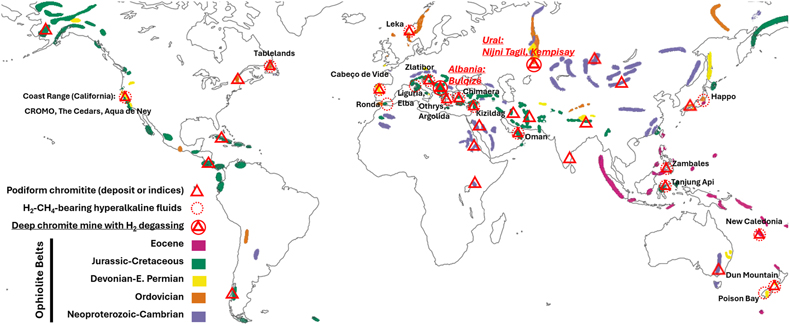
Figure 1 Global distribution of Neoproterozoic and Phanerozoic ophiolite belts, modified after Vaughan and Scarrow (2003)
Vaughan, A.P.M., Scarrow, J.H. (2003) Ophiolite obduction pulses as a proxy indicator of superplume events? Earth and Planetary Science Letters 213, 407–416. https://doi.org/10.1016/S0012-821X(03)00330-3
. Supra-subduction zone ophiolites that host podiform chromitites and reduced H2-CH4-rich fluids discussed in this study are highlighted, including the Kempirsay massif in the Urals (Kazakhstan), the Bulqizë ophiolite (Albania) and other chromitite-bearing peridotite massifs cited in the text.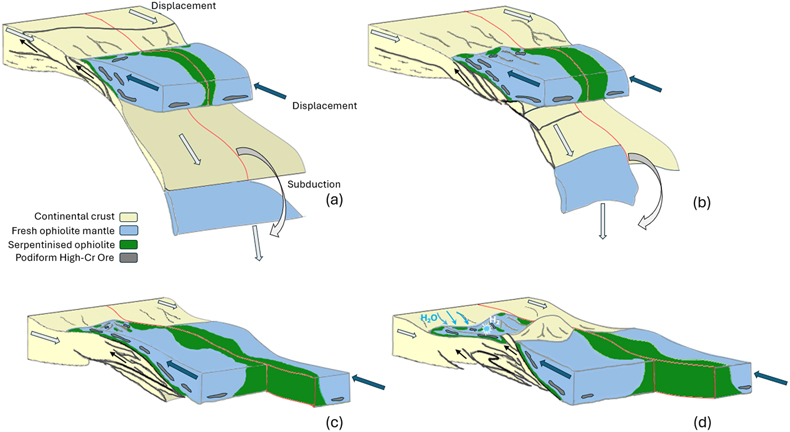
Figure 2 Conceptual 3 D model for the tectonic and hydrological evolution of chromitite-bearing SSZ ophiolites and their long lived hydrogen systems. (a) Continental subduction beneath supra-subduction zone oceanic lithosphere. An inherited transform- or detachment-related fault (red) cuts the mantle wedge and localises hydration and serpentinisation along a narrow damage corridor (green), while a panel of weakly serpentinised harzburgite-dunite (light blue) with podiform chromitite lenses (dark grey) remains comparatively intact. (b–c) Subduction choking, exhumation and lateral transport. Under-thrusting of buoyant continental crust jams the subduction zone and drives uplift and translation of the ophiolite toward the foreland, while strain and fluid flow remain focused within the serpentinite corridor. The chromitite-bearing mantle panel is transported as a coherent block to shallow crustal levels with limited internal disruption. (d) Final obduction and present day configuration. The ophiolite slab is emplaced on the continental margin, with weakly serpentinised mantle panels flanking a narrow, highly serpentinised corridor. Reactivation of inherited fault networks, including the main high permeability corridor and secondary structures, by meteoric water circulation reconnects chromitite bodies to fresh fluids and sustains low temperature H2 generation in preserved Fe2+-rich mantle domains (adapted from Agard et al., 2023
Agard, P., Soret, M., Bonnet, G., Ninkabou, D., Plunder, A., Prigent, C., Yamato, P. (2023) Subduction and obduction processes: The fate of oceanic lithosphere revealed by blueschists, eclogites, and ophiolites. In: Catlos, E.J., Çemen, İ. (Eds.) Compressional Tectonics: Plate Convergence to Mountain Building. American Geophysical Union Geophysical Monograph 277. John Wiley & Sons, Inc., Hoboken, 21–45. https://doi.org/10.1002/9781119773856.ch2
).