



Modern mantle-like μ182W signatures in Paleoarchean rocks from southern India
Affiliations | Corresponding Author | Cite as | Funding information
Published by the European Association of Geochemistry
under Creative Commons License CC BY-NC-ND 4.0
Keywords: 182W isotopes, early Earth, Archean craton, Hadean mantle differentiation, mantle heterogeneity, Indian craton


- Share this article


-
Article views:767Cumulative count of HTML views and PDF downloads.
- Download Citation
- Rights & Permissions

top
Abstract
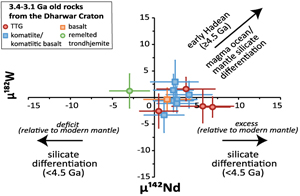
The results reveal μ182W values resembling that of the modern Earth’s upper mantle. In contrast, their anomalous 142Nd isotope compositions requires Sm/Nd fractionation before 4.0 Ga. This implies that the mantle source differentiated only after 182Hf became extinct (<∼4.50 Ga) or was homogenised before silicate differentiation (∼4.38 Ga) with no anomalous contributions from the late veneer or the core. Compared to other Archean cratons, this further confirms an isotopically heterogeneous mantle early in Earth history.
Figures and Tables
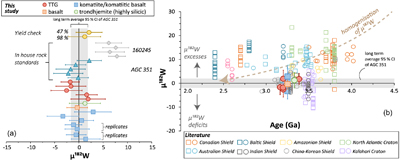 Figure 1 (a) Calculated average μ182W values of samples from the Dharwar Craton from multiple measurements (n, Table 1). Average μ182W values of in house standards (AGC 351 as blue triangles and 160245 as grey diamonds; Table S-3) and replicates of a rhyolite sample from the Singhbhum Craton (sin 13 as yellow circles; Table S-2) with different yields are also plotted. Uncertainties are expressed as 95 % CI. (b) Compilation of μ182W values from literature and samples from this study plotted against time. Circles represent felsic rocks and squares represent mafic and ultramafic rocks. Error bars are removed for clarity. The dashed arrow is a schematic progressive homogenisation of μ182W signatures, which is unclear. | 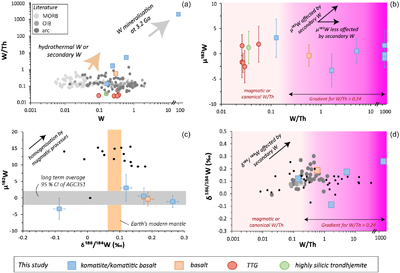 Figure 2 (a) Measured W and Th abundances of samples from the Dharwar Craton plotted using efficient proxies such as W/Th against W to identify the addition of potential secondary W. The same from compiled MORB, OIB and arc derivatives (modified from König et al., 2011) are plotted for comparison. (b) W/Th plotted against their measured μ182W values to identify the effect of potential secondary W. (c) Samples with high W/Th (non-canonical W/Th) are further plotted against their respective δ186/184W values. The range of δ186/184W values for the Earth’s mantle are taken from Kurzweil et al. (2019). (d) Stable W (δ186/184W) isotope systematics of selected samples with high W/Th. Compiled data from MORB, OIB and arc derivatives were taken from Kurzweil et al. (2019). Black circles refer to data on Greenland samples taken from Kurzweil et al. (2020). | 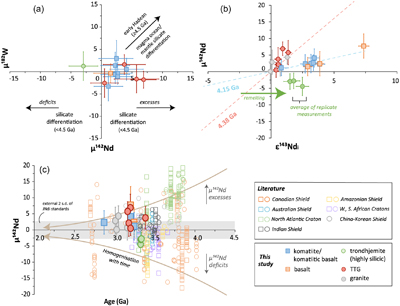 Figure 3 The μ142Nd values of samples from the Dharwar Craton taken from Ravindran et al. (2024), plotted against different parameters. (a) μ142Nd values of samples against their measured μ182W values. (b) μ142Nd-initial ε143Nd values of samples. The possible ages for mantle extraction in the Hadean are also plotted. (c) μ142Nd values of samples relative to time. Circles represent felsic rocks and squares represent mafic and ultramafic rocks. | 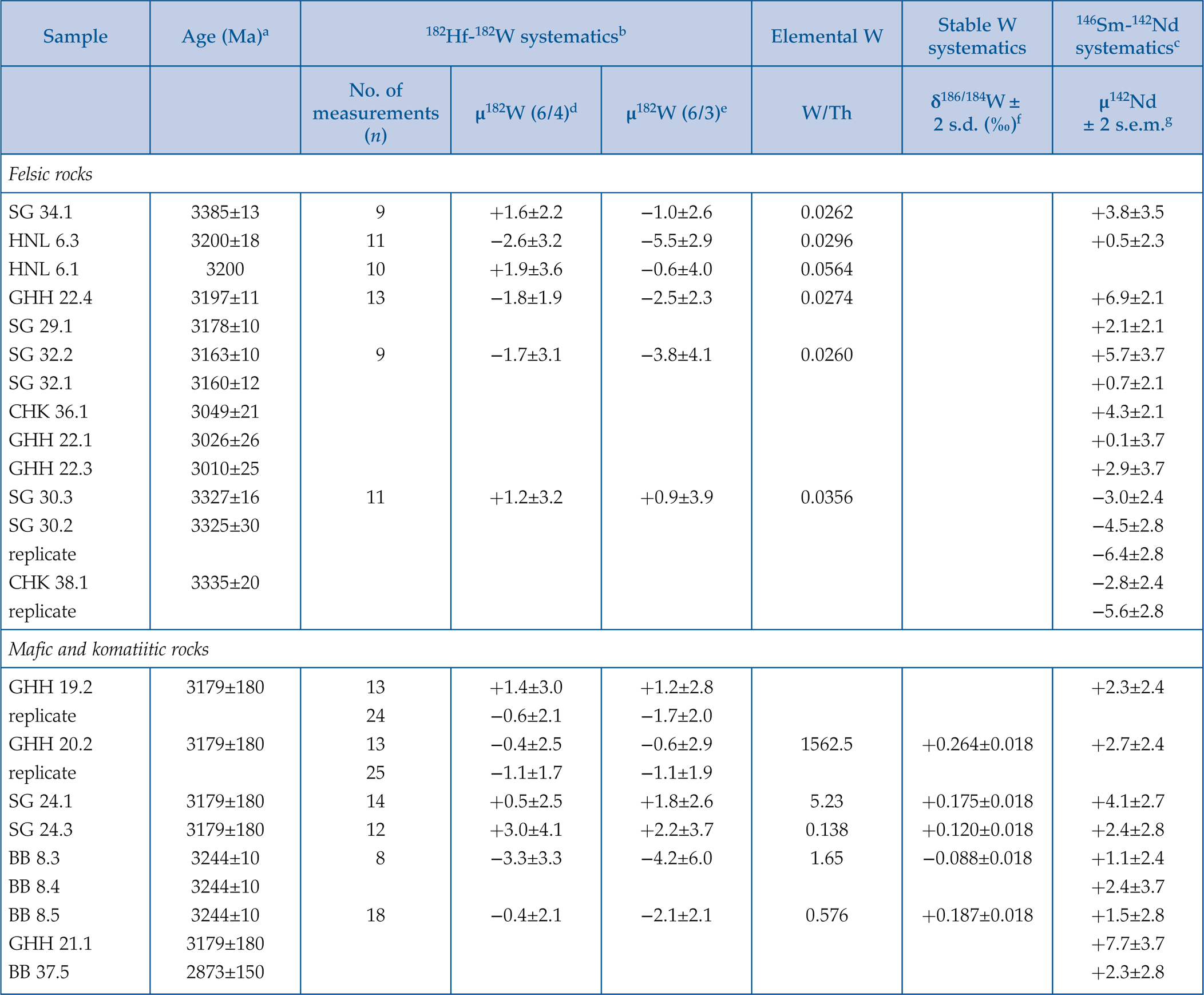 Table 1 Compiled W isotope systematics of rocks from the Dharwar Craton acquired through this study and μ142Nd values from Ravindran et al. (2024). The uncertainty of 182W isotope measurements are expressed as 95 % confidence interval of the number of individual measurements and their respective average μ182W values of each sample. Normalisation of measured 182W/184W using 186W/184W ratio (6/4) is taken as the final value for further interpretation over normalisation using 186W/183W ratio (6/3) (Methods; SI), and all measured isotope ratios given in Tables S-2 and S-3. Samples with non-canonical W/Th ratios were also measured for their stable W (δ186/184W) isotope systematics (Methods; SI). |
| Figure 1 | Figure 2 | Figure 3 | Table 1 |
top
Introduction
The reconstruction of geological processes on early Earth that can be extended to a proper understanding of planetary differentiation requires large and diverse geochemical data sets of the oldest rock record. In recent years, the composition of Hadean mantle domains preserved under Eo- to Paleoarchean cratons and their compositional heterogeneity have been revealed by compilations of long lived (176Lu-176Hf, 147Sm-143Nd, 187Re-187Os) and short lived (182Hf-182W, 146Sm-142Nd; Willbold et al., 2011
Willbold, M., Elliott, T., Moorbath, S. (2011) The tungsten isotopic composition of the Earth’s mantle before the terminal bombardment. Nature 477, 195–198. https://doi.org/10.1038/nature10399
; Morino et al., 2017Morino, P., Caro, G., Reisberg, L., Schumacher, A. (2017) Chemical stratification in the post-magma ocean Earth inferred from coupled 146,147Sm–142,143Nd systematics in ultramafic rocks of the Saglek block (3.25–3.9 Ga; northern Labrador, Canada). Earth and Planetary Science Letters 463, 136–150. https://doi.org/10.1016/j.epsl.2017.01.044
) isotope data. The Hf-W system, in particular, can provide insights into both the earliest silicate or metal-silicate differentiation, due to the short half-life (8.9 Myr; Vockenhuber et al., 2004Vockenhuber, C., Oberli, F., Bichler, M., Ahmad, I., Quitté, G., Meier, M., Halliday, A.N., Lee, D.-C., Kutschera, W., Steier, P., Gehrke, R.J., Helmer, R.G. (2004) New Half-Life Measurement of 182Hf: Improved Chronometer for the Early Solar System. Physical Review Letters 93, 172501. https://doi.org/10.1103/PhysRevLett.93.172501
) and contrasting incompatibilities during melting due to their lithophile (Hf) versus siderophile (W) affinities (e.g., König et al., 2011König, S., Münker, C., Hohl, S., Paulick, H., Barth, A.R., Lagos, M., Pfänder, J., Büchl, A. (2011) The Earth’s tungsten budget during mantle melting and crust formation. Geochimica et Cosmochimica Acta 75, 2119–2136. https://doi.org/10.1016/j.gca.2011.01.031
).The 182Hf-182W isotope system has been applied to trace Earth’s accretion, terrestrial core formation and addition of a late veneer to Earth (Kleine et al., 2002
Kleine, T., Münker, C., Mezger, K., Palme, H. (2002) Rapid accretion and early core formation on asteroids and the terrestrial planets from Hf–W chronometry. Nature 418, 952–955. https://doi.org/10.1038/nature00982
; Willbold et al., 2011Willbold, M., Elliott, T., Moorbath, S. (2011) The tungsten isotopic composition of the Earth’s mantle before the terminal bombardment. Nature 477, 195–198. https://doi.org/10.1038/nature10399
). The variability of 182W/184W ratios relative to the modern mantle (expressed in parts per million as μ182W) in terrestrial Archean rocks has been explained by different hypotheses that consider early silicate differentiation during the lifetime of 182Hf (Rizo et al., 2016Rizo, H., Walker, R.J., Carlson, R.W., Touboul, M., Horan, M.F., Puchtel, I.S., Boyet, M., Rosing, M.T. (2016) Early Earth differentiation investigated through 142Nd, 182W, and highly siderophile element abundances in samples from Isua, Greenland. Geochimica et Cosmochimica Acta 175, 319–336. https://doi.org/10.1016/j.gca.2015.12.007
; Touboul et al., 2012Touboul, M., Puchtel, I.S., Walker, R.J. (2012) 182W Evidence for Long-Term Preservation of Early Mantle Differentiation Products. Science 335, 1065–1069. https://doi.org/10.1126/science.1216351
; Tusch et al., 2022Tusch, J., Hoffmann, J.E., Hasenstab, E., Fischer-Gödde, M., Marien, C.S., Wilson, A.H., Münker, C. (2022) Long-term preservation of Hadean protocrust in Earth’s mantle. Proceedings of the National Academy of Sciences 119, e2120241119. https://doi.org/10.1073/pnas.2120241119
) or incomplete homogenisation of an isotopically heterogeneous early mantle (Willbold et al., 2011Willbold, M., Elliott, T., Moorbath, S. (2011) The tungsten isotopic composition of the Earth’s mantle before the terminal bombardment. Nature 477, 195–198. https://doi.org/10.1038/nature10399
). Coupled and decoupled μ182W-μ142Nd isotope compositions (active for the ∼50 and ∼500 Ma of Earth history) from ancient rocks from well studied areas such as the North Atlantic, Pilbara and Kaapvaal cratons and the Canadian Shield (e.g., Tusch et al., 2021Tusch, J., Münker, C., Hasenstab, E., Jansen, M., Marien, C.S., Kurzweil, F., Van Kranendonk, M.J., Smithies, H., Maier, W., Garbe-Schönberg, D. (2021) Convective isolation of Hadean mantle reservoirs through Archean time. Proceedings of the National Academy of Sciences 118, e2012626118. https://doi.org/10.1073/pnas.2012626118
; Reimink et al., 2018Reimink, J.R., Chacko, T., Carlson, R.W., Shirey, S.B., Liu, J., Stern, R.A., Bauer, A.M., Pearson, D.G., Heaman, L.M. (2018) Petrogenesis and tectonics of the Acasta Gneiss Complex derived from integrated petrology and 142Nd and 182W extinct nuclide-geochemistry. Earth and Planetary Science Letters 494, 12–22. https://doi.org/10.1016/j.epsl.2018.04.047
and references therein) have been used to postulate that these isotope variations represent a regional rather than a global signal.This study reports the first μ182W values of Paleo- to Mesoarchean igneous rocks from coeval greenstone belts and surrounding granitoid-tonalite trondhjemite granite (TTG) terranes in the western part of the Dharwar Craton, India, which are further compared with their W/Th ratios and stable W (δ186/184W values) isotope ratios to estimate the influence of secondary W. These μ182W values, combined with previously reported μ142Nd values, provide constraints on early silicate mantle differentiation and its subsequent homogenisation with time. The isotope signatures elucidate the poorly understood processes of Hadean differentiation in the mantle sources of rocks from the Dharwar Craton. Furthermore, the combined 182Hf-182W and 146Sm-142Nd isotope systematics offer insights into the timing and extent of effective mixing over different timescales between early mantle source reservoirs and late accreted material(s) prior to the onset of modern plate tectonics.
top
Results
The geological background of the western Dharwar Craton, India, and details of the samples taken for this study are presented in detail in the Supplementary Information (Fig. S-1, Table S-1).
Figure 1 (a) Calculated average μ182W values of samples from the Dharwar Craton from multiple measurements (n, Table 1). Average μ182W values of in house standards (AGC 351 as blue triangles and 160245 as grey diamonds; Table S-3) and replicates of a rhyolite sample from the Singhbhum Craton (sin 13 as yellow circles; Table S-2) with different yields are also plotted. Uncertainties are expressed as 95 % CI. (b) Compilation of μ182W values from literature and samples from this study plotted against time. Circles represent felsic rocks and squares represent mafic and ultramafic rocks. Error bars are removed for clarity. The dashed arrow is a schematic progressive homogenisation of μ182W signatures, which is unclear.
The protocols for W separation and the acquisition of isotope data (182W and stable W) are described in the SI (Methods; Fig. S-2). The average μ182W values of all samples of felsic, mafic and komatiitic compositions from the western Dharwar Craton are analytically unresolved relative to the W standard solution NIST® SRM® 3163 (Fig. 1a, Tables 1, S-2 and S-3) and display modern BSE-like μ182W. Remarkably, the results for the Dharwar Craton stand in contrast to μ182W values reported from other cratons worldwide, which generally show statistically significant heterogeneity (Fig. 1b) with positive and negative μ182W relative to the modern BSE reference value. The modern BSE-like μ182W for the samples from the western Dharwar Craton could be a primary isotope signature inherited from the mantle source or may be the result of late addition of W that modified their primary μ182W signatures.
The δ186/184W values of selected samples with high W/Th (Table S-4) range from −0.088 ± 0.018 ‰ to 0.264 ± 0.018 ‰ (Tables 1, S-5). The W abundances of samples range from 0.096 to 125 ppm (Table S-4). The geochemical trace element abundances of all samples taken for this study are presented in detail in the SI (Fig. S-3).
Table 1 Compiled W isotope systematics of rocks from the Dharwar Craton acquired through this study and μ142Nd values from Ravindran et al. (2024)
Ravindran, A., Peters, B.J., Mezger, K., Hasenstab-Dübeler, E., Maya, J.M., Schönbächler, M. (2024) Distinct Hadean Mantle Sources of Felsic and Mafic Terranes Juxtaposed in the Paleoarchean. Geochemistry, Geophysics, Geosystems 25, e2024GC011834. https://doi.org/10.1029/2024GC011834
. The uncertainty of 182W isotope measurements are expressed as 95 % confidence interval of the number of individual measurements and their respective average μ182W values of each sample. Normalisation of measured 182W/184W using 186W/184W ratio (6/4) is taken as the final value for further interpretation over normalisation using 186W/183W ratio (6/3) (Methods; SI), and all measured isotope ratios given in Tables S-2 and S-3. Samples with non-canonical W/Th ratios were also measured for their stable W (δ186/184W) isotope systematics (Methods; SI).| Sample | Age (Ma)a | 182Hf-182W systematicsb | Elemental W | Stable W systematics | 146Sm-142Nd systematicsc | ||
| No. of measurements (n) | μ182W (6/4)d | μ182W (6/3)e | W/Th | δ186/184W ± 2 s.d. (‰)f | μ142Nd | ||
| Felsic rocks | |||||||
| SG 34.1 | 3385±13 | 9 | +1.6±2.2 | −1.0±2.6 | 0.0262 | +3.8±3.5 | |
| HNL 6.3 | 3200±18 | 11 | −2.6±3.2 | −5.5±2.9 | 0.0296 | +0.5±2.3 | |
| HNL 6.1 | 3200 | 10 | +1.9±3.6 | −0.6±4.0 | 0.0564 | ||
| GHH 22.4 | 3197±11 | 13 | −1.8±1.9 | −2.5±2.3 | 0.0274 | +6.9±2.1 | |
| SG 29.1 | 3178±10 | +2.1±2.1 | |||||
| SG 32.2 | 3163±10 | 9 | −1.7±3.1 | −3.8±4.1 | 0.0260 | +5.7±3.7 | |
| SG 32.1 | 3160±12 | +0.7±2.1 | |||||
| CHK 36.1 | 3049±21 | +4.3±2.1 | |||||
| GHH 22.1 | 3026±26 | +0.1±3.7 | |||||
| GHH 22.3 | 3010±25 | +2.9±3.7 | |||||
| SG 30.3 | 3327±16 | 11 | +1.2±3.2 | +0.9±3.9 | 0.0356 | −3.0±2.4 | |
| SG 30.2 | 3325±30 | −4.5±2.8 | |||||
| replicate | −6.4±2.8 | ||||||
| CHK 38.1 | 3335±20 | −2.8±2.4 | |||||
| replicate | −5.6±2.8 | ||||||
| Mafic and komatiitic rocks | |||||||
| GHH 19.2 | 3179±180 | 13 | +1.4±3.0 | +1.2±2.8 | +2.3±2.4 | ||
| replicate | 24 | −0.6±2.1 | −1.7±2.0 | ||||
| GHH 20.2 | 3179±180 | 13 | −0.4±2.5 | −0.6±2.9 | 1562.5 | +0.264±0.018 | +2.7±2.4 |
| replicate | 25 | −1.1±1.7 | −1.1±1.9 | ||||
| SG 24.1 | 3179±180 | 14 | +0.5±2.5 | +1.8±2.6 | 5.23 | +0.175±0.018 | +4.1±2.7 |
| SG 24.3 | 3179±180 | 12 | +3.0±4.1 | +2.2±3.7 | 0.138 | +0.120±0.018 | +2.4±2.8 |
| BB 8.3 | 3244±10 | 8 | −3.3±3.3 | −4.2±6.0 | 1.65 | −0.088±0.018 | +1.1±2.4 |
| BB 8.4 | 3244±10 | +2.4±3.7 | |||||
| BB 8.5 | 3244±10 | 18 | −0.4±2.1 | −2.1±2.1 | 0.576 | +0.187±0.018 | +1.5±2.8 |
| GHH 21.1 | 3179±180 | +7.7±3.7 | |||||
| BB 37.5 | 2873±150 | +2.3±2.8 | |||||
aU-Pb, Sm-Nd and Lu-Hf ages from Ravindran et al. (2021Ravindran, A., Mezger, K., Balakrishnan, S., Berndt, J. (2021) Hf-Nd isotopes from ultramafic and mafic rocks in the western Dharwar Craton, India, record early Archean mantle heterogeneity. Lithos 404–405, 106491. https://doi.org/10.1016/j.lithos.2021.106491, 2023)Ravindran, A., Mezger, K., Balakrishnan, S., Berndt, J., Ranjan, S., Upadhyay, D. (2023) Formation of Paleo- to Meso-Archean continental crust in the western Dharwar Craton, India: Constraints from U–Pb zircon ages and Hf-Pb-Sr isotopes of granitoids and sedimentary rocks. Chemical Geology 615, 121196. https://doi.org/10.1016/j.chemgeo.2022.121196.
b182W isotope measurements from the current study.
c142Nd isotope measurements compiled from Ravindran et al. (2024)Ravindran, A., Peters, B.J., Mezger, K., Hasenstab-Dübeler, E., Maya, J.M., Schönbächler, M. (2024) Distinct Hadean Mantle Sources of Felsic and Mafic Terranes Juxtaposed in the Paleoarchean. Geochemistry, Geophysics, Geosystems 25, e2024GC011834. https://doi.org/10.1029/2024GC011834.
dMass-bias correction by 186W/184W = 0.92767.
eMass-bias correction by 186W/183W = 1.9859.
fUncertainties (2 s.d. = 0.018 ‰) based on long term external reproducibility of rock standard.
gStandard Error of the Mean calculated from the average s.e.m. of standards.
top
Discussion
The effect of secondary processes on μ 182 W. Globally, significantly large μ182W anomalies were reported predominantly in Precambrian mafic to komatiitic rocks, often with variable W/Th ratios (Fig. 1b; see detailed description in SI). The felsic samples and one komatiitic sample from the Dharwar craton have mantle-like or near-canonical W/Th ratios (0.02–0.24; König et al., 2011
König, S., Münker, C., Hohl, S., Paulick, H., Barth, A.R., Lagos, M., Pfänder, J., Büchl, A. (2011) The Earth’s tungsten budget during mantle melting and crust formation. Geochimica et Cosmochimica Acta 75, 2119–2136. https://doi.org/10.1016/j.gca.2011.01.031
; Table 1), whereas the others display higher or supra-canonical W/Th, suggesting that they accumulated W after emplacement. With the exception of a few komatiites, the W/Th and W abundances of samples lie in the range of modern mantle and arc rocks (Fig. 2a). There is no correlation between the measured μ182W and the measured concentrations of W and W/Th ratios of the samples, which is also the case for mafic-komatiitic rocks both with mantle-like (canonical) and variable W/Th (Fig. 2a,b). Additionally, the δ186/184W values of the samples with high W/Th do not correlate with their respective μ182W values (Fig. 2c), which likely reflect derivation from distinct processes (SI). The μ182W values of serpentinised or enriched ultramafic rocks such as komatiitic rocks with non-canonical W/Th ratios (Fig. 2b, Tables S-1, S-4), likely resulting from W mineralisation at ca. 3.2 Ga (Fig. 2a; SI), are similar to that of the other samples. However, the δ186/184W values of all these rocks are distinct from the modern mantle, clearly displaying evidence for metasomatism (Figs. 2c, S-4, SI; cf. Kurzweil et al., 2020Kurzweil, F., Münker, C., Hoffmann, J.E., Tusch, J., Schoenberg, R. (2020) Stable W isotope evidence for redistribution of homogeneous 182W anomalies in SW Greenland. Geochemical Perspectives Letters 14, 53–57. https://doi.org/10.7185/geochemlet.2024
).Figure 2 (a) Measured W and Th abundances of samples from the Dharwar Craton plotted using efficient proxies such as W/Th against W to identify the addition of potential secondary W. The same from compiled MORB, OIB and arc derivatives (modified from König et al., 2011
König, S., Münker, C., Hohl, S., Paulick, H., Barth, A.R., Lagos, M., Pfänder, J., Büchl, A. (2011) The Earth’s tungsten budget during mantle melting and crust formation. Geochimica et Cosmochimica Acta 75, 2119–2136. https://doi.org/10.1016/j.gca.2011.01.031
) are plotted for comparison. (b) W/Th plotted against their measured μ182W values to identify the effect of potential secondary W. (c) Samples with high W/Th (non-canonical W/Th) are further plotted against their respective δ186/184W values. The range of δ186/184W values for the Earth’s mantle are taken from Kurzweil et al. (2019)Kurzweil, F., Münker, C., Grupp, M., Braukmüller, N., Fechtner, L., Christian, M., Hohl, S.V., Schoenberg, R. (2019) The stable tungsten isotope composition of modern igneous reservoirs. Geochimica et Cosmochimica Acta 251, 176–191. https://doi.org/10.1016/j.gca.2019.02.025
. (d) Stable W (δ186/184W) isotope systematics of selected samples with high W/Th. Compiled data from MORB, OIB and arc derivatives were taken from Kurzweil et al. (2019)Kurzweil, F., Münker, C., Grupp, M., Braukmüller, N., Fechtner, L., Christian, M., Hohl, S.V., Schoenberg, R. (2019) The stable tungsten isotope composition of modern igneous reservoirs. Geochimica et Cosmochimica Acta 251, 176–191. https://doi.org/10.1016/j.gca.2019.02.025
. Black circles refer to data on Greenland samples taken from Kurzweil et al. (2020)Kurzweil, F., Münker, C., Hoffmann, J.E., Tusch, J., Schoenberg, R. (2020) Stable W isotope evidence for redistribution of homogeneous 182W anomalies in SW Greenland. Geochemical Perspectives Letters 14, 53–57. https://doi.org/10.7185/geochemlet.2024
.It can be noticed that the komatiite sample with a δ186/184W value close to the Earth’s mantle (Fig. 2c) also has canonical W/Th (Fig. 2b), which could indicate that these proxies are connected, even though there is no correlation (Fig. 2d). The μ182W value of this sample, however, is similar to that of the other samples possessing higher δ186/184W and W/Th compared to the mantle. A correlation of μ182W values of samples with their δ186/184W values could be indicative of homogenisation of μ182W irrespective of time, which is not visible among the samples from this study (Fig. 2c). Since all samples have very similar μ182W values, it is unlikely that late addition of W modified the radiogenic 182W compositions, and the metasomatising agents or surrounding granitoids (SI) thus must have had μ182W values similar to the protolith with magmatic W/Th (Fig. S-4). This result supports an interpretation, where μ182W values are robust signatures of the mantle source of the analysed rocks.
Origin of 182 W- 142 Nd decoupling. Some of the Archean cratons worldwide had undergone Hf/W fractionation from either magma ocean crystallisation, silicate differentiation or late accretion. Different amounts of added extraterrestrial components during the late veneer could create anomalous μ182W in the Earth’s mantle (Willbold et al., 2011
Willbold, M., Elliott, T., Moorbath, S. (2011) The tungsten isotopic composition of the Earth’s mantle before the terminal bombardment. Nature 477, 195–198. https://doi.org/10.1038/nature10399
; Touboul et al., 2012Touboul, M., Puchtel, I.S., Walker, R.J. (2012) 182W Evidence for Long-Term Preservation of Early Mantle Differentiation Products. Science 335, 1065–1069. https://doi.org/10.1126/science.1216351
). The Eoarchean mantle sources of rocks from some cratons were interpreted to exhibit a missing late veneer signature (μ182W average = +12.7 ± 1.2; cf. Tusch et al., 2021Tusch, J., Münker, C., Hasenstab, E., Jansen, M., Marien, C.S., Kurzweil, F., Van Kranendonk, M.J., Smithies, H., Maier, W., Garbe-Schönberg, D. (2021) Convective isolation of Hadean mantle reservoirs through Archean time. Proceedings of the National Academy of Sciences 118, e2012626118. https://doi.org/10.1073/pnas.2012626118
). The rocks from the Dharwar Craton, however, show neither of these properties with no μ182W anomalies relative to the modern mantle (Fig. 1b), which could imply that the mantle source of these rocks received the full late veneer component.Alternatively, early variability of μ182W in terrestrial rocks could result from early silicate differentiation of the Earth during the lifetime of 182Hf. Early Hadean silicate differentiation (≥4.5 Ga) would result in depleted mantle domains with high Hf/W and Sm/Nd, and enriched domains with low Hf/W and Sm/Nd, resulting in a positive correlation between μ182W and μ142Nd values (e.g., Touboul et al., 2012
Touboul, M., Puchtel, I.S., Walker, R.J. (2012) 182W Evidence for Long-Term Preservation of Early Mantle Differentiation Products. Science 335, 1065–1069. https://doi.org/10.1126/science.1216351
). Due to the core affinity of W compared to Hf, addition of a core component with negative μ182W to the mantle source (e.g., Brandon and Walker, 2005Brandon, A.D., Walker, R.J. (2005) The debate over core–mantle interaction. Earth and Planetary Science Letters 232, 211–225. https://doi.org/10.1016/j.epsl.2005.01.034
; Archer et al., 2023Archer, G.J., Budde, G., Worsham, E.A., Stracke, A., Jackson, M.G., Kleine, T. (2023) Origin of 182W Anomalies in Ocean Island Basalts. Geochemistry, Geophysics, Geosystems 24, e2022GC010688. https://doi.org/10.1029/2022GC010688
) may also occur. However, neither of these isotope effects are observed in the rocks from the Dharwar Craton (Fig. 3a).Figure 3 The μ142Nd values of samples from the Dharwar Craton taken from Ravindran et al. (2024)
Ravindran, A., Peters, B.J., Mezger, K., Hasenstab-Dübeler, E., Maya, J.M., Schönbächler, M. (2024) Distinct Hadean Mantle Sources of Felsic and Mafic Terranes Juxtaposed in the Paleoarchean. Geochemistry, Geophysics, Geosystems 25, e2024GC011834. https://doi.org/10.1029/2024GC011834
, plotted against different parameters. (a) μ142Nd values of samples against their measured μ182W values. (b) μ142Nd-initial ε143Nd values of samples. The possible ages for mantle extraction in the Hadean are also plotted. (c) μ142Nd values of samples relative to time. Circles represent felsic rocks and squares represent mafic and ultramafic rocks.In Figure 3, the μ142Nd values of samples from the western Dharwar Craton (Ravindran et al., 2024
Ravindran, A., Peters, B.J., Mezger, K., Hasenstab-Dübeler, E., Maya, J.M., Schönbächler, M. (2024) Distinct Hadean Mantle Sources of Felsic and Mafic Terranes Juxtaposed in the Paleoarchean. Geochemistry, Geophysics, Geosystems 25, e2024GC011834. https://doi.org/10.1029/2024GC011834
) are plotted relative to their 147Sm-143Nd isotope systematics (Fig. 3b) and their emplacement ages (Fig. 3c). Overall, the μ142Nd anomalies are small or negligible compared to the modern mantle (Fig. 3), aligning with those of some Paleo- to Mesoarchean rocks, but distinct from the 142Nd anomalies recorded in Eoarchean rocks (μ142Nd = −18 to +19.3; Fig. 3c). Figure 3b illustrates two distinct slopes in the combined 146,147Sm-142,143Nd isotope systematics, indicating two Hadean mantle differentiation events (Ravindran et al., 2024Ravindran, A., Peters, B.J., Mezger, K., Hasenstab-Dübeler, E., Maya, J.M., Schönbächler, M. (2024) Distinct Hadean Mantle Sources of Felsic and Mafic Terranes Juxtaposed in the Paleoarchean. Geochemistry, Geophysics, Geosystems 25, e2024GC011834. https://doi.org/10.1029/2024GC011834
). Highly silicic and remelted granitoids of trondhjemitic composition from the craton (cf. Ravindran et al., 2023Ravindran, A., Mezger, K., Balakrishnan, S., Berndt, J., Ranjan, S., Upadhyay, D. (2023) Formation of Paleo- to Meso-Archean continental crust in the western Dharwar Craton, India: Constraints from U–Pb zircon ages and Hf-Pb-Sr isotopes of granitoids and sedimentary rocks. Chemical Geology 615, 121196. https://doi.org/10.1016/j.chemgeo.2022.121196
) exhibit negative μ142Nd values (Fig. 3b) in contrast to more positive μ142Nd in other samples. The different μ142Nd values reflect different ages of previous mantle extraction events, also suggesting the possible presence of an enriched Hadean reservoir that differentiated in the Hadean, possibly by ∼4.38 Ga.The observed decoupling of μ182W and μ142Nd in other cratons was suggested to be due to a missing late veneer (Tusch et al., 2019
Tusch, J., Sprung, P., van de Löcht, J., Hoffmann, J.E., Boyd, A.J., Rosing, M.T., Münker, C. (2019) Uniform 182W isotope compositions in Eoarchean rocks from the Isua region, SW Greenland: The role of early silicate differentiation and missing late veneer. Geochimica et Cosmochimica Acta 257, 284–310. https://doi.org/10.1016/j.gca.2019.05.012
), addition of a restite component extracted from a Hadean protocrust that had formed right after magma ocean solidification (Tusch et al., 2022Tusch, J., Hoffmann, J.E., Hasenstab, E., Fischer-Gödde, M., Marien, C.S., Wilson, A.H., Münker, C. (2022) Long-term preservation of Hadean protocrust in Earth’s mantle. Proceedings of the National Academy of Sciences 119, e2120241119. https://doi.org/10.1073/pnas.2120241119
), or crystal-liquid fractionation in an early magma ocean (Puchtel et al., 2016Puchtel, I.S., Blichert-Toft, J., Touboul, M., Horan, M.F., Walker, R.J. (2016) The coupled 182W-142Nd record of early terrestrial mantle differentiation. Geochemistry, Geophysics, Geosystems 17, 2168–2193. https://doi.org/10.1002/2016GC006324
). All these models are unlikely for the Dharwar Craton due to the BSE-like μ182W and anomalous μ142Nd. The most likely explanation is protracted silicate differentiation before or after 182Hf was extinct.Modern mantle-like μ 182 W signatures in Dharwar rocks. Archean felsic and basaltic-komatiitic rocks from the Dharwar Craton have modern mantle-like μ182W values, but also record Sm/Nd fractionation at ∼4.38 Ga, likely from a chondritic reservoir (Bouvier and Boyet, 2016
Bouvier, A., Boyet, M. (2016) Primitive Solar System materials and Earth share a common initial 142Nd abundance. Nature 537, 399–402. https://doi.org/10.1038/nature19351
). The absence of μ182W variations in the rocks from the Dharwar Craton could be (1) due to late silicate differentiation after the life time of 182Hf (after ca. 4.5 Ga) or (2) due to early Hf/W fractionation (≥4.5 Ga) erased by re-homogenisation of the source material before Sm/Nd fractionation at ∼4.38 and ∼4.15 Ga. A vigorous homogenisation of the mantle by rapid stirring, as a result of high mantle temperatures, or meteorite bombardment immediately after early silicate differentiation in the magma ocean was suggested recently (e.g., Marchi and Korenaga, 2025Marchi, S., Korenaga, J. (2025) The shaping of terrestrial planets by late accretions. Nature 641, 1111–1120. https://doi.org/10.1038/s41586-025-08970-8
; Rosas and Korenaga, 2018Rosas, J.C., Korenaga, J. (2018) Rapid crustal growth and efficient crustal recycling in the early Earth: Implications for Hadean and Archean geodynamics. Earth and Planetary Science Letters 494, 42–49. https://doi.org/10.1016/j.epsl.2018.04.051
). Alternatively, homogenising the mantle within the first 100 Myr of Earth history has been considered less likely if stirring of the Hadean mantle was sluggish, for example if the upper depleted mantle layer was too thin to allow mantle overturns and mixing, and thereby homogenisation (e.g., Bédard, 2018Bédard, J.H. (2018) Stagnant lids and mantle overturns: Implications for Archaean tectonics, magmagenesis, crustal growth, mantle evolution, and the start of plate tectonics. Geoscience Frontiers 9, 19–49. https://doi.org/10.1016/j.gsf.2017.01.005
). Only after the period of possible massive bombardment (i.e. after ≥4.1 Ga) did the Earth probably become stable enough to simultaneously maintain different geodynamic modes (e.g., Bédard, 2018Bédard, J.H. (2018) Stagnant lids and mantle overturns: Implications for Archaean tectonics, magmagenesis, crustal growth, mantle evolution, and the start of plate tectonics. Geoscience Frontiers 9, 19–49. https://doi.org/10.1016/j.gsf.2017.01.005
).Variations in μ182W and μ142Nd in the global record (Figs. 1b, 3c) suggest that early silicate differentiation in the early Hadean (>4.5 Ga) could have fractionated both Sm/Nd and Hf/W. However, uniform, BSE-like μ182W sustained in Paleo-Mesoarchean mantle derived melts and differentiated rocks from the Dharwar Craton indicate that this differentiation from the accessible rock record was not global, but rather local. Any effects of differentiation on the mantle source of the rock suites from the Dharwar Craton is not directly visible. This implies that parts of the mantle remained untouched and others had distinct differentiation histories following core formation (cf. Boukaré et al., 2025
Boukaré, C.-É., Badro, J., Samuel, H. (2025) Solidification of Earth’s mantle led inevitably to a basal magma ocean. Nature 640, 114–119. https://doi.org/10.1038/s41586-025-08701-z
).Progressive post-Hadean homogenisation of the mantle is evident in a loss of anomalous 142Nd signals during the Paleo-Mesoarchean and their absence in ∼2.0 Ga old mantle derived rocks (e.g., Puchtel et al., 2025
Puchtel, I.S., Hellmann, J.L., Rizo, H., Blichert-Toft, J., Stepanova, A.V., Samsonov, A.V., Walker, R.J. (2025) Bulk silicate Earth-like 142Nd and 182W mantle component sampled by 2.0 Ga Onega Basin picrites, Fennoscandia. Geochimica et Cosmochimica Acta 393, 133–154. https://doi.org/10.1016/j.gca.2025.01.013
). This contrasts with μ182W variability that persists throughout geological history, even until present day in the sources of OIBs (cf., Archer et al., 2023Archer, G.J., Budde, G., Worsham, E.A., Stracke, A., Jackson, M.G., Kleine, T. (2023) Origin of 182W Anomalies in Ocean Island Basalts. Geochemistry, Geophysics, Geosystems 24, e2022GC010688. https://doi.org/10.1029/2022GC010688
; e.g., Deccan Traps, Pakulla et al., 2025Pakulla, J.J., Tusch, J., Hasenstab-Dübeler, E., Ravindran, A., Jansen, M.W., Leitzke, F.P., Gadpallu, P., Duraiswami, R.A., Münker, C. (2025) The spatio-temporal evolution of 182W and 142Nd in the Deccan-La Réunion plume. Earth and Planetary Science Letters 653, 119225. https://doi.org/10.1016/j.epsl.2025.119225
). This apparent decoupling of μ142Nd and μ182W (SI) implies that the radiogenic 182W variability in Phanerozoic lavas is likely the result of more recent contributions of 182W to the mantle, possibly by addition of core, late veneer or proto-crust materials.top
Conclusions
The μ182W values of rocks from the Dharwar Craton are some of the oldest reported rocks with modern BSE-like signatures, which implies that ancient and younger juvenile material from the region was derived from a mantle source that did not preserve any evidence for magma ocean crystallisation or other silicate differentiation events within the lifetime of 182Hf. The uniform BSE-like μ182W of rocks from the Dharwar Craton contrasts with contemporaneous or slightly older rocks from other Archean terranes (3.6–3.2 Ga; Tusch et al., 2021
Tusch, J., Münker, C., Hasenstab, E., Jansen, M., Marien, C.S., Kurzweil, F., Van Kranendonk, M.J., Smithies, H., Maier, W., Garbe-Schönberg, D. (2021) Convective isolation of Hadean mantle reservoirs through Archean time. Proceedings of the National Academy of Sciences 118, e2012626118. https://doi.org/10.1073/pnas.2012626118
; Mei et al., 2020Mei, Q.-F., Yang, J.-H., Wang, Y.-F., Wang, H., Peng, P. (2020) Tungsten isotopic constraints on homogenization of the Archean silicate Earth: Implications for the transition of tectonic regimes. Earth and Planetary Science Letters 278, 51–64. https://doi.org/10.1016/j.gca.2019.07.050
; Leitzke et al., 2024Leitzke, F.P., Pakulla, J.J., Tusch, J., Ravindran, A., Gordilho-Barbosa, R., Zincone, S.A., Hellers, M., Martins, A.A., Spreafico, R.R., Yang, R., Wombacher, F., Barbosa, J.S.F., Münker, C. (2024) Evidence for a missing late veneer from 182W and 142Nd systematics in the Archean São Francisco Craton. Earth and Planetary Science Letters 647, 119022. https://doi.org/10.1016/j.epsl.2024.119022
) that exhibit either positive or negative μ182W linked to early silicate differentiation or a missing late veneer contribution, neither of which is evident in the source rocks of the Dharwar Craton. Therefore, these rock suites either escaped both processes negating mantle-wide differentiation or survived a rapid early Hadean homogenisation, and show that domains with modern BSE-like μ182W were already present early in the geological record. Collectively, our findings highlight that early mantle differentiation and homogenisation were spatially heterogeneous processes, and that not all mantle reservoirs followed a uniform evolutionary trajectory following core formation (SI). The Dharwar Craton thus represents a unique archive of early mantle evolution, underscoring the importance of regional studies in reconstructing the complexities of early Earth history.top
Acknowledgements
We thank Prof. S. Balakrishnan for assistance during field work in Karnataka, India and Maya J.M for contributing samples that were used for constructing the 142Nd-143Nd isochron. We are also grateful to Manuela Fehr for providing help during method development at ETH Zurich and to Mario Fischer-Gödde for assistance during MC-ICPMS measurement sessions at University of Cologne. We also thank Xiaoyu Zhou, Niklas Kallnik and Tristan Bongartz for assistance in the Cologne lab during W isotope work. Funding for this study was provided by Alexander von Humboldt and Swiss National Science Foundation (SNSF) Mobility Fellowships awarded to AR, a SNSF Ambizione fellowship to BJP (PZ00P2_186064), a SNSF project (200021_208079) to MS and by ETH Zürich. We are grateful to the two reviewers for their constructive comments, which improved the manuscript significantly. We also thank the Editor Helen Williams for her insightful suggestions that further polished the manuscript.
Editor: Helen Williams
top
References
Archer, G.J., Budde, G., Worsham, E.A., Stracke, A., Jackson, M.G., Kleine, T. (2023) Origin of 182W Anomalies in Ocean Island Basalts. Geochemistry, Geophysics, Geosystems 24, e2022GC010688. https://doi.org/10.1029/2022GC010688
 Show in context
 Due to the core affinity of W compared to Hf, addition of a core component with negative μ182W to the mantle source (e.g., Brandon and Walker, 2005; Archer et al., 2023) may also occur.
View in article
This contrasts with μ182W variability that persists throughout geological history, even until present day in the sources of OIBs (cf., Archer et al., 2023; e.g., Deccan Traps, Pakulla et al., 2025).
View in article
Bédard, J.H. (2018) Stagnant lids and mantle overturns: Implications for Archaean tectonics, magmagenesis, crustal growth, mantle evolution, and the start of plate tectonics. Geoscience Frontiers 9, 19–49. https://doi.org/10.1016/j.gsf.2017.01.005
Show in context Alternatively, homogenising the mantle within the first 100 Myr of Earth history has been considered less likely if stirring of the Hadean mantle was sluggish, for example if the upper depleted mantle layer was too thin to allow mantle overturns and mixing, and thereby homogenisation (e.g., Bédard, 2018).
View in article
Only after the period of possible massive bombardment (i.e. after ≥4.1 Ga) did the Earth probably become stable enough to simultaneously maintain different geodynamic modes (e.g., Bédard, 2018).
View in article
Boukaré, C.-É., Badro, J., Samuel, H. (2025) Solidification of Earth’s mantle led inevitably to a basal magma ocean. Nature 640, 114–119. https://doi.org/10.1038/s41586-025-08701-z
Show in context This implies that parts of the mantle remained untouched and others had distinct differentiation histories following core formation (cf. Boukaré et al., 2025).
View in article
Bouvier, A., Boyet, M. (2016) Primitive Solar System materials and Earth share a common initial 142Nd abundance. Nature 537, 399–402. https://doi.org/10.1038/nature19351
Show in context Archean felsic and basaltic-komatiitic rocks from the Dharwar Craton have modern mantle-like μ182W values, but also record Sm/Nd fractionation at ∼4.38 Ga, likely from a chondritic reservoir (Bouvier and Boyet, 2016).
View in article
Brandon, A.D., Walker, R.J. (2005) The debate over core–mantle interaction. Earth and Planetary Science Letters 232, 211–225. https://doi.org/10.1016/j.epsl.2005.01.034
Show in context Due to the core affinity of W compared to Hf, addition of a core component with negative μ182W to the mantle source (e.g., Brandon and Walker, 2005; Archer et al., 2023) may also occur.
View in article
Kleine, T., Münker, C., Mezger, K., Palme, H. (2002) Rapid accretion and early core formation on asteroids and the terrestrial planets from Hf–W chronometry. Nature 418, 952–955. https://doi.org/10.1038/nature00982
Show in context The 182Hf-182W isotope system has been applied to trace Earth’s accretion, terrestrial core formation and addition of a late veneer to Earth (Kleine et al., 2002; Willbold et al., 2011).
View in article
König, S., Münker, C., Hohl, S., Paulick, H., Barth, A.R., Lagos, M., Pfänder, J., Büchl, A. (2011) The Earth’s tungsten budget during mantle melting and crust formation. Geochimica et Cosmochimica Acta 75, 2119–2136. https://doi.org/10.1016/j.gca.2011.01.031
Show in context The Hf-W system, in particular, can provide insights into both the earliest silicate or metal-silicate differentiation, due to the short half-life (8.9 Myr; Vockenhuber et al., 2004) and contrasting incompatibilities during melting due to their lithophile (Hf) versus siderophile (W) affinities (e.g., König et al., 2011).
View in article
The felsic samples and one komatiitic sample from the Dharwar craton have mantle-like or near-canonical W/Th ratios (0.02–0.24; König et al., 2011; Table 1), whereas the others display higher or supra-canonical W/Th, suggesting that they accumulated W after emplacement.
View in article
The same from compiled MORB, OIB and arc derivatives (modified from König et al., 2011) are plotted for comparison.
View in article
Kurzweil, F., Münker, C., Grupp, M., Braukmüller, N., Fechtner, L., Christian, M., Hohl, S.V., Schoenberg, R. (2019) The stable tungsten isotope composition of modern igneous reservoirs. Geochimica et Cosmochimica Acta 251, 176–191. https://doi.org/10.1016/j.gca.2019.02.025
Show in context The range of δ186/184W values for the Earth’s mantle are taken from Kurzweil et al. (2019).
View in article
Compiled data from MORB, OIB and arc derivatives were taken from Kurzweil et al. (2019).
View in article
Kurzweil, F., Münker, C., Hoffmann, J.E., Tusch, J., Schoenberg, R. (2020) Stable W isotope evidence for redistribution of homogeneous 182W anomalies in SW Greenland. Geochemical Perspectives Letters 14, 53–57. https://doi.org/10.7185/geochemlet.2024
Show in context However, the δ186/184W values of all these rocks are distinct from the modern mantle, clearly displaying evidence for metasomatism (Figs. 2c, S-4, SI; cf. Kurzweil et al., 2020).
View in article
Black circles refer to data on Greenland samples taken from Kurzweil et al. (2020).
View in article
Leitzke, F.P., Pakulla, J.J., Tusch, J., Ravindran, A., Gordilho-Barbosa, R., Zincone, S.A., Hellers, M., Martins, A.A., Spreafico, R.R., Yang, R., Wombacher, F., Barbosa, J.S.F., Münker, C. (2024) Evidence for a missing late veneer from 182W and 142Nd systematics in the Archean São Francisco Craton. Earth and Planetary Science Letters 647, 119022. https://doi.org/10.1016/j.epsl.2024.119022
Show in context The uniform BSE-like μ182W of rocks from the Dharwar Craton contrasts with contemporaneous or slightly older rocks from other Archean terranes (3.6–3.2 Ga; Tusch et al., 2021; Mei et al., 2020; Leitzke et al., 2024) that exhibit either positive or negative μ182W linked to early silicate differentiation or a missing late veneer contribution, neither of which is evident in the source rocks of the Dharwar Craton.
View in article
Marchi, S., Korenaga, J. (2025) The shaping of terrestrial planets by late accretions. Nature 641, 1111–1120. https://doi.org/10.1038/s41586-025-08970-8
Show in context A vigorous homogenisation of the mantle by rapid stirring, as a result of high mantle temperatures, or meteorite bombardment immediately after early silicate differentiation in the magma ocean was suggested recently (e.g., Marchi and Korenaga, 2025; Rosas and Korenaga, 2018).
View in article
Mei, Q.-F., Yang, J.-H., Wang, Y.-F., Wang, H., Peng, P. (2020) Tungsten isotopic constraints on homogenization of the Archean silicate Earth: Implications for the transition of tectonic regimes. Earth and Planetary Science Letters 278, 51–64. https://doi.org/10.1016/j.gca.2019.07.050
Show in context The uniform BSE-like μ182W of rocks from the Dharwar Craton contrasts with contemporaneous or slightly older rocks from other Archean terranes (3.6–3.2 Ga; Tusch et al., 2021; Mei et al., 2020; Leitzke et al., 2024) that exhibit either positive or negative μ182W linked to early silicate differentiation or a missing late veneer contribution, neither of which is evident in the source rocks of the Dharwar Craton.
View in article
Morino, P., Caro, G., Reisberg, L., Schumacher, A. (2017) Chemical stratification in the post-magma ocean Earth inferred from coupled 146,147Sm–142,143Nd systematics in ultramafic rocks of the Saglek block (3.25–3.9 Ga; northern Labrador, Canada). Earth and Planetary Science Letters 463, 136–150. https://doi.org/10.1016/j.epsl.2017.01.044
Show in context In recent years, the composition of Hadean mantle domains preserved under Eo- to Paleoarchean cratons and their compositional heterogeneity have been revealed by compilations of long lived (176Lu-176Hf, 147Sm-143Nd, 187Re-187Os) and short lived (182Hf-182W, 146Sm-142Nd; Willbold et al., 2011; Morino et al., 2017) isotope data.
View in article
Pakulla, J.J., Tusch, J., Hasenstab-Dübeler, E., Ravindran, A., Jansen, M.W., Leitzke, F.P., Gadpallu, P., Duraiswami, R.A., Münker, C. (2025) The spatio-temporal evolution of 182W and 142Nd in the Deccan-La Réunion plume. Earth and Planetary Science Letters 653, 119225. https://doi.org/10.1016/j.epsl.2025.119225
Show in context This contrasts with μ182W variability that persists throughout geological history, even until present day in the sources of OIBs (cf., Archer et al., 2023; e.g., Deccan Traps, Pakulla et al., 2025).
View in article
Puchtel, I.S., Blichert-Toft, J., Touboul, M., Horan, M.F., Walker, R.J. (2016) The coupled 182W-142Nd record of early terrestrial mantle differentiation. Geochemistry, Geophysics, Geosystems 17, 2168–2193. https://doi.org/10.1002/2016GC006324
Show in context The observed decoupling of μ182W and μ142Nd in other cratons was suggested to be due to a missing late veneer (Tusch et al., 2019), addition of a restite component extracted from a Hadean protocrust that had formed right after magma ocean solidification (Tusch et al., 2022), or crystal-liquid fractionation in an early magma ocean (Puchtel et al., 2016).
View in article
Puchtel, I.S., Hellmann, J.L., Rizo, H., Blichert-Toft, J., Stepanova, A.V., Samsonov, A.V., Walker, R.J. (2025) Bulk silicate Earth-like 142Nd and 182W mantle component sampled by 2.0 Ga Onega Basin picrites, Fennoscandia. Geochimica et Cosmochimica Acta 393, 133–154. https://doi.org/10.1016/j.gca.2025.01.013
Show in context Progressive post-Hadean homogenisation of the mantle is evident in a loss of anomalous 142Nd signals during the Paleo-Mesoarchean and their absence in ∼2.0 Ga old mantle derived rocks (e.g., Puchtel et al., 2025).
View in article
Ravindran, A., Mezger, K., Balakrishnan, S., Berndt, J. (2021) Hf-Nd isotopes from ultramafic and mafic rocks in the western Dharwar Craton, India, record early Archean mantle heterogeneity. Lithos 404–405, 106491. https://doi.org/10.1016/j.lithos.2021.106491
Show in context U-Pb, Sm-Nd and Lu-Hf ages from Ravindran et al. (2021, 2023).
View in article
Ravindran, A., Mezger, K., Balakrishnan, S., Berndt, J., Ranjan, S., Upadhyay, D. (2023) Formation of Paleo- to Meso-Archean continental crust in the western Dharwar Craton, India: Constraints from U–Pb zircon ages and Hf-Pb-Sr isotopes of granitoids and sedimentary rocks. Chemical Geology 615, 121196. https://doi.org/10.1016/j.chemgeo.2022.121196
Show in context U-Pb, Sm-Nd and Lu-Hf ages from Ravindran et al. (2021, 2023).
View in article
Figure 3b illustrates two distinct slopes in the combined 146,147Sm-142,143Nd isotope systematics, indicating two Hadean mantle differentiation events (Ravindran et al., 2024). Highly silicic and remelted granitoids of trondhjemitic composition from the craton (cf. Ravindran et al., 2023) exhibit negative μ142Nd values (Fig. 3b) in contrast to more positive μ142Nd in other samples.
View in article
Ravindran, A., Peters, B.J., Mezger, K., Hasenstab-Dübeler, E., Maya, J.M., Schönbächler, M. (2024) Distinct Hadean Mantle Sources of Felsic and Mafic Terranes Juxtaposed in the Paleoarchean. Geochemistry, Geophysics, Geosystems 25, e2024GC011834. https://doi.org/10.1029/2024GC011834
Show in context Compiled W isotope systematics of rocks from the Dharwar Craton acquired through this study and μ142Nd values from Ravindran et al. (2024).
View in article
142Nd isotope measurements compiled from Ravindran et al. (2024).
View in article
The μ142Nd values of samples from the Dharwar Craton taken from Ravindran et al. (2024), plotted against different parameters.
View in article
In Figure 3, the μ142Nd values of samples from the western Dharwar Craton (Ravindran et al., 2024) are plotted relative to their 147Sm-143Nd isotope systematics (Fig. 3b) and their emplacement ages (Fig. 3c).
View in article
Figure 3b illustrates two distinct slopes in the combined 146,147Sm-142,143Nd isotope systematics, indicating two Hadean mantle differentiation events (Ravindran et al., 2024). Highly silicic and remelted granitoids of trondhjemitic composition from the craton (cf. Ravindran et al., 2023) exhibit negative μ142Nd values (Fig. 3b) in contrast to more positive μ142Nd in other samples.
View in article
Reimink, J.R., Chacko, T., Carlson, R.W., Shirey, S.B., Liu, J., Stern, R.A., Bauer, A.M., Pearson, D.G., Heaman, L.M. (2018) Petrogenesis and tectonics of the Acasta Gneiss Complex derived from integrated petrology and 142Nd and 182W extinct nuclide-geochemistry. Earth and Planetary Science Letters 494, 12–22. https://doi.org/10.1016/j.epsl.2018.04.047
Show in context Coupled and decoupled μ182W-μ142Nd isotope compositions (active for the ∼50 and ∼500 Ma of Earth history) from ancient rocks from well studied areas such as the North Atlantic, Pilbara and Kaapvaal cratons and the Canadian Shield (e.g., Tusch et al., 2021; Reimink et al., 2018 and references therein) have been used to postulate that these isotope variations represent a regional rather than a global signal.
View in article
Rizo, H., Walker, R.J., Carlson, R.W., Touboul, M., Horan, M.F., Puchtel, I.S., Boyet, M., Rosing, M.T. (2016) Early Earth differentiation investigated through 142Nd, 182W, and highly siderophile element abundances in samples from Isua, Greenland. Geochimica et Cosmochimica Acta 175, 319–336. https://doi.org/10.1016/j.gca.2015.12.007
Show in context The variability of 182W/184W ratios relative to the modern mantle (expressed in parts per million as μ182W) in terrestrial Archean rocks has been explained by different hypotheses that consider early silicate differentiation during the lifetime of 182Hf (Rizo et al., 2016; Touboul et al., 2012; Tusch et al., 2022) or incomplete homogenisation of an isotopically heterogeneous early mantle (Willbold et al., 2011).
View in article
Rosas, J.C., Korenaga, J. (2018) Rapid crustal growth and efficient crustal recycling in the early Earth: Implications for Hadean and Archean geodynamics. Earth and Planetary Science Letters 494, 42–49. https://doi.org/10.1016/j.epsl.2018.04.051
Show in context A vigorous homogenisation of the mantle by rapid stirring, as a result of high mantle temperatures, or meteorite bombardment immediately after early silicate differentiation in the magma ocean was suggested recently (e.g., Marchi and Korenaga, 2025; Rosas and Korenaga, 2018).
View in article
Touboul, M., Puchtel, I.S., Walker, R.J. (2012) 182W Evidence for Long-Term Preservation of Early Mantle Differentiation Products. Science 335, 1065–1069. https://doi.org/10.1126/science.1216351
Show in context The variability of 182W/184W ratios relative to the modern mantle (expressed in parts per million as μ182W) in terrestrial Archean rocks has been explained by different hypotheses that consider early silicate differentiation during the lifetime of 182Hf (Rizo et al., 2016; Touboul et al., 2012; Tusch et al., 2022) or incomplete homogenisation of an isotopically heterogeneous early mantle (Willbold et al., 2011).
View in article
Different amounts of added extraterrestrial components during the late veneer could create anomalous μ182W in the Earth’s mantle (Willbold et al., 2011; Touboul et al., 2012).
View in article
Early Hadean silicate differentiation (≥4.5 Ga) would result in depleted mantle domains with high Hf/W and Sm/Nd, and enriched domains with low Hf/W and Sm/Nd, resulting in a positive correlation between μ182W and μ142Nd values (e.g., Touboul et al., 2012).
View in article
Tusch, J., Sprung, P., van de Löcht, J., Hoffmann, J.E., Boyd, A.J., Rosing, M.T., Münker, C. (2019) Uniform 182W isotope compositions in Eoarchean rocks from the Isua region, SW Greenland: The role of early silicate differentiation and missing late veneer. Geochimica et Cosmochimica Acta 257, 284–310. https://doi.org/10.1016/j.gca.2019.05.012
Show in context The observed decoupling of μ182W and μ142Nd in other cratons was suggested to be due to a missing late veneer (Tusch et al., 2019), addition of a restite component extracted from a Hadean protocrust that had formed right after magma ocean solidification (Tusch et al., 2022), or crystal-liquid fractionation in an early magma ocean (Puchtel et al., 2016).
View in article
Tusch, J., Münker, C., Hasenstab, E., Jansen, M., Marien, C.S., Kurzweil, F., Van Kranendonk, M.J., Smithies, H., Maier, W., Garbe-Schönberg, D. (2021) Convective isolation of Hadean mantle reservoirs through Archean time. Proceedings of the National Academy of Sciences 118, e2012626118. https://doi.org/10.1073/pnas.2012626118
Show in context Coupled and decoupled μ182W-μ142Nd isotope compositions (active for the ∼50 and ∼500 Ma of Earth history) from ancient rocks from well studied areas such as the North Atlantic, Pilbara and Kaapvaal cratons and the Canadian Shield (e.g., Tusch et al., 2021; Reimink et al., 2018 and references therein) have been used to postulate that these isotope variations represent a regional rather than a global signal.
View in article
The Eoarchean mantle sources of rocks from some cratons were interpreted to exhibit a missing late veneer signature (μ182W average = +12.7 ± 1.2; cf. Tusch et al., 2021).
View in article
The uniform BSE-like μ182W of rocks from the Dharwar Craton contrasts with contemporaneous or slightly older rocks from other Archean terranes (3.6–3.2 Ga; Tusch et al., 2021; Mei et al., 2020; Leitzke et al., 2024) that exhibit either positive or negative μ182W linked to early silicate differentiation or a missing late veneer contribution, neither of which is evident in the source rocks of the Dharwar Craton.
View in article
Tusch, J., Hoffmann, J.E., Hasenstab, E., Fischer-Gödde, M., Marien, C.S., Wilson, A.H., Münker, C. (2022) Long-term preservation of Hadean protocrust in Earth’s mantle. Proceedings of the National Academy of Sciences 119, e2120241119. https://doi.org/10.1073/pnas.2120241119
Show in context The variability of 182W/184W ratios relative to the modern mantle (expressed in parts per million as μ182W) in terrestrial Archean rocks has been explained by different hypotheses that consider early silicate differentiation during the lifetime of 182Hf (Rizo et al., 2016; Touboul et al., 2012; Tusch et al., 2022) or incomplete homogenisation of an isotopically heterogeneous early mantle (Willbold et al., 2011).
View in article
The observed decoupling of μ182W and μ142Nd in other cratons was suggested to be due to a missing late veneer (Tusch et al., 2019), addition of a restite component extracted from a Hadean protocrust that had formed right after magma ocean solidification (Tusch et al., 2022), or crystal-liquid fractionation in an early magma ocean (Puchtel et al., 2016).
View in article
Willbold, M., Elliott, T., Moorbath, S. (2011) The tungsten isotopic composition of the Earth’s mantle before the terminal bombardment. Nature 477, 195–198. https://doi.org/10.1038/nature10399
Show in context In recent years, the composition of Hadean mantle domains preserved under Eo- to Paleoarchean cratons and their compositional heterogeneity have been revealed by compilations of long lived (176Lu-176Hf, 147Sm-143Nd, 187Re-187Os) and short lived (182Hf-182W, 146Sm-142Nd; Willbold et al., 2011; Morino et al., 2017) isotope data.
View in article
The 182Hf-182W isotope system has been applied to trace Earth’s accretion, terrestrial core formation and addition of a late veneer to Earth (Kleine et al., 2002; Willbold et al., 2011).
View in article
The variability of 182W/184W ratios relative to the modern mantle (expressed in parts per million as μ182W) in terrestrial Archean rocks has been explained by different hypotheses that consider early silicate differentiation during the lifetime of 182Hf (Rizo et al., 2016; Touboul et al., 2012; Tusch et al., 2022) or incomplete homogenisation of an isotopically heterogeneous early mantle (Willbold et al., 2011).
View in article
Different amounts of added extraterrestrial components during the late veneer could create anomalous μ182W in the Earth’s mantle (Willbold et al., 2011; Touboul et al., 2012).
View in article
Vockenhuber, C., Oberli, F., Bichler, M., Ahmad, I., Quitté, G., Meier, M., Halliday, A.N., Lee, D.-C., Kutschera, W., Steier, P., Gehrke, R.J., Helmer, R.G. (2004) New Half-Life Measurement of 182Hf: Improved Chronometer for the Early Solar System. Physical Review Letters 93, 172501. https://doi.org/10.1103/PhysRevLett.93.172501
Show in context The Hf-W system, in particular, can provide insights into both the earliest silicate or metal-silicate differentiation, due to the short half-life (8.9 Myr; Vockenhuber et al., 2004) and contrasting incompatibilities during melting due to their lithophile (Hf) versus siderophile (W) affinities (e.g., König et al., 2011).
View in article
top
Supplementary Information
The Supplementary Information includes:
- Geological Background
- Methods
- Trace Element Abundances
- Effects of Secondary W
- Hadean Mantle Heterogeneities
- Tables S-1 to S-6
- Figures S-1 to S-4
- Supplementary Information References
Download the Supplementary Information (PDF)
Download Tables S-2 to S-4 (xlsx)
Figures
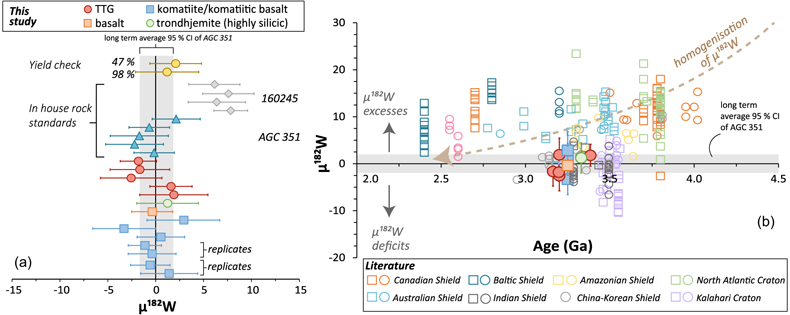
Figure 1 (a) Calculated average μ182W values of samples from the Dharwar Craton from multiple measurements (n, Table 1). Average μ182W values of in house standards (AGC 351 as blue triangles and 160245 as grey diamonds; Table S-3) and replicates of a rhyolite sample from the Singhbhum Craton (sin 13 as yellow circles; Table S-2) with different yields are also plotted. Uncertainties are expressed as 95 % CI. (b) Compilation of μ182W values from literature and samples from this study plotted against time. Circles represent felsic rocks and squares represent mafic and ultramafic rocks. Error bars are removed for clarity. The dashed arrow is a schematic progressive homogenisation of μ182W signatures, which is unclear.
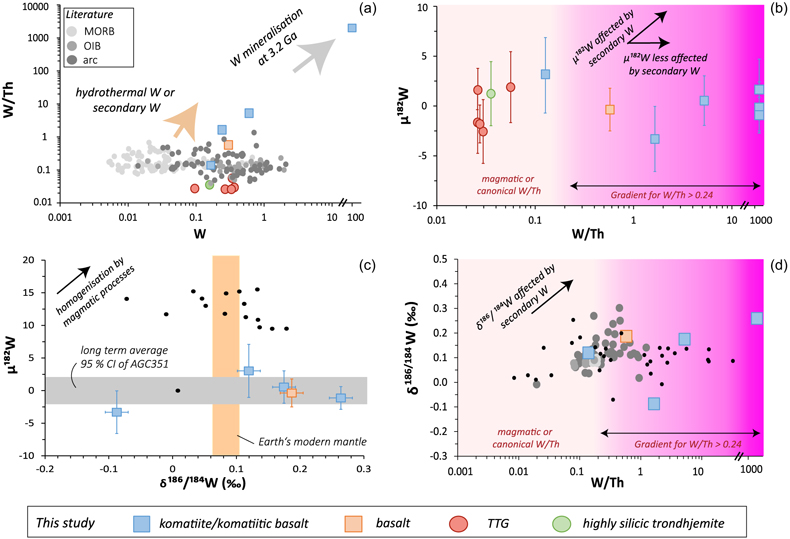
Figure 2 (a) Measured W and Th abundances of samples from the Dharwar Craton plotted using efficient proxies such as W/Th against W to identify the addition of potential secondary W. The same from compiled MORB, OIB and arc derivatives (modified from König et al., 2011
König, S., Münker, C., Hohl, S., Paulick, H., Barth, A.R., Lagos, M., Pfänder, J., Büchl, A. (2011) The Earth’s tungsten budget during mantle melting and crust formation. Geochimica et Cosmochimica Acta 75, 2119–2136. https://doi.org/10.1016/j.gca.2011.01.031
) are plotted for comparison. (b) W/Th plotted against their measured μ182W values to identify the effect of potential secondary W. (c) Samples with high W/Th (non-canonical W/Th) are further plotted against their respective δ186/184W values. The range of δ186/184W values for the Earth’s mantle are taken from Kurzweil et al. (2019)Kurzweil, F., Münker, C., Grupp, M., Braukmüller, N., Fechtner, L., Christian, M., Hohl, S.V., Schoenberg, R. (2019) The stable tungsten isotope composition of modern igneous reservoirs. Geochimica et Cosmochimica Acta 251, 176–191. https://doi.org/10.1016/j.gca.2019.02.025
. (d) Stable W (δ186/184W) isotope systematics of selected samples with high W/Th. Compiled data from MORB, OIB and arc derivatives were taken from Kurzweil et al. (2019)Kurzweil, F., Münker, C., Grupp, M., Braukmüller, N., Fechtner, L., Christian, M., Hohl, S.V., Schoenberg, R. (2019) The stable tungsten isotope composition of modern igneous reservoirs. Geochimica et Cosmochimica Acta 251, 176–191. https://doi.org/10.1016/j.gca.2019.02.025
. Black circles refer to data on Greenland samples taken from Kurzweil et al. (2020)Kurzweil, F., Münker, C., Hoffmann, J.E., Tusch, J., Schoenberg, R. (2020) Stable W isotope evidence for redistribution of homogeneous 182W anomalies in SW Greenland. Geochemical Perspectives Letters 14, 53–57. https://doi.org/10.7185/geochemlet.2024
.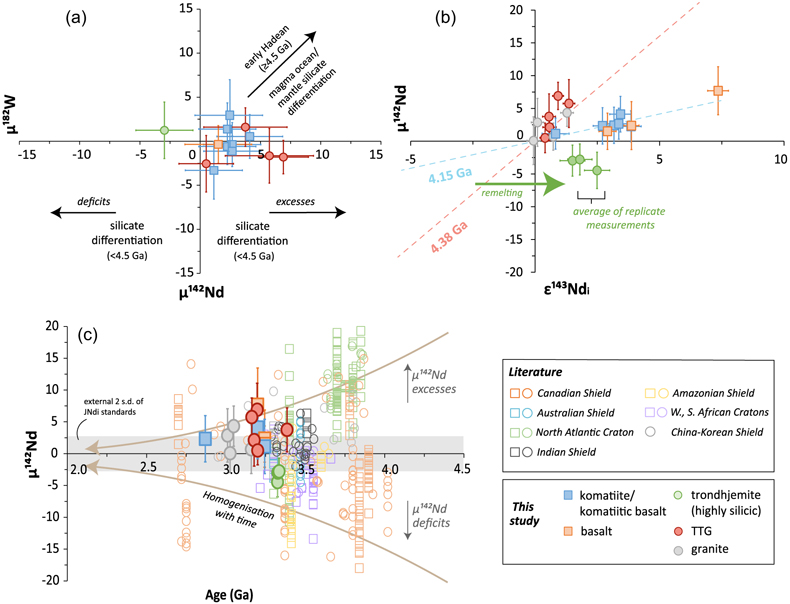
Figure 3 The μ142Nd values of samples from the Dharwar Craton taken from Ravindran et al. (2024)
Ravindran, A., Peters, B.J., Mezger, K., Hasenstab-Dübeler, E., Maya, J.M., Schönbächler, M. (2024) Distinct Hadean Mantle Sources of Felsic and Mafic Terranes Juxtaposed in the Paleoarchean. Geochemistry, Geophysics, Geosystems 25, e2024GC011834. https://doi.org/10.1029/2024GC011834
, plotted against different parameters. (a) μ142Nd values of samples against their measured μ182W values. (b) μ142Nd-initial ε143Nd values of samples. The possible ages for mantle extraction in the Hadean are also plotted. (c) μ142Nd values of samples relative to time. Circles represent felsic rocks and squares represent mafic and ultramafic rocks.