



Temperature dependence of magmatic iron redox speciation to 2100 °C
Affiliations | Corresponding Author | Cite as | Funding information
Published by the European Association of Geochemistry
under Creative Commons License CC BY-NC-ND 4.0
Keywords: iron redox, oxygen fugacity, aerodynamic-laser-levitation furnace, XANES, Mössbauer, martian magmatism, magma ocean


- Share this article


-
Article views:1,306Cumulative count of HTML views and PDF downloads.
- Download Citation
- Rights & Permissions

top
Abstract
Figures
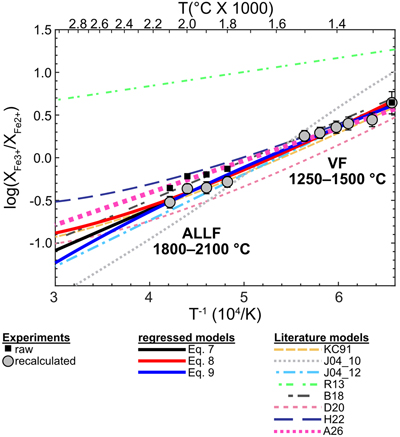 Figure 1 Raw and recalculated | 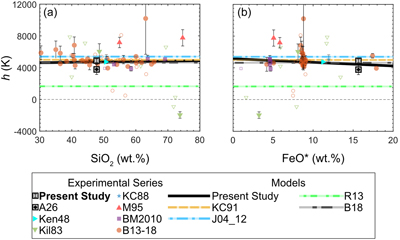 Figure 2 The slope of | 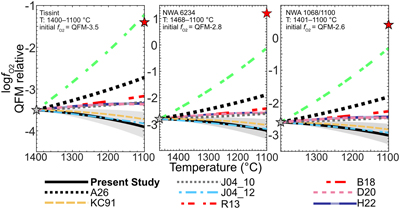 Figure 3 Comparison of predicted fO2 change during unbuffered, isochemical cooling of shergottite liquids Tissint, NWA 6234, and NWA 1068/1100 from liquidus to 1100 °C as calculated by different models (see Fig. 1) following Aithala et al. (2026). Equation 8, the preferred model derived from the present study’s temperature series is shown as a solid black line with shaded area representing 2σ uncertainties (see Fig. S-3 to compare with Eqs. 7 and 9). Gray and red stars indicate fO2s of early and late crystallised assemblages measured in shergottites, respectively. | 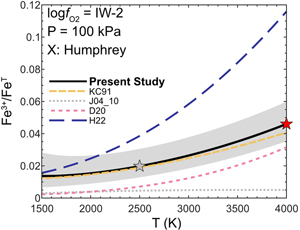 Figure 4 Fe3+/FeT ratios predicted for Humphrey silicate liquid at 100 kPa, logfO2 = IW-2 (Hirschmann, 2021) at temperatures ranging from 1500–4000 K calculated from thermodynamic models that incorporate non-zero values of ΔCP (see Fig. 1). Gray and red stars indicate Fe3+/FeT ratios for Equation 8 at 2500 and 4000 K (Fe3+/FeT = 0.020 and 0.046, respectively). Shaded region reflects 2σ uncertainty on the h-coefficient of Equation 8. |
| Figure 1 | Figure 2 | Figure 3 | Figure 4 |
top
Introduction
The redox speciation of multivalent cations, especially iron, has a significant influence on igneous mass transfer and phase equilibria (Cottrell et al., 2021
Cottrell, E., Birner, S.K., Brounce, M., Davis, F.A., Waters, L.E., Kelley, K.A. (2021) Oxygen fugacity across tectonic settings. In: Moretti, R., Neuville, D.R. (Eds.) Magma Redox Geochemistry. American Geophysical Union Geophysical Monograph Series 266, John Wiley & Sons, Inc., Hoboken, NJ, 33–61. https://doi.org/10.1002/9781119473206.ch3
and references therein). The iron redox speciation, quantified as the Fe3+/Fe2+ ratio, in magmas is primarily controlled by the chemical potential of oxygen (generally quantified by oxygen fugacity, fO2), but also influenced by temperature, pressure, and melt composition. The effects of melt composition have been investigated extensively (e.g., Kress and Carmichael, 1991Kress, V.C., Carmichael, I.S.E. (1991) The compressibility of silicate liquids containing Fe2O3 and the effect of composition, temperature, oxygen fugacity and pressure on their redox states. Contributions to Mineralogy and Petrology 108, 82–92. https://doi.org/10.1007/Bf00307328
; Jayasuriya et al., 2004Jayasuriya, K.D., O’Neill, H.St.C., Berry, A.J., Campbell, S.J. (2004) A Mössbauer study of the oxidation state of Fe in silicate melts. American Mineralogist 89, 1597–1609. https://doi.org/10.2138/am-2004-11-1203
; Righter et al., 2013Righter, K., Danielson, L.R., Pando, K., Morris, R.V., Graff, T.G., Agresti, D.G., Martin, A.M., Sutton, S.R., Newville, M., Lanzirotti, A. (2013) Redox systematics of martian magmas with implications for magnetite stability. American Mineralogist 98, 616–628. https://doi.org/10.2138/am.2013.4251
; Borisov et al., 2018Borisov, A., Behrens, H., Holtz, F. (2018) Ferric/ferrous ratio in silicate melts: A new model for 1 atm data with special emphasis on the effects of melt composition. Contributions to Mineralogy and Petrology 173, 98. https://doi.org/10.1007/s00410-018-1524-8
; Aithala et al., 2026Aithala, S.P., Lange, R.A., Hirschmann, M.M. (2026) Controls on iron-redox state in martian magmas quantified by Mössbauer spectroscopy, colorimetric wet chemistry, and XANES spectroscopy. Journal of Geophysical Research: Planets 131, e2025JE009148. https://doi.org/10.1029/2025JE009148
) and the effect of pressure has garnered considerable recent attention (Zhang et al., 2017Zhang, H.L., Hirschmann, M.M., Cottrell, E., Withers, A.C. (2017) Effect of pressure on Fe3+/ΣFe ratio in a mafic magma and consequences for magma ocean redox gradients. Geochimica et Cosmochimica Acta 204, 83–103. https://doi.org/10.1016/j.gca.2017.01.023
, 2024Zhang, H.L., Hirschmann, M.M., Lord, O.T., Rosenthal, A., Yaroslavtsev, S., Cottrell, E., Chumakov, A.I., Walter, M.J. (2024) Ferric iron stabilization at deep magma ocean conditions. Science Advances 10, eadp1752. https://doi.org/10.1126/sciadv.adp1752
; Armstrong et al., 2019Armstrong, K., Frost, D.J., McCammon, C.A., Rubie, D.C., Boffa Ballaran, T. (2019) Deep magma ocean formation set the oxidation state of Earth’s mantle. Science 365, 903–906. https://doi.org/10.1126/science.aax8376
; Deng et al., 2020Deng, J., Du, Z., Karki, B.B., Ghosh, D.B., Lee, K.K.M. (2020) A magma ocean origin to divergent redox evolutions of rocky planetary bodies and early atmospheres. Nature Communications 11, 2007. https://doi.org/10.1038/s41467-020-15757-0
; Kuwahara et al., 2023Kuwahara, H., Nakada, R., Kadoya, S., Yoshino, T., Irifune, T. (2023) Hadean mantle oxidation inferred from melting of peridotite under lower-mantle conditions. Nature Geoscience 16, 461–465. https://doi.org/10.1038/s41561-023-01169-4
). Previous models of Fe3+/Fe2+ in magmas, however, predict significantly different temperature dependencies (e.g., Kress and Carmichael, 1991Kress, V.C., Carmichael, I.S.E. (1991) The compressibility of silicate liquids containing Fe2O3 and the effect of composition, temperature, oxygen fugacity and pressure on their redox states. Contributions to Mineralogy and Petrology 108, 82–92. https://doi.org/10.1007/Bf00307328
; Righter et al., 2013Righter, K., Danielson, L.R., Pando, K., Morris, R.V., Graff, T.G., Agresti, D.G., Martin, A.M., Sutton, S.R., Newville, M., Lanzirotti, A. (2013) Redox systematics of martian magmas with implications for magnetite stability. American Mineralogist 98, 616–628. https://doi.org/10.2138/am.2013.4251
; Borisov et al., 2018Borisov, A., Behrens, H., Holtz, F. (2018) Ferric/ferrous ratio in silicate melts: A new model for 1 atm data with special emphasis on the effects of melt composition. Contributions to Mineralogy and Petrology 173, 98. https://doi.org/10.1007/s00410-018-1524-8
; Deng et al., 2020Deng, J., Du, Z., Karki, B.B., Ghosh, D.B., Lee, K.K.M. (2020) A magma ocean origin to divergent redox evolutions of rocky planetary bodies and early atmospheres. Nature Communications 11, 2007. https://doi.org/10.1038/s41467-020-15757-0
; Hirschmann, 2022Hirschmann, M.M. (2022) Magma oceans, iron and chromium redox, and the origin of comparatively oxidized planetary mantles. Geochimica et Cosmochimica Acta, 328, 221–241. https://doi.org/10.1016/j.gca.2022.04.005
; Aithala et al., 2026Aithala, S.P., Lange, R.A., Hirschmann, M.M. (2026) Controls on iron-redox state in martian magmas quantified by Mössbauer spectroscopy, colorimetric wet chemistry, and XANES spectroscopy. Journal of Geophysical Research: Planets 131, e2025JE009148. https://doi.org/10.1029/2025JE009148
). In addition, the few experimental studies designed to isolate the effects of temperature (e.g., Kress and Carmichael, 1988Kress, V.C., Carmichael, I.S.E. (1988) Stoichiometry of the iron oxidation reaction in silicate melts. American Mineralogist 73, 1267–1274.
; Moore et al., 1995Moore, G., Righter, K., Carmichael, I.S.E. The effect of dissolved water on the oxidation state of iron in natural silicate liquids. Contributions to Mineralogy and Petrology 120, 170–179 (1995) https://doi.org/10.1007/BF00287114
; Borisov and McCammon, 2010Borisov, A., McCammon, C. (2010) The effect of silica on ferric/ferrous ratio in silicate melts: An experimental study using Mossbauer spectroscopy. American Mineralogist 95, 545–555. https://doi.org/10.2138/am.2010.3217
; Aithala et al., 2026Aithala, S.P., Lange, R.A., Hirschmann, M.M. (2026) Controls on iron-redox state in martian magmas quantified by Mössbauer spectroscopy, colorimetric wet chemistry, and XANES spectroscopy. Journal of Geophysical Research: Planets 131, e2025JE009148. https://doi.org/10.1029/2025JE009148
) have spanned relatively narrow intervals (≤350 K).Two igneous processes in which the temperature dependence of Fe3+/Fe2+ in magmas is key are redox evolution associated with magmatic cooling and differentiation (Cottrell et al., 2021
Cottrell, E., Birner, S.K., Brounce, M., Davis, F.A., Waters, L.E., Kelley, K.A. (2021) Oxygen fugacity across tectonic settings. In: Moretti, R., Neuville, D.R. (Eds.) Magma Redox Geochemistry. American Geophysical Union Geophysical Monograph Series 266, John Wiley & Sons, Inc., Hoboken, NJ, 33–61. https://doi.org/10.1002/9781119473206.ch3
) and the establishment of oxidised planetary mantles in deep magma oceans (Hirschmann, 2012Hirschmann, M.M. (2012) Magma ocean influence on early atmosphere mass and composition. Earth and Planetary Science Letters 341–344, 48–57. https://doi.org/10.1016/j.epsl.2012.06.015
, 2022Hirschmann, M.M. (2022) Magma oceans, iron and chromium redox, and the origin of comparatively oxidized planetary mantles. Geochimica et Cosmochimica Acta, 328, 221–241. https://doi.org/10.1016/j.gca.2022.04.005
; Deng et al., 2020Deng, J., Du, Z., Karki, B.B., Ghosh, D.B., Lee, K.K.M. (2020) A magma ocean origin to divergent redox evolutions of rocky planetary bodies and early atmospheres. Nature Communications 11, 2007. https://doi.org/10.1038/s41467-020-15757-0
; Henningsen et al., 2025Henningsen, E.L., Korenaga, J., Marchi, S. (2025) Impact driven redox stratification of Earth’s mantle. Journal of Geophysical Research: Solid Earth 130, e2024JB030817. https://doi.org/10.1029/2024JB030817
). For the former, one case of interest is redox variations during petrologic evolution of martian basalts, which are more pronounced than their terrestrial equivalents (Herd, 2019Herd, C.D.K. (2019) Reconciling redox: Making spatial and temporal sense of oxygen fugacity variations in martian igneous rocks. 50th Lunar and Planetary Institute Science Conference, Abstract #2746.
; Aithala et al. 2026Aithala, S.P., Lange, R.A., Hirschmann, M.M. (2026) Controls on iron-redox state in martian magmas quantified by Mössbauer spectroscopy, colorimetric wet chemistry, and XANES spectroscopy. Journal of Geophysical Research: Planets 131, e2025JE009148. https://doi.org/10.1029/2025JE009148
). Experimental studies of Fe redox systematics of Fe-rich, martian-relevant magmas from Righter et al. (2013)Righter, K., Danielson, L.R., Pando, K., Morris, R.V., Graff, T.G., Agresti, D.G., Martin, A.M., Sutton, S.R., Newville, M., Lanzirotti, A. (2013) Redox systematics of martian magmas with implications for magnetite stability. American Mineralogist 98, 616–628. https://doi.org/10.2138/am.2013.4251
and Aithala et al. (2026)Aithala, S.P., Lange, R.A., Hirschmann, M.M. (2026) Controls on iron-redox state in martian magmas quantified by Mössbauer spectroscopy, colorimetric wet chemistry, and XANES spectroscopy. Journal of Geophysical Research: Planets 131, e2025JE009148. https://doi.org/10.1029/2025JE009148
found that Fe3+/Fe2+ ratios of these magmas are more sensitive to temperature than Fe-poor silicate liquids. Aithala et al. (2026)Aithala, S.P., Lange, R.A., Hirschmann, M.M. (2026) Controls on iron-redox state in martian magmas quantified by Mössbauer spectroscopy, colorimetric wet chemistry, and XANES spectroscopy. Journal of Geophysical Research: Planets 131, e2025JE009148. https://doi.org/10.1029/2025JE009148
concluded that this increased temperature sensitivity could drive significant fO2 increases relative to standard redox buffers during magmatic cooling and hypothesised that this effect could account for a significant fraction of the fO2 increases measured within and across martian basalts.Recent studies pertaining to magma oceans have considered redox conditions in melts equilibrating with core-destined Fe alloy and found, at these extreme conditions (>2500 K), temperature may have a pronounced effect on Fe3+/Fe2+ ratios (Hirschmann, 2022
Hirschmann, M.M. (2022) Magma oceans, iron and chromium redox, and the origin of comparatively oxidized planetary mantles. Geochimica et Cosmochimica Acta, 328, 221–241. https://doi.org/10.1016/j.gca.2022.04.005
; Henningsen et al., 2025Henningsen, E.L., Korenaga, J., Marchi, S. (2025) Impact driven redox stratification of Earth’s mantle. Journal of Geophysical Research: Solid Earth 130, e2024JB030817. https://doi.org/10.1029/2024JB030817
) and may contribute significantly to the relatively oxidised conditions established during Earth’s mantle solidification. However, large differences in Fe3+/Fe2+ ratios calculated from different models (Hirschmann, 2022Hirschmann, M.M. (2022) Magma oceans, iron and chromium redox, and the origin of comparatively oxidized planetary mantles. Geochimica et Cosmochimica Acta, 328, 221–241. https://doi.org/10.1016/j.gca.2022.04.005
) arise because of uncertainties in extrapolation to high temperature from experimental constraints, which are limited to <1650 °C.To better constrain the temperature-Fe redox systematics of silicate melts, we investigated Fe3+/Fe2+ variations from 1250–2100 °C for an Fe-rich martian-relevant basaltic melt. These experiments span 850 °C, a greater range for a nearly isochemical system than any previous investigation of Fe3+/Fe2+ ratios in silicate melts and therefore provide fundamental constraints on the thermodynamics of iron redox in silicate melts. They are applicable to understanding redox processes during martian igneous evolution and can improve understanding of Fe3+/Fe2+ ratios at magma ocean conditions.
top
Thermodynamic Background
Magmatic Fe3+/Fe2+ratio is governed by the reaction,
Eq. 1

At standard pressure, P0 (100 kPa), the energetics of this reaction are given by
Eq. 2

where Xi represents the mole fraction of component, i, ΔGT,P0 is the change in free energy at temperature T (K), R is the gas constant (8.314 J/mol K), and γi are the activity coefficients for melt components, i.
Estimates of ΔGT,P0 can be derived empirically from experiments on iron-bearing molten silicates by the simplified expression,
Eq. 3

where a and b are regressed coefficients (Sack et al. 1981
Sack, R.O., Carmichael, I.S.E., Rivers, M., Ghiorso, M.S. (1981) Ferric-ferrous equilibria in natural silicate liquids at 1 bar. Contributions to Mineralogy and Petrology 75, 369–376. https://doi.org/10.1007/bf00374720
; Kilinc et al. 1983Kilinc, A., Carmichael, I.S.E., Rivers, M.L., Sack, R.O. (1983) The ferric-ferrous ratio of natural silicate liquids equilibrated in air. Contributions to Mineralogy and Petrology 83, 136–140. https://doi.org/10.1007/bf00373086
; Borisov et al. 2018Borisov, A., Behrens, H., Holtz, F. (2018) Ferric/ferrous ratio in silicate melts: A new model for 1 atm data with special emphasis on the effects of melt composition. Contributions to Mineralogy and Petrology 173, 98. https://doi.org/10.1007/s00410-018-1524-8
). An expanded version of Equation 3 explicitly accounts for distinct heat capacities (Cp) of FeO and FeO1.5 in molten silicates (Kress and Carmichael, 1991Kress, V.C., Carmichael, I.S.E. (1991) The compressibility of silicate liquids containing Fe2O3 and the effect of composition, temperature, oxygen fugacity and pressure on their redox states. Contributions to Mineralogy and Petrology 108, 82–92. https://doi.org/10.1007/Bf00307328
; Jayasuriya et al., 2004Jayasuriya, K.D., O’Neill, H.St.C., Berry, A.J., Campbell, S.J. (2004) A Mössbauer study of the oxidation state of Fe in silicate melts. American Mineralogist 89, 1597–1609. https://doi.org/10.2138/am-2004-11-1203
; Deng et al., 2020Deng, J., Du, Z., Karki, B.B., Ghosh, D.B., Lee, K.K.M. (2020) A magma ocean origin to divergent redox evolutions of rocky planetary bodies and early atmospheres. Nature Communications 11, 2007. https://doi.org/10.1038/s41467-020-15757-0
; Hirschmann, 2022Hirschmann, M.M. (2022) Magma oceans, iron and chromium redox, and the origin of comparatively oxidized planetary mantles. Geochimica et Cosmochimica Acta, 328, 221–241. https://doi.org/10.1016/j.gca.2022.04.005
):Eq. 4

where ΔCP = CPFeO1.5−CPFeO−0.25CPO2 and T0 is a reference temperature (generally 1673 K). The value ΔCP can be derived from calorimetric studies of iron-bearing silicate liquids (27.9 ± 1 0.4 J/K, Stebbins et al., 1984
Stebbins, J.F., Carmichael, I.S.E., Moret, L.K. (1984) Heat capacities and entropies of silicate liquids and glasses. Contributions to Mineralogy and Petrology 86, 131–148. https://doi.org/10.1007/bf00381840
; or 33.25 ± 6.06 J/K, Lange and Navrotsky et al., 1992Lange, R.A., Navrotsky, A. (1992) Heat capacities of Fe2O3-bearing silicate liquids. Contributions to Mineralogy and Petrology 110, 311–320. https://doi.org/10.1007/BF00310746
). The influence of the ΔCP term on calculated Fe3+/Fe2+ ratios is small at temperatures <1650 °C, but as noted by Hirschmann (2022)Hirschmann, M.M. (2022) Magma oceans, iron and chromium redox, and the origin of comparatively oxidized planetary mantles. Geochimica et Cosmochimica Acta, 328, 221–241. https://doi.org/10.1016/j.gca.2022.04.005
can significantly enhance predicted Fe3+/Fe2+ ratios in extrapolations above 2000 K.Following previous work (e.g., Sack et al., 1981
Sack, R.O., Carmichael, I.S.E., Rivers, M., Ghiorso, M.S. (1981) Ferric-ferrous equilibria in natural silicate liquids at 1 bar. Contributions to Mineralogy and Petrology 75, 369–376. https://doi.org/10.1007/bf00374720
; Kress and Carmichael, 1991Kress, V.C., Carmichael, I.S.E. (1991) The compressibility of silicate liquids containing Fe2O3 and the effect of composition, temperature, oxygen fugacity and pressure on their redox states. Contributions to Mineralogy and Petrology 108, 82–92. https://doi.org/10.1007/Bf00307328
; Jayasuriya et al., 2004Jayasuriya, K.D., O’Neill, H.St.C., Berry, A.J., Campbell, S.J. (2004) A Mössbauer study of the oxidation state of Fe in silicate melts. American Mineralogist 89, 1597–1609. https://doi.org/10.2138/am-2004-11-1203
; Righter et al., 2013Righter, K., Danielson, L.R., Pando, K., Morris, R.V., Graff, T.G., Agresti, D.G., Martin, A.M., Sutton, S.R., Newville, M., Lanzirotti, A. (2013) Redox systematics of martian magmas with implications for magnetite stability. American Mineralogist 98, 616–628. https://doi.org/10.2138/am.2013.4251
, Borisov et al., 2018Borisov, A., Behrens, H., Holtz, F. (2018) Ferric/ferrous ratio in silicate melts: A new model for 1 atm data with special emphasis on the effects of melt composition. Contributions to Mineralogy and Petrology 173, 98. https://doi.org/10.1007/s00410-018-1524-8
; Hirschmann, 2022Hirschmann, M.M. (2022) Magma oceans, iron and chromium redox, and the origin of comparatively oxidized planetary mantles. Geochimica et Cosmochimica Acta, 328, 221–241. https://doi.org/10.1016/j.gca.2022.04.005
; Aithala et al., 2026Aithala, S.P., Lange, R.A., Hirschmann, M.M. (2026) Controls on iron-redox state in martian magmas quantified by Mössbauer spectroscopy, colorimetric wet chemistry, and XANES spectroscopy. Journal of Geophysical Research: Planets 131, e2025JE009148. https://doi.org/10.1029/2025JE009148
), we combine Equations 2 and 4, replace the logfO2 stoichiometric coefficient with an empirical parameter, k, the inverse temperature coefficient from Equation 4 with h, and the term with a simple compositional term, ∑diXi, to yield the expression,
 Eq. 5

For experimentally quenched glasses synthesised at a single fO2 and identical composition, the effect of temperature simplifies to
Eq. 6

where C is the sum of c, ∑diXi, and klogfO2.
top
Temperature Dependence on Fe3+/FeT from 1250–2100 °C
Starting mixes similar to martian basalt Humphrey (McSween et al., 2006
McSween, H.Y., Ruff, S.W., Morris, R.V., Bell, J.F., Herkenhoff, K., Gellert, R., Stockstill, K.R., Tornabene, L.L., Squyres, S.W., Crisp, J.A., Christensen, P.R., McCoy, T.J., Mittlefehldt, D.W., Schmidt, M. (2006) Alkaline volcanic rocks from the Columbia Hills, Gusev crater, Mars. Journal of Geophysical Research: Planets 111, E09S91. https://doi.org/10.1029/2006je002698
; Aithala et al., 2026Aithala, S.P., Lange, R.A., Hirschmann, M.M. (2026) Controls on iron-redox state in martian magmas quantified by Mössbauer spectroscopy, colorimetric wet chemistry, and XANES spectroscopy. Journal of Geophysical Research: Planets 131, e2025JE009148. https://doi.org/10.1029/2025JE009148
) were synthesised from high purity reagents for super-liquidus 100 kPa experiments in vertical gas mixing (VF) and aerodynamic-laser-levitation furnace (ALLF) experiments (Table S-1). VF experiments, previously reported by Aithala et al. (2026)Aithala, S.P., Lange, R.A., Hirschmann, M.M. (2026) Controls on iron-redox state in martian magmas quantified by Mössbauer spectroscopy, colorimetric wet chemistry, and XANES spectroscopy. Journal of Geophysical Research: Planets 131, e2025JE009148. https://doi.org/10.1029/2025JE009148
, were equilibrated in air and ALLF experiments were levitated in O2 gas. Experiments were quenched rapidly (SI), with all but one sample (VF271) yielding 100 % glass. Major element compositions of all glasses were determined by EPMA (Table S-2) and Fe3+/Fe2+ ratios were determined by XANES (Table S-3). VF glass Fe3+/Fe2+ was also determined with Mössbauer spectroscopy (Aithala et al., 2026Aithala, S.P., Lange, R.A., Hirschmann, M.M. (2026) Controls on iron-redox state in martian magmas quantified by Mössbauer spectroscopy, colorimetric wet chemistry, and XANES spectroscopy. Journal of Geophysical Research: Planets 131, e2025JE009148. https://doi.org/10.1029/2025JE009148
), but the ALLF glass was not, as their small masses precluded conventional Mössbauer spectroscopic analyses. Compositions of glasses from the partially crystallised experiment and the ALLF experiments differ from the starting composition owing, respectively, to partial crystallisation and volatilisation of Na, K, and P (Fig. S-1; Supplementary Information (SI)).top
Discussion
After adjusting experimental Fe3+/Fe2+ of VF271 and the ALLF experiments to represent a single average composition (SI), we evaluate the temperature coefficient, h, and the significance of the ΔCp term by regressing versions of Equation 6. At constant composition and fO2, we regress 3 weighted-least squares equations: one with a regressed h-coefficient where ΔCp ≡ 0, (Eq. 7), one with a regressed h-coefficient and fixed ΔCp (adopted from Hirschmann, 2022
Hirschmann, M.M. (2022) Magma oceans, iron and chromium redox, and the origin of comparatively oxidized planetary mantles. Geochimica et Cosmochimica Acta, 328, 221–241. https://doi.org/10.1016/j.gca.2022.04.005
) (Eq. 8), and finally fitting both h- and ΔCp terms (Eq. 9):Eq. 7

Eq. 8

Eq. 9

According to the unreduced χ2 goodness of fit
 , all regressions are similarly accurate and precise (Table S-4), and their curves overlap throughout the investigated temperature interval (Fig. 1). The ΔCp terms in Equations 8 and 9 having opposite signs indicates divergent deviations from linearity.
Figure 1 Raw and recalculated
 ratios from VF (1250–1500 °C) and ALLF (1800–2100 °C) experimental series versus reciprocal temperature (error bars represent 2σ). Adjustments are made to compare experiments at a common oxygen fugacity and composition (see SI). Data are compared to thermodynamic models from this study (Eqs. 7–9) and previous parameterisations calculated at logfO2 = −0.68, P0 (100 kPa) and average Humphrey composition (Table S-2). KC91 = Kress and Carmichael (1991)
Kress, V.C., Carmichael, I.S.E. (1991) The compressibility of silicate liquids containing Fe2O3 and the effect of composition, temperature, oxygen fugacity and pressure on their redox states. Contributions to Mineralogy and Petrology 108, 82–92. https://doi.org/10.1007/Bf00307328
, J04_10 and J04_12 = Jayasuriya et al., (2004)Jayasuriya, K.D., O’Neill, H.St.C., Berry, A.J., Campbell, S.J. (2004) A Mössbauer study of the oxidation state of Fe in silicate melts. American Mineralogist 89, 1597–1609. https://doi.org/10.2138/am-2004-11-1203
, Eqs. 10 and 12; R13 = Righter et al., (2013)Righter, K., Danielson, L.R., Pando, K., Morris, R.V., Graff, T.G., Agresti, D.G., Martin, A.M., Sutton, S.R., Newville, M., Lanzirotti, A. (2013) Redox systematics of martian magmas with implications for magnetite stability. American Mineralogist 98, 616–628. https://doi.org/10.2138/am.2013.4251
, D20 = Deng et al., (2020)Deng, J., Du, Z., Karki, B.B., Ghosh, D.B., Lee, K.K.M. (2020) A magma ocean origin to divergent redox evolutions of rocky planetary bodies and early atmospheres. Nature Communications 11, 2007. https://doi.org/10.1038/s41467-020-15757-0
, H22 = Hirschmann (2022)Hirschmann, M.M. (2022) Magma oceans, iron and chromium redox, and the origin of comparatively oxidized planetary mantles. Geochimica et Cosmochimica Acta, 328, 221–241. https://doi.org/10.1016/j.gca.2022.04.005
, A26 = Aithala et al., (2026)Aithala, S.P., Lange, R.A., Hirschmann, M.M. (2026) Controls on iron-redox state in martian magmas quantified by Mössbauer spectroscopy, colorimetric wet chemistry, and XANES spectroscopy. Journal of Geophysical Research: Planets 131, e2025JE009148. https://doi.org/10.1029/2025JE009148
.Previous models, parameterised from smaller temperature intervals and not optimised for a martian composition, do not reproduce the
s as well as Eqs. 7–9, which are calibrated from the present experiments. However, parameterisations from Kress and Carmichael (1991)Kress, V.C., Carmichael, I.S.E. (1991) The compressibility of silicate liquids containing Fe2O3 and the effect of composition, temperature, oxygen fugacity and pressure on their redox states. Contributions to Mineralogy and Petrology 108, 82–92. https://doi.org/10.1007/Bf00307328
, Jayasuriya et al. (2004Jayasuriya, K.D., O’Neill, H.St.C., Berry, A.J., Campbell, S.J. (2004) A Mössbauer study of the oxidation state of Fe in silicate melts. American Mineralogist 89, 1597–1609. https://doi.org/10.2138/am-2004-11-1203
; Eq. 12), and Borisov et al. (2018)Borisov, A., Behrens, H., Holtz, F. (2018) Ferric/ferrous ratio in silicate melts: A new model for 1 atm data with special emphasis on the effects of melt composition. Contributions to Mineralogy and Petrology 173, 98. https://doi.org/10.1007/s00410-018-1524-8
match experimental values within experimental uncertainties. The Hirschmann (2022)Hirschmann, M.M. (2022) Magma oceans, iron and chromium redox, and the origin of comparatively oxidized planetary mantles. Geochimica et Cosmochimica Acta, 328, 221–241. https://doi.org/10.1016/j.gca.2022.04.005
model reproduces VF series well but overestimate ALLF . The Jayasuriya et al. (2004Jayasuriya, K.D., O’Neill, H.St.C., Berry, A.J., Campbell, S.J. (2004) A Mössbauer study of the oxidation state of Fe in silicate melts. American Mineralogist 89, 1597–1609. https://doi.org/10.2138/am-2004-11-1203
; Eq. 10), Righter et al. (2013)Righter, K., Danielson, L.R., Pando, K., Morris, R.V., Graff, T.G., Agresti, D.G., Martin, A.M., Sutton, S.R., Newville, M., Lanzirotti, A. (2013) Redox systematics of martian magmas with implications for magnetite stability. American Mineralogist 98, 616–628. https://doi.org/10.2138/am.2013.4251
, and Deng et al. (2020)Deng, J., Du, Z., Karki, B.B., Ghosh, D.B., Lee, K.K.M. (2020) A magma ocean origin to divergent redox evolutions of rocky planetary bodies and early atmospheres. Nature Communications 11, 2007. https://doi.org/10.1038/s41467-020-15757-0
models yield systematic discrepancies. The Hirschmann (2022)Hirschmann, M.M. (2022) Magma oceans, iron and chromium redox, and the origin of comparatively oxidized planetary mantles. Geochimica et Cosmochimica Acta, 328, 221–241. https://doi.org/10.1016/j.gca.2022.04.005
model overestimates are likely the result of low temperature Fe3+/Fe2+ data points being fit with a small h-coefficient combined with superimposition of an independently derived, positive ΔCp term, resulting in positive deviations at elevated temperatures. The new experiments at 1800–2100 °C demonstrate that a larger h-coefficient is warranted.Examining models regressed here, Equation 7 better fits the experiments compared to Equation 8 as demonstrated by its smaller χ2 (Table S-4), despite the unlikely assumption of ΔCp ≡ 0. The effect of a positive ΔCp, causing positive
deviations at elevated temperature relative to linear models, is not evident in the experimental interval 1250–2100 °C. In fact, the measured trend to slightly lower values at elevated temperatures, as evident from the possibly negative value of ΔCp (−23.74 J/K ± 51.05 J/K; p value = 0.66) regressed in Equation 9. A negative value of ΔCp conflicts with calorimetric studies of Fe-bearing silicate liquids (Stebbins et al., 1984Stebbins, J.F., Carmichael, I.S.E., Moret, L.K. (1984) Heat capacities and entropies of silicate liquids and glasses. Contributions to Mineralogy and Petrology 86, 131–148. https://doi.org/10.1007/bf00381840
; Lange and Navrotsky, 1992Lange, R.A., Navrotsky, A. (1992) Heat capacities of Fe2O3-bearing silicate liquids. Contributions to Mineralogy and Petrology 110, 311–320. https://doi.org/10.1007/BF00310746
) and this specific value is not statistically significant, nor does its inclusion improve the fit from the linear Equation 7 model from the perspective of reduced chi square (Table S-4). Ultimately, a well defined value of ΔCp may not be resolvable from the present data; i.e. Hirschman (2022)Hirschmann, M.M. (2022) Magma oceans, iron and chromium redox, and the origin of comparatively oxidized planetary mantles. Geochimica et Cosmochimica Acta, 328, 221–241. https://doi.org/10.1016/j.gca.2022.04.005
noted that the effects of ΔCp should be pronounced at temperatures well above 2000 K. Potentially, the assumption of a constant ΔCp value is not appropriate, as the effects of anharmonicity may be important at very high temperatures (Fiquet et al., 1992Fiquet, G., Gillet, P., Richet, P. (1992) Anharmonicity and high-temperature heat capacity of crystals: the examples of Ca2GeO4, Mg2GeO4 and CaMgGeO4 olivines. Physics and Chemistry of Minerals 18, 469–479. https://doi.org/10.1007/BF00200970
) Although all Equations 7–9 are similarly accurate and precise, we favour Equation 8 for modelling Fe3+/Fe2+ and fO2 systematics at all temperatures as it accounts for a non-zero ΔCp, established from independent calorimetric measurements. Notably, this model is very similar in both form and values to Kress and Carmichael (1991Kress, V.C., Carmichael, I.S.E. (1991) The compressibility of silicate liquids containing Fe2O3 and the effect of composition, temperature, oxygen fugacity and pressure on their redox states. Contributions to Mineralogy and Petrology 108, 82–92. https://doi.org/10.1007/Bf00307328
; h-coefficient = 5235 vs. 4991, ΔCp = 33.25 vs. 27.9 J/K) suggesting that their model extrapolates well to temperatures beyond its calibration dataset.Are martian magmas’ Fe3+/Fe2+ and fO2 more sensitive to temperature variations? The new experiments allow improved resolution of redox variation induced by cooling of martian basalts. Previous work by Righter et al. (2013)
Righter, K., Danielson, L.R., Pando, K., Morris, R.V., Graff, T.G., Agresti, D.G., Martin, A.M., Sutton, S.R., Newville, M., Lanzirotti, A. (2013) Redox systematics of martian magmas with implications for magnetite stability. American Mineralogist 98, 616–628. https://doi.org/10.2138/am.2013.4251
and Aithala et al. (2026)Aithala, S.P., Lange, R.A., Hirschmann, M.M. (2026) Controls on iron-redox state in martian magmas quantified by Mössbauer spectroscopy, colorimetric wet chemistry, and XANES spectroscopy. Journal of Geophysical Research: Planets 131, e2025JE009148. https://doi.org/10.1029/2025JE009148
found enhanced temperature sensitivity (i.e. smaller h-coefficient) for martian magmas as compared to models calibrated from terrestrial or simplified-composition silicate liquids. The newly regressed h-coefficient of 4894 K from Equation 7 from experiments at 1250–2100 °C is greater than h-coefficient of 3775 K found by Aithala et al.(2026)Aithala, S.P., Lange, R.A., Hirschmann, M.M. (2026) Controls on iron-redox state in martian magmas quantified by Mössbauer spectroscopy, colorimetric wet chemistry, and XANES spectroscopy. Journal of Geophysical Research: Planets 131, e2025JE009148. https://doi.org/10.1029/2025JE009148
for the same composition (1250–1500 °C) and significantly exceeds the 1650 K value determined for a shergottitic composition (1300–1500 °C; Righter et al., 2013Righter, K., Danielson, L.R., Pando, K., Morris, R.V., Graff, T.G., Agresti, D.G., Martin, A.M., Sutton, S.R., Newville, M., Lanzirotti, A. (2013) Redox systematics of martian magmas with implications for magnetite stability. American Mineralogist 98, 616–628. https://doi.org/10.2138/am.2013.4251
). Compared to a wider range of model parameterisations and to experimental series in which a fixed starting composition was equilibrated in air over a range of temperatures, the h-coefficient of 4894 K is consistent with previous estimates (Fig. 2).Figure 2 The slope of
versus inverse temperature (h-coefficients) for either series of ≥2 experiments conducted at variable temperature and constant composition and fO2, or from the h-coefficient’s empirical models, as a function of composition ((a) SiO2 and (b) FeO*). Experimental series (data points) are from the present study and others (Table S-5). Models (dashed lines) are from previous studies (see Fig. 1 caption for model source key). Hollow symbols represent the h-coefficients for series comprising two experiments. The solid lines are linear weighted-least squares regressions of h-values vs. wt. % SiO2 (left) (h = 5.095 ± 5.120 X wt. % SiO2 + 4472 ± 302.5; r2 = 0.027) or wt. % FeO* (right) (h = −45.20 ± 17.21 X wt. % FeO + 5141 ± 147.7; r2 = 0.161) to experimental series containing more than two experiments.The survey of temperature effects on
from previous studies (Fig. 2) allows evaluation of the hypothesis that h-coefficients are compositionally dependent; h-coefficients from experimental series with >2 experiments show no resolvable correlation with SiO2 and a weakly negative correlation with FeO* (Fig. 2). In addition, the h-coefficient derived from the present study is also consistent with previously investigated compositions despite elevated FeO*, suggesting that compositional influence on the h-coefficient is not supported, despite previous conclusions from Righter et al. (2013)Righter, K., Danielson, L.R., Pando, K., Morris, R.V., Graff, T.G., Agresti, D.G., Martin, A.M., Sutton, S.R., Newville, M., Lanzirotti, A. (2013) Redox systematics of martian magmas with implications for magnetite stability. American Mineralogist 98, 616–628. https://doi.org/10.2138/am.2013.4251
and Aithala et al. (2026)Aithala, S.P., Lange, R.A., Hirschmann, M.M. (2026) Controls on iron-redox state in martian magmas quantified by Mössbauer spectroscopy, colorimetric wet chemistry, and XANES spectroscopy. Journal of Geophysical Research: Planets 131, e2025JE009148. https://doi.org/10.1029/2025JE009148
.With improved constraints for the temperature dependence of Fe3+/Fe2+ ratios in magmas, we apply Equation 8 to evaluate the isolated effect of magmatic cooling in generating fO2 variations in martian basalt (SI). We consider the redox evolution of shergottites that have undergone significant fO2 increase during differentiation, as recorded by oxybarometry of early and late crystallised mineral assemblages (Tissint — Castle and Herd, 2017
Castle, N., Herd, C.D.K. (2017) Experimental petrology of the Tissint meteorite: Redox estimates, crystallization curves, and evaluation of petrogenetic models. Meteoritics & Planetary Science 52, 125–146. https://doi.org/10.1111/maps.12739
; Northwestern Africa (NWA) 6234 — Gross et al., 2013Gross, J., Filiberto, J., Herd, C.D.K., Daswani, M.M., Schwenzer, S.P., Treiman, A.H. (2013) Petrography, mineral chemistry, and crystallization history of olivine‐phyric shergottite NWA 6234: A new melt composition. Meteoritics & Planetary Science 48, 854–871. https://doi.org/10.1111/maps.12092
; Northwestern Africa (NWA) 1068/1100 — Herd 2006Herd, C.D.K. (2006) Insights into the redox history of the NWA 1068/1110 martian basalt from mineral equilibria and vanadium oxybarometry. American Mineralogist 91, 1616–1627. https://doi.org/10.2138/am.2006.2104
), and calculate their fO2 evolution from unbuffered, isochemical cooling following the scenario presented in Aithala et al. (2026)Aithala, S.P., Lange, R.A., Hirschmann, M.M. (2026) Controls on iron-redox state in martian magmas quantified by Mössbauer spectroscopy, colorimetric wet chemistry, and XANES spectroscopy. Journal of Geophysical Research: Planets 131, e2025JE009148. https://doi.org/10.1029/2025JE009148
. Aithala et al. (2026)Aithala, S.P., Lange, R.A., Hirschmann, M.M. (2026) Controls on iron-redox state in martian magmas quantified by Mössbauer spectroscopy, colorimetric wet chemistry, and XANES spectroscopy. Journal of Geophysical Research: Planets 131, e2025JE009148. https://doi.org/10.1029/2025JE009148
, using their martian-magma specific model, found that cooling contributed significant fO2 increases relative to the quartz-fayalite-magnetite (QFM) buffer, accounting for a significant fraction of observed oxidation, minimising the necessary extent of potentially oxidative pressure variation and/or processes affecting magma chemistry including crystallisation, degassing, or assimilation. However, application of Equation 8 to model magmatic cooling from liquidus temperature (Aithala et al., 2026Aithala, S.P., Lange, R.A., Hirschmann, M.M. (2026) Controls on iron-redox state in martian magmas quantified by Mössbauer spectroscopy, colorimetric wet chemistry, and XANES spectroscopy. Journal of Geophysical Research: Planets 131, e2025JE009148. https://doi.org/10.1029/2025JE009148
) to 1100 °C results in decreases in fO2 relative to QFM of 0.37, 0.39, and 0.37 log units fO2 for Tissint, NWA 6234, and NWA 1068/1100 (Fig. 3). This contrasts the Aithala et al. (2026)Aithala, S.P., Lange, R.A., Hirschmann, M.M. (2026) Controls on iron-redox state in martian magmas quantified by Mössbauer spectroscopy, colorimetric wet chemistry, and XANES spectroscopy. Journal of Geophysical Research: Planets 131, e2025JE009148. https://doi.org/10.1029/2025JE009148
model and suggests that observed shergottite fO2 increases are entirely a product of pressure variation, crystallisation, and/or other open system processes.Figure 3 Comparison of predicted fO2 change during unbuffered, isochemical cooling of shergottite liquids Tissint, NWA 6234, and NWA 1068/1100 from liquidus to 1100 °C as calculated by different models (see Fig. 1) following Aithala et al. (2026)
Aithala, S.P., Lange, R.A., Hirschmann, M.M. (2026) Controls on iron-redox state in martian magmas quantified by Mössbauer spectroscopy, colorimetric wet chemistry, and XANES spectroscopy. Journal of Geophysical Research: Planets 131, e2025JE009148. https://doi.org/10.1029/2025JE009148
. Equation 8, the preferred model derived from the present study’s temperature series is shown as a solid black line with shaded area representing 2σ uncertainties (see Fig. S-3 to compare with Eqs. 7 and 9). Gray and red stars indicate fO2s of early and late crystallised assemblages measured in shergottites, respectively.Differences in Fe3+/FeT ratios extrapolated to magma ocean conditions. Redox conditions in deep magma oceans may be established at extreme temperatures (>3500 K, Hirschmann, 2022
Hirschmann, M.M. (2022) Magma oceans, iron and chromium redox, and the origin of comparatively oxidized planetary mantles. Geochimica et Cosmochimica Acta, 328, 221–241. https://doi.org/10.1016/j.gca.2022.04.005
; Henningsen et al., 2025Henningsen, E.L., Korenaga, J., Marchi, S. (2025) Impact driven redox stratification of Earth’s mantle. Journal of Geophysical Research: Solid Earth 130, e2024JB030817. https://doi.org/10.1029/2024JB030817
) or yet higher on Super-Earths (Young et al., 2024Young, E.D., Stixrude, L., Rogers, J.G., Schlichting, H.E., Marcum, S.P. (2024) Phase Equilibria of Sub-Neptunes and Super-Earths. The Planetary Science Journal 5, 268. https://doi.org/10.3847/psj/ad8c40
), and so the effect of elevated temperature on silicate melt Fe3+/FeT at these conditions may be substantial. Previous models applied to magma ocean redox (e.g., Deng et al. 2020Deng, J., Du, Z., Karki, B.B., Ghosh, D.B., Lee, K.K.M. (2020) A magma ocean origin to divergent redox evolutions of rocky planetary bodies and early atmospheres. Nature Communications 11, 2007. https://doi.org/10.1038/s41467-020-15757-0
; Hirschmann, 2022Hirschmann, M.M. (2022) Magma oceans, iron and chromium redox, and the origin of comparatively oxidized planetary mantles. Geochimica et Cosmochimica Acta, 328, 221–241. https://doi.org/10.1016/j.gca.2022.04.005
; Zhang et al. 2024Zhang, H.L., Hirschmann, M.M., Lord, O.T., Rosenthal, A., Yaroslavtsev, S., Cottrell, E., Chumakov, A.I., Walter, M.J. (2024) Ferric iron stabilization at deep magma ocean conditions. Science Advances 10, eadp1752. https://doi.org/10.1126/sciadv.adp1752
, and references therein) reproduce Fe3+/FeT ratios from experiments at lower temperatures (1250–1500 °C), but when extrapolated to magma ocean temperatures, predict dramatically different Fe3+/FeT (Hirschmann, 2022Hirschmann, M.M. (2022) Magma oceans, iron and chromium redox, and the origin of comparatively oxidized planetary mantles. Geochimica et Cosmochimica Acta, 328, 221–241. https://doi.org/10.1016/j.gca.2022.04.005
). Accurate extrapolation of magmatic Fe3+/FeT is crucial to understanding stabilisation of ferric iron in magma oceans. Without it, models calibrated from very high temperature, high pressure — e.g., experiments from Zhang et al. (2024)Zhang, H.L., Hirschmann, M.M., Lord, O.T., Rosenthal, A., Yaroslavtsev, S., Cottrell, E., Chumakov, A.I., Walter, M.J. (2024) Ferric iron stabilization at deep magma ocean conditions. Science Advances 10, eadp1752. https://doi.org/10.1126/sciadv.adp1752
at 38–71 GPa and 3600–4400 K — could mis-attribute the effects of temperature and pressure. Further, if the temperature dependence of Fe3+/FeT is strong, then the potential temperature of magma ocean may strongly influence the Fe3+/FeT of the resulting solidified mantle (Henningsen et al., 2025Henningsen, E.L., Korenaga, J., Marchi, S. (2025) Impact driven redox stratification of Earth’s mantle. Journal of Geophysical Research: Solid Earth 130, e2024JB030817. https://doi.org/10.1029/2024JB030817
).Although no experimentally derived model extends to the extreme temperatures of magma oceans, Equation 8 is calibrated on a greater range of temperatures than previous parameterisations, and so extrapolation to high temperature may have less uncertainty. Applied at 100 kPa, 2500–4000 K at 2 logfO2 units below iron-wüstite (IW-2) (logfO2-2500 K = −6.34, logfO2-4000 K = −2.41; Hirschmann, 2021
Hirschmann, M.M. (2021) Iron-wüstite revisited: A revised calibration accounting for variable stoichiometry and the effects of pressure. Geochimica et Cosmochimica Acta 313, 74–84. https://doi.org/10.1016/j.gca.2021.08.039
), it predicts Fe3+/FeT ratios of 0.020–0.046 (Fig. 4), similar to that predicted by Kress and Carmichael (1991)Kress, V.C., Carmichael, I.S.E. (1991) The compressibility of silicate liquids containing Fe2O3 and the effect of composition, temperature, oxygen fugacity and pressure on their redox states. Contributions to Mineralogy and Petrology 108, 82–92. https://doi.org/10.1007/Bf00307328
(0.019–0.041) and greater than the models of Jayasuriya et al. (2004)Jayasuriya, K.D., O’Neill, H.St.C., Berry, A.J., Campbell, S.J. (2004) A Mössbauer study of the oxidation state of Fe in silicate melts. American Mineralogist 89, 1597–1609. https://doi.org/10.2138/am-2004-11-1203
Equation 10 (0.0046–0.0050) and Deng et al. (2020)Deng, J., Du, Z., Karki, B.B., Ghosh, D.B., Lee, K.K.M. (2020) A magma ocean origin to divergent redox evolutions of rocky planetary bodies and early atmospheres. Nature Communications 11, 2007. https://doi.org/10.1038/s41467-020-15757-0
(0.007–0.032). However, the Hirschmann (2022)Hirschmann, M.M. (2022) Magma oceans, iron and chromium redox, and the origin of comparatively oxidized planetary mantles. Geochimica et Cosmochimica Acta, 328, 221–241. https://doi.org/10.1016/j.gca.2022.04.005
model predicts significantly greater ratios (0.039–0.116), which are likely not realistic. A modest effect of extreme temperature on magmatic Fe3+/FeT indicates that the increase in Fe3+/FeT ratios found in high temperature-pressure experiments (Armstrong et al., 2019Armstrong, K., Frost, D.J., McCammon, C.A., Rubie, D.C., Boffa Ballaran, T. (2019) Deep magma ocean formation set the oxidation state of Earth’s mantle. Science 365, 903–906. https://doi.org/10.1126/science.aax8376
; Kuwahara et al., 2023Kuwahara, H., Nakada, R., Kadoya, S., Yoshino, T., Irifune, T. (2023) Hadean mantle oxidation inferred from melting of peridotite under lower-mantle conditions. Nature Geoscience 16, 461–465. https://doi.org/10.1038/s41561-023-01169-4
; Zhang et al., 2024Zhang, H.L., Hirschmann, M.M., Lord, O.T., Rosenthal, A., Yaroslavtsev, S., Cottrell, E., Chumakov, A.I., Walter, M.J. (2024) Ferric iron stabilization at deep magma ocean conditions. Science Advances 10, eadp1752. https://doi.org/10.1126/sciadv.adp1752
) are owed primarily to the effect of pressure and that models incorporating strong temperature dependent effects on the Fe3+/FeT of the crystallised mantle (Hirschmann, 2022Hirschmann, M.M. (2022) Magma oceans, iron and chromium redox, and the origin of comparatively oxidized planetary mantles. Geochimica et Cosmochimica Acta, 328, 221–241. https://doi.org/10.1016/j.gca.2022.04.005
; Zhang et al. 2024Zhang, H.L., Hirschmann, M.M., Lord, O.T., Rosenthal, A., Yaroslavtsev, S., Cottrell, E., Chumakov, A.I., Walter, M.J. (2024) Ferric iron stabilization at deep magma ocean conditions. Science Advances 10, eadp1752. https://doi.org/10.1126/sciadv.adp1752
) will require re-examination. Recently, Henningsen et al. (2025)Henningsen, E.L., Korenaga, J., Marchi, S. (2025) Impact driven redox stratification of Earth’s mantle. Journal of Geophysical Research: Solid Earth 130, e2024JB030817. https://doi.org/10.1029/2024JB030817
argued that melt-alloy equilibration during alloy rain-out (at super-liquidus conditions) produces significantly greater Fe3+/FeT ratios than equilibration at the base of a MO, at near-liquidus conditions, but this conclusion is based on a strongly temperature dependent model that may not be accurate.Figure 4 Fe3+/FeT ratios predicted for Humphrey silicate liquid at 100 kPa, logfO2 = IW-2 (Hirschmann, 2021
Hirschmann, M.M. (2021) Iron-wüstite revisited: A revised calibration accounting for variable stoichiometry and the effects of pressure. Geochimica et Cosmochimica Acta 313, 74–84. https://doi.org/10.1016/j.gca.2021.08.039
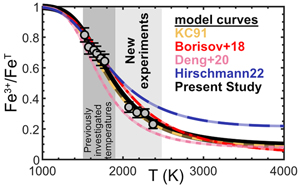
) at temperatures ranging from 1500–4000 K calculated from thermodynamic models that incorporate non-zero values of ΔCP (see Fig. 1). Gray and red stars indicate Fe3+/FeT ratios for Equation 8 at 2500 and 4000 K (Fe3+/FeT = 0.020 and 0.046, respectively). Shaded region reflects 2σ uncertainty on the h-coefficient of Equation 8.top
Acknowledgements
This work was supported by NASA grant 80NSSC21K1826 to UMN, NSF grant EAR-231702 to UMN and IU Indianapolis, and NSF grant EAR-1851684 to IU Indianapolis. XANES analyses were conducted at beamline 4-BM (XFM) at the National Synchrotron Light Source II, a U.S. Department of Energy (DOE) Office of Science User Facility operated for the DOE Office of Science by Brookhaven National Laboratory under Contract No. DE-SC0012704. The authors thank Ryan Tappero for assistance with XANES analyses at 4-BM, and Jennifer Mitchell for assistance with EPMA analyses. This work benefitted from many conversations with Daoheng Wang and from thoughtful reviews by Liz Cottrell and two anonymous referees.
Editor: Francis M. McCubbin
top
References
Aithala, S.P., Lange, R.A., Hirschmann, M.M. (2026) Controls on iron-redox state in martian magmas quantified by Mössbauer spectroscopy, colorimetric wet chemistry, and XANES spectroscopy. Journal of Geophysical Research: Planets 131, e2025JE009148. https://doi.org/10.1029/2025JE009148
 Show in context
 The iron redox speciation, quantified as the Fe3+/Fe2+ ratio, in magmas is primarily controlled by the chemical potential of oxygen (generally quantified by oxygen fugacity, fO2), but also influenced by temperature, pressure, and melt composition. The effects of melt composition have been investigated extensively (e.g., Kress and Carmichael, 1991; Jayasuriya et al., 2004; Righter et al., 2013; Borisov et al., 2018; Aithala et al., 2026) and the effect of pressure has garnered considerable recent attention (Zhang et al., 2017, 2024; Armstrong et al., 2019; Deng et al., 2020; Kuwahara et al., 2023).
View in article
Previous models of Fe3+/Fe2+ in magmas, however, predict significantly different temperature dependencies (e.g., Kress and Carmichael, 1991; Righter et al., 2013; Borisov et al., 2018; Deng et al., 2020; Hirschmann, 2022; Aithala et al., 2026).
View in article
In addition, the few experimental studies designed to isolate the effects of temperature (e.g., Kress and Carmichael, 1988; Moore et al., 1995; Borisov and McCammon, 2010; Aithala et al., 2026) have spanned relatively narrow intervals (≤350 K).
View in article
For the former, one case of interest is redox variations during petrologic evolution of martian basalts, which are more pronounced than their terrestrial equivalents (Herd, 2019; Aithala et al. 2026).
View in article
Experimental studies of Fe redox systematics of Fe-rich, martian-relevant magmas from Righter et al. (2013) and Aithala et al. (2026) found that Fe3+/Fe2+ ratios of these magmas are more sensitive to temperature than Fe-poor silicate liquids. Aithala et al. (2026) concluded that this increased temperature sensitivity could drive significant fO2 increases relative to standard redox buffers during magmatic cooling and hypothesised that this effect could account for a significant fraction of the fO2 increases measured within and across martian basalts.
View in article
Following previous work (e.g., Sack et al., 1981; Kress and Carmichael, 1991; Jayasuriya et al., 2004; Righter et al., 2013, Borisov et al., 2018; Hirschmann, 2022; Aithala et al., 2026), we combine Equations 2 and 4, replace the logfO2 stoichiometric coefficient with an empirical parameter, k, the inverse temperature coefficient from Equation 4 with h, and the term with a simple compositional term, ∑diXi, to yield the expression,
Eq. 5.
View in article
Starting mixes similar to martian basalt Humphrey (McSween et al., 2006; Aithala et al., 2026) were synthesised from high purity reagents for super-liquidus 100 kPa experiments in vertical gas mixing (VF) and aerodynamic-laser-levitation furnace (ALLF) experiments (Table S-1).
View in article
VF experiments, previously reported by Aithala et al. (2026), were equilibrated in air and ALLF experiments were levitated in O2 gas. Experiments were quenched rapidly (SI), with all but one sample (VF271) yielding 100 % glass. Major element compositions of all glasses were determined by EPMA (Table S-2) and Fe3+/Fe2+ ratios were determined by XANES (Table S-3).
View in article
VF glass Fe3+/Fe2+ was also determined with Mössbauer spectroscopy (Aithala et al., 2026), but the ALLF glass was not, as their small masses precluded conventional Mössbauer spectroscopic analyses.
View in article
Data are compared to thermodynamic models from this study (Eqs. 7–9) and previous parameterisations calculated at logfO2 = −0.68, P0 (100 kPa) and average Humphrey composition (Table S-2). KC91 = Kress and Carmichael (1991), J04_10 and J04_12 = Jayasuriya et al., (2004), Eqs. 10 and 12; R13 = Righter et al., (2013), D20 = Deng et al., (2020), H22 = Hirschmann (2022), A26 = Aithala et al., (2026).
View in article
Previous work by Righter et al. (2013) and Aithala et al. (2026) found enhanced temperature sensitivity (i.e. smaller h-coefficient) for martian magmas as compared to models calibrated from terrestrial or simplified-composition silicate liquids.
View in article
The newly regressed h-coefficient of 4894 K from Equation 7 from experiments at 1250–2100 °C is greater than h-coefficient of 3775 K found by Aithala et al.(2026) for the same composition (1250–1500 °C) and significantly exceeds the 1650 K value determined for a shergottitic composition (1300–1500 °C; Righter et al., 2013).
View in article
In addition, the h-coefficient derived from the present study is also consistent with previously investigated compositions despite elevated FeO*, suggesting that compositional influence on the h-coefficient is not supported, despite previous conclusions from Righter et al. (2013) and Aithala et al. (2026).
View in article
We consider the redox evolution of shergottites that have undergone significant fO2 increase during differentiation, as recorded by oxybarometry of early and late crystallised mineral assemblages (Tissint — Castle and Herd, 2017; Northwestern Africa (NWA) 6234 — Gross et al., 2013 ; Northwestern Africa (NWA) 1068/1100 — Herd 2006), and calculate their fO2 evolution from unbuffered, isochemical cooling following the scenario presented in Aithala et al. (2026).
View in article
Aithala et al. (2026), using their martian-magma specific model, found that cooling contributed significant fO2 increases relative to the quartz-fayalite-magnetite (QFM) buffer, accounting for a significant fraction of observed oxidation, minimising the necessary extent of potentially oxidative pressure variation and/or processes affecting magma chemistry including crystallisation, degassing, or assimilation.
View in article
However, application of Equation 8 to model magmatic cooling from liquidus temperature (Aithala et al., 2026) to 1100 °C results in decreases in fO2 relative to QFM of 0.37, 0.39, and 0.37 log units fO2 for Tissint, NWA 6234, and NWA 1068/1100 (Fig. 3).
View in article
This contrasts the Aithala et al. (2026) model and suggests that observed shergottite fO2 increases are entirely a product of pressure variation, crystallisation, and/or other open system processes.
View in article
Comparison of predicted fO2 change during unbuffered, isochemical cooling of shergottite liquids Tissint, NWA 6234, and NWA 1068/1100 from liquidus to 1100 °C as calculated by different models (see Fig. 1) following Aithala et al. (2026).
View in article
Armstrong, K., Frost, D.J., McCammon, C.A., Rubie, D.C., Boffa Ballaran, T. (2019) Deep magma ocean formation set the oxidation state of Earth’s mantle. Science 365, 903–906. https://doi.org/10.1126/science.aax8376
Show in context The iron redox speciation, quantified as the Fe3+/Fe2+ ratio, in magmas is primarily controlled by the chemical potential of oxygen (generally quantified by oxygen fugacity, fO2), but also influenced by temperature, pressure, and melt composition. The effects of melt composition have been investigated extensively (e.g., Kress and Carmichael, 1991; Jayasuriya et al., 2004; Righter et al., 2013; Borisov et al., 2018; Aithala et al., 2026) and the effect of pressure has garnered considerable recent attention (Zhang et al., 2017, 2024; Armstrong et al., 2019; Deng et al., 2020; Kuwahara et al., 2023).
View in article
A modest effect of extreme temperature on magmatic Fe3+/FeT indicates that the increase in Fe3+/FeT ratios found in high temperature-pressure experiments (Armstrong et al., 2019; Kuwahara et al., 2023; Zhang et al., 2024) are owed primarily to the effect of pressure and that models incorporating strong temperature dependent effects on the Fe3+/FeT of the crystallised mantle (Hirschmann, 2022; Zhang et al. 2024) will require re-examination.
View in article
Borisov, A., McCammon, C. (2010) The effect of silica on ferric/ferrous ratio in silicate melts: An experimental study using Mossbauer spectroscopy. American Mineralogist 95, 545–555. https://doi.org/10.2138/am.2010.3217
Show in context In addition, the few experimental studies designed to isolate the effects of temperature (e.g., Kress and Carmichael, 1988; Moore et al., 1995; Borisov and McCammon, 2010; Aithala et al., 2026) have spanned relatively narrow intervals (≤350 K).
View in article
Borisov, A., Behrens, H., Holtz, F. (2018) Ferric/ferrous ratio in silicate melts: A new model for 1 atm data with special emphasis on the effects of melt composition. Contributions to Mineralogy and Petrology 173, 98. https://doi.org/10.1007/s00410-018-1524-8
Show in context The iron redox speciation, quantified as the Fe3+/Fe2+ ratio, in magmas is primarily controlled by the chemical potential of oxygen (generally quantified by oxygen fugacity, fO2), but also influenced by temperature, pressure, and melt composition. The effects of melt composition have been investigated extensively (e.g., Kress and Carmichael, 1991; Jayasuriya et al., 2004; Righter et al., 2013; Borisov et al., 2018; Aithala et al., 2026) and the effect of pressure has garnered considerable recent attention (Zhang et al., 2017, 2024; Armstrong et al., 2019; Deng et al., 2020; Kuwahara et al., 2023).
View in article
Previous models of Fe3+/Fe2+ in magmas, however, predict significantly different temperature dependencies (e.g., Kress and Carmichael, 1991; Righter et al., 2013; Borisov et al., 2018; Deng et al., 2020; Hirschmann, 2022; Aithala et al., 2026).
View in article
Estimates of ΔGT,P0 can be derived empirically from experiments on iron-bearing molten silicates by the simplified expression,
Eq. 3.
where a and b are regressed coefficients (Sack et al. 1981; Kilinc et al. 1983; Borisov et al. 2018).
View in article
Following previous work (e.g., Sack et al., 1981; Kress and Carmichael, 1991; Jayasuriya et al., 2004; Righter et al., 2013, Borisov et al., 2018; Hirschmann, 2022; Aithala et al., 2026), we combine Equations 2 and 4, replace the logfO2 stoichiometric coefficient with an empirical parameter, k, the inverse temperature coefficient from Equation 4 with h, and the term with a simple compositional term, ∑diXi, to yield the expression,
Eq. 5.
View in article
Previous models, parameterised from smaller temperature intervals and not optimised for a martian composition, do not reproduce the s as well as Eqs. 7–9, which are calibrated from the present experiments. However, parameterisations from Kress and Carmichael (1991), Jayasuriya et al. (2004; Eq. 12), and Borisov et al. (2018) match experimental values within experimental uncertainties.
View in article
Castle, N., Herd, C.D.K. (2017) Experimental petrology of the Tissint meteorite: Redox estimates, crystallization curves, and evaluation of petrogenetic models. Meteoritics & Planetary Science 52, 125–146. https://doi.org/10.1111/maps.12739
Show in context We consider the redox evolution of shergottites that have undergone significant fO2 increase during differentiation, as recorded by oxybarometry of early and late crystallised mineral assemblages (Tissint — Castle and Herd, 2017; Northwestern Africa (NWA) 6234 — Gross et al., 2013 ; Northwestern Africa (NWA) 1068/1100 — Herd 2006), and calculate their fO2 evolution from unbuffered, isochemical cooling following the scenario presented in Aithala et al. (2026).
View in article
Cottrell, E., Birner, S.K., Brounce, M., Davis, F.A., Waters, L.E., Kelley, K.A. (2021) Oxygen fugacity across tectonic settings. In: Moretti, R., Neuville, D.R. (Eds.) Magma Redox Geochemistry. American Geophysical Union Geophysical Monograph Series 266, John Wiley & Sons, Inc., Hoboken, NJ, 33–61. https://doi.org/10.1002/9781119473206.ch3
Show in context The redox speciation of multivalent cations, especially iron, has a significant influence on igneous mass transfer and phase equilibria (Cottrell et al., 2021 and references therein).
View in article
Two igneous processes in which the temperature dependence of Fe3+/Fe2+ in magmas is key are redox evolution associated with magmatic cooling and differentiation (Cottrell et al., 2021) and the establishment of oxidised planetary mantles in deep magma oceans (Hirschmann, 2012, 2022; Deng et al., 2020; Henningsen et al., 2025).
View in article
Deng, J., Du, Z., Karki, B.B., Ghosh, D.B., Lee, K.K.M. (2020) A magma ocean origin to divergent redox evolutions of rocky planetary bodies and early atmospheres. Nature Communications 11, 2007. https://doi.org/10.1038/s41467-020-15757-0
Show in context The iron redox speciation, quantified as the Fe3+/Fe2+ ratio, in magmas is primarily controlled by the chemical potential of oxygen (generally quantified by oxygen fugacity, fO2), but also influenced by temperature, pressure, and melt composition. The effects of melt composition have been investigated extensively (e.g., Kress and Carmichael, 1991; Jayasuriya et al., 2004; Righter et al., 2013; Borisov et al., 2018; Aithala et al., 2026) and the effect of pressure has garnered considerable recent attention (Zhang et al., 2017, 2024; Armstrong et al., 2019; Deng et al., 2020; Kuwahara et al., 2023).
View in article
Previous models of Fe3+/Fe2+ in magmas, however, predict significantly different temperature dependencies (e.g., Kress and Carmichael, 1991; Righter et al., 2013; Borisov et al., 2018; Deng et al., 2020; Hirschmann, 2022; Aithala et al., 2026).
View in article
Two igneous processes in which the temperature dependence of Fe3+/Fe2+ in magmas is key are redox evolution associated with magmatic cooling and differentiation (Cottrell et al., 2021) and the establishment of oxidised planetary mantles in deep magma oceans (Hirschmann, 2012, 2022; Deng et al., 2020; Henningsen et al., 2025).
View in article
An expanded version of Equation 3 explicitly accounts for distinct heat capacities (Cp) of FeO and FeO1.5 in molten silicates (Kress and Carmichael, 1991; Jayasuriya et al., 2004; Deng et al., 2020; Hirschmann, 2022):
Eq. 4.
where ΔCP = CPFeO1.5−CPFeO−0.25CPO2 and T0 is a reference temperature (generally 1673 K). The value ΔCP can be derived from calorimetric studies of iron-bearing silicate liquids (27.9 ± 1 0.4 J/K, Stebbins et al., 1984; or 33.25 ± 6.06 J/K, Lange and Navrotsky et al., 1992).
View in article
Data are compared to thermodynamic models from this study (Eqs. 7–9) and previous parameterisations calculated at logfO2 = −0.68, P0 (100 kPa) and average Humphrey composition (Table S-2). KC91 = Kress and Carmichael (1991), J04_10 and J04_12 = Jayasuriya et al., (2004), Eqs. 10 and 12; R13 = Righter et al., (2013), D20 = Deng et al., (2020), H22 = Hirschmann (2022), A26 = Aithala et al., (2026).
View in article
The Jayasuriya et al. (2004; Eq. 10), Righter et al. (2013), and Deng et al. (2020) models yield systematic discrepancies.
View in article
Previous models applied to magma ocean redox (e.g., Deng et al. 2020; Hirschmann, 2022; Zhang et al. 2024, and references therein) reproduce Fe3+/FeT ratios from experiments at lower temperatures (1250–1500 °C), but when extrapolated to magma ocean temperatures, predict dramatically different Fe3+/FeT (Hirschmann, 2022).
View in article
Applied at 100 kPa, 2500–4000 K at 2 logfO2 units below iron-wüstite (IW-2) (logfO2-2500 K = −6.34, logfO2-4000 K = −2.41; Hirschmann, 2021), it predicts Fe3+/FeT ratios of 0.020–0.046 (Fig. 4), similar to that predicted by Kress and Carmichael (1991) (0.019–0.041) and greater than the models of Jayasuriya et al. (2004) Equation 10 (0.0046–0.0050) and Deng et al. (2020) (0.007–0.032).
View in article
Fiquet, G., Gillet, P., Richet, P. (1992) Anharmonicity and high-temperature heat capacity of crystals: the examples of Ca2GeO4, Mg2GeO4 and CaMgGeO4 olivines. Physics and Chemistry of Minerals 18, 469–479. https://doi.org/10.1007/BF00200970
Show in context Potentially, the assumption of a constant ΔCp value is not appropriate, as the effects of anharmonicity may be important at very high temperatures (Fiquet et al., 1992) Although all Equations 7–9 are similarly accurate and precise, we favour Equation 8 for modelling Fe3+/Fe2+ and fO2 systematics at all temperatures as it accounts for a non-zero ΔCp, established from independent calorimetric measurements.
View in article
Gross, J., Filiberto, J., Herd, C.D.K., Daswani, M.M., Schwenzer, S.P., Treiman, A.H. (2013) Petrography, mineral chemistry, and crystallization history of olivine‐phyric shergottite NWA 6234: A new melt composition. Meteoritics & Planetary Science 48, 854–871. https://doi.org/10.1111/maps.12092
Show in context We consider the redox evolution of shergottites that have undergone significant fO2 increase during differentiation, as recorded by oxybarometry of early and late crystallised mineral assemblages (Tissint — Castle and Herd, 2017; Northwestern Africa (NWA) 6234 — Gross et al., 2013 ; Northwestern Africa (NWA) 1068/1100 — Herd 2006), and calculate their fO2 evolution from unbuffered, isochemical cooling following the scenario presented in Aithala et al. (2026).
View in article
Herd, C.D.K. (2006) Insights into the redox history of the NWA 1068/1110 martian basalt from mineral equilibria and vanadium oxybarometry. American Mineralogist 91, 1616–1627. https://doi.org/10.2138/am.2006.2104
Show in context We consider the redox evolution of shergottites that have undergone significant fO2 increase during differentiation, as recorded by oxybarometry of early and late crystallised mineral assemblages (Tissint — Castle and Herd, 2017; Northwestern Africa (NWA) 6234 — Gross et al., 2013 ; Northwestern Africa (NWA) 1068/1100 — Herd 2006), and calculate their fO2 evolution from unbuffered, isochemical cooling following the scenario presented in Aithala et al. (2026).
View in article
Herd, C.D.K. (2019) Reconciling redox: Making spatial and temporal sense of oxygen fugacity variations in martian igneous rocks. 50th Lunar and Planetary Institute Science Conference, Abstract #2746.
Show in context For the former, one case of interest is redox variations during petrologic evolution of martian basalts, which are more pronounced than their terrestrial equivalents (Herd, 2019; Aithala et al. 2026).
View in article
Hirschmann, M.M. (2012) Magma ocean influence on early atmosphere mass and composition. Earth and Planetary Science Letters 341–344, 48–57. https://doi.org/10.1016/j.epsl.2012.06.015
Show in context Two igneous processes in which the temperature dependence of Fe3+/Fe2+ in magmas is key are redox evolution associated with magmatic cooling and differentiation (Cottrell et al., 2021) and the establishment of oxidised planetary mantles in deep magma oceans (Hirschmann, 2012, 2022; Deng et al., 2020; Henningsen et al., 2025).
View in article
Hirschmann, M.M. (2021) Iron-wüstite revisited: A revised calibration accounting for variable stoichiometry and the effects of pressure. Geochimica et Cosmochimica Acta 313, 74–84. https://doi.org/10.1016/j.gca.2021.08.039
Show in context Applied at 100 kPa, 2500–4000 K at 2 logfO2 units below iron-wüstite (IW-2) (logfO2-2500 K = −6.34, logfO2-4000 K = −2.41; Hirschmann, 2021), it predicts Fe3+/FeT ratios of 0.020–0.046 (Fig. 4), similar to that predicted by Kress and Carmichael (1991) (0.019–0.041) and greater than the models of Jayasuriya et al. (2004) Equation 10 (0.0046–0.0050) and Deng et al. (2020) (0.007–0.032).
View in article
Fe3+/FeT ratios predicted for Humphrey silicate liquid at 100 kPa, logfO2 = IW-2 (Hirschmann, 2021) at temperatures ranging from 1500–4000 K calculated from thermodynamic models that incorporate non-zero values of ΔCP (see Fig. 1).
View in article
Hirschmann, M.M. (2022) Magma oceans, iron and chromium redox, and the origin of comparatively oxidized planetary mantles. Geochimica et Cosmochimica Acta, 328, 221–241. https://doi.org/10.1016/j.gca.2022.04.005
Show in context Previous models of Fe3+/Fe2+ in magmas, however, predict significantly different temperature dependencies (e.g., Kress and Carmichael, 1991; Righter et al., 2013; Borisov et al., 2018; Deng et al., 2020; Hirschmann, 2022; Aithala et al., 2026).
View in article
Two igneous processes in which the temperature dependence of Fe3+/Fe2+ in magmas is key are redox evolution associated with magmatic cooling and differentiation (Cottrell et al., 2021) and the establishment of oxidised planetary mantles in deep magma oceans (Hirschmann, 2012, 2022; Deng et al., 2020; Henningsen et al., 2025).
View in article
Recent studies pertaining to magma oceans have considered redox conditions in melts equilibrating with core-destined Fe alloy and found, at these extreme conditions (>2500 K), temperature may have a pronounced effect on Fe3+/Fe2+ ratios (Hirschmann, 2022; Henningsen et al., 2025) and may contribute significantly to the relatively oxidised conditions established during Earth’s mantle solidification.
View in article
However, large differences in Fe3+/Fe2+ ratios calculated from different models (Hirschmann, 2022) arise because of uncertainties in extrapolation to high temperature from experimental constraints, which are limited to <1650 °C.
View in article
An expanded version of Equation 3 explicitly accounts for distinct heat capacities (Cp) of FeO and FeO1.5 in molten silicates (Kress and Carmichael, 1991; Jayasuriya et al., 2004; Deng et al., 2020; Hirschmann, 2022):
Eq. 4.
where ΔCP = CPFeO1.5−CPFeO−0.25CPO2 and T0 is a reference temperature (generally 1673 K). The value ΔCP can be derived from calorimetric studies of iron-bearing silicate liquids (27.9 ± 1 0.4 J/K, Stebbins et al., 1984; or 33.25 ± 6.06 J/K, Lange and Navrotsky et al., 1992).
View in article
The influence of the ΔCP term on calculated Fe3+/Fe2+ ratios is small at temperatures <1650 °C, but as noted by Hirschmann (2022) can significantly enhance predicted Fe3+/Fe2+ ratios in extrapolations above 2000 K.
View in article
Following previous work (e.g., Sack et al., 1981; Kress and Carmichael, 1991; Jayasuriya et al., 2004; Righter et al., 2013, Borisov et al., 2018; Hirschmann, 2022; Aithala et al., 2026), we combine Equations 2 and 4, replace the logfO2 stoichiometric coefficient with an empirical parameter, k, the inverse temperature coefficient from Equation 4 with h, and the term with a simple compositional term, ∑diXi, to yield the expression,
Eq. 5.
View in article
At constant composition and fO2, we regress 3 weighted-least squares equations: one with a regressed h-coefficient where ΔCp ≡ 0, (Eq. 7), one with a regressed h-coefficient and fixed ΔCp (adopted from Hirschmann, 2022) (Eq. 8), and finally fitting both h- and ΔCp terms (Eq. 9):
Eq. 7.
Eq. 8.
Eq. 9.
View in article
Data are compared to thermodynamic models from this study (Eqs. 7–9) and previous parameterisations calculated at logfO2 = −0.68, P0 (100 kPa) and average Humphrey composition (Table S-2). KC91 = Kress and Carmichael (1991), J04_10 and J04_12 = Jayasuriya et al., (2004), Eqs. 10 and 12; R13 = Righter et al., (2013), D20 = Deng et al., (2020), H22 = Hirschmann (2022), A26 = Aithala et al., (2026).
View in article
The Hirschmann (2022) model reproduces VF series well but overestimate ALLF
View in article
The Hirschmann (2022) model overestimates are likely the result of low temperature Fe3+/Fe2+ data points being fit with a small h-coefficient combined with superimposition of an independently derived, positive ΔCp term, resulting in positive deviations at elevated temperatures.
View in article
Ultimately, a well defined value of ΔCp may not be resolvable from the present data; i.e. Hirschman (2022) noted that the effects of ΔCp should be pronounced at temperatures well above 2000 K.
View in article
Redox conditions in deep magma oceans may be established at extreme temperatures (>3500 K, Hirschmann, 2022; Henningsen et al., 2025) or yet higher on Super-Earths (Young et al., 2024), and so the effect of elevated temperature on silicate melt Fe3+/FeT at these conditions may be substantial.
View in article
Previous models applied to magma ocean redox (e.g., Deng et al. 2020; Hirschmann, 2022; Zhang et al. 2024, and references therein) reproduce Fe3+/FeT ratios from experiments at lower temperatures (1250–1500 °C), but when extrapolated to magma ocean temperatures, predict dramatically different Fe3+/FeT (Hirschmann, 2022).
View in article
However, the Hirschmann (2022) model predicts significantly greater ratios (0.039–0.116), which are likely not realistic.
View in article
A modest effect of extreme temperature on magmatic Fe3+/FeT indicates that the increase in Fe3+/FeT ratios found in high temperature-pressure experiments (Armstrong et al., 2019; Kuwahara et al., 2023; Zhang et al., 2024) are owed primarily to the effect of pressure and that models incorporating strong temperature dependent effects on the Fe3+/FeT of the crystallised mantle (Hirschmann, 2022; Zhang et al. 2024) will require re-examination.
View in article
Henningsen, E.L., Korenaga, J., Marchi, S. (2025) Impact driven redox stratification of Earth’s mantle. Journal of Geophysical Research: Solid Earth 130, e2024JB030817. https://doi.org/10.1029/2024JB030817
Show in context Two igneous processes in which the temperature dependence of Fe3+/Fe2+ in magmas is key are redox evolution associated with magmatic cooling and differentiation (Cottrell et al., 2021) and the establishment of oxidised planetary mantles in deep magma oceans (Hirschmann, 2012, 2022; Deng et al., 2020; Henningsen et al., 2025).
View in article
Recent studies pertaining to magma oceans have considered redox conditions in melts equilibrating with core-destined Fe alloy and found, at these extreme conditions (>2500 K), temperature may have a pronounced effect on Fe3+/Fe2+ ratios (Hirschmann, 2022; Henningsen et al., 2025) and may contribute significantly to the relatively oxidised conditions established during Earth’s mantle solidification.
View in article
Redox conditions in deep magma oceans may be established at extreme temperatures (>3500 K, Hirschmann, 2022; Henningsen et al., 2025) or yet higher on Super-Earths (Young et al., 2024), and so the effect of elevated temperature on silicate melt Fe3+/FeT at these conditions may be substantial.
View in article
Further, if the temperature dependence of Fe3+/FeT is strong, then the potential temperature of magma ocean may strongly influence the Fe3+/FeT of the resulting solidified mantle (Henningsen et al., 2025).
View in article
Recently, Henningsen et al. (2025) argued that melt-alloy equilibration during alloy rain-out (at super-liquidus conditions) produces significantly greater Fe3+/FeT ratios than equilibration at the base of a MO, at near-liquidus conditions, but this conclusion is based on a strongly temperature dependent model that may not be accurate.
View in article
Jayasuriya, K.D., O’Neill, H.St.C., Berry, A.J., Campbell, S.J. (2004) A Mössbauer study of the oxidation state of Fe in silicate melts. American Mineralogist 89, 1597–1609. https://doi.org/10.2138/am-2004-11-1203
Show in context The iron redox speciation, quantified as the Fe3+/Fe2+ ratio, in magmas is primarily controlled by the chemical potential of oxygen (generally quantified by oxygen fugacity, fO2), but also influenced by temperature, pressure, and melt composition. The effects of melt composition have been investigated extensively (e.g., Kress and Carmichael, 1991; Jayasuriya et al., 2004; Righter et al., 2013; Borisov et al., 2018; Aithala et al., 2026) and the effect of pressure has garnered considerable recent attention (Zhang et al., 2017, 2024; Armstrong et al., 2019; Deng et al., 2020; Kuwahara et al., 2023).
View in article
An expanded version of Equation 3 explicitly accounts for distinct heat capacities (Cp) of FeO and FeO1.5 in molten silicates (Kress and Carmichael, 1991; Jayasuriya et al., 2004; Deng et al., 2020; Hirschmann, 2022):
Eq. 4.
where ΔCP = CPFeO1.5−CPFeO−0.25CPO2 and T0 is a reference temperature (generally 1673 K). The value ΔCP can be derived from calorimetric studies of iron-bearing silicate liquids (27.9 ± 1 0.4 J/K, Stebbins et al., 1984; or 33.25 ± 6.06 J/K, Lange and Navrotsky et al., 1992).
View in article
Following previous work (e.g., Sack et al., 1981; Kress and Carmichael, 1991; Jayasuriya et al., 2004; Righter et al., 2013, Borisov et al., 2018; Hirschmann, 2022; Aithala et al., 2026), we combine Equations 2 and 4, replace the logfO2 stoichiometric coefficient with an empirical parameter, k, the inverse temperature coefficient from Equation 4 with h, and the term with a simple compositional term, ∑diXi, to yield the expression,
Eq. 5.
View in article
Data are compared to thermodynamic models from this study (Eqs. 7–9) and previous parameterisations calculated at logfO2 = −0.68, P0 (100 kPa) and average Humphrey composition (Table S-2). KC91 = Kress and Carmichael (1991), J04_10 and J04_12 = Jayasuriya et al., (2004), Eqs. 10 and 12; R13 = Righter et al., (2013), D20 = Deng et al., (2020), H22 = Hirschmann (2022), A26 = Aithala et al., (2026).
View in article
Previous models, parameterised from smaller temperature intervals and not optimised for a martian composition, do not reproduce the s as well as Eqs. 7–9, which are calibrated from the present experiments. However, parameterisations from Kress and Carmichael (1991), Jayasuriya et al. (2004; Eq. 12), and Borisov et al. (2018) match experimental values within experimental uncertainties.
View in article
The Jayasuriya et al. (2004; Eq. 10), Righter et al. (2013), and Deng et al. (2020) models yield systematic discrepancies.
View in article
Applied at 100 kPa, 2500–4000 K at 2 logfO2 units below iron-wüstite (IW-2) (logfO2-2500 K = −6.34, logfO2-4000 K = −2.41; Hirschmann, 2021), it predicts Fe3+/FeT ratios of 0.020–0.046 (Fig. 4), similar to that predicted by Kress and Carmichael (1991) (0.019–0.041) and greater than the models of Jayasuriya et al. (2004) Equation 10 (0.0046–0.0050) and Deng et al. (2020) (0.007–0.032).
View in article
Kilinc, A., Carmichael, I.S.E., Rivers, M.L., Sack, R.O. (1983) The ferric-ferrous ratio of natural silicate liquids equilibrated in air. Contributions to Mineralogy and Petrology 83, 136–140. https://doi.org/10.1007/bf00373086
Show in context Estimates of ΔGT,P0 can be derived empirically from experiments on iron-bearing molten silicates by the simplified expression,
Eq. 3.
where a and b are regressed coefficients (Sack et al. 1981; Kilinc et al. 1983; Borisov et al. 2018).
View in article
Kress, V.C., Carmichael, I.S.E. (1988) Stoichiometry of the iron oxidation reaction in silicate melts. American Mineralogist 73, 1267–1274.
Show in context In addition, the few experimental studies designed to isolate the effects of temperature (e.g., Kress and Carmichael, 1988; Moore et al., 1995; Borisov and McCammon, 2010; Aithala et al., 2026) have spanned relatively narrow intervals (≤350 K).
View in article
Kress, V.C., Carmichael, I.S.E. (1991) The compressibility of silicate liquids containing Fe2O3 and the effect of composition, temperature, oxygen fugacity and pressure on their redox states. Contributions to Mineralogy and Petrology 108, 82–92. https://doi.org/10.1007/Bf00307328
Show in context The iron redox speciation, quantified as the Fe3+/Fe2+ ratio, in magmas is primarily controlled by the chemical potential of oxygen (generally quantified by oxygen fugacity, fO2), but also influenced by temperature, pressure, and melt composition. The effects of melt composition have been investigated extensively (e.g., Kress and Carmichael, 1991; Jayasuriya et al., 2004; Righter et al., 2013; Borisov et al., 2018; Aithala et al., 2026) and the effect of pressure has garnered considerable recent attention (Zhang et al., 2017, 2024; Armstrong et al., 2019; Deng et al., 2020; Kuwahara et al., 2023).
View in article
Previous models of Fe3+/Fe2+ in magmas, however, predict significantly different temperature dependencies (e.g., Kress and Carmichael, 1991; Righter et al., 2013; Borisov et al., 2018; Deng et al., 2020; Hirschmann, 2022; Aithala et al., 2026).
View in article
An expanded version of Equation 3 explicitly accounts for distinct heat capacities (Cp) of FeO and FeO1.5 in molten silicates (Kress and Carmichael, 1991; Jayasuriya et al., 2004; Deng et al., 2020; Hirschmann, 2022):
Eq. 4.
where ΔCP = CPFeO1.5−CPFeO−0.25CPO2 and T0 is a reference temperature (generally 1673 K). The value ΔCP can be derived from calorimetric studies of iron-bearing silicate liquids (27.9 ± 1 0.4 J/K, Stebbins et al., 1984; or 33.25 ± 6.06 J/K, Lange and Navrotsky et al., 1992).
View in article
Following previous work (e.g., Sack et al., 1981; Kress and Carmichael, 1991; Jayasuriya et al., 2004; Righter et al., 2013, Borisov et al., 2018; Hirschmann, 2022; Aithala et al., 2026), we combine Equations 2 and 4, replace the logfO2 stoichiometric coefficient with an empirical parameter, k, the inverse temperature coefficient from Equation 4 with h, and the term with a simple compositional term, ∑diXi, to yield the expression,
Eq. 5.
View in article
Data are compared to thermodynamic models from this study (Eqs. 7–9) and previous parameterisations calculated at logfO2 = −0.68, P0 (100 kPa) and average Humphrey composition (Table S-2). KC91 = Kress and Carmichael (1991), J04_10 and J04_12 = Jayasuriya et al., (2004), Eqs. 10 and 12; R13 = Righter et al., (2013), D20 = Deng et al., (2020), H22 = Hirschmann (2022), A26 = Aithala et al., (2026).
View in article
Previous models, parameterised from smaller temperature intervals and not optimised for a martian composition, do not reproduce the s as well as Eqs. 7–9, which are calibrated from the present experiments. However, parameterisations from Kress and Carmichael (1991), Jayasuriya et al. (2004; Eq. 12), and Borisov et al. (2018) match experimental values within experimental uncertainties.
View in article
Notably, this model is very similar in both form and values to Kress and Carmichael (1991; h-coefficient = 5235 vs. 4991, ΔCp = 33.25 vs. 27.9 J/K) suggesting that their model extrapolates well to temperatures beyond its calibration dataset.
View in article
Applied at 100 kPa, 2500–4000 K at 2 logfO2 units below iron-wüstite (IW-2) (logfO2-2500 K = −6.34, logfO2-4000 K = −2.41; Hirschmann, 2021), it predicts Fe3+/FeT ratios of 0.020–0.046 (Fig. 4), similar to that predicted by Kress and Carmichael (1991) (0.019–0.041) and greater than the models of Jayasuriya et al. (2004) Equation 10 (0.0046–0.0050) and Deng et al. (2020) (0.007–0.032).
View in article
Kuwahara, H., Nakada, R., Kadoya, S., Yoshino, T., Irifune, T. (2023) Hadean mantle oxidation inferred from melting of peridotite under lower-mantle conditions. Nature Geoscience 16, 461–465. https://doi.org/10.1038/s41561-023-01169-4
Show in context The iron redox speciation, quantified as the Fe3+/Fe2+ ratio, in magmas is primarily controlled by the chemical potential of oxygen (generally quantified by oxygen fugacity, fO2), but also influenced by temperature, pressure, and melt composition. The effects of melt composition have been investigated extensively (e.g., Kress and Carmichael, 1991; Jayasuriya et al., 2004; Righter et al., 2013; Borisov et al., 2018; Aithala et al., 2026) and the effect of pressure has garnered considerable recent attention (Zhang et al., 2017, 2024; Armstrong et al., 2019; Deng et al., 2020; Kuwahara et al., 2023).
View in article
A modest effect of extreme temperature on magmatic Fe3+/FeT indicates that the increase in Fe3+/FeT ratios found in high temperature-pressure experiments (Armstrong et al., 2019; Kuwahara et al., 2023; Zhang et al., 2024) are owed primarily to the effect of pressure and that models incorporating strong temperature dependent effects on the Fe3+/FeT of the crystallised mantle (Hirschmann, 2022; Zhang et al. 2024) will require re-examination.
View in article
Lange, R.A., Navrotsky, A. (1992) Heat capacities of Fe2O3-bearing silicate liquids. Contributions to Mineralogy and Petrology 110, 311–320. https://doi.org/10.1007/BF00310746
Show in context An expanded version of Equation 3 explicitly accounts for distinct heat capacities (Cp) of FeO and FeO1.5 in molten silicates (Kress and Carmichael, 1991; Jayasuriya et al., 2004; Deng et al., 2020; Hirschmann, 2022):
Eq. 4.
where ΔCP = CPFeO1.5−CPFeO−0.25CPO2 and T0 is a reference temperature (generally 1673 K). The value ΔCP can be derived from calorimetric studies of iron-bearing silicate liquids (27.9 ± 1 0.4 J/K, Stebbins et al., 1984; or 33.25 ± 6.06 J/K, Lange and Navrotsky et al., 1992).
View in article
A negative value of ΔCp conflicts with calorimetric studies of Fe-bearing silicate liquids (Stebbins et al., 1984; Lange and Navrotsky, 1992) and this specific value is not statistically significant, nor does its inclusion improve the fit from the linear Equation 7 model from the perspective of reduced chi square (Table S-4).
View in article
McSween, H.Y., Ruff, S.W., Morris, R.V., Bell, J.F., Herkenhoff, K., Gellert, R., Stockstill, K.R., Tornabene, L.L., Squyres, S.W., Crisp, J.A., Christensen, P.R., McCoy, T.J., Mittlefehldt, D.W., Schmidt, M. (2006) Alkaline volcanic rocks from the Columbia Hills, Gusev crater, Mars. Journal of Geophysical Research: Planets 111, E09S91. https://doi.org/10.1029/2006je002698
Show in context Starting mixes similar to martian basalt Humphrey (McSween et al., 2006; Aithala et al., 2026) were synthesised from high purity reagents for super-liquidus 100 kPa experiments in vertical gas mixing (VF) and aerodynamic-laser-levitation furnace (ALLF) experiments (Table S-1).
View in article
Moore, G., Righter, K., Carmichael, I.S.E. The effect of dissolved water on the oxidation state of iron in natural silicate liquids. Contributions to Mineralogy and Petrology 120, 170–179 (1995) https://doi.org/10.1007/BF00287114
Show in context In addition, the few experimental studies designed to isolate the effects of temperature (e.g., Kress and Carmichael, 1988; Moore et al., 1995; Borisov and McCammon, 2010; Aithala et al., 2026) have spanned relatively narrow intervals (≤350 K).
View in article
Righter, K., Danielson, L.R., Pando, K., Morris, R.V., Graff, T.G., Agresti, D.G., Martin, A.M., Sutton, S.R., Newville, M., Lanzirotti, A. (2013) Redox systematics of martian magmas with implications for magnetite stability. American Mineralogist 98, 616–628. https://doi.org/10.2138/am.2013.4251
Show in context The iron redox speciation, quantified as the Fe3+/Fe2+ ratio, in magmas is primarily controlled by the chemical potential of oxygen (generally quantified by oxygen fugacity, fO2), but also influenced by temperature, pressure, and melt composition. The effects of melt composition have been investigated extensively (e.g., Kress and Carmichael, 1991; Jayasuriya et al., 2004; Righter et al., 2013; Borisov et al., 2018; Aithala et al., 2026) and the effect of pressure has garnered considerable recent attention (Zhang et al., 2017, 2024; Armstrong et al., 2019; Deng et al., 2020; Kuwahara et al., 2023).
View in article
Previous models of Fe3+/Fe2+ in magmas, however, predict significantly different temperature dependencies (e.g., Kress and Carmichael, 1991; Righter et al., 2013; Borisov et al., 2018; Deng et al., 2020; Hirschmann, 2022; Aithala et al., 2026).
View in article
Experimental studies of Fe redox systematics of Fe-rich, martian-relevant magmas from Righter et al. (2013) and Aithala et al. (2026) found that Fe3+/Fe2+ ratios of these magmas are more sensitive to temperature than Fe-poor silicate liquids. Aithala et al. (2026) concluded that this increased temperature sensitivity could drive significant fO2 increases relative to standard redox buffers during magmatic cooling and hypothesised that this effect could account for a significant fraction of the fO2 increases measured within and across martian basalts.
View in article
Following previous work (e.g., Sack et al., 1981; Kress and Carmichael, 1991; Jayasuriya et al., 2004; Righter et al., 2013, Borisov et al., 2018; Hirschmann, 2022; Aithala et al., 2026), we combine Equations 2 and 4, replace the logfO2 stoichiometric coefficient with an empirical parameter, k, the inverse temperature coefficient from Equation 4 with h, and the term with a simple compositional term, ∑diXi, to yield the expression,
Eq. 5.
View in article
Data are compared to thermodynamic models from this study (Eqs. 7–9) and previous parameterisations calculated at logfO2 = −0.68, P0 (100 kPa) and average Humphrey composition (Table S-2). KC91 = Kress and Carmichael (1991), J04_10 and J04_12 = Jayasuriya et al., (2004), Eqs. 10 and 12; R13 = Righter et al., (2013), D20 = Deng et al., (2020), H22 = Hirschmann (2022), A26 = Aithala et al., (2026).
View in article
The Jayasuriya et al. (2004; Eq. 10), Righter et al. (2013), and Deng et al. (2020) models yield systematic discrepancies.
View in article
Previous work by Righter et al. (2013) and Aithala et al. (2026) found enhanced temperature sensitivity (i.e. smaller h-coefficient) for martian magmas as compared to models calibrated from terrestrial or simplified-composition silicate liquids.
View in article
The newly regressed h-coefficient of 4894 K from Equation 7 from experiments at 1250–2100 °C is greater than h-coefficient of 3775 K found by Aithala et al.(2026) for the same composition (1250–1500 °C) and significantly exceeds the 1650 K value determined for a shergottitic composition (1300–1500 °C; Righter et al., 2013).
View in article
In addition, the h-coefficient derived from the present study is also consistent with previously investigated compositions despite elevated FeO*, suggesting that compositional influence on the h-coefficient is not supported, despite previous conclusions from Righter et al. (2013) and Aithala et al. (2026).
View in article
Sack, R.O., Carmichael, I.S.E., Rivers, M., Ghiorso, M.S. (1981) Ferric-ferrous equilibria in natural silicate liquids at 1 bar. Contributions to Mineralogy and Petrology 75, 369–376. https://doi.org/10.1007/bf00374720
Show in context Estimates of ΔGT,P0 can be derived empirically from experiments on iron-bearing molten silicates by the simplified expression,
Eq. 3.
where a and b are regressed coefficients (Sack et al. 1981; Kilinc et al. 1983; Borisov et al. 2018).
View in article
Stebbins, J.F., Carmichael, I.S.E., Moret, L.K. (1984) Heat capacities and entropies of silicate liquids and glasses. Contributions to Mineralogy and Petrology 86, 131–148. https://doi.org/10.1007/bf00381840
Show in context An expanded version of Equation 3 explicitly accounts for distinct heat capacities (Cp) of FeO and FeO1.5 in molten silicates (Kress and Carmichael, 1991; Jayasuriya et al., 2004; Deng et al., 2020; Hirschmann, 2022):
Eq. 4.
where ΔCP = CPFeO1.5−CPFeO−0.25CPO2 and T0 is a reference temperature (generally 1673 K). The value ΔCP can be derived from calorimetric studies of iron-bearing silicate liquids (27.9 ± 1 0.4 J/K, Stebbins et al., 1984; or 33.25 ± 6.06 J/K, Lange and Navrotsky et al., 1992).
View in article
A negative value of ΔCp conflicts with calorimetric studies of Fe-bearing silicate liquids (Stebbins et al., 1984; Lange and Navrotsky, 1992) and this specific value is not statistically significant, nor does its inclusion improve the fit from the linear Equation 7 model from the perspective of reduced chi square (Table S-4).
View in article
Young, E.D., Stixrude, L., Rogers, J.G., Schlichting, H.E., Marcum, S.P. (2024) Phase Equilibria of Sub-Neptunes and Super-Earths. The Planetary Science Journal 5, 268. https://doi.org/10.3847/psj/ad8c40
Show in context Redox conditions in deep magma oceans may be established at extreme temperatures (>3500 K, Hirschmann, 2022; Henningsen et al., 2025) or yet higher on Super-Earths (Young et al., 2024), and so the effect of elevated temperature on silicate melt Fe3+/FeT at these conditions may be substantial.
View in article
Zhang, H.L., Hirschmann, M.M., Cottrell, E., Withers, A.C. (2017) Effect of pressure on Fe3+/ΣFe ratio in a mafic magma and consequences for magma ocean redox gradients. Geochimica et Cosmochimica Acta 204, 83–103. https://doi.org/10.1016/j.gca.2017.01.023
Show in context The iron redox speciation, quantified as the Fe3+/Fe2+ ratio, in magmas is primarily controlled by the chemical potential of oxygen (generally quantified by oxygen fugacity, fO2), but also influenced by temperature, pressure, and melt composition. The effects of melt composition have been investigated extensively (e.g., Kress and Carmichael, 1991; Jayasuriya et al., 2004; Righter et al., 2013; Borisov et al., 2018; Aithala et al., 2026) and the effect of pressure has garnered considerable recent attention (Zhang et al., 2017, 2024; Armstrong et al., 2019; Deng et al., 2020; Kuwahara et al., 2023).
View in article
Zhang, H.L., Hirschmann, M.M., Lord, O.T., Rosenthal, A., Yaroslavtsev, S., Cottrell, E., Chumakov, A.I., Walter, M.J. (2024) Ferric iron stabilization at deep magma ocean conditions. Science Advances 10, eadp1752. https://doi.org/10.1126/sciadv.adp1752
Show in context The iron redox speciation, quantified as the Fe3+/Fe2+ ratio, in magmas is primarily controlled by the chemical potential of oxygen (generally quantified by oxygen fugacity, fO2), but also influenced by temperature, pressure, and melt composition. The effects of melt composition have been investigated extensively (e.g., Kress and Carmichael, 1991; Jayasuriya et al., 2004; Righter et al., 2013; Borisov et al., 2018; Aithala et al., 2026) and the effect of pressure has garnered considerable recent attention (Zhang et al., 2017, 2024; Armstrong et al., 2019; Deng et al., 2020; Kuwahara et al., 2023).
View in article
Previous models applied to magma ocean redox (e.g., Deng et al. 2020; Hirschmann, 2022; Zhang et al. 2024, and references therein) reproduce Fe3+/FeT ratios from experiments at lower temperatures (1250–1500 °C), but when extrapolated to magma ocean temperatures, predict dramatically different Fe3+/FeT (Hirschmann, 2022).
View in article
Without it, models calibrated from very high temperature, high pressure — e.g., experiments from Zhang et al. (2024) at 38–71 GPa and 3600–4400 K — could mis-attribute the effects of temperature and pressure.
View in article
A modest effect of extreme temperature on magmatic Fe3+/FeT indicates that the increase in Fe3+/FeT ratios found in high temperature-pressure experiments (Armstrong et al., 2019; Kuwahara et al., 2023; Zhang et al., 2024) are owed primarily to the effect of pressure and that models incorporating strong temperature dependent effects on the Fe3+/FeT of the crystallised mantle (Hirschmann, 2022; Zhang et al. 2024) will require re-examination.
View in article
top
Supplementary Information
The Supplementary Information includes:
- 1. Methods
- 2. Results
- 3. Recalculating experiments to common oxygen fugacity and melt composition
- 4. Applying temperature Equations 7–9 to model silicate liquids of differing compositions and fO2s
- Tables S-1 to S-5
- Figures S-1 to S-3
- Supplementary Information References
Download the Supplementary Information (PDF)
Figures
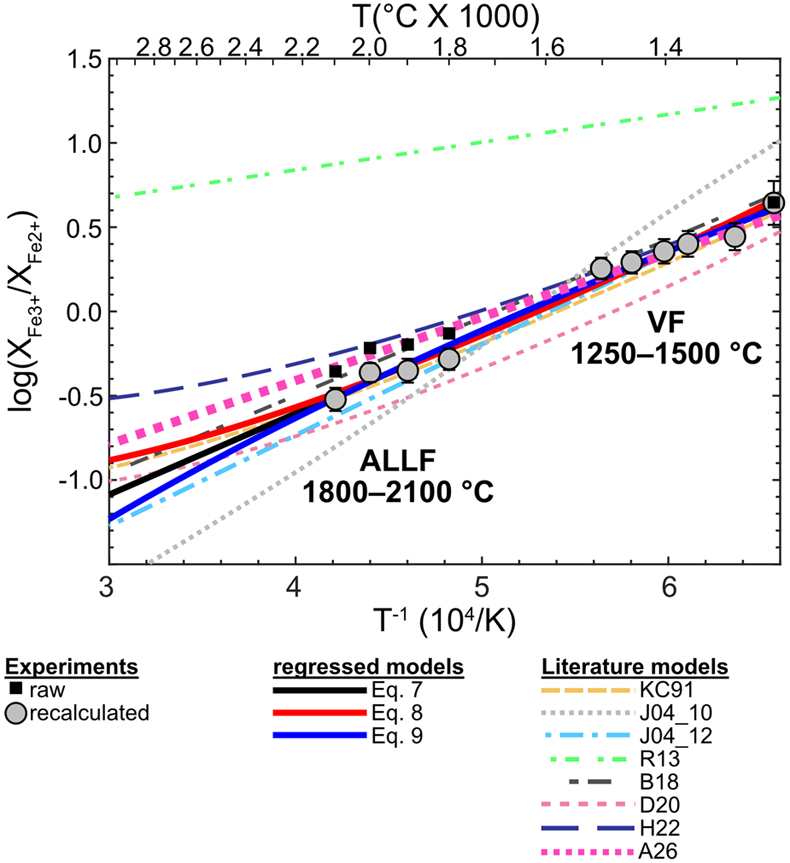
Figure 1 Raw and recalculated
ratios from VF (1250–1500 °C) and ALLF (1800–2100 °C) experimental series versus reciprocal temperature (error bars represent 2σ). Adjustments are made to compare experiments at a common oxygen fugacity and composition (see SI). Data are compared to thermodynamic models from this study (Eqs. 7–9) and previous parameterisations calculated at logfO2 = −0.68, P0 (100 kPa) and average Humphrey composition (Table S-2). KC91 = Kress and Carmichael (1991)Kress, V.C., Carmichael, I.S.E. (1991) The compressibility of silicate liquids containing Fe2O3 and the effect of composition, temperature, oxygen fugacity and pressure on their redox states. Contributions to Mineralogy and Petrology 108, 82–92. https://doi.org/10.1007/Bf00307328
, J04_10 and J04_12 = Jayasuriya et al., (2004)Jayasuriya, K.D., O’Neill, H.St.C., Berry, A.J., Campbell, S.J. (2004) A Mössbauer study of the oxidation state of Fe in silicate melts. American Mineralogist 89, 1597–1609. https://doi.org/10.2138/am-2004-11-1203
, Eqs. 10 and 12; R13 = Righter et al., (2013)Righter, K., Danielson, L.R., Pando, K., Morris, R.V., Graff, T.G., Agresti, D.G., Martin, A.M., Sutton, S.R., Newville, M., Lanzirotti, A. (2013) Redox systematics of martian magmas with implications for magnetite stability. American Mineralogist 98, 616–628. https://doi.org/10.2138/am.2013.4251
, D20 = Deng et al., (2020)Deng, J., Du, Z., Karki, B.B., Ghosh, D.B., Lee, K.K.M. (2020) A magma ocean origin to divergent redox evolutions of rocky planetary bodies and early atmospheres. Nature Communications 11, 2007. https://doi.org/10.1038/s41467-020-15757-0
, H22 = Hirschmann (2022)Hirschmann, M.M. (2022) Magma oceans, iron and chromium redox, and the origin of comparatively oxidized planetary mantles. Geochimica et Cosmochimica Acta, 328, 221–241. https://doi.org/10.1016/j.gca.2022.04.005
, A26 = Aithala et al., (2026)Aithala, S.P., Lange, R.A., Hirschmann, M.M. (2026) Controls on iron-redox state in martian magmas quantified by Mössbauer spectroscopy, colorimetric wet chemistry, and XANES spectroscopy. Journal of Geophysical Research: Planets 131, e2025JE009148. https://doi.org/10.1029/2025JE009148
.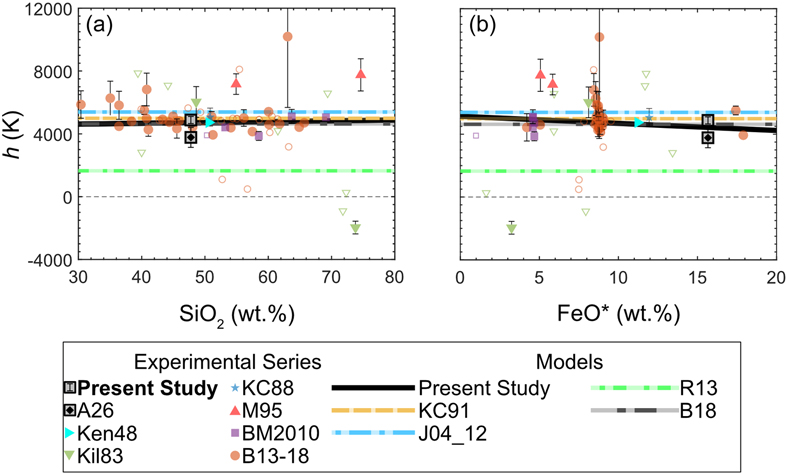
Figure 2 The slope of
versus inverse temperature (h-coefficients) for either series of ≥2 experiments conducted at variable temperature and constant composition and fO2, or from the h-coefficient’s empirical models, as a function of composition ((a) SiO2 and (b) FeO*). Experimental series (data points) are from the present study and others (Table S-5). Models (dashed lines) are from previous studies (see Fig. 1 caption for model source key). Hollow symbols represent the h-coefficients for series comprising two experiments. The solid lines are linear weighted-least squares regressions of h-values vs. wt. % SiO2 (left) (h = 5.095 ± 5.120 X wt. % SiO2 + 4472 ± 302.5; r2 = 0.027) or wt. % FeO* (right) (h = −45.20 ± 17.21 X wt. % FeO + 5141 ± 147.7; r2 = 0.161) to experimental series containing more than two experiments.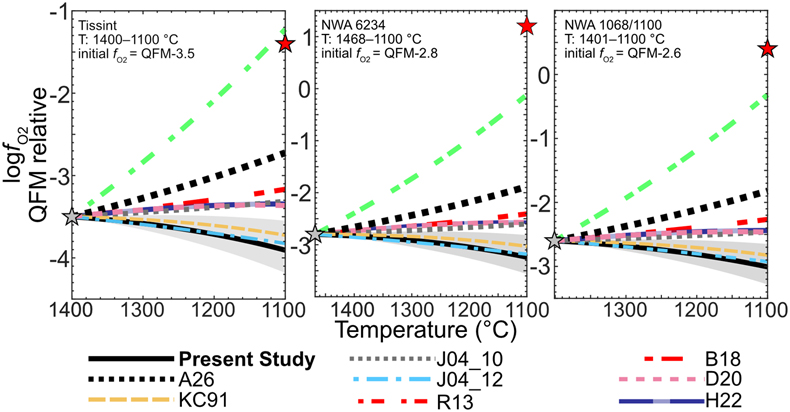
Figure 3 Comparison of predicted fO2 change during unbuffered, isochemical cooling of shergottite liquids Tissint, NWA 6234, and NWA 1068/1100 from liquidus to 1100 °C as calculated by different models (see Fig. 1) following Aithala et al. (2026)
Aithala, S.P., Lange, R.A., Hirschmann, M.M. (2026) Controls on iron-redox state in martian magmas quantified by Mössbauer spectroscopy, colorimetric wet chemistry, and XANES spectroscopy. Journal of Geophysical Research: Planets 131, e2025JE009148. https://doi.org/10.1029/2025JE009148
. Equation 8, the preferred model derived from the present study’s temperature series is shown as a solid black line with shaded area representing 2σ uncertainties (see Fig. S-3 to compare with Eqs. 7 and 9). Gray and red stars indicate fO2s of early and late crystallised assemblages measured in shergottites, respectively.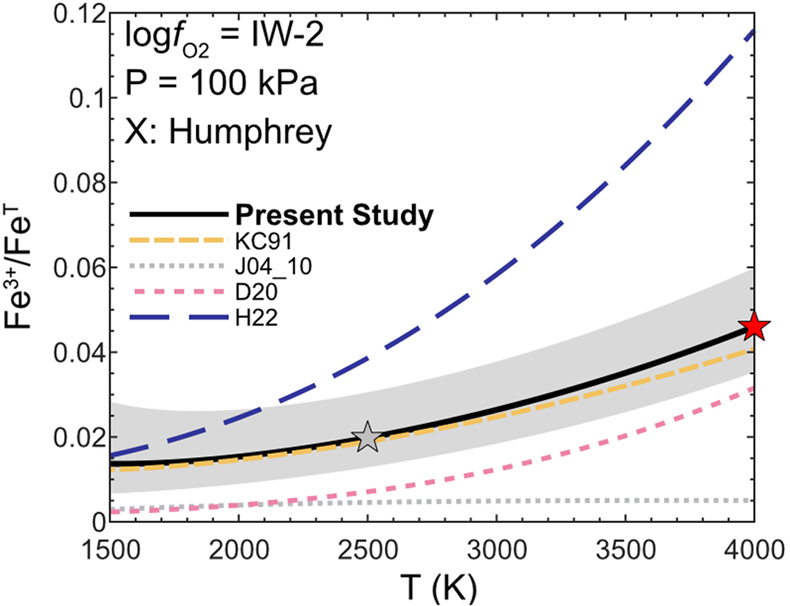
Figure 4 Fe3+/FeT ratios predicted for Humphrey silicate liquid at 100 kPa, logfO2 = IW-2 (Hirschmann, 2021
Hirschmann, M.M. (2021) Iron-wüstite revisited: A revised calibration accounting for variable stoichiometry and the effects of pressure. Geochimica et Cosmochimica Acta 313, 74–84. https://doi.org/10.1016/j.gca.2021.08.039
) at temperatures ranging from 1500–4000 K calculated from thermodynamic models that incorporate non-zero values of ΔCP (see Fig. 1). Gray and red stars indicate Fe3+/FeT ratios for Equation 8 at 2500 and 4000 K (Fe3+/FeT = 0.020 and 0.046, respectively). Shaded region reflects 2σ uncertainty on the h-coefficient of Equation 8.