



Expanding Mars’ lithologic diversity: discovery of a garnet-bearing clast in NWA 8171
Affiliations | Corresponding Author | Cite as | Funding information
Published by the European Association of Geochemistry
under Creative Commons License CC BY-NC-ND 4.0
Keywords: Mars, meteorites, petrology, metamorphism


- Share this article


-
Article views:1,260Cumulative count of HTML views and PDF downloads.
- Download Citation
- Rights & Permissions

top
Abstract
Figures
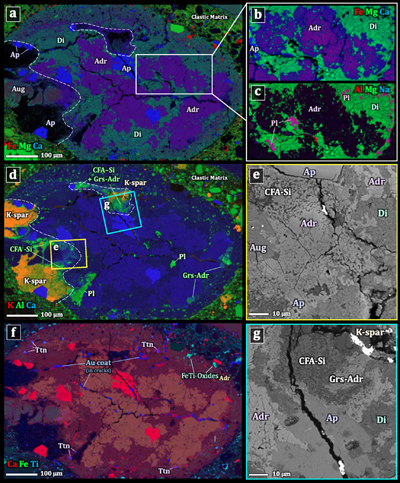 Figure 1 Chemical maps of the garnet-bearing clast. (a) Red-Green-Blue (RGB) map of Fe (R), Mg (G), and Ca (B) with the main phases labelled and the boundary between the domains delineated with white dashed lines. (b) RGB map of Fe (R) contrast stretched to show details, Mg (G), and Ca (B). (c) RGB map of Al (R), Mg (G), and Na (B). (d) RGB map of K (R), Al (G), Ca (B) highlighting feldspars, andradite-grossular and poorly crystalline unidentified Ca-Fe-Al-rich silicates (CFA-Si). (e) BSE image of the contact between the two domains showing irregular intergrowths of Ca-Fe-Al-rich silicates (CFA-Si) with andradite, augite, K-spar, and diopside. (f) RGB map of Ca (R), Fe (G), Ti (B) highlighting the Ti-rich phase occurrences. Some bright blue areas (Ti-rich) are remnant Au-coat in cracks from previous analyses. (g) BSE image of the domain contact area showing CFA-Si, grossular-andradite, diopside, K-spar, apatite, and andradite. | 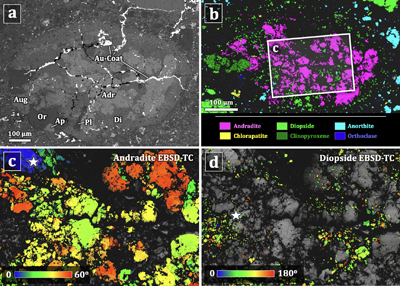 Figure 2 Electron backscatter diffraction (EBSD) of the garnet-bearing clast. (a) BSE image with the main phases labelled, including remnant Au-coat. (b) Phase map of the minerals identified by EBSD (1 μm step size). (c, d) Texture Component (TC) figures showing relative orientations of andradite (c) and diopside (d). EBSD-TC maps display crystallographic mis-orientation relative to defined points of reference (white stars). | 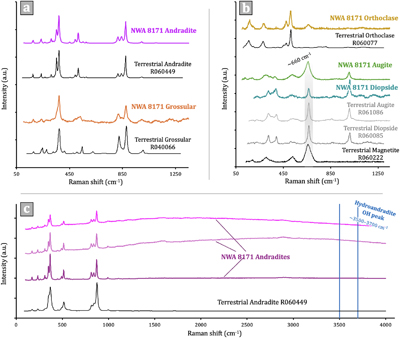 Figure 3 Raman spectroscopy of various minerals in the garnet-bearing clast. Spectra are normalised to 1 and offset for clarity. (a) Representative Raman spectra for garnet in NWA 8171, and (b) other major minerals, with comparisons to the RRUFF database (Lafuente et al., 2016). Potential phases contributing to the ∼660 cm−1 hump in orthoclase are also shown. (c) Raman spectra from 3 andradite point analyses showing the absence of a peak at ∼3500–3700 cm−1 that is typical when hydroandradite (Ca3Fe3+2(SiO4)3−x(OH)4x) is present (i.e. Jenkins et al., 2025). | 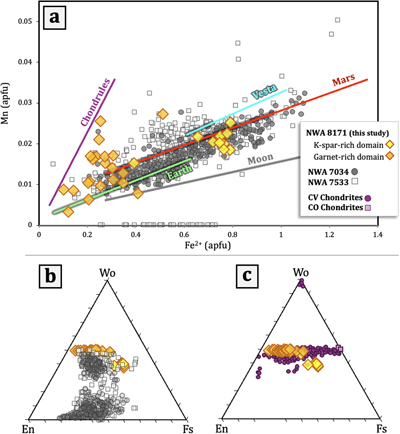 Figure 4 Comparisons between the garnet-bearing clast pyroxene compositions in NWA 8171 and other meteorites. (a) NWA 8171 pyroxene atoms per formula unit (apfu; based on 6 O) Mn and Fe2+ compositions in comparison to pyroxenes in paired martian breccias NWA 7034 and NWA 7533 (data points drawn after Agee et al., 2013, and calculated from Hewins et al., 2017, data; respectively), and other planetary bodies (achondrite trendlines after Papike et al., 2009; chondrules trendline after Papike, 1998). (b) Major element pyroxenes comparisons between NWA 8171, martian regolith breccia pairs NWA 7034 and NWA 7533, and (c) CV and CO chondrites (data points after Ganino and Libourel, 2020 and references therein). Wo = molar CaO/(CaO+MgO+FeOT), En = molar MgO/(CaO+MgO+FeOT), Fs = molar FeOT/(CaO+MgO+FeOT). |
| Figure 1 | Figure 2 | Figure 3 | Figure 4 |
top
Introduction
In order to define the geologic processes that shaped Mars over its 4.5 billion year history, characterising its mineral diversity is essential. At this time, only ∼200 minerals are known or inferred to occur on Mars (Hazen et al., 2023
Hazen, R.M., Downs, R.T., Morrison, S.M., Tutolo, B.M., Blake, D.F., et al. (2023) On the Diversity and Formation Modes of Martian Minerals. Journal of Geophysical Research: Planets 128, e2023JE007865. https://doi.org/10.1029/2023JE007865
); significantly less than the ∼6000 minerals on Earth (Hazen et al., 2008Hazen, R.M., Papineau, D., Bleeker, W., Downs, R.T., Ferry, J.M., McCoy, T.J., Sverjensky, D.A., Yang, H. (2008) Mineral evolution. American Mineralogist 93, 1693–1720. https://doi.org/10.2138/am.2008.2955
). This contrast is mainly attributed to Mars’ lack of plate tectonics, widespread water, and life – at least through most of its history (Hazen et al., 2023Hazen, R.M., Downs, R.T., Morrison, S.M., Tutolo, B.M., Blake, D.F., et al. (2023) On the Diversity and Formation Modes of Martian Minerals. Journal of Geophysical Research: Planets 128, e2023JE007865. https://doi.org/10.1029/2023JE007865
). However, the large differences in mineral diversity between the two planets can also be ascribed to the lack of high resolution mineralogical data from Mars, with only ∼400 martian meteorites and 10 martian landing sites explored in situ (Udry et al., 2020Udry, A., Howarth, G.H., Herd, C.D.K., Day, J.M.D., Lapen, T.J., Filiberto, J. (2020) What Martian Meteorites Reveal About the Interior and Surface of Mars. Journal of Geophysical Research: Planets 125, e2020JE006523. https://doi.org/10.1029/2020JE006523
). As minerals, and the rocks they make up, are products of complex interactions between the lithosphere, atmosphere, hydrosphere, and even biosphere; detailed analyses of newly discovered martian rocks and minerals are crucial for identifying previously unidentified geologic processes.Here, we present the preliminary mineralogical and chemical characterisation of a garnet-bearing rock type in martian meteorite Northwest Africa (NWA) 8171 – the first identification of a garnet-bearing lithology from Mars.
NWA 8171. NWA 8171 is one of 18 martian regolith breccia meteorites, all paired to the same meteorite fall. They are classified as polymict breccias as they comprise a variety of clasts from several different source lithologies embedded in a fine-grained matrix (Agee et al., 2013
Agee, C.B., Wilson, N.V., McCubbin, F.M., Ziegler, K., Polyak, V.J., et al. (2013) Unique Meteorite from Early Amazonian Mars: Water-Rich Basaltic Breccia Northwest Africa 7034. Science 339, 780–785. https://doi.org/10.1126/science.1228858
; Humayun et al., 2013Humayun, M., Nemchin, A., Zanda, B., Hewins, R.H., Grange, M., et al. (2013) Origin and age of the earliest Martian crust from meteorite NWA 7533. Nature 503, 513–516. https://doi.org/10.1038/nature12764
; McCubbin et al., 2016McCubbin, F.M., Boyce, J.W., Novák-Szabó, T., Santos, A.R., Tartèse, R., et al. (2016) Geologic history of Martian regolith breccia Northwest Africa 7034: Evidence for hydrothermal activity and lithologic diversity in the Martian crust. Journal of Geophysical Research: Planets 121, 2120–2149. https://doi.org/10.1002/2016JE005143
; Hewins et al., 2017Hewins, R.H., Zanda, B., Humayun, M., Nemchin, A., Lorand, J.-P., et al. (2017) Regolith breccia Northwest Africa 7533: Mineralogy and petrology with implications for early Mars. Meteoritics & Planetary Science 52, 89–124. https://doi.org/10.1111/maps.12740
). The clasts’ source rocks are most likely from the ancient southern highlands of Mars, with some clasts estimated to be ∼4.4 billion years old (Ga) (Humayun et al., 2013Humayun, M., Nemchin, A., Zanda, B., Hewins, R.H., Grange, M., et al. (2013) Origin and age of the earliest Martian crust from meteorite NWA 7533. Nature 503, 513–516. https://doi.org/10.1038/nature12764
). They were eventually assembled and lithified into a breccia during an impact event ∼1.5 Ga (McCubbin et al., 2016McCubbin, F.M., Boyce, J.W., Novák-Szabó, T., Santos, A.R., Tartèse, R., et al. (2016) Geologic history of Martian regolith breccia Northwest Africa 7034: Evidence for hydrothermal activity and lithologic diversity in the Martian crust. Journal of Geophysical Research: Planets 121, 2120–2149. https://doi.org/10.1002/2016JE005143
). Due to their polymict nature, there are significant heterogeneities between each of the paired stones, providing the opportunity to discover new martian rock types like the recently recognised granitic rock fragments in paired meteorite NWA 7533 (Malarewicz et al., 2025Malarewicz, V., Beyssac, O., Zanda, B., Marin-Carbonne, J., Leroux, H., et al. (2025) Evidence for pre-Noachian granitic rocks on Mars from quartz in meteorite NWA 7533. Nature Geoscience 18, 207–212. https://doi.org/10.1038/s41561-025-01653-z
) and the garnet-bearing rock in NWA 8171 described here. More information on NWA 8171 and paired meteorites is provided in the Supplementary Information (SI).top
Materials and Methods
One grain mount of NWA 8171 (ROMESM58935 from the Royal Ontario Museum) was analysed. No thin sections were available. Mineral compositions, chemical maps, bulk composition estimates, and backscatter electron (BSE) images were acquired using electron microprobe, and scanning electron microscopes. Electron backscattered diffraction (EBSD) maps of the clast, and Raman spectra for the major minerals were also collected. More details on these methods are provided in the SI.
top
Results
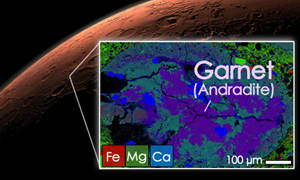
The garnet in NWA 8171 has been identified by Raman, EBSD, and microprobe as andradite (Ca3Fe3+2(SiO4)3) occurring in a rounded clast (∼540 μm × 830 μm) embedded in the meteorite’s matrix (Fig. 1).
Figure 1 Chemical maps of the garnet-bearing clast. (a) Red-Green-Blue (RGB) map of Fe (R), Mg (G), and Ca (B) with the main phases labelled and the boundary between the domains delineated with white dashed lines. (b) RGB map of Fe (R) contrast stretched to show details, Mg (G), and Ca (B). (c) RGB map of Al (R), Mg (G), and Na (B). (d) RGB map of K (R), Al (G), Ca (B) highlighting feldspars, andradite-grossular and poorly crystalline unidentified Ca-Fe-Al-rich silicates (CFA-Si). (e) BSE image of the contact between the two domains showing irregular intergrowths of Ca-Fe-Al-rich silicates (CFA-Si) with andradite, augite, K-spar, and diopside. (f) RGB map of Ca (R), Fe (G), Ti (B) highlighting the Ti-rich phase occurrences. Some bright blue areas (Ti-rich) are remnant Au-coat in cracks from previous analyses. (g) BSE image of the domain contact area showing CFA-Si, grossular-andradite, diopside, K-spar, apatite, and andradite.
The clast comprises two textural and mineralogical domains: an andradite-rich domain with subhedral to anhedral andradites in a fine-grained diopside matrix, and a K-feldspar-rich (K-spar) domain of coarse-grained feldspar and augite. Chlorapatite is a significant component of both domains, and is distinctly euhedral in the K-spar-rich domain. Fine-grained intergrowths of diopside, andradite, grossular, and feldspar occur at the contact between the domains (Fig. 1e,g).
Andradite-rich domain. Microprobe analyses of the andradites indicate they are relatively homogenous (Adr97Grs2.1Prp0.6Sps0.3; mineral abbreviations in Table S-1), although some grains display zoning from Fe3+-rich cores to Ca,Al-rich rims, as well as randomly distributed enrichments of Ca and Al (Adr91.8Grs7.4Prp0.6Sps0.2) (Fig. 1b, Table S-3). The andradite grains also exhibit embayed margins and contain numerous diopside inclusions. Although not detected by microprobe, EDS mapping reveals Al-rich regions at andradite/K-spar and andradite/clast-rim boundaries. Raman spectra from these regions are consistent with andradite and/or grossular, indicating an Al-rich ugrandite garnet is present. These regions were not analysed by microprobe due to their fine grain size (Figs. 1, S-8).
The diopside-rich matrix (En39.2Fs11.8Wo49) exhibits patchy Fe enrichments (En31.1Fs20.2Wo48.7), and also includes several Na-rich plagioclase grains (Ab50.2–72.4An48.2–21.5Or1.6–6). EBSD analysis reveals good crystallinity in the plagioclase, but a significant portion of the diopside-rich matrix is amorphous at the scale of our analyses (1–0.35 μm step size; Fig. 2). Where crystalline, diopside grains are typically <5 μm in size (Fig. 2d). Microprobe analyses of the diopside indicate good pyroxene stoichiometry (pyroxene structural sites [T, M1, M2] all filled as expected; Table S-5) with analytical totals close to 100 % (Table S-3). Apatites in the andradite-rich domain are Cl-rich (3.54–4.55 wt. % Cl) with relatively high Si compositions (average SiO2 = 1.95 ± 1.34 (s.d.) wt. %; Table S-5). The high Si measurements are well correlated with lower totals and higher Mg concentrations, interpreted here as mixtures of chlorapatite and Mg-Si-rich inclusions (likely diopside; Fig. S-2). Apatite EBSD indicates that they are dominantly amorphous, containing sparse, randomly oriented <5 μm fragments of crystalline apatite (Fig. S-2). Due to the wide range of orientations, the apatite halogen abundances reported in Table S-5 should be regarded as qualitative estimates only, as F and Cl X-ray count rates have been shown to vary significantly during microprobe analyses of apatite, and are strongly dependent on crystal orientation (e.g., Stormer et al., 1993
Stormer, J.C., Pierson, M.L., Tacker, R.C. (1993) Variation of F and Cl X-ray intensity due to anisotropic diffusion in apatite during electron microprobe analysis. American Mineralogist 78, 641–648. http://www.minsocam.org/ammin/AM78/AM78_641.pdf
).Figure 2 Electron backscatter diffraction (EBSD) of the garnet-bearing clast. (a) BSE image with the main phases labelled, including remnant Au-coat. (b) Phase map of the minerals identified by EBSD (1 μm step size). (c, d) Texture Component (TC) figures showing relative orientations of andradite (c) and diopside (d). EBSD-TC maps display crystallographic mis-orientation relative to defined points of reference (white stars).
EDS and EBSD mapping illustrate compositional zoning in the fine-grained component of the andradite-rich domain (Figs. S-3, S-5), with an Mg-diopside-rich core; Mg-poor, Fe-Al-rich (garnet- and feldspar-rich) poorly crystalline inner rim; and thin Mg-rich outer rim (likely diopside) in contact with the breccia’s clastic matrix. The fine-grained rim does not extend into the K-spar-rich domain. Fe-Ti oxides are also present in this rim, with trace anhedral 10–20 μm titanite grains (identified by EDS; Figs. 1f, S-4). These Ti-rich phases are also observed at the contact between the andradite-rich and K-spar-rich domains.
K-feldspar-rich domain. The K-spar-rich domain is dominated by Fe-rich augite and K-Na-rich feldspar. The augites exhibit zoning from relatively Fe-rich cores (En21Fs40Wo39) to thin slightly Fe-poor rims (En22Fs37Wo41), although this zoning is more pronounced in EDS maps (Fig. S-3). The feldspars also show evidence of zoning with K-rich rims, and patchy exsolution varying between Ab31An6Or63 and Ab57An7Or36 (Fig. 1d). Apatites in the K-rich domain are slightly more F-rich than those in the andradite-rich domain (average wt. % F = 0.93 ± 0.28 (s.d.) and 0.71 ± 0.07 (s.d.), respectively). EBSD analyses show that the augite grains and the larger apatite grains in the K-spar-rich domain are strongly crystalline, while the feldspar grains are almost entirely amorphous at the scale of the analyses carried out here (1 μm step size; Fig. 2b). However, Raman analyses of the feldspars indicate some crystallinity with strong orthoclase peaks evident in several point measurements, and featureless spectra in others (Fig. 3a). The feldspars in the coarse domain also include numerous Fe, Mg, and Ti-rich inclusions (Fig. 1f), that may be contributing to the ∼660 cm−1 peak in orthoclase Raman spectra (Fig. 3b). The K-rich feldspars also often exhibit slightly lower analytical totals in microprobe analyses (98.5 % on average; Table S-3). Al-enrichments associated with grossular-andradite and/or poorly-crystalline finely intergrown unidentified Ca-Fe-Al silicates with low analytical totals occur at boundaries between K-spars and the andradite-rich domain (Figs. 1, S-8, Table S-3).
Figure 3 Raman spectroscopy of various minerals in the garnet-bearing clast. Spectra are normalised to 1 and offset for clarity. (a) Representative Raman spectra for garnet in NWA 8171, and (b) other major minerals, with comparisons to the RRUFF database (Lafuente et al., 2016
Lafuente, B., Downs, R.T., Yang, H., Stone, N. (2016) 1. The power of databases: The RRUFF project. In: Armbruster, T., Danisi, R.M. (Eds.) Highlights in Mineralogical Crystallography. De Gruyter, Berlin, 1–30. https://doi.org/10.1515/9783110417104-003
). Potential phases contributing to the ∼660 cm−1 hump in orthoclase are also shown. (c) Raman spectra from 3 andradite point analyses showing the absence of a peak at ∼3500–3700 cm−1 that is typical when hydroandradite (Ca3Fe3+2(SiO4)3−x(OH)4x) is present (i.e. Jenkins et al., 2025Jenkins, L.E., Lee, M.R., Daly, L., King, A.J., Chung, P., et al. (2025) Identification of hydroandradite in CM carbonaceous chondrites: A product of calc-silicate alteration on C-complex asteroids. American Mineralogist 110, 1238–1248. https://doi.org/10.2138/am-2024-9389
).top
Discussion and Conclusions
The first identification of a garnet-bearing rock type in a martian meteorite is significant. Notably, garnet is an important metamorphic mineral on Earth (Baxter et al., 2017
Baxter, E.F., Caddick, M.J., Dragovic, B. (2017) Garnet: A Rock-Forming Mineral Petrochronometer. Reviews in Mineralogy and Geochemistry 83, 469–533. https://doi.org/10.2138/rmg.2017.83.15
). Terrestrial andradite garnets are commonly associated with contact metamorphism and metasomatism, occurring with diopside-hedenbergite in skarns or rodingites (Li et al., 2004Li, X.-P., Rahn, M., Bucher, K. (2004) Metamorphic Processes in Rodingites of the Zermatt-Saas Ophiolites. International Geology Review 46, 28–51. https://doi.org/10.2747/0020-6814.46.1.28
; Chiama et al., 2023Chiama, K., Gabor, M., Lupini, I., Rutledge, R., Nord, J.A., et al. (2023) The secret life of garnets: a comprehensive, standardized dataset of garnet geochemical analyses integrating localities and petrogenesis. Earth System Science Data 15, 4235–4259. https://doi.org/10.5194/essd-15-4235-2023
). However, on Mars, the extent and nature of metamorphism remains speculative (McSween, 2015McSween, H.Y. (2015) Petrology on Mars. American Mineralogist 100, 2380–2395. https://doi.org/10.2138/am-2015-5257
), limited to putative identifications of metamorphic phases in orbital spectra such as prehnite, chlorite, and epidote (Ehlmann et al., 2011Ehlmann, B.L., Mustard, J.F., Clark, R.N., Swayze, G.A., Murchie, S.L. (2011) Evidence for Low-Grade Metamorphism, Hydrothermal Alteration, and Diagenesis on Mars from Phyllosilicate Mineral Assemblages. Clays and Clay Minerals 59, 359–377. https://doi.org/10.1346/CCMN.2011.0590402
; Carter et al., 2013Carter, J., Poulet, F., Bibring, J.‐P., Mangold, N., Murchie, S. (2013) Hydrous minerals on Mars as seen by the CRISM and OMEGA imaging spectrometers: Updated global view. Journal of Geophysical Research: Planets 118, 831–858. https://doi.org/10.1029/2012JE004145
), and rare in situ detections of serpentine likely formed by magmatic devolatisation (i.e. Tosca et al., 2025Tosca, N.J., Tice, M.M., Hurowitz, J.A., Pedersen, D.A.K., Henneke, J., et al. (2025) In situ evidence for serpentinization within the Máaz formation, Jezero crater, Mars. Science Advances 11, eadr8793. https://doi.org/10.1126/sciadv.adr8793
).Alternatively, andradite garnets can also crystallise in igneous settings. On Earth, assemblages of andradite, clinopyroxenes, and K-spar similar to those in NWA 8171, have been identified in alkaline igneous rocks (Chiama et al., 2023
Chiama, K., Gabor, M., Lupini, I., Rutledge, R., Nord, J.A., et al. (2023) The secret life of garnets: a comprehensive, standardized dataset of garnet geochemical analyses integrating localities and petrogenesis. Earth System Science Data 15, 4235–4259. https://doi.org/10.5194/essd-15-4235-2023
). Extrusive alkali-rich rocks (trachytes and trachy-andesites) have been identified in martian meteorites and in situ on the martian surface (Payré et al., 2024Payré, V., Udry, A., Fraeman, A.A. (2024) Igneous Diversity of the Early Martian Crust. Minerals 14, 452. https://doi.org/10.3390/min14050452
; Schmidt et al., 2025Schmidt, M.E., Kizovski, T.V., Liu, Y., Hernandez-Montenegro, J.D., Tice, M.M., et al. (2025) Diverse and highly differentiated lava suite in Jezero crater, Mars: Constraints on intracrustal magmatism revealed by Mars 2020 PIXL. Science Advances 11, eadr2613. https://doi.org/10.1126/sciadv.adr2613
). As no garnet has been identified in these rocks, if igneous, the garnet-bearing clast in NWA 8171 could represent a distinct stage of alkali-rich magma differentiation, and/or a previously unrepresented magma source.Since andradite-bearing assemblages can form in a variety of geological environments, here we present a discussion of the possible origins for the garnet-bearing clast in NWA 8171, and the implications for Mars.
Potential origins of the garnet-bearing clast. Firstly, as NWA 8171 is a regolith breccia, it is necessary to consider if the garnet-bearing clast is extra-martian in origin, delivered and incorporated into regolith on the surface of Mars through impacts. While no physical non-martian components have been found in the martian regolith breccia meteorites, elevated siderophile concentrations in these meteorites indicate the incorporation of ∼5 % CI chondritic material (i.e. Humayun et al., 2013
Humayun, M., Nemchin, A., Zanda, B., Hewins, R.H., Grange, M., et al. (2013) Origin and age of the earliest Martian crust from meteorite NWA 7533. Nature 503, 513–516. https://doi.org/10.1038/nature12764
). In addition, numerous meteorites have been found on the surface of Mars by rovers, with 15 classified in the Meteoritical Bulletin (https://www.lpi.usra.edu/meteor/).While the mineralogy of the garnet-bearing clast is not consistent with these meteorites, andradite-bearing assemblages have been identified as secondary metasomatic phases in several carbonaceous chondrites including oxidised CVs (Vigarano-like), COs (Ornans-like), and more rarely, CMs (Murchison-like) (MacPherson and Krot, 2014
MacPherson, G.J., Krot, A.N. (2014) The formation of Ca‐, Fe‐rich silicates in reduced and oxidized CV chondrites: The roles of impact‐modified porosity and permeability, and heterogeneous distribution of water ices. Meteoritics & Planetary Science 49, 1250–1270. https://doi.org/10.1111/maps.12316
; Ganino and Libourel, 2020Ganino, C., Libourel, G. (2020) Fumarolic-like activity on carbonaceous chondrite parent body. Science Advances 6, eabb1166. https://doi.org/10.1126/sciadv.abb1166
; Jenkins et al., 2025Jenkins, L.E., Lee, M.R., Daly, L., King, A.J., Chung, P., et al. (2025) Identification of hydroandradite in CM carbonaceous chondrites: A product of calc-silicate alteration on C-complex asteroids. American Mineralogist 110, 1238–1248. https://doi.org/10.2138/am-2024-9389
). In these chondrites, andradite typically occurs with other Ca-Fe silicates within, or rimming Calcium Aluminum Inclusions (CAIs) and chondrules, but can also be found surrounding dark lithic inclusions, and/or disseminated in matrix material (Krot et al., 1998aKrot, A.N., Petaev, M.I., Scott, E.R.D., Choi, B.-G., Zolensky, M.E., Keil, K. (1998a) Progressive alteration in CV3 chondrites: More evidence for asteroidal alteration. Meteoritics & Planetary Science 33, 1065–1085. https://doi.org/10.1111/j.1945-5100.1998.tb01713.x
, 1998bKrot, A.N., Petaev, M.I., Zolensky, M.E., Keil, K., Scott, E.R.D., Nakamura, K. (1998b) Secondary calcium‐iron‐rich minerals in the Bali‐like and Allende‐like oxidized CV3 chondrites and Allende dark inclusions. Meteoritics & Planetary Science 33, 623–645. https://doi.org/10.1111/j.1945-5100.1998.tb01668.x
; MacPherson and Krot, 2014MacPherson, G.J., Krot, A.N. (2014) The formation of Ca‐, Fe‐rich silicates in reduced and oxidized CV chondrites: The roles of impact‐modified porosity and permeability, and heterogeneous distribution of water ices. Meteoritics & Planetary Science 49, 1250–1270. https://doi.org/10.1111/maps.12316
; Ganino and Libourel, 2020Ganino, C., Libourel, G. (2020) Fumarolic-like activity on carbonaceous chondrite parent body. Science Advances 6, eabb1166. https://doi.org/10.1126/sciadv.abb1166
). Chondritic andradite is most commonly associated with diopside-hedenbergite, wollastonite, and feldspathoids ± sulfides ± metal, with these assemblages occurring as pseudomorphs and replacements of Fe-rich minerals, in veins and cavities, and/or as nodules in the fine grained matrix (Krot et al., 1998aKrot, A.N., Petaev, M.I., Scott, E.R.D., Choi, B.-G., Zolensky, M.E., Keil, K. (1998a) Progressive alteration in CV3 chondrites: More evidence for asteroidal alteration. Meteoritics & Planetary Science 33, 1065–1085. https://doi.org/10.1111/j.1945-5100.1998.tb01713.x
, 1998bKrot, A.N., Petaev, M.I., Zolensky, M.E., Keil, K., Scott, E.R.D., Nakamura, K. (1998b) Secondary calcium‐iron‐rich minerals in the Bali‐like and Allende‐like oxidized CV3 chondrites and Allende dark inclusions. Meteoritics & Planetary Science 33, 623–645. https://doi.org/10.1111/j.1945-5100.1998.tb01668.x
; MacPherson and Krot, 2014MacPherson, G.J., Krot, A.N. (2014) The formation of Ca‐, Fe‐rich silicates in reduced and oxidized CV chondrites: The roles of impact‐modified porosity and permeability, and heterogeneous distribution of water ices. Meteoritics & Planetary Science 49, 1250–1270. https://doi.org/10.1111/maps.12316
; Ganino and Libourel, 2020Ganino, C., Libourel, G. (2020) Fumarolic-like activity on carbonaceous chondrite parent body. Science Advances 6, eabb1166. https://doi.org/10.1126/sciadv.abb1166
).These assemblages are often finer grained than the garnet in NWA 8171, but there are some textural and compositional similarities; with subhedral andradite in CV chondrites often occurring in a fine grained matrix of Ca-Fe-Si-rich minerals (Fig. S-6). Pyroxene major element compositions are also very similar to chondrites (i.e. Fe, Mg, Ca; Fig. 4).
Figure 4 Comparisons between the garnet-bearing clast pyroxene compositions in NWA 8171 and other meteorites. (a) NWA 8171 pyroxene atoms per formula unit (apfu; based on 6 O) Mn and Fe2+ compositions in comparison to pyroxenes in paired martian breccias NWA 7034 and NWA 7533 (data points drawn after Agee et al., 2013
Agee, C.B., Wilson, N.V., McCubbin, F.M., Ziegler, K., Polyak, V.J., et al. (2013) Unique Meteorite from Early Amazonian Mars: Water-Rich Basaltic Breccia Northwest Africa 7034. Science 339, 780–785. https://doi.org/10.1126/science.1228858
, and calculated from Hewins et al., 2017Hewins, R.H., Zanda, B., Humayun, M., Nemchin, A., Lorand, J.-P., et al. (2017) Regolith breccia Northwest Africa 7533: Mineralogy and petrology with implications for early Mars. Meteoritics & Planetary Science 52, 89–124. https://doi.org/10.1111/maps.12740
, data; respectively), and other planetary bodies (achondrite trendlines after Papike et al., 2009Papike, J.J., Karner, J.M., Shearer, C.K., Burger, P.V. (2009) Silicate mineralogy of martian meteorites. Geochimica et Cosmochimica Acta 73, 7443–7485. https://doi.org/10.1016/j.gca.2009.09.008
; chondrules trendline after Papike, 1998Papike, J.J. (1998) Planetary materials. De Gruyter, Berlin. https://doi.org/10.1515/9781501508806
). (b) Major element pyroxenes comparisons between NWA 8171, martian regolith breccia pairs NWA 7034 and NWA 7533, and (c) CV and CO chondrites (data points after Ganino and Libourel, 2020Ganino, C., Libourel, G. (2020) Fumarolic-like activity on carbonaceous chondrite parent body. Science Advances 6, eabb1166. https://doi.org/10.1126/sciadv.abb1166
and references therein). Wo = molar CaO/(CaO+MgO+FeOT), En = molar MgO/(CaO+MgO+FeOT), Fs = molar FeOT/(CaO+MgO+FeOT).In order to further narrow down the origin of the garnet-bearing clast, we also examined pyroxene Mn/Fe ratios (Fig. 4), a commonly used geochemical marker for primary igneous pyroxenes from various planetary bodies (Papike et al., 2009
Papike, J.J., Karner, J.M., Shearer, C.K., Burger, P.V. (2009) Silicate mineralogy of martian meteorites. Geochimica et Cosmochimica Acta 73, 7443–7485. https://doi.org/10.1016/j.gca.2009.09.008
). As shown in Figure 4 and Figure S-7, the Mn/Fe ratios of the pyroxenes in the garnet-bearing clast generally fall in the same range as those from other paired martian breccias, although these values are often between Earth and Mars. The pyroxenes in the garnet-bearing domain however, show significant variation, extending into the compositional fields for chondrites, the Earth, Moon, and Vesta (Fig. 4). While the wide range of Mn/Fe ratios in the pyroxenes from the andradite-rich domain could indicate a different parent body, it could also indicate that this domain formed from secondary alteration processes on Mars. Lower Mn/Fe ratios are often associated with secondary oxidation on Mars (Yen et al., 2010Yen, A.S., Clark, B.C., Ming, D.W., Mittlefehldt, D.W., Gellert, R., Morris, R.V. (2010) Chemical Alteration on Mars Indicated by the Iron-Manganese Ratio. 41st Lunar and Planetary Science Conference, abstract 2546. https://www.lpi.usra.edu/meetings/lpsc2010/pdf/2546.pdf
) and pyroxenes with elevated Mn/Fe ratios have been identified in clast-laden impact melt rocks in other paired breccia samples (Hewins et al., 2017Hewins, R.H., Zanda, B., Humayun, M., Nemchin, A., Lorand, J.-P., et al. (2017) Regolith breccia Northwest Africa 7533: Mineralogy and petrology with implications for early Mars. Meteoritics & Planetary Science 52, 89–124. https://doi.org/10.1111/maps.12740
). The garnet-bearing domain is also intergrown with the K-spar-rich domain (Figs. 1, S-8), which contains augite with martian Mn/Fe ratios. However, Mn/Fe ratios of secondary pyroxenes in carbonaceous chondrites can also overlap with the martian compositional field (Fig. S-7); thus, although a martian origin is likely, Mn/Fe ratios alone cannot definitively rule out an extra-martian origin.Regardless of its parent body, the clast’s precise petrogenesis remains difficult to constrain. Given the small sample size, it is challenging to determine whether the two domains equilibrated under the same conditions. Feldspar thermometry from the K-spar-rich domain indicates a high crystallisation temperature of 900 to 1000 °C (Fig. S-9; after Benisek et al., 2004
Benisek, A., Kroll, H., Cemič, L. (2004) New developments in two-feldspar thermometry. American Mineralogist 89, 1496–1504. https://doi.org/10.2138/am-2004-1018
). The patchy perthitic feldspars, large apatites, and Fe-rich augite with a lack of orthopyroxene in this domain are also somewhat similar to the igneous perthitic and monzonitic clasts in NWA 8171 pairs (Hewins et al., 2017Hewins, R.H., Zanda, B., Humayun, M., Nemchin, A., Lorand, J.-P., et al. (2017) Regolith breccia Northwest Africa 7533: Mineralogy and petrology with implications for early Mars. Meteoritics & Planetary Science 52, 89–124. https://doi.org/10.1111/maps.12740
; Figs. S-10 to S-12). The lack of plagioclase in the K-spar-rich domain, which is common in monzonitic clasts, could be due to sampling bias; or this domain could represent a previously unsampled syenitic lithology. However, Fe-rich augite is relatively rare in martian regolith breccias, and the perthitic exsolution observed here is more subtle in comparison (Fig. S-12).The plagioclase in the andradite-rich domain implies a lower crystallisation temperature <900 °C (Fig. S-9), possibly reflecting later crystallisation or a subsequent alteration process. The lack of obvious hydro-andradite, minimal OH in apatite, and high analytical totals for andradite and diopside indicate that this assemblage formed in relatively anhydrous conditions (Fig. 3c, Table S-3). Secondary andradite-diopside assemblages in aqueously altered carbonaceous chondrites may likewise be anhydrous, likely because they formed at relatively low water/rock ratios (MacPherson and Krot, 2014
MacPherson, G.J., Krot, A.N. (2014) The formation of Ca‐, Fe‐rich silicates in reduced and oxidized CV chondrites: The roles of impact‐modified porosity and permeability, and heterogeneous distribution of water ices. Meteoritics & Planetary Science 49, 1250–1270. https://doi.org/10.1111/maps.12316
).The fine grained corona/rim surrounding the garnet-rich domain may have formed after the original rock was incorporated into the breccia. An impact event could have induced localised reactions and partial recrystallisation of this region through contact with the hot clastic matrix. In contrast, the K-rich domain, representing a higher temperature assemblage, may have been less reactive and therefore less susceptible to overprinting under these conditions.
If we use carbonaceous chondrites as an analogue, the andradite-bearing assemblage in NWA 8171 could have formed on the surface of Mars through localised, low temperature, fluid-assisted thermal metamorphism which dissolved Ca, Fe, Mg, and Si that eventually precipitated as the Ca-Fe-silicate assemblages (Krot et al., 1998a
Krot, A.N., Petaev, M.I., Scott, E.R.D., Choi, B.-G., Zolensky, M.E., Keil, K. (1998a) Progressive alteration in CV3 chondrites: More evidence for asteroidal alteration. Meteoritics & Planetary Science 33, 1065–1085. https://doi.org/10.1111/j.1945-5100.1998.tb01713.x
, 1998bKrot, A.N., Petaev, M.I., Zolensky, M.E., Keil, K., Scott, E.R.D., Nakamura, K. (1998b) Secondary calcium‐iron‐rich minerals in the Bali‐like and Allende‐like oxidized CV3 chondrites and Allende dark inclusions. Meteoritics & Planetary Science 33, 623–645. https://doi.org/10.1111/j.1945-5100.1998.tb01668.x
; MacPherson and Krot, 2014MacPherson, G.J., Krot, A.N. (2014) The formation of Ca‐, Fe‐rich silicates in reduced and oxidized CV chondrites: The roles of impact‐modified porosity and permeability, and heterogeneous distribution of water ices. Meteoritics & Planetary Science 49, 1250–1270. https://doi.org/10.1111/maps.12316
). This process may have replaced minerals within the K-spar-rich domain, with grossular-andradite forming at orthoclase interfaces and andradite + diopside at greater distances from these boundaries. However, the nearly end-member andradite compositions that dominate NWA 8171 are unusual, indicating extremely oxidising conditions.Evidence for such oxidising environments on Mars is abundant. The martian regolith breccia meteorites are considered among the most oxidised martian meteorites due to the presence of maghemite and goethite (Gattacceca et al., 2014
Gattacceca, J., Rochette, P., Scorzelli, R.B., Munayco, P., Agee, C., et al. (2014) Martian meteorites and Martian magnetic anomalies: A new perspective from NWA 7034. Geophysical Research Letters 41, 4859–4864. https://doi.org/10.1002/2014GL060464
). Mn oxides in paired breccia meteorites are also interpreted to have formed in ancient, long term oxidising aqueous environments on Mars (Liu et al., 2021Liu, Y., Fischer, W.W., Ma, C., Beckett, J.R., Tschauner, O., et al. (2021) Manganese oxides in Martian meteorites Northwest Africa (NWA) 7034 and 7533. Icarus 364, 114471. https://doi.org/10.1016/j.icarus.2021.114471
), and orbiters and in situ analyses have identified numerous oxidized phases on the martian surface (i.e. Morris et al., 2006Morris, R.V., Klingelhöfer, G., Schröder, C., Rodionov, D.S., Yen, A., et al. (2006) Mössbauer mineralogy of rock, soil, and dust at Gusev crater, Mars: Spirit’s journey through weakly altered olivine basalt on the plains and pervasively altered basalt in the Columbia Hills. Journal of Geophysical Research: Planets 111, E02S13. https://doi.org/10.1029/2005JE002584
; Bibring et al., 2006Bibring, J.-P., Langevin, Y., Mustard, J.F., Poulet, F., Arvidson, R., et al. (2006) Global Mineralogical and Aqueous Mars History Derived from OMEGA/Mars Express Data. Science 312, 400–404. https://doi.org/10.1126/science.1122659
).Regardless, it is still unclear if the chemistry and textures of the garnet-bearing assemblage represent the conditions at the time of formation, or after shock metamorphism. Given that the clast has been subjected to at least two shock metamorphism events (the breccia forming event, and ejection from Mars), and all major phases show evidence of deformation (Figs. 2, S-13), it is difficult to definitively determine which chemical and structural features retain their original signatures.
Further analyses will be needed to narrow down the origin and implications of the garnet-bearing clast. While destructive analyses have been avoided here due to the rarity of the clast, oxygen isotope measurements will likely be needed to definitively confirm its potential martian origin. However, if martian, the chemical and mineralogical details reported here indicate that the lithological diversity on Mars may be greater than previously assumed. If the andradite-bearing clast is a product of martian metasomatic or metamorphic processes, the clast could record the environmental conditions of ancient hydrothermal systems associated with impacts or intruding plutons (McSween et al., 2015
McSween, H.Y., Labotka, T.C., Viviano‐Beck, C.E. (2015) Metamorphism in the Martian crust. Meteoritics & Planetary Science 50, 590–603. https://doi.org/10.1111/maps.12330
). Alternatively, if it formed at high temperatures, the clast may represent a previously unsampled source or differentiation pathway, potentially providing new insights into Mars’ crustal evolution.top
Acknowledgments
TVK was partially supported by the Dorothy Killam Fellowship awarded to KT. KT was supported by NSERC Discovery Grant 2022-04381. AČ acknowledges Rita Levi Montalcini fellowship (Italian MUR). Analyses at University of Portsmouth were supported by STFC grant ST/S000291/1 to JRD. Joe Dunlop and Geoff Long are thanked for their help collecting EBSD datasets. Yanan Liu and Brian Joy are thanked for helping collect microprobe maps and point measurements. The Mars image in the background of the graphical abstract is credited to JPL-NASA. We are grateful to Dr. Robert Hazen and one anonymous reviewer whose suggestions greatly improved this manuscript. We also thank Dr. Ambre Luguet for editorial handling and guidance.
Editor: Ambre Luguet
top
Declaration of AI Use
During the preparation of this work the author used OpenAI software for grammatical improvements while writing. The author reviewed and edited the resulting minor wording suggestions and takes full responsibility for the content of the publication. No interpretations, figures, or analyses were completed with AI.
top
References
Agee, C.B., Wilson, N.V., McCubbin, F.M., Ziegler, K., Polyak, V.J., et al. (2013) Unique Meteorite from Early Amazonian Mars: Water-Rich Basaltic Breccia Northwest Africa 7034. Science 339, 780–785. https://doi.org/10.1126/science.1228858
 Show in context
 They are classified as polymict breccias as they comprise a variety of clasts from several different source lithologies embedded in a fine-grained matrix (Agee et al., 2013; Humayun et al., 2013; McCubbin et al., 2016; Hewins et al., 2017).
View in article
(a) NWA 8171 pyroxene atoms per formula unit (apfu; based on 6 O) Mn and Fe2+ compositions in comparison to pyroxenes in paired martian breccias NWA 7034 and NWA 7533 (data points drawn after Agee et al., 2013, and calculated from Hewins et al., 2017, data; respectively), and other planetary bodies (achondrite trendlines after Papike et al., 2009; chondrules trendline after Papike, 1998).
View in article
Baxter, E.F., Caddick, M.J., Dragovic, B. (2017) Garnet: A Rock-Forming Mineral Petrochronometer. Reviews in Mineralogy and Geochemistry 83, 469–533. https://doi.org/10.2138/rmg.2017.83.15
Show in context The first identification of a garnet-bearing rock type in a martian meteorite is significant. Notably, garnet is an important metamorphic mineral on Earth (Baxter et al., 2017).
View in article
Benisek, A., Kroll, H., Cemič, L. (2004) New developments in two-feldspar thermometry. American Mineralogist 89, 1496–1504. https://doi.org/10.2138/am-2004-1018
Show in context Feldspar thermometry from the K-spar-rich domain indicates a high crystallisation temperature of 900 to 1000 °C (Fig. S-9; after Benisek et al., 2004).
View in article
Bibring, J.-P., Langevin, Y., Mustard, J.F., Poulet, F., Arvidson, R., et al. (2006) Global Mineralogical and Aqueous Mars History Derived from OMEGA/Mars Express Data. Science 312, 400–404. https://doi.org/10.1126/science.1122659
Show in context Mn oxides in paired breccia meteorites are also interpreted to have formed in ancient, long term oxidising aqueous environments on Mars (Liu et al., 2021), and orbiters and in situ analyses have identified numerous oxidized phases on the martian surface (i.e. Morris et al., 2006; Bibring et al., 2006).
View in article
Carter, J., Poulet, F., Bibring, J.‐P., Mangold, N., Murchie, S. (2013) Hydrous minerals on Mars as seen by the CRISM and OMEGA imaging spectrometers: Updated global view. Journal of Geophysical Research: Planets 118, 831–858. https://doi.org/10.1029/2012JE004145
Show in context However, on Mars, the extent and nature of metamorphism remains speculative (McSween, 2015), limited to putative identifications of metamorphic phases in orbital spectra such as prehnite, chlorite, and epidote (Ehlmann et al., 2011; Carter et al., 2013), and rare in situ detections of serpentine likely formed by magmatic devolatisation (i.e. Tosca et al., 2025).
View in article
Chiama, K., Gabor, M., Lupini, I., Rutledge, R., Nord, J.A., et al. (2023) The secret life of garnets: a comprehensive, standardized dataset of garnet geochemical analyses integrating localities and petrogenesis. Earth System Science Data 15, 4235–4259. https://doi.org/10.5194/essd-15-4235-2023
Show in context Terrestrial andradite garnets are commonly associated with contact metamorphism and metasomatism, occurring with diopside-hedenbergite in skarns or rodingites (Li et al., 2004; Chiama et al., 2023).
View in article
On Earth, assemblages of andradite, clinopyroxenes, and K-spar similar to those in NWA 8171, have been identified in alkaline igneous rocks (Chiama et al., 2023).
View in article
Ehlmann, B.L., Mustard, J.F., Clark, R.N., Swayze, G.A., Murchie, S.L. (2011) Evidence for Low-Grade Metamorphism, Hydrothermal Alteration, and Diagenesis on Mars from Phyllosilicate Mineral Assemblages. Clays and Clay Minerals 59, 359–377. https://doi.org/10.1346/CCMN.2011.0590402
Show in context However, on Mars, the extent and nature of metamorphism remains speculative (McSween, 2015), limited to putative identifications of metamorphic phases in orbital spectra such as prehnite, chlorite, and epidote (Ehlmann et al., 2011; Carter et al., 2013), and rare in situ detections of serpentine likely formed by magmatic devolatisation (i.e. Tosca et al., 2025).
View in article
Ganino, C., Libourel, G. (2020) Fumarolic-like activity on carbonaceous chondrite parent body. Science Advances 6, eabb1166. https://doi.org/10.1126/sciadv.abb1166
Show in context While the mineralogy of the garnet-bearing clast is not consistent with these meteorites, andradite-bearing assemblages have been identified as secondary metasomatic phases in several carbonaceous chondrites including oxidised CVs (Vigarano-like), COs (Ornans-like), and more rarely, CMs (Murchison-like) (MacPherson and Krot, 2014; Ganino and Libourel, 2020; Jenkins et al., 2025).
View in article
In these chondrites, andradite typically occurs with other Ca-Fe silicates within, or rimming Calcium Aluminum Inclusions (CAIs) and chondrules, but can also be found surrounding dark lithic inclusions, and/or disseminated in matrix material (Krot et al., 1998a, 1998b; MacPherson and Krot, 2014; Ganino and Libourel, 2020).
View in article
Chondritic andradite is most commonly associated with diopside-hedenbergite, wollastonite, and feldspathoids ± sulfides ± metal, with these assemblages occurring as pseudomorphs and replacements of Fe-rich minerals, in veins and cavities, and/or as nodules in the fine grained matrix (Krot et al., 1998a, 1998b; MacPherson and Krot, 2014; Ganino and Libourel, 2020.
View in article
(b) Major element pyroxenes comparisons between NWA 8171, martian regolith breccia pairs NWA 7034 and NWA 7533, and (c) CV and CO chondrites (data points after Ganino and Libourel, 2020 and references therein).
View in article
Gattacceca, J., Rochette, P., Scorzelli, R.B., Munayco, P., Agee, C., et al. (2014) Martian meteorites and Martian magnetic anomalies: A new perspective from NWA 7034. Geophysical Research Letters 41, 4859–4864. https://doi.org/10.1002/2014GL060464
Show in context The martian regolith breccia meteorites are considered among the most oxidised martian meteorites due to the presence of maghemite and goethite (Gattacceca et al., 2014).
View in article
Hazen, R.M., Papineau, D., Bleeker, W., Downs, R.T., Ferry, J.M., McCoy, T.J., Sverjensky, D.A., Yang, H. (2008) Mineral evolution. American Mineralogist 93, 1693–1720. https://doi.org/10.2138/am.2008.2955
Show in context At this time, only ∼200 minerals are known or inferred to occur on Mars (Hazen et al., 2023); significantly less than the ∼6000 minerals on Earth (Hazen et al., 2008).
View in article
Hazen, R.M., Downs, R.T., Morrison, S.M., Tutolo, B.M., Blake, D.F., et al. (2023) On the Diversity and Formation Modes of Martian Minerals. Journal of Geophysical Research: Planets 128, e2023JE007865. https://doi.org/10.1029/2023JE007865
Show in context At this time, only ∼200 minerals are known or inferred to occur on Mars (Hazen et al., 2023); significantly less than the ∼6000 minerals on Earth (Hazen et al., 2008).
View in article
This contrast is mainly attributed to Mars’ lack of plate tectonics, widespread water, and life – at least through most of its history (Hazen et al., 2023).
View in article
Hewins, R.H., Zanda, B., Humayun, M., Nemchin, A., Lorand, J.-P., et al. (2017) Regolith breccia Northwest Africa 7533: Mineralogy and petrology with implications for early Mars. Meteoritics & Planetary Science 52, 89–124. https://doi.org/10.1111/maps.12740
Show in context They are classified as polymict breccias as they comprise a variety of clasts from several different source lithologies embedded in a fine-grained matrix (Agee et al., 2013; Humayun et al., 2013; McCubbin et al., 2016; Hewins et al., 2017).
View in article
(a) NWA 8171 pyroxene atoms per formula unit (apfu; based on 6 O) Mn and Fe2+ compositions in comparison to pyroxenes in paired martian breccias NWA 7034 and NWA 7533 (data points drawn after Agee et al., 2013, and calculated from Hewins et al., 2017, data; respectively), and other planetary bodies (achondrite trendlines after Papike et al., 2009; chondrules trendline after Papike, 1998).
View in article
Lower Mn/Fe ratios are often associated with secondary oxidation on Mars (Yen et al., 2010) and pyroxenes with elevated Mn/Fe ratios have been identified in clast-laden impact melt rocks in other paired breccia samples (Hewins et al., 2017).
View in article
The patchy perthitic feldspars, large apatites, and Fe-rich augite with a lack of orthopyroxene in this domain are also somewhat similar to the igneous perthitic and monzonitic clasts in NWA 8171 pairs (Hewins et al., 2017; Figs. S-10 to S-12).
View in article
Humayun, M., Nemchin, A., Zanda, B., Hewins, R.H., Grange, M., et al. (2013) Origin and age of the earliest Martian crust from meteorite NWA 7533. Nature 503, 513–516. https://doi.org/10.1038/nature12764
Show in context They are classified as polymict breccias as they comprise a variety of clasts from several different source lithologies embedded in a fine-grained matrix (Agee et al., 2013; Humayun et al., 2013; McCubbin et al., 2016; Hewins et al., 2017).
View in article
The clasts’ source rocks are most likely from the ancient southern highlands of Mars, with some clasts estimated to be ∼4.4 billion years old (Ga) (Humayun et al., 2013).
View in article
While no physical non-martian components have been found in the martian regolith breccia meteorites, elevated siderophile concentrations in these meteorites indicate the incorporation of ∼5 % CI chondritic material (i.e. Humayun et al., 2013).
View in article
Jenkins, L.E., Lee, M.R., Daly, L., King, A.J., Chung, P., et al. (2025) Identification of hydroandradite in CM carbonaceous chondrites: A product of calc-silicate alteration on C-complex asteroids. American Mineralogist 110, 1238–1248. https://doi.org/10.2138/am-2024-9389
Show in context (c) Raman spectra from 3 andradite point analyses showing the absence of a peak at ∼3500–3700 cm−1 that is typical when hydroandradite (Ca3Fe3+2(SiO4)3−x(OH)4x) is present (i.e. Jenkins et al., 2025).
View in article
While the mineralogy of the garnet-bearing clast is not consistent with these meteorites, andradite-bearing assemblages have been identified as secondary metasomatic phases in several carbonaceous chondrites including oxidised CVs (Vigarano-like), COs (Ornans-like), and more rarely, CMs (Murchison-like) (MacPherson and Krot, 2014; Ganino and Libourel, 2020; Jenkins et al., 2025).
View in article
Krot, A.N., Petaev, M.I., Scott, E.R.D., Choi, B.-G., Zolensky, M.E., Keil, K. (1998a) Progressive alteration in CV3 chondrites: More evidence for asteroidal alteration. Meteoritics & Planetary Science 33, 1065–1085. https://doi.org/10.1111/j.1945-5100.1998.tb01713.x
Show in context In these chondrites, andradite typically occurs with other Ca-Fe silicates within, or rimming Calcium Aluminum Inclusions (CAIs) and chondrules, but can also be found surrounding dark lithic inclusions, and/or disseminated in matrix material (Krot et al., 1998a, 1998b; MacPherson and Krot, 2014; Ganino and Libourel, 2020).
View in article
Chondritic andradite is most commonly associated with diopside-hedenbergite, wollastonite, and feldspathoids ± sulfides ± metal, with these assemblages occurring as pseudomorphs and replacements of Fe-rich minerals, in veins and cavities, and/or as nodules in the fine grained matrix (Krot et al., 1998a, 1998b; MacPherson and Krot, 2014; Ganino and Libourel, 2020.
View in article
If we use carbonaceous chondrites as an analogue, the andradite-bearing assemblage in NWA 8171 could have formed on the surface of Mars through localised, low temperature, fluid-assisted thermal metamorphism which dissolved Ca, Fe, Mg, and Si that eventually precipitated as the Ca-Fe-silicate assemblages (Krot et al., 1998a, 1998b; MacPherson and Krot, 2014).
View in article
Krot, A.N., Petaev, M.I., Zolensky, M.E., Keil, K., Scott, E.R.D., Nakamura, K. (1998b) Secondary calcium‐iron‐rich minerals in the Bali‐like and Allende‐like oxidized CV3 chondrites and Allende dark inclusions. Meteoritics & Planetary Science 33, 623–645. https://doi.org/10.1111/j.1945-5100.1998.tb01668.x
Show in context In these chondrites, andradite typically occurs with other Ca-Fe silicates within, or rimming Calcium Aluminum Inclusions (CAIs) and chondrules, but can also be found surrounding dark lithic inclusions, and/or disseminated in matrix material (Krot et al., 1998a, 1998b; MacPherson and Krot, 2014; Ganino and Libourel, 2020).
View in article
Chondritic andradite is most commonly associated with diopside-hedenbergite, wollastonite, and feldspathoids ± sulfides ± metal, with these assemblages occurring as pseudomorphs and replacements of Fe-rich minerals, in veins and cavities, and/or as nodules in the fine grained matrix (Krot et al., 1998a, 1998b; MacPherson and Krot, 2014; Ganino and Libourel, 2020.
View in article
If we use carbonaceous chondrites as an analogue, the andradite-bearing assemblage in NWA 8171 could have formed on the surface of Mars through localised, low temperature, fluid-assisted thermal metamorphism which dissolved Ca, Fe, Mg, and Si that eventually precipitated as the Ca-Fe-silicate assemblages (Krot et al., 1998a, 1998b; MacPherson and Krot, 2014).
View in article
Lafuente, B., Downs, R.T., Yang, H., Stone, N. (2016) 1. The power of databases: The RRUFF project. In: Armbruster, T., Danisi, R.M. (Eds.) Highlights in Mineralogical Crystallography. De Gruyter, Berlin, 1–30. https://doi.org/10.1515/9783110417104-003
Show in context (a) Representative Raman spectra for garnet in NWA 8171, and (b) other major minerals, with comparisons to the RRUFF database (Lafuente et al., 2016).
View in article
Li, X.-P., Rahn, M., Bucher, K. (2004) Metamorphic Processes in Rodingites of the Zermatt-Saas Ophiolites. International Geology Review 46, 28–51. https://doi.org/10.2747/0020-6814.46.1.28
Show in context Terrestrial andradite garnets are commonly associated with contact metamorphism and metasomatism, occurring with diopside-hedenbergite in skarns or rodingites (Li et al., 2004; Chiama et al., 2023).
View in article
Liu, Y., Fischer, W.W., Ma, C., Beckett, J.R., Tschauner, O., et al. (2021) Manganese oxides in Martian meteorites Northwest Africa (NWA) 7034 and 7533. Icarus 364, 114471. https://doi.org/10.1016/j.icarus.2021.114471
Show in context Mn oxides in paired breccia meteorites are also interpreted to have formed in ancient, long term oxidising aqueous environments on Mars (Liu et al., 2021), and orbiters and in situ analyses have identified numerous oxidized phases on the martian surface (i.e. Morris et al., 2006; Bibring et al., 2006).
View in article
MacPherson, G.J., Krot, A.N. (2014) The formation of Ca‐, Fe‐rich silicates in reduced and oxidized CV chondrites: The roles of impact‐modified porosity and permeability, and heterogeneous distribution of water ices. Meteoritics & Planetary Science 49, 1250–1270. https://doi.org/10.1111/maps.12316
Show in context While the mineralogy of the garnet-bearing clast is not consistent with these meteorites, andradite-bearing assemblages have been identified as secondary metasomatic phases in several carbonaceous chondrites including oxidised CVs (Vigarano-like), COs (Ornans-like), and more rarely, CMs (Murchison-like) (MacPherson and Krot, 2014; Ganino and Libourel, 2020; Jenkins et al., 2025).
View in article
In these chondrites, andradite typically occurs with other Ca-Fe silicates within, or rimming Calcium Aluminum Inclusions (CAIs) and chondrules, but can also be found surrounding dark lithic inclusions, and/or disseminated in matrix material (Krot et al., 1998a, 1998b; MacPherson and Krot, 2014; Ganino and Libourel, 2020).
View in article
Chondritic andradite is most commonly associated with diopside-hedenbergite, wollastonite, and feldspathoids ± sulfides ± metal, with these assemblages occurring as pseudomorphs and replacements of Fe-rich minerals, in veins and cavities, and/or as nodules in the fine grained matrix (Krot et al., 1998a, 1998b; MacPherson and Krot, 2014; Ganino and Libourel, 2020.
View in article
Secondary andradite-diopside assemblages in aqueously altered carbonaceous chondrites may likewise be anhydrous, likely because they formed at relatively low water/rock ratios (MacPherson and Krot, 2014).
View in article
If we use carbonaceous chondrites as an analogue, the andradite-bearing assemblage in NWA 8171 could have formed on the surface of Mars through localised, low temperature, fluid-assisted thermal metamorphism which dissolved Ca, Fe, Mg, and Si that eventually precipitated as the Ca-Fe-silicate assemblages (Krot et al., 1998a, 1998b; MacPherson and Krot, 2014).
View in article
Malarewicz, V., Beyssac, O., Zanda, B., Marin-Carbonne, J., Leroux, H., et al. (2025) Evidence for pre-Noachian granitic rocks on Mars from quartz in meteorite NWA 7533. Nature Geoscience 18, 207–212. https://doi.org/10.1038/s41561-025-01653-z
Show in context Due to their polymict nature, there are significant heterogeneities between each of the paired stones, providing the opportunity to discover new martian rock types like the recently recognised granitic rock fragments in paired meteorite NWA 7533 (Malarewicz et al., 2025) and the garnet-bearing rock in NWA 8171 described here.
View in article
McCubbin, F.M., Boyce, J.W., Novák-Szabó, T., Santos, A.R., Tartèse, R., et al. (2016) Geologic history of Martian regolith breccia Northwest Africa 7034: Evidence for hydrothermal activity and lithologic diversity in the Martian crust. Journal of Geophysical Research: Planets 121, 2120–2149. https://doi.org/10.1002/2016JE005143
Show in context They are classified as polymict breccias as they comprise a variety of clasts from several different source lithologies embedded in a fine-grained matrix (Agee et al., 2013; Humayun et al., 2013; McCubbin et al., 2016; Hewins et al., 2017).
View in article
They were eventually assembled and lithified into a breccia during an impact event ∼1.5 Ga (McCubbin et al., 2016).
View in article
McSween, H.Y. (2015) Petrology on Mars. American Mineralogist 100, 2380–2395. https://doi.org/10.2138/am-2015-5257
Show in context However, on Mars, the extent and nature of metamorphism remains speculative (McSween, 2015), limited to putative identifications of metamorphic phases in orbital spectra such as prehnite, chlorite, and epidote (Ehlmann et al., 2011; Carter et al., 2013), and rare in situ detections of serpentine likely formed by magmatic devolatisation (i.e. Tosca et al., 2025).
View in article
McSween, H.Y., Labotka, T.C., Viviano‐Beck, C.E. (2015) Metamorphism in the Martian crust. Meteoritics & Planetary Science 50, 590–603. https://doi.org/10.1111/maps.12330
Show in context If the andradite-bearing clast is a product of martian metasomatic or metamorphic processes, the clast could record the environmental conditions of ancient hydrothermal systems associated with impacts or intruding plutons (McSween et al., 2015).
View in article
Morris, R.V., Klingelhöfer, G., Schröder, C., Rodionov, D.S., Yen, A., et al. (2006) Mössbauer mineralogy of rock, soil, and dust at Gusev crater, Mars: Spirit’s journey through weakly altered olivine basalt on the plains and pervasively altered basalt in the Columbia Hills. Journal of Geophysical Research: Planets 111, E02S13. https://doi.org/10.1029/2005JE002584
Show in context Mn oxides in paired breccia meteorites are also interpreted to have formed in ancient, long term oxidising aqueous environments on Mars (Liu et al., 2021), and orbiters and in situ analyses have identified numerous oxidized phases on the martian surface (i.e. Morris et al., 2006; Bibring et al., 2006).
View in article
Papike, J.J. (1998) Planetary materials. De Gruyter, Berlin. https://doi.org/10.1515/9781501508806
Show in context (a) NWA 8171 pyroxene atoms per formula unit (apfu; based on 6 O) Mn and Fe2+ compositions in comparison to pyroxenes in paired martian breccias NWA 7034 and NWA 7533 (data points drawn after Agee et al., 2013, and calculated from Hewins et al., 2017, data; respectively), and other planetary bodies (achondrite trendlines after Papike et al., 2009; chondrules trendline after Papike, 1998).
View in article
Papike, J.J., Karner, J.M., Shearer, C.K., Burger, P.V. (2009) Silicate mineralogy of martian meteorites. Geochimica et Cosmochimica Acta 73, 7443–7485. https://doi.org/10.1016/j.gca.2009.09.008
Show in context In order to further narrow down the origin of the garnet-bearing clast, we also examined pyroxene Mn/Fe ratios (Fig. 4), a commonly used geochemical marker for primary igneous pyroxenes from various planetary bodies (Papike et al., 2009).
View in article
(a) NWA 8171 pyroxene atoms per formula unit (apfu; based on 6 O) Mn and Fe2+ compositions in comparison to pyroxenes in paired martian breccias NWA 7034 and NWA 7533 (data points drawn after Agee et al., 2013, and calculated from Hewins et al., 2017, data; respectively), and other planetary bodies (achondrite trendlines after Papike et al., 2009; chondrules trendline after Papike, 1998).
View in article
Payré, V., Udry, A., Fraeman, A.A. (2024) Igneous Diversity of the Early Martian Crust. Minerals 14, 452. https://doi.org/10.3390/min14050452
Show in context Extrusive alkali-rich rocks (trachytes and trachy-andesites) have been identified in martian meteorites and in situ on the martian surface (Payré et al., 2024; Schmidt et al., 2025).
View in article
Schmidt, M.E., Kizovski, T.V., Liu, Y., Hernandez-Montenegro, J.D., Tice, M.M., et al. (2025) Diverse and highly differentiated lava suite in Jezero crater, Mars: Constraints on intracrustal magmatism revealed by Mars 2020 PIXL. Science Advances 11, eadr2613. https://doi.org/10.1126/sciadv.adr2613
Show in context Extrusive alkali-rich rocks (trachytes and trachy-andesites) have been identified in martian meteorites and in situ on the martian surface (Payré et al., 2024; Schmidt et al., 2025).
View in article
Stormer, J.C., Pierson, M.L., Tacker, R.C. (1993) Variation of F and Cl X-ray intensity due to anisotropic diffusion in apatite during electron microprobe analysis. American Mineralogist 78, 641–648. http://www.minsocam.org/ammin/AM78/AM78_641.pdf
Show in context Due to the wide range of orientations, the apatite halogen abundances reported in Table S-5 should be regarded as qualitative estimates only, as F and Cl X-ray count rates have been shown to vary significantly during microprobe analyses of apatite, and are strongly dependent on crystal orientation (e.g., Stormer et al., 1993).
View in article
Tosca, N.J., Tice, M.M., Hurowitz, J.A., Pedersen, D.A.K., Henneke, J., et al. (2025) In situ evidence for serpentinization within the Máaz formation, Jezero crater, Mars. Science Advances 11, eadr8793. https://doi.org/10.1126/sciadv.adr8793
Show in context However, on Mars, the extent and nature of metamorphism remains speculative (McSween, 2015), limited to putative identifications of metamorphic phases in orbital spectra such as prehnite, chlorite, and epidote (Ehlmann et al., 2011; Carter et al., 2013), and rare in situ detections of serpentine likely formed by magmatic devolatisation (i.e. Tosca et al., 2025).
View in article
Udry, A., Howarth, G.H., Herd, C.D.K., Day, J.M.D., Lapen, T.J., Filiberto, J. (2020) What Martian Meteorites Reveal About the Interior and Surface of Mars. Journal of Geophysical Research: Planets 125, e2020JE006523. https://doi.org/10.1029/2020JE006523
Show in context However, the large differences in mineral diversity between the two planets can also be ascribed to the lack of high resolution mineralogical data from Mars, with only ∼400 martian meteorites and 10 martian landing sites explored in situ (Udry et al., 2020).
View in article
Yen, A.S., Clark, B.C., Ming, D.W., Mittlefehldt, D.W., Gellert, R., Morris, R.V. (2010) Chemical Alteration on Mars Indicated by the Iron-Manganese Ratio. 41st Lunar and Planetary Science Conference, abstract 2546. https://www.lpi.usra.edu/meetings/lpsc2010/pdf/2546.pdf
Show in context Lower Mn/Fe ratios are often associated with secondary oxidation on Mars (Yen et al., 2010) and pyroxenes with elevated Mn/Fe ratios have been identified in clast-laden impact melt rocks in other paired breccia samples (Hewins et al., 2017).
View in article
top
Supplementary Information
The Supplementary Information includes:
- Background on NWA 8171
- Detailed Methods
- Table S-1 to S-5
- Figures S-1 to S-13
- Supplementary Information References
Download the Supplementary Information (PDF)
Download Table S-4 (xlsx)
Download Table S-5 (xlsx)
Figures
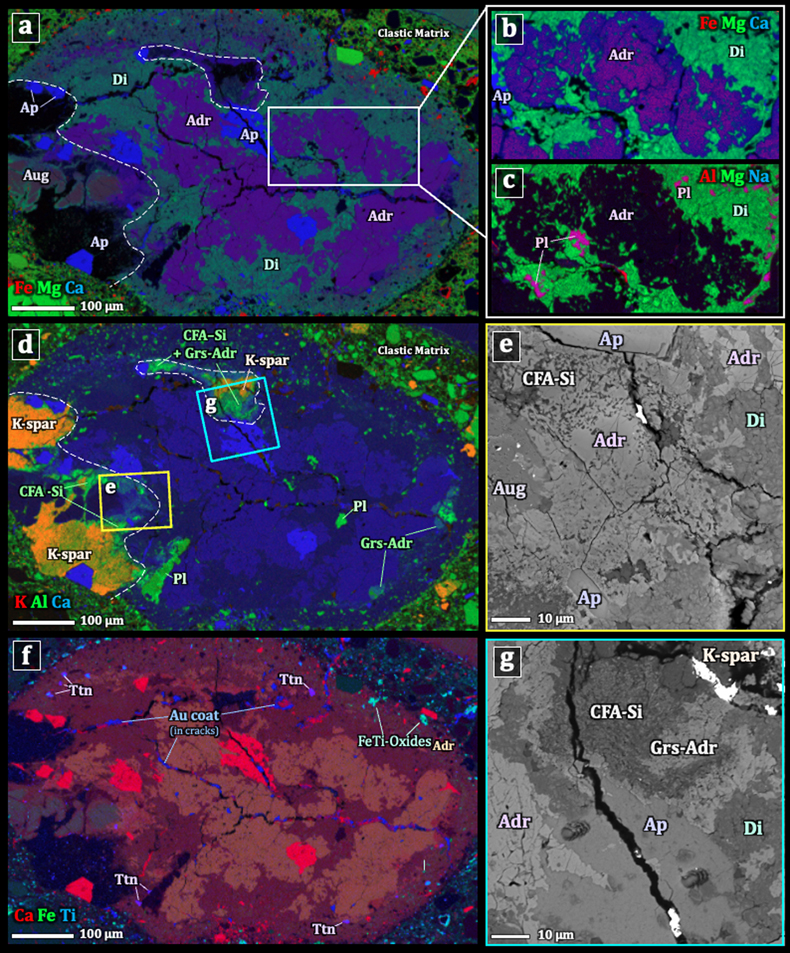
Figure 1 Chemical maps of the garnet-bearing clast. (a) Red-Green-Blue (RGB) map of Fe (R), Mg (G), and Ca (B) with the main phases labelled and the boundary between the domains delineated with white dashed lines. (b) RGB map of Fe (R) contrast stretched to show details, Mg (G), and Ca (B). (c) RGB map of Al (R), Mg (G), and Na (B). (d) RGB map of K (R), Al (G), Ca (B) highlighting feldspars, andradite-grossular and poorly crystalline unidentified Ca-Fe-Al-rich silicates (CFA-Si). (e) BSE image of the contact between the two domains showing irregular intergrowths of Ca-Fe-Al-rich silicates (CFA-Si) with andradite, augite, K-spar, and diopside. (f) RGB map of Ca (R), Fe (G), Ti (B) highlighting the Ti-rich phase occurrences. Some bright blue areas (Ti-rich) are remnant Au-coat in cracks from previous analyses. (g) BSE image of the domain contact area showing CFA-Si, grossular-andradite, diopside, K-spar, apatite, and andradite.
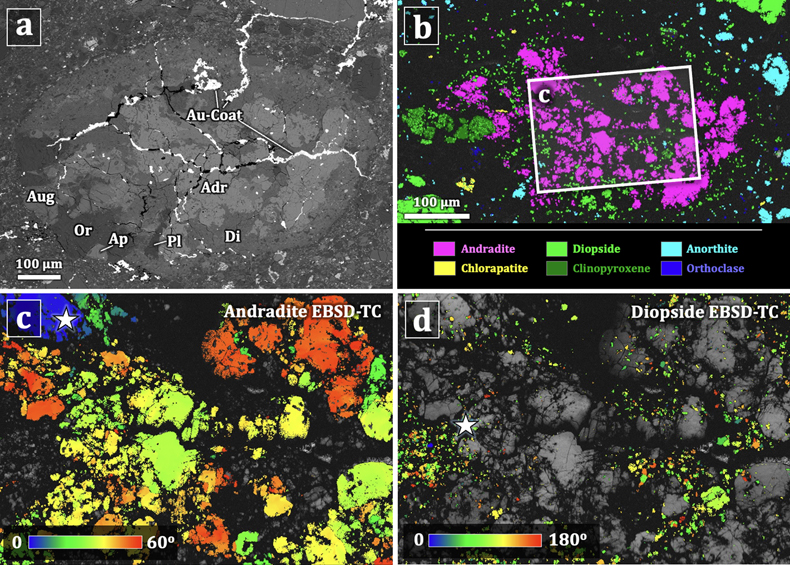
Figure 2 Electron backscatter diffraction (EBSD) of the garnet-bearing clast. (a) BSE image with the main phases labelled, including remnant Au-coat. (b) Phase map of the minerals identified by EBSD (1 μm step size). (c, d) Texture Component (TC) figures showing relative orientations of andradite (c) and diopside (d). EBSD-TC maps display crystallographic mis-orientation relative to defined points of reference (white stars).
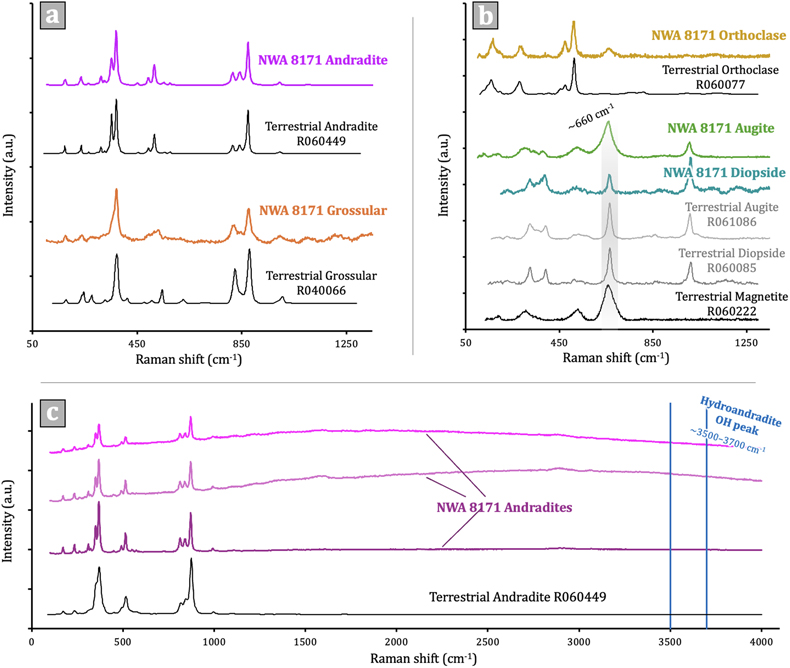
Figure 3 Raman spectroscopy of various minerals in the garnet-bearing clast. Spectra are normalised to 1 and offset for clarity. (a) Representative Raman spectra for garnet in NWA 8171, and (b) other major minerals, with comparisons to the RRUFF database (Lafuente et al., 2016
Lafuente, B., Downs, R.T., Yang, H., Stone, N. (2016) 1. The power of databases: The RRUFF project. In: Armbruster, T., Danisi, R.M. (Eds.) Highlights in Mineralogical Crystallography. De Gruyter, Berlin, 1–30. https://doi.org/10.1515/9783110417104-003
). Potential phases contributing to the ∼660 cm−1 hump in orthoclase are also shown. (c) Raman spectra from 3 andradite point analyses showing the absence of a peak at ∼3500–3700 cm−1 that is typical when hydroandradite (Ca3Fe3+ 2(SiO4)3−x (OH)4x ) is present (i.e. Jenkins et al., 2025Jenkins, L.E., Lee, M.R., Daly, L., King, A.J., Chung, P., et al. (2025) Identification of hydroandradite in CM carbonaceous chondrites: A product of calc-silicate alteration on C-complex asteroids. American Mineralogist 110, 1238–1248. https://doi.org/10.2138/am-2024-9389
).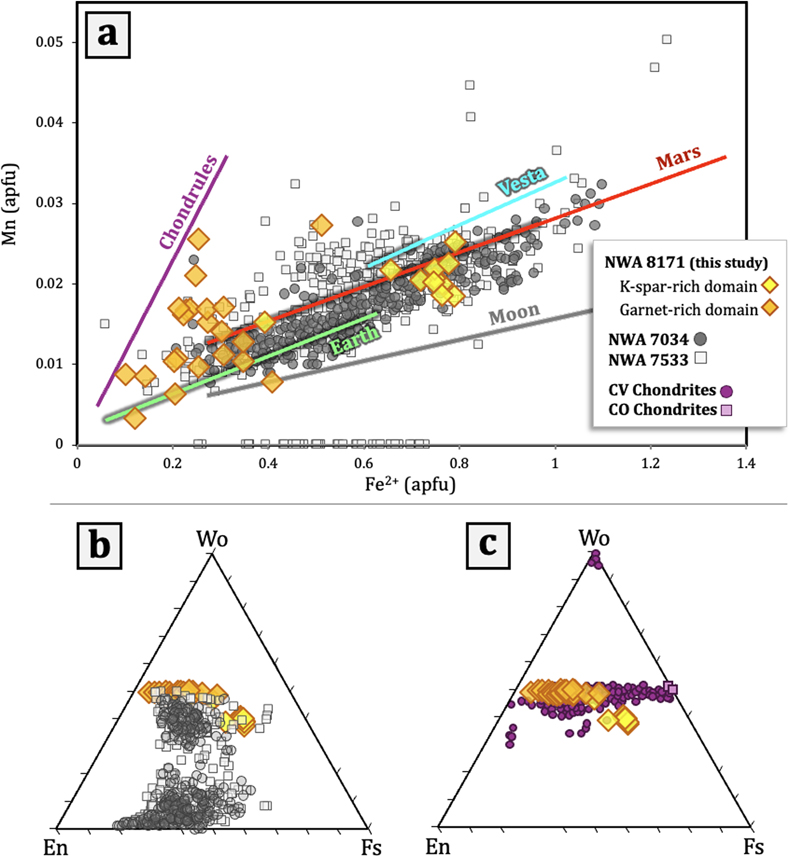
Figure 4 Comparisons between the garnet-bearing clast pyroxene compositions in NWA 8171 and other meteorites. (a) NWA 8171 pyroxene atoms per formula unit (apfu; based on 6 O) Mn and Fe2+ compositions in comparison to pyroxenes in paired martian breccias NWA 7034 and NWA 7533 (data points drawn after Agee et al., 2013
Agee, C.B., Wilson, N.V., McCubbin, F.M., Ziegler, K., Polyak, V.J., et al. (2013) Unique Meteorite from Early Amazonian Mars: Water-Rich Basaltic Breccia Northwest Africa 7034. Science 339, 780–785. https://doi.org/10.1126/science.1228858
, and calculated from Hewins et al., 2017Hewins, R.H., Zanda, B., Humayun, M., Nemchin, A., Lorand, J.-P., et al. (2017) Regolith breccia Northwest Africa 7533: Mineralogy and petrology with implications for early Mars. Meteoritics & Planetary Science 52, 89–124. https://doi.org/10.1111/maps.12740
, data; respectively), and other planetary bodies (achondrite trendlines after Papike et al., 2009Papike, J.J., Karner, J.M., Shearer, C.K., Burger, P.V. (2009) Silicate mineralogy of martian meteorites. Geochimica et Cosmochimica Acta 73, 7443–7485. https://doi.org/10.1016/j.gca.2009.09.008
; chondrules trendline after Papike, 1998Papike, J.J. (1998) Planetary materials. De Gruyter, Berlin. https://doi.org/10.1515/9781501508806
). (b) Major element pyroxenes comparisons between NWA 8171, martian regolith breccia pairs NWA 7034 and NWA 7533, and (c) CV and CO chondrites (data points after Ganino and Libourel, 2020Ganino, C., Libourel, G. (2020) Fumarolic-like activity on carbonaceous chondrite parent body. Science Advances 6, eabb1166. https://doi.org/10.1126/sciadv.abb1166
and references therein). Wo = molar CaO/(CaO+MgO+FeOT), En = molar MgO/(CaO+MgO+FeOT), Fs = molar FeOT/(CaO+MgO+FeOT).