


Geochemical constraints on the use of an amorphous precursor phase by corals
Affiliations | Corresponding Author | Cite as | Funding information
Published by the European Association of Geochemistry
under Creative Commons License CC BY 4.0
Keywords: Coral, biomineralization, ACC


- Share this article


-
Article views:660Cumulative count of HTML views and PDF downloads.
- Download Citation
- Rights & Permissions

top
Abstract
Figures
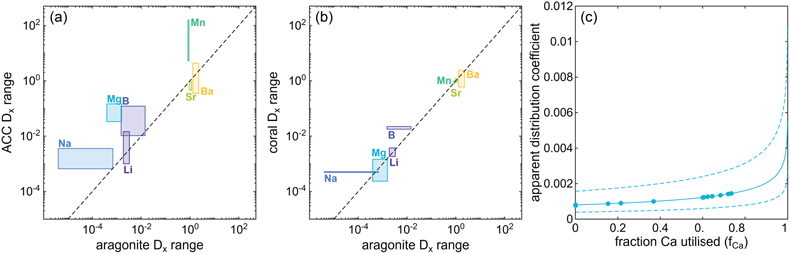
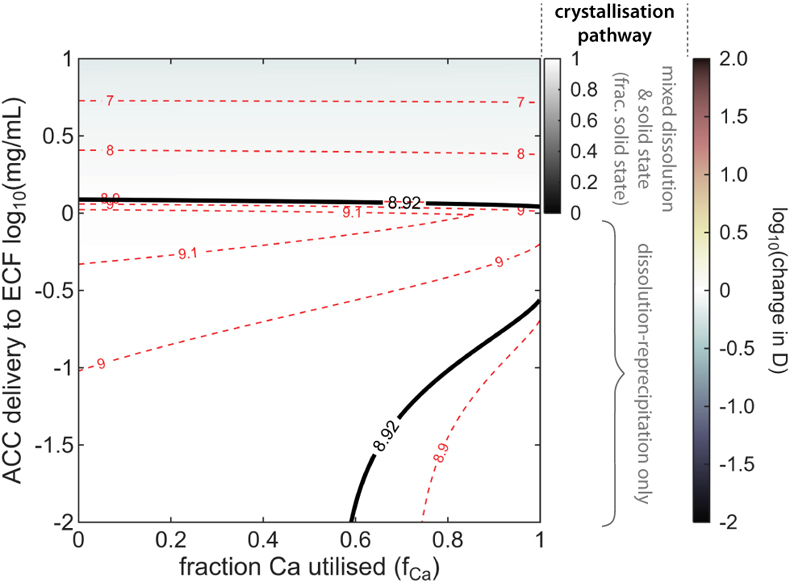
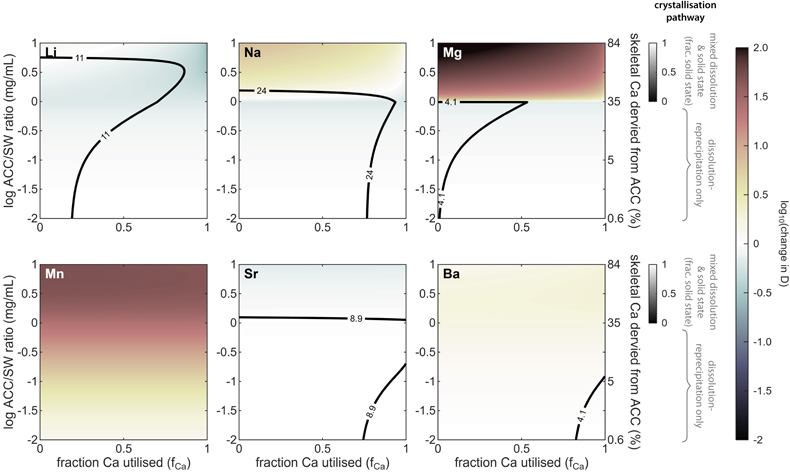
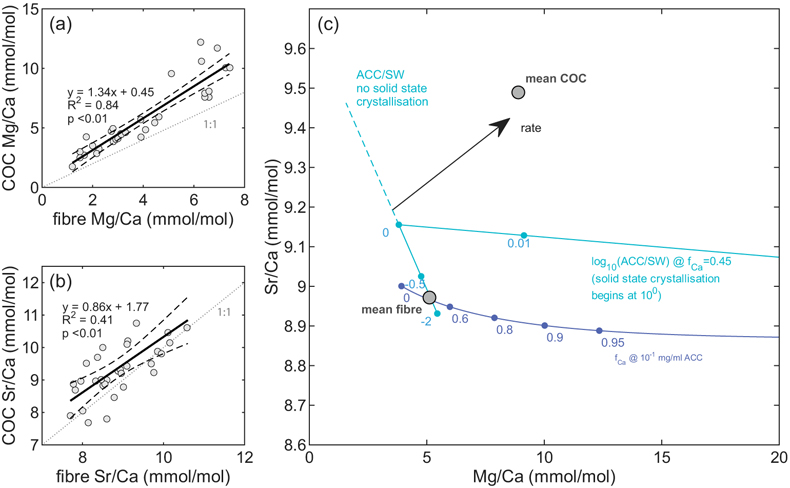
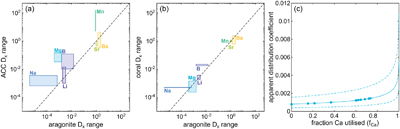 Figure 1 Trace element distribution coefficients in amorphous calcium carbonate (ACC), inorganic aragonite, and coral aragonite, and the impact of Rayleigh fractionation in a closed reservoir on these (see the Supplementary Information for sources). (a) ACC is characterised by trace element distribution coefficients 1–2 orders of magnitude higher than aragonite in many cases (see Evans et al., 2020 for ACC data and the Supplementary Information for aragonite data sources). (b) In contrast, inorganic aragonite precipitated from seawater and coral skeletons are characterised by broadly similar distribution coefficient ranges. (c) A Rayleigh fractionation model demonstrates that the composition of many corals (circles) can be reconciled with the inorganic distribution coefficient and moderate degrees of Ca utilisation. | 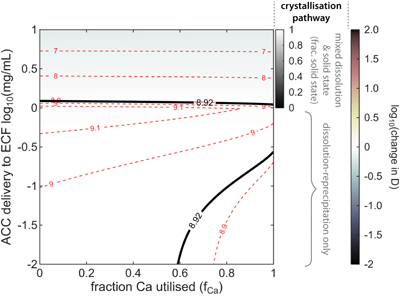 Figure 2 The impact of ACC delivery to the calcification site on coral Sr/Ca. Contours show predicted skeletal Sr/Ca in mmol/mol for a given degree of ACC transport to the calcification site and Rayleigh fractionation (fCa, the proportion of the Ca in a compartment that is consumed), assuming that the inorganic aragonite distribution coefficient otherwise applies. Panel colour shows the predicted change in the apparent distribution coefficient relative to the case of no ACC delivery (where e.g., a value of −1 would indicate a predicted distribution coefficient 1 order of magnitude lower than that had no ACC been present). The model assumes that ACC is fully dissolved and reprecipitated at low ACC/seawater ratios but undergoes increasing degrees of solid state crystallisation at higher ratios, as the solubility limit of ACC is reached (left hand colour bar). The black line shows the mean symbiotic coral fibre Sr/Ca based on our data compilation (Table S-1), indicating a range of parameter space can explain these data. | 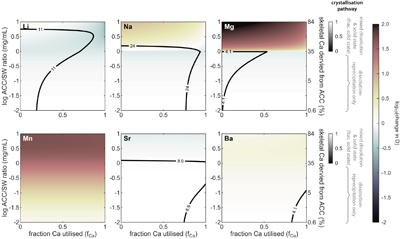 Figure 3 The change in apparent distribution coefficient for a given degree of ACC delivery and Rayleigh fractionation for a suite of commonly analysed trace elements in coral skeletons, relative to the case that no ACC is delivered to the calcification site but an equivalent degree of Rayleigh fractionation. The black lines show the location of the average fibre measurement of all symbiotic corals in our compilation (Table S-1). Most systems (Li, Na, Sr, Ba) have a minor sensitivity to the inclusion of ACC in a trace element model like this, either because the concentration of the element in ACC is very low (Li, Na), or because the ACC and aragonite distribution coefficients are broadly similar (Sr, Ba). In contrast, Mg is a sensitive tracer of the involvement of ACC if crystallisation is a localised or solid state process (log10(ACC/SW) > 100). Note that for all systems except Mn, no substantial change in the apparent distribution coefficient is expected at low to moderate degrees of ACC delivery. Mn is in contrast a sensitive tracer of ACC, notable because any degree of ACC transport results in a model that predicts higher DMn than the (sparse) data (see Fig. 1b) under the assumption of the inorganic distribution coefficients used here. | 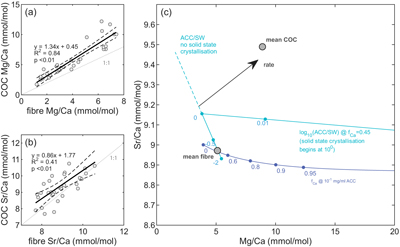 Figure 4 The relationship between COC and fibre Mg/Ca and Sr/Ca, and possible drivers. COC and fibre (a) Mg/Ca and (b) Sr/Ca between samples/species are strongly correlated, with most COC measurements offset to higher values. Least squares linear regressions and 95 % CI are shown in both cases. (c) Mean COC and fibre Mg/Ca and Sr/Ca are offset by ∼4 and ∼0.5 mmol/mol, respectively. The trajectories of Rayleigh fractionation and differential degrees of ACC delivery are overlain, to explore whether change in these processes can explain the different compositions of these skeletal components. While both can explain the higher COC Mg/Ca (the length of the trajectories is greater than the COC/fibre difference), neither can explain the Sr/Ca data. Instead, the trajectory of the kinetic rate effect on Mg and Sr incorporation (black arrow; Gaetani and Cohen, 2006; Mavromatis et al., 2022) suggests that this is the principal driver. |
| Figure 1 | Figure 2 | Figure 3 | Figure 4 |
top
Introduction
The chemical and isotopic composition of coral aragonite act as important tracers of past environment (e.g., Beck et al., 1992
Beck, J.W., Edwards, R.L., Ito, E., Taylor, F.W., Recy, J., Rougerie, F., Joannot, P., Henin, C. (1992) Sea-Surface Temperature from Coral Skeletal Strontium/Calcium Ratios. Science 257, 644–647. https://doi.org/10.1126/science.257.5070.644
). Many of these proxies have roots in thermodynamics or empirical observations (D’Olivo et al., 2019D’Olivo, J.P., Ellwood, G., DeCarlo, T.M., McCulloch, M.T. (2019) Deconvolving the long-term impacts of ocean acidification and warming on coral biomineralisation. Earth and Planetary Science Letters 526, 115785. https://doi.org/10.1016/j.epsl.2019.115785
; Gaetani and Cohen, 2006Gaetani, G.A., Cohen, A.L. (2006) Element partitioning during precipitation of aragonite from seawater: A framework for understanding paleoproxies. Geochimica et Cosmochimica Acta 70, 4617–4634. https://doi.org/10.1016/j.gca.2006.07.008
) but their utility is fundamentally limited by ‘vital effects’ – physiological processes that at least partially decouple skeletal composition from environmental signals and drive species and colony-level variations (Gagnon et al., 2007Gagnon, A.C., Adkins, J.F., Fernandez, D.P., Robinson, L.F. (2007) Sr/Ca and Mg/Ca vital effects correlated with skeletal architecture in a scleractinian deep-sea coral and the role of Rayleigh fractionation. Earth and Planetary Science Letters 261, 280–295. https://doi.org/10.1016/j.epsl.2007.07.013
). While this issue has been known about for as long as biomineral geochemistry has been used in climate reconstruction (Urey et al., 1951Urey, H.C., Lowenstam, H.A., Epstein, S., McKinney, C.R. (1951) Measurement of paleotemperatures and temperatures of the upper Cretaceous of England, Denmark, and the southeastern United States. GSA Bulletin 62, 399–416. https://doi.org/10.1130/0016-7606(1951)62[399:MOPATO]2.0.CO;2
), the mechanistic causes remain poorly constrained (Evans et al., 2025Evans, D., Rickaby, R.E.M., Foster, G.L. (2025) Geochemical Proxy Systems in Marine CaCO3 Biominerals Record Both Environmental Changes and Biomineralisation Processes. Elements 21, 85–91. https://doi.org/10.2138/gselements.21.2.85
).Skeleton formation in the stony (Scleractinian) corals occurs at the interface between the hard aragonite skeleton and the coral polyp in spaces ∼10 μm in size, filled with a seawater derived fluid (Ram and Erez, 2025
Ram, S., Erez, J. (2025) Corals feel the water chemistry: trace elements in coral skeletons reflect accurately their seawater chemistry, biological and geochemical implications. Geochimica et Cosmochimica Acta 400, 142–157. https://doi.org/10.1016/j.gca.2025.05.003
) with a chemistry that is modified to promote CaCO3 precipitation (Sevilgen et al., 2019Sevilgen, D.S., Venn, A.A., Hu, M.Y., Tambutté, E., de Beer, D., Planas-Bielsa, V., Tambutté, S. (2019) Full in vivo characterization of carbonate chemistry at the site of calcification in corals. Science Advances 5, eaau7447. https://doi.org/10.1126/sciadv.aau7447
). Coral skeletons exhibit considerable μm scale chemical heterogeneity (Standish et al., 2024Standish, C.D., Milton, J.A., Page, T.M., Brown, R.M., Douglas, D., Paul, B., Schlatt, L., Foster, G.L. (2024) 2D geochemical imaging of biogenic marine carbonates using LA-TOF-ICP-MS at 1 and 2 μm pixel resolution. Chemical Geology 670, 122438. https://doi.org/10.1016/j.chemgeo.2024.122438
), and are characterised by two microstructural components: i) rapid accretion deposits known as the centres of calcification (COCs) that are organic-rich, and associated with nucleation of new skeleton and accomplish skeletal extension, and ii) the fibrous aragonite thickening deposits that grow more slowly and are organic-poor (Cuif and Dauphin, 2005Cuif, J.-P., Dauphin, Y. (2005) The two-step mode of growth in the scleractinian coral skeletons from the micrometre to the overall scale. Journal of Structural Biology 150, 319–331. https://doi.org/10.1016/j.jsb.2005.03.004
).Recent work has identified a role for amorphous calcium carbonate (ACC) and other metastable precursor phases in the calcification process of corals (e.g., Schmidt et al., 2024
Schmidt, C.A., Tambutté, E., Venn, A.A., Zou, Z., Castillo Alvarez, C., Devriendt, L.S., Bechtel, H.A., Stifler, C.A., Anglemyer, S., Breit, C.P., Foust, C.L., Hopanchuk, A., Klaus, C.N., Kohler, I.J., LeCloux, I.M., Mezera, J., Patton, M.R., Purisch, A., Quach, V., Sengkhammee, J.S., Sristy, T., Vattem, S., Walch, E.J., Albéric, M., Politi, Y., Fratzl, P., Tambutté, S., Gilbert, P.U.P.A. (2024) Myriad Mapping of nanoscale minerals reveals calcium carbonate hemihydrate in forming nacre and coral biominerals. Nature Communications 15, 1812. https://doi.org/10.1038/s41467-024-46117-x
), in common with many other marine calcifying organisms (Gilbert et al., 2022Gilbert, P.U.P.A., Bergmann, K.D., Boekelheide, N., Tambutté, S., Mass, T., Marin, F., Adkins, J.F., Erez, J., Gilbert, B., Knutson, V., Cantine, M., Hernández, J.O., Knoll, A.H. (2022) Biomineralization: Integrating mechanism and evolutionary history. Science Advances 8, eabl9653. https://doi.org/10.1126/sciadv.abl9653
). ACC is broadly characterised by trace element (TE) distribution coefficients (DX) ∼1–2 orders of magnitude higher than aragonite grown by a classical ion-by-ion mechanisms (Fig. 1a; Evans et al., 2020Evans, D., Gray, W.R., Rae, J.W.B., Greenop, R., Webb, P.B., Penkman, K., Kröger, R., Allison, N. (2020) Trace and major element incorporation into amorphous calcium carbonate (ACC) precipitated from seawater. Geochimica et Cosmochimica Acta 290, 293–311. https://doi.org/10.1016/j.gca.2020.08.034
), where:Eq. 1

and X/Ca is the molar concentration of element X relative to Ca in the mineral or in seawater. As such, the observation of ACC at the growing crystal surface is seemingly at odds with our knowledge of coral skeletal chemistry, because inorganic aragonite precipitated from seawater is compositionally similar to coral aragonite for most trace element systems (Fig. 1b) with only minor modifications to the inorganic partition coefficients. For example, kinetic processes (Gaetani and Cohen, 2006
Gaetani, G.A., Cohen, A.L. (2006) Element partitioning during precipitation of aragonite from seawater: A framework for understanding paleoproxies. Geochimica et Cosmochimica Acta 70, 4617–4634. https://doi.org/10.1016/j.gca.2006.07.008
) and Rayleigh fractionation can drive changes in distribution coefficients, in the latter case causing them to trend towards 1 as calcium is utilised in an enclosed reservoir (Fig. 1c; Ram and Erez, 2025Ram, S., Erez, J. (2025) Corals feel the water chemistry: trace elements in coral skeletons reflect accurately their seawater chemistry, biological and geochemical implications. Geochimica et Cosmochimica Acta 400, 142–157. https://doi.org/10.1016/j.gca.2025.05.003
). Together, these processes are sufficient to explain the entirety of the offset of most TE systems from the composition of inorganic aragonite, such that the inclusion of ACC – from a geochemical viewpoint alone – at best appears to be an unnecessary complication in modelling coral skeletal chemistry, and may be difficult to align with our understanding of the chemistry of ACC.Figure 1 Trace element distribution coefficients in amorphous calcium carbonate (ACC), inorganic aragonite, and coral aragonite, and the impact of Rayleigh fractionation in a closed reservoir on these (see the Supplementary Information for sources). (a) ACC is characterised by trace element distribution coefficients 1–2 orders of magnitude higher than aragonite in many cases (see Evans et al., 2020
Evans, D., Gray, W.R., Rae, J.W.B., Greenop, R., Webb, P.B., Penkman, K., Kröger, R., Allison, N. (2020) Trace and major element incorporation into amorphous calcium carbonate (ACC) precipitated from seawater. Geochimica et Cosmochimica Acta 290, 293–311. https://doi.org/10.1016/j.gca.2020.08.034
for ACC data and the Supplementary Information for aragonite data sources). (b) In contrast, inorganic aragonite precipitated from seawater and coral skeletons are characterised by broadly similar distribution coefficient ranges. (c) A Rayleigh fractionation model demonstrates that the composition of many corals (circles) can be reconciled with the inorganic distribution coefficient and moderate degrees of Ca utilisation.A factor that must be considered in reconciling these observations is the way in which the organism produces and utilises the metastable precursor phase. ACC may be produced and stored intracellularly in vacuoles or vesicles before being delivered to the calcification site (as in echinoderms; Vidavsky et al., 2016
Vidavsky, N., Addadi, S., Schertel, A., Ben-Ezra, D., Shpigel, M., Addadi, L., Weiner, S. (2016) Calcium transport into the cells of the sea urchin larva in relation to spicule formation. Proceedings of the National Academy of Sciences 113, 12637–12642. https://doi.org/10.1073/pnas.1612017113
), or nucleate directly in this enclosed space, either homogeneously or on/in the vicinity of the growing biomineral surface. In both cases, crystallisation may proceed either via a dissolution-reprecipitation reaction (Giuffre et al., 2015Giuffre, A.J., Gagnon, A.C., De Yoreo, J.J., Dove, P.M. (2015) Isotopic tracer evidence for the amorphous calcium carbonate to calcite transformation by dissolution–reprecipitation. Geochimica et Cosmochimica Acta 165, 407–417. https://doi.org/10.1016/j.gca.2015.06.002
) or solid state transformation (Jantschke and Scholz, 2025Jantschke, A., Scholz, D. (2025) Amorphous Intermediate Phases: A Major Contribution to the ‘Vital Effect’? Elements 21, 118–124. https://doi.org/10.2138/gselements.21.2.118
). Where a given biomineral falls between these end member possibilities will strongly impact the chemistry of the resulting crystal, as will the degree to which crystallisation takes place in a localised environment with a chemistry dominated by ACC dissolution rather than that of the average composition of the calcification site (Branson et al., 2025Branson, O., Chauhan, N., Evans, D., Foster, G.L., Rickaby, R.E.M. (2025) Geochemical tracers of biomineralisation processes. In: Anbar, A., Weis, D. (Eds.) Treatise on Geochemistry. Third Edition, Elsevier, Oxford, 4, 177–235. https://doi.org/10.1016/B978-0-323-99762-1.00128-5
). In the case that ACC is delivered to and fully dissolved into the fluid at the calcification site, the amorphous phase would drive skeletal composition only via the degree to which this process modifies the bulk chemistry of this space. In contrast, if it is formed directly at the crystal surface and transformed without any further exchange, the biomineral would have a composition more similar to ACC.Sun et al. (2020)
Sun, C.-Y., Stifler, C.A., Chopdekar, R.V., Schmidt, C.A., Parida, G., Schoeppler, V., Fordyce, B.I., Brau, J.H., Mass, T., Tambutté, S., Gilbert, P.U.P.A. (2020) From particle attachment to space-filling coral skeletons. Proceedings of the National Academy of Sciences 117, 30159–30170. https://doi.org/10.1073/pnas.2012025117
, principally on the basis of crystallographic observations, proposed that coral biomineralisation could occur via both ACC attachment and be ‘space filling’ via subsequent ion-by-ion growth. Geochemical data can place some unambiguous constraints on the dynamics of this process. For example, that coral aragonite does not have a composition similar to ACC, even on a micrometre scale (Standish et al., 2024Standish, C.D., Milton, J.A., Page, T.M., Brown, R.M., Douglas, D., Paul, B., Schlatt, L., Foster, G.L. (2024) 2D geochemical imaging of biogenic marine carbonates using LA-TOF-ICP-MS at 1 and 2 μm pixel resolution. Chemical Geology 670, 122438. https://doi.org/10.1016/j.chemgeo.2024.122438
), suggests that solid state ACC crystallisation cannot be more than a minor process during the formation of any skeletal component. However, this leaves a wide range of possibilities in terms of the extent to which ACC could modulate coral skeletal chemistry.We assess how aragonite formation via an ACC precursor phase might be reconciled with coral skeletal composition by evaluating a simple geochemical model using a compilation of coral trace element data. We focus on the following key questions: 1) Can the compositional similarity between coral and inorganic aragonite be reconciled with precipitation via ACC? 2) Does the relative contribution of ACC crystallisation versus ion-by-ion growth play a role in driving the observed chemical differences between the COC and fibre regions?
top
Including an ACC Phase in a Simple Coral Model
We interpret published skeletal trace element data (Table S-1) within the context of a simple, two stage Rayleigh distillation model designed to mimic key coral biomineralisation processes (see the Supplementary Information). We assume that the calcification site (extracellular calcifying fluid; ECF) contains seawater, and that the composition of this fluid is modified only via the delivery and (partial) dissolution of ACC, which is formed in a separate, enclosed space. We recognise this is a simplification as ion transport (e.g., via Ca2+ ATPase) is not included. However, this would have only a minor impact on our findings given that ECF [Ca2+] measurements are typically close to seawater values (Al-Horani et al., 2003
Al-Horani, F.A., Al-Moghrabi, S.M., de Beer, D. (2003) The mechanism of calcification and its relation to photosynthesis and respiration in the scleractinian coral Galaxea fascicularis. Marine Biology 142, 419–426. https://doi.org/10.1007/s00227-002-0981-8
). The model is centred on the case that ACC is formed in vesicles or vacuoles before delivery to the ECF (Sun et al., 2020Sun, C.-Y., Stifler, C.A., Chopdekar, R.V., Schmidt, C.A., Parida, G., Schoeppler, V., Fordyce, B.I., Brau, J.H., Mass, T., Tambutté, S., Gilbert, P.U.P.A. (2020) From particle attachment to space-filling coral skeletons. Proceedings of the National Academy of Sciences 117, 30159–30170. https://doi.org/10.1073/pnas.2012025117
), but our results are insensitive to this assumption (see the SI). Both the ACC and aragonite precipitation steps incorporate Rayleigh distillation (Ram and Erez, 2025Ram, S., Erez, J. (2025) Corals feel the water chemistry: trace elements in coral skeletons reflect accurately their seawater chemistry, biological and geochemical implications. Geochimica et Cosmochimica Acta 400, 142–157. https://doi.org/10.1016/j.gca.2025.05.003
), and we make the simplifying assumption that the ECF is otherwise fully replenished, i.e. this is not a steady state model that considers the effect of the rate of seawater versus ACC transport as a variable. The ACC/seawater ratios in the ECF were modelled over wide ranges, with ACC completely dissolving at low ACC/seawater ratios (10−2 to 100 mg/mL). Beyond this range we assume some portion of the ACC undergoes solid state transformation upon attachment, which is linearly varied from 0 % at 100 mg/mL to complete solid state transformation at 101 mg/mL. The rationale for these two conditions is that at low ACC/seawater ratios, ACC would readily dissolve as the ECF is characterised by a saturation state lower than the solubility product of ACC (Purgstaller et al., 2019Purgstaller, B., Goetschl, K.E., Mavromatis, V., Dietzel, M. (2019) Solubility investigations in the amorphous calcium magnesium carbonate system. CrystEngComm 21, 155–164. https://doi.org/10.1039/C8CE01596A
). At higher ratios, ACC is sufficiently stable that solid state transformation may become important. While we do not know the point at which the crystallisation mechanism may change, our key findings are insensitive to this choice, and we explore alternative models in which ACC undergoes complete dissolution at all ACC/seawater ratios in the SI.top
The Impact of ACC on Coral Skeletal Chemistry
Modelled skeletal Sr/Ca is shown as an example in Figure 2, for a wide range of possible degrees of calcium utilisation (i.e. Rayleigh distillation) and ECF ACC/seawater ratios. For this system, the model predicts minor changes in Sr/Ca for a wide range of both parameters, which is because aragonite DSr is close to 1, making the model insensitive to Rayleigh fractionation, and ACC DSr is sufficiently close to 1 (Fig. 1a) that moderate degrees of ACC delivery do not substantially alter the ECF Sr/Ca. Only in the region of the model space in which solid state crystallisation dominates (ACC/seawater > 100) does the predicted Sr/Ca substantially decrease, driven by the lower ACC DSr. The model therefore demonstrates that the hypothetical average coral in our compilation can be modelled using a wide range of these parameters (black line in Fig. 2).
Figure 2 The impact of ACC delivery to the calcification site on coral Sr/Ca. Contours show predicted skeletal Sr/Ca in mmol/mol for a given degree of ACC transport to the calcification site and Rayleigh fractionation (fCa, the proportion of the Ca in a compartment that is consumed), assuming that the inorganic aragonite distribution coefficient otherwise applies. Panel colour shows the predicted change in the apparent distribution coefficient relative to the case of no ACC delivery (where e.g., a value of −1 would indicate a predicted distribution coefficient 1 order of magnitude lower than that had no ACC been present). The model assumes that ACC is fully dissolved and reprecipitated at low ACC/seawater ratios but undergoes increasing degrees of solid state crystallisation at higher ratios, as the solubility limit of ACC is reached (left hand colour bar). The black line shows the mean symbiotic coral fibre Sr/Ca based on our data compilation (Table S-1), indicating a range of parameter space can explain these data.
Figure 3 expands this analysis to include five other commonly analysed or informative trace element systems. Here, the panels are coloured with the change in the ‘apparent’ measured distribution coefficient between the coral skeleton and surrounding seawater compared to the case of no ACC involvement. For example, a change in log10D of 1 indicates an apparent distribution coefficient 1 order of magnitude higher for a given set of model parameters, relative to the case that no ACC is present. This exercise demonstrates that while skeletal chemistry should be measurably sensitive to these factors, the overall magnitude of change across the parameter range is small in most cases (Li, Na, Sr, Ba). Therefore, dissolution of ACC in the ECF up to ratios of 100 mg/mL is readily reconcilable with observed coral skeletal composition (i.e. ∼40 % of the skeleton formed from Ca delivered via ACC), and we therefore show that coral chemistry – in broad terms – is not in conflict with a biomineralisation model in which ACC is a key component.
Figure 3 The change in apparent distribution coefficient for a given degree of ACC delivery and Rayleigh fractionation for a suite of commonly analysed trace elements in coral skeletons, relative to the case that no ACC is delivered to the calcification site but an equivalent degree of Rayleigh fractionation. The black lines show the location of the average fibre measurement of all symbiotic corals in our compilation (Table S-1). Most systems (Li, Na, Sr, Ba) have a minor sensitivity to the inclusion of ACC in a trace element model like this, either because the concentration of the element in ACC is very low (Li, Na), or because the ACC and aragonite distribution coefficients are broadly similar (Sr, Ba). In contrast, Mg is a sensitive tracer of the involvement of ACC if crystallisation is a localised or solid state process (log10(ACC/SW) > 100). Note that for all systems except Mn, no substantial change in the apparent distribution coefficient is expected at low to moderate degrees of ACC delivery. Mn is in contrast a sensitive tracer of ACC, notable because any degree of ACC transport results in a model that predicts higher DMn than the (sparse) data (see Fig. 1b) under the assumption of the inorganic distribution coefficients used here.
The above result is similarly the case for Mg, up to the point that ACC undergoes solid state transformation or reprecipitation in a highly localised environment. Here, very minor degrees of ACC inclusion (i.e. a few percent) drive large changes in the predicted distribution coefficient, because ACC DMg is 2 orders of magnitude higher than that of aragonite (Evans et al., 2020
Evans, D., Gray, W.R., Rae, J.W.B., Greenop, R., Webb, P.B., Penkman, K., Kröger, R., Allison, N. (2020) Trace and major element incorporation into amorphous calcium carbonate (ACC) precipitated from seawater. Geochimica et Cosmochimica Acta 290, 293–311. https://doi.org/10.1016/j.gca.2020.08.034
; Gaetani and Cohen, 2006Gaetani, G.A., Cohen, A.L. (2006) Element partitioning during precipitation of aragonite from seawater: A framework for understanding paleoproxies. Geochimica et Cosmochimica Acta 70, 4617–4634. https://doi.org/10.1016/j.gca.2006.07.008
). As such, while it is possible to reconcile large amounts of dissolved ACC with skeletal geochemistry, it is not possible to reconcile coral Mg/Ca with substantial degrees of solid state or localised crystallisation. Given that ACC and/or other metastable phases have been observed attached to the growing edge of coral skeletons (Mass et al., 2017Mass, T., Giuffre, A.J., Sun, C.-Y., Stifler, C.A., Frazier, M.J., Neder, M., Tamura, N., Stan, C.V., Marcus, M.A., Gilbert, P.U.P.A. (2017) Amorphous calcium carbonate particles form coral skeletons. Proceedings of the National Academy of Sciences 114, E7670–E7678. https://doi.org/10.1073/pnas.1707890114
; Schmidt et al., 2024Schmidt, C.A., Tambutté, E., Venn, A.A., Zou, Z., Castillo Alvarez, C., Devriendt, L.S., Bechtel, H.A., Stifler, C.A., Anglemyer, S., Breit, C.P., Foust, C.L., Hopanchuk, A., Klaus, C.N., Kohler, I.J., LeCloux, I.M., Mezera, J., Patton, M.R., Purisch, A., Quach, V., Sengkhammee, J.S., Sristy, T., Vattem, S., Walch, E.J., Albéric, M., Politi, Y., Fratzl, P., Tambutté, S., Gilbert, P.U.P.A. (2024) Myriad Mapping of nanoscale minerals reveals calcium carbonate hemihydrate in forming nacre and coral biominerals. Nature Communications 15, 1812. https://doi.org/10.1038/s41467-024-46117-x
), coral Mg/Ca requires either that this process is of minor importance, or that ACC exchange with the ECF during crystallisation is efficient and near complete. In addition, we note that while skeletal chemistry may be reconciled with large degrees of ACC dissolution, direct measurements of ECF carbonate chemistry constrain ACC delivery to the lower part of the range modelled here, e.g., 100 mg/mL ACC (∼35 % of skeletal Ca from ACC) would result in ECF DIC ∼2–3× that of direct observations (Sevilgen et al., 2019Sevilgen, D.S., Venn, A.A., Hu, M.Y., Tambutté, E., de Beer, D., Planas-Bielsa, V., Tambutté, S. (2019) Full in vivo characterization of carbonate chemistry at the site of calcification in corals. Science Advances 5, eaau7447. https://doi.org/10.1126/sciadv.aau7447
).top
Can ACC Explain Heterogeneity between Skeletal Components?
The average trace element composition of COCs and fibres in the same specimen is systematically offset across a wide number of species (Fig. 4a,b, Table S-1), with COCs characterised by Mg/Ca and Sr/Ca ∼30 % and ∼5 % higher, respectively, albeit with considerable inter-species/sample variability. We explore whether these offsets can be explained by COC formation being characterised by different degrees of calcium utilisation, ACC delivery, or precipitation rate, by extracting 2 D planes from the models shown in Figure 3. For example, the hypothesis that the COC/fibre offset may be explained by a greater degree of calcium utilisation (fCa, the fraction of the Ca in a compartment that has been consumed) can be tested by extracting and plotting modelled Mg/Ca and Sr/Ca values across the full range of fCa. In doing so (Fig. 4c, dark blue line) it becomes clear that a change in this process could result in large changes in skeletal Mg/Ca, but cannot explain the observed COC/fibre Sr/Ca differences, because Sr/Ca is very insensitive to Rayleigh distillation (Fig. 2). Assessing the impact of ACC delivery and crystallisation by performing the same exercise in the perpendicular direction in model space (teal line in Fig. 4c) similarly demonstrates that the COC/fibre Mg/Ca offset may be explained by a greater degree of ACC during COC formation, but that differential degrees of solid state ACC crystallisation alone cannot explain the majority of the variance in the Sr/Ca data, as Sr/Ca is an insensitive tracer of ACC as the distribution coefficient is similar in ACC and aragonite.
Figure 4 The relationship between COC and fibre Mg/Ca and Sr/Ca, and possible drivers. COC and fibre (a) Mg/Ca and (b) Sr/Ca between samples/species are strongly correlated, with most COC measurements offset to higher values. Least squares linear regressions and 95 % CI are shown in both cases. (c) Mean COC and fibre Mg/Ca and Sr/Ca are offset by ∼4 and ∼0.5 mmol/mol, respectively. The trajectories of Rayleigh fractionation and differential degrees of ACC delivery are overlain, to explore whether change in these processes can explain the different compositions of these skeletal components. While both can explain the higher COC Mg/Ca (the length of the trajectories is greater than the COC/fibre difference), neither can explain the Sr/Ca data. Instead, the trajectory of the kinetic rate effect on Mg and Sr incorporation (black arrow; Gaetani and Cohen, 2006
Gaetani, G.A., Cohen, A.L. (2006) Element partitioning during precipitation of aragonite from seawater: A framework for understanding paleoproxies. Geochimica et Cosmochimica Acta 70, 4617–4634. https://doi.org/10.1016/j.gca.2006.07.008
; Mavromatis et al., 2022Mavromatis, V., Brazier, J.-M., Goetschl, K.E. (2022) Controls of temperature and mineral growth rate on Mg incorporation in aragonite. Geochimica et Cosmochimica Acta 317, 53–64. https://doi.org/10.1016/j.gca.2021.10.015
) suggests that this is the principal driver.Moreover, we note that while differential contributions of ACC to the COC and fibre regions could conceivably explain some of the intra-skeletal coral heterogeneity, the predicted direction of this effect is inconsistent between the two elemental systems: an ACC contribution via solid state crystallisation, which would be required to explain the observed increase in Mg/Ca, results in a minor Sr/Ca decrease (teal line, Fig. 4c), whereas COCs in fact have higher Sr/Ca in most cases (Fig. 4a,b). Further work is required to resolve this, in particular, better knowledge of the degree to which aragonite crystallised from ACC retains an ACC chemical signature; if ACC can be dissolved and reprecipitated even at very high ACC/seawater ratios, this process could explain much of the Sr/Ca variance (dashed line, Fig. 4c), although this would be at odds with our understanding of ECF chemistry more broadly. While ACC may ultimately represent an important piece of the puzzle (Schmidt et al., 2024
Schmidt, C.A., Tambutté, E., Venn, A.A., Zou, Z., Castillo Alvarez, C., Devriendt, L.S., Bechtel, H.A., Stifler, C.A., Anglemyer, S., Breit, C.P., Foust, C.L., Hopanchuk, A., Klaus, C.N., Kohler, I.J., LeCloux, I.M., Mezera, J., Patton, M.R., Purisch, A., Quach, V., Sengkhammee, J.S., Sristy, T., Vattem, S., Walch, E.J., Albéric, M., Politi, Y., Fratzl, P., Tambutté, S., Gilbert, P.U.P.A. (2024) Myriad Mapping of nanoscale minerals reveals calcium carbonate hemihydrate in forming nacre and coral biominerals. Nature Communications 15, 1812. https://doi.org/10.1038/s41467-024-46117-x
), we note that the kinetic rate effect on Mg and Sr incorporation into aragonite (Gaetani and Cohen, 2006Gaetani, G.A., Cohen, A.L. (2006) Element partitioning during precipitation of aragonite from seawater: A framework for understanding paleoproxies. Geochimica et Cosmochimica Acta 70, 4617–4634. https://doi.org/10.1016/j.gca.2006.07.008
; Zhong and Mucci, 1989Zhong, S., Mucci, A. (1989) Calcite and aragonite precipitation from seawater solutions of various salinities: Precipitation rates and overgrowth compositions. Chemical Geology 78, 283–299. https://doi.org/10.1016/0009-2541(89)90064-8
) acts in both the right direction and is of approximately the right magnitude to explain much of the observed COC/fibre offsets (black arrow, Fig. 4c). Coupled with a moderate degree of ACC delivery and dissolution (<1 mg/mL, i.e. <40 % of skeletal Ca from ACC dissolution), which additionally acts to increase Sr/Ca but not Mg/Ca, COC chemistry may be overall more parsimoniously ascribed to a faster precipitation rate (Brahmi et al., 2012Brahmi, C., Kopp, C., Domart-Coulon, I., Stolarski, J., Meibom, A. (2012) Skeletal growth dynamics linked to trace-element composition in the scleractinian coral Pocillopora damicornis. Geochimica et Cosmochimica Acta 99, 146–158. https://doi.org/10.1016/j.gca.2012.09.031
).In conclusion, we show that minor to moderate amounts of ACC delivery to the ECF (∼0.01–1 mg/mL, equivalent to ∼1–40 % of skeletal Ca) can be reconciled with coral skeletal chemistry, despite the very different chemical composition of ACC and aragonite, provided that either the majority of this ACC undergoes complete dissolution and/or exchange with the bulk ECF. In contrast, if solid state transformation or localised reprecipitation of ACC is the main mechanism by which ACC contributes to calcification, then only ∼1 % of skeletal Ca derived from ACC can be reconciled with coral aragonite. If correct, this suggests that even if coral skeletogenesis involves ACC, the physiochemical conditions within the ECF remain the key driver of coral skeletal growth, as it is this that controls the dissolution/reprecipitation process. However, major gaps in our knowledge remain, with resolving the style of ACC crystallisation and the chemistry of intermediate phases key to comprehensively and mechanistically understanding skeletal chemistry.
top
Acknowledgements
The model code is available in the Supplementary Information and at https://zenodo.org/records/20701444.
We thank Tom DeCarlo and two anonymous reviewers for their comments and Eric Oelkers for his editorial handling that together greatly improved this manuscript. GLF was supported in this work by Horizon Europe ERC Advanced Grant ##884650 (Microns2Reefs). DE acknowledges support from the Royal Society (award reference URF\R1\221735) and UKRI (UKRI Frontier Research Guarantee Proposal (Horizon Europe ERC Starting Grants Guarantee), award reference EP/Y034252/1).
Editor: Eric Oelkers
top
References
Al-Horani, F.A., Al-Moghrabi, S.M., de Beer, D. (2003) The mechanism of calcification and its relation to photosynthesis and respiration in the scleractinian coral Galaxea fascicularis. Marine Biology 142, 419–426. https://doi.org/10.1007/s00227-002-0981-8
 Show in context
 We recognise this is a simplification as ion transport (e.g., via Ca2+ ATPase) is not included. However, this would have only a minor impact on our findings given that ECF [Ca2+] measurements are typically close to seawater values (Al-Horani et al., 2003).
View in article
Beck, J.W., Edwards, R.L., Ito, E., Taylor, F.W., Recy, J., Rougerie, F., Joannot, P., Henin, C. (1992) Sea-Surface Temperature from Coral Skeletal Strontium/Calcium Ratios. Science 257, 644–647. https://doi.org/10.1126/science.257.5070.644
Show in context The chemical and isotopic composition of coral aragonite act as important tracers of past environment (e.g., Beck et al., 1992).
View in article
Brahmi, C., Kopp, C., Domart-Coulon, I., Stolarski, J., Meibom, A. (2012) Skeletal growth dynamics linked to trace-element composition in the scleractinian coral Pocillopora damicornis. Geochimica et Cosmochimica Acta 99, 146–158. https://doi.org/10.1016/j.gca.2012.09.031
Show in context Coupled with a moderate degree of ACC delivery and dissolution (<1 mg/mL, i.e. <40 % of skeletal Ca from ACC dissolution), which additionally acts to increase Sr/Ca but not Mg/Ca, COC chemistry may be overall more parsimoniously ascribed to a faster precipitation rate (Brahmi et al., 2012).
View in article
Branson, O., Chauhan, N., Evans, D., Foster, G.L., Rickaby, R.E.M. (2025) Geochemical tracers of biomineralisation processes. In: Anbar, A., Weis, D. (Eds.) Treatise on Geochemistry. Third Edition, Elsevier, Oxford, 4, 177–235. https://doi.org/10.1016/B978-0-323-99762-1.00128-5
Show in context Where a given biomineral falls between these end member possibilities will strongly impact the chemistry of the resulting crystal, as will the degree to which crystallisation takes place in a localised environment with a chemistry dominated by ACC dissolution rather than that of the average composition of the calcification site (Branson et al., 2025).
View in article
Cuif, J.-P., Dauphin, Y. (2005) The two-step mode of growth in the scleractinian coral skeletons from the micrometre to the overall scale. Journal of Structural Biology 150, 319–331. https://doi.org/10.1016/j.jsb.2005.03.004
Show in context Coral skeletons exhibit considerable μm scale chemical heterogeneity (Standish et al., 2024), and are characterised by two microstructural components: i) rapid accretion deposits known as the centres of calcification (COCs) that are organic-rich, and associated with nucleation of new skeleton and accomplish skeletal extension, and ii) the fibrous aragonite thickening deposits that grow more slowly and are organic-poor (Cuif and Dauphin, 2005).
View in article
D’Olivo, J.P., Ellwood, G., DeCarlo, T.M., McCulloch, M.T. (2019) Deconvolving the long-term impacts of ocean acidification and warming on coral biomineralisation. Earth and Planetary Science Letters 526, 115785. https://doi.org/10.1016/j.epsl.2019.115785
Show in context Many of these proxies have roots in thermodynamics or empirical observations (D’Olivo et al., 2019; Gaetani and Cohen, 2006) but their utility is fundamentally limited by ‘vital effects’ – physiological processes that at least partially decouple skeletal composition from environmental signals and drive species and colony-level variations (Gagnon et al., 2007).
View in article
Evans, D., Gray, W.R., Rae, J.W.B., Greenop, R., Webb, P.B., Penkman, K., Kröger, R., Allison, N. (2020) Trace and major element incorporation into amorphous calcium carbonate (ACC) precipitated from seawater. Geochimica et Cosmochimica Acta 290, 293–311. https://doi.org/10.1016/j.gca.2020.08.034
Show in context ACC is broadly characterised by trace element (TE) distribution coefficients (DX) ∼1–2 orders of magnitude higher than aragonite grown by a classical ion-by-ion mechanisms (Fig. 1a; Evans et al., 2020), where:
Eq. 1
and X/Ca is the molar concentration of element X relative to Ca in the mineral or in seawater.
View in article
Here, very minor degrees of ACC inclusion (i.e. a few percent) drive large changes in the predicted distribution coefficient, because ACC DMg is 2 orders of magnitude higher than that of aragonite (Evans et al., 2020; Gaetani and Cohen, 2006).
View in article
Evans, D., Rickaby, R.E.M., Foster, G.L. (2025) Geochemical Proxy Systems in Marine CaCO3 Biominerals Record Both Environmental Changes and Biomineralisation Processes. Elements 21, 85–91. https://doi.org/10.2138/gselements.21.2.85
Show in context While this issue has been known about for as long as biomineral geochemistry has been used in climate reconstruction (Urey et al., 1951), the mechanistic causes remain poorly constrained (Evans et al., 2025).
View in article
Gaetani, G.A., Cohen, A.L. (2006) Element partitioning during precipitation of aragonite from seawater: A framework for understanding paleoproxies. Geochimica et Cosmochimica Acta 70, 4617–4634. https://doi.org/10.1016/j.gca.2006.07.008
Show in context Many of these proxies have roots in thermodynamics or empirical observations (D’Olivo et al., 2019; Gaetani and Cohen, 2006) but their utility is fundamentally limited by ‘vital effects’ – physiological processes that at least partially decouple skeletal composition from environmental signals and drive species and colony-level variations (Gagnon et al., 2007).
View in article
As such, the observation of ACC at the growing crystal surface is seemingly at odds with our knowledge of coral skeletal chemistry, because inorganic aragonite precipitated from seawater is compositionally similar to coral aragonite for most trace element systems (Fig. 1b) with only minor modifications to the inorganic partition coefficients.
View in article
For example, kinetic processes (Gaetani and Cohen, 2006) and Rayleigh fractionation can drive changes in distribution coefficients, in the latter case causing them to trend towards 1 as calcium is utilised in an enclosed reservoir (Fig. 1c; Ram and Erez, 2025).
View in article
Here, very minor degrees of ACC inclusion (i.e. a few percent) drive large changes in the predicted distribution coefficient, because ACC DMg is 2 orders of magnitude higher than that of aragonite (Evans et al., 2020; Gaetani and Cohen, 2006).
View in article
Instead, the trajectory of the kinetic rate effect on Mg and Sr incorporation (black arrow; Gaetani and Cohen, 2006; Mavromatis et al., 2022) suggests that this is the principal driver.
View in article
Further work is required to resolve this, in particular, better knowledge of the degree to which aragonite crystallised from ACC retains an ACC chemical signature; if ACC can be dissolved and reprecipitated even at very high ACC/seawater ratios, this process could explain much of the Sr/Ca variance (dashed line, Fig. 4c), although this would be at odds with our understanding of ECF chemistry more broadly. While ACC may ultimately represent an important piece of the puzzle (Schmidt et al., 2024), we note that the kinetic rate effect on Mg and Sr incorporation into aragonite (Gaetani and Cohen, 2006; Zhong and Mucci, 1989) acts in both the right direction and is of approximately the right magnitude to explain much of the observed COC/fibre offsets (black arrow, Fig. 4c).
View in article
Gagnon, A.C., Adkins, J.F., Fernandez, D.P., Robinson, L.F. (2007) Sr/Ca and Mg/Ca vital effects correlated with skeletal architecture in a scleractinian deep-sea coral and the role of Rayleigh fractionation. Earth and Planetary Science Letters 261, 280–295. https://doi.org/10.1016/j.epsl.2007.07.013
Show in context Many of these proxies have roots in thermodynamics or empirical observations (D’Olivo et al., 2019; Gaetani and Cohen, 2006) but their utility is fundamentally limited by ‘vital effects’ – physiological processes that at least partially decouple skeletal composition from environmental signals and drive species and colony-level variations (Gagnon et al., 2007).
View in article
Gilbert, P.U.P.A., Bergmann, K.D., Boekelheide, N., Tambutté, S., Mass, T., Marin, F., Adkins, J.F., Erez, J., Gilbert, B., Knutson, V., Cantine, M., Hernández, J.O., Knoll, A.H. (2022) Biomineralization: Integrating mechanism and evolutionary history. Science Advances 8, eabl9653. https://doi.org/10.1126/sciadv.abl9653
Show in context Recent work has identified a role for amorphous calcium carbonate (ACC) and other metastable precursor phases in the calcification process of corals (e.g., Schmidt et al., 2024), in common with many other marine calcifying organisms (Gilbert et al., 2022).
View in article
Giuffre, A.J., Gagnon, A.C., De Yoreo, J.J., Dove, P.M. (2015) Isotopic tracer evidence for the amorphous calcium carbonate to calcite transformation by dissolution–reprecipitation. Geochimica et Cosmochimica Acta 165, 407–417. https://doi.org/10.1016/j.gca.2015.06.002
Show in context In both cases, crystallisation may proceed either via a dissolution-reprecipitation reaction (Giuffre et al., 2015) or solid state transformation (Jantschke and Scholz, 2025).
View in article
Jantschke, A., Scholz, D. (2025) Amorphous Intermediate Phases: A Major Contribution to the ‘Vital Effect’? Elements 21, 118–124. https://doi.org/10.2138/gselements.21.2.118
Show in context In both cases, crystallisation may proceed either via a dissolution-reprecipitation reaction (Giuffre et al., 2015) or solid state transformation (Jantschke and Scholz, 2025).
View in article
Mass, T., Giuffre, A.J., Sun, C.-Y., Stifler, C.A., Frazier, M.J., Neder, M., Tamura, N., Stan, C.V., Marcus, M.A., Gilbert, P.U.P.A. (2017) Amorphous calcium carbonate particles form coral skeletons. Proceedings of the National Academy of Sciences 114, E7670–E7678. https://doi.org/10.1073/pnas.1707890114
Show in context Given that ACC and/or other metastable phases have been observed attached to the growing edge of coral skeletons (Mass et al., 2017; Schmidt et al., 2024), coral Mg/Ca requires either that this process is of minor importance, or that ACC exchange with the ECF during crystallisation is efficient and near complete.
View in article
Mavromatis, V., Brazier, J.-M., Goetschl, K.E. (2022) Controls of temperature and mineral growth rate on Mg incorporation in aragonite. Geochimica et Cosmochimica Acta 317, 53–64. https://doi.org/10.1016/j.gca.2021.10.015
Show in context Instead, the trajectory of the kinetic rate effect on Mg and Sr incorporation (black arrow; Gaetani and Cohen, 2006; Mavromatis et al., 2022) suggests that this is the principal driver.
View in article
Purgstaller, B., Goetschl, K.E., Mavromatis, V., Dietzel, M. (2019) Solubility investigations in the amorphous calcium magnesium carbonate system. CrystEngComm 21, 155–164. https://doi.org/10.1039/C8CE01596A
Show in context The rationale for these two conditions is that at low ACC/seawater ratios, ACC would readily dissolve as the ECF is characterised by a saturation state lower than the solubility product of ACC (Purgstaller et al., 2019).
View in article
Ram, S., Erez, J. (2025) Corals feel the water chemistry: trace elements in coral skeletons reflect accurately their seawater chemistry, biological and geochemical implications. Geochimica et Cosmochimica Acta 400, 142–157. https://doi.org/10.1016/j.gca.2025.05.003
Show in context Skeleton formation in the stony (Scleractinian) corals occurs at the interface between the hard aragonite skeleton and the coral polyp in spaces ∼10 μm in size, filled with a seawater derived fluid (Ram and Erez, 2025) with a chemistry that is modified to promote CaCO3 precipitation (Sevilgen et al., 2019).
View in article
For example, kinetic processes (Gaetani and Cohen, 2006) and Rayleigh fractionation can drive changes in distribution coefficients, in the latter case causing them to trend towards 1 as calcium is utilised in an enclosed reservoir (Fig. 1c; Ram and Erez, 2025).
View in article
The model is centred on the case that ACC is formed in vesicles or vacuoles before delivery to the ECF (Sun et al., 2020), but our results are insensitive to this assumption (see the SI). Both the ACC and aragonite precipitation steps incorporate Rayleigh distillation (Ram and Erez, 2025), and we make the simplifying assumption that the ECF is otherwise fully replenished, i.e. this is not a steady state model that considers the effect of the rate of seawater versus ACC transport as a variable.
View in article
Schmidt, C.A., Tambutté, E., Venn, A.A., Zou, Z., Castillo Alvarez, C., Devriendt, L.S., Bechtel, H.A., Stifler, C.A., Anglemyer, S., Breit, C.P., Foust, C.L., Hopanchuk, A., Klaus, C.N., Kohler, I.J., LeCloux, I.M., Mezera, J., Patton, M.R., Purisch, A., Quach, V., Sengkhammee, J.S., Sristy, T., Vattem, S., Walch, E.J., Albéric, M., Politi, Y., Fratzl, P., Tambutté, S., Gilbert, P.U.P.A. (2024) Myriad Mapping of nanoscale minerals reveals calcium carbonate hemihydrate in forming nacre and coral biominerals. Nature Communications 15, 1812. https://doi.org/10.1038/s41467-024-46117-x
Show in context Recent work has identified a role for amorphous calcium carbonate (ACC) and other metastable precursor phases in the calcification process of corals (e.g., Schmidt et al., 2024), in common with many other marine calcifying organisms (Gilbert et al., 2022).
View in article
Given that ACC and/or other metastable phases have been observed attached to the growing edge of coral skeletons (Mass et al., 2017; Schmidt et al., 2024), coral Mg/Ca requires either that this process is of minor importance, or that ACC exchange with the ECF during crystallisation is efficient and near complete.
View in article
Further work is required to resolve this, in particular, better knowledge of the degree to which aragonite crystallised from ACC retains an ACC chemical signature; if ACC can be dissolved and reprecipitated even at very high ACC/seawater ratios, this process could explain much of the Sr/Ca variance (dashed line, Fig. 4c), although this would be at odds with our understanding of ECF chemistry more broadly. While ACC may ultimately represent an important piece of the puzzle (Schmidt et al., 2024), we note that the kinetic rate effect on Mg and Sr incorporation into aragonite (Gaetani and Cohen, 2006; Zhong and Mucci, 1989) acts in both the right direction and is of approximately the right magnitude to explain much of the observed COC/fibre offsets (black arrow, Fig. 4c).
View in article
Sevilgen, D.S., Venn, A.A., Hu, M.Y., Tambutté, E., de Beer, D., Planas-Bielsa, V., Tambutté, S. (2019) Full in vivo characterization of carbonate chemistry at the site of calcification in corals. Science Advances 5, eaau7447. https://doi.org/10.1126/sciadv.aau7447
Show in context Skeleton formation in the stony (Scleractinian) corals occurs at the interface between the hard aragonite skeleton and the coral polyp in spaces ∼10 μm in size, filled with a seawater derived fluid (Ram and Erez, 2025) with a chemistry that is modified to promote CaCO3 precipitation (Sevilgen et al., 2019).
View in article
In addition, we note that while skeletal chemistry may be reconciled with large degrees of ACC dissolution, direct measurements of ECF carbonate chemistry constrain ACC delivery to the lower part of the range modelled here, e.g., 100 mg/mL ACC (∼35 % of skeletal Ca from ACC) would result in ECF DIC ∼2–3× that of direct observations (Sevilgen et al., 2019).
View in article
Standish, C.D., Milton, J.A., Page, T.M., Brown, R.M., Douglas, D., Paul, B., Schlatt, L., Foster, G.L. (2024) 2D geochemical imaging of biogenic marine carbonates using LA-TOF-ICP-MS at 1 and 2 μm pixel resolution. Chemical Geology 670, 122438. https://doi.org/10.1016/j.chemgeo.2024.122438
Show in context Coral skeletons exhibit considerable μm scale chemical heterogeneity (Standish et al., 2024), and are characterised by two microstructural components: i) rapid accretion deposits known as the centres of calcification (COCs) that are organic-rich, and associated with nucleation of new skeleton and accomplish skeletal extension, and ii) the fibrous aragonite thickening deposits that grow more slowly and are organic-poor (Cuif and Dauphin, 2005).
View in article
Geochemical data can place some unambiguous constraints on the dynamics of this process. For example, that coral aragonite does not have a composition similar to ACC, even on a micrometre scale (Standish et al., 2024), suggests that solid state ACC crystallisation cannot be more than a minor process during the formation of any skeletal component.
View in article
Sun, C.-Y., Stifler, C.A., Chopdekar, R.V., Schmidt, C.A., Parida, G., Schoeppler, V., Fordyce, B.I., Brau, J.H., Mass, T., Tambutté, S., Gilbert, P.U.P.A. (2020) From particle attachment to space-filling coral skeletons. Proceedings of the National Academy of Sciences 117, 30159–30170. https://doi.org/10.1073/pnas.2012025117
Show in context Sun et al. (2020), principally on the basis of crystallographic observations, proposed that coral biomineralisation could occur via both ACC attachment and be ‘space filling’ via subsequent ion-by-ion growth.
View in article
The model is centred on the case that ACC is formed in vesicles or vacuoles before delivery to the ECF (Sun et al., 2020), but our results are insensitive to this assumption (see the SI). Both the ACC and aragonite precipitation steps incorporate Rayleigh distillation (Ram and Erez, 2025), and we make the simplifying assumption that the ECF is otherwise fully replenished, i.e. this is not a steady state model that considers the effect of the rate of seawater versus ACC transport as a variable.
View in article
Urey, H.C., Lowenstam, H.A., Epstein, S., McKinney, C.R. (1951) Measurement of paleotemperatures and temperatures of the upper Cretaceous of England, Denmark, and the southeastern United States. GSA Bulletin 62, 399–416. https://doi.org/10.1130/0016-7606(1951)62[399:MOPATO]2.0.CO;2
Show in context While this issue has been known about for as long as biomineral geochemistry has been used in climate reconstruction (Urey et al., 1951), the mechanistic causes remain poorly constrained (Evans et al., 2025).
View in article
Vidavsky, N., Addadi, S., Schertel, A., Ben-Ezra, D., Shpigel, M., Addadi, L., Weiner, S. (2016) Calcium transport into the cells of the sea urchin larva in relation to spicule formation. Proceedings of the National Academy of Sciences 113, 12637–12642. https://doi.org/10.1073/pnas.1612017113
Show in context ACC may be produced and stored intracellularly in vacuoles or vesicles before being delivered to the calcification site (as in echinoderms; Vidavsky et al., 2016), or nucleate directly in this enclosed space, either homogeneously or on/in the vicinity of the growing biomineral surface.
View in article
Zhong, S., Mucci, A. (1989) Calcite and aragonite precipitation from seawater solutions of various salinities: Precipitation rates and overgrowth compositions. Chemical Geology 78, 283–299. https://doi.org/10.1016/0009-2541(89)90064-8
Show in context Further work is required to resolve this, in particular, better knowledge of the degree to which aragonite crystallised from ACC retains an ACC chemical signature; if ACC can be dissolved and reprecipitated even at very high ACC/seawater ratios, this process could explain much of the Sr/Ca variance (dashed line, Fig. 4c), although this would be at odds with our understanding of ECF chemistry more broadly. While ACC may ultimately represent an important piece of the puzzle (Schmidt et al., 2024), we note that the kinetic rate effect on Mg and Sr incorporation into aragonite (Gaetani and Cohen, 2006; Zhong and Mucci, 1989) acts in both the right direction and is of approximately the right magnitude to explain much of the observed COC/fibre offsets (black arrow, Fig. 4c).
View in article
top
Supplementary Information
The Supplementary Information includes:
- Rayleigh Distillation Model Description
- Data Sources Used to Perform the Calculations
- Model Code
- Table S-1
- Figures S-1 and S-2
- Supplementary Information References
Download the Supplementary Information (PDF)
Download Table S-1 (xlsx)
Download Model Code (mlx)