



Contrasting controls on δ18O-δ2H and δ18O-δ17O systematics in a balance filled lake
Affiliations | Corresponding Author | Cite as | Funding information
Published by the European Association of Geochemistry
under Creative Commons License CC BY-NC-ND 4.0
Keywords: triple oxygen, isotope systematics, lake mass balance


- Share this article


-
Article views:366Cumulative count of HTML views and PDF downloads.
- Download Citation
- Rights & Permissions

top
Abstract
Figures and Tables
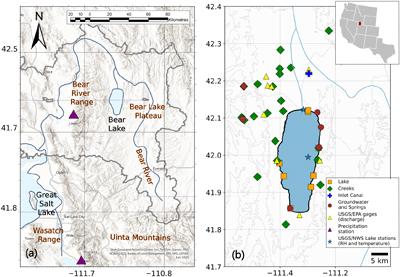 Figure 1 (a) Bear River watershed (grey outline) map and (b) sampling site locations; inset shows Bear Lake in the western U.S. This study utilised replicate samples from sites shown in panel (b) and previously reported by Custado et al. (2025). | 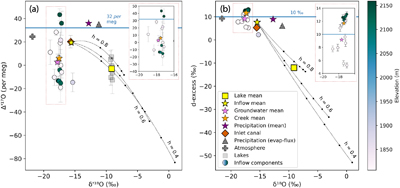 Figure 2 (a) Δ′17O versus δ′18O and (b) d-excess versus δ18O. Blue lines denote the Global Meteoric Water Line (GMWL), while black dashed lines represent lake isotopic evolution during evaporation at different humidities. Black dots indicate Xe values from 0 to 1 in increments of 0.2. Inflow components (circles) represent individual stream samples and are coloured by elevation; the inlet canal is included in the inflow mean. Insets show magnified views of the areas within the red dashed boxes. Only samples with paired discharge information were used in the calculations. Note that the error bars for d-excess are smaller than the markers. A link to the complete data set is included in the Supplementary Information. | 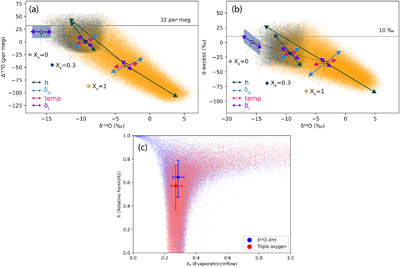 Figure 3 Sensitivity of lake isotopic composition and environmental parameters to varying evaporation conditions. Changes in the lake isotopic composition as a function of Xe are shown in (a) δ′18O versus Δ′17O and (b) δ18O versus d-excess spaces, while changes in Xe (x axis) and h (y axis) from varying isotopic inputs are shown in (c). Horizontal lines in (a) and (b) represent the GMWL. Error bars in (c) represent the IQR around the median value (circle). Inputs for (a) and (b) were h, δA, temperature, and δI; inputs for (c) were δA, temperature, δI, and lake composition (δL). Each marker represents one of 100,000 simulations sampled from normal distributions defined by the calculated input parameter values and uncertainties (see Supplementary Information). Arrows in (a) and (b) indicate the range of outputs generated by varying a single input while holding others constant (cf. Gázquez et al., 2018). Corresponding individual simulations are compiled in Figure S-4. | 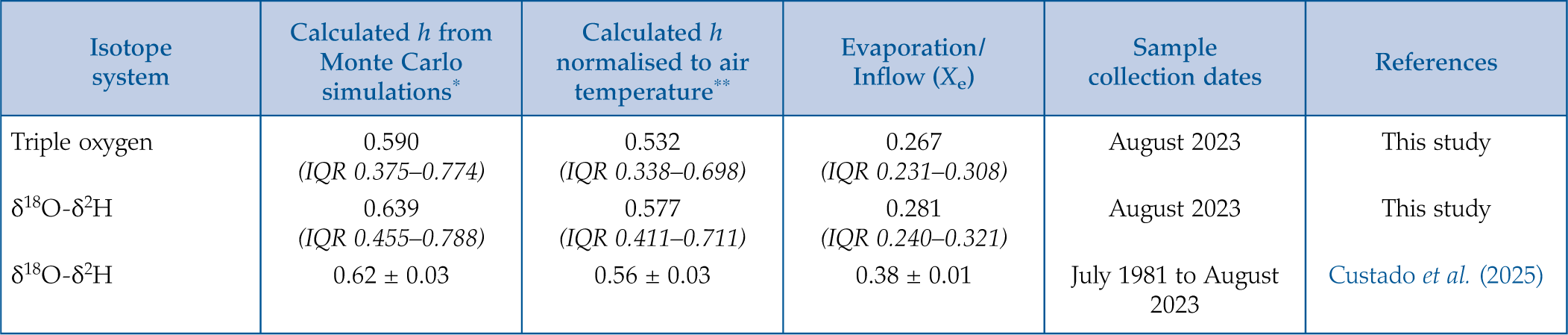 Table 1 Comparison of calculated relative humidity and Xe. Values are reported as median and IQR from 100,000 Monte Carlo simulations due to the non-normality of the output distributions (Fig. S-2). Mean and 1σ values are in Table S-3. |
| Figure 1 | Figure 2 | Figure 3 | Table 1 |
top
Introduction
Stable isotope hydrology in lakes has traditionally relied on δ18O-δ2H systematics to constrain lake water balance (Gonfiantini, 1986
Gonfiantini, R. (1986) Environmental Isotopes in Lake Studies. In: Fritz, P., Fontes, J.Ch. (Eds.) Handbook of Environmental Isotope Geochemistry: Volume 2, The Terrestrial Environment, B. Elsevier, Amsterdam, 113–168. https://doi.org/10.1016/B978-0-444-42225-5.50008-5
; Gat, 1995Gat, J.R. (1995) Stable Isotopes of Fresh and Saline Lakes. In: Lerman, A., Imboden, D.M., Gat, J.R. (Eds.) Physics and Chemistry of Lakes. Second Edition, Springer, Berlin, Heidelberg, 139–165. https://doi.org/10.1007/978-3-642-85132-2_5
; Gibson et al., 2016Gibson, J.J., Birks, S.J., Yi, Y. (2016) Stable isotope mass balance of lakes: a contemporary perspective. Quaternary Science Reviews 131, 316–328. https://doi.org/10.1016/j.quascirev.2015.04.013
). Initially, δ17O was believed to provide no additional information beyond the δ18O-δ2H framework. However, analytical advancements now allow the precise quantification of mass dependent fractionation between δ17O and δ18O, from which an analogue to d-excess, 17O excess (Δ'17O), can be calculated. Previous studies have noted the relative insensitivity of Δ'17O to temperature compared to d-excess (Angert et al., 2004Angert, A., Cappa, C.D., DePaolo, D.J. (2004) Kinetic 17O effects in the hydrologic cycle: Indirect evidence and implications. Geochimica et Cosmochimica Acta 68, 3487–3495. https://doi.org/10.1016/j.gca.2004.02.010
; Uemura et al., 2010Uemura, R., Barkan, E., Abe, O., Luz, B. (2010) Triple isotope composition of oxygen in atmospheric water vapor. Geophysical Research Letters 37, L04402. https://doi.org/10.1029/2009GL041960
). This characteristic increases the potential of the δ17O-δ18O system to provide unique hydrological information in both modern (Pierchala et al., 2022Pierchala, A., Rozanski, K., Dulinski, M., Gorczyca, Z. (2022) Quantification the diffusion-induced fractionation of 1H217O isotopologue in air accompanying the process of water evaporation. Geochimica et Cosmochimica Acta 322, 244–259. https://doi.org/10.1016/j.gca.2022.01.020
; Voigt et al., 2025Voigt, C., Gázquez, F., Martegani, L., Sánchez Villanueva, A.I., Medina, A., Jiménez-Espinosa, R., Jiménez-Millán, J., Rodríguez-Rodríguez, M. (2025) How seasonal hydroclimate variability drives the triple oxygen and hydrogen isotope composition of small lake systems in semiarid environments. Hydrology and Earth System Sciences 29, 1783–1806. https://doi.org/10.5194/hess-29-1783-2025
) and palaeoclimate settings, where it has been used to reconstruct humidity and evaporation conditions (Gázquez et al., 2018Gázquez, F., Morellón, M., Bauska, T., Herwartz, D., Surma, J., et al. (2018) Triple oxygen and hydrogen isotopes of gypsum hydration water for quantitative paleo-humidity reconstruction. Earth and Planetary Science Letters 481, 177–188. https://doi.org/10.1016/j.epsl.2017.10.020
; Passey and Ji, 2019Passey, B.H., Ji, H. (2019) Triple oxygen isotope signatures of evaporation in lake waters and carbonates: A case study from the western United States. Earth and Planetary Science Letters 518, 1–12. https://doi.org/10.1016/j.epsl.2019.04.026
; Gázquez-Sánchez et al., 2023Gázquez-Sánchez, F., Jiménez-Espejo, F., Rodríquez-Rodríquez, M., Martegani, L., Voigt, C., et al. (2023) Roman water management impacted the hydrological functioning of wetlands during drought periods. Scientific Reports 13, 18815. https://doi.org/10.1038/s41598-023-46010-5
; Katz et al., 2023Katz, S.A., Levin, N.E., Rodbell, D.T., Gillikin, D.P., Aron, P.G., Passey, B.H., Tapia, P.M., Serrepe, A.R., Abbott, M.B. (2023) Detecting hydrologic distinctions among Andean lakes using clumped and triple oxygen isotopes. Earth and Planetary Science Letters 602, 117927. https://doi.org/10.1016/j.epsl.2022.117927
). Its utility may be greatest in studies using mineral archives, particularly authigenic carbonates, where paired δ2H data cannot be extracted from the same mineral. The introduction of high throughput instruments to measure δ17O has further enhanced measurement efficiency and precision, supplementing existing tools for palaeoclimate research and modern water management (e.g., Berman et al., 2013Berman, E.S.F., Levin, N.E., Landais, A., Li, S., Owano, T. (2013) Measurement of δ18O, δ17O, and 17O-excess in Water by Off-Axis Integrated Cavity Output Spectroscopy and Isotope Ratio Mass Spectrometry. Analytical Chemistry 85, 10392–10398. https://doi.org/10.1021/ac402366t
; Steig et al., 2021Steig, E.J., Jones, T.R., Schauer, A.J., Kahle, E.C., Morris, V.A., Vaughn, B.H., Davidge, L., White, J.W.C. (2021) Continuous-Flow Analysis of δ17O, δ18O, and δD of H2O on an Ice Core from the South Pole. Frontiers in Earth Science 9, 640292. https://doi.org/10.3389/feart.2021.640292
).In this study, we present a new triple oxygen isotope data set from Bear Lake, Utah/Idaho to derive relative humidity and evaporation-to-inflow ratios. By comparing the triple oxygen and δ18O-δ2H data from replicates of the same samples (cf. Custado et al., 2025
Custado, M.J., Gagnon, C.A., Belanger, B., Sekhon, N., Bernstein-Schalet, J., Kinsley, C.W., Sharp, W.D., Oster, J.L., Ibarra, D.E. (2025) Constraining the Modern Hydrological Balance of Bear Lake, Utah-Idaho: Insights From Stable Isotopes (δ18O and δ2H). Water Resources Research 61, e2024WR038264. https://doi.org/10.1029/2024WR038264
), we highlight how each system constrains key parameters, demonstrating the added utility of Δ'17O in lake balance applications. This work is compared to previous Δ'17O data from Bear Lake (Passey and Ji, 2019Passey, B.H., Ji, H. (2019) Triple oxygen isotope signatures of evaporation in lake waters and carbonates: A case study from the western United States. Earth and Planetary Science Letters 518, 1–12. https://doi.org/10.1016/j.epsl.2019.04.026
) and comparable modelling for other mid-latitude lakes (Surma et al., 2015Surma, J., Assonov, S., Bolourchi, M.J., Staubwasser, M. (2015) Triple oxygen isotope signatures in evaporated water bodies from the Sistan Oasis, Iran. Geophysical Research Letters 42, 8456–8462. https://doi.org/10.1002/2015GL066475
, 2018Surma, J., Assonov, S., Herwartz, D., Voigt, C., Staubwasser, M. (2018) The evolution of 17O-excess in surface water of the arid environment during recharge and evaporation. Scientific Reports 8, 4972. https://doi.org/10.1038/s41598-018-23151-6
; Gázquez et al., 2018Gázquez, F., Morellón, M., Bauska, T., Herwartz, D., Surma, J., et al. (2018) Triple oxygen and hydrogen isotopes of gypsum hydration water for quantitative paleo-humidity reconstruction. Earth and Planetary Science Letters 481, 177–188. https://doi.org/10.1016/j.epsl.2017.10.020
; Voigt et al., 2021Voigt, C., Herwartz, D., Dorador, C., Staubwasser, M. (2021) Triple oxygen isotope systematics of evaporation and mixing processes in a dynamic desert lake system. Hydrology and Earth System Sciences 25, 1211–1228. https://doi.org/10.5194/hess-25-1211-2021
, 2025Voigt, C., Gázquez, F., Martegani, L., Sánchez Villanueva, A.I., Medina, A., Jiménez-Espinosa, R., Jiménez-Millán, J., Rodríguez-Rodríguez, M. (2025) How seasonal hydroclimate variability drives the triple oxygen and hydrogen isotope composition of small lake systems in semiarid environments. Hydrology and Earth System Sciences 29, 1783–1806. https://doi.org/10.5194/hess-29-1783-2025
).top
Steady State Isotopic Mass Balance Equations
The Craig-Gordon evaporation model is often used to describe isotope exchange at the water-atmosphere interface during evaporation of an open water body (Craig and Gordon, 1965
Craig, H., Gordon, L.I. (1965) Deuterium and oxygen 18 variations in the ocean and marine atmosphere. In: Tongiorgi, E. (Ed.) Stable Isotopes in Oceanographic Studies and Paleotemperatures. Spoleto, Italy, 9–130.
). The kinetic component of this isotopic process can be modelled through molecular diffusion, as predicted by kinetic theory (Criss, 1999Criss, R.E. (1999) Principles of Stable Isotope Distribution. Oxford University Press, New York. https://doi.org/10.1093/oso/9780195117752.001.0001
). Building on these concepts, the following equation represents the steady state isotopic mass balance of a well mixed, throughflow lake (Craig and Gordon, 1965Craig, H., Gordon, L.I. (1965) Deuterium and oxygen 18 variations in the ocean and marine atmosphere. In: Tongiorgi, E. (Ed.) Stable Isotopes in Oceanographic Studies and Paleotemperatures. Spoleto, Italy, 9–130.
; Gonfiantini, 1986Gonfiantini, R. (1986) Environmental Isotopes in Lake Studies. In: Fritz, P., Fontes, J.Ch. (Eds.) Handbook of Environmental Isotope Geochemistry: Volume 2, The Terrestrial Environment, B. Elsevier, Amsterdam, 113–168. https://doi.org/10.1016/B978-0-444-42225-5.50008-5
; Criss, 1999Criss, R.E. (1999) Principles of Stable Isotope Distribution. Oxford University Press, New York. https://doi.org/10.1093/oso/9780195117752.001.0001
; Gibson et al., 2016Gibson, J.J., Birks, S.J., Yi, Y. (2016) Stable isotope mass balance of lakes: a contemporary perspective. Quaternary Science Reviews 131, 316–328. https://doi.org/10.1016/j.quascirev.2015.04.013
; Passey and Levin, 2021Passey, B.H., Levin, N.E. (2021) Triple Oxygen Isotopes in Meteoric Waters, Carbonates, and Biological Apatites: Implications for Continental Paleoclimate Reconstruction. Reviews in Mineralogy and Geochemistry 86, 429–462. https://doi.org/10.2138/rmg.2021.86.13
):Eq. 1

where R represents isotopic (17O, 18O, 2H) compositions expressed in ratios relative to a known standard (Vienna Standard Mean Ocean Water, VSMOW). The subscripts L, A, and I denote the steady state isotopic compositions of the lake, atmospheric moisture, and inflow, respectively. The variable h represents relative humidity normalised to the lake surface temperature, Xe the evaporation-to-inflow ratio, αeq the equilibrium fractionation factor, and αdiff the kinetic fractionation at zero humidity (diffusion end member). Note that in Criss (1999)
Criss, R.E. (1999) Principles of Stable Isotope Distribution. Oxford University Press, New York. https://doi.org/10.1093/oso/9780195117752.001.0001
, αeq·αdiff is expressed as α0evap. This work follows the conventions for α in Gonfiantini (1986)Gonfiantini, R. (1986) Environmental Isotopes in Lake Studies. In: Fritz, P., Fontes, J.Ch. (Eds.) Handbook of Environmental Isotope Geochemistry: Volume 2, The Terrestrial Environment, B. Elsevier, Amsterdam, 113–168. https://doi.org/10.1016/B978-0-444-42225-5.50008-5
, where α > 1.We applied Equation 1 to both triple oxygen and δ18O-δ2H isotope systems. Ratios are preferred in triple oxygen isotopic calculations as Δ'17O is derived from linearised isotopic data (δ'; Eq. 2; Miller, 2002
Miller, M.F. (2002) Isotopic fractionation and the quantification of 17O anomalies in the oxygen three-isotope system: an appraisal and geochemical significance. Geochimica et Cosmochimica Acta 66, 1881–1889. https://doi.org/10.1016/S0016-7037(02)00832-3
; Luz and Barkan, 2010Luz, B., Barkan, E. (2010) Variations of 17O/16O and 18O/16O in meteoric waters. Geochimica et Cosmochimica Acta 74, 6276–6286. https://doi.org/10.1016/j.gca.2010.08.016
):Eq. 2

A full description of the equations is provided in the Supplementary Information.
top
Study Site
Bear Lake lies within the semi-arid northeast Great Basin, bounded by the Bear Lake Plateau and Bear River Range (Fig. 1). The lake is primarily fed by the Bear River through an inlet canal, whose headwaters are located further south in the Uinta Mountains. Surrounding creeks and springs provide additional input, particularly those originating from the Bear River Range. Groundwater is estimated to have a minor contribution (Bright, 2009
Bright, J. (2009) Isotope and major-ion chemistry of groundwater in Bear Lake Valley, Utah and Idaho, with emphasis on the Bear River Range. In: Rosenbaum, J.G., Kaufman, D.S. (Eds.) Paleoenvironments of Bear Lake, Utah and Idaho, and its catchment. Geological Society of America, Boulder, Special Paper 450, 105–132. https://doi.org/10.1130/2009.2450(04)
; Custado et al., 2025Custado, M.J., Gagnon, C.A., Belanger, B., Sekhon, N., Bernstein-Schalet, J., Kinsley, C.W., Sharp, W.D., Oster, J.L., Ibarra, D.E. (2025) Constraining the Modern Hydrological Balance of Bear Lake, Utah-Idaho: Insights From Stable Isotopes (δ18O and δ2H). Water Resources Research 61, e2024WR038264. https://doi.org/10.1029/2024WR038264
). Most precipitation falls as snow, which reaches the lake through immediate and delayed snowmelt via streams. Water exits the lake through evaporation and an outlet canal (Bright, 2009Bright, J. (2009) Isotope and major-ion chemistry of groundwater in Bear Lake Valley, Utah and Idaho, with emphasis on the Bear River Range. In: Rosenbaum, J.G., Kaufman, D.S. (Eds.) Paleoenvironments of Bear Lake, Utah and Idaho, and its catchment. Geological Society of America, Boulder, Special Paper 450, 105–132. https://doi.org/10.1130/2009.2450(04)
). Annual volumetric discharge of each inflow component is summarised in Table S-1. Additionally, a brief description of the physical and hydroclimatic setting of the lake is provided in the Supplementary Information.Figure 1 (a) Bear River watershed (grey outline) map and (b) sampling site locations; inset shows Bear Lake in the western U.S. This study utilised replicate samples from sites shown in panel (b) and previously reported by Custado et al. (2025)
Custado, M.J., Gagnon, C.A., Belanger, B., Sekhon, N., Bernstein-Schalet, J., Kinsley, C.W., Sharp, W.D., Oster, J.L., Ibarra, D.E. (2025) Constraining the Modern Hydrological Balance of Bear Lake, Utah-Idaho: Insights From Stable Isotopes (δ18O and δ2H). Water Resources Research 61, e2024WR038264. https://doi.org/10.1029/2024WR038264
.top
Analytical and Computational Methods
Lake, stream, and groundwater samples were collected during baseflow in August 2023 (Fig. 1) and analysed along with isotopic standards using a Picarro L2140-i cavity ring down spectrometer at Brown University, USA. Precipitation samples were obtained from sampling stations located in Utah State University and Utah Valley University. Analytical drift and memory corrections were applied before data normalisation to the VSMOW-SLAP scale using internally calibrated reference waters (Gröning, 2011
Gröning, M. (2011) Improved water δ2H and δ18O calibration and calculation of measurement uncertainty using a simple software tool. Rapid Communications in Mass Spectrometry 25, 2711–2720. https://doi.org/10.1002/rcm.5074
; Hutchings and Konecky, 2023Hutchings, J.A., Konecky, B.L. (2023) Optimization of a Picarro L2140-i cavity ring-down spectrometer for routine measurement of triple oxygen isotope ratios in meteoric waters. Atmospheric Measurement Techniques 16, 1663–1682. https://doi.org/10.5194/amt-16-1663-2023
).The second order isotopic parameters are calculated using the following equations:
Eq. 3

Eq. 4

Relative humidity and Xe from each isotope system were derived using Monte Carlo simulations (n = 100,000) of Equation 1, with input distributions generated from measured isotope data of samples and corresponding analytical uncertainties (Table S-2, Fig. S-1). A detailed description of the computational approach is provided in the Supplementary Information.
Final values reported in Table 1 are the median of the output distributions (Fig. S-2), with uncertainties expressed as the interquartile range (IQR, 25th-75th percentiles). Means and standard deviations (1σ) are reported in Table S-3.
Table 1 Comparison of calculated relative humidity and Xe. Values are reported as median and IQR from 100,000 Monte Carlo simulations due to the non-normality of the output distributions (Fig. S-2). Mean and 1σ values are in Table S-3.
*Mass balance derived humidity is normalised to lake surface temperature, while instrument derived humidity is normalised to air temperature.
**Temperatures used for conversion: evaporation flux weighted lake (11.16 °C) and air temperature (12.72 °C). See Table S-4 for monthly values.
top
Isotopic Mass Balance of Bear Lake
Figure 2 illustrates our new isotopic data set in both δ'18O-Δ'17O and δ18O-d-excess spaces, overlain on evaporation trajectories modelled as a function of Xe at different humidities (Eq. 1).
Figure 2 (a) Δ′17O versus δ′18O and (b) d-excess versus δ18O. Blue lines denote the Global Meteoric Water Line (GMWL), while black dashed lines represent lake isotopic evolution during evaporation at different humidities. Black dots indicate Xe values from 0 to 1 in increments of 0.2. Inflow components (circles) represent individual stream samples and are coloured by elevation; the inlet canal is included in the inflow mean. Insets show magnified views of the areas within the red dashed boxes. Only samples with paired discharge information were used in the calculations. Note that the error bars for d-excess are smaller than the markers. A link to the complete data set is included in the Supplementary Information.
The volume weighted mean inflow (yellow star, Fig. 2) is composed of inputs from the inlet canal (orange diamond, 55.68 % of total volumetric inflow), on-lake precipitation (purple star, 18.91 %), creeks (orange star, 25.39 %), and groundwater (pink star, 0.01 %). The spread in the Δ'17O of the inflow components, like d-excess, suggests potential for Δ'17O to distinguish sources with different evaporation histories, as is the case with this system (inset plots, Fig. 2). For example, Voigt et al. (2021)
Voigt, C., Herwartz, D., Dorador, C., Staubwasser, M. (2021) Triple oxygen isotope systematics of evaporation and mixing processes in a dynamic desert lake system. Hydrology and Earth System Sciences 25, 1211–1228. https://doi.org/10.5194/hess-25-1211-2021
previously demonstrated that Δ'17O can resolve the evaporation trajectories of shallow lakes with and without recharge in Salar del Huasco, Chile. In contrast, Bear Lake is primarily fed by snowmelt from surrounding mountains, which exhibit a narrower range of d-excess values.top
Deriving h and Xe from Mass Balance Calculations
Table 1 summarises the mass balance results along with the multi-year data set results of Custado et al. (2025)
Custado, M.J., Gagnon, C.A., Belanger, B., Sekhon, N., Bernstein-Schalet, J., Kinsley, C.W., Sharp, W.D., Oster, J.L., Ibarra, D.E. (2025) Constraining the Modern Hydrological Balance of Bear Lake, Utah-Idaho: Insights From Stable Isotopes (δ18O and δ2H). Water Resources Research 61, e2024WR038264. https://doi.org/10.1029/2024WR038264
.The calculated uncertainties do not statistically differentiate the values in Table 1, partly due to the conservative approach used to generate input uncertainties, which better captures data variability (see Supplementary Information). Nevertheless, the median triple oxygen derived h and Xe are slightly lower than δ18O-δ2H estimates and comparable to Custado et al. (2025)
Custado, M.J., Gagnon, C.A., Belanger, B., Sekhon, N., Bernstein-Schalet, J., Kinsley, C.W., Sharp, W.D., Oster, J.L., Ibarra, D.E. (2025) Constraining the Modern Hydrological Balance of Bear Lake, Utah-Idaho: Insights From Stable Isotopes (δ18O and δ2H). Water Resources Research 61, e2024WR038264. https://doi.org/10.1029/2024WR038264
. The observed discrepancies likely reflect temporal coverage differences in the data, while analytical uncertainty and data variability account for the modelled uncertainties (Table S-1).The evaporation flux weighted relative humidity calculated from monthly United States Geological Survey (USGS) observations (Table S-4) is ∼0.53, closer to the triple oxygen derived median h when normalised to air temperature. This agreement suggests that triple oxygen data may better constrain above lake humidity, even with limited temporal resolution. Oxygen isotopes are generally more sensitive to kinetic fractionation than deuterium (Gonfiantini, 1986
Gonfiantini, R. (1986) Environmental Isotopes in Lake Studies. In: Fritz, P., Fontes, J.Ch. (Eds.) Handbook of Environmental Isotope Geochemistry: Volume 2, The Terrestrial Environment, B. Elsevier, Amsterdam, 113–168. https://doi.org/10.1016/B978-0-444-42225-5.50008-5
) and may therefore better record relative humidity changes. Additionally, the relative insensitivity of Δ'17O to temperature compared to d-excess allows moisture source effects to be isolated without temperature corrections (Angert et al., 2004Angert, A., Cappa, C.D., DePaolo, D.J. (2004) Kinetic 17O effects in the hydrologic cycle: Indirect evidence and implications. Geochimica et Cosmochimica Acta 68, 3487–3495. https://doi.org/10.1016/j.gca.2004.02.010
; Uemura et al., 2010Uemura, R., Barkan, E., Abe, O., Luz, B. (2010) Triple isotope composition of oxygen in atmospheric water vapor. Geophysical Research Letters 37, L04402. https://doi.org/10.1029/2009GL041960
). However, additional constraints on the input parameters are needed to reduce estimation errors.top
Isotopic Controls on h and Xe
Previous studies have highlighted the sensitivity of isotopic mass balance models to varying isotopic and environmental inputs (e.g., Gázquez et al., 2018
Gázquez, F., Morellón, M., Bauska, T., Herwartz, D., Surma, J., et al. (2018) Triple oxygen and hydrogen isotopes of gypsum hydration water for quantitative paleo-humidity reconstruction. Earth and Planetary Science Letters 481, 177–188. https://doi.org/10.1016/j.epsl.2017.10.020
; Passey and Ji, 2019Passey, B.H., Ji, H. (2019) Triple oxygen isotope signatures of evaporation in lake waters and carbonates: A case study from the western United States. Earth and Planetary Science Letters 518, 1–12. https://doi.org/10.1016/j.epsl.2019.04.026
; Voigt et al., 2021Voigt, C., Herwartz, D., Dorador, C., Staubwasser, M. (2021) Triple oxygen isotope systematics of evaporation and mixing processes in a dynamic desert lake system. Hydrology and Earth System Sciences 25, 1211–1228. https://doi.org/10.5194/hess-25-1211-2021
), particularly relative humidity and the isotopic compositions of inflow and atmospheric moisture (Barkan and Luz, 2007Barkan, E., Luz, B. (2007) Diffusivity fractionations of H216O/H217O and H216O/H218O in air and their implications for isotope hydrology. Rapid Communications in Mass Spectrometry 21, 2999–3005. https://doi.org/10.1002/rcm.3180
; Surma et al., 2015Surma, J., Assonov, S., Bolourchi, M.J., Staubwasser, M. (2015) Triple oxygen isotope signatures in evaporated water bodies from the Sistan Oasis, Iran. Geophysical Research Letters 42, 8456–8462. https://doi.org/10.1002/2015GL066475
, 2018Surma, J., Assonov, S., Herwartz, D., Voigt, C., Staubwasser, M. (2018) The evolution of 17O-excess in surface water of the arid environment during recharge and evaporation. Scientific Reports 8, 4972. https://doi.org/10.1038/s41598-018-23151-6
; Voigt et al., 2021Voigt, C., Herwartz, D., Dorador, C., Staubwasser, M. (2021) Triple oxygen isotope systematics of evaporation and mixing processes in a dynamic desert lake system. Hydrology and Earth System Sciences 25, 1211–1228. https://doi.org/10.5194/hess-25-1211-2021
). The influence of salinity and wind turbulence (n), while important, was not explicitly considered; instead a value of n = 0.5, commonly applied to lake studies (Gonfiantini, 1986Gonfiantini, R. (1986) Environmental Isotopes in Lake Studies. In: Fritz, P., Fontes, J.Ch. (Eds.) Handbook of Environmental Isotope Geochemistry: Volume 2, The Terrestrial Environment, B. Elsevier, Amsterdam, 113–168. https://doi.org/10.1016/B978-0-444-42225-5.50008-5
; Criss, 1999Criss, R.E. (1999) Principles of Stable Isotope Distribution. Oxford University Press, New York. https://doi.org/10.1093/oso/9780195117752.001.0001
; Gibson et al., 2016Gibson, J.J., Birks, S.J., Yi, Y. (2016) Stable isotope mass balance of lakes: a contemporary perspective. Quaternary Science Reviews 131, 316–328. https://doi.org/10.1016/j.quascirev.2015.04.013
), was adopted to correct for the αdiff values used (Table S-2). For this work, we focus on parameters that can be constrained given available environmental data. Nevertheless, we provide Figure S-3 to model the response of lake isotopic composition to varying n. Figure 3 summarises how lake isotopic composition, h, and Xe respond to a range of inputs.Figure 3 Sensitivity of lake isotopic composition and environmental parameters to varying evaporation conditions. Changes in the lake isotopic composition as a function of Xe are shown in (a) δ′18O versus Δ′17O and (b) δ18O versus d-excess spaces, while changes in Xe (x axis) and h (y axis) from varying isotopic inputs are shown in (c). Horizontal lines in (a) and (b) represent the GMWL. Error bars in (c) represent the IQR around the median value (circle). Inputs for (a) and (b) were h, δA, temperature, and δI; inputs for (c) were δA, temperature, δI, and lake composition (δL). Each marker represents one of 100,000 simulations sampled from normal distributions defined by the calculated input parameter values and uncertainties (see Supplementary Information). Arrows in (a) and (b) indicate the range of outputs generated by varying a single input while holding others constant (cf. Gázquez et al., 2018
Gázquez, F., Morellón, M., Bauska, T., Herwartz, D., Surma, J., et al. (2018) Triple oxygen and hydrogen isotopes of gypsum hydration water for quantitative paleo-humidity reconstruction. Earth and Planetary Science Letters 481, 177–188. https://doi.org/10.1016/j.epsl.2017.10.020
). Corresponding individual simulations are compiled in Figure S-4.In both systems, the spread in the modelled lake isotopic composition increases with Xe (Fig. 3a,b). This pattern is consistent when simulations are focused on separate input parameters, with humidity and isotopic composition of atmospheric moisture having the greatest relative influence at Xe = 1 (Fig. S-4). However, lake isotopic composition responds more strongly to inflow at lower Xe, likely due to less kinetic fractionation at lower evaporation rates (Fig. S-4a,e). Conversely, at higher Xe, the parameters that control the isotopic (δA) and moisture (h) gradient above the lake become increasingly important as more vapour escapes from the lake (Craig and Gordon, 1965
Craig, H., Gordon, L.I. (1965) Deuterium and oxygen 18 variations in the ocean and marine atmosphere. In: Tongiorgi, E. (Ed.) Stable Isotopes in Oceanographic Studies and Paleotemperatures. Spoleto, Italy, 9–130.
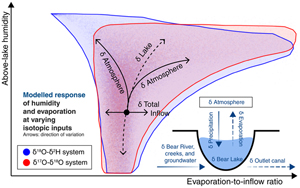
).Additionally, both isotope systems feature a triangular solution space for h and Xe (Fig. 3c), with the δ18O-δ2H system showing greater divergence in Xe at higher h. Consequently, Δ'17O appears to provide a tighter constraint on relative humidity and its trade off with Xe. Figure S-4 illustrates how this solution space changes when variability is isolated to individual parameters, showing that the spread at high h is primarily governed by δA (Fig. S-4). Despite preserving the GMWL relationship between atmospheric δ18O with δ2H in the model, the non-unique solutions at high h demonstrates the strong sensitivity of the δ18O-δ2H system to atmospheric moisture variability.
Previous studies often rely on estimating δA due to difficulties in making direct measurements (Surma et al., 2015
Surma, J., Assonov, S., Bolourchi, M.J., Staubwasser, M. (2015) Triple oxygen isotope signatures in evaporated water bodies from the Sistan Oasis, Iran. Geophysical Research Letters 42, 8456–8462. https://doi.org/10.1002/2015GL066475
, 2018Surma, J., Assonov, S., Herwartz, D., Voigt, C., Staubwasser, M. (2018) The evolution of 17O-excess in surface water of the arid environment during recharge and evaporation. Scientific Reports 8, 4972. https://doi.org/10.1038/s41598-018-23151-6
; Gázquez et al., 2018Gázquez, F., Morellón, M., Bauska, T., Herwartz, D., Surma, J., et al. (2018) Triple oxygen and hydrogen isotopes of gypsum hydration water for quantitative paleo-humidity reconstruction. Earth and Planetary Science Letters 481, 177–188. https://doi.org/10.1016/j.epsl.2017.10.020
; Passey and Ji, 2019Passey, B.H., Ji, H. (2019) Triple oxygen isotope signatures of evaporation in lake waters and carbonates: A case study from the western United States. Earth and Planetary Science Letters 518, 1–12. https://doi.org/10.1016/j.epsl.2019.04.026
; Voigt et al., 2021Voigt, C., Herwartz, D., Dorador, C., Staubwasser, M. (2021) Triple oxygen isotope systematics of evaporation and mixing processes in a dynamic desert lake system. Hydrology and Earth System Sciences 25, 1211–1228. https://doi.org/10.5194/hess-25-1211-2021
). Here, we estimated δA by assuming that atmospheric moisture upwind of the lake is in equilibrium with evaporation flux weighted mean precipitation, implicitly accounting for seasonality to better reproduce observed lake and inflow isotopic compositions (Eq. S-14; Gibson et al., 2016Gibson, J.J., Birks, S.J., Yi, Y. (2016) Stable isotope mass balance of lakes: a contemporary perspective. Quaternary Science Reviews 131, 316–328. https://doi.org/10.1016/j.quascirev.2015.04.013
; Custado et al., 2025Custado, M.J., Gagnon, C.A., Belanger, B., Sekhon, N., Bernstein-Schalet, J., Kinsley, C.W., Sharp, W.D., Oster, J.L., Ibarra, D.E. (2025) Constraining the Modern Hydrological Balance of Bear Lake, Utah-Idaho: Insights From Stable Isotopes (δ18O and δ2H). Water Resources Research 61, e2024WR038264. https://doi.org/10.1029/2024WR038264
). Other studies instead assume complete or partial isotopic equilibrium between atmospheric moisture and inflow waters (Gázquez et al., 2018Gázquez, F., Morellón, M., Bauska, T., Herwartz, D., Surma, J., et al. (2018) Triple oxygen and hydrogen isotopes of gypsum hydration water for quantitative paleo-humidity reconstruction. Earth and Planetary Science Letters 481, 177–188. https://doi.org/10.1016/j.epsl.2017.10.020
; Passey and Ji, 2019Passey, B.H., Ji, H. (2019) Triple oxygen isotope signatures of evaporation in lake waters and carbonates: A case study from the western United States. Earth and Planetary Science Letters 518, 1–12. https://doi.org/10.1016/j.epsl.2019.04.026
), with limited existing measurements in continental settings (e.g., Voigt et al., 2021Voigt, C., Herwartz, D., Dorador, C., Staubwasser, M. (2021) Triple oxygen isotope systematics of evaporation and mixing processes in a dynamic desert lake system. Hydrology and Earth System Sciences 25, 1211–1228. https://doi.org/10.5194/hess-25-1211-2021
, 2025Voigt, C., Gázquez, F., Martegani, L., Sánchez Villanueva, A.I., Medina, A., Jiménez-Espinosa, R., Jiménez-Millán, J., Rodríguez-Rodríguez, M. (2025) How seasonal hydroclimate variability drives the triple oxygen and hydrogen isotope composition of small lake systems in semiarid environments. Hydrology and Earth System Sciences 29, 1783–1806. https://doi.org/10.5194/hess-29-1783-2025
). Regardless of the chosen approach, fractionation during evaporation has been consistently demonstrated to be sensitive to both δA and relative humidity, underscoring the need for more direct measurements of these parameters.top
Comparison to Previous Studies
To simulate palaeoclimate applications of Δ'17O in lakes, we calculated the δ'17O-δ'18O slope between the source and lake waters (λlake) using empirical λlake-Δ'17O relationships derived by Passey and Ji (2019)
Passey, B.H., Ji, H. (2019) Triple oxygen isotope signatures of evaporation in lake waters and carbonates: A case study from the western United States. Earth and Planetary Science Letters 518, 1–12. https://doi.org/10.1016/j.epsl.2019.04.026
and Katz et al. (2023)Katz, S.A., Levin, N.E., Rodbell, D.T., Gillikin, D.P., Aron, P.G., Passey, B.H., Tapia, P.M., Serrepe, A.R., Abbott, M.B. (2023) Detecting hydrologic distinctions among Andean lakes using clumped and triple oxygen isotopes. Earth and Planetary Science Letters 602, 117927. https://doi.org/10.1016/j.epsl.2022.117927
, and subsequently, the reconstructed δ18O of the unevaporated catchment precipitation (δ18Orucp) (Eqs. S-15, S-16). Multiple λlake-δ18Orucp pairs were calculated from these empirical equations and compared with values derived directly from measured inflow and lake isotopic data. These values are summarised in Table S-5.The calculated λlake values using the empirical coefficients (λlake = 0.5213 to 0.5235) yielded higher median δ18Orucp estimates (Table S-5) than the measured stream samples (−18.1 ± 1.4 ‰, Passey and Ji, 2019
Passey, B.H., Ji, H. (2019) Triple oxygen isotope signatures of evaporation in lake waters and carbonates: A case study from the western United States. Earth and Planetary Science Letters 518, 1–12. https://doi.org/10.1016/j.epsl.2019.04.026
; −17.2 ± 0.6 ‰ (1σ), this study). In contrast, the λlake value calculated from measured inflow and lake samples (0.5246) resulted in a δ18Orucp value of −18.1 ± 5.4 ‰, expectedly lower than the measured stream samples. This discrepancy underscores the importance of additional data from diverse modern lake environments to refine empirical λlake-Δ'17O relationships and better constrain inflow water distributions in palaeo-catchments.Triple oxygen isotope mass balance models have been implemented in semi-permanent freshwater systems in arid environments, where groundwater recharge is of periodic importance (Surma et al., 2015
Surma, J., Assonov, S., Bolourchi, M.J., Staubwasser, M. (2015) Triple oxygen isotope signatures in evaporated water bodies from the Sistan Oasis, Iran. Geophysical Research Letters 42, 8456–8462. https://doi.org/10.1002/2015GL066475
, 2018Surma, J., Assonov, S., Herwartz, D., Voigt, C., Staubwasser, M. (2018) The evolution of 17O-excess in surface water of the arid environment during recharge and evaporation. Scientific Reports 8, 4972. https://doi.org/10.1038/s41598-018-23151-6
; Voigt et al., 2021Voigt, C., Herwartz, D., Dorador, C., Staubwasser, M. (2021) Triple oxygen isotope systematics of evaporation and mixing processes in a dynamic desert lake system. Hydrology and Earth System Sciences 25, 1211–1228. https://doi.org/10.5194/hess-25-1211-2021
). These studies show that triple oxygen isotopes can distinguish between simple and recharged evaporation. Although Bear Lake currently receives minimal groundwater input, palaeoclimate records indicate that it has alternated between underfilled and overfilled states, implying periods of substantial groundwater influence (Bright, 2009Bright, J. (2009) Isotope and major-ion chemistry of groundwater in Bear Lake Valley, Utah and Idaho, with emphasis on the Bear River Range. In: Rosenbaum, J.G., Kaufman, D.S. (Eds.) Paleoenvironments of Bear Lake, Utah and Idaho, and its catchment. Geological Society of America, Boulder, Special Paper 450, 105–132. https://doi.org/10.1130/2009.2450(04)
; Dean, 2009Dean, W.E. (2009) Endogenic carbonate sedimentation in Bear Lake, Utah and Idaho, over the last two glacial-interglacial cycles. In: Rosenbaum, J.G., Kaufman, D.S. (Eds.) Paleoenvironments of Bear Lake, Utah and Idaho, and its catchment. Geological Society of America, Boulder, Special Paper 450, 169–196. https://doi.org/10.1130/2009.2450(07)
; Kaufman et al., 2009Kaufman, D.S., Bright, J., Dean, W.E., Rosenbaum, J.G., Moser, K., et al. (2009) A quarter-million years of paleoenvironmental change at Bear Lake, Utah and Idaho. In: Rosenbaum, J.G., Kaufman, D.S. (Eds.) Paleoenvironments of Bear Lake, Utah and Idaho, and its catchment. Geological Society of America, Boulder, Special Paper 450, 311–351. https://doi.org/10.1130/2009.2450(14)
). Reconstructions of h and Xe from gypsum hydration waters where the lake balance model simultaneously solves for both isotope systems show that changes in Xe at higher values (>0.75) produce lower variations in the back calculated h (Gázquez et al., 2018Gázquez, F., Morellón, M., Bauska, T., Herwartz, D., Surma, J., et al. (2018) Triple oxygen and hydrogen isotopes of gypsum hydration water for quantitative paleo-humidity reconstruction. Earth and Planetary Science Letters 481, 177–188. https://doi.org/10.1016/j.epsl.2017.10.020
). Figure 3c shows that this observation is likely due to the constraints provided by the triple oxygen data. Together with the ability to reconstruct the isotopic composition of the unevaporated source waters, these observations demonstrate the potential of triple oxygen isotopes to provide unique hydrological insights.top
Implications
Comparison of triple oxygen and δ18O-δ2H isotopic systems reveals differing sensitivities to environmental and isotopic inputs when estimating h and Xe. Both systems yielded comparable Xe values, supporting their use in water management applications where quantifying hydrological balance components, such as evaporation, are essential (e.g., Surma et al., 2015
Surma, J., Assonov, S., Bolourchi, M.J., Staubwasser, M. (2015) Triple oxygen isotope signatures in evaporated water bodies from the Sistan Oasis, Iran. Geophysical Research Letters 42, 8456–8462. https://doi.org/10.1002/2015GL066475
; Custado et al., 2025Custado, M.J., Gagnon, C.A., Belanger, B., Sekhon, N., Bernstein-Schalet, J., Kinsley, C.W., Sharp, W.D., Oster, J.L., Ibarra, D.E. (2025) Constraining the Modern Hydrological Balance of Bear Lake, Utah-Idaho: Insights From Stable Isotopes (δ18O and δ2H). Water Resources Research 61, e2024WR038264. https://doi.org/10.1029/2024WR038264
). Simultaneous use of both systems may best constrain multiple parametric unknowns (Gázquez et al., 2018Gázquez, F., Morellón, M., Bauska, T., Herwartz, D., Surma, J., et al. (2018) Triple oxygen and hydrogen isotopes of gypsum hydration water for quantitative paleo-humidity reconstruction. Earth and Planetary Science Letters 481, 177–188. https://doi.org/10.1016/j.epsl.2017.10.020
); however, improved monitoring of h and the isotopic composition of atmospheric moisture at the lake surface is necessary to reduce uncertainties in under constrained fluxes, such as evaporation and groundwater discharge, particularly in semi-arid regions where annual Xe values are typically high.Additionally, patterns in our data suggest that Δ'17O may be a more consistent recorder of above lake h. This finding supports the growing use of triple oxygen isotopes in palaeoclimate studies, which have been analysed in lacustrine carbonate and gypsum hydration waters to reconstruct past environmental conditions (Gázquez et al., 2018
Gázquez, F., Morellón, M., Bauska, T., Herwartz, D., Surma, J., et al. (2018) Triple oxygen and hydrogen isotopes of gypsum hydration water for quantitative paleo-humidity reconstruction. Earth and Planetary Science Letters 481, 177–188. https://doi.org/10.1016/j.epsl.2017.10.020
; Passey and Ji, 2019Passey, B.H., Ji, H. (2019) Triple oxygen isotope signatures of evaporation in lake waters and carbonates: A case study from the western United States. Earth and Planetary Science Letters 518, 1–12. https://doi.org/10.1016/j.epsl.2019.04.026
; Katz et al., 2023Katz, S.A., Levin, N.E., Rodbell, D.T., Gillikin, D.P., Aron, P.G., Passey, B.H., Tapia, P.M., Serrepe, A.R., Abbott, M.B. (2023) Detecting hydrologic distinctions among Andean lakes using clumped and triple oxygen isotopes. Earth and Planetary Science Letters 602, 117927. https://doi.org/10.1016/j.epsl.2022.117927
), and lacustrine chert to reconstruct past elevation (Ibarra et al., 2021Ibarra, D.E., Kukla, T., Methner, K.A., Mulch, A., Chamberlain, C.P. (2021) Reconstructing Past Elevations From Triple Oxygen Isotopes of Lacustrine Chert: Application to the Eocene Nevadaplano, Elko Basin, Nevada, United States. Frontiers in Earth Science 9, 628868. https://doi.org/10.3389/feart.2021.628868
). However, mass balance derived h is normalised to lake temperature, making constraints on past lake temperatures important for palaeoclimate reconstructions. As shown in our calculations, even a modest difference between lake air temperatures yields considerably different h estimates (Table 1).The combined use of Δ'17O and d-excess has been proposed for tracking moisture sources, leveraging the lower temperature sensitivity of Δ'17O relative to d-excess (Angert et al., 2004
Angert, A., Cappa, C.D., DePaolo, D.J. (2004) Kinetic 17O effects in the hydrologic cycle: Indirect evidence and implications. Geochimica et Cosmochimica Acta 68, 3487–3495. https://doi.org/10.1016/j.gca.2004.02.010
; Uemura et al., 2010Uemura, R., Barkan, E., Abe, O., Luz, B. (2010) Triple isotope composition of oxygen in atmospheric water vapor. Geophysical Research Letters 37, L04402. https://doi.org/10.1029/2009GL041960
). However, its application to reconstruct h and δ18Orucp requires well constrained isotopic inputs, as demonstrated by the differences between estimates derived from measured samples and empirical relationships. Therefore, this work underscores the need to expand Δ'17O measurements of meteoric waters across seasons and environmental gradients to better characterise δ17O-δ18O isotope system fractionation and improve accuracy of mass balance models and empirical relationships, such as those of Passey and Ji (2019)Passey, B.H., Ji, H. (2019) Triple oxygen isotope signatures of evaporation in lake waters and carbonates: A case study from the western United States. Earth and Planetary Science Letters 518, 1–12. https://doi.org/10.1016/j.epsl.2019.04.026
and Katz et al. (2023)Katz, S.A., Levin, N.E., Rodbell, D.T., Gillikin, D.P., Aron, P.G., Passey, B.H., Tapia, P.M., Serrepe, A.R., Abbott, M.B. (2023) Detecting hydrologic distinctions among Andean lakes using clumped and triple oxygen isotopes. Earth and Planetary Science Letters 602, 117927. https://doi.org/10.1016/j.epsl.2022.117927
. Additionally, further improvements in analytical precision and throughput (e.g., Hutchings and Konecky, 2023Hutchings, J.A., Konecky, B.L. (2023) Optimization of a Picarro L2140-i cavity ring-down spectrometer for routine measurement of triple oxygen isotope ratios in meteoric waters. Atmospheric Measurement Techniques 16, 1663–1682. https://doi.org/10.5194/amt-16-1663-2023
; Terzer-Wassmuth et al., 2023Terzer-Wassmuth, S., Wassenaar, L.I., Araguás-Araguás, L.J., Stumpp, C. (2023) Balancing precision and throughput of δ17O and Δ’17O analysis of natural waters by Cavity Ringdown Spectroscopy. MethodsX 10, 102150. https://doi.org/10.1016/j.mex.2023.102150
) will also help reduce uncertainty.top
Acknowledgements
This work was funded by NSF AGS 2102901 and AGS 2333-173 to DEI, NSF AGS 2333172 to JKCR, NSF AGS 2102884 to JLO, with additional support from the Brown University Division of Research.
Editor: Gavin Foster
top
References
Angert, A., Cappa, C.D., DePaolo, D.J. (2004) Kinetic 17O effects in the hydrologic cycle: Indirect evidence and implications. Geochimica et Cosmochimica Acta 68, 3487–3495. https://doi.org/10.1016/j.gca.2004.02.010
 Show in context
 Previous studies have noted the relative insensitivity of Δ'17O to temperature compared to d-excess (Angert et al., 2004; Uemura et al., 2010).
View in article
Additionally, the relative insensitivity of Δ'17O to temperature compared to d-excess allows moisture source effects to be isolated without temperature corrections (Angert et al., 2004; Uemura et al., 2010).
View in article
The combined use of Δ'17O and d-excess has been proposed for tracking moisture sources, leveraging the lower temperature sensitivity of Δ'17O relative to d-excess (Angert et al., 2004; Uemura et al., 2010).
View in article
Barkan, E., Luz, B. (2007) Diffusivity fractionations of H216O/H217O and H216O/H218O in air and their implications for isotope hydrology. Rapid Communications in Mass Spectrometry 21, 2999–3005. https://doi.org/10.1002/rcm.3180
Show in context Previous studies have highlighted the sensitivity of isotopic mass balance models to varying isotopic and environmental inputs (e.g., Gázquez et al., 2018; Passey and Ji, 2019; Voigt et al., 2021), particularly relative humidity and the isotopic compositions of inflow and atmospheric moisture (Barkan and Luz, 2007; Surma et al., 2015, 2018; Voigt et al., 2021).
View in article
Berman, E.S.F., Levin, N.E., Landais, A., Li, S., Owano, T. (2013) Measurement of δ18O, δ17O, and 17O-excess in Water by Off-Axis Integrated Cavity Output Spectroscopy and Isotope Ratio Mass Spectrometry. Analytical Chemistry 85, 10392–10398. https://doi.org/10.1021/ac402366t
Show in context The introduction of high throughput instruments to measure δ17O has further enhanced measurement efficiency and precision, supplementing existing tools for palaeoclimate research and modern water management (e.g., Berman et al., 2013; Steig et al., 2021).
View in article
Bright, J. (2009) Isotope and major-ion chemistry of groundwater in Bear Lake Valley, Utah and Idaho, with emphasis on the Bear River Range. In: Rosenbaum, J.G., Kaufman, D.S. (Eds.) Paleoenvironments of Bear Lake, Utah and Idaho, and its catchment. Geological Society of America, Boulder, Special Paper 450, 105–132. https://doi.org/10.1130/2009.2450(04)
Show in context Groundwater is estimated to have a minor contribution (Bright, 2009; Custado et al., 2025).
View in article
Water exits the lake through evaporation and an outlet canal (Bright, 2009).
View in article
These studies show that triple oxygen isotopes can distinguish between simple and recharged evaporation. Although Bear Lake currently receives minimal groundwater input, palaeoclimate records indicate that it has alternated between underfilled and overfilled states, implying periods of substantial groundwater influence (Bright, 2009; Dean, 2009; Kaufman et al., 2009).
View in article
Craig, H., Gordon, L.I. (1965) Deuterium and oxygen 18 variations in the ocean and marine atmosphere. In: Tongiorgi, E. (Ed.) Stable Isotopes in Oceanographic Studies and Paleotemperatures. Spoleto, Italy, 9–130.
Show in context The Craig-Gordon evaporation model is often used to describe isotope exchange at the water-atmosphere interface during evaporation of an open water body (Craig and Gordon, 1965).
View in article
Building on these concepts, the following equation represents the steady state isotopic mass balance of a well mixed, throughflow lake (Craig and Gordon, 1965; Gonfiantini, 1986; Criss, 1999; Gibson et al., 2016; Passey and Levin, 2021):
Eq. 1
where R represents isotopic (17O, 18O, 2H) compositions expressed in ratios relative to a known standard (Vienna Standard Mean Ocean Water, VSMOW).
View in article
Conversely, at higher Xe, the parameters that control the isotopic (δA) and moisture (h) gradient above the lake become increasingly important as more vapour escapes from the lake (Craig and Gordon, 1965).
View in article
Criss, R.E. (1999) Principles of Stable Isotope Distribution. Oxford University Press, New York. https://doi.org/10.1093/oso/9780195117752.001.0001
Show in context The kinetic component of this isotopic process can be modelled through molecular diffusion, as predicted by kinetic theory (Criss, 1999).
View in article
Building on these concepts, the following equation represents the steady state isotopic mass balance of a well mixed, throughflow lake (Craig and Gordon, 1965; Gonfiantini, 1986; Criss, 1999; Gibson et al., 2016; Passey and Levin, 2021):
Eq. 1
where R represents isotopic (17O, 18O, 2H) compositions expressed in ratios relative to a known standard (Vienna Standard Mean Ocean Water, VSMOW).
View in article
Note that in Criss (1999), αeq·αdiff is expressed as α0evap.
View in article
The influence of salinity and wind turbulence (n), while important, was not explicitly considered; instead a value of n = 0.5, commonly applied to lake studies (Gonfiantini, 1986; Criss, 1999; Gibson et al., 2016), was adopted to correct for the αdiff values used (Table S-2).
View in article
Custado, M.J., Gagnon, C.A., Belanger, B., Sekhon, N., Bernstein-Schalet, J., Kinsley, C.W., Sharp, W.D., Oster, J.L., Ibarra, D.E. (2025) Constraining the Modern Hydrological Balance of Bear Lake, Utah-Idaho: Insights From Stable Isotopes (δ18O and δ2H). Water Resources Research 61, e2024WR038264. https://doi.org/10.1029/2024WR038264
Show in context By comparing the triple oxygen and δ18O-δ2H data from replicates of the same samples (cf. Custado et al., 2025), we highlight how each system constrains key parameters, demonstrating the added utility of Δ'17O in lake balance applications.
View in article
Groundwater is estimated to have a minor contribution (Bright, 2009; Custado et al., 2025).
View in article
This study utilised replicate samples from sites shown in panel (b) and previously reported by Custado et al. (2025).
View in article
Table 1 summarises the mass balance results along with the multi-year data set results of Custado et al. (2025).
View in article
Nevertheless, the median triple oxygen derived h and Xe are slightly lower than δ18O-δ2H estimates and comparable to Custado et al. (2025).
View in article
Here, we estimated δA by assuming that atmospheric moisture upwind of the lake is in equilibrium with evaporation flux weighted mean precipitation, implicitly accounting for seasonality to better reproduce observed lake and inflow isotopic compositions (Eq. S-14; Gibson et al., 2016; Custado et al., 2025).
View in article
Both systems yielded comparable Xe values, supporting their use in water management applications where quantifying hydrological balance components, such as evaporation, are essential (e.g., Surma et al., 2015; Custado et al., 2025).
View in article
Dean, W.E. (2009) Endogenic carbonate sedimentation in Bear Lake, Utah and Idaho, over the last two glacial-interglacial cycles. In: Rosenbaum, J.G., Kaufman, D.S. (Eds.) Paleoenvironments of Bear Lake, Utah and Idaho, and its catchment. Geological Society of America, Boulder, Special Paper 450, 169–196. https://doi.org/10.1130/2009.2450(07)
Show in context These studies show that triple oxygen isotopes can distinguish between simple and recharged evaporation. Although Bear Lake currently receives minimal groundwater input, palaeoclimate records indicate that it has alternated between underfilled and overfilled states, implying periods of substantial groundwater influence (Bright, 2009; Dean, 2009; Kaufman et al., 2009).
View in article
Gat, J.R. (1995) Stable Isotopes of Fresh and Saline Lakes. In: Lerman, A., Imboden, D.M., Gat, J.R. (Eds.) Physics and Chemistry of Lakes. Second Edition, Springer, Berlin, Heidelberg, 139–165. https://doi.org/10.1007/978-3-642-85132-2_5
Show in context Stable isotope hydrology in lakes has traditionally relied on δ18O-δ2H systematics to constrain lake water balance (Gonfiantini, 1986; Gat, 1995; Gibson et al., 2016).
View in article
Gázquez, F., Morellón, M., Bauska, T., Herwartz, D., Surma, J., et al. (2018) Triple oxygen and hydrogen isotopes of gypsum hydration water for quantitative paleo-humidity reconstruction. Earth and Planetary Science Letters 481, 177–188. https://doi.org/10.1016/j.epsl.2017.10.020
Show in context This characteristic increases the potential of the δ17O-δ18O system to provide unique hydrological information in both modern (Pierchala et al., 2022; Voigt et al., 2025) and palaeoclimate settings, where it has been used to reconstruct humidity and evaporation conditions (Gázquez et al., 2018; Passey and Ji, 2019; Gázquez-Sánchez et al., 2023; Katz et al., 2023).
View in article
This work is compared to previous Δ'17O data from Bear Lake (Passey and Ji, 2019) and comparable modelling for other mid-latitude lakes (Surma et al., 2015, 2018; Gázquez et al., 2018; Voigt et al., 2021, 2025).
View in article
Previous studies have highlighted the sensitivity of isotopic mass balance models to varying isotopic and environmental inputs (e.g., Gázquez et al., 2018; Passey and Ji, 2019; Voigt et al., 2021), particularly relative humidity and the isotopic compositions of inflow and atmospheric moisture (Barkan and Luz, 2007; Surma et al., 2015, 2018; Voigt et al., 2021).
View in article
Arrows in (a) and (b) indicate the range of outputs generated by varying a single input while holding others constant (cf. Gázquez et al., 2018).
View in article
Previous studies often rely on estimating δA due to difficulties in making direct measurements (Surma et al., 2015, 2018; Gázquez et al., 2018; Passey and Ji, 2019; Voigt et al., 2021).
View in article
Other studies instead assume complete or partial isotopic equilibrium between atmospheric moisture and inflow waters (Gázquez et al., 2018; Passey and Ji, 2019), with limited existing measurements in continental settings (e.g., Voigt et al., 2021, 2025).
View in article
Reconstructions of h and Xe from gypsum hydration waters where the lake balance model simultaneously solves for both isotope systems show that changes in Xe at higher values (>0.75) produce lower variations in the back calculated h (Gázquez et al., 2018).
View in article
Simultaneous use of both systems may best constrain multiple parametric unknowns (Gázquez et al., 2018); however, improved monitoring of h and the isotopic composition of atmospheric moisture at the lake surface is necessary to reduce uncertainties in under constrained fluxes, such as evaporation and groundwater discharge, particularly in semi-arid regions where annual Xe values are typically high.
View in article
This finding supports the growing use of triple oxygen isotopes in palaeoclimate studies, which have been analysed in lacustrine carbonate and gypsum hydration waters to reconstruct past environmental conditions (Gázquez et al., 2018; Passey and Ji, 2019; Katz et al., 2023), and lacustrine chert to reconstruct past elevation (Ibarra et al., 2021).
View in article
Gázquez-Sánchez, F., Jiménez-Espejo, F., Rodríquez-Rodríquez, M., Martegani, L., Voigt, C., et al. (2023) Roman water management impacted the hydrological functioning of wetlands during drought periods. Scientific Reports 13, 18815. https://doi.org/10.1038/s41598-023-46010-5
Show in context This characteristic increases the potential of the δ17O-δ18O system to provide unique hydrological information in both modern (Pierchala et al., 2022; Voigt et al., 2025) and palaeoclimate settings, where it has been used to reconstruct humidity and evaporation conditions (Gázquez et al., 2018; Passey and Ji, 2019; Gázquez-Sánchez et al., 2023; Katz et al., 2023).
View in article
Gibson, J.J., Birks, S.J., Yi, Y. (2016) Stable isotope mass balance of lakes: a contemporary perspective. Quaternary Science Reviews 131, 316–328. https://doi.org/10.1016/j.quascirev.2015.04.013
Show in context Stable isotope hydrology in lakes has traditionally relied on δ18O-δ2H systematics to constrain lake water balance (Gonfiantini, 1986; Gat, 1995; Gibson et al., 2016).
View in article
Building on these concepts, the following equation represents the steady state isotopic mass balance of a well mixed, throughflow lake (Craig and Gordon, 1965; Gonfiantini, 1986; Criss, 1999; Gibson et al., 2016; Passey and Levin, 2021):
Eq. 1
where R represents isotopic (17O, 18O, 2H) compositions expressed in ratios relative to a known standard (Vienna Standard Mean Ocean Water, VSMOW).
View in article
The influence of salinity and wind turbulence (n), while important, was not explicitly considered; instead a value of n = 0.5, commonly applied to lake studies (Gonfiantini, 1986; Criss, 1999; Gibson et al., 2016), was adopted to correct for the αdiff values used (Table S-2).
View in article
Here, we estimated δA by assuming that atmospheric moisture upwind of the lake is in equilibrium with evaporation flux weighted mean precipitation, implicitly accounting for seasonality to better reproduce observed lake and inflow isotopic compositions (Eq. S-14; Gibson et al., 2016; Custado et al., 2025).
View in article
Gonfiantini, R. (1986) Environmental Isotopes in Lake Studies. In: Fritz, P., Fontes, J.Ch. (Eds.) Handbook of Environmental Isotope Geochemistry: Volume 2, The Terrestrial Environment, B. Elsevier, Amsterdam, 113–168. https://doi.org/10.1016/B978-0-444-42225-5.50008-5
Show in context Stable isotope hydrology in lakes has traditionally relied on δ18O-δ2H systematics to constrain lake water balance (Gonfiantini, 1986; Gat, 1995; Gibson et al., 2016).
View in article
Building on these concepts, the following equation represents the steady state isotopic mass balance of a well mixed, throughflow lake (Craig and Gordon, 1965; Gonfiantini, 1986; Criss, 1999; Gibson et al., 2016; Passey and Levin, 2021):
Eq. 1
where R represents isotopic (17O, 18O, 2H) compositions expressed in ratios relative to a known standard (Vienna Standard Mean Ocean Water, VSMOW).
View in article
This work follows the conventions for α in Gonfiantini (1986), where α > 1.
View in article
Oxygen isotopes are generally more sensitive to kinetic fractionation than deuterium (Gonfiantini, 1986) and may therefore better record relative humidity changes.
View in article
The influence of salinity and wind turbulence (n), while important, was not explicitly considered; instead a value of n = 0.5, commonly applied to lake studies (Gonfiantini, 1986; Criss, 1999; Gibson et al., 2016), was adopted to correct for the αdiff values used (Table S-2).
View in article
Gröning, M. (2011) Improved water δ2H and δ18O calibration and calculation of measurement uncertainty using a simple software tool. Rapid Communications in Mass Spectrometry 25, 2711–2720. https://doi.org/10.1002/rcm.5074
Show in context Analytical drift and memory corrections were applied before data normalisation to the VSMOW-SLAP scale using internally calibrated reference waters (Gröning, 2011; Hutchings and Konecky, 2023).
View in article
Hutchings, J.A., Konecky, B.L. (2023) Optimization of a Picarro L2140-i cavity ring-down spectrometer for routine measurement of triple oxygen isotope ratios in meteoric waters. Atmospheric Measurement Techniques 16, 1663–1682. https://doi.org/10.5194/amt-16-1663-2023
Show in context Analytical drift and memory corrections were applied before data normalisation to the VSMOW-SLAP scale using internally calibrated reference waters (Gröning, 2011; Hutchings and Konecky, 2023).
View in article
Additionally, further improvements in analytical precision and throughput (e.g., Hutchings and Konecky, 2023; Terzer-Wassmuth et al., 2023) will also help reduce uncertainty.
View in article
Ibarra, D.E., Kukla, T., Methner, K.A., Mulch, A., Chamberlain, C.P. (2021) Reconstructing Past Elevations From Triple Oxygen Isotopes of Lacustrine Chert: Application to the Eocene Nevadaplano, Elko Basin, Nevada, United States. Frontiers in Earth Science 9, 628868. https://doi.org/10.3389/feart.2021.628868
Show in context This finding supports the growing use of triple oxygen isotopes in palaeoclimate studies, which have been analysed in lacustrine carbonate and gypsum hydration waters to reconstruct past environmental conditions (Gázquez et al., 2018; Passey and Ji, 2019; Katz et al., 2023), and lacustrine chert to reconstruct past elevation (Ibarra et al., 2021).
View in article
Katz, S.A., Levin, N.E., Rodbell, D.T., Gillikin, D.P., Aron, P.G., Passey, B.H., Tapia, P.M., Serrepe, A.R., Abbott, M.B. (2023) Detecting hydrologic distinctions among Andean lakes using clumped and triple oxygen isotopes. Earth and Planetary Science Letters 602, 117927. https://doi.org/10.1016/j.epsl.2022.117927
Show in context This characteristic increases the potential of the δ17O-δ18O system to provide unique hydrological information in both modern (Pierchala et al., 2022; Voigt et al., 2025) and palaeoclimate settings, where it has been used to reconstruct humidity and evaporation conditions (Gázquez et al., 2018; Passey and Ji, 2019; Gázquez-Sánchez et al., 2023; Katz et al., 2023).
View in article
To simulate palaeoclimate applications of Δ'17O in lakes, we calculated the δ'17O-δ'18O slope between the source and lake waters (λlake) using empirical λlake-Δ'17O relationships derived by Passey and Ji (2019) and Katz et al. (2023), and subsequently, the reconstructed δ18O of the unevaporated catchment precipitation (δ18Orucp) (Eqs. S-15, S-16).
View in article
This finding supports the growing use of triple oxygen isotopes in palaeoclimate studies, which have been analysed in lacustrine carbonate and gypsum hydration waters to reconstruct past environmental conditions (Gázquez et al., 2018; Passey and Ji, 2019; Katz et al., 2023), and lacustrine chert to reconstruct past elevation (Ibarra et al., 2021).
View in article
Therefore, this work underscores the need to expand Δ'17O measurements of meteoric waters across seasons and environmental gradients to better characterise δ17O-δ18O isotope system fractionation and improve accuracy of mass balance models and empirical relationships, such as those of Passey and Ji (2019) and Katz et al. (2023).
View in article
Kaufman, D.S., Bright, J., Dean, W.E., Rosenbaum, J.G., Moser, K., et al. (2009) A quarter-million years of paleoenvironmental change at Bear Lake, Utah and Idaho. In: Rosenbaum, J.G., Kaufman, D.S. (Eds.) Paleoenvironments of Bear Lake, Utah and Idaho, and its catchment. Geological Society of America, Boulder, Special Paper 450, 311–351. https://doi.org/10.1130/2009.2450(14)
Show in context These studies show that triple oxygen isotopes can distinguish between simple and recharged evaporation. Although Bear Lake currently receives minimal groundwater input, palaeoclimate records indicate that it has alternated between underfilled and overfilled states, implying periods of substantial groundwater influence (Bright, 2009; Dean, 2009; Kaufman et al., 2009).
View in article
Luz, B., Barkan, E. (2010) Variations of 17O/16O and 18O/16O in meteoric waters. Geochimica et Cosmochimica Acta 74, 6276–6286. https://doi.org/10.1016/j.gca.2010.08.016
Show in context Ratios are preferred in triple oxygen isotopic calculations as Δ'17O is derived from linearised isotopic data (δ'; Eq. 2; Miller, 2002; Luz and Barkan, 2010):
Eq. 2
A full description of the equations is provided in the Supplementary Information.
View in article
Miller, M.F. (2002) Isotopic fractionation and the quantification of 17O anomalies in the oxygen three-isotope system: an appraisal and geochemical significance. Geochimica et Cosmochimica Acta 66, 1881–1889. https://doi.org/10.1016/S0016-7037(02)00832-3
Show in context Ratios are preferred in triple oxygen isotopic calculations as Δ'17O is derived from linearised isotopic data (δ'; Eq. 2; Miller, 2002; Luz and Barkan, 2010):
Eq. 2
A full description of the equations is provided in the Supplementary Information.
View in article
Passey, B.H., Ji, H. (2019) Triple oxygen isotope signatures of evaporation in lake waters and carbonates: A case study from the western United States. Earth and Planetary Science Letters 518, 1–12. https://doi.org/10.1016/j.epsl.2019.04.026
Show in context This characteristic increases the potential of the δ17O-δ18O system to provide unique hydrological information in both modern (Pierchala et al., 2022; Voigt et al., 2025) and palaeoclimate settings, where it has been used to reconstruct humidity and evaporation conditions (Gázquez et al., 2018; Passey and Ji, 2019; Gázquez-Sánchez et al., 2023; Katz et al., 2023).
View in article
This work is compared to previous Δ'17O data from Bear Lake (Passey and Ji, 2019) and comparable modelling for other mid-latitude lakes (Surma et al., 2015, 2018; Gázquez et al., 2018; Voigt et al., 2021, 2025).
View in article
Previous studies have highlighted the sensitivity of isotopic mass balance models to varying isotopic and environmental inputs (e.g., Gázquez et al., 2018; Passey and Ji, 2019; Voigt et al., 2021), particularly relative humidity and the isotopic compositions of inflow and atmospheric moisture (Barkan and Luz, 2007; Surma et al., 2015, 2018; Voigt et al., 2021).
View in article
Previous studies often rely on estimating δA due to difficulties in making direct measurements (Surma et al., 2015, 2018; Gázquez et al., 2018; Passey and Ji, 2019; Voigt et al., 2021).
View in article
Other studies instead assume complete or partial isotopic equilibrium between atmospheric moisture and inflow waters (Gázquez et al., 2018; Passey and Ji, 2019), with limited existing measurements in continental settings (e.g., Voigt et al., 2021, 2025).
View in article
To simulate palaeoclimate applications of Δ'17O in lakes, we calculated the δ'17O-δ'18O slope between the source and lake waters (λlake) using empirical λlake-Δ'17O relationships derived by Passey and Ji (2019) and Katz et al. (2023), and subsequently, the reconstructed δ18O of the unevaporated catchment precipitation (δ18Orucp) (Eqs. S-15, S-16).
View in article
The calculated λlake values using the empirical coefficients (λlake = 0.5213 to 0.5235) yielded higher median δ18Orucp estimates (Table S-5) than the measured stream samples (−18.1 ± 1.4 ‰, Passey and Ji, 2019; −17.2 ± 0.6 ‰ (1σ), this study).
View in article
This finding supports the growing use of triple oxygen isotopes in palaeoclimate studies, which have been analysed in lacustrine carbonate and gypsum hydration waters to reconstruct past environmental conditions (Gázquez et al., 2018; Passey and Ji, 2019; Katz et al., 2023), and lacustrine chert to reconstruct past elevation (Ibarra et al., 2021).
View in article
Therefore, this work underscores the need to expand Δ'17O measurements of meteoric waters across seasons and environmental gradients to better characterise δ17O-δ18O isotope system fractionation and improve accuracy of mass balance models and empirical relationships, such as those of Passey and Ji (2019) and Katz et al. (2023).
View in article
Passey, B.H., Levin, N.E. (2021) Triple Oxygen Isotopes in Meteoric Waters, Carbonates, and Biological Apatites: Implications for Continental Paleoclimate Reconstruction. Reviews in Mineralogy and Geochemistry 86, 429–462. https://doi.org/10.2138/rmg.2021.86.13
Show in context Building on these concepts, the following equation represents the steady state isotopic mass balance of a well mixed, throughflow lake (Craig and Gordon, 1965; Gonfiantini, 1986; Criss, 1999; Gibson et al., 2016; Passey and Levin, 2021):
Eq. 1
where R represents isotopic (17O, 18O, 2H) compositions expressed in ratios relative to a known standard (Vienna Standard Mean Ocean Water, VSMOW).
View in article
Pierchala, A., Rozanski, K., Dulinski, M., Gorczyca, Z. (2022) Quantification the diffusion-induced fractionation of 1H217O isotopologue in air accompanying the process of water evaporation. Geochimica et Cosmochimica Acta 322, 244–259. https://doi.org/10.1016/j.gca.2022.01.020
Show in context This characteristic increases the potential of the δ17O-δ18O system to provide unique hydrological information in both modern (Pierchala et al., 2022; Voigt et al., 2025) and palaeoclimate settings, where it has been used to reconstruct humidity and evaporation conditions (Gázquez et al., 2018; Passey and Ji, 2019; Gázquez-Sánchez et al., 2023; Katz et al., 2023).
View in article
Steig, E.J., Jones, T.R., Schauer, A.J., Kahle, E.C., Morris, V.A., Vaughn, B.H., Davidge, L., White, J.W.C. (2021) Continuous-Flow Analysis of δ17O, δ18O, and δD of H2O on an Ice Core from the South Pole. Frontiers in Earth Science 9, 640292. https://doi.org/10.3389/feart.2021.640292
Show in context The introduction of high throughput instruments to measure δ17O has further enhanced measurement efficiency and precision, supplementing existing tools for palaeoclimate research and modern water management (e.g., Berman et al., 2013; Steig et al., 2021).
View in article
Surma, J., Assonov, S., Bolourchi, M.J., Staubwasser, M. (2015) Triple oxygen isotope signatures in evaporated water bodies from the Sistan Oasis, Iran. Geophysical Research Letters 42, 8456–8462. https://doi.org/10.1002/2015GL066475
Show in context This work is compared to previous Δ'17O data from Bear Lake (Passey and Ji, 2019) and comparable modelling for other mid-latitude lakes (Surma et al., 2015, 2018; Gázquez et al., 2018; Voigt et al., 2021, 2025).
View in article
Previous studies have highlighted the sensitivity of isotopic mass balance models to varying isotopic and environmental inputs (e.g., Gázquez et al., 2018; Passey and Ji, 2019; Voigt et al., 2021), particularly relative humidity and the isotopic compositions of inflow and atmospheric moisture (Barkan and Luz, 2007; Surma et al., 2015, 2018; Voigt et al., 2021).
View in article
Previous studies often rely on estimating δA due to difficulties in making direct measurements (Surma et al., 2015, 2018; Gázquez et al., 2018; Passey and Ji, 2019; Voigt et al., 2021).
View in article
Triple oxygen isotope mass balance models have been implemented in semi-permanent freshwater systems in arid environments, where groundwater recharge is of periodic importance (Surma et al., 2015, 2018; Voigt et al., 2021).
View in article
Both systems yielded comparable Xe values, supporting their use in water management applications where quantifying hydrological balance components, such as evaporation, are essential (e.g., Surma et al., 2015; Custado et al., 2025).
View in article
Surma, J., Assonov, S., Herwartz, D., Voigt, C., Staubwasser, M. (2018) The evolution of 17O-excess in surface water of the arid environment during recharge and evaporation. Scientific Reports 8, 4972. https://doi.org/10.1038/s41598-018-23151-6
Show in context This work is compared to previous Δ'17O data from Bear Lake (Passey and Ji, 2019) and comparable modelling for other mid-latitude lakes (Surma et al., 2015, 2018; Gázquez et al., 2018; Voigt et al., 2021, 2025).
View in article
Previous studies have highlighted the sensitivity of isotopic mass balance models to varying isotopic and environmental inputs (e.g., Gázquez et al., 2018; Passey and Ji, 2019; Voigt et al., 2021), particularly relative humidity and the isotopic compositions of inflow and atmospheric moisture (Barkan and Luz, 2007; Surma et al., 2015, 2018; Voigt et al., 2021).
View in article
Previous studies often rely on estimating δA due to difficulties in making direct measurements (Surma et al., 2015, 2018; Gázquez et al., 2018; Passey and Ji, 2019; Voigt et al., 2021).
View in article
Triple oxygen isotope mass balance models have been implemented in semi-permanent freshwater systems in arid environments, where groundwater recharge is of periodic importance (Surma et al., 2015, 2018; Voigt et al., 2021).
View in article
Terzer-Wassmuth, S., Wassenaar, L.I., Araguás-Araguás, L.J., Stumpp, C. (2023) Balancing precision and throughput of δ17O and Δ’17O analysis of natural waters by Cavity Ringdown Spectroscopy. MethodsX 10, 102150. https://doi.org/10.1016/j.mex.2023.102150
Show in context Additionally, further improvements in analytical precision and throughput (e.g., Hutchings and Konecky, 2023; Terzer-Wassmuth et al., 2023) will also help reduce uncertainty.
View in article
Uemura, R., Barkan, E., Abe, O., Luz, B. (2010) Triple isotope composition of oxygen in atmospheric water vapor. Geophysical Research Letters 37, L04402. https://doi.org/10.1029/2009GL041960
Show in context Previous studies have noted the relative insensitivity of Δ'17O to temperature compared to d-excess (Angert et al., 2004; Uemura et al., 2010).
View in article
Additionally, the relative insensitivity of Δ'17O to temperature compared to d-excess allows moisture source effects to be isolated without temperature corrections (Angert et al., 2004; Uemura et al., 2010).
View in article
The combined use of Δ'17O and d-excess has been proposed for tracking moisture sources, leveraging the lower temperature sensitivity of Δ'17O relative to d-excess (Angert et al., 2004; Uemura et al., 2010).
View in article
Voigt, C., Herwartz, D., Dorador, C., Staubwasser, M. (2021) Triple oxygen isotope systematics of evaporation and mixing processes in a dynamic desert lake system. Hydrology and Earth System Sciences 25, 1211–1228. https://doi.org/10.5194/hess-25-1211-2021
Show in context The spread in the Δ'17O of the inflow components, like d-excess, suggests potential for Δ'17O to distinguish sources with different evaporation histories, as is the case with this system (inset plots, Fig. 2). For example, Voigt et al. (2021) previously demonstrated that Δ'17O can resolve the evaporation trajectories of shallow lakes with and without recharge in Salar del Huasco, Chile.
View in article
Previous studies have highlighted the sensitivity of isotopic mass balance models to varying isotopic and environmental inputs (e.g., Gázquez et al., 2018; Passey and Ji, 2019; Voigt et al., 2021), particularly relative humidity and the isotopic compositions of inflow and atmospheric moisture (Barkan and Luz, 2007; Surma et al., 2015, 2018; Voigt et al., 2021).
View in article
This work is compared to previous Δ'17O data from Bear Lake (Passey and Ji, 2019) and comparable modelling for other mid-latitude lakes (Surma et al., 2015, 2018; Gázquez et al., 2018; Voigt et al., 2021, 2025)
View in article
Previous studies often rely on estimating δA due to difficulties in making direct measurements (Surma et al., 2015, 2018; Gázquez et al., 2018; Passey and Ji, 2019; Voigt et al., 2021).
View in article
Other studies instead assume complete or partial isotopic equilibrium between atmospheric moisture and inflow waters (Gázquez et al., 2018; Passey and Ji, 2019), with limited existing measurements in continental settings (e.g., Voigt et al., 2021, 2025).
View in article
Triple oxygen isotope mass balance models have been implemented in semi-permanent freshwater systems in arid environments, where groundwater recharge is of periodic importance (Surma et al., 2015, 2018; Voigt et al., 2021).
View in article
Voigt, C., Gázquez, F., Martegani, L., Sánchez Villanueva, A.I., Medina, A., Jiménez-Espinosa, R., Jiménez-Millán, J., Rodríguez-Rodríguez, M. (2025) How seasonal hydroclimate variability drives the triple oxygen and hydrogen isotope composition of small lake systems in semiarid environments. Hydrology and Earth System Sciences 29, 1783–1806. https://doi.org/10.5194/hess-29-1783-2025
Show in context This characteristic increases the potential of the δ17O-δ18O system to provide unique hydrological information in both modern (Pierchala et al., 2022; Voigt et al., 2025) and palaeoclimate settings, where it has been used to reconstruct humidity and evaporation conditions (Gázquez et al., 2018; Passey and Ji, 2019; Gázquez-Sánchez et al., 2023; Katz et al., 2023).
View in article
This work is compared to previous Δ'17O data from Bear Lake (Passey and Ji, 2019) and comparable modelling for other mid-latitude lakes (Surma et al., 2015, 2018; Gázquez et al., 2018; Voigt et al., 2021, 2025).
View in article
Other studies instead assume complete or partial isotopic equilibrium between atmospheric moisture and inflow waters (Gázquez et al., 2018; Passey and Ji, 2019), with limited existing measurements in continental settings (e.g., Voigt et al., 2021, 2025).
View in article
top
Supplementary Information
The Supplementary Information includes:
- Datasets and Code
- Physical and Hydroclimatic Setting of Bear Lake
- Isotope Notations
- Analytical and Data Reduction Methods
- Monte Carlo Implementation of the Lake Isotopic Mass Balance Equation
- Reconstruction of the δ18O Composition of Unevaporated Catchment Precipitation (δ18Orucp)
- Tables S-1 to S-6
- Figures S-1 to S-4
- Supplementary Information References
Download the Supplementary Information (PDF)
Figures
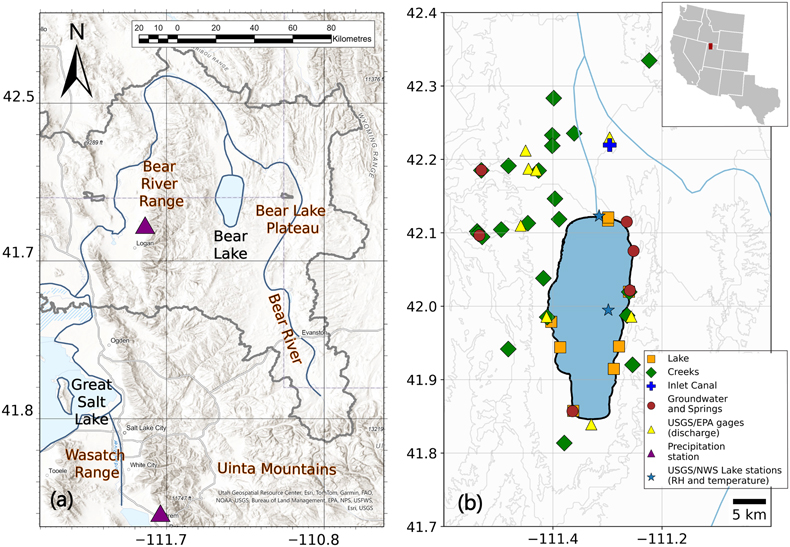
Figure 1 (a) Bear River watershed (grey outline) map and (b) sampling site locations; inset shows Bear Lake in the western U.S. This study utilised replicate samples from sites shown in panel (b) and previously reported by Custado et al. (2025)
Custado, M.J., Gagnon, C.A., Belanger, B., Sekhon, N., Bernstein-Schalet, J., Kinsley, C.W., Sharp, W.D., Oster, J.L., Ibarra, D.E. (2025) Constraining the Modern Hydrological Balance of Bear Lake, Utah-Idaho: Insights From Stable Isotopes (δ18O and δ2H). Water Resources Research 61, e2024WR038264. https://doi.org/10.1029/2024WR038264
.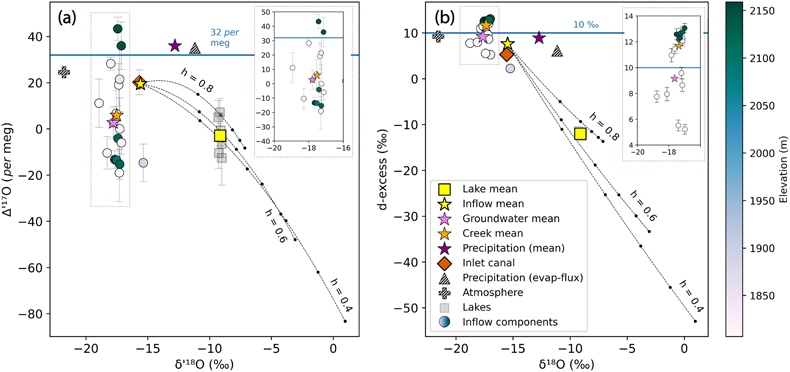
Figure 2 (a) Δ′17O versus δ′18O and (b) d-excess versus δ18O. Blue lines denote the Global Meteoric Water Line (GMWL), while black dashed lines represent lake isotopic evolution during evaporation at different humidities. Black dots indicate Xe values from 0 to 1 in increments of 0.2. Inflow components (circles) represent individual stream samples and are coloured by elevation; the inlet canal is included in the inflow mean. Insets show magnified views of the areas within the red dashed boxes. Only samples with paired discharge information were used in the calculations. Note that the error bars for d-excess are smaller than the markers. A link to the complete data set is included in the Supplementary Information.
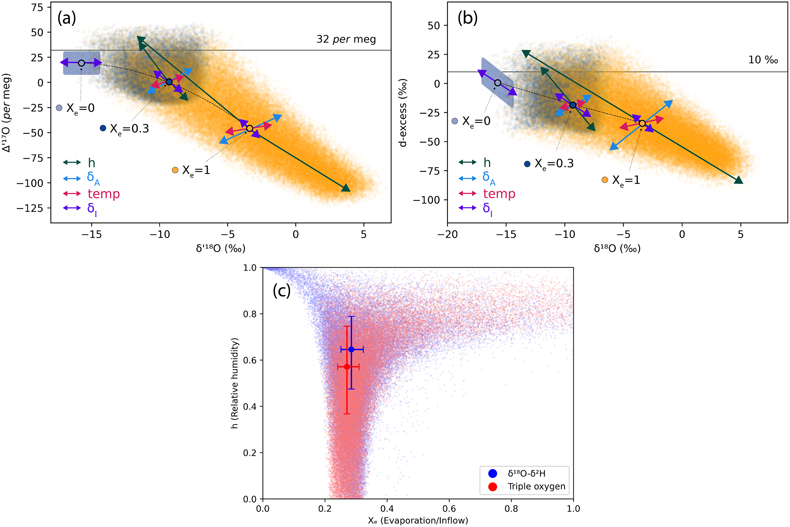
Figure 3 Sensitivity of lake isotopic composition and environmental parameters to varying evaporation conditions. Changes in the lake isotopic composition as a function of Xe are shown in (a) δ′18O versus Δ′17O and (b) δ18O versus d-excess spaces, while changes in Xe (x axis) and h (y axis) from varying isotopic inputs are shown in (c). Horizontal lines in (a) and (b) represent the GMWL. Error bars in (c) represent the IQR around the median value (circle). Inputs for (a) and (b) were h, δA, temperature, and δI; inputs for (c) were δA, temperature, δI, and lake composition (δL). Each marker represents one of 100,000 simulations sampled from normal distributions defined by the calculated input parameter values and uncertainties (see Supplementary Information). Arrows in (a) and (b) indicate the range of outputs generated by varying a single input while holding others constant (cf. Gázquez et al., 2018
Gázquez, F., Morellón, M., Bauska, T., Herwartz, D., Surma, J., et al. (2018) Triple oxygen and hydrogen isotopes of gypsum hydration water for quantitative paleo-humidity reconstruction. Earth and Planetary Science Letters 481, 177–188. https://doi.org/10.1016/j.epsl.2017.10.020
). Corresponding individual simulations are compiled in Figure S-4.