


Accurate equilibrium Δ47-Δ48 values in bivalves despite bulk differences in inner layer
Affiliations | Corresponding Author | Cite as | Funding information
Published by the European Association of Geochemistry
under Creative Commons License CC BY 4.0
Keywords: dual clumped isotopes, palaeothermometry, bivalves


- Share this article


-
Article views:348Cumulative count of HTML views and PDF downloads.
- Download Citation
- Rights & Permissions

top
Abstract
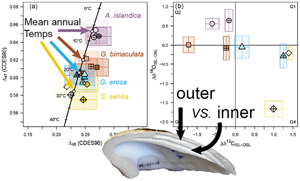
Figures and Tables
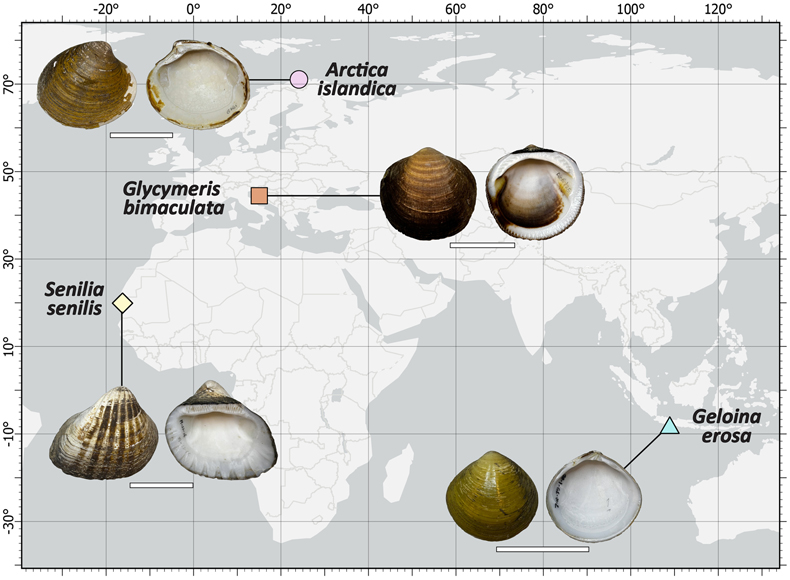
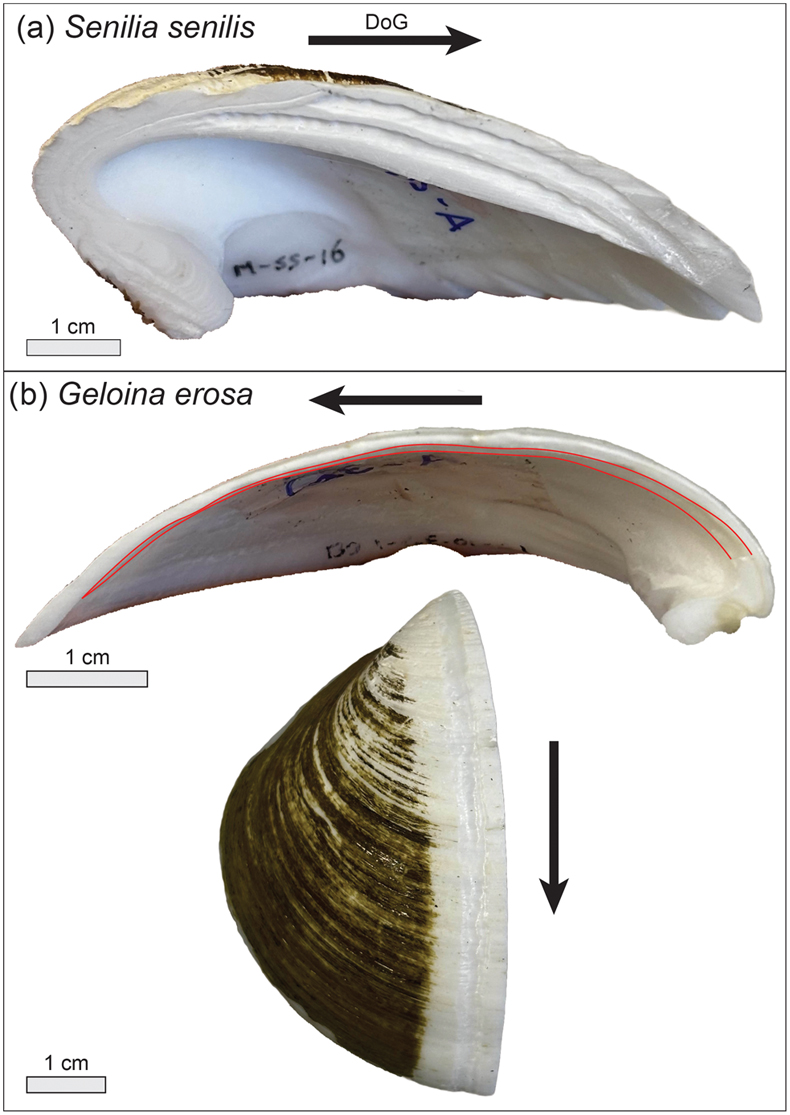
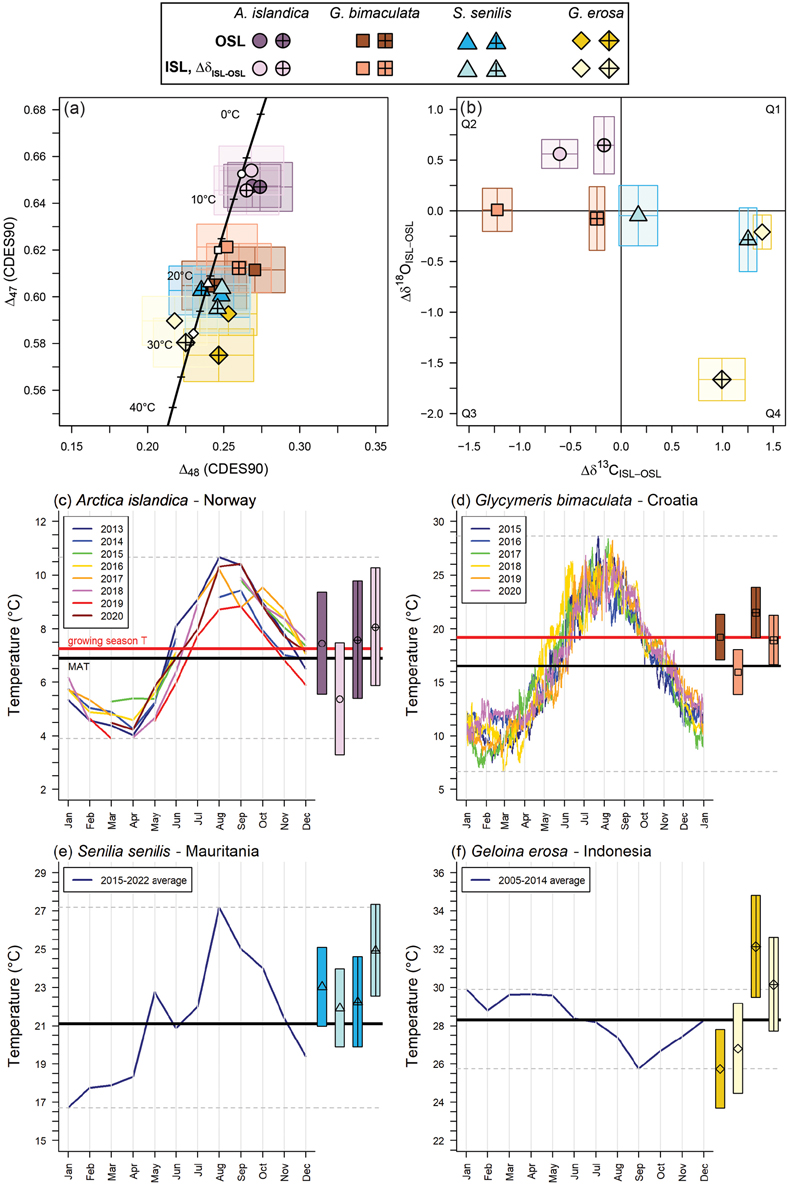
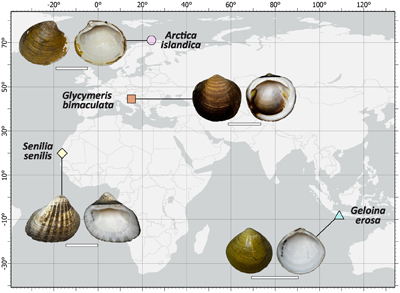 Figure 1 Sampling locations. Symbols and colours correspond to subsequent figures. Scale bars = 2 cm. Basemap: Esri World Countries Generalised 2022 (Sources: Esri, Garmin, and U.S. Central Intelligence Agency (The World Factbook)). | 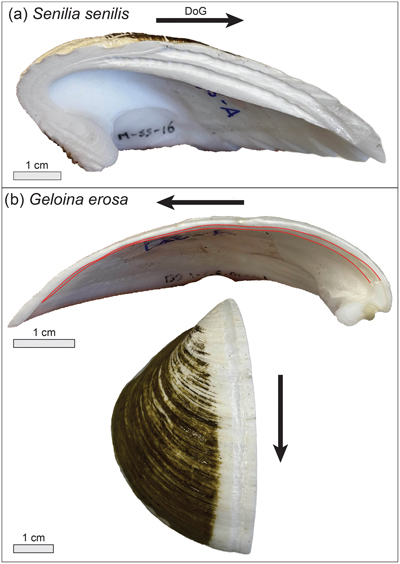 Figure 2 Example drill paths. (a) Cross sectional approach showing time synchronous growth bands milled. (b) Exterior approach showing the entire ISL thickness milled (red outline) and the entire OSL hinge-commissure transect milled (below). Black arrows show direction of growth (DoG). | 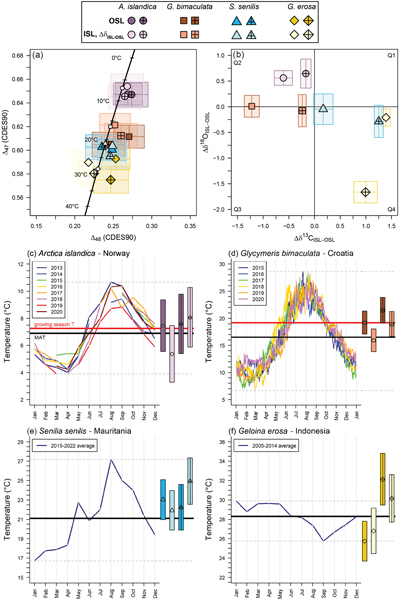 Figure 3 (a) Δ47-Δ48 equilibrium line (Fiebig et al., 2024). Symbols and colours correspond to species: darker values the OSL, lighter values the ISL. Internal crosses differentiate two individuals. Shaded boxes show 95 % CI. White symbols along equilibrium line show MAT for species with corresponding shape. (b) Δδ18OISL-OSL vs. Δδ13CISL-OSL. ISL colour values used arbitrarily to visually unify the two specimens, with OSL and ISL values collapsed into single points by subtraction. Shaded boxes show propagated 2 s.e. Quadrants labelled Q1-Q4 in extreme corners. (c–f) Environmental temperatures. Temperature curves (left) differentiate years by colour. Δ47 temperatures (right) show boxes spanning 95 % CI. Grey dashed lines highlight absolute maximum and minimum environmental temperatures. Thick black lines show MAT. Thick red lines show mean growing season temperature (GST) (A. islandica: March–November; G. bimaculata: May–December). | 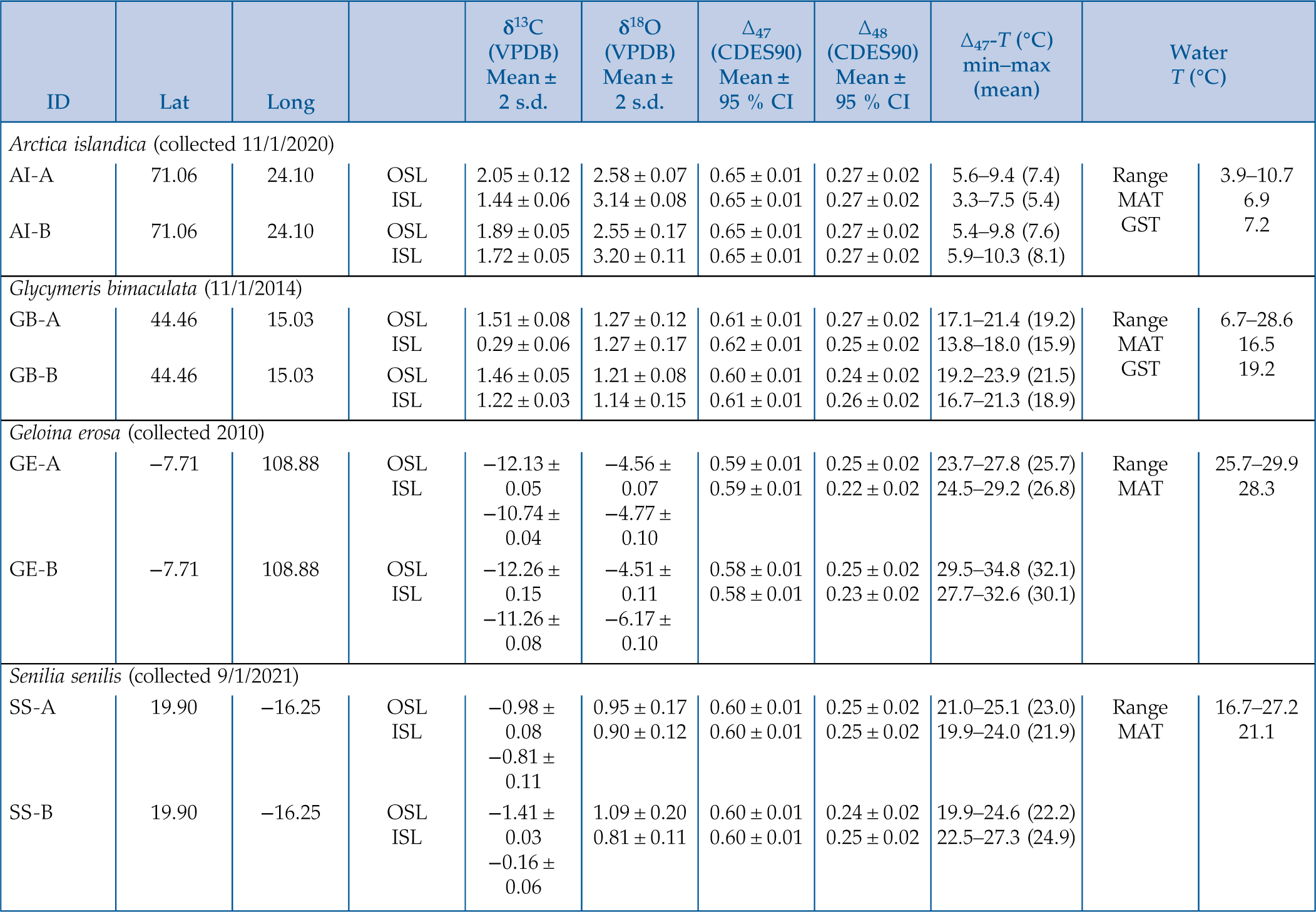 Table 1 Summary of collection locations, isotopic results for OSL and ISL, and environmental water data. |
| Figure 1 | Figure 2 | Figure 3 | Table 1 |
top
Introduction
Biogenic carbonates are important palaeoclimate archives, providing long term perspectives on climate change and contextualising major biosphere transitions throughout Earth history. The δ18O composition of skeletal carbonates such as corals, foraminifera, and bivalves are often measured to reconstruct marine palaeotemperatures (e.g., Chen and Watkins, 2025
Chen, S., Watkins, J.M. (2025) Oxygen and Carbon Isotopes in Marine Carbonates: A Biogenic Climate Archive Built Upon Disequilibria. Elements 21, 112–117. https://doi.org/10.2138/gselements.21.2.112
). However, this requires knowledge of the isotopic value of formation water (δ18Owater). Clumped isotope measurements circumvent the need for a priori δ18Owater quantities by recording palaeotemperature independently, which can subsequently be used alongside carbonate δ18O to calculate δ18Owater empirically (Huntington and Petersen, 2023Huntington, K.W., Petersen, S.V. (2023) Frontiers of Carbonate Clumped Isotope Thermometry. Annual Review of Earth and Planetary Sciences 51, 611–641. https://doi.org/10.1146/annurev-earth-031621-085949
). In thermodynamic equilibrium, bonding between “heavy” oxygen and carbon isotopes within the carbonate lattice varies exclusively with mineralisation temperature (Ghosh et al., 2006Ghosh, P., Adkins, J., Affek, H., Balta, B., Guo, W., Schauble, E.A., Schrag, D., Eiler, J.M. (2006) 13C–18O bonds in carbonate minerals: A new kind of paleothermometer. Geochimica et Cosmochimica Acta 70, 1439–1456. https://doi.org/10.1016/j.gca.2005.11.014
; Schauble et al., 2006Schauble, E.A., Ghosh, P., Eiler, J.M. (2006) Preferential formation of 13C–18O bonds in carbonate minerals, estimated using first-principles lattice dynamics. Geochimica et Cosmochimica Acta 70, 2510–2529. https://doi.org/10.1016/j.gca.2006.02.011
). Therefore, the excess abundance of multiply substituted (“clumped”) isotopologues of CO2 evolved from CaCO3 compared to the predicted abundance based on randomly arranged isotopes (Δ47) functions as a well calibrated palaeothermometer (e.g,. Kelson et al., 2017Kelson, J.R., Huntington, K.W., Schauer, A.J., Saenger, C., Lechler, A.R. (2017) Toward a universal carbonate clumped isotope calibration: Diverse synthesis and preparatory methods suggest a single temperature relationship. Geochimica et Cosmochimica Acta 197, 104–131. https://doi.org/10.1016/j.gca.2016.10.010
; Anderson et al., 2021Anderson, N.T., Kelson, J.R., Kele, S., Daëron, M., Bonifacie, M., Horita, J., Mackey, T.J., John, C.M., Kluge, T., Petschnig, P., Jost, A.B., Huntington, K.W., Bernasconi, S.M., Bergmann, K.D. (2021) A Unified Clumped Isotope Thermometer Calibration (0.5–1,100°C) Using Carbonate-Based Standardization. Geophysical Research Letters 48, e2020GL092069. https://doi.org/10.1029/2020GL092069
). This has improved records of palaeohydrological dynamics underpinned by reconstructed δ18Owater (Huntington and Petersen, 2023Huntington, K.W., Petersen, S.V. (2023) Frontiers of Carbonate Clumped Isotope Thermometry. Annual Review of Earth and Planetary Sciences 51, 611–641. https://doi.org/10.1146/annurev-earth-031621-085949
and refs therein).Carbonates that originally precipitate out of thermodynamic equilibrium (e.g., corals, brachiopods, coccoliths; Davies et al., 2022
Davies, A.J., Guo, W., Bernecker, M., Tagliavento, M., Raddatz, J., Gischler, E., Floegel, S., Fiebig, J. (2022) Dual clumped isotope thermometry of coral carbonate. Geochimica et Cosmochimica Acta 338, 66–78. https://doi.org/10.1016/j.gca.2022.10.015
, 2023Davies, A.J., Brand, U., Tagliavento, M., Bitner, M.A., Bajnai, D., Staudigel, P., Bernecker, M., Fiebig, J. (2023) Isotopic disequilibrium in brachiopods disentangled with dual clumped isotope thermometry. Geochimica et Cosmochimica Acta 359, 135–147. https://doi.org/10.1016/j.gca.2023.08.005
; Clark et al., 2025Clark, A.J., Jaggi, M., Bernasconi, S.M., Fiebig, J., Stoll, H.M. (2025) Clumped Isotope Temperatures of Coccolithophores From Global Sediment Traps. Paleoceanography and Paleoclimatology 40, e2024PA005054. https://doi.org/10.1029/2024PA005054
) violate preconditions for Δ47 palaeothermometry, but can be identified less ambiguously using dual clumped isotope analysis (Δ47 plus Δ48) (e.g., Bajnai et al., 2020Bajnai, D., Guo, W., Spötl, C., Coplen, T.B., Methner, K., Löffler, N., Krsnik, E., Gischler, E., Hansen, M., Henkel, D., Price, G.D., Raddatz, J., Scholz, D., Fiebig, J. (2020) Dual clumped isotope thermometry resolves kinetic biases in carbonate formation temperatures. Nature Communications 11, 4005. https://doi.org/10.1038/s41467-020-17501-0
; Davies et al., 2022Davies, A.J., Guo, W., Bernecker, M., Tagliavento, M., Raddatz, J., Gischler, E., Floegel, S., Fiebig, J. (2022) Dual clumped isotope thermometry of coral carbonate. Geochimica et Cosmochimica Acta 338, 66–78. https://doi.org/10.1016/j.gca.2022.10.015
, 2023Davies, A.J., Brand, U., Tagliavento, M., Bitner, M.A., Bajnai, D., Staudigel, P., Bernecker, M., Fiebig, J. (2023) Isotopic disequilibrium in brachiopods disentangled with dual clumped isotope thermometry. Geochimica et Cosmochimica Acta 359, 135–147. https://doi.org/10.1016/j.gca.2023.08.005
). Because Δ48 is similarly controlled by temperature but concerns different CO2 isotopologues, a temperature dependent equilibrium between Δ47 and Δ48 exists, which has been constrained by Fiebig et al. (2021Fiebig, J., Daëron, M., Bernecker, M., Guo, W., Schneider, G., Boch, R., Bernasconi, S.M., Jautzy, J., Dietzel, M. (2021) Calibration of the dual clumped isotope thermometer for carbonates. Geochimica et Cosmochimica Acta 312, 235–256. https://doi.org/10.1016/j.gca.2021.07.012
, 2024)Fiebig, J., Bernecker, M., Meijer, N., Methner, K., Staudigel, P.T., Davies, A.J., Bayarjargal, L., Spahr, D., Winkler, B., Hofmann, S., Granzin, M., Petersen, S.V. (2024) Carbonate clumped isotope values compromised by nitrate-derived NO2 interferent. Chemical Geology 670, 122382. https://doi.org/10.1016/j.chemgeo.2024.122382
considering ab initio thermodynamic predictions related to bond energies (Hill et al., 2014Hill, P.S., Tripati, A.K., Schauble, E.A. (2014) Theoretical constraints on the effects of pH, salinity, and temperature on clumped isotope signatures of dissolved inorganic carbon species and precipitating carbonate minerals. Geochimica et Cosmochimica Acta 125, 610–652. https://doi.org/10.1016/j.gca.2013.06.018
) plus empirical measurements of carbonates that crystallised closest to equilibrium. Moreover, the equilibrium Δ47-Δ48-T relationships for calcite remain valid for other common biomineral CaCO3 polymorphs, including aragonite (Bernecker et al., 2025Bernecker, M., Bonifacie, M., Staudigel, P., Meijer, N., Siebert, J., Wehr, N., Haussühl, E., Bernasconi, S.M., Petrash, D.A., Dietzel, M., Fiebig, J. (2025) Effects of mineralogy on Δ47 and Δ48 of carbonate-derived CO2 below analytical resolution. Geochimica et Cosmochimica Acta 401, 89–103. https://doi.org/10.1016/j.gca.2025.06.004
). With Δ47-Δ48 measurements, disequilibrium signals can provide new insight into biomineralisation processes even if not primary growth temperature.Bivalve shells are favoured palaeoclimate archives due to frequently good preservation in the fossil record and their ubiquity across aquatic environments. Schlidt et al. (2025)
Schlidt, V., Evans, D., de Winter, N.J., Bernecker, M., Arndt, I., Staudigel, P.T., Davies, A.J., Brand, U., Müller, W., Fiebig, J. (2025) Most bivalves and gastropods calcify indistinguishably from dual clumped isotope equilibrium. Geochimica et Cosmochimica Acta 410, 174–187. https://doi.org/10.1016/j.gca.2025.10.008
measured the Δ47-Δ48 composition of 14 modern marine bivalve species, finding only one analytically distinguishable from Δ47-Δ48 equilibrium. Curley et al. (2023)Curley, A.N., Petersen, S.V., Edie, S.M., Guo, W. (2023) Biologically driven isotopic fractionations in bivalves: from palaeoenvironmental problem to palaeophysiological proxy. Biological Reviews 98, 1016–1032. https://doi.org/10.1111/brv.12940
, Gey et al. (2024)Gey, C.J., Pfister, L., Türk, G., Thielen, F., Leonard, L., Schmitt, K.E., Schöne, B.R. (2024) Biologically driven isotope fractionation in ultrastructurally different shell portions of freshwater pearl mussels (Margaritifera margaritifera): Implications for stream water δ18O reconstructions. Limnology and Oceanography Letters 9, 827–836. https://doi.org/10.1002/lol2.10426
, and Lollos et al. (2025)Lollos, D.M., Curley, A.N., Petersen, S.V. (2025) Regional variation in biologically driven isotopic fractionations in cosmopolitan bivalve genera Dosinia and Mactra. PALAIOS 40, 321–335. https://doi.org/10.2110/palo.2025.004
recently showed that some bivalves have a heterogeneous isotopic composition in different structural layers, frequently in δ18O and δ13C but only significantly in Δ47 in two fossil species. Schlidt et al. (2025)Schlidt, V., Evans, D., de Winter, N.J., Bernecker, M., Arndt, I., Staudigel, P.T., Davies, A.J., Brand, U., Müller, W., Fiebig, J. (2025) Most bivalves and gastropods calcify indistinguishably from dual clumped isotope equilibrium. Geochimica et Cosmochimica Acta 410, 174–187. https://doi.org/10.1016/j.gca.2025.10.008
were unable to address mixing effects from isotopically distinct layers as they crushed and homogenised valves wholesale. Lollos et al. (2025)Lollos, D.M., Curley, A.N., Petersen, S.V. (2025) Regional variation in biologically driven isotopic fractionations in cosmopolitan bivalve genera Dosinia and Mactra. PALAIOS 40, 321–335. https://doi.org/10.2110/palo.2025.004
made the first attempt at measuring dual clumped isotopes in different layers of modern bivalve shells, but problems with standardisation and low replication led to relatively high uncertainty in Δ48. So, to date there have still been no high precision Δ47-Δ48 measurements on the different layers of bivalve shells.Here we present layer-specific dual clumped isotope measurements of four bivalve species. All specimens were collected live from natural environments with directly monitored water temperatures at two of four locations. Time synchronous sampling of the outer shell layer (OSL) and inner shell layer (ISL) allowed robust comparison of compositions. The Δ47, Δ48, δ18O, and δ13C values were assessed for their fidelity to environmental values and discussed for their implications on future palaeoclimate applications of dual clumped isotopes in bivalves.
top
Methods
Samples. Four bivalve species, aragonitic in both layers, were measured for dual clumped isotopes (Fig. 1): Arctica islandica (North Sea, Norway), Glycymeris bimaculata (Pag Bay, Croatia), Senilia senilis (Atlantic Ocean, Mauritania), and Geloina erosa (brackish mangrove, Indonesia). Specimens were collected live with articulated valves. Shells longer than 3 cm were selected to ensure sufficient sample sizes.
Figure 1 Sampling locations. Symbols and colours correspond to subsequent figures. Scale bars = 2 cm. Basemap: Esri World Countries Generalised 2022 (Sources: Esri, Garmin, and U.S. Central Intelligence Agency (The World Factbook)).
We sampled one valve each from two different individuals of these species to assess reproducibility. Each valve was sectioned along the axis of maximum growth using a water cooled saw and cut faces were polished to a ∼15 μm finish to highlight growth banding and the OSL-ISL boundary. The organic-rich periostracum and ligaments were removed before sampling. Samples of ∼100 mg were milled with a hand drill at 3000 rpm, making consistent slow passes over the entire sampling area and taking frequent ∼10–30 s breaks to minimise frictional heating (Fig. 2).
Figure 2 Example drill paths. (a) Cross sectional approach showing time synchronous growth bands milled. (b) Exterior approach showing the entire ISL thickness milled (red outline) and the entire OSL hinge-commissure transect milled (below). Black arrows show direction of growth (DoG).
Clusters of at least two mid-life growth increments traceable across the OSL-ISL boundary under magnification were selected (Fig. 2a). These bands were milled out in the OSL and ISL separately, ensuring that the same part of ontogeny was represented in both samples from the same shell, but different years may have been sampled in the second shell for that species based on different sizes and band visibility. The thin shell of G. erosa required milling a strip the entire thickness of the ISL to yield 100 mg (Fig. 2b). This represents a lifetime average of material, so an equivalent transect from hinge to commissure of the OSL was drilled externally. It was possible to visually confirm that OSL and ISL material did not mix in cross sectional view, despite coming from different faces. Powders were manually homogenised and aliquoted in 7–9 replicates of 10.0 ± 0.2 mg. The powders remained in a vacuum oven at 30 °C for at least two weeks prior to analysis to prevent isotopic exchange with adsorbed water (Staudigel et al., 2025
Staudigel, P., Bernecker, M., Curley, A., Meijer, N., Bayarjargal, L., Dietzel, M., Fiebig, J. (2025) Isotopic resetting of CO2 in the presence of carbonate samples: Implications for oxygen- and clumped-isotope analyses. Chemical Geology 694, 123012. https://doi.org/10.1016/j.chemgeo.2025.123012
).Isotopic analysis. Samples were digested in 108 % phosphoric acid in a common acid bath at 90 °C as described in Fiebig et al. (2019)
Fiebig, J., Bajnai, D., Löffler, N., Methner, K., Krsnik, E., Mulch, A., Hofmann, S. (2019) Combined high-precision Δ48 and Δ47 analysis of carbonates. Chemical Geology 522, 186–191. https://doi.org/10.1016/j.chemgeo.2019.05.019
. Heated (1000 °C) and equilibrated (25 °C) gas standards were run as described in Bernecker et al. (2023)Bernecker, M., Hofmann, S., Staudigel, P.T., Davies, A.J., Tagliavento, M., Meijer, N., Ballian, A., Fiebig, J. (2023) A robust methodology for triple (Δ47, Δ48, Δ49) clumped isotope analysis of carbonates. Chemical Geology 642, 121803. https://doi.org/10.1016/j.chemgeo.2023.121803
. Mass spectrometric raw data was processed using the D4xgui app (Bernecker et al., 2026Bernecker, M., Daëron, M., Staudigel, P.T., Hofmann, S., Fiebig, J. (2026) D4Xgui: A tool for baseline correction and standardization of carbonate clumped isotope raw data. SoftwareX 33, 102492. https://doi.org/10.1016/j.softx.2025.102492
), including correction of raw m/z 47–49 intensities for the pressure baseline, data anchoring relative to nominal Δ47 and Δ48 of equilibrated gases (Fiebig et al., 2021Fiebig, J., Daëron, M., Bernecker, M., Guo, W., Schneider, G., Boch, R., Bernasconi, S.M., Jautzy, J., Dietzel, M. (2021) Calibration of the dual clumped isotope thermometer for carbonates. Geochimica et Cosmochimica Acta 312, 235–256. https://doi.org/10.1016/j.gca.2021.07.012
), and full error propagation considering mass spectrometric measurements and data standardisation. Δ47 and Δ48 are reported in CDES90 and 95 % confidence intervals (CI) are considered for data interpretation. When aggregating data from multiple samples, Monte Carlo simulations (n = 10,000) considering sample means and standard error resulting from the former data processing were used.Environmental data sets. Environmental temperature data for the sampling locations were compiled from various sources. In all but one case, the duration of these records includes the actual lifetime of the shells based on collection dates. For G. bimaculata, the in situ record begins the year after sample collection, and the low inter-year variability in that record indicates that extrapolation to the recent lifetime of the animal is reasonable.
For A. islandica, monthly mean water temperature data (direct measurements, 5 m depth) were extracted from publicly accessible data from the Ingøya monitoring station of the Norwegian Institute for Marine Research (https://www.imr.no/forskning/forskningsdata/stasjoner/view?station=Ingoy). We compiled data from 2013–2020 (samples collected in 2020) to obtain at least five observations for each month. For G. bimaculata, daily water temperature data (direct measurements, 3–4 m depth) from 2015–2020 (samples collected in 2014) for Pag Bay were contributed by the Institute of Oceanography and Fisheries (Split, Croatia) (e.g., Vilibić et al., 2022
Vilibić, I., Dunić, N., Peharda, M. (2022) Near-surface ocean temperature variations across temporal scales in the coastal eastern Adriatic. Continental Shelf Research 245, 104786. https://doi.org/10.1016/j.csr.2022.104786
). For S. senilis and G. erosa, we used the interpolated data product from the World Ocean Atlas (WOA) 2023 at 0.25° resolution (Locarnini et al., 2024Locarnini, R.A., Mishonov, A.V., Baranova, O.K., Reagan, J.R., Boyer, T.P., Seidov, D., Wang, Z., Garcia, H.E., Bouchard, C., Cross, S.L., Paver, C.R., Dukhovskoy, D. (2024) World Ocean Atlas 2023, Volume 1: Temperature. NOAA Atlas NESDIS 89. https://doi.org/10.25923/54bh-1613
). Monthly mean temperature data for 0–10 m were extracted from the nearest appropriate grid cell to the sampling location. The 2015–2022 and 2005–2014 data products were used for S. senilis (samples collected in 2021) and G. erosa (samples collected in 2010), respectively.top
Results
Dual clumped isotopes. All samples but one G. bimaculata OSL were in equilibrium (i.e. the 95 % CI overlapped the equilibrium line of Fiebig et al., 2024
Fiebig, J., Bernecker, M., Meijer, N., Methner, K., Staudigel, P.T., Davies, A.J., Bayarjargal, L., Spahr, D., Winkler, B., Hofmann, S., Granzin, M., Petersen, S.V. (2024) Carbonate clumped isotope values compromised by nitrate-derived NO2 interferent. Chemical Geology 670, 122382. https://doi.org/10.1016/j.chemgeo.2024.122382
) (Fig. 3a). Within each valve, the difference between OSL and ISL temperatures was smaller than the 95 % CIs, which overlapped significantly, rendering them all analytically indistinguishable. For all samples, the mean annual water temperature (MAT) was contained within the 95 % confidence window (Fig. 3c–f), including the disequilibrium G. bimaculata sample, indicating that only Δ48 was significantly positively biased.Figure 3 (a) Δ47-Δ48 equilibrium line (Fiebig et al., 2024
Fiebig, J., Bernecker, M., Meijer, N., Methner, K., Staudigel, P.T., Davies, A.J., Bayarjargal, L., Spahr, D., Winkler, B., Hofmann, S., Granzin, M., Petersen, S.V. (2024) Carbonate clumped isotope values compromised by nitrate-derived NO2 interferent. Chemical Geology 670, 122382. https://doi.org/10.1016/j.chemgeo.2024.122382
). Symbols and colours correspond to species: darker values the OSL, lighter values the ISL. Internal crosses differentiate two individuals. Shaded boxes show 95 % CI. White symbols along equilibrium line show MAT for species with corresponding shape. (b) Δδ18OISL-OSL vs. Δδ13CISL-OSL. ISL colour values used arbitrarily to visually unify the two specimens, with OSL and ISL values collapsed into single points by subtraction. Shaded boxes show propagated 2 s.e. Quadrants labelled Q1-Q4 in extreme corners. (c–f) Environmental temperatures. Temperature curves (left) differentiate years by colour. Δ47 temperatures (right) show boxes spanning 95 % CI. Grey dashed lines highlight absolute maximum and minimum environmental temperatures. Thick black lines show MAT. Thick red lines show mean growing season temperature (GST) (A. islandica: March–November; G. bimaculata: May–December).Temperatures derived from sample mean Δ47 values were within 3.8 °C of either MAT or growing season temperature (GST) in all cases (Fig. 3c–f, Table 1). The mean difference between the Δ47 temperature and relevant environmental mean was 1.6 ± 2.6 °C (2 s.d.). Binning four A. islandica samples, the mean Δ47 temperature was 7.1 ± 4.7 °C (2 s.e.), where MAT and GST were 6.9 °C and 7.2 °C, respectively. The total temperature range from individual samples including the 95 % CIs (3.3–10.3 °C) is almost the same size as the total annual water temperature range (3.9–10.7 °C). Binning four G. bimaculata samples, the mean Δ47 temperature was 18.9 ± 6.0 °C (2 s.e.), where MAT and GST temperature were 16.5 °C and 19.2 °C, respectively. For all individual samples, the entire 95 % CI (13.8–23.9 °C) was within the total seasonal temperature range (6.7–28.6 °C) but skewed towards the GST. Binning four S. senilis samples, the mean Δ47 temperature was 23.0 ± 5.0 °C (2 s.e.), where MAT was 21.1 °C. The total temperature range from individual samples including the 95 % CIs (19.9–27.3 °C), aligned better with warmer months within the full seasonal water temperature range (16.7–27.2 °C). Binning four G. erosa samples, the mean Δ47 temperature was 28.7 ± 7.0 °C (2 s.e.), where MAT was 28.3 °C. Although all 95 % CIs (23.7–34.8 °C) overlapped the total seasonal temperature range (25.7–29.9 °C), together their range is several degrees wider than the recorded environmental temperatures.
Table 1 Summary of collection locations, isotopic results for OSL and ISL, and environmental water data.
| ID | Lat | Long | δ13C (VPDB) Mean ± 2 s.d. | δ18O (VPDB) Mean ± 2 s.d. | Δ47 (CDES90) Mean ± 95 % CI | Δ48 (CDES90) Mean ± 95 % CI | Δ47-T (°C) min–max (mean) | Water T (°C) | ||
| Arctica islandica (collected 11/1/2020) | ||||||||||
| AI-A | 71.06 | 24.10 | OSL ISL | 2.05 ± 0.12 1.44 ± 0.06 | 2.58 ± 0.07 3.14 ± 0.08 | 0.65 ± 0.01 0.65 ± 0.01 | 0.27 ± 0.02 0.27 ± 0.02 | 5.6–9.4 (7.4) 3.3–7.5 (5.4) | Range MAT GST | 3.9–10.7 6.9 7.2 |
| AI-B | 71.06 | 24.10 | OSL ISL | 1.89 ± 0.05 1.72 ± 0.05 | 2.55 ± 0.17 3.20 ± 0.11 | 0.65 ± 0.01 0.65 ± 0.01 | 0.27 ± 0.02 0.27 ± 0.02 | 5.4–9.8 (7.6) 5.9–10.3 (8.1) | ||
| Glycymeris bimaculata (11/1/2014) | ||||||||||
| GB-A | 44.46 | 15.03 | OSL ISL | 1.51 ± 0.08 0.29 ± 0.06 | 1.27 ± 0.12 1.27 ± 0.17 | 0.61 ± 0.01 0.62 ± 0.01 | 0.27 ± 0.02 0.25 ± 0.02 | 17.1–21.4 (19.2) 13.8–18.0 (15.9) | Range MAT GST | 6.7–28.6 16.5 19.2 |
| GB-B | 44.46 | 15.03 | OSL ISL | 1.46 ± 0.05 1.22 ± 0.03 | 1.21 ± 0.08 1.14 ± 0.15 | 0.60 ± 0.01 0.61 ± 0.01 | 0.24 ± 0.02 0.26 ± 0.02 | 19.2–23.9 (21.5) 16.7–21.3 (18.9) | ||
| Geloina erosa (collected 2010) | ||||||||||
| GE-A | −7.71 | 108.88 | OSL ISL | −12.13 ± 0.05 −10.74 ± 0.04 | −4.56 ± 0.07 −4.77 ± 0.10 | 0.59 ± 0.01 0.59 ± 0.01 | 0.25 ± 0.02 0.22 ± 0.02 | 23.7–27.8 (25.7) 24.5–29.2 (26.8) | Range MAT | 25.7–29.9 28.3 |
| GE-B | −7.71 | 108.88 | OSL ISL | −12.26 ± 0.15 −11.26 ± 0.08 | −4.51 ± 0.11 −6.17 ± 0.10 | 0.58 ± 0.01 0.58 ± 0.01 | 0.25 ± 0.02 0.23 ± 0.02 | 29.5–34.8 (32.1) 27.7–32.6 (30.1) | ||
| Senilia senilis (collected 9/1/2021) | ||||||||||
| SS-A | 19.90 | −16.25 | OSL ISL | −0.98 ± 0.08 −0.81 ± 0.11 | 0.95 ± 0.17 0.90 ± 0.12 | 0.60 ± 0.01 0.60 ± 0.01 | 0.25 ± 0.02 0.25 ± 0.02 | 21.0–25.1 (23.0) 19.9–24.0 (21.9) | Range MAT | 16.7–27.2 21.1 |
| SS-B | 19.90 | −16.25 | OSL ISL | −1.41 ± 0.03 −0.16 ± 0.06 | 1.09 ± 0.20 0.81 ± 0.11 | 0.60 ± 0.01 0.60 ± 0.01 | 0.24 ± 0.02 0.25 ± 0.02 | 19.9–24.6 (22.2) 22.5–27.3 (24.9) | ||
Bulk isotopic composition. Absolute OSL δ18O values from the two individuals of each species were analytically indistinguishable in all cases (Table 1). Absolute OSL δ13C values were all analytically indistinguishable except S. senilis, where the two differed by 0.43 ‰ (2 s.d. < 0.2 ‰) (Table 1). In contrast, ISL δ18O values were all indistinguishable except for G. erosa, where the two differed by 1.40 ‰ (2 s.d. < 0.2 ‰), and ISL δ13C values were distinguishable in every case with differences ranging from 0.28 to 0.93 ‰ (2 s.d. 0.03–0.11 ‰) (Table 1).
All but one shell (G. bimaculata) had measurable differences between ISL and OSL δ18O and/or δ13C values (Δδ18OISL-OSL, Δδ13CISL-OSL) (Fig. 3b). Altogether, Δδ18OISL-OSL values spanned −1.66 to +0.65 ‰ and Δδ13CISL-OSL spanned −1.22 to +1.39 ‰. Among individuals of the same species, the magnitudes of these offsets differed but their directionality was largely the same. A. islandica fell in quadrant 1 (+Δδ18OISL-OSL, −Δδ13CISL-OSL). G. bimaculata had Δδ18OISL-OSL ≈ 0 ‰ and −Δδ13CISL-OSL values, the larger of which come from the specimen biased in Δ48. S. senilis and G.erosa fell in quadrant 4 (−Δδ18OISL-OSL, +Δδ13CISL-OSL values).
top
Discussion
Dual clumped isotopes record MAT/GST highly accurately. It is uncertain whether the S. senilis Δ47 temperatures were truly warm season biased as it appears (Fig. 3e) because WOA data down to 10 m were averaged, potentially including waters cooler than the true shallow growth environment. A similar consideration is true for G. erosa, plus the real seasonality in a shallow, tidal mangrove where summer water temperatures can exceed 30 °C (Soeprobowati et al., 2023
Soeprobowati, T.R., Jumari, J., Wasiq Hidayat, J., Muhammad, F., Hanif Al Falah, M., Kadek Dita Cahyani, N., Gell, P. (2023) Water Quality Status of Mangrove Ecosystem in Bedono, Sayung, Demak, Central Java. Pollution 9, 1374–1385. https://doi.org/10.22059/poll.2023.355899.1803
) is very likely greater than the offshore data point. In both cases employing WOA data, density of instrumental measurements affects the fidelity of temperatures, and the multi-year monthly averaging masks extremes in given months/years that the instrumental data resolves.Both the OSL and ISL record comparable temperatures. The one non-equilibrium sample could be strictly fortuitous (a 5 % probability) or might indicate slightly elevated levels of organics (Fiebig et al., 2024
Fiebig, J., Bernecker, M., Meijer, N., Methner, K., Staudigel, P.T., Davies, A.J., Bayarjargal, L., Spahr, D., Winkler, B., Hofmann, S., Granzin, M., Petersen, S.V. (2024) Carbonate clumped isotope values compromised by nitrate-derived NO2 interferent. Chemical Geology 670, 122382. https://doi.org/10.1016/j.chemgeo.2024.122382
). Even with accurate equilibrium clumped isotope temperatures, different bulk δ18O in the two layers would still bias δ18Owater reconstructions. Inter-layer homogeneity should be assessed prior to using Δ47 and δ18O to calculate δ18Owater. Good agreement between OSL values from the same location across different specimens suggests that the OSL is better for reconstructing δ18Owater than the ISL (Table 1).Our accurate temperature reconstructions evidence the validity of drilling as a preparation method, despite previous experiments where frictional heating induced with high drill speeds in small areas partially reset Δ47 temperatures (e.g. Staudigel and Swart, 2016
Staudigel, P.T., Swart, P.K. (2016) Isotopic behavior during the aragonite-calcite transition: Implications for sample preparation and proxy interpretation. Chemical Geology 442, 130–138. https://doi.org/10.1016/j.chemgeo.2016.09.013
; Staudigel et al., 2023Staudigel, P., Davies, A.J., Bernecker, M., Tagliavento, M., van der Lubbe, H.J.L., Nooitgedacht, C., Looser, N., Bernasconi, S.M., Vonhof, H., Fiebig, J. (2023) Fingerprinting Kinetic Isotope Effects and Diagenetic Exchange Reactions Using Fluid Inclusion and Dual-Clumped Isotope Analysis. Geochemistry, Geophysics, Geosystems 24, e2022GC010766. https://doi.org/10.1029/2022GC010766
). Although there still may be some reordering or aragonite-to-calcite conversion (Staudigel and Swart, 2016Staudigel, P.T., Swart, P.K. (2016) Isotopic behavior during the aragonite-calcite transition: Implications for sample preparation and proxy interpretation. Chemical Geology 442, 130–138. https://doi.org/10.1016/j.chemgeo.2016.09.013
noted 95–100 % aragonite at drill speeds of 4000 rpm), comparisons between our hand drilled samples and environmental temperatures indicate that any effect from this preparation bias is dwarfed by analytical uncertainty and natural seasonality. Frictional heating from drilling should be a minimal concern when following cautious procedures as done here (low speed and pressure, constant motion, and short intermittent contact periods), especially when the sample material is not very resistant to milling as are most recent and well preserved fossil bivalves.Considering the near total lack of intra-specific differences in δ18O and δ13C values deriving from the OSL, it appears that external dissolved inorganic carbonate (DIC) is likely compositionally identical for the two specimens collected at each location. Different OSL δ13C among the two S. senilis shells could be due to the samples reflecting different growth years wherein bottom water δ13C varied, but indistinguishable δ18O and temperatures limit confidence in upwelling or freshening as potential causes. Alternatively, variable DIC of porewaters surrounding the burrowing shells could be important and tend to vary in δ13C more than δ18O due to microbial activity.
The intra-specific variation in Δδ13CISL-OSL and Δδ18OISL-OSL could be driven by either kinetic or source effects. Considering all samples, there is no strong correlation between Δδ18OISL-OSL and Δδ13CISL-OSL, not supporting prevalent kinetic control on the bulk isotopic composition. Some evidence suggests that δ18O may be more susceptible to kinetic effects than Δ47 or Δ48 due a combination of higher measurement precision and slower equilibration at the CaCO3-H2O interface depending on mineral surface characteristics (Schlidt et al., 2025
Schlidt, V., Evans, D., de Winter, N.J., Bernecker, M., Arndt, I., Staudigel, P.T., Davies, A.J., Brand, U., Müller, W., Fiebig, J. (2025) Most bivalves and gastropods calcify indistinguishably from dual clumped isotope equilibrium. Geochimica et Cosmochimica Acta 410, 174–187. https://doi.org/10.1016/j.gca.2025.10.008
), but even if minor kinetic effects exist here, source effects likely overshadow them.The immediate DIC source for the ISL might become measurably distinct from ambient water firstly by isotopic modification of internal DIC by numerous metabolic processes (e.g., respiration, tissue maintenance, digestion, reproduction), and secondly when that modified internal DIC is transformed into extrapallial (calcifying) fluid. If the same or different fractionating processes occur when secreting the outer extrapallial fluid (which may or may not be the case), mixing with ambient water may overprint this physiologically derived signal, leading to very consistent OSL δ18O and δ13C values, whereas the ISL values preserve it.
Members of the same species occupying the same quadrant in Figure 3 demonstrate an inherent consistency in the pathways fractionating internal DIC on the species level due to shared physiology, but the differences in absolute magnitudes of Δδ18OISL-OSL and Δδ13CISL-OSL values could be due to individual level factors like metabolic rate, diet, reproduction, and valve closure variably influencing internal DIC (e.g., Curley et al., 2023
Curley, A.N., Petersen, S.V., Edie, S.M., Guo, W. (2023) Biologically driven isotopic fractionations in bivalves: from palaeoenvironmental problem to palaeophysiological proxy. Biological Reviews 98, 1016–1032. https://doi.org/10.1111/brv.12940
and refs. therein). Additionally, the spread of values further affirms that these fundamental fractionating pathways can vary among different species of bivalves, as previously reported (e.g., Lollos et al., 2025Lollos, D.M., Curley, A.N., Petersen, S.V. (2025) Regional variation in biologically driven isotopic fractionations in cosmopolitan bivalve genera Dosinia and Mactra. PALAIOS 40, 321–335. https://doi.org/10.2110/palo.2025.004
; Curley et al., 2023Curley, A.N., Petersen, S.V., Edie, S.M., Guo, W. (2023) Biologically driven isotopic fractionations in bivalves: from palaeoenvironmental problem to palaeophysiological proxy. Biological Reviews 98, 1016–1032. https://doi.org/10.1111/brv.12940
).Some of G. erosa’s large Δδ18OISL-OSL and Δδ13CISL-OSL values could be due to their unique ecology as a tidal species (Purba et al., 2025
Purba, M.M., Fajri, N.E., Yuliati, Y. (2025) Bioecology of lokan calm (Geloina erosa) in the mangrove ecosystem of Buruk Bakul village, Bukit Batu district, Bengkalis regency, Riau province. Aurelia Journal 7, 55–66. https://doi.org/10.15578/aj.v7i1.14329
), where in different years they may have experienced more meaningfully different behaviours, freshwater inputs, and DIC sources. They also have δ13C values in either layer consistently at least 10 ‰ lower than any of the other species (Table 1), possibly consistent with relatively high incorporation of metabolic DIC in the calcifying fluid carbon budget due to more time spent with valves closed during low tide (e.g., Gillikin et al., 2007Gillikin, D.P., Lorrain, A., Meng, L., Dehairs, F. (2007) A large metabolic carbon contribution to the δ13C record in marine aragonitic bivalve shells. Geochimica et Cosmochimica Acta 71, 2936–2946. https://doi.org/10.1016/j.gca.2007.04.003
).top
Conclusions
Δ47 temperatures from hand drilled A. islandica, G. bimaculata, S. senilis, and G. erosa shells were consistently within 3.8 °C (on average 1.6 °C) of environmental mean temperatures. Δ47-Δ48 values fell on the equilibrium line in all except one case, wherein the Δ47 temperature remained accurate. Temperatures reconstructed from either OSL or ISL carbonate in the same shell were analytically indistinguishable, but δ18O and δ13C varied systematically. Inter-layer δ18O and δ13C offsets indicate some amount of physiological influence, likely driven by source effects. The directionality of these is consistent among individuals of the same species, suggesting a common mechanism. In some cases, Δδ18OISL-OSL values are great enough to meaningfully bias reconstructed δ18Owater if the ISL is sampled, despite accurate Δ47 temperatures, highlighting the importance of considering intra-shell variability when using bivalve shells as hydroclimate archives.
top
Acknowledgements
We would like to acknowledge assistance from Jan van Gils (S. senilis), Rob Witbaard (A. islandica) and Simon Troelstra (G. erosa) in acquiring some of the specimens used in this work. We thank Miguel Bernecker, Sven Hofman, Niels Meijer, and Philip Staudigel for assistance in the lab. JF was supported through DFG, Reinhart Koselleck project FI-948/13–1, NJW and BO were financially supported by the Netherlands Research Council (NWO) through a personal VENI fellowship awarded to NJW (MACRO, VI.Veni.222.354). NJW was supported by funds from the “Sectorplan Beta and Techniek” by the Dutch Ministry for Education, Culture and Science. MP was supported by CSF project BivalveSPEECH (IP-2024-05-2190). This manuscript was improved by the contribution of editorial and anonymous peer review.
Editor: Eric Oelkers
top
References
Anderson, N.T., Kelson, J.R., Kele, S., Daëron, M., Bonifacie, M., Horita, J., Mackey, T.J., John, C.M., Kluge, T., Petschnig, P., Jost, A.B., Huntington, K.W., Bernasconi, S.M., Bergmann, K.D. (2021) A Unified Clumped Isotope Thermometer Calibration (0.5–1,100°C) Using Carbonate-Based Standardization. Geophysical Research Letters 48, e2020GL092069. https://doi.org/10.1029/2020GL092069
 Show in context
 Therefore, the excess abundance of multiply substituted (“clumped”) isotopologues of CO2 evolved from CaCO3 compared to the predicted abundance based on randomly arranged isotopes (Δ47) functions as a well calibrated palaeothermometer (e.g,. Kelson et al., 2017; Anderson et al., 2021).
View in article
Bajnai, D., Guo, W., Spötl, C., Coplen, T.B., Methner, K., Löffler, N., Krsnik, E., Gischler, E., Hansen, M., Henkel, D., Price, G.D., Raddatz, J., Scholz, D., Fiebig, J. (2020) Dual clumped isotope thermometry resolves kinetic biases in carbonate formation temperatures. Nature Communications 11, 4005. https://doi.org/10.1038/s41467-020-17501-0
Show in context Carbonates that originally precipitate out of thermodynamic equilibrium (e.g., corals, brachiopods, coccoliths; Davies et al., 2022, 2023; Clark et al., 2025) violate preconditions for Δ47 palaeothermometry, but can be identified less ambiguously using dual clumped isotope analysis (Δ47 plus Δ48) (e.g., Bajnai et al., 2020; Davies et al., 2022, 2023).
View in article
Bernecker, M., Hofmann, S., Staudigel, P.T., Davies, A.J., Tagliavento, M., Meijer, N., Ballian, A., Fiebig, J. (2023) A robust methodology for triple (Δ47, Δ48, Δ49) clumped isotope analysis of carbonates. Chemical Geology 642, 121803. https://doi.org/10.1016/j.chemgeo.2023.121803
Show in context Heated (1000 °C) and equilibrated (25 °C) gas standards were run as described in Bernecker et al. (2023).
View in article
Bernecker, M., Bonifacie, M., Staudigel, P., Meijer, N., Siebert, J., Wehr, N., Haussühl, E., Bernasconi, S.M., Petrash, D.A., Dietzel, M., Fiebig, J. (2025) Effects of mineralogy on Δ47 and Δ48 of carbonate-derived CO2 below analytical resolution. Geochimica et Cosmochimica Acta 401, 89–103. https://doi.org/10.1016/j.gca.2025.06.004
Show in context Because Δ48 is similarly controlled by temperature but concerns different CO2 isotopologues, a temperature dependent equilibrium between Δ47 and Δ48 exists, which has been constrained by Fiebig et al. (2021, 2024) considering ab initio thermodynamic predictions related to bond energies (Hill et al., 2014) plus empirical measurements of carbonates that crystallised closest to equilibrium. Moreover, the equilibrium Δ47-Δ48-T relationships for calcite remain valid for other common biomineral CaCO3 polymorphs, including aragonite (Bernecker et al., 2025).
View in article
Bernecker, M., Daëron, M., Staudigel, P.T., Hofmann, S., Fiebig, J. (2026) D4Xgui: A tool for baseline correction and standardization of carbonate clumped isotope raw data. SoftwareX 33, 102492. https://doi.org/10.1016/j.softx.2025.102492
Show in context Mass spectrometric raw data was processed using the D4xgui app (Bernecker et al., 2026), including correction of raw m/z 47–49 intensities for the pressure baseline, data anchoring relative to nominal Δ47 and Δ48 of equilibrated gases (Fiebig et al., 2021), and full error propagation considering mass spectrometric measurements and data standardisation.
View in article
Chen, S., Watkins, J.M. (2025) Oxygen and Carbon Isotopes in Marine Carbonates: A Biogenic Climate Archive Built Upon Disequilibria. Elements 21, 112–117. https://doi.org/10.2138/gselements.21.2.112
Show in context The δ18O composition of skeletal carbonates such as corals, foraminifera, and bivalves are often measured to reconstruct marine palaeotemperatures (e.g., Chen and Watkins, 2025).
View in article
Clark, A.J., Jaggi, M., Bernasconi, S.M., Fiebig, J., Stoll, H.M. (2025) Clumped Isotope Temperatures of Coccolithophores From Global Sediment Traps. Paleoceanography and Paleoclimatology 40, e2024PA005054. https://doi.org/10.1029/2024PA005054
Show in context Carbonates that originally precipitate out of thermodynamic equilibrium (e.g., corals, brachiopods, coccoliths; Davies et al., 2022, 2023; Clark et al., 2025) violate preconditions for Δ47 palaeothermometry, but can be identified less ambiguously using dual clumped isotope analysis (Δ47 plus Δ48) (e.g., Bajnai et al., 2020; Davies et al., 2022, 2023).
View in article
Curley, A.N., Petersen, S.V., Edie, S.M., Guo, W. (2023) Biologically driven isotopic fractionations in bivalves: from palaeoenvironmental problem to palaeophysiological proxy. Biological Reviews 98, 1016–1032. https://doi.org/10.1111/brv.12940
Show in context Curley et al. (2023), Gey et al. (2024), and Lollos et al. (2025) recently showed that some bivalves have a heterogeneous isotopic composition in different structural layers, frequently in δ18O and δ13C but only significantly in Δ47 in two fossil species.
View in article
Members of the same species occupying the same quadrant in Figure 3 demonstrate an inherent consistency in the pathways fractionating internal DIC on the species level due to shared physiology, but the differences in absolute magnitudes of Δδ18OISL-OSL and Δδ13CISL-OSL values could be due to individual level factors like metabolic rate, diet, reproduction, and valve closure variably influencing internal DIC (e.g., Curley et al., 2023 and refs. therein).
View in article
Additionally, the spread of values further affirms that these fundamental fractionating pathways can vary among different species of bivalves, as previously reported (e.g., Lollos et al., 2025; Curley et al., 2023).
View in article
Davies, A.J., Guo, W., Bernecker, M., Tagliavento, M., Raddatz, J., Gischler, E., Floegel, S., Fiebig, J. (2022) Dual clumped isotope thermometry of coral carbonate. Geochimica et Cosmochimica Acta 338, 66–78. https://doi.org/10.1016/j.gca.2022.10.015
Show in context Carbonates that originally precipitate out of thermodynamic equilibrium (e.g., corals, brachiopods, coccoliths; Davies et al., 2022, 2023; Clark et al., 2025) violate preconditions for Δ47 palaeothermometry, but can be identified less ambiguously using dual clumped isotope analysis (Δ47 plus Δ48) (e.g., Bajnai et al., 2020; Davies et al., 2022, 2023).
View in article
Davies, A.J., Brand, U., Tagliavento, M., Bitner, M.A., Bajnai, D., Staudigel, P., Bernecker, M., Fiebig, J. (2023) Isotopic disequilibrium in brachiopods disentangled with dual clumped isotope thermometry. Geochimica et Cosmochimica Acta 359, 135–147. https://doi.org/10.1016/j.gca.2023.08.005
Show in context Carbonates that originally precipitate out of thermodynamic equilibrium (e.g., corals, brachiopods, coccoliths; Davies et al., 2022, 2023; Clark et al., 2025) violate preconditions for Δ47 palaeothermometry, but can be identified less ambiguously using dual clumped isotope analysis (Δ47 plus Δ48) (e.g., Bajnai et al., 2020; Davies et al., 2022, 2023).
View in article
Fiebig, J., Bajnai, D., Löffler, N., Methner, K., Krsnik, E., Mulch, A., Hofmann, S. (2019) Combined high-precision Δ48 and Δ47 analysis of carbonates. Chemical Geology 522, 186–191. https://doi.org/10.1016/j.chemgeo.2019.05.019
Show in context Samples were digested in 108 % phosphoric acid in a common acid bath at 90 °C as described in Fiebig et al. (2019).
View in article
Fiebig, J., Daëron, M., Bernecker, M., Guo, W., Schneider, G., Boch, R., Bernasconi, S.M., Jautzy, J., Dietzel, M. (2021) Calibration of the dual clumped isotope thermometer for carbonates. Geochimica et Cosmochimica Acta 312, 235–256. https://doi.org/10.1016/j.gca.2021.07.012
Show in context Because Δ48 is similarly controlled by temperature but concerns different CO2 isotopologues, a temperature dependent equilibrium between Δ47 and Δ48 exists, which has been constrained by Fiebig et al. (2021, 2024) considering ab initio thermodynamic predictions related to bond energies (Hill et al., 2014) plus empirical measurements of carbonates that crystallised closest to equilibrium. Moreover, the equilibrium Δ47-Δ48-T relationships for calcite remain valid for other common biomineral CaCO3 polymorphs, including aragonite (Bernecker et al., 2025).
View in article
Mass spectrometric raw data was processed using the D4xgui app (Bernecker et al., 2026), including correction of raw m/z 47–49 intensities for the pressure baseline, data anchoring relative to nominal Δ47 and Δ48 of equilibrated gases (Fiebig et al., 2021), and full error propagation considering mass spectrometric measurements and data standardisation.
View in article
Fiebig, J., Bernecker, M., Meijer, N., Methner, K., Staudigel, P.T., Davies, A.J., Bayarjargal, L., Spahr, D., Winkler, B., Hofmann, S., Granzin, M., Petersen, S.V. (2024) Carbonate clumped isotope values compromised by nitrate-derived NO2 interferent. Chemical Geology 670, 122382. https://doi.org/10.1016/j.chemgeo.2024.122382
Show in context Because Δ48 is similarly controlled by temperature but concerns different CO2 isotopologues, a temperature dependent equilibrium between Δ47 and Δ48 exists, which has been constrained by Fiebig et al. (2021, 2024) considering ab initio thermodynamic predictions related to bond energies (Hill et al., 2014) plus empirical measurements of carbonates that crystallised closest to equilibrium. Moreover, the equilibrium Δ47-Δ48-T relationships for calcite remain valid for other common biomineral CaCO3 polymorphs, including aragonite (Bernecker et al., 2025).
View in article
All samples but one G. bimaculata OSL were in equilibrium (i.e. the 95 % CI overlapped the equilibrium line of Fiebig et al., 2024) (Fig. 3a).
View in article
(a) Δ47-Δ48 equilibrium line (Fiebig et al., 2024).
View in article
Both the OSL and ISL record comparable temperatures. The one non-equilibrium sample could be strictly fortuitous (a 5 % probability) or might indicate slightly elevated levels of organics (Fiebig et al., 2024).
View in article
Gey, C.J., Pfister, L., Türk, G., Thielen, F., Leonard, L., Schmitt, K.E., Schöne, B.R. (2024) Biologically driven isotope fractionation in ultrastructurally different shell portions of freshwater pearl mussels (Margaritifera margaritifera): Implications for stream water δ18O reconstructions. Limnology and Oceanography Letters 9, 827–836. https://doi.org/10.1002/lol2.10426
Show in context Curley et al. (2023), Gey et al. (2024), and Lollos et al. (2025) recently showed that some bivalves have a heterogeneous isotopic composition in different structural layers, frequently in δ18O and δ13C but only significantly in Δ47 in two fossil species.
View in article
Ghosh, P., Adkins, J., Affek, H., Balta, B., Guo, W., Schauble, E.A., Schrag, D., Eiler, J.M. (2006) 13C–18O bonds in carbonate minerals: A new kind of paleothermometer. Geochimica et Cosmochimica Acta 70, 1439–1456. https://doi.org/10.1016/j.gca.2005.11.014
Show in context In thermodynamic equilibrium, bonding between “heavy” oxygen and carbon isotopes within the carbonate lattice varies exclusively with mineralisation temperature (Ghosh et al., 2006; Schauble et al., 2006).
View in article
Gillikin, D.P., Lorrain, A., Meng, L., Dehairs, F. (2007) A large metabolic carbon contribution to the δ13C record in marine aragonitic bivalve shells. Geochimica et Cosmochimica Acta 71, 2936–2946. https://doi.org/10.1016/j.gca.2007.04.003
Show in context They also have δ13C values in either layer consistently at least 10 ‰ lower than any of the other species (Table 1), possibly consistent with relatively high incorporation of metabolic DIC in the calcifying fluid carbon budget due to more time spent with valves closed during low tide (e.g., Gillikin et al., 2007).
View in article
Hill, P.S., Tripati, A.K., Schauble, E.A. (2014) Theoretical constraints on the effects of pH, salinity, and temperature on clumped isotope signatures of dissolved inorganic carbon species and precipitating carbonate minerals. Geochimica et Cosmochimica Acta 125, 610–652. https://doi.org/10.1016/j.gca.2013.06.018
Show in context Because Δ48 is similarly controlled by temperature but concerns different CO2 isotopologues, a temperature dependent equilibrium between Δ47 and Δ48 exists, which has been constrained by Fiebig et al. (2021, 2024) considering ab initio thermodynamic predictions related to bond energies (Hill et al., 2014) plus empirical measurements of carbonates that crystallised closest to equilibrium. Moreover, the equilibrium Δ47-Δ48-T relationships for calcite remain valid for other common biomineral CaCO3 polymorphs, including aragonite (Bernecker et al., 2025).
View in article
Huntington, K.W., Petersen, S.V. (2023) Frontiers of Carbonate Clumped Isotope Thermometry. Annual Review of Earth and Planetary Sciences 51, 611–641. https://doi.org/10.1146/annurev-earth-031621-085949
Show in context Clumped isotope measurements circumvent the need for a priori δ18Owater quantities by recording palaeotemperature independently, which can subsequently be used alongside carbonate δ18O to calculate δ18Owater empirically (Huntington and Petersen, 2023).
View in article
This has improved records of palaeohydrological dynamics underpinned by reconstructed δ18Owater (Huntington and Petersen, 2023 and refs therein).
View in article
Kelson, J.R., Huntington, K.W., Schauer, A.J., Saenger, C., Lechler, A.R. (2017) Toward a universal carbonate clumped isotope calibration: Diverse synthesis and preparatory methods suggest a single temperature relationship. Geochimica et Cosmochimica Acta 197, 104–131. https://doi.org/10.1016/j.gca.2016.10.010
Show in context Therefore, the excess abundance of multiply substituted (“clumped”) isotopologues of CO2 evolved from CaCO3 compared to the predicted abundance based on randomly arranged isotopes (Δ47) functions as a well calibrated palaeothermometer (e.g,. Kelson et al., 2017; Anderson et al., 2021).
View in article
Locarnini, R.A., Mishonov, A.V., Baranova, O.K., Reagan, J.R., Boyer, T.P., Seidov, D., Wang, Z., Garcia, H.E., Bouchard, C., Cross, S.L., Paver, C.R., Dukhovskoy, D. (2024) World Ocean Atlas 2023, Volume 1: Temperature. NOAA Atlas NESDIS 89. https://doi.org/10.25923/54bh-1613
Show in context For S. senilis and G. erosa, we used the interpolated data product from the World Ocean Atlas (WOA) 2023 at 0.25° resolution (Locarnini et al., 2024).
View in article
Lollos, D.M., Curley, A.N., Petersen, S.V. (2025) Regional variation in biologically driven isotopic fractionations in cosmopolitan bivalve genera Dosinia and Mactra. PALAIOS 40, 321–335. https://doi.org/10.2110/palo.2025.004
Show in context Curley et al. (2023), Gey et al. (2024), and Lollos et al. (2025) recently showed that some bivalves have a heterogeneous isotopic composition in different structural layers, frequently in δ18O and δ13C but only significantly in Δ47 in two fossil species.
View in article
Lollos et al. (2025) made the first attempt at measuring dual clumped isotopes in different layers of modern bivalve shells, but problems with standardisation and low replication led to relatively high uncertainty in Δ48.
View in article
Additionally, the spread of values further affirms that these fundamental fractionating pathways can vary among different species of bivalves, as previously reported (e.g., Lollos et al., 2025; Curley et al., 2023).
View in article
Purba, M.M., Fajri, N.E., Yuliati, Y. (2025) Bioecology of lokan calm (Geloina erosa) in the mangrove ecosystem of Buruk Bakul village, Bukit Batu district, Bengkalis regency, Riau province. Aurelia Journal 7, 55–66. https://doi.org/10.15578/aj.v7i1.14329
Show in context Some of G. erosa’s large Δδ18OISL-OSL and Δδ13CISL-OSL values could be due to their unique ecology as a tidal species (Purba et al., 2025), where in different years they may have experienced more meaningfully different behaviours, freshwater inputs, and DIC sources.
View in article
Schauble, E.A., Ghosh, P., Eiler, J.M. (2006) Preferential formation of 13C–18O bonds in carbonate minerals, estimated using first-principles lattice dynamics. Geochimica et Cosmochimica Acta 70, 2510–2529. https://doi.org/10.1016/j.gca.2006.02.011
Show in context In thermodynamic equilibrium, bonding between “heavy” oxygen and carbon isotopes within the carbonate lattice varies exclusively with mineralisation temperature (Ghosh et al., 2006; Schauble et al., 2006).
View in article
Schlidt, V., Evans, D., de Winter, N.J., Bernecker, M., Arndt, I., Staudigel, P.T., Davies, A.J., Brand, U., Müller, W., Fiebig, J. (2025) Most bivalves and gastropods calcify indistinguishably from dual clumped isotope equilibrium. Geochimica et Cosmochimica Acta 410, 174–187. https://doi.org/10.1016/j.gca.2025.10.008
Show in context Bivalve shells are favoured palaeoclimate archives due to frequently good preservation in the fossil record and their ubiquity across aquatic environments. Schlidt et al. (2025) measured the Δ47-Δ48 composition of 14 modern marine bivalve species, finding only one analytically distinguishable from Δ47-Δ48 equilibrium.
View in article
Schlidt et al. (2025) were unable to address mixing effects from isotopically distinct layers as they crushed and homogenised valves wholesale.
View in article
Some evidence suggests that δ18O may be more susceptible to kinetic effects than Δ47 or Δ48 due a combination of higher measurement precision and slower equilibration at the CaCO3-H2O interface depending on mineral surface characteristics (Schlidt et al., 2025), but even if minor kinetic effects exist here, source effects likely overshadow them.
View in article
Soeprobowati, T.R., Jumari, J., Wasiq Hidayat, J., Muhammad, F., Hanif Al Falah, M., Kadek Dita Cahyani, N., Gell, P. (2023) Water Quality Status of Mangrove Ecosystem in Bedono, Sayung, Demak, Central Java. Pollution 9, 1374–1385. https://doi.org/10.22059/poll.2023.355899.1803
Show in context A similar consideration is true for G. erosa, plus the real seasonality in a shallow, tidal mangrove where summer water temperatures can exceed 30 °C (Soeprobowati et al., 2023) is very likely greater than the offshore data point. In both cases employing WOA data, density of instrumental measurements affects the fidelity of temperatures, and the multi-year monthly averaging masks extremes in given months/years that the instrumental data resolves.
View in article
Staudigel, P.T., Swart, P.K. (2016) Isotopic behavior during the aragonite-calcite transition: Implications for sample preparation and proxy interpretation. Chemical Geology 442, 130–138. https://doi.org/10.1016/j.chemgeo.2016.09.013
Show in context Our accurate temperature reconstructions evidence the validity of drilling as a preparation method, despite previous experiments where frictional heating induced with high drill speeds in small areas partially reset Δ47 temperatures (e.g. Staudigel and Swart, 2016; Staudigel et al., 2023).
View in article
Although there still may be some reordering or aragonite-to-calcite conversion (Staudigel and Swart, 2016 noted 95–100 % aragonite at drill speeds of 4000 rpm), comparisons between our hand drilled samples and environmental temperatures indicate that any effect from this preparation bias is dwarfed by analytical uncertainty and natural seasonality.
View in article
Staudigel, P., Davies, A.J., Bernecker, M., Tagliavento, M., van der Lubbe, H.J.L., Nooitgedacht, C., Looser, N., Bernasconi, S.M., Vonhof, H., Fiebig, J. (2023) Fingerprinting Kinetic Isotope Effects and Diagenetic Exchange Reactions Using Fluid Inclusion and Dual-Clumped Isotope Analysis. Geochemistry, Geophysics, Geosystems 24, e2022GC010766. https://doi.org/10.1029/2022GC010766
Show in context Our accurate temperature reconstructions evidence the validity of drilling as a preparation method, despite previous experiments where frictional heating induced with high drill speeds in small areas partially reset Δ47 temperatures (e.g. Staudigel and Swart, 2016; Staudigel et al., 2023).
View in article
Staudigel, P., Bernecker, M., Curley, A., Meijer, N., Bayarjargal, L., Dietzel, M., Fiebig, J. (2025) Isotopic resetting of CO2 in the presence of carbonate samples: Implications for oxygen- and clumped-isotope analyses. Chemical Geology 694, 123012. https://doi.org/10.1016/j.chemgeo.2025.123012
Show in context The powders remained in a vacuum oven at 30 °C for at least two weeks prior to analysis to prevent isotopic exchange with adsorbed water (Staudigel et al., 2025).
View in article
Vilibić, I., Dunić, N., Peharda, M. (2022) Near-surface ocean temperature variations across temporal scales in the coastal eastern Adriatic. Continental Shelf Research 245, 104786. https://doi.org/10.1016/j.csr.2022.104786
Show in context For G. bimaculata, daily water temperature data (direct measurements, 3–4 m depth) from 2015–2020 (samples collected in 2014) for Pag Bay were contributed by the Institute of Oceanography and Fisheries (Split, Croatia) (e.g., Vilibić et al., 2022).
View in article
top
Supplementary Information
The Supplementary Information includes:
- Tables S-1 to S-7
- Supplementary Information References
Download the Supplementary Information (PDF)
Download Tables S-1 to S-5 (xlsx)
Download Tables S-6 and S-7 (xlsx)