


Fluid-present melting of early Archean crust: Stable Sr isotopes from the Kaapvaal Craton
Affiliations | Corresponding Author | Cite as | Funding information
Published by the European Association of Geochemistry
under Creative Commons License CC BY-NC-ND 4.0
Keywords: Fluid-present melting, Archean crust, Stable Sr isotopes, Kaapvaal Craton, Tsawela gneiss


- Share this article


-
Article views:211Cumulative count of HTML views and PDF downloads.
- Download Citation
- Rights & Permissions

top
Abstract
Figures
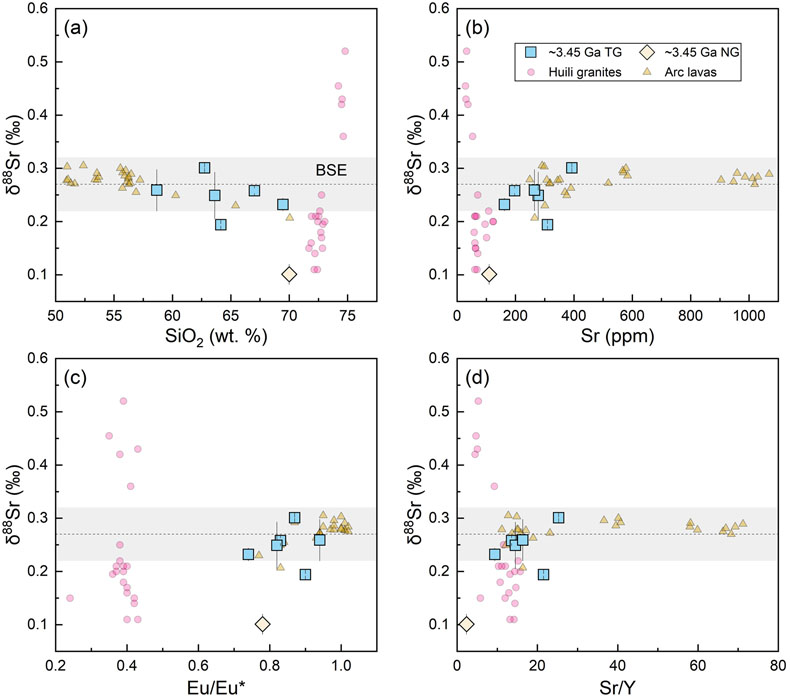
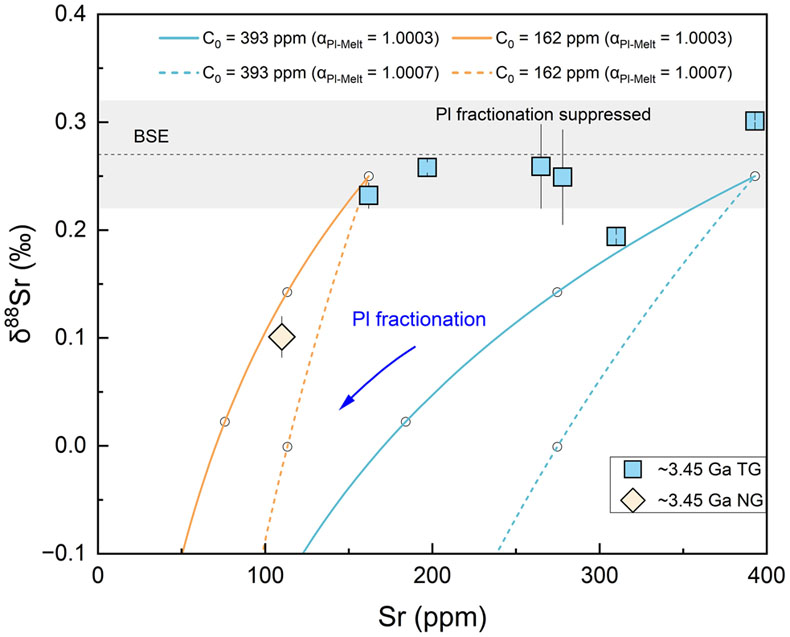
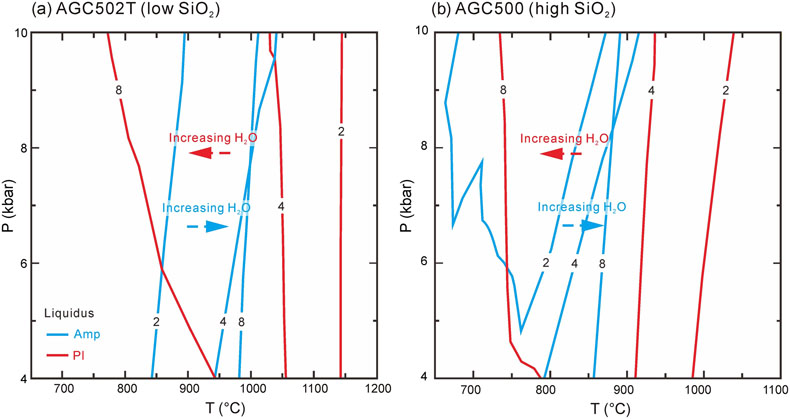
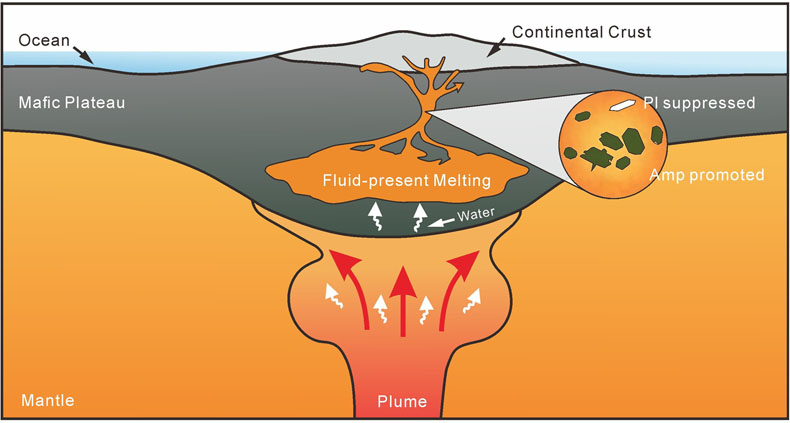
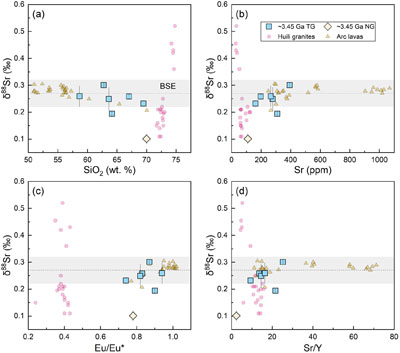 Figure 1 The δ88Sr versus (a) SiO2, (b) Sr, (c) Eu/Eu*, and (d) Sr/Y for the ∼3.45 Ga TG and NG samples. The BSE value is from Moynier et al. (2010). The δ88Sr values of Huili granites and arc lavas (Aegean and Mariana arc) are derived from Chen et al. (2025b) and Klaver et al. (2020), respectively. | 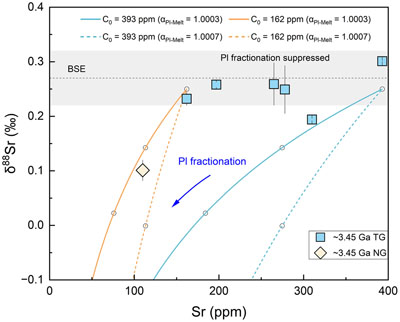 Figure 2 Rayleigh fractionation models for stable Sr isotope evolution of residual melt during fractional crystallisation of sodium rich magma. Bulk fractionation factors (αPl-Melt) between plagioclase and melt of 1.0003 and 1.0007 are assumed according to Chen et al. (2025b) and Charlier et al. (2012), respectively. C0 is the initial Sr content in primary melt, with values of 162 and 393 ppm corresponding to the observed range of the TG samples. Circular markers on each curve represent 10 wt. % increments of plagioclase fractionation. | 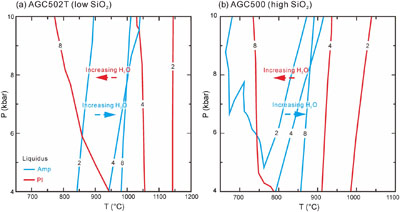 Figure 3 Pseudosections illustrating the suppression of plagioclase (Pl) liquidus relative to amphibole (Amp) liquidus during magmatic cooling at 4–10 kbar, with labels indicating H2O contents (in wt. %). Calculations using samples (a) AGC502T (primitive melt proxy) and (b) AGC500 (evolved), demonstrate that the suppression of plagioclase by high melt H2O content is consistent regardless of bulk SiO2 variations. | 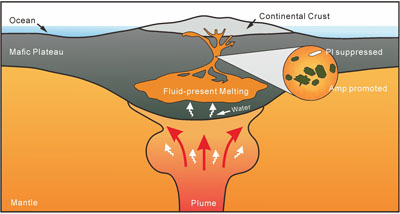 Figure 4 Schematic model for fluid-present melting of mafic crust in a Paleoarchean plateau setting, producing the ∼3.45 Ga Tsawela Gneiss in Kaapvaal Craton. The source of fluid is discussed in the main text. |
| Figure 1 | Figure 2 | Figure 3 | Figure 4 |
top
Introduction
Earth is the only terrestrial planet with voluminous felsic continental crust. The formation of early Archean crust is a fundamental issue for understanding planetary differentiation and habitability. Water is widely regarded as a decisive factor during the generation and evolution of silicic rocks (e.g., tonalite-trondhjemite-granodiorite, TTG). Water significantly lowers rock solidus temperature, reduces melt viscosity, enhances melt volume, thereby influencing the composition of residual mineral assemblages, melt compositions and differentiation pathways (Collins et al., 2020
Collins, W.J., Murphy, J.B., Johnson, T.E., Huang, H.Q. (2020) Critical role of water in the formation of continental crust. Nature Geoscience 13, 331–338. https://doi.org/10.1038/s41561-020-0573-6
). Based on the mode of water involvement during melting, previous studies have proposed two fundamental end member models with significant tectonic implications: fluid-present and fluid-absent melting (Beard and Lofgren, 1991Beard, J.S., Lofgren, G.E. (1991) Dehydration Melting and Water-Saturated Melting of Basaltic and Andesitic Greenstones and Amphibolites at 1, 3, and 6.9 kb. Journal of Petrology 32, 365–401. https://doi.org/10.1093/petrology/32.2.365
; Pourteau et al., 2020Pourteau, A., Doucet, L.S., Blereau, E.R., Volante, S., Johnson, T.E., Collins, W.J., Li, Z.X., Champion, D.C. (2020) TTG generation by fluid-fluxed crustal melting: Direct evidence from the Proterozoic Georgetown Inlier, NE Australia. Earth and Planetary Science Letters 550, 116548. https://doi.org/10.1016/j.epsl.2020.116548
; Tamblyn et al., 2023Tamblyn, R., Hermann, J., Hasterok, D., Sossi, P., Pettke, T., Chatterjee, S. (2023) Hydrated komatiites as a source of water for TTG formation in the Archean. Earth and Planetary Science Letters 603, 117982. https://doi.org/10.1016/j.epsl.2022.117982
). The former typically involves the influx of external free fluids, enabling melting at relatively low temperatures and is commonly invoked to support subduction or water-rich tectonic environments. In contrast, the latter primarily occurs in the absence of a free fluid phase and is driven by heating or decompression that induces the breakdown of hydrous minerals, typically associated with thickened lower crust or a mafic plateau setting. It is suggested that hydrous mantle plateaus occurred occasionally in the Phanerozoic (Liu et al., 2017Liu, J., Xia, Q.K., Kuritani, T., Hanski, E., Yu, H.R. (2017) Mantle hydration and the role of water in the generation of large igneous provinces. Nature Communications 8, 1824. https://doi.org/10.1038/s41467-017-01940-3
). Distinguishing between those two melting mechanisms is not only a fundamental petrological issue but also central to evaluate whether water-rich conditions within mafic plateaus existed in the Archean (Roman and Arndt, 2020Roman, A., Arndt, N. (2020) Differentiated Archean oceanic crust: Its thermal structure, mechanical stability and a test of the sagduction hypothesis. Geochimica et Cosmochimica Acta 278, 65–77. https://doi.org/10.1016/j.gca.2019.07.009
; Smithies et al., 2021Smithies, R.H., Lu, Y., Kirkland, C.L., Johnson, T.E., Mole, D.R., Champion, D.C., et al (2021) Oxygen isotopes trace the origins of Earth’s earliest continental crust. Nature 592, 70–75. https://doi.org/10.1038/s41586-021-03337-1
).However, precisely identifying the specific mechanisms of partial melting remains challenging. On the one hand, traditional thermobarometry highly depends on pressure, melt composition, water activity, and equilibrium state, making it difficult to serve as a direct indicator for fluid-present melting (Schwindinger et al., 2019
Schwindinger, M., Weinberg, R.F., Clos, F. (2019) Wet or dry? The difficulty of identifying the presence of water during crustal melting. Journal of Metamorphic Geology 37, 339–358. https://doi.org/10.1111/jmg.12465
). On the other hand, Archean felsic terranes commonly underwent amphibolite to granulite facies metamorphic overprinting, obscuring primary magmatic signatures. Because the stability of plagioclase is highly sensitive to the water content of melts, fluid-present melting suppresses plagioclase stability, whereas fluid-absent melting stabilises plagioclase (Beard and Lofgren, 1991Beard, J.S., Lofgren, G.E. (1991) Dehydration Melting and Water-Saturated Melting of Basaltic and Andesitic Greenstones and Amphibolites at 1, 3, and 6.9 kb. Journal of Petrology 32, 365–401. https://doi.org/10.1093/petrology/32.2.365
; Müntener and Ulmer, 2018Müntener, O., Ulmer, P. (2018) Arc crust formation and differentiation constrained by experimental petrology. American Journal of Science 318, 64–89. https://doi.org/10.2475/01.2018.04
). Plagioclase is the primary reservoir of Sr in magmatic systems and preferentially incorporates heavy Sr isotopes relative to the bulk rock, such that its fractionation or residue produces resolvable stable Sr isotope fractionation (Charlier et al., 2012Charlier, B.L.A., Nowell, G.M., Parkinson, I.J., Kelley, S.P., Pearson, D.G., Burton, K.W. (2012) High temperature strontium stable isotope behaviour in the early solar system and planetary bodies. Earth and Planetary Science Letters 329-330, 31–40. https://doi.org/10.1016/j.epsl.2012.02.008
; Klaver et al., 2020Klaver, M., Lewis, J., Parkinson, I.J., Elburg, M.A., Vroon, P.Z., Kelley, K.A., Elliott, T. (2020) Sr isotopes in arcs revisited: tracking slab dehydration using δ88/86Sr and 87Sr/86Sr systematics of arc lavas. Geochimica et Cosmochimica Acta 288, 101–119. https://doi.org/10.1016/j.gca.2020.08.010
; Chen et al., 2025bChen, X.Q., Deng, G.X., Jiang, D.S., Nan, X.Y., Huang, F. (2025b) Stable strontium isotope fractionation during crystal-melt separation in granitic magma evolution. Acta Geochimica 44, 731–739. https://doi.org/10.1007/s11631-024-00752-9
). This highlights stable Sr isotope (δ88Sr) as a potentially powerful tracer of plagioclase behaviour and melting mechanism.The Kaapvaal Craton is one of the classic regions for studying the formation of Archean continental crust. The ∼3.45 Ga Tsawela Gneiss (TG) from the Ancient Gneiss Complex (AGC) (Fig. S-1) is mainly composed of tonalite to trondhjemite (Fig. S-2a), providing a critical window into the debate over fluid-present versus fluid-absent melting. The TG exhibits calc-alkaline trends (Fig. S-2b), moderate Sr contents, and low Sr/Y ratios, consistent with a low pressure TTG origin (Fig. S-3). The TG displays weak deformation, lack migmatisation features, and has low loss on ignition (LOI) values, indicating relatively limited later modification (Hoffmann et al., 2016
Hoffmann, J.E., Kröner, A., Hegner, E., Viehmann, S., Xie, H., et al (2016) Source composition, fractional crystallization and magma mixing processes in the 3.48–3.43 Ga Tsawela tonalite suite (Ancient Gneiss Complex, Swaziland) – Implications for Palaeoarchaean geodynamics. Precambrian Research 276, 43–66. https://doi.org/10.1016/j.precamres.2016.01.026
). The source of TG is close to depleted mantle and lacks clear evidence for the involvement of ancient continental crustal materials (Hoffmann et al., 2016Hoffmann, J.E., Kröner, A., Hegner, E., Viehmann, S., Xie, H., et al (2016) Source composition, fractional crystallization and magma mixing processes in the 3.48–3.43 Ga Tsawela tonalite suite (Ancient Gneiss Complex, Swaziland) – Implications for Palaeoarchaean geodynamics. Precambrian Research 276, 43–66. https://doi.org/10.1016/j.precamres.2016.01.026
). Based on rock assemblages, geochemistry and palaeomagnetic detection, these rocks are commonly interpreted to have formed in a mafic plateau tectonic setting during the early Archean (Hoffmann et al., 2016Hoffmann, J.E., Kröner, A., Hegner, E., Viehmann, S., Xie, H., et al (2016) Source composition, fractional crystallization and magma mixing processes in the 3.48–3.43 Ga Tsawela tonalite suite (Ancient Gneiss Complex, Swaziland) – Implications for Palaeoarchaean geodynamics. Precambrian Research 276, 43–66. https://doi.org/10.1016/j.precamres.2016.01.026
; Brenner et al., 2026Brenner, A.R., Fu, R.R., Foley, B.J., Lourenço, D.L., Palma-Gomez, J., et al (2026) Paleomagnetic detection of relative plate motions and an infrequently reversing core dynamo at 3.5 Ga. Science 391, 1278–1282. https://doi.org/10.1126/science.adw9250
).Here, we investigate the ∼3.45 Ga TG exposed in the Kaapvaal Craton for high precision stable Sr isotopic analysis to distinguish the melting mechanisms. By integrating whole rock geochemistry and modelling, we aim to (1) evaluate plagioclase behaviour during TG petrogenesis, and (2) test the reliability of stable Sr isotopes in distinguishing fluid-present versus fluid-absent melting during ∼3.45 Ga TG formation.
top
Geological Background
Background. The Kaapvaal Craton preserves some of Earth’s representative Archean crustal fragments, comprising the AGC in Eswatini and the 3.6–3.2 Ga Barberton granitoid-greenstone terrane (BGGT) in South Africa (Hoffmann et al., 2016
Hoffmann, J.E., Kröner, A., Hegner, E., Viehmann, S., Xie, H., et al (2016) Source composition, fractional crystallization and magma mixing processes in the 3.48–3.43 Ga Tsawela tonalite suite (Ancient Gneiss Complex, Swaziland) – Implications for Palaeoarchaean geodynamics. Precambrian Research 276, 43–66. https://doi.org/10.1016/j.precamres.2016.01.026
). The AGC is primarily composed of the 3.66–3.2 Ga Ngwane Gneiss (NG), the 3.47–3.42 Ga TG and ∼3.46 Ga Dwalile Supracrustal Suite (DSS) (Hoffmann et al., 2016Hoffmann, J.E., Kröner, A., Hegner, E., Viehmann, S., Xie, H., et al (2016) Source composition, fractional crystallization and magma mixing processes in the 3.48–3.43 Ga Tsawela tonalite suite (Ancient Gneiss Complex, Swaziland) – Implications for Palaeoarchaean geodynamics. Precambrian Research 276, 43–66. https://doi.org/10.1016/j.precamres.2016.01.026
). The NG exhibits a bimodal character with interlayered felsic and mafic components. It is intensely deformed and experienced upper amphibolite to granulite facies metamorphism, and represents the oldest basement component of the AGC. The TG is a weakly to well foliated TTG suite (Fig. S-2a) and intruded the older NG and Dwalile Greenstone remnants (Hoffmann et al., 2016Hoffmann, J.E., Kröner, A., Hegner, E., Viehmann, S., Xie, H., et al (2016) Source composition, fractional crystallization and magma mixing processes in the 3.48–3.43 Ga Tsawela tonalite suite (Ancient Gneiss Complex, Swaziland) – Implications for Palaeoarchaean geodynamics. Precambrian Research 276, 43–66. https://doi.org/10.1016/j.precamres.2016.01.026
). Within the TG, SiO2 contents range from 58.67 to 71.48 wt. %. They originated from a juvenile source supported by Nd and Hf isotopic compositions (Zeh et al., 2011Zeh, A., Gerdes, A., Millonig, L. (2011) Hafnium isotope record of the Ancient Gneiss Complex, Swaziland, southern Africa: evidence for Archaean crust-mantle formation and crust reworking between 3.66 and 2.73 Ga. Journal of the Geological Society 168, 953–963. https://doi.org/10.1144/0016-76492010-117
; Hoffmann et al., 2016Hoffmann, J.E., Kröner, A., Hegner, E., Viehmann, S., Xie, H., et al (2016) Source composition, fractional crystallization and magma mixing processes in the 3.48–3.43 Ga Tsawela tonalite suite (Ancient Gneiss Complex, Swaziland) – Implications for Palaeoarchaean geodynamics. Precambrian Research 276, 43–66. https://doi.org/10.1016/j.precamres.2016.01.026
). Importantly, the low initial 87Sr/86Sr ratios reported for the AGC (Davies and Allsopp, 1976Davies, R.D., Allsopp, H.L. (1976) Strontium isotopic evidence relating to the evolution of the lower Precambrian granitic crust in Swaziland. Geology 4, 553–556. https://doi.org/10.1130/0091-7613(1976)4<553:SIERTT>2.0.CO;2
) suggest negligible involvement of pre-existing siliceous crust. Interpretation of major and trace element proxies is complicated by source heterogeneity, fractional crystallisation, and melting depth (Kendrick and Yakymchuk, 2020Kendrick, J., Yakymchuk, C. (2020) Garnet fractionation, progressive melt loss and bulk composition variations in anatectic metabasites: Complications for interpreting the geodynamic significance of TTGs. Geoscience Frontiers 11, 745–763. https://doi.org/10.1016/j.gsf.2019.12.001
). We integrate stable Sr isotopes with modelling to constrain the petrogenetic regime of the TG suite.Samples and methods. Six TG and one NG samples were analysed; sample location (Fig. S-1), petrography, major and trace element data, U-Pb zircon ages, and Hf-Nd isotopes were reported in Hoffmann et al. (2016)
Hoffmann, J.E., Kröner, A., Hegner, E., Viehmann, S., Xie, H., et al (2016) Source composition, fractional crystallization and magma mixing processes in the 3.48–3.43 Ga Tsawela tonalite suite (Ancient Gneiss Complex, Swaziland) – Implications for Palaeoarchaean geodynamics. Precambrian Research 276, 43–66. https://doi.org/10.1016/j.precamres.2016.01.026
. TG samples are medium to coarse grained tonalitic gneisses with weak deformation; sample AGC502T exhibits more pronounced fabric development. The studied NG sample (AGC470) is a strongly deformed migmatitic orthogneiss.Stable and radiogenic Sr isotope measurements were performed at the State Key Laboratory of Lithospheric and Environmental Coevolution, University of Science and Technology of China, following the protocol of Chen et al. (2022)
Chen, X.Q., Zeng, Z., Yu, H.M., Sun, N., Huang, F. (2022) Precise measurements of δ88/86Sr for twenty geological reference materials by double-spike MC-ICP-MS. International Journal of Mass Spectrometry 479, 116883. https://doi.org/10.1016/j.ijms.2022.116883
. Long term external reproducibility was 0.03 ‰ (2 s.d.) for δ88Sr and 0.000025 (2 s.d.) for 87Sr/86Sr. Procedural blanks were <0.18 ng Sr. Initial 87Sr/86Sr ratios were calculated at 3.45 Ga. Results for international standards and replicate analyses (Table S-1) are in agreement with certified values, ensuring data robustness. For the TG samples, replicate analyses show differences of 87Sr/86Sr but a consistent δ88Sr value, which were attributed to the slight heterogeneity of the Rb/Sr ratio among the different mineral phases within the bulk rock powders, while δ88Sr remains homogeneous at the hand specimen scale (Chen et al., 2025bChen, X.Q., Deng, G.X., Jiang, D.S., Nan, X.Y., Huang, F. (2025b) Stable strontium isotope fractionation during crystal-melt separation in granitic magma evolution. Acta Geochimica 44, 731–739. https://doi.org/10.1007/s11631-024-00752-9
).top
Results
The δ88Sr and 87Sr/86Sr ratios for the AGC gneisses are summarised in Table S-1. TG samples exhibit 87Sr/86Sr ratios of 0.723139–0.773669 and initial (87Sr/86Sr)t values of 0.69799–0.71722. Their δ88Sr values range from 0.19 ‰ to 0.30 ‰ (2 s.d. < 0.04 ‰), with a mean of 0.25 ± 0.07 ‰ (2 s.d.) (Figs. 1, S-4), largely overlapping with the reported Bulk Silicate Earth (BSE) values (0.27 ± 0.05 ‰, Moynier et al., 2010
Moynier, F., Agranier, A., Hezel, D.C., Bouvier, A. (2010) Sr stable isotope composition of Earth, the Moon, Mars, Vesta and meteorites. Earth and Planetary Science Letters 300, 359–366. https://doi.org/10.1016/j.epsl.2010.10.017
; 0.29 ± 0.07 ‰, Charlier et al., 2012Charlier, B.L.A., Nowell, G.M., Parkinson, I.J., Kelley, S.P., Pearson, D.G., Burton, K.W. (2012) High temperature strontium stable isotope behaviour in the early solar system and planetary bodies. Earth and Planetary Science Letters 329-330, 31–40. https://doi.org/10.1016/j.epsl.2012.02.008
; 0.30 ± 0.02 ‰, Amsellem et al., 2018Amsellem, E., Moynier, F., Day, J.M.D., Moreira, M., Puchtel, I.S., Teng, F.Z. (2018) The stable strontium isotopic composition of ocean island basalts, mid-ocean ridge basalts, and komatiites. Chemical Geology 483, 595–602. https://doi.org/10.1016/j.chemgeo.2018.03.030
). Compared with the wide range for granitoids δ88Sr (−1.51 ‰ to 0.54 ‰) (Chen et al., 2025aChen, X.Q., Quan, Y., Liu, X.C., Deng, G., Nan, X., Huang, F. (2025a) Stable strontium isotope fractionation by fluid-melt interaction recorded in the Himalayan leucogranites. Chemical Geology 690, 122869. https://doi.org/10.1016/j.chemgeo.2025.122869
, 2025bChen, X.Q., Deng, G.X., Jiang, D.S., Nan, X.Y., Huang, F. (2025b) Stable strontium isotope fractionation during crystal-melt separation in granitic magma evolution. Acta Geochimica 44, 731–739. https://doi.org/10.1007/s11631-024-00752-9
) (Fig. S-4), the stable Sr isotope fractionation in the TG sample is negligible (Fig. 1).Figure 1 The δ88Sr versus (a) SiO2, (b) Sr, (c) Eu/Eu*, and (d) Sr/Y for the ∼3.45 Ga TG and NG samples. The BSE value is from Moynier et al. (2010)
Moynier, F., Agranier, A., Hezel, D.C., Bouvier, A. (2010) Sr stable isotope composition of Earth, the Moon, Mars, Vesta and meteorites. Earth and Planetary Science Letters 300, 359–366. https://doi.org/10.1016/j.epsl.2010.10.017
. The δ88Sr values of Huili granites and arc lavas (Aegean and Mariana arc) are derived from Chen et al. (2025b)Chen, X.Q., Deng, G.X., Jiang, D.S., Nan, X.Y., Huang, F. (2025b) Stable strontium isotope fractionation during crystal-melt separation in granitic magma evolution. Acta Geochimica 44, 731–739. https://doi.org/10.1007/s11631-024-00752-9
and Klaver et al. (2020)Klaver, M., Lewis, J., Parkinson, I.J., Elburg, M.A., Vroon, P.Z., Kelley, K.A., Elliott, T. (2020) Sr isotopes in arcs revisited: tracking slab dehydration using δ88/86Sr and 87Sr/86Sr systematics of arc lavas. Geochimica et Cosmochimica Acta 288, 101–119. https://doi.org/10.1016/j.gca.2020.08.010
, respectively.The NG sample shows δ88Sr = 0.10 ± 0.02 ‰, significantly lighter than both TG samples and BSE. Its 87Sr/86Sr ratio is 0.758083, with a calculated initial (87Sr/86Sr)t value of 0.70597.
top
Discussion
What controls δ88Sr in the early Archean felsic magmas? Available data for Archean mantle derived rocks indicate that the stable Sr isotopic composition of the convecting mantle has remained constant since the Paleoarchean (Amsellem et al., 2018
Amsellem, E., Moynier, F., Day, J.M.D., Moreira, M., Puchtel, I.S., Teng, F.Z. (2018) The stable strontium isotopic composition of ocean island basalts, mid-ocean ridge basalts, and komatiites. Chemical Geology 483, 595–602. https://doi.org/10.1016/j.chemgeo.2018.03.030
). Importantly, mafic igneous processes have limited effect on stable Sr isotope fractionation (Amsellem et al., 2018Amsellem, E., Moynier, F., Day, J.M.D., Moreira, M., Puchtel, I.S., Teng, F.Z. (2018) The stable strontium isotopic composition of ocean island basalts, mid-ocean ridge basalts, and komatiites. Chemical Geology 483, 595–602. https://doi.org/10.1016/j.chemgeo.2018.03.030
). Stable Sr isotopes in felsic magmas are primarily governed by feldspar and apatite, either through crystallisation or as residual phase. Plagioclase and apatite preferentially incorporate heavy Sr isotopes, while K feldspar favours light isotopes (Charlier et al., 2012Charlier, B.L.A., Nowell, G.M., Parkinson, I.J., Kelley, S.P., Pearson, D.G., Burton, K.W. (2012) High temperature strontium stable isotope behaviour in the early solar system and planetary bodies. Earth and Planetary Science Letters 329-330, 31–40. https://doi.org/10.1016/j.epsl.2012.02.008
; Andrews and Jacobson, 2018Andrews, M.G., Jacobson, A.D. (2018) Controls on the solute geochemistry of subglacial discharge from the Russell Glacier, Greenland Ice Sheet determined by radiogenic and stable Sr isotope ratios. Geochimica et Cosmochimica Acta 239, 312–329. https://doi.org/10.1016/j.gca.2018.08.004
; Klaver et al., 2020Klaver, M., Lewis, J., Parkinson, I.J., Elburg, M.A., Vroon, P.Z., Kelley, K.A., Elliott, T. (2020) Sr isotopes in arcs revisited: tracking slab dehydration using δ88/86Sr and 87Sr/86Sr systematics of arc lavas. Geochimica et Cosmochimica Acta 288, 101–119. https://doi.org/10.1016/j.gca.2020.08.010
; Chen et al., 2025bChen, X.Q., Deng, G.X., Jiang, D.S., Nan, X.Y., Huang, F. (2025b) Stable strontium isotope fractionation during crystal-melt separation in granitic magma evolution. Acta Geochimica 44, 731–739. https://doi.org/10.1007/s11631-024-00752-9
). In this study, the TG exhibits an average δ88Sr of 0.25 ± 0.07 ‰, consistent with the mantle/BSE composition (Moynier et al., 2010Moynier, F., Agranier, A., Hezel, D.C., Bouvier, A. (2010) Sr stable isotope composition of Earth, the Moon, Mars, Vesta and meteorites. Earth and Planetary Science Letters 300, 359–366. https://doi.org/10.1016/j.epsl.2010.10.017
), suggesting that plagioclase was a negligible residual phase in the melting source. The lack of correlations between δ88Sr and SiO2, Sr contents, Eu/Eu* (Fig. 1) suggests negligible plagioclase, K feldspar and apatite fractionation. In addition, Rayleigh fractionation modelling (Fig. 2) suggests that 10 wt. % plagioclase fractionation would decrease the δ88Sr value of whole rock to 0.14 ‰ (for plagioclase-melt fractionation factor αPl-Melt = 1.0003 from Chen et al., 2025bChen, X.Q., Deng, G.X., Jiang, D.S., Nan, X.Y., Huang, F. (2025b) Stable strontium isotope fractionation during crystal-melt separation in granitic magma evolution. Acta Geochimica 44, 731–739. https://doi.org/10.1007/s11631-024-00752-9
) and 0.00 ‰ (for αPl-Melt = 1.0007 from Charlier et al., 2012Charlier, B.L.A., Nowell, G.M., Parkinson, I.J., Kelley, S.P., Pearson, D.G., Burton, K.W. (2012) High temperature strontium stable isotope behaviour in the early solar system and planetary bodies. Earth and Planetary Science Letters 329-330, 31–40. https://doi.org/10.1016/j.epsl.2012.02.008
). This demonstrates that δ88Sr is sufficiently sensitive to detect even a small amount of plagioclase crystallisation. However, this deviation is not observed in the TG suite. Also, the coarse grained texture of the TG precludes rapid cooling as a potential mechanism for suppressed plagioclase fractionation.Figure 2 Rayleigh fractionation models for stable Sr isotope evolution of residual melt during fractional crystallisation of sodium rich magma. Bulk fractionation factors (αPl-Melt) between plagioclase and melt of 1.0003 and 1.0007 are assumed according to Chen et al. (2025b)
Chen, X.Q., Deng, G.X., Jiang, D.S., Nan, X.Y., Huang, F. (2025b) Stable strontium isotope fractionation during crystal-melt separation in granitic magma evolution. Acta Geochimica 44, 731–739. https://doi.org/10.1007/s11631-024-00752-9
and Charlier et al. (2012)Charlier, B.L.A., Nowell, G.M., Parkinson, I.J., Kelley, S.P., Pearson, D.G., Burton, K.W. (2012) High temperature strontium stable isotope behaviour in the early solar system and planetary bodies. Earth and Planetary Science Letters 329-330, 31–40. https://doi.org/10.1016/j.epsl.2012.02.008
, respectively. C0 is the initial Sr content in primary melt, with values of 162 and 393 ppm corresponding to the observed range of the TG samples. Circular markers on each curve represent 10 wt. % increments of plagioclase fractionation.Secondary processes are unlikely to account for the restricted δ88Sr values observed in the TG samples. First, the TG samples are fresh, as indicated by low LOI values, and no correlation exists between LOI and δ88Sr (Fig. S-5). Second, the major Sr hosting minerals (feldspar, apatite) are relatively stable during amphibolite facies metamorphism. The narrow δ88Sr range despite variable initial Sr isotopes (Fig. S-5b) and bulk compositions argue against substantial metamorphic resetting or crustal contamination. Previous hybridisation models require mixing between mafic and felsic end members (Hoffmann et al., 2016
Hoffmann, J.E., Kröner, A., Hegner, E., Viehmann, S., Xie, H., et al (2016) Source composition, fractional crystallization and magma mixing processes in the 3.48–3.43 Ga Tsawela tonalite suite (Ancient Gneiss Complex, Swaziland) – Implications for Palaeoarchaean geodynamics. Precambrian Research 276, 43–66. https://doi.org/10.1016/j.precamres.2016.01.026
); however, reproducing the observed Sr concentrations through such a process would require the mafic component to contain an extremely high Sr content (800 ppm), which is inconsistent with typical mafic melts (Fig. S-10b). Moreover, magma mixing between isotopically distinct end members would be expected to generate resolvable δ88Sr heterogeneity (Fig. S-10a), which is not observed. Therefore, the narrow δ88Sr range of the TG samples likely reflects their primary magmatic compositions, consistent with the preservation of their relatively low initial Sr isotope compositions (Davies and Allsopp, 1976Davies, R.D., Allsopp, H.L. (1976) Strontium isotopic evidence relating to the evolution of the lower Precambrian granitic crust in Swaziland. Geology 4, 553–556. https://doi.org/10.1130/0091-7613(1976)4<553:SIERTT>2.0.CO;2
; this study).However, the Sr content of TG samples decreases with increasing SiO2 (Fig. S-5a) (Hoffmann et al., 2016
Hoffmann, J.E., Kröner, A., Hegner, E., Viehmann, S., Xie, H., et al (2016) Source composition, fractional crystallization and magma mixing processes in the 3.48–3.43 Ga Tsawela tonalite suite (Ancient Gneiss Complex, Swaziland) – Implications for Palaeoarchaean geodynamics. Precambrian Research 276, 43–66. https://doi.org/10.1016/j.precamres.2016.01.026
). This trend may indicate heterogeneous Sr contents in their mafic precursors, consistent with the observed heterogeneity in whole rock Hf-Nd and initial (87Sr/86Sr)t values (Davies and Allsopp, 1976Davies, R.D., Allsopp, H.L. (1976) Strontium isotopic evidence relating to the evolution of the lower Precambrian granitic crust in Swaziland. Geology 4, 553–556. https://doi.org/10.1130/0091-7613(1976)4<553:SIERTT>2.0.CO;2
; Fig. S-6) (Hoffmann et al., 2016Hoffmann, J.E., Kröner, A., Hegner, E., Viehmann, S., Xie, H., et al (2016) Source composition, fractional crystallization and magma mixing processes in the 3.48–3.43 Ga Tsawela tonalite suite (Ancient Gneiss Complex, Swaziland) – Implications for Palaeoarchaean geodynamics. Precambrian Research 276, 43–66. https://doi.org/10.1016/j.precamres.2016.01.026
). This interpretation is further supported by the wide variation in Sr contents (∼25–250 ppm), Sr/Y (1.2–9.8), and Eu/Eu* (0.78–1.02) of the ∼3.46 Ga DSS greenstone remnants (Fig. S-7) (Hoffmann et al., 2020Hoffmann, J.E., Musese, E., Kröner, A., Schneider, K.P., Wong, J., et al (2020) Hafnium-Neodymium isotope, trace element and U-Pb zircon age constraints on the petrogenesis of the 3.44–3.46 Ga Dwalile greenstone remnant, Ancient gneiss Complex, Swaziland. Precambrian Research 351, 105970. https://doi.org/10.1016/j.precamres.2020.105970
).Fluid-present melting and tectonic implications. A mafic plateau setting has been proposed as a viable tectonic environment for the formation of voluminous felsic crust during the early Archean (Johnson et al., 2017
Johnson, T.E., Brown, M., Gardiner, N.J., Kirkland, C.L., Smithies, R.H. (2017) Earth’s first stable continents did not form by subduction. Nature 543, 239–242. https://doi.org/10.1038/nature21383
). However, this view has been challenged by the argument that the lower crust of thick mafic plateaus is predominantly dry, thereby limiting the production of large volumes of silicic melt (Roman and Arndt, 2020Roman, A., Arndt, N. (2020) Differentiated Archean oceanic crust: Its thermal structure, mechanical stability and a test of the sagduction hypothesis. Geochimica et Cosmochimica Acta 278, 65–77. https://doi.org/10.1016/j.gca.2019.07.009
). Resolving the presence or absence of fluids in mafic plateaus is therefore critical for understanding the mechanisms of early continental crust formation and differentiation.Thermochemically, magmatic water reduces melt polymerisation by breaking Si-O-Si bonds (Stolper, 1982
Stolper, E. (1982) The speciation of water in silicate melts. Geochimica et Cosmochimica Acta 46, 2609–2620. https://doi.org/10.1016/0016-7037(82)90381-7
), which significantly depresses the plagioclase liquidus while expanding the stability field of amphibole (Beard and Lofgren, 1991Beard, J.S., Lofgren, G.E. (1991) Dehydration Melting and Water-Saturated Melting of Basaltic and Andesitic Greenstones and Amphibolites at 1, 3, and 6.9 kb. Journal of Petrology 32, 365–401. https://doi.org/10.1093/petrology/32.2.365
; Pichavant and Macdonald, 2007Pichavant, M., Macdonald, R. (2007) Crystallization of primitive basaltic magmas at crustal pressures and genesis of the calc-alkaline igneous suite: experimental evidence from St Vincent, Lesser Antilles arc. Contributions to Mineralogy and Petrology 154, 535–558. https://doi.org/10.1007/s00410-007-0208-6
; Müntener and Ulmer, 2018Müntener, O., Ulmer, P. (2018) Arc crust formation and differentiation constrained by experimental petrology. American Journal of Science 318, 64–89. https://doi.org/10.2475/01.2018.04
). The resulting melts are consequently enriched in Al2O3, follow calc-alkaline differentiation trends, exhibit low Sr/Y ratios (Beard and Lofgren, 1991Beard, J.S., Lofgren, G.E. (1991) Dehydration Melting and Water-Saturated Melting of Basaltic and Andesitic Greenstones and Amphibolites at 1, 3, and 6.9 kb. Journal of Petrology 32, 365–401. https://doi.org/10.1093/petrology/32.2.365
; Pichavant and Macdonald, 2007Pichavant, M., Macdonald, R. (2007) Crystallization of primitive basaltic magmas at crustal pressures and genesis of the calc-alkaline igneous suite: experimental evidence from St Vincent, Lesser Antilles arc. Contributions to Mineralogy and Petrology 154, 535–558. https://doi.org/10.1007/s00410-007-0208-6
; Müntener and Ulmer, 2018Müntener, O., Ulmer, P. (2018) Arc crust formation and differentiation constrained by experimental petrology. American Journal of Science 318, 64–89. https://doi.org/10.2475/01.2018.04
) and most importantly, preserve δ88Sr values indistinguishable from mantle compositions because plagioclase, the primary Sr-rich phase that preferentially incorporates heavy Sr, is largely absent from the fractional crystallisation assemblages. The restricted, mantle-like δ88Sr values of the TG samples require minimal isotopic fractionation, which in turn demands suppression of plagioclase crystallisation. While high pressure (>1.5 GPa) can also destabilise plagioclase, the TG samples are characterised by low pressure TTG signatures (Fig. S-3), ruling out a deep origin. We therefore ascribe the suppression of plagioclase crystallisation to fluid-present melting. This interpretation is independently supported by their calc-alkaline differentiation trend (Hoffmann et al., 2016Hoffmann, J.E., Kröner, A., Hegner, E., Viehmann, S., Xie, H., et al (2016) Source composition, fractional crystallization and magma mixing processes in the 3.48–3.43 Ga Tsawela tonalite suite (Ancient Gneiss Complex, Swaziland) – Implications for Palaeoarchaean geodynamics. Precambrian Research 276, 43–66. https://doi.org/10.1016/j.precamres.2016.01.026
), low pressure TTG affinity (Fig. S-3; Pourteau et al., 2020Pourteau, A., Doucet, L.S., Blereau, E.R., Volante, S., Johnson, T.E., Collins, W.J., Li, Z.X., Champion, D.C. (2020) TTG generation by fluid-fluxed crustal melting: Direct evidence from the Proterozoic Georgetown Inlier, NE Australia. Earth and Planetary Science Letters 550, 116548. https://doi.org/10.1016/j.epsl.2020.116548
) and no obvious Eu anomaly (Hoffmann et al., 2016Hoffmann, J.E., Kröner, A., Hegner, E., Viehmann, S., Xie, H., et al (2016) Source composition, fractional crystallization and magma mixing processes in the 3.48–3.43 Ga Tsawela tonalite suite (Ancient Gneiss Complex, Swaziland) – Implications for Palaeoarchaean geodynamics. Precambrian Research 276, 43–66. https://doi.org/10.1016/j.precamres.2016.01.026
). In contrast, fluid-absent melting favours plagioclase crystallisation, producing melts with lighter δ88Sr and tholeiitic differentiation trends (Müntener and Ulmer, 2018Müntener, O., Ulmer, P. (2018) Arc crust formation and differentiation constrained by experimental petrology. American Journal of Science 318, 64–89. https://doi.org/10.2475/01.2018.04
).Figure 3 Pseudosections illustrating the suppression of plagioclase (Pl) liquidus relative to amphibole (Amp) liquidus during magmatic cooling at 4–10 kbar, with labels indicating H2O contents (in wt. %). Calculations using samples (a) AGC502T (primitive melt proxy) and (b) AGC500 (evolved), demonstrate that the suppression of plagioclase by high melt H2O content is consistent regardless of bulk SiO2 variations.
To quantitatively evaluate the impact of magmatic H2O content on mineral crystallisation sequences during magma cooling, we performed thermodynamic forward modelling at 4–10 kbar using the bulk compositions of sample AGC502T (primitive proxy) and AGC500 (evolved). Phase equilibrium modelling (Figs. 3, S-8) quantitatively confirms these experimental relationships linking water content to the stability fields of plagioclase and amphibole (Beard and Lofgren, 1991
Beard, J.S., Lofgren, G.E. (1991) Dehydration Melting and Water-Saturated Melting of Basaltic and Andesitic Greenstones and Amphibolites at 1, 3, and 6.9 kb. Journal of Petrology 32, 365–401. https://doi.org/10.1093/petrology/32.2.365
; Müntener and Ulmer, 2018Müntener, O., Ulmer, P. (2018) Arc crust formation and differentiation constrained by experimental petrology. American Journal of Science 318, 64–89. https://doi.org/10.2475/01.2018.04
). A progressive increase in melt H2O content lowers the plagioclase liquidus from >1200 °C to ∼750 °C while simultaneously extending the stability field of amphibole to ∼1050 °C (Figs. 3, S-8). Crucially, the effect of water activity on depressing the plagioclase liquidus far exceeds that of temperature and pressure variations in the upper to lower crustal regime, serving as the principal control on plagioclase stability, independent of the bulk composition (Fig. 3a,b).Plagioclase fractionation may be suspended due to insufficient gravitational settling in a viscous magma chamber, which would drive magma to higher Sr contents, δ88Sr values and positive Eu anomalies in the cumulate portions. However, those features are absent in the TG suite (Figs. 1, S-5). Thus, plagioclase was neither a significant fractionating nor a cumulate-forming phase, consistent with suppressed plagioclase crystallisation under water-rich conditions.
These findings challenge the prevailing assumption that the lower crust of mafic plateaus is inherently water-poor (Roman and Arndt, 2020
Roman, A., Arndt, N. (2020) Differentiated Archean oceanic crust: Its thermal structure, mechanical stability and a test of the sagduction hypothesis. Geochimica et Cosmochimica Acta 278, 65–77. https://doi.org/10.1016/j.gca.2019.07.009
). Their “wet” geochemical signature suggests that fluid activity was pivotal in non-plate tectonic regimes. Water not only enhances melt productivity by depressing the solidus but also promotes calc-alkaline differentiation, facilitating rapid generation of voluminous felsic crust. Consequently, early continental growth may not require modern style subduction; instead, it could have occurred within hydrated mafic plateaus (Fig. 4).The ultimate source of these fluids remains uncertain, but can be constrained. Seawater hydrothermal alteration is a potential source (Vezinet et al., 2018
Vezinet, A., Pearson, D.G., Thomassot, E., Stern, R.A., Sarkar, C., Luo, Y., Fisher, C.M. (2018) Hydrothermally-altered mafic crust as source for early Earth TTG: Pb/Hf/O isotope and trace element evidence in zircon from TTG of the Eoarchean Saglek Block, N. Labrador. Earth and Planetary Science Letters 503, 95–107. https://doi.org/10.1016/j.epsl.2018.09.015
); however, intensely altered oceanic crust is characterised by elevated δ88Sr values (0.27–0.34 ‰), higher 87Sr/86Sr, and correlated enrichments in fluid mobile element ratios such as K/La and K/Th ratios (Klaver et al., 2020Klaver, M., Lewis, J., Parkinson, I.J., Elburg, M.A., Vroon, P.Z., Kelley, K.A., Elliott, T. (2020) Sr isotopes in arcs revisited: tracking slab dehydration using δ88/86Sr and 87Sr/86Sr systematics of arc lavas. Geochimica et Cosmochimica Acta 288, 101–119. https://doi.org/10.1016/j.gca.2020.08.010
; Liu and He, 2021Liu, C.T., He, Y. (2021) Rise of major subaerial landmasses about 3.0 to 2.7 billion years ago. Geochemical Perspectives Letters 18, 1–5. https://doi.org/10.7185/geochemlet.2115
). In contrast, the TG samples display mantle-like stable Sr isotopic compositions and lack systematic correlations with K/La and K/Th ratios (Fig. S-9), suggesting that the involvement of hydrothermal alteration fluids was likely minimal. Altered komatiites within oceanic plateaus represent another potential fluid source through dehydration (Tamblyn et al., 2023Tamblyn, R., Hermann, J., Hasterok, D., Sossi, P., Pettke, T., Chatterjee, S. (2023) Hydrated komatiites as a source of water for TTG formation in the Archean. Earth and Planetary Science Letters 603, 117982. https://doi.org/10.1016/j.epsl.2022.117982
). Although Barberton komatiites exhibit relatively heavy δ88Sr values (0.16–0.97 ‰) (Amsellem et al., 2018Amsellem, E., Moynier, F., Day, J.M.D., Moreira, M., Puchtel, I.S., Teng, F.Z. (2018) The stable strontium isotopic composition of ocean island basalts, mid-ocean ridge basalts, and komatiites. Chemical Geology 483, 595–602. https://doi.org/10.1016/j.chemgeo.2018.03.030
), the isotopic composition of the fluids released remains poorly constrained. By comparison, the low Sr content of komatiites (average Sr contents = 23 ppm; Chavagnac, 2004Chavagnac, V. (2004) A geochemical and Nd isotopic study of Barberton komatiites (South Africa): implication for the Archean mantle. Lithos 75, 253–281. https://doi.org/10.1016/j.lithos.2004.03.001
) limits their ability to significantly modify the bulk Sr isotopic compositions of the mafic source. On the other hand, natural observations reveal that low temperature, slab derived fluids are enriched in light Sr isotopes (δ88Sr = 0.122–0.157 ‰) (Kani et al., 2023Kani, T., Misawa, K., Morikawa, N., Kazahaya, K., Kusuhara, F., Yoneda, S., Terakado, Y. (2023) Strontium Isotope Characteristics (δ88/86Sr, 87Sr/86Sr) of Arima-Type Brines Originated from Slab-Fluids. Geophysical Research Letters 50. https://doi.org/10.1029/2022GL100309
), whereas high temperature fluids (>700 °C) tend to equilibrate with their source rocks, preserving a mantle-like isotopic signature (Klaver et al., 2020Klaver, M., Lewis, J., Parkinson, I.J., Elburg, M.A., Vroon, P.Z., Kelley, K.A., Elliott, T. (2020) Sr isotopes in arcs revisited: tracking slab dehydration using δ88/86Sr and 87Sr/86Sr systematics of arc lavas. Geochimica et Cosmochimica Acta 288, 101–119. https://doi.org/10.1016/j.gca.2020.08.010
). Therefore, the mantle-like δ88Sr values exclude shallow, fractionated fluids but are consistent with high temperature fluid-rock equilibrium. Collectively, these observations suggest that the TG magmas were influenced by deep seated, high temperature fluids, partially derived from hydrated komatiites from the middle-lower crust (Tamblyn et al., 2023Tamblyn, R., Hermann, J., Hasterok, D., Sossi, P., Pettke, T., Chatterjee, S. (2023) Hydrated komatiites as a source of water for TTG formation in the Archean. Earth and Planetary Science Letters 603, 117982. https://doi.org/10.1016/j.epsl.2022.117982
) and possibly from mantle plumes underplating the oldest continental fragments (Liu et al., 2017Liu, J., Xia, Q.K., Kuritani, T., Hanski, E., Yu, H.R. (2017) Mantle hydration and the role of water in the generation of large igneous provinces. Nature Communications 8, 1824. https://doi.org/10.1038/s41467-017-01940-3
; Pourteau et al., 2020Pourteau, A., Doucet, L.S., Blereau, E.R., Volante, S., Johnson, T.E., Collins, W.J., Li, Z.X., Champion, D.C. (2020) TTG generation by fluid-fluxed crustal melting: Direct evidence from the Proterozoic Georgetown Inlier, NE Australia. Earth and Planetary Science Letters 550, 116548. https://doi.org/10.1016/j.epsl.2020.116548
; Smithies et al., 2021Smithies, R.H., Lu, Y., Kirkland, C.L., Johnson, T.E., Mole, D.R., Champion, D.C., et al (2021) Oxygen isotopes trace the origins of Earth’s earliest continental crust. Nature 592, 70–75. https://doi.org/10.1038/s41586-021-03337-1
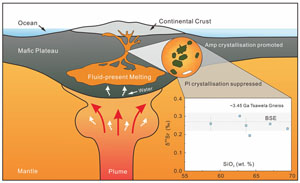
), facilitating efficient crustal differentiation without the prerequisite of modern style plate subduction, although these sources cannot be uniquely distinguished.Figure 4 Schematic model for fluid-present melting of mafic crust in a Paleoarchean plateau setting, producing the ∼3.45 Ga Tsawela Gneiss in Kaapvaal Craton. The source of fluid is discussed in the main text.
top
Conclusions
Stable Sr isotopes demonstrate that the ∼3.45 Ga Tsawela Gneiss formed through fluid-present melting of mafic crust. The mantle-like δ88Sr values, consistency with calc-alkaline trends and phase equilibrium modelling provide direct Sr isotopic evidence for water-rich conditions in a Paleoarchean mafic plateau setting. Voluminous felsic crust can be generated efficiently under hydrous conditions without modern style subduction. Water is a critical driver of early continental growth, enabling differentiation of mafic plateaus and shaping the thermal volatile evolution of the early Earth.
top
Acknowledgements
This study was supported by the National Natural Science Foundation of China (Grant No. 42403002). JEH thanks the German Research Foundation (DFG) for grants HO 4697/1-1 and HO 4697/1-2. We thank Chun-Hui Li (from Chengdu University of Technology) for helpful discussion. We thank editor Helen Williams and Ambre Luguet for patient handling of the manuscript. We are also grateful to Renée Tamblyn and one anonymous reviewer for their constructive comments and suggestions that greatly improved the manuscript.
Editor: Helen Williams and Ambre Luguet
top
References
Amsellem, E., Moynier, F., Day, J.M.D., Moreira, M., Puchtel, I.S., Teng, F.Z. (2018) The stable strontium isotopic composition of ocean island basalts, mid-ocean ridge basalts, and komatiites. Chemical Geology 483, 595–602. https://doi.org/10.1016/j.chemgeo.2018.03.030
 Show in context
 Their δ88Sr values range from 0.19 ‰ to 0.30 ‰ (2 s.d. < 0.04 ‰), with a mean of 0.25 ± 0.07 ‰ (2 s.d.) (Figs. 1, S-4), largely overlapping with the reported Bulk Silicate Earth (BSE) values (0.27 ± 0.05 ‰, Moynier et al., 2010; 0.29 ± 0.07 ‰, Charlier et al., 2012; 0.30 ± 0.02 ‰, Amsellem et al., 2018).
View in article
Available data for Archean mantle derived rocks indicate that the stable Sr isotopic composition of the convecting mantle has remained constant since the Paleoarchean (Amsellem et al., 2018).
View in article
Importantly, mafic igneous processes have limited effect on stable Sr isotope fractionation (Amsellem et al., 2018).
View in article
Although Barberton komatiites exhibit relatively heavy δ88Sr values (0.16–0.97 ‰) (Amsellem et al., 2018), the isotopic composition of the fluids released remains poorly constrained.
View in article
Andrews, M.G., Jacobson, A.D. (2018) Controls on the solute geochemistry of subglacial discharge from the Russell Glacier, Greenland Ice Sheet determined by radiogenic and stable Sr isotope ratios. Geochimica et Cosmochimica Acta 239, 312–329. https://doi.org/10.1016/j.gca.2018.08.004
Show in context Plagioclase and apatite preferentially incorporate heavy Sr isotopes, while K feldspar favours light isotopes (Charlier et al., 2012; Andrews and Jacobson, 2018; Klaver et al., 2020; Chen et al., 2025b).
View in article
Beard, J.S., Lofgren, G.E. (1991) Dehydration Melting and Water-Saturated Melting of Basaltic and Andesitic Greenstones and Amphibolites at 1, 3, and 6.9 kb. Journal of Petrology 32, 365–401. https://doi.org/10.1093/petrology/32.2.365
Show in context Based on the mode of water involvement during melting, previous studies have proposed two fundamental end member models with significant tectonic implications: fluid-present and fluid-absent melting (Beard and Lofgren, 1991; Pourteau et al., 2020; Tamblyn et al., 2023).
View in article
Because the stability of plagioclase is highly sensitive to the water content of melts, fluid-present melting suppresses plagioclase stability, whereas fluid-absent melting stabilises plagioclase (Beard and Lofgren, 1991; Müntener and Ulmer, 2018).
View in article
Thermochemically, magmatic water reduces melt polymerisation by breaking Si-O-Si bonds (Stolper, 1982), which significantly depresses the plagioclase liquidus while expanding the stability field of amphibole (Beard and Lofgren, 1991; Pichavant and Macdonald, 2007; Müntener and Ulmer, 2018).
View in article
The resulting melts are consequently enriched in Al2O3, follow calc-alkaline differentiation trends, exhibit low Sr/Y ratios (Beard and Lofgren, 1991; Pichavant and Macdonald, 2007; Müntener and Ulmer, 2018) and most importantly, preserve δ88Sr values indistinguishable from mantle compositions because plagioclase, the primary Sr-rich phase that preferentially incorporates heavy Sr, is largely absent from the fractional crystallisation assemblages.
View in article
Phase equilibrium modelling (Figs. 3, S-8) quantitatively confirms these experimental relationships linking water content to the stability fields of plagioclase and amphibole (Beard and Lofgren, 1991; Müntener and Ulmer, 2018).
View in article
Brenner, A.R., Fu, R.R., Foley, B.J., Lourenço, D.L., Palma-Gomez, J., et al (2026) Paleomagnetic detection of relative plate motions and an infrequently reversing core dynamo at 3.5 Ga. Science 391, 1278–1282. https://doi.org/10.1126/science.adw9250
Show in context Based on rock assemblages, geochemistry and palaeomagnetic detection, these rocks are commonly interpreted to have formed in a mafic plateau tectonic setting during the early Archean (Hoffmann et al., 2016; Brenner et al., 2026).
View in article
Charlier, B.L.A., Nowell, G.M., Parkinson, I.J., Kelley, S.P., Pearson, D.G., Burton, K.W. (2012) High temperature strontium stable isotope behaviour in the early solar system and planetary bodies. Earth and Planetary Science Letters 329-330, 31–40. https://doi.org/10.1016/j.epsl.2012.02.008
Show in context Plagioclase is the primary reservoir of Sr in magmatic systems and preferentially incorporates heavy Sr isotopes relative to the bulk rock, such that its fractionation or residue produces resolvable stable Sr isotope fractionation (Charlier et al., 2012; Klaver et al., 2020; Chen et al., 2025b).
View in article
Their δ88Sr values range from 0.19 ‰ to 0.30 ‰ (2 s.d. < 0.04 ‰), with a mean of 0.25 ± 0.07 ‰ (2 s.d.) (Figs. 1, S-4), largely overlapping with the reported Bulk Silicate Earth (BSE) values (0.27 ± 0.05 ‰, Moynier et al., 2010; 0.29 ± 0.07 ‰, Charlier et al., 2012; 0.30 ± 0.02 ‰, Amsellem et al., 2018).
View in article
Plagioclase and apatite preferentially incorporate heavy Sr isotopes, while K feldspar favours light isotopes (Charlier et al., 2012; Andrews and Jacobson, 2018; Klaver et al., 2020; Chen et al., 2025b).
View in article
In addition, Rayleigh fractionation modelling (Fig. 2) suggests that 10 wt. % plagioclase fractionation would decrease the δ88Sr value of whole rock to 0.14 ‰ (for plagioclase-melt fractionation factor αPl-Melt = 1.0003 from Chen et al., 2025b) and 0.00 ‰ (for αPl-Melt = 1.0007 from Charlier et al., 2012).
View in article
Bulk fractionation factors (αPl-Melt) between plagioclase and melt of 1.0003 and 1.0007 are assumed according to Chen et al. (2025b) and Charlier et al. (2012), respectively. C0 is the initial Sr content in primary melt, with values of 162 and 393 ppm corresponding to the observed range of the TG samples.
View in article
Chavagnac, V. (2004) A geochemical and Nd isotopic study of Barberton komatiites (South Africa): implication for the Archean mantle. Lithos 75, 253–281. https://doi.org/10.1016/j.lithos.2004.03.001
Show in context By comparison, the low Sr content of komatiites (average Sr contents = 23 ppm; Chavagnac, 2004) limits their ability to significantly modify the bulk Sr isotopic compositions of the mafic source.
View in article
Chen, X.Q., Zeng, Z., Yu, H.M., Sun, N., Huang, F. (2022) Precise measurements of δ88/86Sr for twenty geological reference materials by double-spike MC-ICP-MS. International Journal of Mass Spectrometry 479, 116883. https://doi.org/10.1016/j.ijms.2022.116883
Show in context Stable and radiogenic Sr isotope measurements were performed at the State Key Laboratory of Lithospheric and Environmental Coevolution, University of Science and Technology of China, following the protocol of Chen et al. (2022).
View in article
Chen, X.Q., Quan, Y., Liu, X.C., Deng, G., Nan, X., Huang, F. (2025a) Stable strontium isotope fractionation by fluid-melt interaction recorded in the Himalayan leucogranites. Chemical Geology 690, 122869. https://doi.org/10.1016/j.chemgeo.2025.122869
Show in context Compared with the wide range for granitoids δ88Sr (−1.51 ‰ to 0.54 ‰) (Chen et al., 2025a, 2025b) (Fig. S-4), the stable Sr isotope fractionation in the TG sample is negligible (Fig. 1).
View in article
Chen, X.Q., Deng, G.X., Jiang, D.S., Nan, X.Y., Huang, F. (2025b) Stable strontium isotope fractionation during crystal-melt separation in granitic magma evolution. Acta Geochimica 44, 731–739. https://doi.org/10.1007/s11631-024-00752-9
Show in context Plagioclase is the primary reservoir of Sr in magmatic systems and preferentially incorporates heavy Sr isotopes relative to the bulk rock, such that its fractionation or residue produces resolvable stable Sr isotope fractionation (Charlier et al., 2012; Klaver et al., 2020; Chen et al., 2025b).
View in article
For the TG samples, replicate analyses show differences of 87Sr/86Sr but a consistent δ88Sr value, which were attributed to the slight heterogeneity of the Rb/Sr ratio among the different mineral phases within the bulk rock powders, while δ88Sr remains homogeneous at the hand specimen scale (Chen et al., 2025b).
View in article
Compared with the wide range for granitoids δ88Sr (−1.51 ‰ to 0.54 ‰) (Chen et al., 2025a, 2025b) (Fig. S-4), the stable Sr isotope fractionation in the TG sample is negligible (Fig. 1).
View in article
The δ88Sr values of Huili granites and arc lavas (Aegean and Mariana arc) are derived from Chen et al. (2025b) and Klaver et al. (2020), respectively.
View in article
Plagioclase and apatite preferentially incorporate heavy Sr isotopes, while K feldspar favours light isotopes (Charlier et al., 2012; Andrews and Jacobson, 2018; Klaver et al., 2020; Chen et al., 2025b).
View in article
In addition, Rayleigh fractionation modelling (Fig. 2) suggests that 10 wt. % plagioclase fractionation would decrease the δ88Sr value of whole rock to 0.14 ‰ (for plagioclase-melt fractionation factor αPl-Melt = 1.0003 from Chen et al., 2025b) and 0.00 ‰ (for αPl-Melt = 1.0007 from Charlier et al., 2012).
View in article
Bulk fractionation factors (αPl-Melt) between plagioclase and melt of 1.0003 and 1.0007 are assumed according to Chen et al. (2025b) and Charlier et al. (2012), respectively. C0 is the initial Sr content in primary melt, with values of 162 and 393 ppm corresponding to the observed range of the TG samples.
View in article
Collins, W.J., Murphy, J.B., Johnson, T.E., Huang, H.Q. (2020) Critical role of water in the formation of continental crust. Nature Geoscience 13, 331–338. https://doi.org/10.1038/s41561-020-0573-6
Show in context Water significantly lowers rock solidus temperature, reduces melt viscosity, enhances melt volume, thereby influencing the composition of residual mineral assemblages, melt compositions and differentiation pathways (Collins et al., 2020).
View in article
Davies, R.D., Allsopp, H.L. (1976) Strontium isotopic evidence relating to the evolution of the lower Precambrian granitic crust in Swaziland. Geology 4, 553–556. https://doi.org/10.1130/0091-7613(1976)4<553:SIERTT>2.0.CO;2
Show in context Importantly, the low initial 87Sr/86Sr ratios reported for the AGC (Davies and Allsopp, 1976) suggest negligible involvement of pre-existing siliceous crust. Interpretation of major and trace element proxies is complicated by source heterogeneity, fractional crystallisation, and melting depth (Kendrick and Yakymchuk, 2020).
View in article
Therefore, the narrow δ88Sr range of the TG samples likely reflects their primary magmatic compositions, consistent with the preservation of their relatively low initial Sr isotope compositions (Davies and Allsopp, 1976; this study).
View in article
This trend may indicate heterogeneous Sr contents in their mafic precursors, consistent with the observed heterogeneity in whole rock Hf-Nd and initial (87Sr/86Sr)t values (Davies and Allsopp, 1976; Fig. S-6) (Hoffmann et al., 2016).
View in article
Hoffmann, J.E., Kröner, A., Hegner, E., Viehmann, S., Xie, H., et al (2016) Source composition, fractional crystallization and magma mixing processes in the 3.48–3.43 Ga Tsawela tonalite suite (Ancient Gneiss Complex, Swaziland) – Implications for Palaeoarchaean geodynamics. Precambrian Research 276, 43–66. https://doi.org/10.1016/j.precamres.2016.01.026
Show in context The TG displays weak deformation, lack migmatisation features, and has low loss on ignition (LOI) values, indicating relatively limited later modification (Hoffmann et al., 2016).
View in article
The source of TG is close to depleted mantle and lacks clear evidence for the involvement of ancient continental crustal materials (Hoffmann et al., 2016).
View in article
Based on rock assemblages, geochemistry and palaeomagnetic detection, these rocks are commonly interpreted to have formed in a mafic plateau tectonic setting during the early Archean (Hoffmann et al., 2016; Brenner et al., 2026).
View in article
The Kaapvaal Craton preserves some of Earth’s representative Archean crustal fragments, comprising the AGC in Eswatini and the 3.6–3.2 Ga Barberton granitoid-greenstone terrane (BGGT) in South Africa (Hoffmann et al., 2016).
View in article
The AGC is primarily composed of the 3.66–3.2 Ga Ngwane Gneiss (NG), the 3.47–3.42 Ga TG and ∼3.46 Ga Dwalile Supracrustal Suite (DSS) (Hoffmann et al., 2016).
View in article
The TG is a weakly to well foliated TTG suite (Fig. S-2a) and intruded the older NG and Dwalile Greenstone remnants (Hoffmann et al., 2016).
View in article
Within the TG, SiO2 contents range from 58.67 to 71.48 wt. %. They originated from a juvenile source supported by Nd and Hf isotopic compositions (Zeh et al., 2011; Hoffmann et al., 2016).
View in article
Six TG and one NG samples were analysed; sample location (Fig. S-1), petrography, major and trace element data, U-Pb zircon ages, and Hf-Nd isotopes were reported in Hoffmann et al. (2016).
View in article
Previous hybridisation models require mixing between mafic and felsic end members (Hoffmann et al., 2016); however, reproducing the observed Sr concentrations through such a process would require the mafic component to contain an extremely high Sr content (800 ppm), which is inconsistent with typical mafic melts (Fig. S-10b).
View in article
However, the Sr content of TG samples decreases with increasing SiO2 (Fig. S-5a) (Hoffmann et al., 2016).
View in article
This trend may indicate heterogeneous Sr contents in their mafic precursors, consistent with the observed heterogeneity in whole rock Hf-Nd and initial (87Sr/86Sr)t values (Davies and Allsopp, 1976; Fig. S-6) (Hoffmann et al., 2016).
View in article
This interpretation is independently supported by their calc-alkaline differentiation trend (Hoffmann et al., 2016), low pressure TTG affinity (Fig. S-3; Pourteau et al., 2020) and no obvious Eu anomaly (Hoffmann et al., 2016).
View in article
Hoffmann, J.E., Musese, E., Kröner, A., Schneider, K.P., Wong, J., et al (2020) Hafnium-Neodymium isotope, trace element and U-Pb zircon age constraints on the petrogenesis of the 3.44–3.46 Ga Dwalile greenstone remnant, Ancient gneiss Complex, Swaziland. Precambrian Research 351, 105970. https://doi.org/10.1016/j.precamres.2020.105970
Show in context This interpretation is further supported by the wide variation in Sr contents (∼25–250 ppm), Sr/Y (1.2–9.8), and Eu/Eu* (0.78–1.02) of the ∼3.46 Ga DSS greenstone remnants (Fig. S-7) (Hoffmann et al., 2020).
View in article
Johnson, T.E., Brown, M., Gardiner, N.J., Kirkland, C.L., Smithies, R.H. (2017) Earth’s first stable continents did not form by subduction. Nature 543, 239–242. https://doi.org/10.1038/nature21383
Show in context A mafic plateau setting has been proposed as a viable tectonic environment for the formation of voluminous felsic crust during the early Archean (Johnson et al., 2017).
View in article
Kani, T., Misawa, K., Morikawa, N., Kazahaya, K., Kusuhara, F., Yoneda, S., Terakado, Y. (2023) Strontium Isotope Characteristics (δ88/86Sr, 87Sr/86Sr) of Arima-Type Brines Originated from Slab-Fluids. Geophysical Research Letters 50. https://doi.org/10.1029/2022GL100309
Show in context On the other hand, natural observations reveal that low temperature, slab derived fluids are enriched in light Sr isotopes (δ88Sr = 0.122–0.157 ‰) (Kani et al., 2023), whereas high temperature fluids (>700 °C) tend to equilibrate with their source rocks, preserving a mantle-like isotopic signature (Klaver et al., 2020).
View in article
Kendrick, J., Yakymchuk, C. (2020) Garnet fractionation, progressive melt loss and bulk composition variations in anatectic metabasites: Complications for interpreting the geodynamic significance of TTGs. Geoscience Frontiers 11, 745–763. https://doi.org/10.1016/j.gsf.2019.12.001
Show in context Importantly, the low initial 87Sr/86Sr ratios reported for the AGC (Davies and Allsopp, 1976) suggest negligible involvement of pre-existing siliceous crust. Interpretation of major and trace element proxies is complicated by source heterogeneity, fractional crystallisation, and melting depth (Kendrick and Yakymchuk, 2020).
View in article
Klaver, M., Lewis, J., Parkinson, I.J., Elburg, M.A., Vroon, P.Z., Kelley, K.A., Elliott, T. (2020) Sr isotopes in arcs revisited: tracking slab dehydration using δ88/86Sr and 87Sr/86Sr systematics of arc lavas. Geochimica et Cosmochimica Acta 288, 101–119. https://doi.org/10.1016/j.gca.2020.08.010
Show in context Plagioclase is the primary reservoir of Sr in magmatic systems and preferentially incorporates heavy Sr isotopes relative to the bulk rock, such that its fractionation or residue produces resolvable stable Sr isotope fractionation (Charlier et al., 2012; Klaver et al., 2020; Chen et al., 2025b).
View in article
The δ88Sr values of Huili granites and arc lavas (Aegean and Mariana arc) are derived from Chen et al. (2025b) and Klaver et al. (2020), respectively.
View in article
Plagioclase and apatite preferentially incorporate heavy Sr isotopes, while K feldspar favours light isotopes (Charlier et al., 2012; Andrews and Jacobson, 2018; Klaver et al., 2020; Chen et al., 2025b).
View in article
The ultimate source of these fluids remains uncertain, but can be constrained. Seawater hydrothermal alteration is a potential source (Vezinet et al., 2018); however, intensely altered oceanic crust is characterised by elevated δ88Sr values (0.27–0.34 ‰), higher 87Sr/86Sr, and correlated enrichments in fluid mobile element ratios such as K/La and K/Th ratios (Klaver et al., 2020; Liu and He, 2021).
View in article
On the other hand, natural observations reveal that low temperature, slab derived fluids are enriched in light Sr isotopes (δ88Sr = 0.122–0.157 ‰) (Kani et al., 2023), whereas high temperature fluids (>700 °C) tend to equilibrate with their source rocks, preserving a mantle-like isotopic signature (Klaver et al., 2020).
View in article
Liu, C.T., He, Y. (2021) Rise of major subaerial landmasses about 3.0 to 2.7 billion years ago. Geochemical Perspectives Letters 18, 1–5. https://doi.org/10.7185/geochemlet.2115
Show in context The ultimate source of these fluids remains uncertain, but can be constrained. Seawater hydrothermal alteration is a potential source (Vezinet et al., 2018); however, intensely altered oceanic crust is characterised by elevated δ88Sr values (0.27–0.34 ‰), higher 87Sr/86Sr, and correlated enrichments in fluid mobile element ratios such as K/La and K/Th ratios (Klaver et al., 2020; Liu and He, 2021).
View in article
Liu, J., Xia, Q.K., Kuritani, T., Hanski, E., Yu, H.R. (2017) Mantle hydration and the role of water in the generation of large igneous provinces. Nature Communications 8, 1824. https://doi.org/10.1038/s41467-017-01940-3
Show in context It is suggested that hydrous mantle plateaus occurred occasionally in the Phanerozoic (Liu et al., 2017).
View in article
Collectively, these observations suggest that the TG magmas were influenced by deep seated, high temperature fluids, partially derived from hydrated komatiites from the middle-lower crust (Tamblyn et al., 2023) and possibly from mantle plumes underplating the oldest continental fragments (Liu et al., 2017; Pourteau et al., 2020; Smithies et al., 2021), facilitating efficient crustal differentiation without the prerequisite of modern style plate subduction, although these sources cannot be uniquely distinguished.
View in article
Moynier, F., Agranier, A., Hezel, D.C., Bouvier, A. (2010) Sr stable isotope composition of Earth, the Moon, Mars, Vesta and meteorites. Earth and Planetary Science Letters 300, 359–366. https://doi.org/10.1016/j.epsl.2010.10.017
Show in context Their δ88Sr values range from 0.19 ‰ to 0.30 ‰ (2 s.d. < 0.04 ‰), with a mean of 0.25 ± 0.07 ‰ (2 s.d.) (Figs. 1, S-4), largely overlapping with the reported Bulk Silicate Earth (BSE) values (0.27 ± 0.05 ‰, Moynier et al., 2010; 0.29 ± 0.07 ‰, Charlier et al., 2012; 0.30 ± 0.02 ‰, Amsellem et al., 2018).
View in article
The BSE value is from Moynier et al. (2010).
View in article
In this study, the TG exhibits an average δ88Sr of 0.25 ± 0.07 ‰, consistent with the mantle/BSE composition (Moynier et al., 2010), suggesting that plagioclase was a negligible residual phase in the melting source.
View in article
Müntener, O., Ulmer, P. (2018) Arc crust formation and differentiation constrained by experimental petrology. American Journal of Science 318, 64–89. https://doi.org/10.2475/01.2018.04
Show in context Because the stability of plagioclase is highly sensitive to the water content of melts, fluid-present melting suppresses plagioclase stability, whereas fluid-absent melting stabilises plagioclase (Beard and Lofgren, 1991; Müntener and Ulmer, 2018).
View in article
Thermochemically, magmatic water reduces melt polymerisation by breaking Si-O-Si bonds (Stolper, 1982), which significantly depresses the plagioclase liquidus while expanding the stability field of amphibole (Beard and Lofgren, 1991; Pichavant and Macdonald, 2007; Müntener and Ulmer, 2018).
View in article
The resulting melts are consequently enriched in Al2O3, follow calc-alkaline differentiation trends, exhibit low Sr/Y ratios (Beard and Lofgren, 1991; Pichavant and Macdonald, 2007; Müntener and Ulmer, 2018) and most importantly, preserve δ88Sr values indistinguishable from mantle compositions because plagioclase, the primary Sr-rich phase that preferentially incorporates heavy Sr, is largely absent from the fractional crystallisation assemblages.
View in article
In contrast, fluid-absent melting favours plagioclase crystallisation, producing melts with lighter δ88Sr and tholeiitic differentiation trends (Müntener and Ulmer, 2018).
View in article
Phase equilibrium modelling (Figs. 3, S-8) quantitatively confirms these experimental relationships linking water content to the stability fields of plagioclase and amphibole (Beard and Lofgren, 1991; Müntener and Ulmer, 2018).
View in article
Pichavant, M., Macdonald, R. (2007) Crystallization of primitive basaltic magmas at crustal pressures and genesis of the calc-alkaline igneous suite: experimental evidence from St Vincent, Lesser Antilles arc. Contributions to Mineralogy and Petrology 154, 535–558. https://doi.org/10.1007/s00410-007-0208-6
Show in context Thermochemically, magmatic water reduces melt polymerisation by breaking Si-O-Si bonds (Stolper, 1982), which significantly depresses the plagioclase liquidus while expanding the stability field of amphibole (Beard and Lofgren, 1991; Pichavant and Macdonald, 2007; Müntener and Ulmer, 2018).
View in article
The resulting melts are consequently enriched in Al2O3, follow calc-alkaline differentiation trends, exhibit low Sr/Y ratios (Beard and Lofgren, 1991; Pichavant and Macdonald, 2007; Müntener and Ulmer, 2018) and most importantly, preserve δ88Sr values indistinguishable from mantle compositions because plagioclase, the primary Sr-rich phase that preferentially incorporates heavy Sr, is largely absent from the fractional crystallisation assemblages.
View in article
Pourteau, A., Doucet, L.S., Blereau, E.R., Volante, S., Johnson, T.E., Collins, W.J., Li, Z.X., Champion, D.C. (2020) TTG generation by fluid-fluxed crustal melting: Direct evidence from the Proterozoic Georgetown Inlier, NE Australia. Earth and Planetary Science Letters 550, 116548. https://doi.org/10.1016/j.epsl.2020.116548
Show in context Based on the mode of water involvement during melting, previous studies have proposed two fundamental end member models with significant tectonic implications: fluid-present and fluid-absent melting (Beard and Lofgren, 1991; Pourteau et al., 2020; Tamblyn et al., 2023).
View in article
This interpretation is independently supported by their calc-alkaline differentiation trend (Hoffmann et al., 2016), low pressure TTG affinity (Fig. S-3; Pourteau et al., 2020) and no obvious Eu anomaly (Hoffmann et al., 2016).
View in article
Collectively, these observations suggest that the TG magmas were influenced by deep seated, high temperature fluids, partially derived from hydrated komatiites from the middle-lower crust (Tamblyn et al., 2023) and possibly from mantle plumes underplating the oldest continental fragments (Liu et al., 2017; Pourteau et al., 2020; Smithies et al., 2021), facilitating efficient crustal differentiation without the prerequisite of modern style plate subduction, although these sources cannot be uniquely distinguished.
View in article
Roman, A., Arndt, N. (2020) Differentiated Archean oceanic crust: Its thermal structure, mechanical stability and a test of the sagduction hypothesis. Geochimica et Cosmochimica Acta 278, 65–77. https://doi.org/10.1016/j.gca.2019.07.009
Show in context Distinguishing between those two melting mechanisms is not only a fundamental petrological issue but also central to evaluate whether water-rich conditions within mafic plateaus existed in the Archean (Roman and Arndt, 2020; Smithies et al., 2021).
View in article
However, this view has been challenged by the argument that the lower crust of thick mafic plateaus is predominantly dry, thereby limiting the production of large volumes of silicic melt (Roman and Arndt, 2020).
View in article
These findings challenge the prevailing assumption that the lower crust of mafic plateaus is inherently water-poor (Roman and Arndt, 2020).
View in article
Schwindinger, M., Weinberg, R.F., Clos, F. (2019) Wet or dry? The difficulty of identifying the presence of water during crustal melting. Journal of Metamorphic Geology 37, 339–358. https://doi.org/10.1111/jmg.12465
Show in context On the one hand, traditional thermobarometry highly depends on pressure, melt composition, water activity, and equilibrium state, making it difficult to serve as a direct indicator for fluid-present melting (Schwindinger et al., 2019).
View in article
Smithies, R.H., Lu, Y., Kirkland, C.L., Johnson, T.E., Mole, D.R., Champion, D.C., et al (2021) Oxygen isotopes trace the origins of Earth’s earliest continental crust. Nature 592, 70–75. https://doi.org/10.1038/s41586-021-03337-1
Show in context Distinguishing between those two melting mechanisms is not only a fundamental petrological issue but also central to evaluate whether water-rich conditions within mafic plateaus existed in the Archean (Roman and Arndt, 2020; Smithies et al., 2021).
View in article
Collectively, these observations suggest that the TG magmas were influenced by deep seated, high temperature fluids, partially derived from hydrated komatiites from the middle-lower crust (Tamblyn et al., 2023) and possibly from mantle plumes underplating the oldest continental fragments (Liu et al., 2017; Pourteau et al., 2020; Smithies et al., 2021), facilitating efficient crustal differentiation without the prerequisite of modern style plate subduction, although these sources cannot be uniquely distinguished.
View in article
Stolper, E. (1982) The speciation of water in silicate melts. Geochimica et Cosmochimica Acta 46, 2609–2620. https://doi.org/10.1016/0016-7037(82)90381-7
Show in context Thermochemically, magmatic water reduces melt polymerisation by breaking Si-O-Si bonds (Stolper, 1982), which significantly depresses the plagioclase liquidus while expanding the stability field of amphibole (Beard and Lofgren, 1991; Pichavant and Macdonald, 2007; Müntener and Ulmer, 2018).
View in article
Tamblyn, R., Hermann, J., Hasterok, D., Sossi, P., Pettke, T., Chatterjee, S. (2023) Hydrated komatiites as a source of water for TTG formation in the Archean. Earth and Planetary Science Letters 603, 117982. https://doi.org/10.1016/j.epsl.2022.117982
Show in context Based on the mode of water involvement during melting, previous studies have proposed two fundamental end member models with significant tectonic implications: fluid-present and fluid-absent melting (Beard and Lofgren, 1991; Pourteau et al., 2020; Tamblyn et al., 2023).
View in article
Altered komatiites within oceanic plateaus represent another potential fluid source through dehydration (Tamblyn et al., 2023).
View in article
Collectively, these observations suggest that the TG magmas were influenced by deep seated, high temperature fluids, partially derived from hydrated komatiites from the middle-lower crust (Tamblyn et al., 2023) and possibly from mantle plumes underplating the oldest continental fragments (Liu et al., 2017; Pourteau et al., 2020; Smithies et al., 2021), facilitating efficient crustal differentiation without the prerequisite of modern style plate subduction, although these sources cannot be uniquely distinguished.
View in article
Vezinet, A., Pearson, D.G., Thomassot, E., Stern, R.A., Sarkar, C., Luo, Y., Fisher, C.M. (2018) Hydrothermally-altered mafic crust as source for early Earth TTG: Pb/Hf/O isotope and trace element evidence in zircon from TTG of the Eoarchean Saglek Block, N. Labrador. Earth and Planetary Science Letters 503, 95–107. https://doi.org/10.1016/j.epsl.2018.09.015
Show in context The ultimate source of these fluids remains uncertain, but can be constrained. Seawater hydrothermal alteration is a potential source (Vezinet et al., 2018); however, intensely altered oceanic crust is characterised by elevated δ88Sr values (0.27–0.34 ‰), higher 87Sr/86Sr, and correlated enrichments in fluid mobile element ratios such as K/La and K/Th ratios (Klaver et al., 2020; Liu and He, 2021).
View in article
Zeh, A., Gerdes, A., Millonig, L. (2011) Hafnium isotope record of the Ancient Gneiss Complex, Swaziland, southern Africa: evidence for Archaean crust-mantle formation and crust reworking between 3.66 and 2.73 Ga. Journal of the Geological Society 168, 953–963. https://doi.org/10.1144/0016-76492010-117
Show in context Within the TG, SiO2 contents range from 58.67 to 71.48 wt. %. They originated from a juvenile source supported by Nd and Hf isotopic compositions (Zeh et al., 2011; Hoffmann et al., 2016).
View in article
top
Supplementary Information
The supplementary material includes:
- Thermodynamic modeling
- The metamorphic overprinting of ∼3.45 Ga NG sample
- Rayleigh fractionation modeling
- Binary mixing modeling of mafic and felsic melts
- Discussion: evaluation of potential non-primary factors
- Figures S-1to S-11
- Tables S-1 and S-2
- Supplementary materials references
Download the Supplementary Information (PDF)