


Fluorine in the late fluids of asteroid Ryugu
Affiliations | Corresponding Author | Cite as | Funding information
Published by the European Association of Geochemistry
under Creative Commons License CC BY-NC-ND 4.0
Keywords: Ryugu, Fluorine, Transmission Electron Microscopy, brines, phyllosilicates


- Share this article


-
Article views:14Cumulative count of HTML views and PDF downloads.
- Download Citation
- Rights & Permissions

top
Abstract
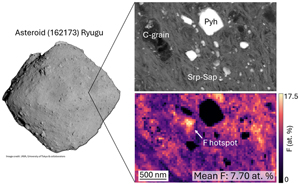
Figures
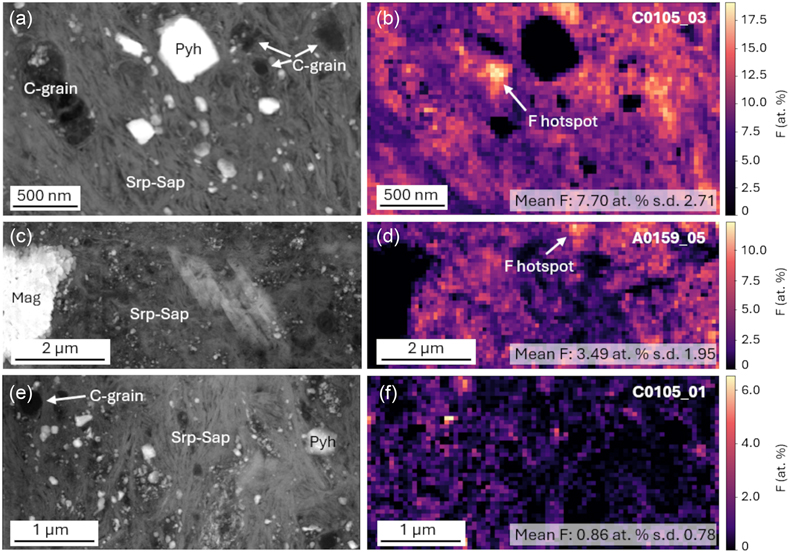
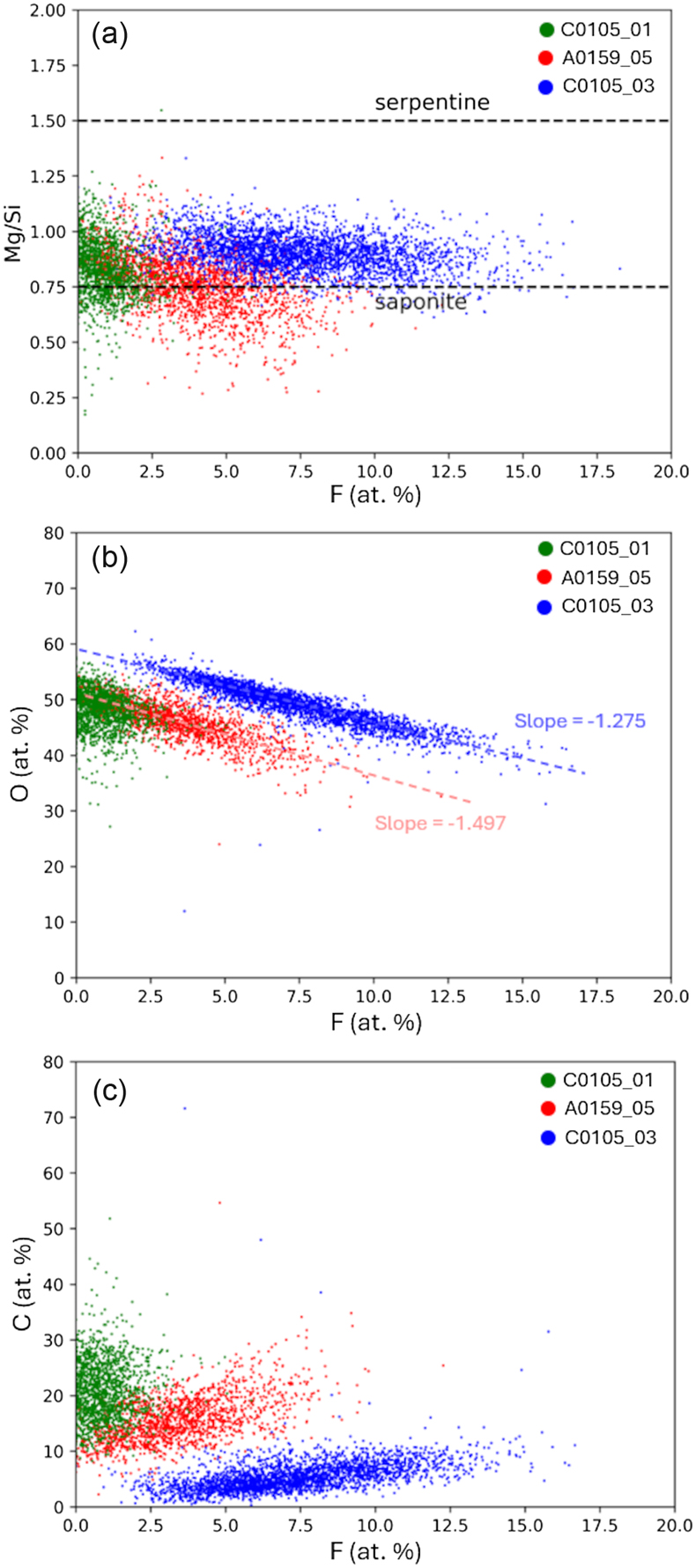
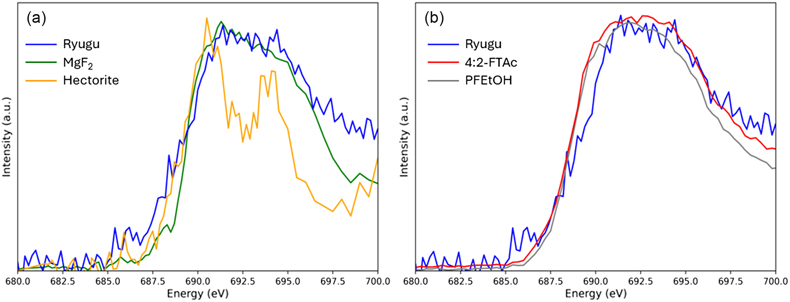
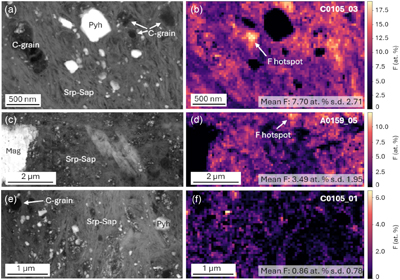 Figure 1 Distribution of F within the phyllosilicates. (a, c, e) High angle annular dark field (HAADF) images of three different FIB sections (C0105_03, A0159_05, and C0105_01). (b, d, f) Corresponding STEM-EDS F concentration maps (in at. %). Map pixel sizes are 34 nm (b), 85 nm (d), and 60 nm (f). Colour scales are linear. Fluorine is associated with the phyllosilicates (Srp-Sap), whereas organic particles (C-grain), magnetite (Mag), and sulphides (Pyh) do not show detectable F. The F signal within the organic grain in (b) results from its intergrowth with phyllosilicates, as visible in the HAADF image in (a). Fluorine content varies between samples and within individual sections, ranging from areas with no detectable F to localised hotspots reaching an average of ∼14.5 at. %. Mean F values (at. %) and standard deviations (s.d.) are reported for each FIB section and were calculated using only pixels attributed to phyllosilicates; pixels corresponding to other phases were excluded. | 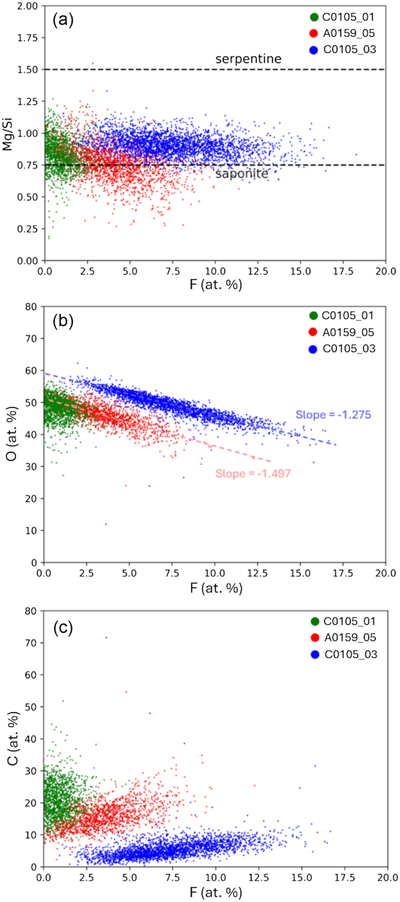 Figure 2 Relationship between F and Mg/Si (a), O (b) and C (c) in the three samples shown in Figure 1. Each dot corresponds to one phyllosilicate pixel in a STEM-EDS map. The Mg/Si ratios indicate that saponite dominates over serpentine, suggesting that F preferentially associates with saponite. The dashed line at Mg/Si = 0.75 marks the low charge saponite end member. The anticorrelation between F and O indicates substitution of OH by F, while the non-ideal 1:1 relationship likely reflects partial loss of F and O during analysis and the complex saponite-serpentine intergrowth. The positive F-C trend supports either co-incorporation of F and soluble organics within porous phyllosilicates or, less likely, the presence of fluorinated organics. | 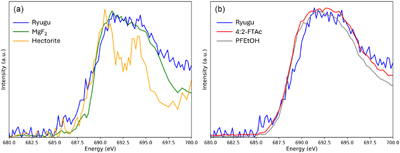 Figure 3 STXM based XANES spectra at the F K-edge of Ryugu’s matrix and different inorganic and organic compounds. (a) Spectra of the F bearing phase in Ryugu (blue), a synthetic hectorite (orange), and MgF2 (green). (b) Spectra of the F bearing phase in Ryugu (blue), and two fluorinated organic compounds from Roesch et al. (2023): 4:2-FTAc (4:2-fluorotelomeracrylate; red) and PFEtOH (trifluoroethanol; grey). |
| Figure 1 | Figure 2 | Figure 3 |
top
Introduction
Fluorine and other halogens play important roles in geo-, bio-, and cosmo-chemistry (Harlov and Aranovich, 2018
Harlov, D.E., Aranovich, L. (2018) The role of halogens in terrestrial and extraterrestrial geochemical processes: surface, crust, and mantle. Springer, Berlin. https://doi.org/10.1007/978-3-319-61667-4
). Their abundances in primitive extraterrestrial materials, such as carbonaceous chondrites, provide valuable constraints on the chemical and physical conditions of the early Solar System. However, uncertainties remain regarding their behaviour during its formation and evolution. For instance, it is unclear which phases host these elements during the nebular phase and how they respond to alteration processes in the asteroidal parent bodies (Brearley and Jones, 2018Brearley, A.J., Jones R.H. (2018) Halogens in chondritic meteorites. In: Harlov, D.E., Aranovich, L. (Eds.) The role of halogens in terrestrial and extraterrestrial geochemical processes: surface, crust, and mantle. Springer, Berlin, 871–958. https://doi.org/10.1007/978-3-319-61667-4
; Barnes and Zolensky, 2022Barnes, J.J., Zolensky, M.E. (2022) A Halogen Record of Fluid Activity in the Solar System. Elements 18, 15–20. https://doi.org/10.2138/gselements.18.1.15
).The most recent estimates for halogen contents in CI chondrites are Cl = 717 ± 110 μg/g, F = 92 ± 20 μg/g, Br = 3.77 ± 0.90 μg/g, and I = 0.77 ± 0.31 μg/g (Lodders and Fegley, 2023
Lodders, K., Fegley, B. (2023) Solar system abundances and condensation temperatures of the halogens fluorine, chlorine, bromine, and iodine. Geochemistry 83, 125957. https://doi.org/10.1016/j.chemer.2023.125957
). Although CI chondrites exhibit the highest chlorine and F contents among carbonaceous chondrites, only a single report exists of a fluorite (CaF2) grain occurring in a CI-like clast within the Tsukuba ordinary chondrite (Nakashima et al., 2003Nakashima, D., Nakamura, T., Noguchi, T. (2003) Formation history of CI-like phyllosilicate-rich clasts in the Tsukuba meteorite inferred from mineralogy and noble gas signatures. Earth and Planetary Science Letters 212, 321–336. https://doi.org/10.1016/S0012-821X(03)00282-6
), and while F-rich apatite occurs in Orgueil, no chlorine bearing phases have been identified (Brearley and Jones, 2018Brearley, A.J., Jones R.H. (2018) Halogens in chondritic meteorites. In: Harlov, D.E., Aranovich, L. (Eds.) The role of halogens in terrestrial and extraterrestrial geochemical processes: surface, crust, and mantle. Springer, Berlin, 871–958. https://doi.org/10.1007/978-3-319-61667-4
; Harrison et al., 2025Harrison, C.S., King, A.J., Jones, R.H., Piani, L. (2025) Petrography of phosphates in CI and CY carbonaceous chondrites. Meteoritics and Planetary Science 60, 2594–2622 https://doi.org/10.1111/maps.70052
). Recently, Mg, Na phosphates have been reported in a CI-like clast in Cold Bokkeveld (CM2 chondrite) and in Oued Chebeika 002, with chlorine detected in the former and both F and chlorine in the latter (Gattacceca et al., 2025Gattacceca, J., Gounelle, M., Devouard, B., Barrat, J.-A., Bonal, L., et al. (2025) Oued Chebeika 002: A new CI1 meteorite linked to outer solar system bodies. Meteoritics and Planetary Science 60, 1441–1479. https://doi.org/10.1111/maps.14359
; Lee et al., 2025aLee, M.R., Salge, T., Maclaren, I. (2025a) Magnesium phosphate in the Cold Bokkeveld (CM2) carbonaceous chondrite. Meteoritics and Planetary Science 60, 2017–2032. https://doi.org/10.1111/maps.70018
). This apparent discrepancy between bulk halogen abundances and the scarcity of discrete halogen bearing phases has led to debate regarding the mineralogical hosts of halogens in these meteorites. The identification of halogen bearing phases in CI chondrites is complicated by their extensive aqueous alteration, which has deeply modified the original mineralogy (Lee et al., 2025bLee, M.R., Alexander, C.M.O’D., Bischoff, A., Brearley, A.J., Dobrică, E., et al. (2025b) Low-Temperature Aqueous Alteration of Chondrites. Space Science Reviews 221, 11. https://doi.org/10.1007/s11214-024-01132-8
), consuming primary halogen bearing phases and redistributing halogens into secondary minerals. For example, chlorine has been observed in association with phyllosilicates and organic matter (Schöler et al., 2005Schöler, H.F., Nkusi, G., Niedan, V.W., Müller, G., Spitthoff, B. (2005) Screening of organic halogens and identification of chlorinated benzoic acids in carbonaceous meteorites. Chemosphere 60, 1505–1512. https://doi.org/10.1016/j.chemosphere.2005.02.069
; Le Guillou et al., 2014Le Guillou, C., Bernard, S., Brearley, A.J., Remusat, L. (2014) Evolution of organic matter in Orgueil, Murchison and Renazzo during parent body aqueous alteration: In situ investigations. Geochimica et Cosmochimica Acta 131, 368–392. https://doi.org/10.1016/j.gca.2013.11.020
; Brearley and Jones, 2018Brearley, A.J., Jones R.H. (2018) Halogens in chondritic meteorites. In: Harlov, D.E., Aranovich, L. (Eds.) The role of halogens in terrestrial and extraterrestrial geochemical processes: surface, crust, and mantle. Springer, Berlin, 871–958. https://doi.org/10.1007/978-3-319-61667-4
), although these associations may also reflect the result of terrestrial weathering. Consequently, the distribution of halogens in CI chondrite parent bodies remains a key unresolved question.Samples returned by the Hayabusa2 and OSIRIS-REx missions, which delivered material from the CI-like asteroids Ryugu and Bennu, allowed the study of pristine CI-like materials unaffected by terrestrial weathering. Ryugu samples contain chlorine bearing organics, halite and Na carbonates, and Mg, Na phosphates containing F (Nakamura et al., 2023
Nakamura, T., Matsumoto, M., Amano, K., Enokido, Y., Zolensky, M.E., et al. (2023) Formation and evolution of carbonaceous asteroid Ryugu: Direct evidence from returned samples. Science 379, eabn8671. https://doi.org/10.1126/science.abn8671
; Matsumoto et al., 2024Matsumoto, T., Noguchi, T., Miyake, A., Igami, Y., Matsumoto, M., et al. (2024) Sodium carbonates on Ryugu as evidence of highly saline water in the outer Solar System. Nature Astronomy 8, 1536–1543. https://doi.org/10.1038/s41550-024-02418-1
). Na carbonates and Mg, Na phosphates containing F, halite and Na fluoride have also been identified in Bennu samples (McCoy et al., 2025McCoy, T.J., Russell, S.S., Zega, T.J., Thomas-Keprta, K.L., Singerling, S.A., et al. (2025) An evaporite sequence from ancient brine recorded in Bennu samples. Nature 637, 1072–1077. https://doi.org/10.1038/s41586-024-08495-6
; Singerling et al., 2025Singerling, S.A., Brenker, F.E., Tkalcec, B., Russell, S.S., Zega, T.J., McCoy, T.J., Connolly, H.C. Jr., Lauretta, D.S. (2025) Na,Ca carbonates in OSIRIS-REx samples: Evidence for low-temperature, Na-bearing brines on Bennu’s parent body. Geochimica et Cosmochimica Acta 404, 86–92. https://doi.org/10.1016/j.gca.2025.06.028
). The identification of these phases in returned samples confirms that the halogen content of CI chondrites is intrinsic and not the result of terrestrial weathering or contamination. Moreover, these minerals have been interpreted to have formed from late brines, highlighting the role of such fluids in concentrating alkalis and halogens and the potential of halogens to serve as tracers of late stage aqueous processes.Here, we present analyses of Ryugu samples revealing locally high F abundances in phyllosilicates. These observations open the discussion on F speciation and partitioning, providing insights on the geochemical processes that occurred during the latest stages of aqueous alteration on CI parent bodies.
top
Material and Methods
The Ryugu samples are from chambers A (sample A0159) and C (sample C0105-045). Eight focused ion beam (FIB) sections were prepared from grain A0159, six from the main grain and two from detached grains found alongside. Four FIB sections were prepared from grain C0105-045. Analyses were conducted using scanning transmission X-ray microscopy (STXM) coupled with X-ray absorption near-edge structure (XANES) spectroscopy, scanning transmission electron microscopy (STEM) coupled with energy dispersive X-ray spectroscopy (EDS) and Fourier transform infrared spectroscopy (FTIR), see details in Supplementary Information.
top
Fluorine Distribution and Contamination Assessment
Fluorine is preferentially associated with phyllosilicates (Fig. 1). The mean F concentration measured for the phyllosilicates within each FIB section ranges from undetectable to ∼7.70 at. % (Table S-2, Fig. S-5), with pronounced spatial variability, as shown by the STEM-EDS maps (Fig. 1). The Mg/Si ratios suggest that at least two thirds of the phyllosilicates are saponite. This represents a conservative estimate, as many data points are close to the saponite end member, suggesting that the proportion of saponite may be higher in some of the samples (Figs. 2a, S-5). Fluorine is also detected within one carbonate grain (average 1.05 at. %; Fig. S-6), but is otherwise absent from oxides, sulphides and individual organic particles (Figs. 1, S-6).
Figure 1 Distribution of F within the phyllosilicates. (a, c, e) High angle annular dark field (HAADF) images of three different FIB sections (C0105_03, A0159_05, and C0105_01). (b, d, f) Corresponding STEM-EDS F concentration maps (in at. %). Map pixel sizes are 34 nm (b), 85 nm (d), and 60 nm (f). Colour scales are linear. Fluorine is associated with the phyllosilicates (Srp-Sap), whereas organic particles (C-grain), magnetite (Mag), and sulphides (Pyh) do not show detectable F. The F signal within the organic grain in (b) results from its intergrowth with phyllosilicates, as visible in the HAADF image in (a). Fluorine content varies between samples and within individual sections, ranging from areas with no detectable F to localised hotspots reaching an average of ∼14.5 at. %. Mean F values (at. %) and standard deviations (s.d.) are reported for each FIB section and were calculated using only pixels attributed to phyllosilicates; pixels corresponding to other phases were excluded.
Figure 2 Relationship between F and Mg/Si (a), O (b) and C (c) in the three samples shown in Figure 1. Each dot corresponds to one phyllosilicate pixel in a STEM-EDS map. The Mg/Si ratios indicate that saponite dominates over serpentine, suggesting that F preferentially associates with saponite. The dashed line at Mg/Si = 0.75 marks the low charge saponite end member. The anticorrelation between F and O indicates substitution of OH by F, while the non-ideal 1:1 relationship likely reflects partial loss of F and O during analysis and the complex saponite-serpentine intergrowth. The positive F-C trend supports either co-incorporation of F and soluble organics within porous phyllosilicates or, less likely, the presence of fluorinated organics.
Fluorine also shows an anticorrelation with O (Figs. 2b, S-7), consistent with substitution of OH- by F- in phyllosilicates. However, the observed O-F anticorrelation does not follow the expected 1:1 trend, but rather shows a ∼1.5:1 trend. This deviation may reflect the complex intergrowth of serpentine and saponite, which have different O/OH ratios, as well as the preferential loss of F relative to O under the electron beam (Fig. S-8). No clear correlations are observed with other elements, except carbon. Concentrations of chlorine and Na range from undetectable to 0.8 at. % and 1.25 at. %, respectively (Fig. S-9).
Some highly localised hotspots (<100 nm) show elevated F concentrations relative to the surrounding area, accompanied by an increase in C but no increase in other elements (Fig. 2c). These areas appear darker in the HAADF images (Fig. 1) possibly reflecting organic matter within the phyllosilicate porosity.
Given that the F-C correlation could reflect the presence of fluorinated organic compounds, which are common contaminants (Roesch et al., 2023
Roesch, P., Vogel, C., Wittwer, P., Huthwelker, T., Borca, C.N., Sommerfeld, T., Kluge, S., Piechotta, C., Kalbe, U., Simon, F.-G. (2023) Taking a look at the surface: μ-XRF mapping and fluorine K-edge μ-XANES spectroscopy of organofluorinated compounds in environmental samples and consumer products. Environmental Science: Processes and Impacts 25, 1213–1223. https://doi.org/10.1039/D3EM00107E
), we carefully evaluated this hypothesis. However, several lines of evidence support an indigenous origin for the detected F: (i) All samples were prepared and stored under identical conditions, yet F is detected in FIB sections from grains A0159 and C0105-045, but not in FIB sections from the detached grains associated with A0159 (Fig. S-5), suggesting that its occurrence is not related to preparation or handling. (ii) Neither XANES nor FTIR analyses reveal unambiguos C-F signatures, making the presence of fluorinated organic contaminants unlikely (Figs. S-10, S-11). (iii) Fluorine has previously been reported in Bennu and Ryugu samples, where it occurs in halides and Na carbonates (Matsumoto et al., 2024Matsumoto, T., Noguchi, T., Miyake, A., Igami, Y., Matsumoto, M., et al. (2024) Sodium carbonates on Ryugu as evidence of highly saline water in the outer Solar System. Nature Astronomy 8, 1536–1543. https://doi.org/10.1038/s41550-024-02418-1
; McCoy et al., 2025McCoy, T.J., Russell, S.S., Zega, T.J., Thomas-Keprta, K.L., Singerling, S.A., et al. (2025) An evaporite sequence from ancient brine recorded in Bennu samples. Nature 637, 1072–1077. https://doi.org/10.1038/s41586-024-08495-6
; Singerling et al., 2025Singerling, S.A., Brenker, F.E., Tkalcec, B., Russell, S.S., Zega, T.J., McCoy, T.J., Connolly, H.C. Jr., Lauretta, D.S. (2025) Na,Ca carbonates in OSIRIS-REx samples: Evidence for low-temperature, Na-bearing brines on Bennu’s parent body. Geochimica et Cosmochimica Acta 404, 86–92. https://doi.org/10.1016/j.gca.2025.06.028
).top
Fluorine Speciation
The STXM based XANES spectra collected at the F K-edge exhibit a broad absorption feature between 691–695 eV (Fig. 3), with no difference between F hotspots and the surrounding matrix (Fig. S-10). In contrast, synthetic F bearing smectite (hectorite; see SI) shows two distinct peaks at 690 and 694 eV (Fig. 3). This discrepancy may reflect the small domain size and low crystallinity of Ryugu phyllosilicates, which may contribute to the broadening of the spectral features. In addition, F in Ryugu may be predominantly adsorbed on phyllosilicate surfaces rather than being incorporated in the structure, as in synthetic hectorite, which could further modify the F K-edge spectral response. Moreover, Ryugu phyllosilicates have been described as an intergrowth of smectite (saponite) and serpentine (Nakamura et al., 2023
Nakamura, T., Matsumoto, M., Amano, K., Enokido, Y., Zolensky, M.E., et al. (2023) Formation and evolution of carbonaceous asteroid Ryugu: Direct evidence from returned samples. Science 379, eabn8671. https://doi.org/10.1126/science.abn8671
). Thus, differences in phyllosilicate mineralogy and F speciation may both contribute to the distinct spectral response observed in Ryugu. The broad absorption observed in Ryugu also shares similarities with reference MgF2 (sellaite) and fluorinated organic reference spectra (Roesch et al., 2023Roesch, P., Vogel, C., Wittwer, P., Huthwelker, T., Borca, C.N., Sommerfeld, T., Kluge, S., Piechotta, C., Kalbe, U., Simon, F.-G. (2023) Taking a look at the surface: μ-XRF mapping and fluorine K-edge μ-XANES spectroscopy of organofluorinated compounds in environmental samples and consumer products. Environmental Science: Processes and Impacts 25, 1213–1223. https://doi.org/10.1039/D3EM00107E
), although notable differences persist (Fig. 3), particularly an additional low energy absorption shoulder absent from MgF2 and fluorinated organic spectra.Figure 3 STXM based XANES spectra at the F K-edge of Ryugu’s matrix and different inorganic and organic compounds. (a) Spectra of the F bearing phase in Ryugu (blue), a synthetic hectorite (orange), and MgF2 (green). (b) Spectra of the F bearing phase in Ryugu (blue), and two fluorinated organic compounds from Roesch et al. (2023)
Roesch, P., Vogel, C., Wittwer, P., Huthwelker, T., Borca, C.N., Sommerfeld, T., Kluge, S., Piechotta, C., Kalbe, U., Simon, F.-G. (2023) Taking a look at the surface: μ-XRF mapping and fluorine K-edge μ-XANES spectroscopy of organofluorinated compounds in environmental samples and consumer products. Environmental Science: Processes and Impacts 25, 1213–1223. https://doi.org/10.1039/D3EM00107E
: 4:2-FTAc (4:2-fluorotelomeracrylate; red) and PFEtOH (trifluoroethanol; grey).The FTIR analysis reveals spectra similar to those reported for other Ryugu particles, with the main bands in the 1000–1800 cm-1 region assigned to phyllosilicates and organic matter (Fig. S-11). This region also overlaps with the spectral range in which C-F vibrations are typically observed (1000–1400 cm-1). However, no distinct bands that can be unambiguously attributed to C-F species are clearly visible, even in sample C0105_03, which exhibits the highest F content (Fig. S-11).
The exact speciation of F remains uncertain, but combining XANES, FTIR and EDS observations, the following hypotheses can be considered. 1) F may be incorporated into phyllosilicates by substituting for OH groups. Substitution at the OH site has been occasionally reported in extraterrestrial materials. Recently, Topping et al. (2025)
Topping, N., Bridges, J.C., Hicks, L.J., Petera, L., Allen, C.S., et al. (2025) Sulfur-bearing serpentine in carbonaceous chondrites. Meteoritics and Planetary Science 60, 2864–2890. https://doi.org/10.1111/maps.70069
reported sulphur bearing serpentine in several carbonaceous chondrites, including Ryugu, while chlorine bearing smectite has been described in the ordinary chondrite Bishunpur (Alexander et al., 1989Alexander, C.M.O’D., Barber, D.J., Hutchison, R. (1989) The microstructure of Semarkona and Bishunpur. Geochimica et Cosmochimica Acta 53, 3045–3057. https://doi.org/10.1016/0016-7037(89)90180-4
). The OH-F substitution in phyllosilicate involves two mechanisms: (i) F could be incorporated directly into the forming phyllosilicate if the F activity in the mineralising fluid is high enough (Thomas et al., 1977Thomas, J., Glass, H.D., White, W.A., Trandel, R.M. (1977) Fluorine content of clay minerals and argillaceous earth materials. Clays and Clay Minerals 25, 278–284. https://doi.org/10.1346/CCMN.1977.0250405
), and (ii) F may substitute surficial OH groups by adsorption after phyllosilicate formation (Du et al., 2011Du, J., Wu, D., Xiao, H., Li, P. (2011) Adsorption of fluoride on clay minerals and their mechanisms using X-ray photoelectron spectroscopy. Frontiers of Environmental Science and Engineering in China 5, 212–226. https://doi.org/10.1007/s11783-010-0255-5
). Based on mass balance and mixing calculations, the inferred degree of OH-F substitution in our samples ranges from ∼4 % to 50 % (Fig. S-12). 2) F may occur as nanoscale fluoride salts, including cryolite-like (Na3AlF6) phases formed through interaction between F-rich fluids and phyllosilicates (Du et al., 2011Du, J., Wu, D., Xiao, H., Li, P. (2011) Adsorption of fluoride on clay minerals and their mechanisms using X-ray photoelectron spectroscopy. Frontiers of Environmental Science and Engineering in China 5, 212–226. https://doi.org/10.1007/s11783-010-0255-5
), or as NaF and MgF2 precipitated from late stage brines. Although MgF2 would be expected to produce a positive Mg-F correlation, variations in the serpentine/smectite ratio may mask this relationship, allowing minor MgF2 to occur without generating a clear positive Mg-F correlation (Fig. S-13). A possible Na-F relationship is also observed in some data sets, with the most F-rich samples showing slightly elevated Na (Fig. S-9), consistent with the possible presence of Na bearing fluoride phases such as NaF or cryolite. The identification of NaF in asteroid Bennu supports this interpretation (McCoy et al., 2025McCoy, T.J., Russell, S.S., Zega, T.J., Thomas-Keprta, K.L., Singerling, S.A., et al. (2025) An evaporite sequence from ancient brine recorded in Bennu samples. Nature 637, 1072–1077. https://doi.org/10.1038/s41586-024-08495-6
). However, Na concentrations are low (<1.25 at. %). Thus, if Na bearing fluoride phases are present, they are likely to be very minor. 3) F could be organic in nature, as suggested by the F-C correlation in the EDS data (Fig. 2c). However, fluorination of organic matter is complex, and as discussed above, neither XANES nor FTIR analyses show distinct spectral signatures unequivocally attributable to C-F bonds (Figs. S-10, S-11). Therefore, although the presence of minor amounts of F bonded to C cannot be completely excluded, the apparent correlation observed in the EDS data more likely reflects the late stage percolation of fluids enriched in both F and soluble organic compounds through phyllosilicate porosity (Le Guillou et al., 2014Le Guillou, C., Bernard, S., Brearley, A.J., Remusat, L. (2014) Evolution of organic matter in Orgueil, Murchison and Renazzo during parent body aqueous alteration: In situ investigations. Geochimica et Cosmochimica Acta 131, 368–392. https://doi.org/10.1016/j.gca.2013.11.020
; Viennet et al., 2023Viennet, J.-C., Roskosz, M., Nakamura, T., Beck, P., Baptiste, B., et al. (2023) Interaction between clay minerals and organics in asteroid Ryugu. Geochemical Perspectives Letters 25, 8–12. https://doi.org/10.7185/geochemlet.2307
). These hypotheses are not mutually exclusive, but incorporation of F through substitution for OH in phyllosilicates, possibly with an additional contribution from fluoride salts, is considered the most likely explanation for the observed F in the samples.top
Source of Fluorine and Late Fluid Enrichment
The bulk halogen inventory of Ryugu is poorly constrained, except for chlorine, the abundance of which (776 ± 21 μg/g; Yokoyama et al., 2022
Yokoyama, T., Nagashima, K., Nakai, I., Young, E.D., Abe, Y., et al. (2022) Samples returned from the asteroid Ryugu are similar to Ivuna-type carbonaceous meteorites. Science 379, eabn7850. https://doi.org/10.1126/science.abn7850
) is nearly identical to that of CI chondrites (717 μg/g; Lodders and Fegley, 2023Lodders, K., Fegley, B. (2023) Solar system abundances and condensation temperatures of the halogens fluorine, chlorine, bromine, and iodine. Geochemistry 83, 125957. https://doi.org/10.1016/j.chemer.2023.125957
). Given this similarity, it can be hypothesised that the F content of Ryugu should fall within the range measured for CI chondrites (92 ± 20 μg/g; Lodders and Fegley, 2023Lodders, K., Fegley, B. (2023) Solar system abundances and condensation temperatures of the halogens fluorine, chlorine, bromine, and iodine. Geochemistry 83, 125957. https://doi.org/10.1016/j.chemer.2023.125957
). Instead, the F content observed in our samples is markedly higher (at least two orders of magnitude higher than CI chondrite value), pointing to a significant enrichment relative to CI chondrite and suggesting local enrichment.Regarding the origin of F, it is likely that one or more F bearing phases were incorporated into the matrix protolith, which consisted, among other components, of amorphous and anhydrous silicates, sulphides, organic matter, and ices. However, the exact nature of these F bearing phases, formed under nebular conditions, remains uncertain. Fluorine has first been proposed to condense as fluorapatite (Lodders, 2003
Lodders, K. (2003) Solar system abundances and condensation temperatures of the elements. The Astrophysical Journal 591, 1220–1247. https://doi.org/10.1086/375492
). However, nebular reactions required to form fluorapatite are complex, involving diffusion of cations and anions between different mineral phases, and are unlikely to occur efficiently in the solar nebula and fluorapatite is more likely to form during parent body evolution (Lodders and Fegley, 2023Lodders, K., Fegley, B. (2023) Solar system abundances and condensation temperatures of the halogens fluorine, chlorine, bromine, and iodine. Geochemistry 83, 125957. https://doi.org/10.1016/j.chemer.2023.125957
), as supported by petrological evidence (Lewis and Jones, 2016Lewis, J.A., Jones, R.H. (2016) Phosphate and feldspar mineralogy of equilibrated L chondrites: The record of metasomatism during metamorphism in ordinary chondrite parent bodies. Meteoritics and Planetary Science 51, 1886–1913. https://doi.org/10.1111/maps.12719
; Brearley and Jones, 2018Brearley, A.J., Jones R.H. (2018) Halogens in chondritic meteorites. In: Harlov, D.E., Aranovich, L. (Eds.) The role of halogens in terrestrial and extraterrestrial geochemical processes: surface, crust, and mantle. Springer, Berlin, 871–958. https://doi.org/10.1007/978-3-319-61667-4
; Harrison et al., 2025Harrison, C.S., King, A.J., Jones, R.H., Piani, L. (2025) Petrography of phosphates in CI and CY carbonaceous chondrites. Meteoritics and Planetary Science 60, 2594–2622 https://doi.org/10.1111/maps.70052
). Another possibility is that F condensed through reactions of HF with silicate minerals and metal alloys, forming metal fluorides such as NaF, CaF2, MgF2, and FeF2 (Lodders and Fegley, 2023Lodders, K., Fegley, B. (2023) Solar system abundances and condensation temperatures of the halogens fluorine, chlorine, bromine, and iodine. Geochemistry 83, 125957. https://doi.org/10.1016/j.chemer.2023.125957
). The presence of MgF2 has been proposed in enstatite chondrites, although no direct mineralogical evidence has been reported (Rubin and Choi, 2009Rubin, A.E., Choi, B.-G. (2009) Origin of Halogens and Nitrogen in Enstatite Chondrites. Earth, Moon, and Planets 105, 41–53. https://doi.org/10.1007/s11038-009-9316-9
). Zolotov and Mironenko (2007)Zolotov, M.Y., Mironenko, M.V. (2007) Hydrogen chloride as a source of acid fluids in parent bodies of chondrites. 38th Lunar and Planetary Science Conference 1338, 2340.
suggested that chlorine could have been accreted in chondrites as HCl hydrates, raising the possibility that HF hydrates were also present in the solar nebula.Regardless of the identity of the primary F bearing phases, extensive aqueous alteration on the parent body likely led to their alteration and F release into the fluid. Because F enrichment is necessarily localised, a mechanism is required to explain its concentration in specific regions.
Previous studies of Ryugu and Bennu have reported localised elemental enrichments, particularly in Ca and Na, which have been interpreted as part of an evaporitic sequence precipitated from brines (Matsumoto et al., 2024
Matsumoto, T., Noguchi, T., Miyake, A., Igami, Y., Matsumoto, M., et al. (2024) Sodium carbonates on Ryugu as evidence of highly saline water in the outer Solar System. Nature Astronomy 8, 1536–1543. https://doi.org/10.1038/s41550-024-02418-1
; McCoy et al., 2025McCoy, T.J., Russell, S.S., Zega, T.J., Thomas-Keprta, K.L., Singerling, S.A., et al. (2025) An evaporite sequence from ancient brine recorded in Bennu samples. Nature 637, 1072–1077. https://doi.org/10.1038/s41586-024-08495-6
; Singerling et al., 2025Singerling, S.A., Brenker, F.E., Tkalcec, B., Russell, S.S., Zega, T.J., McCoy, T.J., Connolly, H.C. Jr., Lauretta, D.S. (2025) Na,Ca carbonates in OSIRIS-REx samples: Evidence for low-temperature, Na-bearing brines on Bennu’s parent body. Geochimica et Cosmochimica Acta 404, 86–92. https://doi.org/10.1016/j.gca.2025.06.028
). Na carbonates and Mg, Na phosphates commonly occur as veins within Na-rich phyllosilicates, suggesting precipitation within fractures (Matsumoto et al., 2024Matsumoto, T., Noguchi, T., Miyake, A., Igami, Y., Matsumoto, M., et al. (2024) Sodium carbonates on Ryugu as evidence of highly saline water in the outer Solar System. Nature Astronomy 8, 1536–1543. https://doi.org/10.1038/s41550-024-02418-1
; McCoy et al., 2025McCoy, T.J., Russell, S.S., Zega, T.J., Thomas-Keprta, K.L., Singerling, S.A., et al. (2025) An evaporite sequence from ancient brine recorded in Bennu samples. Nature 637, 1072–1077. https://doi.org/10.1038/s41586-024-08495-6
). The same is true for Ca, as in Ryugu sample A0159 a millimetre scale dolomite vein has been identified. This grain is strongly enriched in carbonates relative to the average Ryugu abundance (22.7 vol. % vs. 3 vol. %; Jossé et al., 2025Jossé, L., Dionnet, Z., Aléon-Toppani, A., Brunetto, R., King, A., Gardés, E., Héripré, E., Loizeau, D., Cryan, S., Hatakeda, K. (2025) 3D SR-μXCT analysis for lithology detection: Application to Ryugu sample A0159. Meteoritics and Planetary Science 60, 2623–2654. https://doi.org/10.1111/maps.70056
). Dolomite, like Na carbonates, may have formed from brines (Libourel et al., 2026Libourel, G., Portail, M., Guigoz, V., Brändli, V., Collin, C., et al. (2026) Low temperature brine formation by serpentinization on asteroid (162,173) Ryugu. Earth and Planetary Science Letters 679, 119885. https://doi.org/10.1016/j.epsl.2026.119885
). These textural and chemical features indicate that late stage brines played a key role in elemental enrichment, with fracture/pore-controlled fluid flow promoting localised concentration of dissolved species (Iizuka et al., 2025Iizuka, T., Shibuya, T., Hayakawa, T., Yokoyama, T., Gautam, I. et al. (2025) Late fluid flow in a primitive asteroid revealed by Lu–Hf isotopes in Ryugu. Nature 646, 62–67. https://doi.org/10.1038/s41586-025-09483-0
). Moreover, Na carbonates show F concentration comparable to those observed in our samples, ranging from 3.31 to 6.01 at. % (Matsumoto et al., 2024Matsumoto, T., Noguchi, T., Miyake, A., Igami, Y., Matsumoto, M., et al. (2024) Sodium carbonates on Ryugu as evidence of highly saline water in the outer Solar System. Nature Astronomy 8, 1536–1543. https://doi.org/10.1038/s41550-024-02418-1
; Singerling et al., 2025Singerling, S.A., Brenker, F.E., Tkalcec, B., Russell, S.S., Zega, T.J., McCoy, T.J., Connolly, H.C. Jr., Lauretta, D.S. (2025) Na,Ca carbonates in OSIRIS-REx samples: Evidence for low-temperature, Na-bearing brines on Bennu’s parent body. Geochimica et Cosmochimica Acta 404, 86–92. https://doi.org/10.1016/j.gca.2025.06.028
), suggesting that F was available in the fluid and became concentrated during late stage brines evolution.Although Na carbonates were not observed in our samples, possibly reflecting limited Na availability, the most F-rich samples exhibit slightly elevated Na relative to those with lower F abundances (Fig. S-9). This relationship suggests coupling between alkaline elements and F, consistent with brine mediated concentration processes. We therefore propose that F enrichment occurred during the latest stages of aqueous alteration, with F concentrated in residual brines within pore spaces and fractures. Because Na carbonates did not form in our samples, and because limited phosphorus availability likely restricted the formation of apatite and Mg, Na phosphates, phosphate phases may have remained spatially decoupled from F-rich fluids, thereby limiting F uptake. Under these conditions, F was preferentially incorporated into saponite, replacing OH groups by absorption, and may also have precipitated as F bearing salts.
top
Conclusions
We observed heterogeneous F enrichments in phyllosilicates in Ryugu grains, suggesting the importance of late stage fluids in concentrating this element. However, further studies on additional Ryugu samples, and possibly on Bennu and Oued Chebeika 002, are needed to better constrain F variability, its speciation, and the enrichment mechanism. In addition, measuring bulk F concentration in Ryugu samples, as recommended by the Ryugu Reference Project (Yokoyama et al., 2026
Yokoyama, T., Avice, G., Busemann, H., Dauphas, N., Glavin, D.P., et al. (2026) Ryugu Reference Project: Recommendations from the Measurement Definition Team. Meteoritics and Planetary Science 61, 819–848. https://doi.org/10.1111/maps.70141
), will help clarify whether the observed F enrichment is restricted to specific samples or is more widespread among Ryugu materials. A clearer understanding of fluorine’s cosmo-/geo-chemical behaviour will also provide insights into halogen fractionation, thermodynamical modelling of fluorine in fluid-rock interactions, and the evolution of volatile elements in the early Solar System.top
Acknowledgements
We wish to thank David Troadec for the preparation of the FIB sections, as well as Christian Vogel for providing the raw XANES data of published fluorinated organic compounds. We are particularly thankful to Rachid Belkou, Sufal Swaraj and Stefan Stenescu for their help on the HERMES STXM beamline at the SOLEIL synchrotron. We also thank all the members of the Hayabusa2 project for their technical and scientific contributions. The Ryugu grain A0159 analysed in this study was allocated to the Institut d’Astrophysique Spatiale (IAS, Orsay). Small fragments found alongside A0159 were prepared in Japan by Kentaro Hatakeda and transferred by IAS to University of Lille in the framework of the LARCAS French collaboration project. We are grateful to K. Hatakeda and the JAXA Curation team for their efforts in preparing and transferring the A0159 fragments. We also thank the LARCAS members for useful discussions. This work was carried out at the electron microscopy facility of the Advanced Characterization Platform of the Chevreul Institute, University of Lille-CNRS. This project has been funded by ISITE ULNE and the “Métropole Européenne de Lille” through the “TEM-Aster project”, and the ANR project LARCAS under grant ANR-22-CE49-0009-01 of the French Agence Nationale de la Recherche. The Chevreul Institute is thanked for its help in the development of this work through the CHEMACT project supported by the “Ministère de l’Enseignement Supérieur de la Recherche et de l’Innovation”, the region “Hauts-de-France” and the “Métropole Européenne de Lille”. Finally, we sincerely thank Editor Romain Tartèse for handling the manuscript, and Rhian Jones and Martin Lee for their thoughtful and constructive reviews, which helped improve the manuscript.
Editor: Romain Tartèse
top
References
Alexander, C.M.O’D., Barber, D.J., Hutchison, R. (1989) The microstructure of Semarkona and Bishunpur. Geochimica et Cosmochimica Acta 53, 3045–3057. https://doi.org/10.1016/0016-7037(89)90180-4
 Show in context
Recently, Topping et al. (2025) reported sulphur bearing serpentine in several carbonaceous chondrites, including Ryugu, while chlorine bearing smectite has been described in the ordinary chondrite Bishunpur (Alexander et al., 1989).
View in article
Barnes, J.J., Zolensky, M.E. (2022) A Halogen Record of Fluid Activity in the Solar System. Elements 18, 15–20. https://doi.org/10.2138/gselements.18.1.15
Show in context For instance, it is unclear which phases host these elements during the nebular phase and how they respond to alteration processes in the asteroidal parent bodies (Brearley and Jones, 2018; Barnes and Zolensky, 2022).
View in article
Brearley, A.J., Jones R.H. (2018) Halogens in chondritic meteorites. In: Harlov, D.E., Aranovich, L. (Eds.) The role of halogens in terrestrial and extraterrestrial geochemical processes: surface, crust, and mantle. Springer, Berlin, 871–958. https://doi.org/10.1007/978-3-319-61667-4
Show in context For instance, it is unclear which phases host these elements during the nebular phase and how they respond to alteration processes in the asteroidal parent bodies (Brearley and Jones, 2018; Barnes and Zolensky, 2022).
View in article
Although CI chondrites exhibit the highest chlorine and F contents among carbonaceous chondrites, only a single report exists of a fluorite (CaF2) grain occurring in a CI-like clast within the Tsukuba ordinary chondrite (Nakashima et al., 2003), and while F-rich apatite occurs in Orgueil, no chlorine bearing phases have been identified (Brearley and Jones, 2018, Harrison et al., 2025).
View in article
For example, chlorine has been observed in association with phyllosilicates and organic matter (Schöler et al., 2005; Le Guillou et al., 2014; Brearley and Jones, 2018), although these associations may also reflect the result of terrestrial weathering. Consequently, the distribution of halogens in CI chondrite parent bodies remains a key unresolved question.
View in article
However, nebular reactions required to form fluorapatite are complex, involving diffusion of cations and anions between different mineral phases, and are unlikely to occur efficiently in the solar nebula and fluorapatite is more likely to form during parent body evolution (Lodders and Fegley, 2023), as supported by petrological evidence (Lewis and Jones, 2016; Brearley and Jones, 2018; Harrison et al., 2025).
View in article
Du, J., Wu, D., Xiao, H., Li, P. (2011) Adsorption of fluoride on clay minerals and their mechanisms using X-ray photoelectron spectroscopy. Frontiers of Environmental Science and Engineering in China 5, 212–226. https://doi.org/10.1007/s11783-010-0255-5
Show in context The OH-F substitution in phyllosilicate involves two mechanisms: (i) F could be incorporated directly into the forming phyllosilicate if the F activity in the mineralising fluid is high enough (Thomas et al., 1977), and (ii) F may substitute surficial OH groups by adsorption after phyllosilicate formation (Du et al., 2011).
View in article
2) F may occur as nanoscale fluoride salts, including cryolite-like (Na3AlF6) phases formed through interaction between F-rich fluids and phyllosilicates (Du et al., 2011), or as NaF and MgF2 precipitated from late stage brines.
View in article
Gattacceca, J., Gounelle, M., Devouard, B., Barrat, J.-A., Bonal, L., et al. (2025) Oued Chebeika 002: A new CI1 meteorite linked to outer solar system bodies. Meteoritics and Planetary Science 60, 1441–1479. https://doi.org/10.1111/maps.14359
Show in context Recently, Mg, Na phosphates have been reported in a CI-like clast in Cold Bokkeveld (CM2 chondrite) and in Oued Chebeika 002, with chlorine detected in the former and both F and chlorine in the latter (Gattacceca et al., 2025; Lee et al., 2025a).
View in article
Harlov, D.E., Aranovich, L. (2018) The role of halogens in terrestrial and extraterrestrial geochemical processes: surface, crust, and mantle. Springer, Berlin. https://doi.org/10.1007/978-3-319-61667-4
Show in context Fluorine and other halogens play important roles in geo-, bio-, and cosmo-chemistry (Harlov and Aranovich, 2018).
View in article
Harrison, C.S., King, A.J., Jones, R.H., Piani, L. (2025) Petrography of phosphates in CI and CY carbonaceous chondrites. Meteoritics and Planetary Science 60, 2594–2622 https://doi.org/10.1111/maps.70052
Show in context Although CI chondrites exhibit the highest chlorine and F contents among carbonaceous chondrites, only a single report exists of a fluorite (CaF2) grain occurring in a CI-like clast within the Tsukuba ordinary chondrite (Nakashima et al., 2003), and while F-rich apatite occurs in Orgueil, no chlorine bearing phases have been identified (Brearley and Jones, 2018, Harrison et al., 2025).
View in article
However, nebular reactions required to form fluorapatite are complex, involving diffusion of cations and anions between different mineral phases, and are unlikely to occur efficiently in the solar nebula and fluorapatite is more likely to form during parent body evolution (Lodders and Fegley, 2023), as supported by petrological evidence (Lewis and Jones, 2016; Brearley and Jones, 2018; Harrison et al., 2025).
View in article
Iizuka, T., Shibuya, T., Hayakawa, T., Yokoyama, T., Gautam, I. et al. (2025) Late fluid flow in a primitive asteroid revealed by Lu–Hf isotopes in Ryugu. Nature 646, 62–67. https://doi.org/10.1038/s41586-025-09483-0
Show in context These textural and chemical features indicate that late stage brines played a key role in elemental enrichment, with fracture/pore-controlled fluid flow promoting localised concentration of dissolved species (Iizuka et al., 2025).
View in article
Jossé, L., Dionnet, Z., Aléon-Toppani, A., Brunetto, R., King, A., Gardés, E., Héripré, E., Loizeau, D., Cryan, S., Hatakeda, K. (2025) 3D SR-μXCT analysis for lithology detection: Application to Ryugu sample A0159. Meteoritics and Planetary Science 60, 2623–2654. https://doi.org/10.1111/maps.70056
Show in context This grain is strongly enriched in carbonates relative to the average Ryugu abundance (22.7 vol. % vs. 3 vol. %; Jossé et al., 2025).
View in article
Le Guillou, C., Bernard, S., Brearley, A.J., Remusat, L. (2014) Evolution of organic matter in Orgueil, Murchison and Renazzo during parent body aqueous alteration: In situ investigations. Geochimica et Cosmochimica Acta 131, 368–392. https://doi.org/10.1016/j.gca.2013.11.020
Show in context For example, chlorine has been observed in association with phyllosilicates and organic matter (Schöler et al., 2005; Le Guillou et al., 2014; Brearley and Jones, 2018), although these associations may also reflect the result of terrestrial weathering. Consequently, the distribution of halogens in CI chondrite parent bodies remains a key unresolved question.
View in article
Therefore, although the presence of minor amounts of F bonded to C cannot be completely excluded, the apparent correlation observed in the EDS data more likely reflects the late stage percolation of fluids enriched in both F and soluble organic compounds through phyllosilicate porosity (Le Guillou et al., 2014; Viennet et al., 2023).
View in article
Lee, M.R., Salge, T., Maclaren, I. (2025a) Magnesium phosphate in the Cold Bokkeveld (CM2) carbonaceous chondrite. Meteoritics and Planetary Science 60, 2017–2032. https://doi.org/10.1111/maps.70018
Show in context Recently, Mg, Na phosphates have been reported in a CI-like clast in Cold Bokkeveld (CM2 chondrite) and in Oued Chebeika 002, with chlorine detected in the former and both F and chlorine in the latter (Gattacceca et al., 2025; Lee et al., 2025a).
View in article
Lee, M.R., Alexander, C.M.O’D., Bischoff, A., Brearley, A.J., Dobrică, E., et al. (2025b) Low-Temperature Aqueous Alteration of Chondrites. Space Science Reviews 221, 11. https://doi.org/10.1007/s11214-024-01132-8
Show in context The identification of halogen bearing phases in CI chondrites is complicated by their extensive aqueous alteration, which has deeply modified the original mineralogy (Lee et al., 2025b), consuming primary halogen bearing phases and redistributing halogens into secondary minerals.
View in article
Lewis, J.A., Jones, R.H. (2016) Phosphate and feldspar mineralogy of equilibrated L chondrites: The record of metasomatism during metamorphism in ordinary chondrite parent bodies. Meteoritics and Planetary Science 51, 1886–1913. https://doi.org/10.1111/maps.12719
Show in context However, nebular reactions required to form fluorapatite are complex, involving diffusion of cations and anions between different mineral phases, and are unlikely to occur efficiently in the solar nebula and fluorapatite is more likely to form during parent body evolution (Lodders and Fegley, 2023), as supported by petrological evidence (Lewis and Jones, 2016; Brearley and Jones, 2018; Harrison et al., 2025).
View in article
Libourel, G., Portail, M., Guigoz, V., Brändli, V., Collin, C., et al. (2026) Low temperature brine formation by serpentinization on asteroid (162,173) Ryugu. Earth and Planetary Science Letters 679, 119885. https://doi.org/10.1016/j.epsl.2026.119885
Show in context Dolomite, like Na carbonates, may have formed from brines (Libourel et al., 2026).
View in article
Lodders, K. (2003) Solar system abundances and condensation temperatures of the elements. The Astrophysical Journal 591, 1220–1247. https://doi.org/10.1086/375492
Show in context However, the exact nature of these F bearing phases, formed under nebular conditions, remains uncertain. Fluorine has first been proposed to condense as fluorapatite (Lodders, 2003).
View in article
Lodders, K., Fegley, B. (2023) Solar system abundances and condensation temperatures of the halogens fluorine, chlorine, bromine, and iodine. Geochemistry 83, 125957. https://doi.org/10.1016/j.chemer.2023.125957
Show in context The most recent estimates for halogen contents in CI chondrites are Cl = 717 ± 110 μg/g, F = 92 ± 20 μg/g, Br = 3.77 ± 0.90 μg/g, and I = 0.77 ± 0.31 μg/g (Lodders and Fegley, 2023).
View in article
The bulk halogen inventory of Ryugu is poorly constrained, except for chlorine, the abundance of which (776 ± 21 μg/g; Yokoyama et al., 2022) is nearly identical to that of CI chondrites (717 μg/g; Lodders and Fegley, 2023).
View in article
Given this similarity, it can be hypothesised that the F content of Ryugu should fall within the range measured for CI chondrites (92 ± 20 μg/g; Lodders and Fegley, 2023).
View in article
However, nebular reactions required to form fluorapatite are complex, involving diffusion of cations and anions between different mineral phases, and are unlikely to occur efficiently in the solar nebula and fluorapatite is more likely to form during parent body evolution (Lodders and Fegley, 2023), as supported by petrological evidence (Lewis and Jones, 2016; Brearley and Jones, 2018; Harrison et al., 2025).
View in article
Matsumoto, T., Noguchi, T., Miyake, A., Igami, Y., Matsumoto, M., et al. (2024) Sodium carbonates on Ryugu as evidence of highly saline water in the outer Solar System. Nature Astronomy 8, 1536–1543. https://doi.org/10.1038/s41550-024-02418-1
Show in context Ryugu samples contain chlorine bearing organics, halite and Na carbonates, and Mg, Na phosphates containing F (Nakamura et al., 2023; Matsumoto et al., 2024).
View in article
(iii) Fluorine has previously been reported in Bennu and Ryugu samples, where it occurs in halides and Na carbonates (Matsumoto et al., 2024; McCoy et al., 2025; Singerling et al., 2025).
View in article
Previous studies of Ryugu and Bennu have reported localised elemental enrichments, particularly in Ca and Na, which have been interpreted as part of an evaporitic sequence precipitated from brines (Matsumoto et al., 2024; McCoy et al., 2025; Singerling et al., 2025).
View in article
Na carbonates and Mg, Na phosphates commonly occur as veins within Na-rich phyllosilicates, suggesting precipitation within fractures (Matsumoto et al., 2024; McCoy et al., 2025).
View in article
Moreover, Na carbonates show F concentration comparable to those observed in our samples, ranging from 3.31 to 6.01 at. % (Matsumoto et al., 2024; Singerling et al., 2025), suggesting that F was available in the fluid and became concentrated during late stage brines evolution.
View in article
McCoy, T.J., Russell, S.S., Zega, T.J., Thomas-Keprta, K.L., Singerling, S.A., et al. (2025) An evaporite sequence from ancient brine recorded in Bennu samples. Nature 637, 1072–1077. https://doi.org/10.1038/s41586-024-08495-6
Show in context Na carbonates and Mg, Na phosphates containing F, halite and Na fluoride have also been identified in Bennu samples (McCoy et al., 2025; Singerling et al., 2025).
View in article
(iii) Fluorine has previously been reported in Bennu and Ryugu samples, where it occurs in halides and Na carbonates (Matsumoto et al., 2024; McCoy et al., 2025; Singerling et al., 2025).
View in article
The identification of NaF in asteroid Bennu supports this interpretation (McCoy et al., 2025).
View in article
Previous studies of Ryugu and Bennu have reported localised elemental enrichments, particularly in Ca and Na, which have been interpreted as part of an evaporitic sequence precipitated from brines (Matsumoto et al., 2024; McCoy et al., 2025; Singerling et al., 2025).
View in article
Na carbonates and Mg, Na phosphates commonly occur as veins within Na-rich phyllosilicates, suggesting precipitation within fractures (Matsumoto et al., 2024; McCoy et al., 2025).
View in article
Nakamura, T., Matsumoto, M., Amano, K., Enokido, Y., Zolensky, M.E., et al. (2023) Formation and evolution of carbonaceous asteroid Ryugu: Direct evidence from returned samples. Science 379, eabn8671. https://doi.org/10.1126/science.abn8671
Show in context Ryugu samples contain chlorine bearing organics, halite and Na carbonates, and Mg, Na phosphates containing F (Nakamura et al., 2023; Matsumoto et al., 2024).
View in article
Moreover, Ryugu phyllosilicates have been described as an intergrowth of smectite (saponite) and serpentine (Nakamura et al., 2023).
View in article
Nakashima, D., Nakamura, T., Noguchi, T. (2003) Formation history of CI-like phyllosilicate-rich clasts in the Tsukuba meteorite inferred from mineralogy and noble gas signatures. Earth and Planetary Science Letters 212, 321–336. https://doi.org/10.1016/S0012-821X(03)00282-6
Show in context Although CI chondrites exhibit the highest chlorine and F contents among carbonaceous chondrites, only a single report exists of a fluorite (CaF2) grain occurring in a CI-like clast within the Tsukuba ordinary chondrite (Nakashima et al., 2003), and while F-rich apatite occurs in Orgueil, no chlorine bearing phases have been identified (Brearley and Jones, 2018, Harrison et al., 2025).
View in article
Roesch, P., Vogel, C., Wittwer, P., Huthwelker, T., Borca, C.N., Sommerfeld, T., Kluge, S., Piechotta, C., Kalbe, U., Simon, F.-G. (2023) Taking a look at the surface: μ-XRF mapping and fluorine K-edge μ-XANES spectroscopy of organofluorinated compounds in environmental samples and consumer products. Environmental Science: Processes and Impacts 25, 1213–1223. https://doi.org/10.1039/D3EM00107E
Show in context Given that the F-C correlation could reflect the presence of fluorinated organic compounds, which are common contaminants (Roesch et al., 2023), we carefully evaluated this hypothesis.
View in article
The broad absorption observed in Ryugu also shares similarities with reference MgF2 (sellaite) and fluorinated organic reference spectra (Roesch et al., 2023), although notable differences persist (Fig. 3), particularly an additional low energy absorption shoulder absent from MgF2 and fluorinated organic spectra.
View in article
(b) Spectra of the F bearing phase in Ryugu (blue), and two fluorinated organic compounds from Roesch et al. (2023): 4:2-FTAc (4:2-fluorotelomeracrylate; red) and PFEtOH (trifluoroethanol; grey).
View in article
Rubin, A.E., Choi, B.-G. (2009) Origin of Halogens and Nitrogen in Enstatite Chondrites. Earth, Moon, and Planets 105, 41–53. https://doi.org/10.1007/s11038-009-9316-9
Show in context The presence of MgF2 has been proposed in enstatite chondrites, although no direct mineralogical evidence has been reported (Rubin and Choi, 2009). Zolotov and Mironenko (2007) suggested that chlorine could have been accreted in chondrites as HCl hydrates, raising the possibility that HF hydrates were also present in the solar nebula.
View in article
Schöler, H.F., Nkusi, G., Niedan, V.W., Müller, G., Spitthoff, B. (2005) Screening of organic halogens and identification of chlorinated benzoic acids in carbonaceous meteorites. Chemosphere 60, 1505–1512. https://doi.org/10.1016/j.chemosphere.2005.02.069
Show in context For example, chlorine has been observed in association with phyllosilicates and organic matter (Schöler et al., 2005; Le Guillou et al., 2014; Brearley and Jones, 2018), although these associations may also reflect the result of terrestrial weathering. Consequently, the distribution of halogens in CI chondrite parent bodies remains a key unresolved question.
View in article
Singerling, S.A., Brenker, F.E., Tkalcec, B., Russell, S.S., Zega, T.J., McCoy, T.J., Connolly, H.C. Jr., Lauretta, D.S. (2025) Na,Ca carbonates in OSIRIS-REx samples: Evidence for low-temperature, Na-bearing brines on Bennu’s parent body. Geochimica et Cosmochimica Acta 404, 86–92. https://doi.org/10.1016/j.gca.2025.06.028
Show in context Na carbonates and Mg, Na phosphates containing F, halite and Na fluoride have also been identified in Bennu samples (McCoy et al., 2025; Singerling et al., 2025).
View in article
(iii) Fluorine has previously been reported in Bennu and Ryugu samples, where it occurs in halides and Na carbonates (Matsumoto et al., 2024; McCoy et al., 2025; Singerling et al., 2025).
View in article
Previous studies of Ryugu and Bennu have reported localised elemental enrichments, particularly in Ca and Na, which have been interpreted as part of an evaporitic sequence precipitated from brines (Matsumoto et al., 2024; McCoy et al., 2025; Singerling et al., 2025).
View in article
Moreover, Na carbonates show F concentration comparable to those observed in our samples, ranging from 3.31 to 6.01 at. % (Matsumoto et al., 2024; Singerling et al., 2025), suggesting that F was available in the fluid and became concentrated during late stage brines evolution.
View in article
Thomas, J., Glass, H.D., White, W.A., Trandel, R.M. (1977) Fluorine content of clay minerals and argillaceous earth materials. Clays and Clay Minerals 25, 278–284. https://doi.org/10.1346/CCMN.1977.0250405
Show in context The OH-F substitution in phyllosilicate involves two mechanisms: (i) F could be incorporated directly into the forming phyllosilicate if the F activity in the mineralising fluid is high enough (Thomas et al., 1977), and (ii) F may substitute surficial OH groups by adsorption after phyllosilicate formation (Du et al., 2011).
View in article
Topping, N., Bridges, J.C., Hicks, L.J., Petera, L., Allen, C.S., et al. (2025) Sulfur-bearing serpentine in carbonaceous chondrites. Meteoritics and Planetary Science 60, 2864–2890. https://doi.org/10.1111/maps.70069
Show in context Recently, Topping et al. (2025) reported sulphur bearing serpentine in several carbonaceous chondrites, including Ryugu, while chlorine bearing smectite has been described in the ordinary chondrite Bishunpur (Alexander et al., 1989).
View in article
Viennet, J.-C., Roskosz, M., Nakamura, T., Beck, P., Baptiste, B., et al. (2023) Interaction between clay minerals and organics in asteroid Ryugu. Geochemical Perspectives Letters 25, 8–12. https://doi.org/10.7185/geochemlet.2307
Show in context Therefore, although the presence of minor amounts of F bonded to C cannot be completely excluded, the apparent correlation observed in the EDS data more likely reflects the late stage percolation of fluids enriched in both F and soluble organic compounds through phyllosilicate porosity (Le Guillou et al., 2014; Viennet et al., 2023).
View in article
Yokoyama, T., Nagashima, K., Nakai, I., Young, E.D., Abe, Y., et al. (2022) Samples returned from the asteroid Ryugu are similar to Ivuna-type carbonaceous meteorites. Science 379, eabn7850. https://doi.org/10.1126/science.abn7850
Show in context The bulk halogen inventory of Ryugu is poorly constrained, except for chlorine, the abundance of which (776 ± 21 μg/g; Yokoyama et al., 2022) is nearly identical to that of CI chondrites (717 μg/g; Lodders and Fegley, 2023).
View in article
Yokoyama, T., Avice, G., Busemann, H., Dauphas, N., Glavin, D.P., et al. (2026) Ryugu Reference Project: Recommendations from the Measurement Definition Team. Meteoritics and Planetary Science 61, 819–848. https://doi.org/10.1111/maps.70141
Show in context In addition, measuring bulk F concentration in Ryugu samples, as recommended by the Ryugu Reference Project (Yokoyama et al., 2026), will help clarify whether the observed F enrichment is restricted to specific samples or is more widespread among Ryugu materials.
View in article
Zolotov, M.Y., Mironenko, M.V. (2007) Hydrogen chloride as a source of acid fluids in parent bodies of chondrites. 38th Lunar and Planetary Science Conference 1338, 2340.
Show in context The presence of MgF2 has been proposed in enstatite chondrites, although no direct mineralogical evidence has been reported (Rubin and Choi, 2009). Zolotov and Mironenko (2007) suggested that chlorine could have been accreted in chondrites as HCl hydrates, raising the possibility that HF hydrates were also present in the solar nebula.
View in article
top
Supplementary Information
The Supplementary Information includes:
- Materials
- Analytical methods
- Tables S-1 and S-2
- Figures S-5 to S-12
- Supplementary Information References
Download the Supplementary Information (PDF)