



Altered chromite as hidden carrier of isotopically light Zn in forearc mantle
Affiliations | Corresponding Author | Cite as | Funding information
Published by the European Association of Geochemistry
under Creative Commons License CC BY-NC-ND 4.0
Keywords: Zn isotopes, carbonate bearing fluids, altered chromite, forearc mantle


- Share this article


-
Article views:14Cumulative count of HTML views and PDF downloads.
- Download Citation
- Rights & Permissions

top
Abstract
Figures
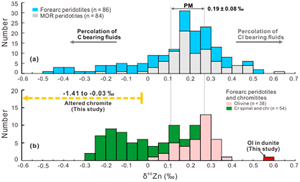
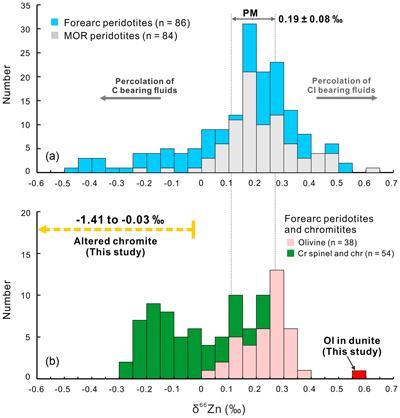 Figure 1 (a) A summary of Zn isotope data of oceanic peridotites/serpentinites (see Supplementary Information for data sources). (b) Zn isotopes of chromites from forearc ophiolitic peridotites and chromitites presented in this and previous studies. The grey dashed lines mark the range of primitive mantle (PM; Fang et al., 2022). | 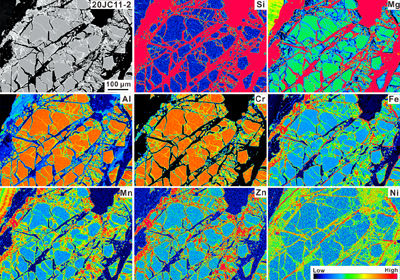 Figure 2 Elemental distribution maps of chromite from one heavily fragmented and altered sample (20JC11-2) that displays significantly light Zn isotopes. | 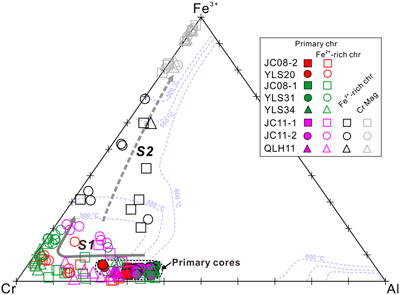 Figure 3 Ternary Cr-Fe3+-Al plot showing compositional variations of primary and altered chromites. S1 and S2 display different stages of chromite alteration. The isothermal lines (defined by olivine Fo = 90) demonstrate the phase relations within the spinel prism [(Fe,Mg)(Al,Cr,Fe3+)2O4] over the temperature range of 500–600 °C (cf. Sack and Ghiorso, 1991). | 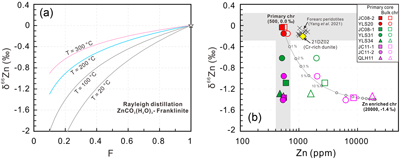 Figure 4 (a) Rayleigh distillation modelling results for δ66Zn evolution of secondary Zn, Fe enriched chromites (e.g., franklinite) precipitated from a carbonate bearing fluid at different temperatures (see SI). δ66Zninitial was set to +0.00 ‰, similar to that documented in chromite from Group 1 samples. (b) Plot of δ66Zn versus bulk Zn of chromites (hollow symbol) in the samples. Dashed line denotes mixing result between a primary chromite end member and a secondary Zn, Fe enriched chromite end member (see SI). Grey areas mark Zn range of primary chromites in studied samples and δ66Zn range of primary chromites reported from forearc ophiolitic peridotites and chromitites (−0.27 to +0.23 ‰; Yang et al., 2021; Lian et al., 2024; Su et al., 2026). |
| Figure 1 | Figure 2 | Figure 3 | Figure 4 |
top
Introduction
Zinc (Zn) is a transition metal that exhibits lithophile, siderophile or chalcophile behaviour depending on geological processes (Moynier et al., 2017
Moynier, F., Vance, D., Fujii, T., Savage, P. (2017) The isotope geochemistry of zinc and copper. Reviews in Mineralogy and Geochemistry 82, 543–600. https://doi.org/10.2138/rmg.2017.82.13
). In hydrothermal solutions, Zn is highly mobile and significant Zn isotope fractionation occurs between different aqueous Zn species (chloride, sulfide, and carbonate) under certain fluid conditions (Fujii et al., 2011Fujii, T., Moynier, F., Pons, M.-L., Albarède, F. (2011) The origin of Zn isotope fractionation in sulfides. Geochimica et Cosmochimica Acta 75, 7632–7643. https://doi.org/10.1016/j.gca.2011.09.036
, 2014Fujii, T., Moynier, F., Blichert-Toft, J., Albarède, F. (2014) Density functional theory estimation of isotope fractionation of Fe, Ni, Cu, and Zn among species relevant to geochemical and biological environments. Geochimica et Cosmochimica Acta 140, 553–576. https://doi.org/10.1016/j.gca.2014.05.051
), making Zn and its isotopes (δ66Zn) a useful tracer of fluid chemistry among different geological environments (Pons et al., 2011Pons, M.-L., Quitté, G., Fujii, T., Rosing, M.T., Reynard, B., Moynier, F., Douchet, C., Albarède, F. (2011) Early Archean serpentine mud volcanoes at Isua, Greenland, as a niche for early life. Proceedings of the National Academy of Sciences of the United States of America 108, 17639–17643. https://doi.org/10.1073/pnas.1108061108
; Debret et al., 2018Debret, B., Bouilhol, P., Pons, M.L., Williams, H. (2018) Carbonate Transfer during the Onset of Slab Devolatilization: New Insights from Fe and Zn Stable Isotopes. Journal of Petrology 59, 1145–1166. https://doi.org/10.1093/petrology/egy057
, 2021Debret, B., Garrido, C.J., Pons, M.-L., Bouilhol, P., Inglis, E., López Sánchez-Vizcaíno, V., Williams, H. (2021) Iron and zinc stable isotope evidence for open-system high-pressure dehydration of antigorite serpentinite in subduction zones. Geochimica et Cosmochimica Acta 296, 210–225. https://doi.org/10.1016/j.gca.2020.12.001
, 2024Debret, B., Andreani, M., Godard, M. (2024) A review of abyssal serpentinite geochemistry and geodynamics. Earth-Science Reviews 258, 104910. https://doi.org/10.1016/j.earscirev.2024.104910
).Several Zn isotope studies of oceanic peridotites/serpentinites from mid-ocean ridges and forearcs have documented a wide δ66Zn range (−0.48 to +0.62 ‰; see summary in Fig. 1) relative to that of the primitive mantle (0.19 ± 0.08 ‰; Fang et al., 2022
Fang, S.-B., Huang, J., Zhang, X.-C., Ionov, D.A., Zhao, Z.-F., Huang, F. (2022) Zinc isotope fractionation in mantle rocks and minerals, and a revised δ66Zn value for the Bulk Silicate Earth. Geochimica et Cosmochimica Acta 338, 79–92. https://doi.org/10.1016/j.gca.2022.10.017
). Such large isotopic variations cannot be ascribed to high temperature magmatic processes (Sossi et al., 2018Sossi, P.A., Nebel, O., O’Neill, H.St.C., Moynier, F. (2018) Zinc isotope composition of the Earth and its behaviour during planetary accretion. Chemical Geology 477, 73–84. https://doi.org/10.1016/j.chemgeo.2017.12.006
; Chen et al., 2021Chen, Z., Chen, J., Zeng, Z., Soh Tamehe, L., Zhang, T., Zhang, Y., Yin, X., Wang, X., Chen, S., Shai, W. (2021) Zinc isotopes of the Mariana and Ryukyu arc-related lavas reveal recycling of forearc serpentinites into the subarc mantle. Journal of Geophysical Research: Solid Earth 126, e2021JB022261. https://doi.org/10.1029/2021JB022261
), but are likely induced by widespread fluid-rock interactions associated with peridotite exhumation and serpentinisation (Pons et al., 2011Pons, M.-L., Quitté, G., Fujii, T., Rosing, M.T., Reynard, B., Moynier, F., Douchet, C., Albarède, F. (2011) Early Archean serpentine mud volcanoes at Isua, Greenland, as a niche for early life. Proceedings of the National Academy of Sciences of the United States of America 108, 17639–17643. https://doi.org/10.1073/pnas.1108061108
; Debret et al., 2018Debret, B., Bouilhol, P., Pons, M.L., Williams, H. (2018) Carbonate Transfer during the Onset of Slab Devolatilization: New Insights from Fe and Zn Stable Isotopes. Journal of Petrology 59, 1145–1166. https://doi.org/10.1093/petrology/egy057
, 2024Debret, B., Andreani, M., Godard, M. (2024) A review of abyssal serpentinite geochemistry and geodynamics. Earth-Science Reviews 258, 104910. https://doi.org/10.1016/j.earscirev.2024.104910
). Within such solid + fluid systems, the changes in Zn isotopes in peridotites are primarily driven by mineral dissolution-reprecipitation reactions (Putnis, 2009Putnis, A. (2009) Mineral replacement reactions. Reviews in Mineralogy and Geochemistry 70, 87–124. https://doi.org/10.2138/rmg.2009.70.3
), depending on the conditions and nature of fluids in different geological environments (Pons et al., 2011Pons, M.-L., Quitté, G., Fujii, T., Rosing, M.T., Reynard, B., Moynier, F., Douchet, C., Albarède, F. (2011) Early Archean serpentine mud volcanoes at Isua, Greenland, as a niche for early life. Proceedings of the National Academy of Sciences of the United States of America 108, 17639–17643. https://doi.org/10.1073/pnas.1108061108
; Debret et al., 2018Debret, B., Bouilhol, P., Pons, M.L., Williams, H. (2018) Carbonate Transfer during the Onset of Slab Devolatilization: New Insights from Fe and Zn Stable Isotopes. Journal of Petrology 59, 1145–1166. https://doi.org/10.1093/petrology/egy057
, 2024Debret, B., Andreani, M., Godard, M. (2024) A review of abyssal serpentinite geochemistry and geodynamics. Earth-Science Reviews 258, 104910. https://doi.org/10.1016/j.earscirev.2024.104910
). In addition, it has been shown that spinel, as an accessary phase in upper mantle peridotites, hosts up to ∼60 % of the bulk rock Zn budget (Fang et al., 2022Fang, S.-B., Huang, J., Zhang, X.-C., Ionov, D.A., Zhao, Z.-F., Huang, F. (2022) Zinc isotope fractionation in mantle rocks and minerals, and a revised δ66Zn value for the Bulk Silicate Earth. Geochimica et Cosmochimica Acta 338, 79–92. https://doi.org/10.1016/j.gca.2022.10.017
). This implies that dissolution and precipitation of spinels during widespread fluid-rock interactions (Arai and Akizawa, 2014Arai, S., Akizawa, N. (2014) Precipitation and dissolution of chromite by hydrothermal solutions in the Oman ophiolite: New behavior of Cr and chromite. American Mineralogist 99, 28–34. https://doi.org/10.2138/am.2014.4473
) may considerably affect Zn elemental and isotopic variations in oceanic peridotites (Debret et al., 2024Debret, B., Andreani, M., Godard, M. (2024) A review of abyssal serpentinite geochemistry and geodynamics. Earth-Science Reviews 258, 104910. https://doi.org/10.1016/j.earscirev.2024.104910
). Moreover, a recent study demonstrated that Cr spinels in oceanic peridotites display overall lighter δ66Zn than that of Al spinels in cratonic peridotites, probably reflecting a chemical control on Zn isotope systematics of spinels (Yang et al., 2021Yang, C., Liu, S.-A., Zhang, L., Wang, Z.-Z., Liu, P.-P., Li, S.-G. (2021) Zinc isotope fractionation between Cr-spinel and olivine and its implications for chromite crystallization during magma differentiation. Geochimica et Cosmochimica Acta 313, 277–294. https://doi.org/10.1016/j.gca.2021.08.005
). Nonetheless, an assessment of Zn isotope systematics in Cr spinels and its potential effect on Zn isotopic variations in oceanic mantle rocks is lacking.Figure 1 (a) A summary of Zn isotope data of oceanic peridotites/serpentinites (see Supplementary Information for data sources). (b) Zn isotopes of chromites from forearc ophiolitic peridotites and chromitites presented in this and previous studies. The grey dashed lines mark the range of primitive mantle (PM; Fang et al., 2022
Fang, S.-B., Huang, J., Zhang, X.-C., Ionov, D.A., Zhao, Z.-F., Huang, F. (2022) Zinc isotope fractionation in mantle rocks and minerals, and a revised δ66Zn value for the Bulk Silicate Earth. Geochimica et Cosmochimica Acta 338, 79–92. https://doi.org/10.1016/j.gca.2022.10.017
).In this study, we present mineral chemistry, elemental mapping, and Zn isotopes of variably altered chromites from high Cr-type (spinel Cr# > 60) ophiolitic chromitites in Tibet, China. Our new data reveal significant δ66Zn variability in chromite, including the lightest values recorded in peridotite minerals, and demonstrate that these significantly light isotopic signatures primarily stem from secondary Zn, Fe enriched phases precipitated during fluid mediated alteration. These findings highlight the pivotal role of chromite alteration in driving Zn elemental and isotopic variability in Cr-rich forearc mantle rocks.
top
Results
Eight chromitites and one chromite-rich dunite collected from several Tibetan ophiolites in China were studied in detail (Fig. S-1, Tables S-1–S-7; see Supplementary Information (SI)). The chromitite samples display a variety of textures (Figs. S-2–S-4), with chromite modes ranging from 25 % to 97 % (Table S-1). Primary silicates (mostly olivines) in these samples have been completely replaced by secondary mineral assemblages consisting of chlorite ± serpentine ± dolomite ± sulfides (Table S-1, Fig. S-5). Chromites are variably replaced by secondary Fe enriched zones along the rims and fractures (Figs. S-4–S-8). The relative proportions of Fe enriched zones in mapped chromites in these samples vary from <5 % to ∼60 % (Fig. S-9).
The core regions of chromites in these samples have low variability of Cr# [100 × Cr/(Cr + Al)] values (63.0–78.5), Mg# [100 × Mg/(Mg + Fe2+)] values (60.8–75.8), and Fe3+/Fetotal ratios (0.14–0.29) (Figs. S-10, S-11). Minor elements (Zn, Mn) in the core regions also show restricted variations (Figs. 2, S-6–S-8), with Zn contents of 432–1058 μg/g (mostly <600 μg/g). In contrast, Fe enriched zones in these samples show systematically increased Cr# (up to ∼100), decreased Mg# (down to ∼0), as well as highly variable Fe3+/Fetotal ratios (0.03–0.67) and Zn contents (<200 to ∼40,000 μg/g) compared with corresponding cores (Figs. S-10, S-11).
Figure 2 Elemental distribution maps of chromite from one heavily fragmented and altered sample (20JC11-2) that displays significantly light Zn isotopes.
The chromitite samples are further subdivided into three groups, based on the extent of Zn enrichment in Fe enriched zones (Figs. 3, S-10 and S-11). In Group 1 samples, the Fe enriched zones are almost Fe2+-rich (ferrous) chromites, with Fe3+/Fetotal ratios of 0.02–0.35 and Zn contents of 300–1445 μg/g (mostly <1000 μg/g). In Group 2 samples, the Fe enriched zones are also ferrous chromites, with similar Fe3+/Fetotal ratios (0.05–0.34) but apparently higher Zn contents (427–4209 μg/g, mostly >1000 μg/g). In Group 3 samples, the Fe enriched zones are mixtures of ferrous chromites (Fe3+/Fetotal = 0.03–0.39, Zn = 610–39,060 μg/g), Fe3+-rich (ferrian) chromites (Fe3+/Fetotal = 0.41–0.59, Zn = 786–15,090 μg/g), and Cr magnetites (Fe3+/Fetotal = 0.61–0.67, Zn = <200–2889 μg/g).
Figure 3 Ternary Cr-Fe3+-Al plot showing compositional variations of primary and altered chromites. S1 and S2 display different stages of chromite alteration. The isothermal lines (defined by olivine Fo = 90) demonstrate the phase relations within the spinel prism [(Fe,Mg)(Al,Cr,Fe3+)2O4] over the temperature range of 500–600 °C (cf. Sack and Ghiorso, 1991
Sack, R.O., Ghiorso, M.S. (1991) Chromian spinels as petrogenetic indicators: Thermodynamics and petrological applications. American Mineralogist 76, 827–847. http://www.minsocam.org/ammin/AM76/AM76_827.pdf
).In terms of Zn isotopes, chromites from Group 1 samples have δ66Zn of −0.15 ‰ to −0.03 ‰, while anomalously negative δ66Zn are documented in chromites from Group 2 (−0.62 ‰ to −1.29 ‰) and Group 3 (−0.96 to −1.41 ‰) samples (Fig. 4). Given that chromites in these samples are variably altered, these isotopic values likely represent mixed signatures between primary cores and secondary Fe enriched zones. For comparison, both chromites and olivines in the chromite-rich dunite (21DZ02) are unaltered (Fig. S-4), with δ66Zn of 0.57 ± 0.04 ‰ and −0.21 ± 0.02 ‰, respectively (Table S-7).
Figure 4 (a) Rayleigh distillation modelling results for δ66Zn evolution of secondary Zn, Fe enriched chromites (e.g., franklinite) precipitated from a carbonate bearing fluid at different temperatures (see SI). δ66Zninitial was set to +0.00 ‰, similar to that documented in chromite from Group 1 samples. (b) Plot of δ66Zn versus bulk Zn of chromites (hollow symbol) in the samples. Dashed line denotes mixing result between a primary chromite end member and a secondary Zn, Fe enriched chromite end member (see SI). Grey areas mark Zn range of primary chromites in studied samples and δ66Zn range of primary chromites reported from forearc ophiolitic peridotites and chromitites (−0.27 to +0.23 ‰; Yang et al., 2021
Yang, C., Liu, S.-A., Zhang, L., Wang, Z.-Z., Liu, P.-P., Li, S.-G. (2021) Zinc isotope fractionation between Cr-spinel and olivine and its implications for chromite crystallization during magma differentiation. Geochimica et Cosmochimica Acta 313, 277–294. https://doi.org/10.1016/j.gca.2021.08.005
; Lian et al., 2024Lian, D., Liu, F., Cai, P., Wu, W., Li, J., Majka, J., Xu, Z., Yang, J. (2024) Osmium and zinc isotope constraints on the origin of chromitites from the Yarlung-Zangbo ophiolites, Tibet, China. Mineralium Deposita 59, 1089–1107. https://doi.org/10.1007/s00126-024-01252-9
; Su et al., 2026Su, B.-X., Xiao, Y., Wang, J., Pan, Q.-Q., Zhao, S.-Q. (2026) Reversed inter-mineral Fe-Zn isotope fractionation in ophiolitic peridotites: Evidence for widespread hydration of oceanic lithospheric mantle. American Journal of Science 326, 7. https://doi.org/10.2475/001c.160209
).top
Discussion
Fluid-mediated alteration of chromite. Chromite alteration is common in ophiolitic peridotites and chromitites (Gervilla et al., 2012
Gervilla, F., Padrón-Navarta, J.A., Kerestedjian, T., Sergeeva, I., González-Jiménez, J.M., Fanlo, I. (2012) Formation of ferrian chromite in podiform chromitites from the Golyamo Kamenyane serpentinite, Eastern Rhodopes, SE Bulgaria: a two-stage process. Contributions to Mineralogy and Petrology 164, 643–657. https://doi.org/10.1007/s00410-012-0763-3
; Eslami et al., 2021Eslami, A., Malvoisin, B., Brunet, F., Kananian, A., Bach, W., Grieco, G., Cavallo, A., Gatta, G.D. (2021) Podiform magnetite ore(s) in the Sabzevar ophiolite (NE Iran): oceanic hydrothermal alteration of a chromite deposit. Contributions to Mineralogy and Petrology 176, 43. https://doi.org/10.1007/s00410-021-01799-0
; Liu et al., 2023Liu, R., Zhao, J., Zhou, M., Han, Q. (2023) Alteration of chromite during serpentinization of peridotites. Lithos 460–461, 107385. https://doi.org/10.1016/j.lithos.2023.107385
), with textures and compositions of primary chromites can be modified to variable extents via mineral replacement (dissolution-precipitation) reactions in the presence of fluids (Putnis, 2009Putnis, A. (2009) Mineral replacement reactions. Reviews in Mineralogy and Geochemistry 70, 87–124. https://doi.org/10.2138/rmg.2009.70.3
; Arai and Akizawa, 2014Arai, S., Akizawa, N. (2014) Precipitation and dissolution of chromite by hydrothermal solutions in the Oman ophiolite: New behavior of Cr and chromite. American Mineralogist 99, 28–34. https://doi.org/10.2138/am.2014.4473
). For Group 1 and 2 samples, the secondary Fe enriched zones are almost ferrous chromites, characterised by progressive increase in Cr and Fe (mainly in Fe2+ form) coupled with decrease in Mg and Al compared with corresponding chromite cores. Notably, Fe enriched zones in some samples are closely associated with chlorite inclusions within chromite cores (Fig. S-5c), or develop porous textures with abundant chlorites filling the pores (Fig. S-5d,e). These features together with co-precipitation of interstitial chlorite ± serpentine suggest reaction between primary chromite and co-existing olivine under H2O saturated conditions, during which primary chromites were progressively dissolved along the rims and fractures and re-precipitated as porous Fe2+-rich chromites along with chlorite filling the pores (see SI; Gervilla et al., 2012Gervilla, F., Padrón-Navarta, J.A., Kerestedjian, T., Sergeeva, I., González-Jiménez, J.M., Fanlo, I. (2012) Formation of ferrian chromite in podiform chromitites from the Golyamo Kamenyane serpentinite, Eastern Rhodopes, SE Bulgaria: a two-stage process. Contributions to Mineralogy and Petrology 164, 643–657. https://doi.org/10.1007/s00410-012-0763-3
).For Group 3 samples, the Fe enriched zones are composed of ferrous, ferrian chromites, and Cr magnetites, which occur as both single phase and mixed phases. In the former cases, the contacts between ferrous/ferrian chromites and primary cores are diffusive (Fig. S-5f), in contrast with the sharp contacts between Cr magnetites and primary cores (Fig. S-5i). In the latter cases, successive outward transitions from ferrous to ferrian chromite and Cr magnetite are documented (Fig. S-5g,h). These features, together with the progressive increase in Fe3+/Fetotal and decrease in Cr from ferrous to ferrian chromite and then to Cr magnetite (Fig. S-10), suggest a two-stage alteration process. The first stage involves the precipitation of ferrous chromites similar to those documented in Group 1 and 2 samples. In the second stage, the growth of intervening ferrian chromites and Cr magnetites likely resulted from inter-crystalline diffusion reaction between early formed, ferrous chromite and a Cr-poor, Fe3+-rich end member phase in presence of fluids (see SI; Prabhakar and Bhattacharya, 2013
Prabhakar, N., Bhattacharya, A. (2013) Origin of zoned spinel by coupled dissolution–precipitation and inter-crystalline diffusion: evidence from serpentinized wehrlite, Bangriposi, Eastern India. Contributions to Mineralogy and Petrology 166, 1047–1066. https://doi.org/10.1007/s00410-013-0909-y
). The most likely candidate for this end member phase is magnetite, given the sharp contact between Cr magnetite and primary cores, and the continuous change in Cr and Fe3+ from ferrian chromite to Cr magnetite that trends toward pure magnetite.The presence of ferrian chromites and Cr magnetites in Fe enriched zones in Group 3 samples suggests more advanced alteration, consistent with higher extents of fragmentation of chromites in these samples (Fig. S-4). Similar two-stage alteration of chromites has been widely documented in ophiolitic peridotites and chromitites, and is generally interpreted as the results of fluid-rock interaction in the course of their exhumation (Gervilla et al., 2012
Gervilla, F., Padrón-Navarta, J.A., Kerestedjian, T., Sergeeva, I., González-Jiménez, J.M., Fanlo, I. (2012) Formation of ferrian chromite in podiform chromitites from the Golyamo Kamenyane serpentinite, Eastern Rhodopes, SE Bulgaria: a two-stage process. Contributions to Mineralogy and Petrology 164, 643–657. https://doi.org/10.1007/s00410-012-0763-3
; Eslami et al., 2021Eslami, A., Malvoisin, B., Brunet, F., Kananian, A., Bach, W., Grieco, G., Cavallo, A., Gatta, G.D. (2021) Podiform magnetite ore(s) in the Sabzevar ophiolite (NE Iran): oceanic hydrothermal alteration of a chromite deposit. Contributions to Mineralogy and Petrology 176, 43. https://doi.org/10.1007/s00410-021-01799-0
). Several thermodynamic models of chromite alteration under various temperature and fO2 conditions further predicted that these first stage reactions take place under high temperature ranges (>450 to ∼700 °C) with increasing fO2, while the second stage reactions take place under lower temperatures with decreasing fO2 (Eslami et al., 2021Eslami, A., Malvoisin, B., Brunet, F., Kananian, A., Bach, W., Grieco, G., Cavallo, A., Gatta, G.D. (2021) Podiform magnetite ore(s) in the Sabzevar ophiolite (NE Iran): oceanic hydrothermal alteration of a chromite deposit. Contributions to Mineralogy and Petrology 176, 43. https://doi.org/10.1007/s00410-021-01799-0
; Liu et al., 2023Liu, R., Zhao, J., Zhou, M., Han, Q. (2023) Alteration of chromite during serpentinization of peridotites. Lithos 460–461, 107385. https://doi.org/10.1016/j.lithos.2023.107385
). These inferred conditions are supported by observed compositional variations in secondary phases formed during different stages. In the first stage, the high temperature is evidenced by these less chloritised ferrous chromites that display compositions approaching those of primary cores, while the increasing fO2 is suggested by these heavily chloritised ferrous chromites which tend to contain more Fe3+ as the alteration reaction proceeds (Fig. 3). In the second stage, the precipitation of a magnetite end member along with serpentine ± talc ± Ni-Fe sulfides in the matrix (Figs. S-4–S-8) is consistent with the expected products of serpentinisation, which is favoured by low temperature (<400 °C) and reducing conditions (McCollom and Bach, 2009McCollom, T.M., Bach, W. (2009) Thermodynamic constraints on hydrogen generation during serpentinization of ultramafic rocks. Geochimica et Cosmochimica Acta 73, 856–875. https://doi.org/10.1016/j.gca.2008.10.032
).Zn enrichment and significantly light Zn isotopes in altered chromite. Chromites in the studied chromitites display a wide δ66Zn range (−1.41 to −0.03 ‰), including the lightest value ever documented in terrestrial rocks and minerals. Given that chromites in these samples are variably altered, these δ66Zn values most likely represent mixed signatures. Notably, chromites from Group1 samples as well as the chromite-rich dunite show δ66Zn (−0.21 to −0.03 ‰) similar to values reported for fresh chromites from forearc ophiolitic peridotites and chromitites (−0.27 to +0.23 ‰, Fig. S-12; Yang et al., 2021
Yang, C., Liu, S.-A., Zhang, L., Wang, Z.-Z., Liu, P.-P., Li, S.-G. (2021) Zinc isotope fractionation between Cr-spinel and olivine and its implications for chromite crystallization during magma differentiation. Geochimica et Cosmochimica Acta 313, 277–294. https://doi.org/10.1016/j.gca.2021.08.005
; Lian et al., 2024Lian, D., Liu, F., Cai, P., Wu, W., Li, J., Majka, J., Xu, Z., Yang, J. (2024) Osmium and zinc isotope constraints on the origin of chromitites from the Yarlung-Zangbo ophiolites, Tibet, China. Mineralium Deposita 59, 1089–1107. https://doi.org/10.1007/s00126-024-01252-9
; Su et al., 2026Su, B.-X., Xiao, Y., Wang, J., Pan, Q.-Q., Zhao, S.-Q. (2026) Reversed inter-mineral Fe-Zn isotope fractionation in ophiolitic peridotites: Evidence for widespread hydration of oceanic lithospheric mantle. American Journal of Science 326, 7. https://doi.org/10.2475/001c.160209
), while chromites from Group 2 and 3 samples feature highly negative δ66Zn (−1.41 to −0.62 ‰). Elemental mapping and quantitative analysis further show that Zn is more evenly distributed in chromites from Group 1 samples, with limited Zn enrichment in secondary Fe enriched zones relative to corresponding cores (Figs. S-10, S-11). In contrast, Zn is significantly and heterogeneously enriched in secondary Fe enriched zones (up to 4.86 wt. %) relative to corresponding cores in chromites from Group 2 and 3 samples (Figs. S-10, S-11), linking these anomalously negative δ66Zn with Zn, Fe enriched zones precipitated during fluid mediated alteration.Theoretical studies have predicted significant Zn isotopic fractionation between different Zn species (e.g., chloride, sulfide, carbonate) in hydrothermal fluids under certain conditions (Fujii et al., 2011
Fujii, T., Moynier, F., Pons, M.-L., Albarède, F. (2011) The origin of Zn isotope fractionation in sulfides. Geochimica et Cosmochimica Acta 75, 7632–7643. https://doi.org/10.1016/j.gca.2011.09.036
, 2014Fujii, T., Moynier, F., Blichert-Toft, J., Albarède, F. (2014) Density functional theory estimation of isotope fractionation of Fe, Ni, Cu, and Zn among species relevant to geochemical and biological environments. Geochimica et Cosmochimica Acta 140, 553–576. https://doi.org/10.1016/j.gca.2014.05.051
). Notably, at high pCO2 and pH conditions, isotopically heavy Zn is preferentially incorporated into aqueous carbonates, resulting in negative δ66Zn values in other co-existing Zn species in fluids (Fujii et al., 2011Fujii, T., Moynier, F., Pons, M.-L., Albarède, F. (2011) The origin of Zn isotope fractionation in sulfides. Geochimica et Cosmochimica Acta 75, 7632–7643. https://doi.org/10.1016/j.gca.2011.09.036
). The documentation of dolomite + chlorite ± serpentine associations in the matrix provide direct evidence of carbonate bearing fluids involved in the alteration processes. This means secondary Zn, Fe enriched chromites precipitated from these fluids are expected to be enriched in isotopically light Zn. Simple Rayleigh distillation modelling between Zn bearing chromite (ZnFe2O4) and a fluid phase complexing Zn mainly as carbonate (ZnCO3(H2O)3), following the procedures detailed described by Debret et al. (2024)Debret, B., Andreani, M., Godard, M. (2024) A review of abyssal serpentinite geochemistry and geodynamics. Earth-Science Reviews 258, 104910. https://doi.org/10.1016/j.earscirev.2024.104910
, further show that the precipitated Zn bearing chromites can have highly negative δ66Zn (see SI; Fig. 4a).The inferred alteration effect on Zn isotopic variations in chromites is consistent with the results of binary mixing between a primary chromite end member and a secondary Zn, Fe enriched chromite end member (Fig. 4b). As documented above, chromites from Group 1 samples are little affected by alteration and largely preserve primary compositional signatures, while chromites from Group 2 and 3 samples are more intensely and heterogeneously modified (Fig. S-13). In this frame, Zn and δ66Zn of the primary chromite end member were set to 500 μg/g and 0.00 ‰, respectively, similar to those values documented from Group 1 samples. For the Zn enriched end member, Zn and δ66Zn were set to 20,000 μg/g and −1.41 ‰, respectively, covering those values documented from Group 2 and Group 3 samples. Then, the bulk Zn contents of chromite in each sample were recalculated using the Zn contents of Fe enriched zones and primary cores, and their relative proportions as estimated based on mapped chromite grains (Fig. S-9). It should be noted that the extent of Zn enrichment in Fe enriched zones is determined by both the nature of fluids (i.e. Zn budget in the system) and fluid/rock ratios (i.e. the extent of reaction). Despite the uncertainties for estimated bulk Zn in chromites, the results show that chromites from most Group 2 and 3 samples display coupled δ66Zn-bulk Zn variations generally following the modelled mixing curve (Fig. 4b).
The strong similarity in the distribution pattern of Fe enriched zones in different sample groups suggests that Zn was mainly enriched during widespread fluid-rock reactions. The close association of these Zn, Fe enriched zones with the chlorite-serpentine matrix further suggests these enriched elements could be released from olivine (host peridotites) upon serpentinisation and redistributed during different stages of chromite alteration via dissolution-precipitation reactions (Arai and Akizawa, 2014
Arai, S., Akizawa, N. (2014) Precipitation and dissolution of chromite by hydrothermal solutions in the Oman ophiolite: New behavior of Cr and chromite. American Mineralogist 99, 28–34. https://doi.org/10.2138/am.2014.4473
). The progressive Zn enrichment in Fe enriched zones from Group 1 to Group 3 samples is also consistent with an increasing extent of chromite alteration with decreasing temperatures and increasing fluid/rock ratios (Fig. S-13). Note that highly enriched Zn (up to several wt. %) has been documented in some ferrous and ferrian chromites from Group 3 samples, indicating some of the Zn could be externally added to the system by Zn-rich mineralising fluids.Effect of chromite alteration on Zn isotope systematics in forearc mantle. High Cr-type (spinel Cr# > 60) ophiolitic chromitites primarily form at forearc settings, with slab-derived fluids playing a critical role in their genesis and subsequent modification (Su et al., 2020
Su, B.-X., Robinson, P.T., Chen, C., Xiao, Y., Melcher, F., Bai, Y., Gu, X.-Y., Uysal, I., Lenaz, D. (2020) The occurrence, origin, and fate of water in chromitites in ophiolites. American Mineralogist 105, 894–903. https://doi.org/10.2138/am-2020-7270
, 2021Su, B., Liu, X., Chen, C., Robinson, P.T., Xiao, Y., Zhou, M., Bai, Y., Uysal, I., Zhang, P. (2021) A new model for chromitite formation in ophiolites: Fluid immiscibility. Science China Earth Sciences 64, 220–230. https://doi.org/10.1007/s11430-020-9690-4
). Available Zn isotope studies of forearc peridotites/serpentinites have documented a wide δ66Zn range (−0.48 to +0.52 ‰; Fig. 1a), with non-equilibrium Zn isotope fractionation in these highly serpentinised rocks having been attributed to extensive fluid-rock reactions (Debret et al., 2024Debret, B., Andreani, M., Godard, M. (2024) A review of abyssal serpentinite geochemistry and geodynamics. Earth-Science Reviews 258, 104910. https://doi.org/10.1016/j.earscirev.2024.104910
). On the other hand, Zn isotope analyses of fresh Cr spinels/chromites from forearc ophiolitic peridotites and chromitites revealed a moderate range of δ66Zn (−0.27 to +0.23 ‰; Fig. 1b), which covers the observed δ66Zn variations in least affected chromites from Group 1 samples as well as the chromite-rich dunite (Fig. 4b). However, these anomalously negative δ66Zn documented in intensely altered chromites from Group 2 and 3 samples are unexpected, suggesting Zn isotopes in chromites can be significantly changed during alteration.Despite its low modal abundance (1–3 %) in most forearc peridotites, primary Cr spinels host a certain amount (up to 60 %) of the Zn budget in the peridotites (Yang et al., 2021
Yang, C., Liu, S.-A., Zhang, L., Wang, Z.-Z., Liu, P.-P., Li, S.-G. (2021) Zinc isotope fractionation between Cr-spinel and olivine and its implications for chromite crystallization during magma differentiation. Geochimica et Cosmochimica Acta 313, 277–294. https://doi.org/10.1016/j.gca.2021.08.005
; Fang et al., 2022Fang, S.-B., Huang, J., Zhang, X.-C., Ionov, D.A., Zhao, Z.-F., Huang, F. (2022) Zinc isotope fractionation in mantle rocks and minerals, and a revised δ66Zn value for the Bulk Silicate Earth. Geochimica et Cosmochimica Acta 338, 79–92. https://doi.org/10.1016/j.gca.2022.10.017
). More importantly, primary chromites can be significantly modified by hydrothermal solutions (Arai and Akizawa, 2014Arai, S., Akizawa, N. (2014) Precipitation and dissolution of chromite by hydrothermal solutions in the Oman ophiolite: New behavior of Cr and chromite. American Mineralogist 99, 28–34. https://doi.org/10.2138/am.2014.4473
), resulting in highly enriched Zn (up to several wt. %) in altered chromites (Singh and Singh, 2013Singh, A.K., Singh, R.B. (2013) Genetic implications of Zn- and Mn-rich Cr-spinels in serpentinites of the Tidding Suture Zone, eastern Himalaya, NE India. Geological Journal 48, 22–38. https://doi.org/10.1002/gj.2428
; Gamal El Dien et al., 2019Gamal El Dien, H., Arai, S., Doucet, L.-S., Li, Z.-X., Kil, Y., Fougerouse, D., Reddy, S.M., Saxey, D.W., Hamdy, M. (2019) Cr-spinel records metasomatism not petrogenesis of mantle rocks. Nature Communications 10, 5103. https://doi.org/10.1038/s41467-019-13117-1
). A wide range of geological and geophysical data have indicated extensive hydration in the forearc mantle, with estimated serpentinisation levels reaching 50 % in some forearcs (Hyndman and Peacock, 2003Hyndman, R.D., Peacock, S.M. (2003) Serpentinization of the forearc mantle. Earth and Planetary Science Letters 212, 417–432. https://doi.org/10.1016/S0012-821X(03)00263-2
). These highlight the possibility that altered chromites serve as a potential sink for Zn and other compatible elements (e.g., Mn) in the serpentinised forearc mantle (Gamal El Dien et al., 2019Gamal El Dien, H., Arai, S., Doucet, L.-S., Li, Z.-X., Kil, Y., Fougerouse, D., Reddy, S.M., Saxey, D.W., Hamdy, M. (2019) Cr-spinel records metasomatism not petrogenesis of mantle rocks. Nature Communications 10, 5103. https://doi.org/10.1038/s41467-019-13117-1
). Moreover, at shallower depths, slab derived, carbonate bearing fluids are significantly transferred to forearc mantle (Kawamoto et al., 2013Kawamoto, T., Yoshikawa, M., Kumagai, Y., Mirabueno, M.H.T., Okuno, M., Kobayashi, T. (2013) Mantle wedge infiltrated with saline fluids from dehydration and decarbonation of subducting slab. Proceedings of the National Academy of Sciences of the United States of America 110, 9663–9668. https://doi.org/10.1073/pnas.1302040110
; Debret et al., 2018Debret, B., Bouilhol, P., Pons, M.L., Williams, H. (2018) Carbonate Transfer during the Onset of Slab Devolatilization: New Insights from Fe and Zn Stable Isotopes. Journal of Petrology 59, 1145–1166. https://doi.org/10.1093/petrology/egy057
), which can dissolve more metals than pure H2O and greatly affect the chemical evolution of the mantle wedge. In this frame, hydrothermally altered Cr spinels by carbonate bearing fluids may not only host a certain amount of Zn budget in the forearc mantle, but preferentially carry isotopically light Zn (Pons et al., 2011Pons, M.-L., Quitté, G., Fujii, T., Rosing, M.T., Reynard, B., Moynier, F., Douchet, C., Albarède, F. (2011) Early Archean serpentine mud volcanoes at Isua, Greenland, as a niche for early life. Proceedings of the National Academy of Sciences of the United States of America 108, 17639–17643. https://doi.org/10.1073/pnas.1108061108
; Fujii et al., 2011Fujii, T., Moynier, F., Pons, M.-L., Albarède, F. (2011) The origin of Zn isotope fractionation in sulfides. Geochimica et Cosmochimica Acta 75, 7632–7643. https://doi.org/10.1016/j.gca.2011.09.036
), providing a plausible explanation for very negative δ66Zn documented in some forearc serpentinites (Fig. 1). These forearc serpentinites may release isotopically light Zn in fluids to modify the mantle wedge, producing light Zn isotopic signatures observed in some arc-front lavas (Chen et al., 2021Chen, Z., Chen, J., Zeng, Z., Soh Tamehe, L., Zhang, T., Zhang, Y., Yin, X., Wang, X., Chen, S., Shai, W. (2021) Zinc isotopes of the Mariana and Ryukyu arc-related lavas reveal recycling of forearc serpentinites into the subarc mantle. Journal of Geophysical Research: Solid Earth 126, e2021JB022261. https://doi.org/10.1029/2021JB022261
). Note that many forearc serpentinites display a primitive mantle-like or much heavier δ66Zn (Fig. 1), suggesting the effect of chromite alteration is highly dependent on the nature (e.g., carbonate bearing) of fluids as well as the extent of alteration reactions.top
Conclusions
This study reports significantly light Zn isotopes in variably altered chromites from ophiolitic chromitites. Textural and chemical data reveal heterogeneously enriched Zn in secondary Fe enriched zones developed along rims and fractures of chromites, pointing to different stages and extents of fluid mediated alteration. The involvement of carbonate bearing fluids is expected to result in anomalously negative δ66Zn in secondary Zn, Fe enriched chromites precipitated from the fluids, which facilitates Zn elemental and isotopic variability in bulk chromites. These findings highlight the role of this type of chromite alteration in affecting Zn isotopic variations in highly serpentinised forearc mantle.
top
Acknowledgements
We thank editor Raúl Fonseca and two reviewers for their constructive comments, which significantly improved the quality of the paper. This research is funded by the National Natural Science Foundation of China (U2344202, 42472087) and National Science and Technology Major Project (2025D1006100). Dr. Jing Wang from the IGGCAS is appreciated for conducting the Zn isotope analyses.
Editor: Raúl O.C. Fonseca
top
References
Arai, S., Akizawa, N. (2014) Precipitation and dissolution of chromite by hydrothermal solutions in the Oman ophiolite: New behavior of Cr and chromite. American Mineralogist 99, 28–34. https://doi.org/10.2138/am.2014.4473
 Show in context
This implies that dissolution and precipitation of spinels during widespread fluid-rock interactions (Arai and Akizawa, 2014) may considerably affect Zn elemental and isotopic variations in oceanic peridotites (Debret et al., 2024).
View in article
Chromite alteration is common in ophiolitic peridotites and chromitites (Gervilla et al., 2012; Eslami et al., 2021; Liu et al., 2023), with textures and compositions of primary chromites can be modified to variable extents via mineral replacement (dissolution-precipitation) reactions in the presence of fluids (Putnis, 2009; Arai and Akizawa, 2014).
View in article
The close association of these Zn, Fe enriched zones with the chlorite-serpentine matrix further suggests these enriched elements could be released from olivine (host peridotites) upon serpentinisation and redistributed during different stages of chromite alteration via dissolution-precipitation reactions (Arai and Akizawa, 2014).
View in article
More importantly, primary chromites can be significantly modified by hydrothermal solutions (Arai and Akizawa, 2014), resulting in highly enriched Zn (up to several wt. %) in altered chromites (Singh and Singh, 2013; Gamal El Dien et al., 2019).
View in article
Chen, Z., Chen, J., Zeng, Z., Soh Tamehe, L., Zhang, T., Zhang, Y., Yin, X., Wang, X., Chen, S., Shai, W. (2021) Zinc isotopes of the Mariana and Ryukyu arc-related lavas reveal recycling of forearc serpentinites into the subarc mantle. Journal of Geophysical Research: Solid Earth 126, e2021JB022261. https://doi.org/10.1029/2021JB022261
Show in context Such large isotopic variations cannot be ascribed to high temperature magmatic processes (Sossi et al., 2018; Chen et al., 2021), but are likely induced by widespread fluid-rock interactions associated with peridotite exhumation and serpentinisation (Pons et al., 2011; Debret et al., 2018, 2024).
View in article
These forearc serpentinites may release isotopically light Zn in fluids to modify the mantle wedge, producing light Zn isotopic signatures observed in some arc-front lavas (Chen et al., 2021).
View in article
Debret, B., Bouilhol, P., Pons, M.L., Williams, H. (2018) Carbonate Transfer during the Onset of Slab Devolatilization: New Insights from Fe and Zn Stable Isotopes. Journal of Petrology 59, 1145–1166. https://doi.org/10.1093/petrology/egy057
Show in context In hydrothermal solutions, Zn is highly mobile and significant Zn isotope fractionation occurs between different aqueous Zn species (chloride, sulfide, and carbonate) under certain fluid conditions (Fujii et al., 2011, 2014), making Zn and its isotopes (δ66Zn) a useful tracer of fluid chemistry among different geological environments (Pons et al., 2011; Debret et al., 2018, 2021, 2024).
View in article
Such large isotopic variations cannot be ascribed to high temperature magmatic processes (Sossi et al., 2018; Chen et al., 2021), but are likely induced by widespread fluid-rock interactions associated with peridotite exhumation and serpentinisation (Pons et al., 2011; Debret et al., 2018, 2024).
View in article
Within such solid + fluid systems, the changes in Zn isotopes in peridotites are primarily driven by mineral dissolution-reprecipitation reactions (Putnis, 2009), depending on the conditions and nature of fluids in different geological environments (Pons et al., 2011; Debret et al., 2018, 2024).
View in article
Moreover, at shallower depths, slab derived, carbonate bearing fluids are significantly transferred to forearc mantle (Kawamoto et al., 2013; Debret et al., 2018), which can dissolve more metals than pure H2O and greatly affect the chemical evolution of the mantle wedge.
View in article
Debret, B., Garrido, C.J., Pons, M.-L., Bouilhol, P., Inglis, E., López Sánchez-Vizcaíno, V., Williams, H. (2021) Iron and zinc stable isotope evidence for open-system high-pressure dehydration of antigorite serpentinite in subduction zones. Geochimica et Cosmochimica Acta 296, 210–225. https://doi.org/10.1016/j.gca.2020.12.001
Show in context In hydrothermal solutions, Zn is highly mobile and significant Zn isotope fractionation occurs between different aqueous Zn species (chloride, sulfide, and carbonate) under certain fluid conditions (Fujii et al., 2011, 2014), making Zn and its isotopes (δ66Zn) a useful tracer of fluid chemistry among different geological environments (Pons et al., 2011; Debret et al., 2018, 2021, 2024).
View in article
Debret, B., Andreani, M., Godard, M. (2024) A review of abyssal serpentinite geochemistry and geodynamics. Earth-Science Reviews 258, 104910. https://doi.org/10.1016/j.earscirev.2024.104910
Show in context In hydrothermal solutions, Zn is highly mobile and significant Zn isotope fractionation occurs between different aqueous Zn species (chloride, sulfide, and carbonate) under certain fluid conditions (Fujii et al., 2011, 2014), making Zn and its isotopes (δ66Zn) a useful tracer of fluid chemistry among different geological environments (Pons et al., 2011; Debret et al., 2018, 2021, 2024).
View in article
Such large isotopic variations cannot be ascribed to high temperature magmatic processes (Sossi et al., 2018; Chen et al., 2021), but are likely induced by widespread fluid-rock interactions associated with peridotite exhumation and serpentinisation (Pons et al., 2011; Debret et al., 2018, 2024).
View in article
Within such solid + fluid systems, the changes in Zn isotopes in peridotites are primarily driven by mineral dissolution-reprecipitation reactions (Putnis, 2009), depending on the conditions and nature of fluids in different geological environments (Pons et al., 2011; Debret et al., 2018, 2024).
View in article
This implies that dissolution and precipitation of spinels during widespread fluid-rock interactions (Arai and Akizawa, 2014) may considerably affect Zn elemental and isotopic variations in oceanic peridotites (Debret et al., 2024).
View in article
Simple Rayleigh distillation modelling between Zn bearing chromite (ZnFe2O4) and a fluid phase complexing Zn mainly as carbonate (ZnCO3(H2O)3), following the procedures detailed described by Debret et al. (2024), further show that the precipitated Zn bearing chromites can have highly negative δ66Zn (see SI; Fig. 4a).
View in article
Available Zn isotope studies of forearc peridotites/serpentinites have documented a wide δ66Zn range (−0.48 to +0.52 ‰; Fig. 1a), with non-equilibrium Zn isotope fractionation in these highly serpentinised rocks having been attributed to extensive fluid-rock reactions (Debret et al., 2024).
View in article
Eslami, A., Malvoisin, B., Brunet, F., Kananian, A., Bach, W., Grieco, G., Cavallo, A., Gatta, G.D. (2021) Podiform magnetite ore(s) in the Sabzevar ophiolite (NE Iran): oceanic hydrothermal alteration of a chromite deposit. Contributions to Mineralogy and Petrology 176, 43. https://doi.org/10.1007/s00410-021-01799-0
Show in context Chromite alteration is common in ophiolitic peridotites and chromitites (Gervilla et al., 2012; Eslami et al., 2021; Liu et al., 2023), with textures and compositions of primary chromites can be modified to variable extents via mineral replacement (dissolution-precipitation) reactions in the presence of fluids (Putnis, 2009; Arai and Akizawa, 2014).
View in article
Similar two-stage alteration of chromites has been widely documented in ophiolitic peridotites and chromitites, and is generally interpreted as the results of fluid-rock interaction in the course of their exhumation (Gervilla et al., 2012; Eslami et al., 2021).
View in article
Several thermodynamic models of chromite alteration under various temperature and fO2 conditions further predicted that these first stage reactions take place under high temperature ranges (>450 to ∼700 °C) with increasing fO2, while the second stage reactions take place under lower temperatures with decreasing fO2 (Eslami et al., 2021; Liu et al., 2023).
View in article
Fang, S.-B., Huang, J., Zhang, X.-C., Ionov, D.A., Zhao, Z.-F., Huang, F. (2022) Zinc isotope fractionation in mantle rocks and minerals, and a revised δ66Zn value for the Bulk Silicate Earth. Geochimica et Cosmochimica Acta 338, 79–92. https://doi.org/10.1016/j.gca.2022.10.017
Show in context Several Zn isotope studies of oceanic peridotites/serpentinites from mid-ocean ridges and forearcs have documented a wide δ66Zn range (−0.48 to +0.62 ‰; see summary in Fig. 1) relative to that of the primitive mantle (0.19 ± 0.08 ‰; Fang et al., 2022).
View in article
In addition, it has been shown that spinel, as an accessary phase in upper mantle peridotites, hosts up to ∼60 % of the bulk rock Zn budget (Fang et al., 2022).
View in article
The grey dashed lines mark the range of primitive mantle (PM; Fang et al., 2022).
View in article
Despite its low modal abundance (1–3 %) in most forearc peridotites, primary Cr spinels host a certain amount (up to 60 %) of the Zn budget in the peridotites (Yang et al., 2021; Fang et al., 2022).
View in article
Fujii, T., Moynier, F., Pons, M.-L., Albarède, F. (2011) The origin of Zn isotope fractionation in sulfides. Geochimica et Cosmochimica Acta 75, 7632–7643. https://doi.org/10.1016/j.gca.2011.09.036
Show in context In hydrothermal solutions, Zn is highly mobile and significant Zn isotope fractionation occurs between different aqueous Zn species (chloride, sulfide, and carbonate) under certain fluid conditions (Fujii et al., 2011, 2014), making Zn and its isotopes (δ66Zn) a useful tracer of fluid chemistry among different geological environments (Pons et al., 2011; Debret et al., 2018, 2021, 2024).
View in article
Theoretical studies have predicted significant Zn isotopic fractionation between different Zn species (e.g., chloride, sulfide, carbonate) in hydrothermal fluids under certain conditions (Fujii et al., 2011, 2014).
View in article
Notably, at high pCO2 and pH conditions, isotopically heavy Zn is preferentially incorporated into aqueous carbonates, resulting in negative δ66Zn values in other co-existing Zn species in fluids (Fujii et al., 2011).
View in article
In this frame, hydrothermally altered Cr spinels by carbonate bearing fluids may not only host a certain amount of Zn budget in the forearc mantle, but preferentially carry isotopically light Zn (Pons et al., 2011; Fujii et al., 2011), providing a plausible explanation for very negative δ66Zn documented in some forearc serpentinites (Fig. 1).
View in article
Fujii, T., Moynier, F., Blichert-Toft, J., Albarède, F. (2014) Density functional theory estimation of isotope fractionation of Fe, Ni, Cu, and Zn among species relevant to geochemical and biological environments. Geochimica et Cosmochimica Acta 140, 553–576. https://doi.org/10.1016/j.gca.2014.05.051
Show in context In hydrothermal solutions, Zn is highly mobile and significant Zn isotope fractionation occurs between different aqueous Zn species (chloride, sulfide, and carbonate) under certain fluid conditions (Fujii et al., 2011, 2014), making Zn and its isotopes (δ66Zn) a useful tracer of fluid chemistry among different geological environments (Pons et al., 2011; Debret et al., 2018, 2021, 2024).
View in article
Theoretical studies have predicted significant Zn isotopic fractionation between different Zn species (e.g., chloride, sulfide, carbonate) in hydrothermal fluids under certain conditions (Fujii et al., 2011, 2014).
View in article
Gamal El Dien, H., Arai, S., Doucet, L.-S., Li, Z.-X., Kil, Y., Fougerouse, D., Reddy, S.M., Saxey, D.W., Hamdy, M. (2019) Cr-spinel records metasomatism not petrogenesis of mantle rocks. Nature Communications 10, 5103. https://doi.org/10.1038/s41467-019-13117-1
Show in context More importantly, primary chromites can be significantly modified by hydrothermal solutions (Arai and Akizawa, 2014), resulting in highly enriched Zn (up to several wt. %) in altered chromites (Singh and Singh, 2013; Gamal El Dien et al., 2019).
View in article
These highlight the possibility that altered chromites serve as a potential sink for Zn and other compatible elements (e.g., Mn) in the serpentinised forearc mantle (Gamal El Dien et al., 2019).
View in article
Gervilla, F., Padrón-Navarta, J.A., Kerestedjian, T., Sergeeva, I., González-Jiménez, J.M., Fanlo, I. (2012) Formation of ferrian chromite in podiform chromitites from the Golyamo Kamenyane serpentinite, Eastern Rhodopes, SE Bulgaria: a two-stage process. Contributions to Mineralogy and Petrology 164, 643–657. https://doi.org/10.1007/s00410-012-0763-3
Show in context Chromite alteration is common in ophiolitic peridotites and chromitites (Gervilla et al., 2012; Eslami et al., 2021; Liu et al., 2023), with textures and compositions of primary chromites can be modified to variable extents via mineral replacement (dissolution-precipitation) reactions in the presence of fluids (Putnis, 2009; Arai and Akizawa, 2014).
View in article
These features together with co-precipitation of interstitial chlorite ± serpentine suggest reaction between primary chromite and co-existing olivine under H2O saturated conditions, during which primary chromites were progressively dissolved along the rims and fractures and re-precipitated as porous Fe2+-rich chromites along with chlorite filling the pores (see SI; Gervilla et al., 2012).
View in article
Similar two-stage alteration of chromites has been widely documented in ophiolitic peridotites and chromitites, and is generally interpreted as the results of fluid-rock interaction in the course of their exhumation (Gervilla et al., 2012; Eslami et al., 2021).
View in article
Hyndman, R.D., Peacock, S.M. (2003) Serpentinization of the forearc mantle. Earth and Planetary Science Letters 212, 417–432. https://doi.org/10.1016/S0012-821X(03)00263-2
Show in context A wide range of geological and geophysical data have indicated extensive hydration in the forearc mantle, with estimated serpentinisation levels reaching 50 % in some forearcs (Hyndman and Peacock, 2003).
View in article
Kawamoto, T., Yoshikawa, M., Kumagai, Y., Mirabueno, M.H.T., Okuno, M., Kobayashi, T. (2013) Mantle wedge infiltrated with saline fluids from dehydration and decarbonation of subducting slab. Proceedings of the National Academy of Sciences of the United States of America 110, 9663–9668. https://doi.org/10.1073/pnas.1302040110
Show in context Moreover, at shallower depths, slab derived, carbonate bearing fluids are significantly transferred to forearc mantle (Kawamoto et al., 2013; Debret et al., 2018), which can dissolve more metals than pure H2O and greatly affect the chemical evolution of the mantle wedge.
View in article
Lian, D., Liu, F., Cai, P., Wu, W., Li, J., Majka, J., Xu, Z., Yang, J. (2024) Osmium and zinc isotope constraints on the origin of chromitites from the Yarlung-Zangbo ophiolites, Tibet, China. Mineralium Deposita 59, 1089–1107. https://doi.org/10.1007/s00126-024-01252-9
Show in context Grey areas mark Zn range of primary chromites in studied samples and δ66Zn range of primary chromites reported from forearc ophiolitic peridotites and chromitites (−0.27 to +0.23 ‰; Yang et al., 2021; Lian et al., 2024; Su et al., 2026).
View in article
Notably, chromites from Group1 samples as well as the chromite-rich dunite show δ66Zn (−0.21 to −0.03 ‰) similar to values reported for fresh chromites from forearc ophiolitic peridotites and chromitites (−0.27 to +0.23 ‰, Fig. S-12; Yang et al., 2021; Lian et al., 2024; Su et al., 2026), while chromites from Group 2 and 3 samples feature highly negative δ66Zn (−1.41 to −0.62 ‰).
View in article
Liu, R., Zhao, J., Zhou, M., Han, Q. (2023) Alteration of chromite during serpentinization of peridotites. Lithos 460–461, 107385. https://doi.org/10.1016/j.lithos.2023.107385
Show in context Chromite alteration is common in ophiolitic peridotites and chromitites (Gervilla et al., 2012; Eslami et al., 2021; Liu et al., 2023), with textures and compositions of primary chromites can be modified to variable extents via mineral replacement (dissolution-precipitation) reactions in the presence of fluids (Putnis, 2009; Arai and Akizawa, 2014).
View in article
Several thermodynamic models of chromite alteration under various temperature and fO2 conditions further predicted that these first stage reactions take place under high temperature ranges (>450 to ∼700 °C) with increasing fO2, while the second stage reactions take place under lower temperatures with decreasing fO2 (Eslami et al., 2021; Liu et al., 2023).
View in article
McCollom, T.M., Bach, W. (2009) Thermodynamic constraints on hydrogen generation during serpentinization of ultramafic rocks. Geochimica et Cosmochimica Acta 73, 856–875. https://doi.org/10.1016/j.gca.2008.10.032
Show in context In the second stage, the precipitation of a magnetite end member along with serpentine ± talc ± Ni-Fe sulfides in the matrix (Figs. S-4–S-8) is consistent with the expected products of serpentinisation, which is favoured by low temperature (<400 °C) and reducing conditions (McCollom and Bach, 2009).
View in article
Moynier, F., Vance, D., Fujii, T., Savage, P. (2017) The isotope geochemistry of zinc and copper. Reviews in Mineralogy and Geochemistry 82, 543–600. https://doi.org/10.2138/rmg.2017.82.13
Show in context Zinc (Zn) is a transition metal that exhibits lithophile, siderophile or chalcophile behaviour depending on geological processes (Moynier et al., 2017).
View in article
Prabhakar, N., Bhattacharya, A. (2013) Origin of zoned spinel by coupled dissolution–precipitation and inter-crystalline diffusion: evidence from serpentinized wehrlite, Bangriposi, Eastern India. Contributions to Mineralogy and Petrology 166, 1047–1066. https://doi.org/10.1007/s00410-013-0909-y
Show in context In the second stage, the growth of intervening ferrian chromites and Cr magnetites likely resulted from inter-crystalline diffusion reaction between early formed, ferrous chromite and a Cr-poor, Fe3+-rich end member phase in presence of fluids (see SI; Prabhakar and Bhattacharya, 2013).
View in article
Putnis, A. (2009) Mineral replacement reactions. Reviews in Mineralogy and Geochemistry 70, 87–124. https://doi.org/10.2138/rmg.2009.70.3
Show in context Within such solid + fluid systems, the changes in Zn isotopes in peridotites are primarily driven by mineral dissolution-reprecipitation reactions (Putnis, 2009), depending on the conditions and nature of fluids in different geological environments (Pons et al., 2011; Debret et al., 2018, 2024).
View in article
Chromite alteration is common in ophiolitic peridotites and chromitites (Gervilla et al., 2012; Eslami et al., 2021; Liu et al., 2023), with textures and compositions of primary chromites can be modified to variable extents via mineral replacement (dissolution-precipitation) reactions in the presence of fluids (Putnis, 2009; Arai and Akizawa, 2014).
View in article
Pons, M.-L., Quitté, G., Fujii, T., Rosing, M.T., Reynard, B., Moynier, F., Douchet, C., Albarède, F. (2011) Early Archean serpentine mud volcanoes at Isua, Greenland, as a niche for early life. Proceedings of the National Academy of Sciences of the United States of America 108, 17639–17643. https://doi.org/10.1073/pnas.1108061108
Show in context In hydrothermal solutions, Zn is highly mobile and significant Zn isotope fractionation occurs between different aqueous Zn species (chloride, sulfide, and carbonate) under certain fluid conditions (Fujii et al., 2011, 2014), making Zn and its isotopes (δ66Zn) a useful tracer of fluid chemistry among different geological environments (Pons et al., 2011; Debret et al., 2018, 2021, 2024).
View in article
Such large isotopic variations cannot be ascribed to high temperature magmatic processes (Sossi et al., 2018; Chen et al., 2021), but are likely induced by widespread fluid-rock interactions associated with peridotite exhumation and serpentinisation (Pons et al., 2011; Debret et al., 2018, 2024).
View in article
Within such solid + fluid systems, the changes in Zn isotopes in peridotites are primarily driven by mineral dissolution-reprecipitation reactions (Putnis, 2009), depending on the conditions and nature of fluids in different geological environments (Pons et al., 2011; Debret et al., 2018, 2024).
View in article
In this frame, hydrothermally altered Cr spinels by carbonate bearing fluids may not only host a certain amount of Zn budget in the forearc mantle, but preferentially carry isotopically light Zn (Pons et al., 2011; Fujii et al., 2011), providing a plausible explanation for very negative δ66Zn documented in some forearc serpentinites (Fig. 1).
View in article
Sack, R.O., Ghiorso, M.S. (1991) Chromian spinels as petrogenetic indicators: Thermodynamics and petrological applications. American Mineralogist 76, 827–847. http://www.minsocam.org/ammin/AM76/AM76_827.pdf
Show in context The isothermal lines (defined by olivine Fo = 90) demonstrate the phase relations within the spinel prism [(Fe,Mg)(Al,Cr,Fe3+)2O4] over the temperature range of 500–600 °C (cf. Sack and Ghiorso, 1991).
View in article
Sossi, P.A., Nebel, O., O’Neill, H.St.C., Moynier, F. (2018) Zinc isotope composition of the Earth and its behaviour during planetary accretion. Chemical Geology 477, 73–84. https://doi.org/10.1016/j.chemgeo.2017.12.006
Show in context Such large isotopic variations cannot be ascribed to high temperature magmatic processes (Sossi et al., 2018; Chen et al., 2021), but are likely induced by widespread fluid-rock interactions associated with peridotite exhumation and serpentinisation (Pons et al., 2011; Debret et al., 2018, 2024).
View in article
Su, B.-X., Robinson, P.T., Chen, C., Xiao, Y., Melcher, F., Bai, Y., Gu, X.-Y., Uysal, I., Lenaz, D. (2020) The occurrence, origin, and fate of water in chromitites in ophiolites. American Mineralogist 105, 894–903. https://doi.org/10.2138/am-2020-7270
Show in context High Cr-type (spinel Cr# > 60) ophiolitic chromitites primarily form at forearc settings, with slab-derived fluids playing a critical role in their genesis and subsequent modification (Su et al., 2020, 2021).
View in article
Su, B., Liu, X., Chen, C., Robinson, P.T., Xiao, Y., Zhou, M., Bai, Y., Uysal, I., Zhang, P. (2021) A new model for chromitite formation in ophiolites: Fluid immiscibility. Science China Earth Sciences 64, 220–230. https://doi.org/10.1007/s11430-020-9690-4
Show in context High Cr-type (spinel Cr# > 60) ophiolitic chromitites primarily form at forearc settings, with slab-derived fluids playing a critical role in their genesis and subsequent modification (Su et al., 2020, 2021).
View in article
Su, B.-X., Xiao, Y., Wang, J., Pan, Q.-Q., Zhao, S.-Q. (2026) Reversed inter-mineral Fe-Zn isotope fractionation in ophiolitic peridotites: Evidence for widespread hydration of oceanic lithospheric mantle. American Journal of Science 326, 7. https://doi.org/10.2475/001c.160209
Show in context Grey areas mark Zn range of primary chromites in studied samples and δ66Zn range of primary chromites reported from forearc ophiolitic peridotites and chromitites (−0.27 to +0.23 ‰; Yang et al., 2021; Lian et al., 2024; Su et al., 2026).
View in article
Notably, chromites from Group1 samples as well as the chromite-rich dunite show δ66Zn (−0.21 to −0.03 ‰) similar to values reported for fresh chromites from forearc ophiolitic peridotites and chromitites (−0.27 to +0.23 ‰, Fig. S-12; Yang et al., 2021; Lian et al., 2024; Su et al., 2026), while chromites from Group 2 and 3 samples feature highly negative δ66Zn (−1.41 to −0.62 ‰).
View in article
Singh, A.K., Singh, R.B. (2013) Genetic implications of Zn- and Mn-rich Cr-spinels in serpentinites of the Tidding Suture Zone, eastern Himalaya, NE India. Geological Journal 48, 22–38. https://doi.org/10.1002/gj.2428
Show in context More importantly, primary chromites can be significantly modified by hydrothermal solutions (Arai and Akizawa, 2014), resulting in highly enriched Zn (up to several wt. %) in altered chromites (Singh and Singh, 2013; Gamal El Dien et al., 2019).
View in article
Yang, C., Liu, S.-A., Zhang, L., Wang, Z.-Z., Liu, P.-P., Li, S.-G. (2021) Zinc isotope fractionation between Cr-spinel and olivine and its implications for chromite crystallization during magma differentiation. Geochimica et Cosmochimica Acta 313, 277–294. https://doi.org/10.1016/j.gca.2021.08.005
Show in context Moreover, a recent study demonstrated that Cr spinels in oceanic peridotites display overall lighter δ66Zn than that of Al spinels in cratonic peridotites, probably reflecting a chemical control on Zn isotope systematics of spinels (Yang et al., 2021).
View in article
Grey areas mark Zn range of primary chromites in studied samples and δ66Zn range of primary chromites reported from forearc ophiolitic peridotites and chromitites (−0.27 to +0.23 ‰; Yang et al., 2021; Lian et al., 2024; Su et al., 2026).
View in article
Notably, chromites from Group1 samples as well as the chromite-rich dunite show δ66Zn (−0.21 to −0.03 ‰) similar to values reported for fresh chromites from forearc ophiolitic peridotites and chromitites (−0.27 to +0.23 ‰, Fig. S-12; Yang et al., 2021; Lian et al., 2024; Su et al., 2026), while chromites from Group 2 and 3 samples feature highly negative δ66Zn (−1.41 to −0.62 ‰).
View in article
Despite its low modal abundance (1–3 %) in most forearc peridotites, primary Cr spinels host a certain amount (up to 60 %) of the Zn budget in the peridotites (Yang et al., 2021; Fang et al., 2022).
View in article
top
Supplementary Information
The Supplementary Information includes:
- Analytical Methods
- Geological Background and Sample Description
- Alteration Reactions of Chromite
- Rayleigh Distillation Modelling
- Tables S-1 to S-7
- Figures S-1 to S-13
- Supplementary Information References
- Additional References for Data Sources in Figure 1
Download the Supplementary Information (PDF)
Download Tables S-1 to S-7 (xlsx)
Figures
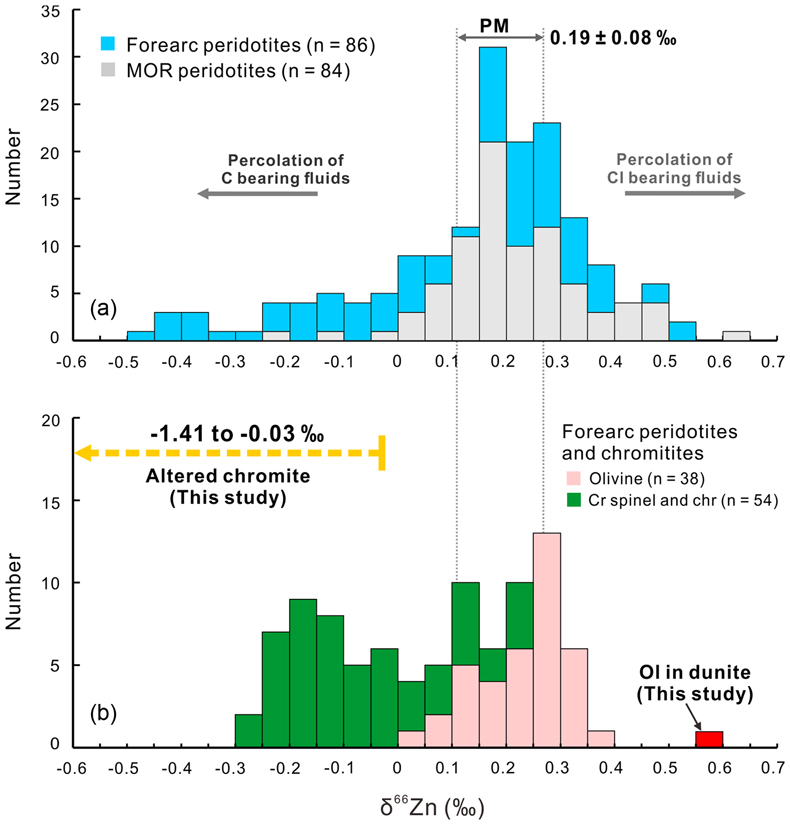
Figure 1 (a) A summary of Zn isotope data of oceanic peridotites/serpentinites (see Supplementary Information for data sources). (b) Zn isotopes of chromites from forearc ophiolitic peridotites and chromitites presented in this and previous studies. The grey dashed lines mark the range of primitive mantle (PM; Fang et al., 2022
Fang, S.-B., Huang, J., Zhang, X.-C., Ionov, D.A., Zhao, Z.-F., Huang, F. (2022) Zinc isotope fractionation in mantle rocks and minerals, and a revised δ66Zn value for the Bulk Silicate Earth. Geochimica et Cosmochimica Acta 338, 79–92. https://doi.org/10.1016/j.gca.2022.10.017
).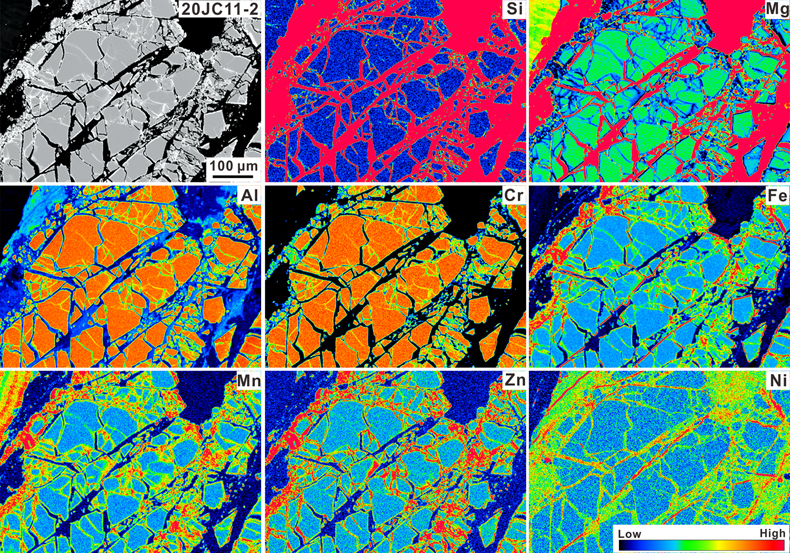
Figure 2 Elemental distribution maps of chromite from one heavily fragmented and altered sample (20JC11-2) that displays significantly light Zn isotopes.
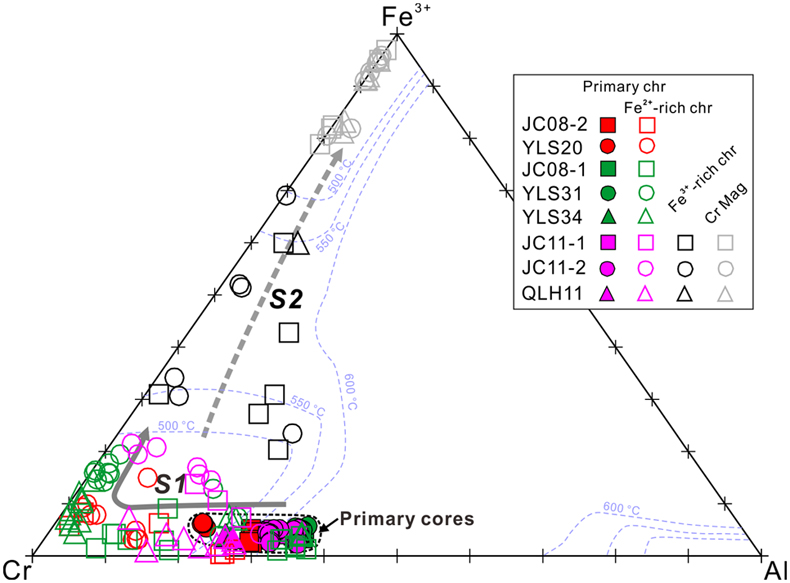
Figure 3 Ternary Cr-Fe3+-Al plot showing compositional variations of primary and altered chromites. S1 and S2 display different stages of chromite alteration. The isothermal lines (defined by olivine Fo = 90) demonstrate the phase relations within the spinel prism [(Fe,Mg)(Al,Cr,Fe3+)2O4] over the temperature range of 500–600 °C (cf. Sack and Ghiorso, 1991
Sack, R.O., Ghiorso, M.S. (1991) Chromian spinels as petrogenetic indicators: Thermodynamics and petrological applications. American Mineralogist 76, 827–847. http://www.minsocam.org/ammin/AM76/AM76_827.pdf
).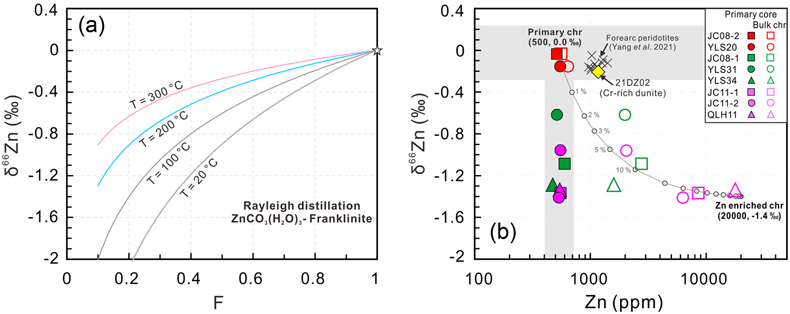
Figure 4 (a) Rayleigh distillation modelling results for δ66Zn evolution of secondary Zn, Fe enriched chromites (e.g., franklinite) precipitated from a carbonate bearing fluid at different temperatures (see SI). δ66Zninitial was set to +0.00 ‰, similar to that documented in chromite from Group 1 samples. (b) Plot of δ66Zn versus bulk Zn of chromites (hollow symbol) in the samples. Dashed line denotes mixing result between a primary chromite end member and a secondary Zn, Fe enriched chromite end member (see SI). Grey areas mark Zn range of primary chromites in studied samples and δ66Zn range of primary chromites reported from forearc ophiolitic peridotites and chromitites (−0.27 to +0.23 ‰; Yang et al., 2021
Yang, C., Liu, S.-A., Zhang, L., Wang, Z.-Z., Liu, P.-P., Li, S.-G. (2021) Zinc isotope fractionation between Cr-spinel and olivine and its implications for chromite crystallization during magma differentiation. Geochimica et Cosmochimica Acta 313, 277–294. https://doi.org/10.1016/j.gca.2021.08.005
; Lian et al., 2024Lian, D., Liu, F., Cai, P., Wu, W., Li, J., Majka, J., Xu, Z., Yang, J. (2024) Osmium and zinc isotope constraints on the origin of chromitites from the Yarlung-Zangbo ophiolites, Tibet, China. Mineralium Deposita 59, 1089–1107. https://doi.org/10.1007/s00126-024-01252-9
; Su et al., 2026Su, B.-X., Xiao, Y., Wang, J., Pan, Q.-Q., Zhao, S.-Q. (2026) Reversed inter-mineral Fe-Zn isotope fractionation in ophiolitic peridotites: Evidence for widespread hydration of oceanic lithospheric mantle. American Journal of Science 326, 7. https://doi.org/10.2475/001c.160209
).