


Xenon isotopes in the Fani Maoré lavas: Implications for upper mantle heterogeneity
Affiliations | Corresponding Author | Cite as | Funding information
Published by the European Association of Geochemistry
under Creative Commons License CC BY-NC-ND 4.0
Keywords: Comoros, xenon, mantle heterogeneity, recycled volatiles


- Share this article


-
Article views:11Cumulative count of HTML views and PDF downloads.
- Download Citation
- Rights & Permissions

top
Abstract
Figures
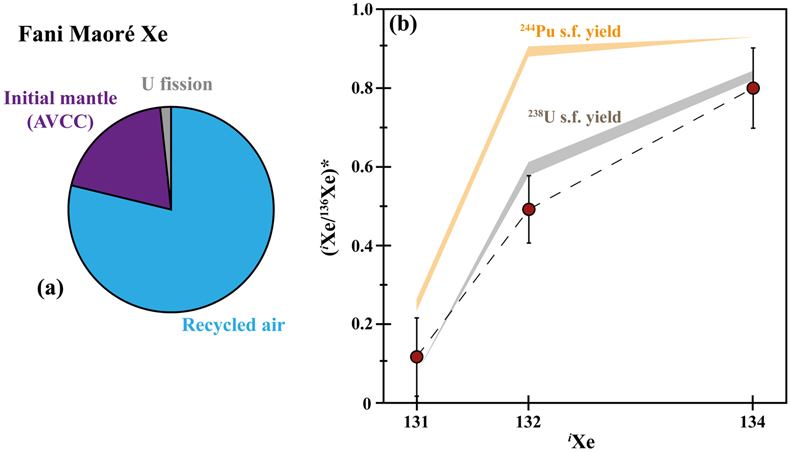
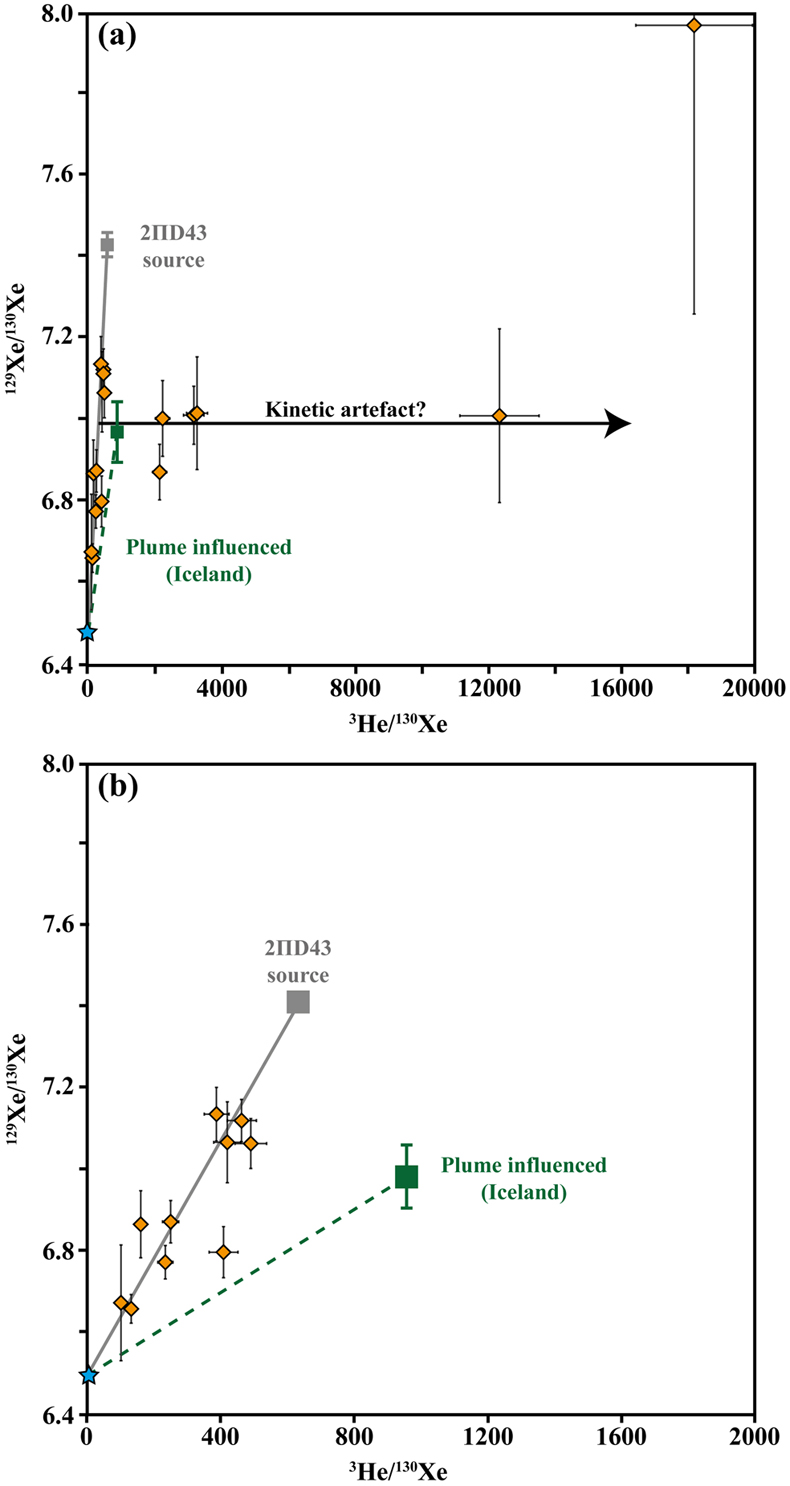
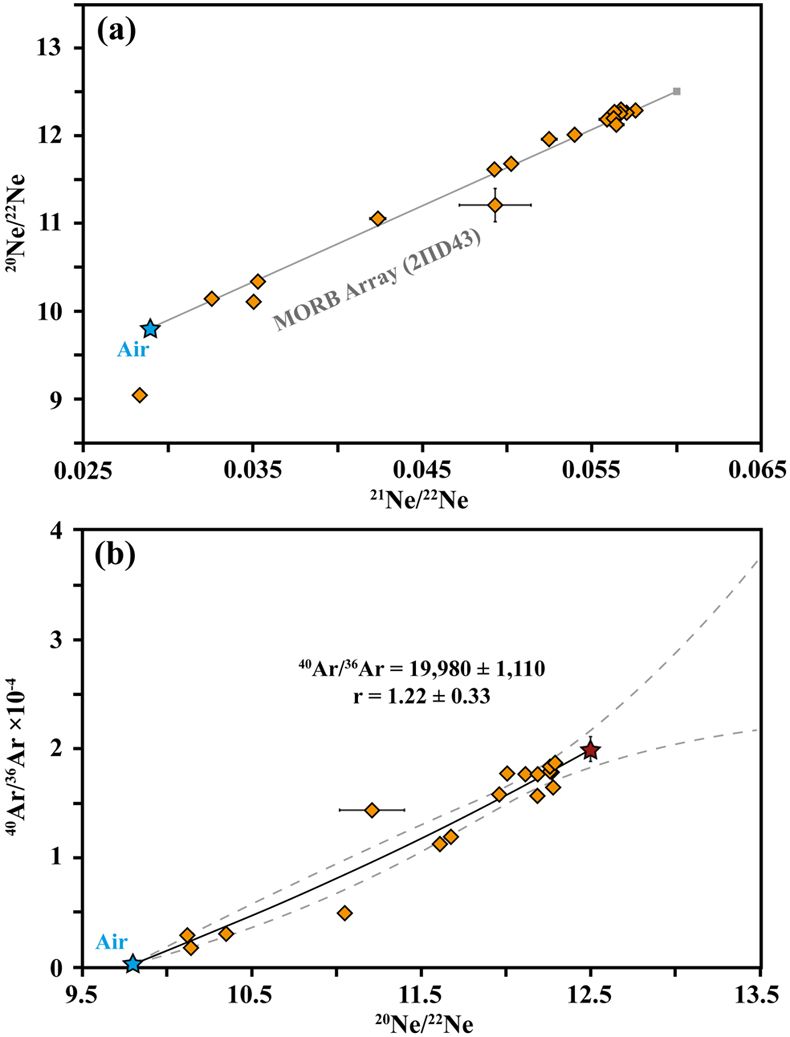
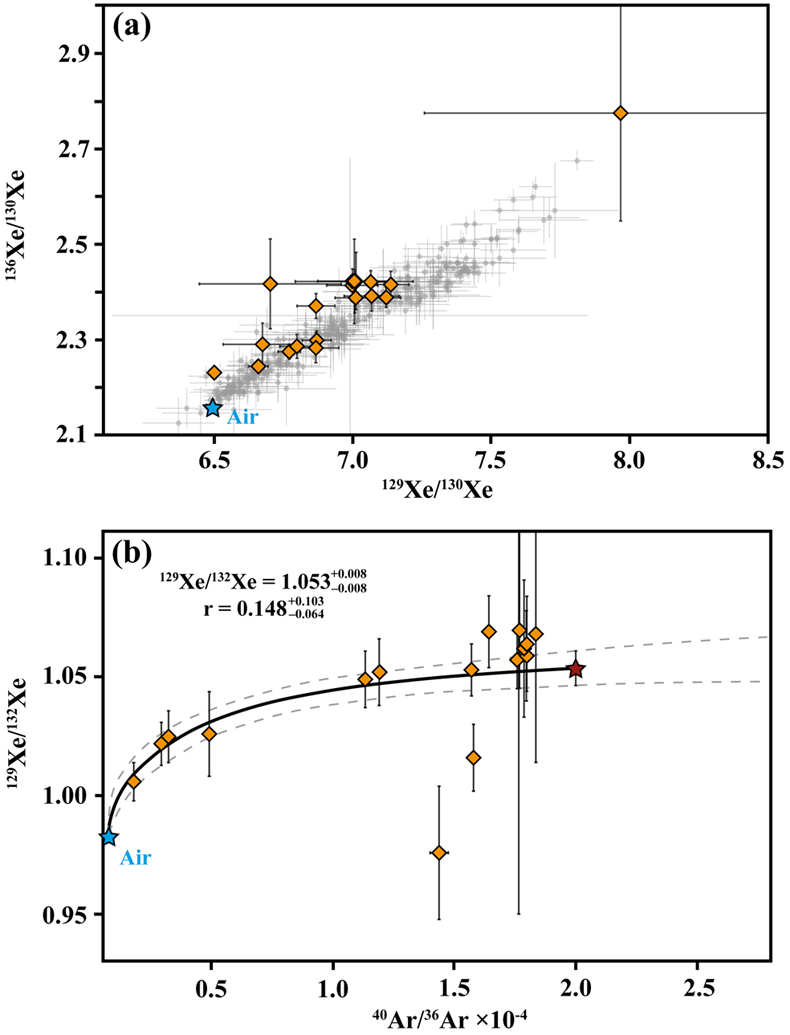
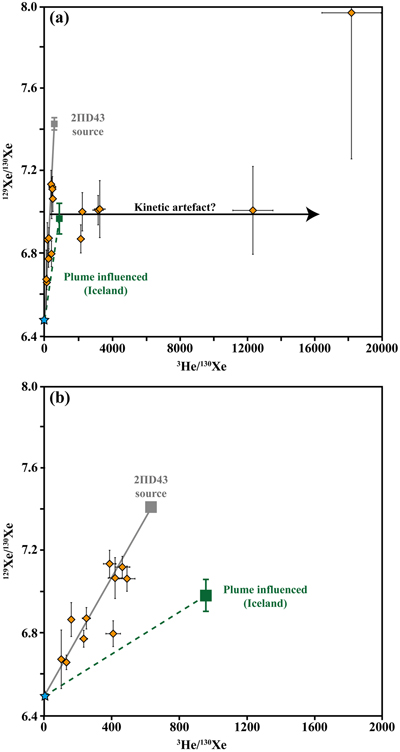 Figure 1 (a) 129Xe/130Xe against 3He/130Xe, with a zoomed in view in (b). Most of the crushing steps plot along the 2ΠD43 array (Parai and Mukhopadhyay, 2021), whereas a subset deviates toward high 3He/130Xe values, indicative of elemental fractionation. The plume influenced array shown is that of Iceland (Mukhopadhyay, 2012). | 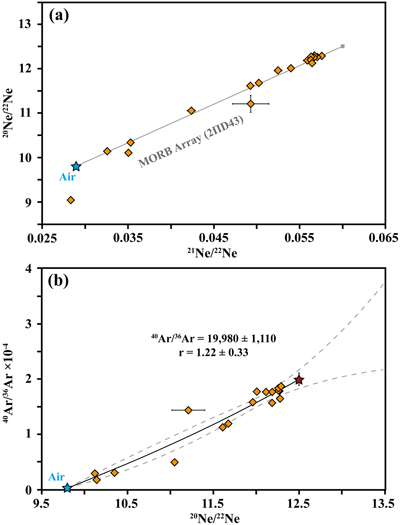 Figure 2 Air-mantle mixing systematics from step crushing of Fani Maoré lavas for Ne and Ar isotopes. (a) 20Ne/22Ne vs. 21Ne/22Ne; crushing steps extend from air and align on the MORB array defined by 2ΠD43 (Moreira et al., 1998). (b) 40Ar/36Ar vs. 20Ne/22Ne; data define a positive mixing hyperbola (r = 1.22 ± 0.33), yielding 40Ar/36Ar = 19,980 ± 1,110 (1σ) at 20Ne/22Ne = 12.5. The 2σ envelope on the hyperbola is represented as the dotted grey lines. | 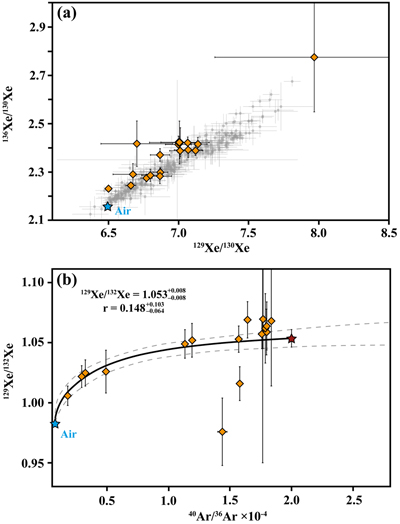 Figure 3 Air-mantle mixing systematics for Xe. (a) 136Xe/130Xe vs. 129Xe/130Xe; crushing steps extend from air and align on the global MORB array (grey symbols; Moreira et al., 1998; Kunz et al., 1998; Parai et al., 2012; Tucker et al., 2012; Parai and Mukhopadhyay, 2015, 2021; Péron and Moreira, 2018). (b) 129Xe/132Xe vs. 40Ar/36Ar; data define a positive mixing hyperbola (r = 0.148+0.103−0.064, 1σ). The resulting extrapolated 129Xe/132Xe ratio is 1.053 ± 0.008. The 1σ envelope on the hyperbola is represented as the dotted grey lines. | 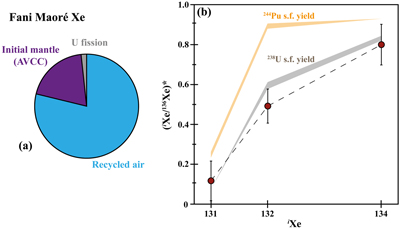 Figure 4 Fissiogenic Xe excesses deconvolution. (a) Pie chart showing the median relative contribution of the four end members (AVCC, air, U fission, Pu fission) to the present day 132Xe in the Fani Maoré lavas. The median contribution from Pu fission is 0 %. (b) Fission spectra of the Fani Maoré lavas compared with theoretical fission spectra from pure 238U and 244Pu fission (Ozima and Podosek, 2002), illustrating the predominance of 238U derived fissiogenic Xe. |
| Figure 1 | Figure 2 | Figure 3 | Figure 4 |
top
Introduction
Noble gases are atmophile elements characterised by their chemical inertness, which, combined with their ultra-trace concentrations in the mantle, makes them particularly sensitive tracers of mantle evolution and mass transfer between planetary reservoirs. Their isotopic compositions are strongly influenced by nucleogenic and radiogenic production, providing a sensitive record of mantle outgassing and evolution through time. Some xenon (Xe) isotopes record the decay of short lived 129I (half-life = 17 Myr; 129Xe) and 244Pu (half-life = 80 Myr; 131-132-134-136Xe), providing insights into the early history of terrestrial planets.
Noble gas isotopes distinguish end member volatile signatures associated with mid-ocean ridge basalt (MORBs) and oceanic island basalts (OIBs), the latter bearing lower radiogenic to primordial Ne, Ar and Xe ratios consistent with a lesser degree of outgassing than the MORB source (e.g., Parai, 2025
Parai, R. (2025) Noble gases in mantle sources from accretion to the present-day. In: Anbar, A., Weis, D. (Eds.) Treatise on Geochemistry. Third Edition, Volume 1, Elsevier, Amsterdam, 513–564. https://doi.org/10.1016/B978-0-323-99762-1.00111-X
and references therein). Recent investigations, however, highlight that significant isotopic heterogeneity may exist among upper-mantle derived samples on a local scale (e.g., Zhang et al., 2026Zhang, X.J., Parai, R., Barry, P.H., Füri, E. (2026) Tracing deep Earth volatile heterogeneities with heavy noble gases in Réunion plume-influenced Central Indian Ridge basalts. Earth and Planetary Science Letters 686, 120038. https://doi.org/10.1016/j.epsl.2026.120038
), highlighting the limits of a simple MORB vs. plume mantle reservoir view. Resolving Xe contributions is more challenging than for Ne or Ar because mantle Xe is dominated by recycled atmospheric Xe owing to the high Xe/light noble gas ratios of subducted materials relative to the mantle (Parai, 2025Parai, R. (2025) Noble gases in mantle sources from accretion to the present-day. In: Anbar, A., Weis, D. (Eds.) Treatise on Geochemistry. Third Edition, Volume 1, Elsevier, Amsterdam, 513–564. https://doi.org/10.1016/B978-0-323-99762-1.00111-X
). This, combined with pervasive secondary atmospheric contamination, has historically hampered precise Xe measurements, motivating specific analytical approaches (Péron and Moreira, 2018Péron, S., Moreira, M. (2018) Onset of volatile recycling into the mantle determined by xenon anomalies. Geochemical Perspectives Letters 9, 21–25. https://doi.org/10.7185/geochemlet.1833
; Parai, 2023Parai, R. (2023) Primordial noble gas isotopes from immoderate crushing of an Icelandic basalt glass. Geochemical Perspectives Letters 27, 32–37. https://doi.org/10.7185/geochemlet.2331
). Two main strategies exist: (i) measuring isotopic excesses relative to air that are, most of the time small, with high precision using large quantities of gas from natural springs (Bekaert et al., 2024Bekaert, D.V., Caracausi, A., Marty, B., Byrne, D.J., Broadley, M.W., Caro, G., Barry, P.H., Seltzer, A.M. (2024) The low primordial heavy noble gas and 244Pu-derived Xe contents of Earth’s convecting mantle. Earth and Planetary Science Letters 642, 118886. https://doi.org/10.1016/j.epsl.2024.118886
), and (ii) measuring the largest possible excesses with lower precision, usually from pillow lavas (e.g., Moreira et al., 1998Moreira, M., Kunz, J., Allègre, C. (1998) Rare Gas Systematics in Popping Rock: Isotopic and Elemental Compositions in the Upper Mantle. Science 279, 1178–1181. https://doi.org/10.1126/science.279.5354.1178
; Mukhopadhyay, 2012Mukhopadhyay, S. (2012) Early differentiation and volatile accretion recorded in deep-mantle neon and xenon. Nature 486, 101–104. https://doi.org/10.1038/nature11141
). The latter is often limited by pre-quenching degassing, which fractionates elemental ratios (Lux, 1987Lux, G. (1987) The behavior of noble gases in silicate liquids: Solution, diffusion, bubbles and surface effects, with applications to natural samples. Geochimica et Cosmochimica Acta 51, 1549–1560. https://doi.org/10.1016/0016-7037(87)90336-X
), and leaves low gas concentrations. In rare cases, however, gas-rich pillow rims, or “popping rocks,” retain high concentrations of unfractionated noble gases, allowing precise isotopic analyses representative of the mantle. The Fani Maoré lavas, erupted 50 km offshore Mayotte in the Mozambique Channel between 2018 and 2021 (Feuillet et al., 2021Feuillet, N., Jorry, S., Crawford, W.C., Deplus, C., Thinon, I., Jacques, E., Saurel, J.M., Lemoine, A., Paquet, F., Satriano, C., Aiken, C., Foix, O., Kowalski, P., Laurent, A., Rinnert, E., Cathalot, C., Donval, J.-P., Guyader, V., Gaillot, A., Scalabrin, C., Moreira, M., Peltier, A., Beauducel, F., Grandin, R., Ballu, V., Daniel, R., Pelleau, P., Gomez, J., Besançon, S., Geli, L., Bernard, P., Bachelery, P., Fouquet, Y., Bertil, D., Lemarchand, A., Van Der Woerd, J. (2021) Birth of a large volcanic edifice offshore Mayotte via lithosphere-scale dyke intrusion. Nature Geoscience 14, 787–795. https://doi.org/10.1038/s41561-021-00809-x
), represent one such rare case.top
Methods and Sample Information
We performed a total of 19 crushing steps on three glassy rims from the Fani Maoré lavas for their He-Ne-Ar and Xe isotopic compositions; full details of the analytical and data reduction procedures are provided in the Supplementary Information. The fragments we used are part of the “DR08” dredge from the MAYOBS2 cruise (Rinnert et al., 2019
Rinnert, E., Lebas, E., Komorowski, J.-C., Paquet, F., Jorry, S., Feuillet, N., Thinon, I., Fouquet, Y. (2019) MAYOBS. https://doi.org/10.18142/291
), previously investigated for He-Ne-Ar isotopes (Sauvalle et al., 2026Sauvalle, R., Moreira, M., Scaillet, B., Feuillet, N., Gasser, C., Jorry, S.J. (2026) He–Ne–Ar isotopic constraints on the mantle source of the Fani Maor´e paroxysm: implications for plume involvement beneath the Comoros. Earth and Planetary Science Letters 690, 120174. https://doi.org/10.1016/j.epsl.2026.120174
). Details about the samples can be found in the Supplementary Information and the entire data set is presented in Tables S-1, S-2 and S-3.top
Results
Elemental ratios. Measured noble gas production ratios (4He/40Ar* and 4He/21Ne*) agree with theoretical mantle production ratios (Graham, 2002
Graham, D.W. (2002) Noble Gas Isotope Geochemistry of Mid-Ocean Ridge and Ocean Island Basalts: Characterization of Mantle Source Reservoirs. Reviews in Mineralogy and Geochemistry 47, 247–317. https://doi.org/10.2138/rmg.2002.47.8
), indicating negligible elemental fractionation during degassing. In contrast, some crushing steps yield extremely low Xe abundances, resulting in anomalously high 3He/130Xe ratios (Fig. 1). This behaviour is not systematic: most steps follow the array defined by the N. Atlantic popping-rock 2ΠD43 in 129Xe/130Xe versus 3He/130Xe space (Fig. 1). No corresponding fractionation is observed in other elemental ratios (e.g., 36Ar/22Ne or 3He/22Ne; Table S-3), suggesting a Xe specific effect. Air standards are unaffected, confirming that this feature is sample specific (Fig. S-4). Consequently, individual Xe measurements display variable and sometimes large analytical uncertainties due to low concentrations.Figure 1 (a) 129Xe/130Xe against 3He/130Xe, with a zoomed in view in (b). Most of the crushing steps plot along the 2ΠD43 array (Parai and Mukhopadhyay, 2021
Parai, R., Mukhopadhyay, S. (2021) Heavy noble gas signatures of the North Atlantic Popping Rock 2ΠD43: Implications for mantle noble gas heterogeneity. Geochimica et Cosmochimica Acta 294, 89–105. https://doi.org/10.1016/j.gca.2020.11.011
), whereas a subset deviates toward high 3He/130Xe values, indicative of elemental fractionation. The plume influenced array shown is that of Iceland (Mukhopadhyay, 2012Mukhopadhyay, S. (2012) Early differentiation and volatile accretion recorded in deep-mantle neon and xenon. Nature 486, 101–104. https://doi.org/10.1038/nature11141
).He-Ne-Ar isotopes. The He-Ne-Ar results obtained in this study are in excellent agreement with previously reported data (Sauvalle et al., 2026
Sauvalle, R., Moreira, M., Scaillet, B., Feuillet, N., Gasser, C., Jorry, S.J. (2026) He–Ne–Ar isotopic constraints on the mantle source of the Fani Maor´e paroxysm: implications for plume involvement beneath the Comoros. Earth and Planetary Science Letters 690, 120174. https://doi.org/10.1016/j.epsl.2026.120174
). The analysed fragments are gas-rich, containing >10−5 cc STP/g of 4He. Helium measurements yield an average 3He/4He of 6.98 ± 0.05 Ra (1σ; Ra = 1.384 × 10⁻⁶, the atmospheric ratio) across the crushing steps. This value falls at the lower end of the canonical MORB range (8 ± 1 Ra; Moreira, 2013Moreira, M. (2013) Noble Gas Constraints on the Origin and Evolution of Earth’s Volatiles. Geochemical Perspectives 2, 229–403. https://doi.org/10.7185/geochempersp.2.2
).Ne and Ar isotopic compositions define mixing arrays between air and mantle derived components (Fig. 2). Most of the crushing steps (11 out of 19) define a coherent mantle cluster characterised by consistently high 20Ne/22Ne and 40Ar/36Ar ratios (Fig. 2). The 20Ne/22Ne isotopic ratio reaches mantle-like values, with 20Ne/22Ne up to ∼12.3 and the 21Ne/22Ne ratio reaches values up to 0.057, overlapping the MORB array (Fig. 2). One crushing step yields a 20Ne/22Ne ratio significantly below air (9.06 ± 0.02; 21Ne/22Ne = 0.0284 ± 0.0001 vs. 9.80 and 0.0290 for air, respectively), the origin of which is discussed later. The 40Ar/36Ar isotopic ratio reaches values up to ∼17,000, well above the atmospheric ratio (295.5; Fig. 2). Extrapolation toward the mantle end member (assuming 20Ne/22Ne = 12.5 for DMM; Moreira et al., 1998
Moreira, M., Kunz, J., Allègre, C. (1998) Rare Gas Systematics in Popping Rock: Isotopic and Elemental Compositions in the Upper Mantle. Science 279, 1178–1181. https://doi.org/10.1126/science.279.5354.1178
) yields a 21Ne/22Neextrap of 0.0593 ± 0.0009 (1σ), a value close to the depleted upper mantle (0.06; Moreira et al., 1998Moreira, M., Kunz, J., Allègre, C. (1998) Rare Gas Systematics in Popping Rock: Isotopic and Elemental Compositions in the Upper Mantle. Science 279, 1178–1181. https://doi.org/10.1126/science.279.5354.1178
). The extrapolated 40Ar/36Ar (Fig. 2) to a 20Ne/22Ne of 12.5 is 19,980 ± 1,110 (1σ) with a curvature parameter of 1.22 ± 0.33 (1σ). This is lower than expected for the DMM (∼27,000; Moreira et al., 1998Moreira, M., Kunz, J., Allègre, C. (1998) Rare Gas Systematics in Popping Rock: Isotopic and Elemental Compositions in the Upper Mantle. Science 279, 1178–1181. https://doi.org/10.1126/science.279.5354.1178
). More details on the extrapolation procedure are provided in the Supplementary Information.Figure 2 Air-mantle mixing systematics from step crushing of Fani Maoré lavas for Ne and Ar isotopes. (a) 20Ne/22Ne vs. 21Ne/22Ne; crushing steps extend from air and align on the MORB array defined by 2ΠD43 (Moreira et al., 1998
Moreira, M., Kunz, J., Allègre, C. (1998) Rare Gas Systematics in Popping Rock: Isotopic and Elemental Compositions in the Upper Mantle. Science 279, 1178–1181. https://doi.org/10.1126/science.279.5354.1178
). (b) 40Ar/36Ar vs. 20Ne/22Ne; data define a positive mixing hyperbola (r = 1.22 ± 0.33), yielding 40Ar/36Ar = 19,980 ± 1,110 (1σ) at 20Ne/22Ne = 12.5. The 2σ envelope on the hyperbola is represented as the dotted grey lines.Xenon isotopes. Several crushing steps show a clear excess in terms of Xe isotopic composition compared to air. This is particularly evident for the heavier, fissiogenic Xe isotopes (131-132-134-136Xe), which are much more abundant than the primordial Xe isotopes in the mantle (124-126-128-130Xe). The very low abundances of 124Xe, 126Xe, and 128Xe result in comparatively large analytical uncertainties that preclude robust interpretation; accordingly, these data are reported in Table S-3 but not further discussed.
Xe isotopic compositions define mixing arrays between air and a mantle-derived end member that largely overlap the field of MORBs (Fig. 3a). Measured 129Xe/130Xe ratios reach 7.14 ± 0.07, lower than the 2ΠD43 mantle source value of 7.41 ± 0.03 (measured from Péron and Moreira, 2018
Péron, S., Moreira, M. (2018) Onset of volatile recycling into the mantle determined by xenon anomalies. Geochemical Perspectives Letters 9, 21–25. https://doi.org/10.7185/geochemlet.1833
; extrapolated from Parai and Mukhopadhyay, 2021Parai, R., Mukhopadhyay, S. (2021) Heavy noble gas signatures of the North Atlantic Popping Rock 2ΠD43: Implications for mantle noble gas heterogeneity. Geochimica et Cosmochimica Acta 294, 89–105. https://doi.org/10.1016/j.gca.2020.11.011
). Normalisation to 132Xe, the most abundant Xe isotope, enables extrapolation toward an air-free mantle composition and subsequent deconvolution of U and Pu fission contributions while minimising the impact of analytical uncertainties (Parai and Mukhopadhyay, 2015Parai, R., Mukhopadhyay, S. (2015) The evolution of MORB and plume mantle volatile budgets: Constraints from fission Xe isotopes in Southwest Indian Ridge basalts. Geochemistry, Geophysics, Geosystems 16, 719–735. https://doi.org/10.1002/2014GC005566
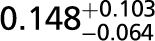
; see SI). The mantle 129Xe/132Xe ratio is determined by fitting the mixing relationship in the 129Xe/132Xe-40Ar/36Ar space (Fig. 3b). The resulting mixing hyperbola displays a curvature of r = 0.148+0.103−0.064, such that variations of 40Ar/36Ar within its uncertainty produce only negligible changes in the extrapolated mantle 129Xe/132Xe ratio (Fig. 3a). Accordingly, the 129Xe/132Xe ratio for Fani Maoré mantle is 1.053 ± 0.008 (1σ; Fig. 3b) by extrapolation to the previously constrained mantle 40Ar/36Ar value (19,980; Fig. 2). This best fit mantle value is then used as a fixed reference to determine the remaining 130,131,134,136Xe/132Xe ratios by York regression (Fig. S-6).Figure 3 Air-mantle mixing systematics for Xe. (a) 136Xe/130Xe vs. 129Xe/130Xe; crushing steps extend from air and align on the global MORB array (grey symbols; Moreira et al., 1998
Moreira, M., Kunz, J., Allègre, C. (1998) Rare Gas Systematics in Popping Rock: Isotopic and Elemental Compositions in the Upper Mantle. Science 279, 1178–1181. https://doi.org/10.1126/science.279.5354.1178
; Kunz et al., 1998Kunz, J., Staudacher, T., Allègre, C.J. (1998) Plutonium-Fission Xenon Found in Earth’s Mantle. Science 280, 877–880. https://doi.org/10.1126/science.280.5365.877
; Parai et al., 2012Parai, R., Mukhopadhyay, S., Standish, J.J. (2012) Heterogeneous upper mantle Ne, Ar and Xe isotopic compositions and a possible Dupal noble gas signature recorded in basalts from the Southwest Indian Ridge. Earth and Planetary Science Letters 359–360, 227–239. https://doi.org/10.1016/j.epsl.2012.10.017
; Tucker et al., 2012Tucker, J.M., Mukhopadhyay, S., Schilling, J.-G. (2012) The heavy noble gas composition of the depleted MORB mantle (DMM) and its implications for the preservation of heterogeneities in the mantle. Earth and Planetary Science Letters 355–356, 244–254. https://doi.org/10.1016/j.epsl.2012.08.025
; Parai and Mukhopadhyay, 2015Parai, R., Mukhopadhyay, S. (2015) The evolution of MORB and plume mantle volatile budgets: Constraints from fission Xe isotopes in Southwest Indian Ridge basalts. Geochemistry, Geophysics, Geosystems 16, 719–735. https://doi.org/10.1002/2014GC005566
, 2021Parai, R., Mukhopadhyay, S. (2021) Heavy noble gas signatures of the North Atlantic Popping Rock 2ΠD43: Implications for mantle noble gas heterogeneity. Geochimica et Cosmochimica Acta 294, 89–105. https://doi.org/10.1016/j.gca.2020.11.011
; Péron and Moreira, 2018Péron, S., Moreira, M. (2018) Onset of volatile recycling into the mantle determined by xenon anomalies. Geochemical Perspectives Letters 9, 21–25. https://doi.org/10.7185/geochemlet.1833
). (b) 129Xe/132Xe vs. 40Ar/36Ar; data define a positive mixing hyperbola (r = 0.148+0.103−0.064, 1σ). The resulting extrapolated 129Xe/132Xe ratio is 1.053 ± 0.008. The 1σ envelope on the hyperbola is represented as the dotted grey lines.The present-day mantle 131-132-134-136Xe inventory can be modelled as a mixture of four components (Caffee et al., 1999
Caffee, M.W., Hudson, G.B., Velsko, C., Huss, G.R., Alexander, Jr., E.C., Chivas, A.R. (1999) Primordial Noble Gases from Earth’s Mantle: Identification of a Primitive Volatile Component. Science 285, 2115–2118. https://doi.org/10.1126/science.285.5436.2115
): (1) the initial mantle (assumed as average carbonaceous chondrite-like, AVCC; Péron and Moreira, 2018Péron, S., Moreira, M. (2018) Onset of volatile recycling into the mantle determined by xenon anomalies. Geochemical Perspectives Letters 9, 21–25. https://doi.org/10.7185/geochemlet.1833
), (2) recycled atmospheric Xe, (3) Pu derived Xe, and (4) U derived Xe. The system is over determined, and end member fractions are obtained by least squares inversion under the constraint Xinit + Xatm + XU + XPu = 1. Mixing proportions are reported as the median of 106 Monte Carlo realisations, with 16th-84th percentile uncertainties. Accordingly, the fissiogenic Xe signature of the Fani Maoré mantle is best explained by 19.4+14.0−7.8 % AVCC, 78.4+8.0−15.1 % recycled air, 0.0+3.3−0.0 % Pu derived fission and 1.7+0.4−1.7 % U derived fission. The Pu derived contribution is statistically indistinguishable from zero, indicating that 244Pu fission is not required to explain the Xe isotopic composition. The U fission dominance is independently supported by comparison with expected fission spectra (Fig. 4b; Bekaert et al., 2019Bekaert, D.V., Broadley, M.W., Caracausi, A., Marty, B. (2019) Novel insights into the degassing history of Earth’s mantle from high precision noble gas analysis of magmatic gas. Earth and Planetary Science Letters 525, 115766. https://doi.org/10.1016/j.epsl.2019.115766
).Figure 4 Fissiogenic Xe excesses deconvolution. (a) Pie chart showing the median relative contribution of the four end members (AVCC, air, U fission, Pu fission) to the present day 132Xe in the Fani Maoré lavas. The median contribution from Pu fission is 0 %. (b) Fission spectra of the Fani Maoré lavas compared with theoretical fission spectra from pure 238U and 244Pu fission (Ozima and Podosek, 2002
Ozima, M., Podosek, F.A. (2002) Noble Gas Geochemistry. Second Edition, Cambridge University Press, Cambridge. https://doi.org/10.1017/CBO9780511545986
), illustrating the predominance of 238U derived fissiogenic Xe.top
Discussion and Conclusions
Sample scale heterogeneity. One crushing step yielded a 20Ne/22Ne ratio of 9.06 ± 0.02 (Table S-1), significantly lower than air. Similarly, ratios have been reported in glassy rims and attributed to fractionated air (Harrison et al., 2003
Harrison, D., Burnard, P.G., Trieloff, M., Turner, G. (2003) Resolving atmospheric contaminants in mantle noble gas analyses. Geochemistry, Geophysics, Geosystems 4, 1023. https://doi.org/10.1029/2002GC000325
). Although ultra-high vacuum pumping prior to analysis evacuates cracks and open vesicles, extremely narrow conduits can drastically reduce permeability, effectively isolating portions of trapped gas. Under such conditions, kinetic fractionation may occur during pumping, preferentially removing lighter species and isotopes. The anomalous step also displays elevated 36Ar/22Ne (24.1) and 40Ar/36Ar (469) but low 4He/40Ar* (1.1; Tables S-3 and S-4), consistent with elemental and isotopic fractionation of atmospheric gases. These observations highlight the complexity of secondary atmospheric contamination, which may involve air, fractionated air, and seawater derived components (Harrison et al., 2003Harrison, D., Burnard, P.G., Trieloff, M., Turner, G. (2003) Resolving atmospheric contaminants in mantle noble gas analyses. Geochemistry, Geophysics, Geosystems 4, 1023. https://doi.org/10.1029/2002GC000325
). This anomalous analysis is probably unrelated to mantle source processes and is therefore excluded from extrapolation fits (Figs. 2, 3).Regarding Xe specifically, some analyses exhibit extremely low abundances (down to 10−15 cc/g; Table S-3) without systematic correlation to the analysed fragment or to other noble gas elemental or isotopic ratios. This Xe specific effect cannot be attributed to degassing since 4He/40Ar and 4He/21Ne* ratios closely match theoretical mantle production ratios (Graham, 2002
Graham, D.W. (2002) Noble Gas Isotope Geochemistry of Mid-Ocean Ridge and Ocean Island Basalts: Characterization of Mantle Source Reservoirs. Reviews in Mineralogy and Geochemistry 47, 247–317. https://doi.org/10.2138/rmg.2002.47.8
), indicating negligible degassing related fractionation. A possible explanation is that rapid vesicle nucleation during fast magma ascent allowed insufficient time for dissolved Xe to equilibrate with newly formed bubbles. Indeed, the Fani Maoré lavas ascended rapidly, perhaps related to their low viscosity (Verdurme et al., 2025Verdurme, P., Chevrel, O., Médard, E., Gurioli, L., Berthod, C., Brückel, K., Komorowski, J.-C., Bachèlery, P. (2025) Lava Rheological Evolution and Flow Emplacement During the Deep Submarine Fani Maoré Eruption (Mayotte). Journal of Geophysical Research: Solid Earth 130, e2024JB030363. https://doi.org/10.1029/2024JB030363
). Noble gas diffusivity in silicate melts decreases with increasing ionic radius (Lux, 1987Lux, G. (1987) The behavior of noble gases in silicate liquids: Solution, diffusion, bubbles and surface effects, with applications to natural samples. Geochimica et Cosmochimica Acta 51, 1549–1560. https://doi.org/10.1016/0016-7037(87)90336-X
); consequently, Xe diffuses more slowly than He, Ne, or Ar. Selective Xe depletion may therefore occur in vesicles that did not fully equilibrate with the melt. These Xe-poor steps occur almost exclusively among analyses isotopically distinct from air, consistent with a sample-intrinsic origin. Importantly, crushing steps with anomalously low Xe abundances yield Xe isotopic ratios indistinguishable, within analytical uncertainty, from those with higher concentrations. This behaviour supports a kinetic, vesicle scale origin rather than mantle source heterogeneity.Both observations highlight that significant variability can arise from vesicle scale kinetic and contamination processes for noble gases, independent of mantle source composition.
The Fani Maoré Mantle: a He-Ne-Ar-Xe Perspective. The Comoros archipelago has traditionally been interpreted as a hot spot track (Class et al., 1998
Class, C., Goldstein, S.L., Altherr, R., Bachèlery, P. (1998) The Process of Plume–Lithosphere Interactions in the Ocean Basins—the Case of Grande Comore. Journal of Petrology 39, 881–903. https://doi.org/10.1093/petroj/39.5.881
), although inconsistencies between volcanic alignment and Somalian plate motion have challenged this view (Morgan and Morgan, 2007Morgan, W.J., Morgan, J.P. (2007) Plate velocities in the hotspot reference frame. In: Foulger, G.R., Jurdy, D.M. (Eds.) Plates, Plumes, and Planetary Processes. Geological Society of America Special Paper 430, 65–78. https://doi.org/10.1130/2007.2430(04)
). Alternative models invoke plume material ponding beneath the lithosphere (Dongmo Wamba et al., 2023Dongmo Wamba, M., Montagner, J.-P., Romanowicz, B. (2023) Imaging deep-mantle plumbing beneath La Réunion and Comores hot spots: Vertical plume conduits and horizontal ponding zones. Science Advances 9, eade3723. https://doi.org/10.1126/sciadv.ade3723
), potentially explaining the lithophile isotopic signatures of Comorian lavas through the involvement of old recycled oceanic crust (Chauvel et al., 2024Chauvel, C., Inglis, E.C., Gutierrez, P., Luu, T.-H., Burckel, P., Besson, P. (2024) Fani Maoré, a new “young HIMU” volcano with extreme geochemistry. Earth and Planetary Science Letters 626, 118529. https://doi.org/10.1016/j.epsl.2023.118529
).Noble gases provide constraints on the origin of magmatism in the Comoros. Light noble gases from Fani Maoré are consistent with a DMM-like source (Sauvalle et al., 2026
Sauvalle, R., Moreira, M., Scaillet, B., Feuillet, N., Gasser, C., Jorry, S.J. (2026) He–Ne–Ar isotopic constraints on the mantle source of the Fani Maor´e paroxysm: implications for plume involvement beneath the Comoros. Earth and Planetary Science Letters 690, 120174. https://doi.org/10.1016/j.epsl.2026.120174
). High extrapolated radiogenic to primordial ratios for Ne and Ar (Fig. 2) are characteristic of the MORB source (Moreira et al., 1998Moreira, M., Kunz, J., Allègre, C. (1998) Rare Gas Systematics in Popping Rock: Isotopic and Elemental Compositions in the Upper Mantle. Science 279, 1178–1181. https://doi.org/10.1126/science.279.5354.1178
), contrasting with the lower ratios typical of less degassed reservoirs, including several HIMU localities (e.g., Zhang et al., 2024Zhang, X.J., Parai, R., Lassiter, J.C. (2024) Primordial and recycled noble gases in the Cook-Austral HIMU mantle: Insights into the onset of volatile subduction. Earth and Planetary Science Letters 629, 118591. https://doi.org/10.1016/j.epsl.2024.118591
). One exception is the HIMU influenced equatorial Atlantic MORBs of Tucker et al. (2012)Tucker, J.M., Mukhopadhyay, S., Schilling, J.-G. (2012) The heavy noble gas composition of the depleted MORB mantle (DMM) and its implications for the preservation of heterogeneities in the mantle. Earth and Planetary Science Letters 355–356, 244–254. https://doi.org/10.1016/j.epsl.2012.08.025
, which show similar Ne-Ar signatures.Xe isotopes provide a more ambiguous signal. The relatively low extrapolated mantle 129Xe/130Xe value (7.00 ± 0.07; 129Xe/132Xe = 1.053 ± 0.008) could reflect either a less degassed mantle contribution or enhanced atmospheric Xe recycling into the mantle source. Fissiogenic Xe provide a decisive constraint: plume influenced mantle sources generally preserve a substantial 244Pu derived fission component relative to the DMM. Because 244Pu has a short half-life (∼80 Myr), a significant Pu contribution implies early isolation and limited subsequent degassing (Parai, 2025
Parai, R. (2025) Noble gases in mantle sources from accretion to the present-day. In: Anbar, A., Weis, D. (Eds.) Treatise on Geochemistry. Third Edition, Volume 1, Elsevier, Amsterdam, 513–564. https://doi.org/10.1016/B978-0-323-99762-1.00111-X
). In contrast, deconvolution of the Fani Maoré Xe isotopic composition yields a median Pu derived contribution of 0 %. This result is supported by the fissiogenic Xe isotope pattern, which is consistent with a dominant 238U fission contribution (Fig. 4). This argues against involvement of a preserved, less degassed mantle reservoir, and supports derivation from a more processed mantle. Consistently, most unfractionated crushing steps (3He/130Xe < 1000) align with the 2ΠD43 array in 129Xe/130Xe versus 3He/130Xe space (Fig. 1). The low extrapolated 129Xe/130Xe (7.00 ± 0.07) is therefore best explained by enhanced recycling of atmospheric Xe into the local mantle, rather than sampling of a primitive plume reservoir. We consequently favour a shallow origin for the recent Fani Maoré paroxysm and volcanism across the Comoros archipelago, consistent with recent geophysical and geochemical constraints (e.g., Bordenca et al., 2023Bordenca, C.V., Faccini, B., Caracausi, A., Coltorti, M., Di Muro, A., Ntaflos, T., Pik, R., Rizzo, A.L., Liuzzo, M., Aiuppa, A. (2023) Geochemical evidence for a lithospheric origin of the Comoros Archipelago (Indian Ocean) as revealed by ultramafic mantle xenoliths from La Grille volcano. Lithos 462–463, 107406. https://doi.org/10.1016/j.lithos.2023.107406
; Boymond et al., 2025Boymond, P., Feuillet, N., Thinon, I., Scholtès, L., Zaragosi, S., Leroy, S., Lemoine, A. (2025) En-échelon Rifting and Origin of the Volcanism in the Comoros. Geochemistry, Geophysics, Geosystems 26, e2024GC011576. https://doi.org/10.1029/2024GC011576
). Notably, HIMU-type Atlantic MORBs of Tucker et al. (2012)Tucker, J.M., Mukhopadhyay, S., Schilling, J.-G. (2012) The heavy noble gas composition of the depleted MORB mantle (DMM) and its implications for the preservation of heterogeneities in the mantle. Earth and Planetary Science Letters 355–356, 244–254. https://doi.org/10.1016/j.epsl.2012.08.025
, despite similar Ne-Ar signatures, show a substantial Pu derived Xe contribution. The origin of this Xe specific contrast between HIMU influenced reservoirs with similar Ne-Ar and lithophile signatures, such as Fani Maoré and the Tucker et al. (2012)Tucker, J.M., Mukhopadhyay, S., Schilling, J.-G. (2012) The heavy noble gas composition of the depleted MORB mantle (DMM) and its implications for the preservation of heterogeneities in the mantle. Earth and Planetary Science Letters 355–356, 244–254. https://doi.org/10.1016/j.epsl.2012.08.025
HIMU-MORBs, remains unclear. This warrants further investigation and may point to heterogeneity within the HIMU reservoir itself.Inferences on Upper Mantle Heterogeneity from the Fani Maoré Paroxysm. As discussed above, enhanced incorporation of recycled atmospheric volatiles into a DMM-like mantle source beneath the Comoros can account for the Xe isotopic systematics of the Fani Maoré lavas. Noble gas signatures previously reported in mantle xenoliths from Grande Comore (Ne-Ar; Bordenca et al., 2023
Bordenca, C.V., Faccini, B., Caracausi, A., Coltorti, M., Di Muro, A., Ntaflos, T., Pik, R., Rizzo, A.L., Liuzzo, M., Aiuppa, A. (2023) Geochemical evidence for a lithospheric origin of the Comoros Archipelago (Indian Ocean) as revealed by ultramafic mantle xenoliths from La Grille volcano. Lithos 462–463, 107406. https://doi.org/10.1016/j.lithos.2023.107406
) further suggest that these characteristics reflect regional mantle properties rather than processes restricted to the recent Fani Maoré paroxysm.Ne and Ar systematics independently support this interpretation: low 40Ar/36Arextrap and 20Ne/22Ne clustering at ∼12.3 (slightly below the MORB value of ∼12.5; Moreira et al., 1998
Moreira, M., Kunz, J., Allègre, C. (1998) Rare Gas Systematics in Popping Rock: Isotopic and Elemental Compositions in the Upper Mantle. Science 279, 1178–1181. https://doi.org/10.1126/science.279.5354.1178
) could indicate a minor recycled atmospheric contribution (Sauvalle et al., 2026Sauvalle, R., Moreira, M., Scaillet, B., Feuillet, N., Gasser, C., Jorry, S.J. (2026) He–Ne–Ar isotopic constraints on the mantle source of the Fani Maor´e paroxysm: implications for plume involvement beneath the Comoros. Earth and Planetary Science Letters 690, 120174. https://doi.org/10.1016/j.epsl.2026.120174
; this study). A median Pu contribution of 0 % is lower than the upper mantle estimate of 31 ± 11 % (relative to total fission; Parai et al., 2019Parai, R., Mukhopadhyay, S., Tucker, J.M., Pető, M.K. (2019) The emerging portrait of an ancient, heterogeneous and continuously evolving mantle plume source. Lithos 346–347, 105153. https://doi.org/10.1016/j.lithos.2019.105153
), though recently questioned by recent measurements of Etna and Eifel spring gases yielding similarly negligible Pu contributions (Bekaert et al., 2024Bekaert, D.V., Caracausi, A., Marty, B., Byrne, D.J., Broadley, M.W., Caro, G., Barry, P.H., Seltzer, A.M. (2024) The low primordial heavy noble gas and 244Pu-derived Xe contents of Earth’s convecting mantle. Earth and Planetary Science Letters 642, 118886. https://doi.org/10.1016/j.epsl.2024.118886
). This may reflect extensive early mantle degassing followed by long term convective processing of the local mantle, resulting in a high time integrated XeU/XePu ratio. This absence of Pu is nevertheless puzzling given the large 129Xe excesses observed, since 129I (half-life ∼17 Myr) became extinct well before 244Pu (∼80 Myr). Alternatively, it may indicate the involvement of subduction derived fluids or ancient, U-rich recycled components, consistent with the radiogenic Pb and Os signatures reported in Comorian lavas (Chauvel et al., 2024Chauvel, C., Inglis, E.C., Gutierrez, P., Luu, T.-H., Burckel, P., Besson, P. (2024) Fani Maoré, a new “young HIMU” volcano with extreme geochemistry. Earth and Planetary Science Letters 626, 118529. https://doi.org/10.1016/j.epsl.2023.118529
).Recycled lithologies are expected to be strongly depleted in noble gases relative to ambient peridotitic mantle, as most He, Ne, Ar, and Xe are efficiently expelled from slabs during subduction (Staudacher and Allègre, 1988
Staudacher, T., Allègre, C.J. (1988) Recycling of oceanic crust and sediments: the noble gas subduction barrier. Earth and Planetary Science Letters 89, 173–183. https://doi.org/10.1016/0012-821X(88)90170-7
). Consequently, low degree melts sampling recycled components may inherit radiogenic lithophile isotopic signatures while being noble gas-poor. The Comorian lithosphere appears pervasively metasomatised by C-rich melts, as documented by metasomatic textures in ultramafic xenoliths from Grande Comore (Coltorti et al., 1999Coltorti, M., Bonadiman, C., Hinton, R.W., Siena, F., Upton, B.G.J. (1999) Carbonatite Metasomatism of the Oceanic Upper Mantle: Evidence from Clinopyroxenes and Glasses in Ultramafic Xenoliths of Grande Comore, Indian Ocean. Journal of Petrology 40, 133–165. https://doi.org/10.1093/petroj/40.1.133
). This process could have modified the lithosphere’s lithophile isotopic composition (Jiang et al., 2026Jiang, P., Perfit, M.R., Anderson, M.K., Kamenov, G., Trucco, A. (2026) Trace element proxies in seamount olivine reveal the ‘missing pyroxenite’ and refertilized peridotite mantle beneath the East Pacific Rise. Earth and Planetary Science Letters 673, 119739. https://doi.org/10.1016/j.epsl.2025.119739
), shifting it toward the HIMU-like signatures observed (Chauvel et al., 2024Chauvel, C., Inglis, E.C., Gutierrez, P., Luu, T.-H., Burckel, P., Besson, P. (2024) Fani Maoré, a new “young HIMU” volcano with extreme geochemistry. Earth and Planetary Science Letters 626, 118529. https://doi.org/10.1016/j.epsl.2023.118529
). Low degree melting of this fertilised lithosphere, triggered by local rifting and/or edge driven convection (Sauvalle et al., 2026Sauvalle, R., Moreira, M., Scaillet, B., Feuillet, N., Gasser, C., Jorry, S.J. (2026) He–Ne–Ar isotopic constraints on the mantle source of the Fani Maor´e paroxysm: implications for plume involvement beneath the Comoros. Earth and Planetary Science Letters 690, 120174. https://doi.org/10.1016/j.epsl.2026.120174
), can produce the observed basanitic compositions. Lithophile isotopes could therefore record the metasomatic overprint, while noble gases isotopes remain mostly controlled by the original lithospheric budget, owing to the noble gas-poor character of the metasomatising agent. These melts and fluids, of recycled origin, should carry a predominantly air-like noble gas signature reflecting subduction recycling efficiencies, which may account for the elevated atmospheric noble gas component proposed for the Fani Maoré mantle. Xe is uniquely sensitive to recycled atmospheric contributions because it is both extremely scarce in the mantle (Parai, 2025Parai, R. (2025) Noble gases in mantle sources from accretion to the present-day. In: Anbar, A., Weis, D. (Eds.) Treatise on Geochemistry. Third Edition, Volume 1, Elsevier, Amsterdam, 513–564. https://doi.org/10.1016/B978-0-323-99762-1.00111-X
) and highly soluble in seawater (Ozima and Podosek, 2002Ozima, M., Podosek, F.A. (2002) Noble Gas Geochemistry. Second Edition, Cambridge University Press, Cambridge. https://doi.org/10.1017/CBO9780511545986
), promoting efficient recycling of atmospheric Xe during subduction. The systematic He < Ne < Ar < Xe progression in atmospheric contributions reflects the differential recycling efficiencies of noble gases during subduction, which scale with ionic radius and seawater solubility (Wang et al., 2020Wang, K., Lu, X., Brodholt, J.P. (2020) Diffusion of noble gases in subduction zone hydrous minerals. Geochimica et Cosmochimica Acta 291, 50–61. https://doi.org/10.1016/j.gca.2020.07.015
). Xe isotopes therefore provide the most sensitive tracer of recycled atmospheric contributions, as reflected by the anomalously low extrapolated 129Xe/130Xe ratio of 7.00 ± 0.07 in the Fani Maoré mantle (Fig. 3).Our results suggest that the low 129Xe/130Xe ratios observed in the region do not require mixing with a primitive deep mantle reservoir but can instead be explained by heterogeneous recycling of atmospheric volatiles within a long term processed, upper mantle domain. More broadly, the Fani Maoré case suggests that the volatile composition of the upper mantle may not be globally homogeneous, but instead preserves persistent regional heterogeneities inherited from long term recycling of surface derived volatiles.
top
Acknowledgements
This research was funded by the European Research Council (Grant agreement No.101096688[APATE][ERC-2022-ADG]) and by LabEx VOLTAIRE (ANR-10-LABX-100-01). N. Feuillet and S.J. Jorry are graciously acknowledged for providing the samples used for this study. The authors thank P. Penhoud for technical assistance with the microtomography acquisitions. S. Péron is acknowledged for providing the code to produce the argon-neon mixing hyperbola. S. Péron, A.E. Saal and S. Guégan are also gratefully acknowledged for scientific discussions. We thank Romain Tartèse for efficient editorial handling, and Rita Parai as well as an anonymous reviewer for their constructive comments and suggestions, which helped improve the first version of the manuscript.
The MAYOBS set of campaigns (https://doi.org/10.18142/291) were conducted by several French research institutions and laboratories (IPGP/CNRS/BRGM/IFREMER/IPGS). We thank the captains and crews of the R/V Marion Dufresne (TAAF/IFREMER/LDA). Since 2019, all activities in Mayotte have been funded by several French ministries (Ministère de l’Enseignement Supérieur, de la Recherche et de l’Innovation; Ministère de la Transition Écologique; Ministère des Outremers; Ministère des Armées; Ministère de l’Intérieur) with the support of the Direction Interministérielle aux Risques Majeurs en Outremer (DIRMOM) and Mission d’Appui aux Politiques Publiques pour les Prévention des Risques Majeurs en Outremer (MAPPPROM).
Editor: Romain Tartèse
top
References
Bekaert, D.V., Broadley, M.W., Caracausi, A., Marty, B. (2019) Novel insights into the degassing history of Earth’s mantle from high precision noble gas analysis of magmatic gas. Earth and Planetary Science Letters 525, 115766. https://doi.org/10.1016/j.epsl.2019.115766
 Show in context
The U fission dominance is independently supported by comparison with expected fission spectra (Fig. 4b; Bekaert et al., 2019).
View in article
Bekaert, D.V., Caracausi, A., Marty, B., Byrne, D.J., Broadley, M.W., Caro, G., Barry, P.H., Seltzer, A.M. (2024) The low primordial heavy noble gas and 244Pu-derived Xe contents of Earth’s convecting mantle. Earth and Planetary Science Letters 642, 118886. https://doi.org/10.1016/j.epsl.2024.118886
Show in context Two main strategies exist: (i) measuring isotopic excesses relative to air that are, most of the time small, with high precision using large quantities of gas from natural springs (Bekaert et al., 2024), and (ii) measuring the largest possible excesses with lower precision, usually from pillow lavas (e.g., Moreira et al., 1998; Mukhopadhyay, 2012).
View in article
A median Pu contribution of 0 % is lower than the upper mantle estimate of 31 ± 11 % (relative to total fission; Parai et al., 2019), though recently questioned by recent measurements of Etna and Eifel spring gases yielding similarly negligible Pu contributions (Bekaert et al., 2024).
View in article
Bordenca, C.V., Faccini, B., Caracausi, A., Coltorti, M., Di Muro, A., Ntaflos, T., Pik, R., Rizzo, A.L., Liuzzo, M., Aiuppa, A. (2023) Geochemical evidence for a lithospheric origin of the Comoros Archipelago (Indian Ocean) as revealed by ultramafic mantle xenoliths from La Grille volcano. Lithos 462–463, 107406. https://doi.org/10.1016/j.lithos.2023.107406
Show in context We consequently favour a shallow origin for the recent Fani Maoré paroxysm and volcanism across the Comoros archipelago, consistent with recent geophysical and geochemical constraints (e.g., Bordenca et al., 2023; Boymond et al., 2025).
View in article
Noble gas signatures previously reported in mantle xenoliths from Grande Comore (Ne-Ar; Bordenca et al., 2023) further suggest that these characteristics reflect regional mantle properties rather than processes restricted to the recent Fani Maoré paroxysm.
View in article
Boymond, P., Feuillet, N., Thinon, I., Scholtès, L., Zaragosi, S., Leroy, S., Lemoine, A. (2025) En-échelon Rifting and Origin of the Volcanism in the Comoros. Geochemistry, Geophysics, Geosystems 26, e2024GC011576. https://doi.org/10.1029/2024GC011576
Show in context We consequently favour a shallow origin for the recent Fani Maoré paroxysm and volcanism across the Comoros archipelago, consistent with recent geophysical and geochemical constraints (e.g., Bordenca et al., 2023; Boymond et al., 2025).
View in article
Caffee, M.W., Hudson, G.B., Velsko, C., Huss, G.R., Alexander, Jr., E.C., Chivas, A.R. (1999) Primordial Noble Gases from Earth’s Mantle: Identification of a Primitive Volatile Component. Science 285, 2115–2118. https://doi.org/10.1126/science.285.5436.2115
Show in context The present-day mantle 131-132-134-136Xe inventory can be modelled as a mixture of four components (Caffee et al., 1999): (1) the initial mantle (assumed as average carbonaceous chondrite-like, AVCC; Péron and Moreira, 2018), (2) recycled atmospheric Xe, (3) Pu derived Xe, and (4) U derived Xe.
View in article
Chauvel, C., Inglis, E.C., Gutierrez, P., Luu, T.-H., Burckel, P., Besson, P. (2024) Fani Maoré, a new “young HIMU” volcano with extreme geochemistry. Earth and Planetary Science Letters 626, 118529. https://doi.org/10.1016/j.epsl.2023.118529
Show in context Alternative models invoke plume material ponding beneath the lithosphere (Dongmo Wamba et al., 2023), potentially explaining the lithophile isotopic signatures of Comorian lavas through the involvement of old recycled oceanic crust (Chauvel et al., 2024).
View in article
Alternatively, it may indicate the involvement of subduction derived fluids or ancient, U-rich recycled components, consistent with the radiogenic Pb and Os signatures reported in Comorian lavas (Chauvel et al., 2024).
View in article
This process could have modified the lithosphere’s lithophile isotopic composition (Jiang et al., 2026), shifting it toward the HIMU-like signatures observed (Chauvel et al., 2024).
View in article
Class, C., Goldstein, S.L., Altherr, R., Bachèlery, P. (1998) The Process of Plume–Lithosphere Interactions in the Ocean Basins—the Case of Grande Comore. Journal of Petrology 39, 881–903. https://doi.org/10.1093/petroj/39.5.881
Show in context The Comoros archipelago has traditionally been interpreted as a hot spot track (Class et al., 1998), although inconsistencies between volcanic alignment and Somalian plate motion have challenged this view (Morgan and Morgan, 2007).
View in article
Coltorti, M., Bonadiman, C., Hinton, R.W., Siena, F., Upton, B.G.J. (1999) Carbonatite Metasomatism of the Oceanic Upper Mantle: Evidence from Clinopyroxenes and Glasses in Ultramafic Xenoliths of Grande Comore, Indian Ocean. Journal of Petrology 40, 133–165. https://doi.org/10.1093/petroj/40.1.133
Show in context The Comorian lithosphere appears pervasively metasomatised by C-rich melts, as documented by metasomatic textures in ultramafic xenoliths from Grande Comore (Coltorti et al., 1999).
View in article
Dongmo Wamba, M., Montagner, J.-P., Romanowicz, B. (2023) Imaging deep-mantle plumbing beneath La Réunion and Comores hot spots: Vertical plume conduits and horizontal ponding zones. Science Advances 9, eade3723. https://doi.org/10.1126/sciadv.ade3723
Show in context Alternative models invoke plume material ponding beneath the lithosphere (Dongmo Wamba et al., 2023), potentially explaining the lithophile isotopic signatures of Comorian lavas through the involvement of old recycled oceanic crust (Chauvel et al., 2024).
View in article
Feuillet, N., Jorry, S., Crawford, W.C., Deplus, C., Thinon, I., Jacques, E., Saurel, J.M., Lemoine, A., Paquet, F., Satriano, C., Aiken, C., Foix, O., Kowalski, P., Laurent, A., Rinnert, E., Cathalot, C., Donval, J.-P., Guyader, V., Gaillot, A., Scalabrin, C., Moreira, M., Peltier, A., Beauducel, F., Grandin, R., Ballu, V., Daniel, R., Pelleau, P., Gomez, J., Besançon, S., Geli, L., Bernard, P., Bachelery, P., Fouquet, Y., Bertil, D., Lemarchand, A., Van Der Woerd, J. (2021) Birth of a large volcanic edifice offshore Mayotte via lithosphere-scale dyke intrusion. Nature Geoscience 14, 787–795. https://doi.org/10.1038/s41561-021-00809-x
Show in context The Fani Maoré lavas, erupted 50 km offshore Mayotte in the Mozambique Channel between 2018 and 2021 (Feuillet et al., 2021), represent one such rare case.
View in article
Graham, D.W. (2002) Noble Gas Isotope Geochemistry of Mid-Ocean Ridge and Ocean Island Basalts: Characterization of Mantle Source Reservoirs. Reviews in Mineralogy and Geochemistry 47, 247–317. https://doi.org/10.2138/rmg.2002.47.8
Show in context Measured noble gas production ratios (4He/40Ar* and 4He/21Ne*) agree with theoretical mantle production ratios (Graham, 2002), indicating negligible elemental fractionation during degassing.
View in article
This Xe specific effect cannot be attributed to degassing since 4He/40Ar and 4He/21Ne* ratios closely match theoretical mantle production ratios (Graham, 2002), indicating negligible degassing related fractionation.
View in article
Harrison, D., Burnard, P.G., Trieloff, M., Turner, G. (2003) Resolving atmospheric contaminants in mantle noble gas analyses. Geochemistry, Geophysics, Geosystems 4, 1023. https://doi.org/10.1029/2002GC000325
Show in context Similarly, ratios have been reported in glassy rims and attributed to fractionated air (Harrison et al., 2003).
View in article
These observations highlight the complexity of secondary atmospheric contamination, which may involve air, fractionated air, and seawater derived components (Harrison et al., 2003).
View in article
Jiang, P., Perfit, M.R., Anderson, M.K., Kamenov, G., Trucco, A. (2026) Trace element proxies in seamount olivine reveal the ‘missing pyroxenite’ and refertilized peridotite mantle beneath the East Pacific Rise. Earth and Planetary Science Letters 673, 119739. https://doi.org/10.1016/j.epsl.2025.119739
Show in context This process could have modified the lithosphere’s lithophile isotopic composition (Jiang et al., 2026), shifting it toward the HIMU-like signatures observed (Chauvel et al., 2024).
View in article
Kunz, J., Staudacher, T., Allègre, C.J. (1998) Plutonium-Fission Xenon Found in Earth’s Mantle. Science 280, 877–880. https://doi.org/10.1126/science.280.5365.877
Show in context (a) 136Xe/130Xe vs. 129Xe/130Xe; crushing steps extend from air and align on the global MORB array (grey symbols, Moreira et al., 1998; Kunz et al., 1998; Parai et al., 2012; Tucker et al., 2012; Parai and Mukhopadhyay, 2015, 2021; Péron and Moreira, 2018).
View in article
Lux, G. (1987) The behavior of noble gases in silicate liquids: Solution, diffusion, bubbles and surface effects, with applications to natural samples. Geochimica et Cosmochimica Acta 51, 1549–1560. https://doi.org/10.1016/0016-7037(87)90336-X
Show in context The latter is often limited by pre-quenching degassing, which fractionates elemental ratios (Lux, 1987), and leaves low gas concentrations.
View in article
Noble gas diffusivity in silicate melts decreases with increasing ionic radius (Lux, 1987); consequently, Xe diffuses more slowly than He, Ne, or Ar.
View in article
Moreira, M. (2013) Noble Gas Constraints on the Origin and Evolution of Earth’s Volatiles. Geochemical Perspectives 2, 229–403. https://doi.org/10.7185/geochempersp.2.2
Show in context This value falls at the lower end of the canonical MORB range (8 ± 1 Ra; Moreira, 2013).
View in article
Moreira, M., Kunz, J., Allègre, C. (1998) Rare Gas Systematics in Popping Rock: Isotopic and Elemental Compositions in the Upper Mantle. Science 279, 1178–1181. https://doi.org/10.1126/science.279.5354.1178
Show in context Two main strategies exist: (i) measuring isotopic excesses relative to air that are, most of the time small, with high precision using large quantities of gas from natural springs (Bekaert et al., 2024), and (ii) measuring the largest possible excesses with lower precision, usually from pillow lavas (e.g., Moreira et al., 1998; Mukhopadhyay, 2012).
View in article
Extrapolation toward the mantle end member (assuming 20Ne/22Ne = 12.5 for DMM; Moreira et al., 1998) yields a 21Ne/22Neextrap of 0.0593 ± 0.0009 (1σ), a value close to the depleted upper mantle (0.06; Moreira et al., 1998).
View in article
This is lower than expected for the DMM (∼27,000; Moreira et al., 1998).
View in article
(a) 20Ne/22Ne vs. 21Ne/22Ne; crushing steps extend from air and align on the MORB array defined by 2ΠD43 (Moreira et al., 1998).
View in article
(a) 136Xe/130Xe vs. 129Xe/130Xe; crushing steps extend from air and align on the global MORB array (grey symbols, Moreira et al., 1998; Kunz et al., 1998; Parai et al., 2012; Tucker et al., 2012; Parai and Mukhopadhyay, 2015, 2021; Péron and Moreira, 2018).
View in article
High extrapolated radiogenic to primordial ratios for Ne and Ar (Fig. 2) are characteristic of the MORB source (Moreira et al., 1998), contrasting with the lower ratios typical of less degassed reservoirs, including several HIMU localities (e.g., Zhang et al., 2024).
View in article
Ne and Ar systematics independently support this interpretation: low 40Ar/36Arextrap and 20Ne/22Ne clustering at ∼12.3 (slightly below the MORB value of ∼12.5; Moreira et al., 1998) could indicate a minor recycled atmospheric contribution (Sauvalle et al., 2026; this study).
View in article
Morgan, W.J., Morgan, J.P. (2007) Plate velocities in the hotspot reference frame. In: Foulger, G.R., Jurdy, D.M. (Eds.) Plates, Plumes, and Planetary Processes. Geological Society of America Special Paper 430, 65–78. https://doi.org/10.1130/2007.2430(04)
Show in context The Comoros archipelago has traditionally been interpreted as a hot spot track (Class et al., 1998), although inconsistencies between volcanic alignment and Somalian plate motion have challenged this view (Morgan and Morgan, 2007).
View in article
Mukhopadhyay, S. (2012) Early differentiation and volatile accretion recorded in deep-mantle neon and xenon. Nature 486, 101–104. https://doi.org/10.1038/nature11141
Show in context Two main strategies exist: (i) measuring isotopic excesses relative to air that are, most of the time small, with high precision using large quantities of gas from natural springs (Bekaert et al., 2024), and (ii) measuring the largest possible excesses with lower precision, usually from pillow lavas (e.g., Moreira et al., 1998; Mukhopadhyay, 2012).
View in article
The plume influenced array shown is that of Iceland (Mukhopadhyay, 2012).
View in article
Ozima, M., Podosek, F.A. (2002) Noble Gas Geochemistry. Second Edition, Cambridge University Press, Cambridge. https://doi.org/10.1017/CBO9780511545986
Show in context (b) Fission spectra of the Fani Maoré lavas compared with theoretical fission spectra from pure 238U and 244Pu fission (Ozima and Podosek, 2002), illustrating the predominance of 238U derived fissiogenic Xe.
View in article
Xe is uniquely sensitive to recycled atmospheric contributions because it is both extremely scarce in the mantle (Parai, 2025) and highly soluble in seawater (Ozima and Podosek, 2002), promoting efficient recycling of atmospheric Xe during subduction.
View in article
Parai, R. (2023) Primordial noble gas isotopes from immoderate crushing of an Icelandic basalt glass. Geochemical Perspectives Letters 27, 32–37. https://doi.org/10.7185/geochemlet.2331
Show in context This, combined with pervasive secondary atmospheric contamination, has historically hampered precise Xe measurements, motivating specific analytical approaches (Péron and Moreira, 2018; Parai, 2023).
View in article
Parai, R. (2025) Noble gases in mantle sources from accretion to the present-day. In: Anbar, A., Weis, D. (Eds.) Treatise on Geochemistry. Third Edition, Volume 1, Elsevier, Amsterdam, 513–564. https://doi.org/10.1016/B978-0-323-99762-1.00111-X
Show in context Noble gas isotopes distinguish end member volatile signatures associated with mid-ocean ridge basalt (MORBs) and oceanic island basalts (OIBs), the latter bearing lower radiogenic to primordial Ne, Ar and Xe ratios consistent with a lesser degree of outgassing than the MORB source (e.g., Parai, 2025 and references therein).
View in article
Resolving Xe contributions is more challenging than for Ne or Ar because mantle Xe is dominated by recycled atmospheric Xe owing to the high Xe/light noble gas ratios of subducted materials relative to the mantle (Parai, 2025).
View in article
Because 244Pu has a short half-life (∼80 Myr), a significant Pu contribution implies early isolation and limited subsequent degassing (Parai, 2025).
View in article
Xe is uniquely sensitive to recycled atmospheric contributions because it is both extremely scarce in the mantle (Parai, 2025) and highly soluble in seawater (Ozima and Podosek, 2002), promoting efficient recycling of atmospheric Xe during subduction.
View in article
Parai, R., Mukhopadhyay, S. (2015) The evolution of MORB and plume mantle volatile budgets: Constraints from fission Xe isotopes in Southwest Indian Ridge basalts. Geochemistry, Geophysics, Geosystems 16, 719–735. https://doi.org/10.1002/2014GC005566
Show in context Normalisation to 132Xe, the most abundant Xe isotope, enables extrapolation toward an air-free mantle composition and subsequent deconvolution of U and Pu fission contributions while minimising the impact of analytical uncertainties (Parai and Mukhopadhyay, 2015; SM).
View in article
(a) 136Xe/130Xe vs. 129Xe/130Xe; crushing steps extend from air and align on the global MORB array (grey symbols, Moreira et al., 1998; Kunz et al., 1998; Parai et al., 2012; Tucker et al., 2012; Parai and Mukhopadhyay, 2015, 2021; Péron and Moreira, 2018).
View in article
Parai, R., Mukhopadhyay, S. (2021) Heavy noble gas signatures of the North Atlantic Popping Rock 2ΠD43: Implications for mantle noble gas heterogeneity. Geochimica et Cosmochimica Acta 294, 89–105. https://doi.org/10.1016/j.gca.2020.11.011
Show in context Most of the crushing steps plot along the 2ΠD43 array (Parai and Mukhopadhyay, 2021), whereas a subset deviates toward high 3He/130Xe values, indicative of elemental fractionation.
View in article
Measured 129Xe/130Xe ratios reach 7.14 ± 0.07, lower than the 2ΠD43 mantle source value of 7.41 ± 0.03 (measured from Péron and Moreira, 2018; extrapolated from Parai and Mukhopadhyay, 2021).
View in article
(a) 136Xe/130Xe vs. 129Xe/130Xe; crushing steps extend from air and align on the global MORB array (grey symbols, Moreira et al., 1998; Kunz et al., 1998; Parai et al., 2012; Tucker et al., 2012; Parai and Mukhopadhyay, 2015, 2021; Péron and Moreira, 2018).
View in article
Parai, R., Mukhopadhyay, S., Standish, J.J. (2012) Heterogeneous upper mantle Ne, Ar and Xe isotopic compositions and a possible Dupal noble gas signature recorded in basalts from the Southwest Indian Ridge. Earth and Planetary Science Letters 359–360, 227–239. https://doi.org/10.1016/j.epsl.2012.10.017
Show in context (a) 136Xe/130Xe vs. 129Xe/130Xe; crushing steps extend from air and align on the global MORB array (grey symbols, Moreira et al., 1998; Kunz et al., 1998; Parai et al., 2012; Tucker et al., 2012; Parai and Mukhopadhyay, 2015, 2021; Péron and Moreira, 2018).
View in article
Parai, R., Mukhopadhyay, S., Tucker, J.M., Pető, M.K. (2019) The emerging portrait of an ancient, heterogeneous and continuously evolving mantle plume source. Lithos 346–347, 105153. https://doi.org/10.1016/j.lithos.2019.105153
Show in context A median Pu contribution of 0 % is lower than the upper mantle estimate of 31 ± 11 % (relative to total fission; Parai et al., 2019), though recently questioned by recent measurements of Etna and Eifel spring gases yielding similarly negligible Pu contributions (Bekaert et al., 2024).
View in article
Péron, S., Moreira, M. (2018) Onset of volatile recycling into the mantle determined by xenon anomalies. Geochemical Perspectives Letters 9, 21–25. https://doi.org/10.7185/geochemlet.1833
Show in context This, combined with pervasive secondary atmospheric contamination, has historically hampered precise Xe measurements, motivating specific analytical approaches (Péron and Moreira, 2018; Parai, 2023).
View in article
Measured 129Xe/130Xe ratios reach 7.14 ± 0.07, lower than the 2ΠD43 mantle source value of 7.41 ± 0.03 (measured from Péron and Moreira, 2018; extrapolated from Parai and Mukhopadhyay, 2021).
View in article
(a) 136Xe/130Xe vs. 129Xe/130Xe; crushing steps extend from air and align on the global MORB array (grey symbols, Moreira et al., 1998; Kunz et al., 1998; Parai et al., 2012; Tucker et al., 2012; Parai and Mukhopadhyay, 2015, 2021; Péron and Moreira, 2018).
View in article
The present-day mantle 131-132-134-136Xe inventory can be modelled as a mixture of four components (Caffee et al., 1999): (1) the initial mantle (assumed as average carbonaceous chondrite-like, AVCC; Péron and Moreira, 2018), (2) recycled atmospheric Xe, (3) Pu derived Xe, and (4) U derived Xe.
View in article
Rinnert, E., Lebas, E., Komorowski, J.-C., Paquet, F., Jorry, S., Feuillet, N., Thinon, I., Fouquet, Y. (2019) MAYOBS. https://doi.org/10.18142/291
Show in context The fragments we used are part of the “DR08” dredge from the MAYOBS2 cruise (Rinnert et al., 2019), previously investigated for He-Ne-Ar isotopes (Sauvalle et al., 2026).
View in article
Sauvalle, R., Moreira, M., Scaillet, B., Feuillet, N., Gasser, C., Jorry, S.J. (2026) He–Ne–Ar isotopic constraints on the mantle source of the Fani Maor´e paroxysm: implications for plume involvement beneath the Comoros. Earth and Planetary Science Letters 690, 120174. https://doi.org/10.1016/j.epsl.2026.120174
Show in context The fragments we used are part of the “DR08” dredge from the MAYOBS2 cruise (Rinnert et al., 2019), previously investigated for He-Ne-Ar isotopes (Sauvalle et al., 2026).
View in article
The He-Ne-Ar results obtained in this study are in excellent agreement with previously reported data (Sauvalle et al., 2026).
View in article
Light noble gases from Fani Maoré are consistent with a DMM-like source (Sauvalle et al., 2026).
View in article
Ne and Ar systematics independently support this interpretation: low 40Ar/36Arextrap and 20Ne/22Ne clustering at ∼12.3 (slightly below the MORB value of ∼12.5; Moreira et al., 1998) could indicate a minor recycled atmospheric contribution (Sauvalle et al., 2026; this study).
View in article
Low degree melting of this fertilised lithosphere, triggered by local rifting and/or edge driven convection (Sauvalle et al., 2026), can produce the observed basanitic compositions.
View in article
Staudacher, T., Allègre, C.J. (1988) Recycling of oceanic crust and sediments: the noble gas subduction barrier. Earth and Planetary Science Letters 89, 173–183. https://doi.org/10.1016/0012-821X(88)90170-7
Show in context Recycled lithologies are expected to be strongly depleted in noble gases relative to ambient peridotitic mantle, as most He, Ne, Ar, and Xe are efficiently expelled from slabs during subduction (Staudacher and Allègre, 1988).
View in article
Tucker, J.M., Mukhopadhyay, S., Schilling, J.-G. (2012) The heavy noble gas composition of the depleted MORB mantle (DMM) and its implications for the preservation of heterogeneities in the mantle. Earth and Planetary Science Letters 355–356, 244–254. https://doi.org/10.1016/j.epsl.2012.08.025
Show in context (a) 136Xe/130Xe vs. 129Xe/130Xe; crushing steps extend from air and align on the global MORB array (grey symbols, Moreira et al., 1998; Kunz et al., 1998; Parai et al., 2012; Tucker et al., 2012; Parai and Mukhopadhyay, 2015, 2021; Péron and Moreira, 2018).
View in article
One exception is the HIMU influenced equatorial Atlantic MORBs of Tucker et al. (2012), which show similar Ne-Ar signatures.
View in article
Notably, HIMU-type Atlantic MORBs of Tucker et al. (2012), despite similar Ne-Ar signatures, show a substantial Pu derived Xe contribution.
View in article
The origin of this Xe specific contrast between HIMU influenced reservoirs with similar Ne-Ar and lithophile signatures, such as Fani Maoré and the Tucker et al. (2012) HIMU-MORBs, remains unclear.
View in article
Verdurme, P., Chevrel, O., Médard, E., Gurioli, L., Berthod, C., Brückel, K., Komorowski, J.-C., Bachèlery, P. (2025) Lava Rheological Evolution and Flow Emplacement During the Deep Submarine Fani Maoré Eruption (Mayotte). Journal of Geophysical Research: Solid Earth 130, e2024JB030363. https://doi.org/10.1029/2024JB030363
Show in context Indeed, the Fani Maoré lavas ascended rapidly, perhaps related to their low viscosity (Verdurme et al., 2025).
View in article
Wang, K., Lu, X., Brodholt, J.P. (2020) Diffusion of noble gases in subduction zone hydrous minerals. Geochimica et Cosmochimica Acta 291, 50–61. https://doi.org/10.1016/j.gca.2020.07.015
Show in context The systematic He < Ne < Ar < Xe progression in atmospheric contributions reflects the differential recycling efficiencies of noble gases during subduction, which scale with ionic radius and seawater solubility (Wang et al., 2020).
View in article
Zhang, X.J., Parai, R., Lassiter, J.C. (2024) Primordial and recycled noble gases in the Cook-Austral HIMU mantle: Insights into the onset of volatile subduction. Earth and Planetary Science Letters 629, 118591. https://doi.org/10.1016/j.epsl.2024.118591
Show in context High extrapolated radiogenic to primordial ratios for Ne and Ar (Fig. 2) are characteristic of the MORB source (Moreira et al., 1998), contrasting with the lower ratios typical of less degassed reservoirs, including several HIMU localities (e.g., Zhang et al., 2024).
View in article
Zhang, X.J., Parai, R., Barry, P.H., Füri, E. (2026) Tracing deep Earth volatile heterogeneities with heavy noble gases in Réunion plume-influenced Central Indian Ridge basalts. Earth and Planetary Science Letters 686, 120038. https://doi.org/10.1016/j.epsl.2026.120038
Show in context Recent investigations, however, highlight that significant isotopic heterogeneity may exist among upper-mantle derived samples on a local scale (e.g., Zhang et al., 2026), highlighting the limits of a simple MORB vs. plume mantle reservoir view.
View in article
top
Supplementary Information
The Supplementary Information includes:
- Material and Methods
- Tables S-1 to S-6
- Figures S-1 to S-6
- Supplementary Information References
 , 1σ). The resulting extrapolated 129Xe/132Xe ratio is 1.053 ± 0.008. The 1σ envelope on the hyperbola is represented as the dotted grey lines.