


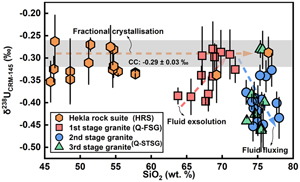
 | Fluid-mediated uranium isotope fractionation in magmatic systems Abstract: Uranium isotopes fractionation behaviour during magmatic differentiation and magmatic-hydrothermal processes remains unclear. In this study, we investigate two distinct magmatic systems: the Hekla rock suite (Iceland), which show basaltic to rhyolitic differentiation, and the Qitianling granites (South China), which show fluid modulated evolution. Our results show distinct U isotopic behaviours: although the δ238U of the Hekla suite is variable (−0.35 ± 0.05 ‰ to −0.26 ± 0.06 ‰; 2 s.d.), it exhibits no correlation with differentiation indices, suggesting limited U isotope fractionation during magmatic differentiation. In contrast, the Qitianling granite show systematic δ238U variations that we link to fluid related processes. Less evolved Qitianling granites (−0.34 ± 0.09 ‰) record 238U enrichment in residual melts through fluid exsolution, whereas more evolved granites (−0.40 ± 0.10 ‰) exhibit lower δ238U because of fluxing by 235U-enriched fluids. These findings demonstrate that variations in δ238U within magmatic systems are primarily governed by fluid related processes rather than by magmatic differentiation. Consequently, U isotopes have the potential to distinguish between these two processes, highlighting their value as tracers for magmatic-hydrothermal activity and fluid mediated transport of critical metals. |
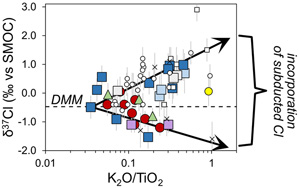 | Resolving the chlorine isotope composition of Earth’s depleted mantle Abstract: The chlorine isotope ratio (δ37Cl value) of Earth’s mantle has implications for volatile exchange between Earth’s surface and mantle, as well as for the source of volatile delivery to Earth. However, there is disagreement about this value, with estimates ranging from −3 ‰ to +0.9 ‰. To resolve this, we examine the δ37Cl values of mid-ocean ridge basalt (MORB) glasses from several ridge segments. We find that the δ37Cl value of the depleted MORB-source mantle (DMM) is ∼ −0.5 ‰, and deviation from that value results from incorporation of subducted material in the DMM. MORB samples that have shallowly assimilated Cl extend towards δ37Cl values of −0.6 ‰ to −1.5 ‰, suggesting assimilation of hydrothermal brines will not result in seawater-like δ37Cl values (0 ‰). The calculated Bulk Silicate Earth δ37Cl value is −0.04 ± 0.13 ‰, statistically indistinguishable from chondrites. This similarity suggests that >91–99 % of Earth’s Cl was inherited from chondrites with little contribution from ingassing of the solar nebula. |
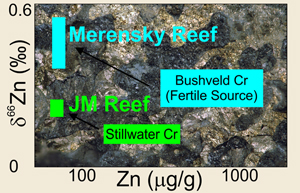 | Zinc isotope evidence for volatile fluid remelting to form PGE-enriched reefs in layered intrusions Abstract: The origin of platinum group element (PGE) enriched zones in layered intrusions, and whether they require magmatic fluids to form them, is debated. Here we report Zn abundance and isotope data for chromitite seams from the 1.27 Ga Muskox, 2.05 Ga Bushveld and 2.7 Ga Stillwater layered igneous complexes, and for the PGE-enriched Merensky (Bushveld) and JM Reefs (Stillwater) and their mineral components. The >0.7 ‰ variability in δ66Zn between mineral phases for both PGE-enriched reefs support their origin through volatile fluid remelting. The Merensky and JM Reefs are ∼0.1 ‰ heavier than underlying chromitite seams due to Rayleigh-type distillation of Zn isotopes during igneous crystallisation. Zinc-rich chromitite seams lower in the magmatic sequences are likely to be faithful representations of the ultramafic parental melts to the intrusions. The Muskox and Bushveld intrusions originated from partial melting of fertile mantle sources, similar to the sources of plume volcanism today. In contrast, the low initial δ66Zn of the Stillwater chromitite seams requires a boninite-type parental melt, suggesting fluid assisted melting processes were important in its formation 2.7 billion years ago. |
 | Comment on “Formation of abnormally high density H2S fluid in sedimentary basins” by Liu et al., 2025 |
| Reply to Comment on “Formation of abnormally high density H2S fluid in sedimentary basins” by Liu et al., 2025 |
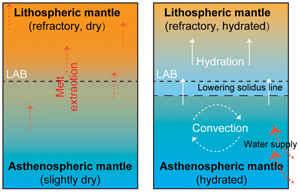 | Water storage in the refractory lithospheric mantle Abstract: This study reveals that ophiolitic olivine contains water, ranging from several to 170 μg.g−1, contradicting expectations of a depleted refractory mantle. This range is comparable to xenolithic olivine from the continental lithospheric mantle. Both types of olivine show a positive correlation between water content and forsterite numbers, a typical proxy for refractory origin, which differs from patterns observed during partial melting or magma differentiation. Our findings indicate that water content in lithospheric mantle minerals may be primarily influenced by hydration after melt extraction rather than the extraction process itself. Thermodynamic factors (temperature, pressure, redox environment) and reduced competition from coexisting phases (e.g., pyroxenes) enable olivine in refractory mantle to incorporate water. This hydration of olivine lowers the melting solidus temperature, promoting recurrent mantle melting and enhancing the refractory nature of mantle residues. The hydrated refractory mantle, sustained by deep mantle water or recycled materials, acts as a significant water reservoir. The interplay between melting and hydration plays a critical role in forming a thick lithospheric mantle. |
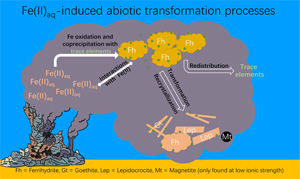 | Fe(II)aq-induced transformation of Fe-rich precipitates from a hydrothermal field Abstract: Aqueous ferrous iron (Fe(II)aq) is known to induce recrystallisation of Fe(III) oxyhydroxides, yet the relevance and implications of this process in low temperature hydrothermal systems remain underexplored. In this study, we investigated natural Fe-rich precipitates containing mixed phases (ferrihydrite, goethite, lepidocrocite) collected from the Longqi Hydrothermal Field on the Southwest Indian Ridge. These precipitates were then incubated with 57Fe labeled Fe(II)aq under anoxic laboratory conditions. Our results show that Fe(II)aq induced rapid mineral transformation of the Fe-rich precipitates containing the geochemical and mineralogical complexity of hydrothermal systems. Secondary lepidocrocite and goethite formed readily, and magnetite was observed under conditions with a high solid Fe(II)/Fe(III) ratio. The 57Fe(II) tracer revealed rapid Fe atom exchange between Fe(II)aq and structural Fe(III) (e.g., pre-existing goethite), leading to increased crystallinity. During the prompt and extensive Fe(II)-induced mineral transformation and recrystallisation, we also identified the development of new morphological features (e.g., lath-like structures) on mineral surfaces, alongside the redistribution of associated Co, Ni, Cu, Zn, and Ba. This suggests their enhanced mobility and potential fluxes to surrounding seawater. Together, these results provide essential, yet frequently overlooked, insights into the role of Fe(II)-Fe(III) interactions in shaping both mineralogical evolution and trace element cycling within Fe-rich hydrothermal systems. |
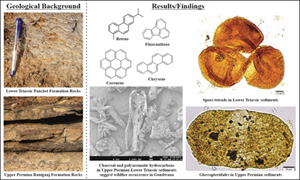 | Impact of wildfires on Gondwanan flora during the Permian–Triassic transition Abstract: The Permian–Triassic (P/T) transition is a critical juncture in Earth’s history. Rock sequences from this interval record a significant loss of biodiversity in marine environments, a reduction of terrestrial vertebrates and the initiation of the Lower Triassic coal gap. Despite these records, little is known about the transition’s impact on floral diversity and its relation to ecological perturbations. Here, we describe the hydrocarbons and charcoals preserved in Upper Permian–Lower Triassic fluviatile sediments from the East Indian Raniganj sub-basin and link them with potential vegetation shifts in Gondwana. Enrichment of pyrogenic polycyclic aromatic hydrocarbons (PAHs) and charcoalified tracheids reveal the presence of chronic wildfires in this floodplain environment. The pattern of vegetation shifts observed corresponds to a reduction of coal-forming Glossopteris Flora, while selective survival and diversification of fire-adapted conifers during the Induan age suggest that wildfires may have exerted an evolutionary pressure. The deficit of coal during the Induan is a clear sign of a decrease in vegetation density. We contend that recolonisation during the Induan occurred in an arid, fire-prone regime which produced charcoal despite scant vegetation cover. |
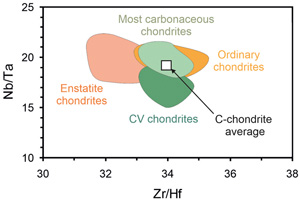 | High field strength elements in chondrites and their refractory components Abstract: In geochemistry and cosmochemistry, chondrites provide important reference values for comparison with planetary compositions. Employing isotope dilution, we report a comprehensive high precision data set for the refractory high field strength elements (HFSEs; W-Nb-Ta-Zr-Hf) and Sm-Nd-Lu-U-Th in different types of chondrites and in refractory inclusions, mainly from CV3 chondrites. Except for U, parent body processes and terrestrial alteration appear to have negligible effects. The CI chondrite data allow calculation of canonical trace element ratios such as Nb/Ta, Zr/Nb, Zr/Hf, Hf/W or Th/U at unprecedented precision and accuracy. Enstatite chondrites exhibit resolvably lower Hf/W and Zr/Hf than carbonaceous and ordinary chondrites. Ratios of Nb/Ta are uniform between all chondrite classes and groups, except for CV chondrites, where Nb/Ta is lowered by admixture of refractory inclusions that display systematic depletions of the slightly less refractory and more siderophile Nb. Regarding parent-daughter ratios of the Lu-Hf, Sm-Nd, Hf-W, and Nb-Zr radioactive decay systems, the variations in chondrites and their refractory components must have already been established in the solar nebula by selective processing of metal and silicate components and condensation processes during CAI formation. |
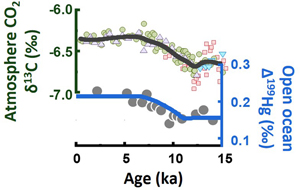 | Mercury isotopes in North Pacific sediments reveal vegetation expansion in warm climates Abstract: Mercury (Hg) concentrations and isotope compositions in sedimentary rocks are widely used to trace volcanism, but their natural variabilities through climate changes remain to be fully understood. Here, we present Hg isotope records from the North Pacific Shatsky Rise, a region without direct terrestrial input, to reconstruct the evolution of open ocean Hg isotopes. During the early Holocene (11–8 ka), the sedimentary Δ199Hg increased from 0.16 ‰ to 0.21 ‰, along with the increase in δ13C of CO2 caused by the expansion of terrestrial vegetation. A higher Δ199Hg (0.23 ‰) is also observed during the warm Pliocene (3.8–2.5 Ma) with higher terrestrial productivity. By constructing a time dependent global Hg box model, we demonstrate that the higher open ocean Δ199Hg in warm climates reflects enhanced atmospheric Hg(0) uptake by terrestrial vegetation. This is likely driven by vegetation expansion and/or biome shifts, which absorb more gaseous Hg with lower Δ199Hg. |
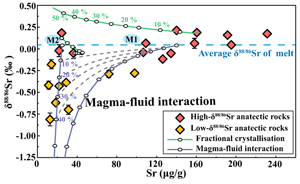 | Stable strontium isotopes reveal magma-fluid interaction during the evolution of granitic magma Abstract: The interaction between granitic magma and fluid at convergent plate margins plays a key role in crustal differentiation and rare metal mineralisation. However, this process remains poorly understood due to the elusive nature of magma and fluid. To address this issue, we reported stable Sr isotope data for anatectic rocks (primarily granitic veins and dikes), melanosomes, and their potential source rocks (mica schist and granitic gneiss) from the Cona area in eastern Himalaya. The anatectic rocks exhibit significantly lower δ88/86Sr than the melanosomes and source rocks. Neither crustal anatexis nor fractional crystallisation significantly contributes to the observed stable Sr isotopic variations. Instead, the variable and extremely low δ88/86Sr values for the anatectic rocks are attributed to the involvement of isotopically light fluids. Geochemical modelling suggests that extremely low δ88/86Sr values of the magmas mostly result from fluid influx into evolving magmas. Thus, stable Sr isotopes emerge as a powerful geochemical tracer of magma-fluid interaction, and are crucial for understanding the petrogenesis of leucogranites and associated rare metal mineralisation in collisional orogens. |
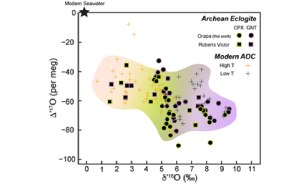 | Eclogite xenoliths record a constant ocean oxygen isotope composition for 3 billion years Abstract: In this work, we utilised the triple oxygen isotope (TOI) composition of Archean-age xenolithic eclogites, representative of Archean subducted altered oceanic crust (AOC) to constrain the triple oxygen isotope composition of the Earth’s ancient ocean. We present new triple oxygen results of eclogite xenolith garnet and clinopyroxene mineral separates from the Orapa kimberlite mine (Botswana). In conjunction with samples from Roberts Victor (South Africa), the combined TOI range of both Archean xenolith suites overlap with modern AOC precisely, and the alteration signature suggests Archean seawater had the same TOI composition as the modern (ice-free) ocean. Using fluid–rock exchange modelling, we demonstrate that Archean seawater was similarly buffered by both high and low temperature interaction with ocean crust, like the present day system. The low δ18O values of Archean cherts typically used to reconstruct Archean seawater are inconsistent with ad hoc suggestions of isotopically light ocean water and provide an important boundary condition for future studies of Archean sediments and models. |
<< Previous issueNext issue >>