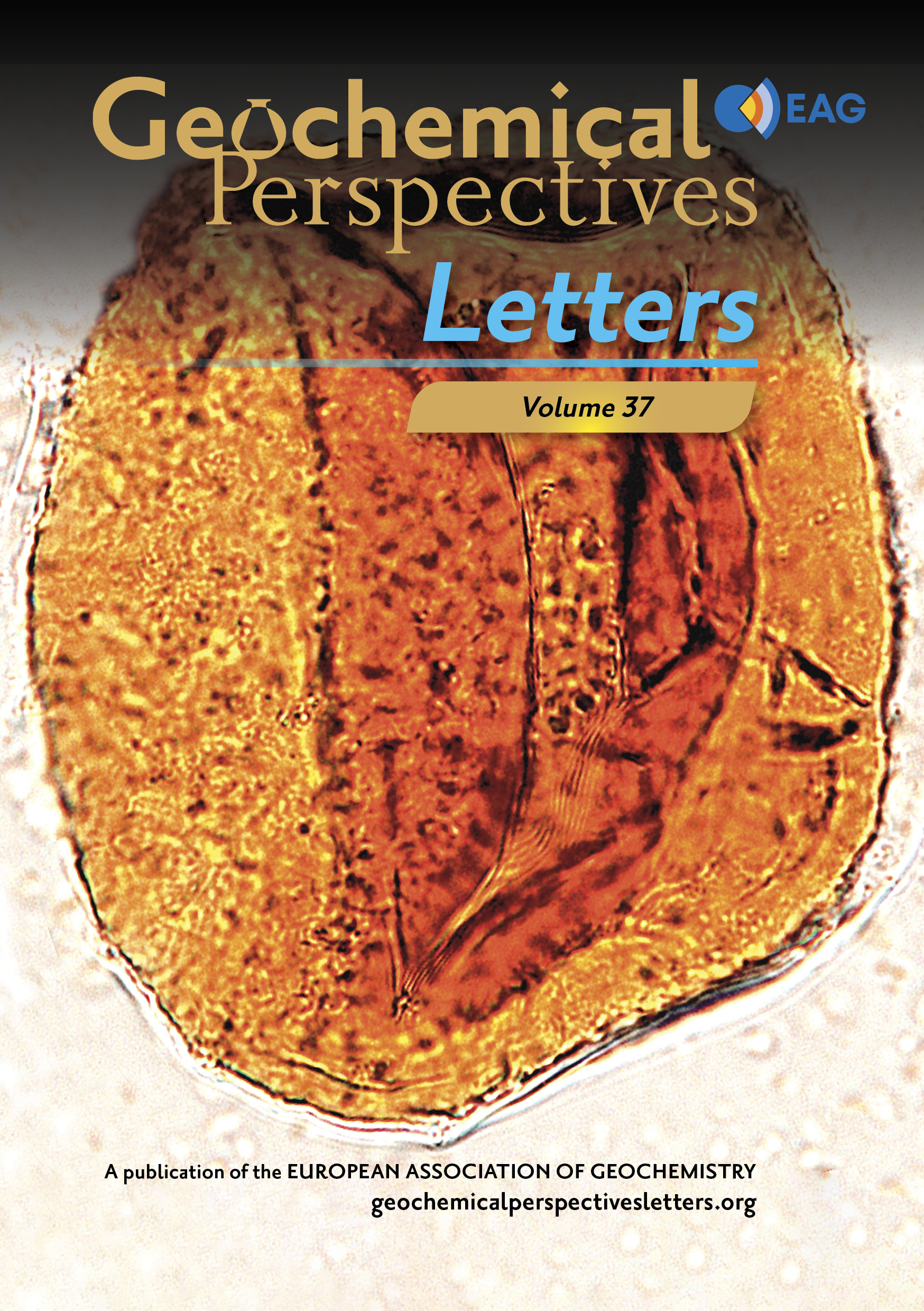



 | Ge, Te, and Zn isotopic link between Ryugu and CI chondrites Abstract: Analyses of samples returned from asteroid Ryugu have revealed chemical, mineralogical, and isotopic similarities to Ivuna-type (CI) carbonaceous chondrites. Compared to other carbonaceous chondrites, CI chondrites are characterised by heavy isotope enrichments of the moderately volatile elements, but until now no study demonstrated that this is also the case for Ryugu. Here we show that Ryugu and CI chondrites have similar elemental and mass dependent isotope systematics of the moderately volatile elements Ge, Te, and Zn, which are distinct from those of all other carbonaceous chondrites. The mass independent (nucleosynthetic) Zn isotope signatures of Ryugu are also most similar to CI chondrites, although the difference to other carbonaceous chondrites is not well resolved. Our results reinforce the notion that Ryugu and CI chondrites formed from the same precursor materials, and indicate that any processes acting on these materials before or after parent body accretion were similar. Given their similar chemical composition to the Sun, Ryugu/CI chondrites likely record the solar system’s average chemical and mass dependent isotopic composition for moderately volatile elements. |
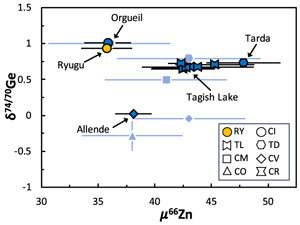
 | Consolidating the isotopic trichotomy of planetary materials with new evidence Abstract: Nucleosynthetic isotope anomalies in planetary materials reveal three reservoirs in the protoplanetary disk: one in the inner Solar System, represented by non-carbonaceous chondrites (NC), and two in the outer Solar System, represented by Ivuna-type carbonaceous chondrites (CI) and other carbonaceous chondrites (CC). Separation of the CC and CI reservoirs has been debated, with some suggesting that certain carbonaceous achondrites might bridge the isotopic gap between these two groups. Our new Fe isotope data for NC and CC achondrites together with so far uncharacterised chondrite groups show that, while three ungrouped CC achondrites share O, Ti and Cr isotopic similarities with CI chondrites, their Fe isotopic compositions differ, spanning the range observed in CC meteorites. These findings reaffirm the existence of a distinct isotopic reservoir represented by CI chondrites, supporting their formation in a distinct region of the protoplanetary disk or alteration of the constituents of CC and CI parent bodies by nebular processes. The absence of CI-like differentiated bodies could be due to their parent bodies incorporating ice during formation, which limited heating. |
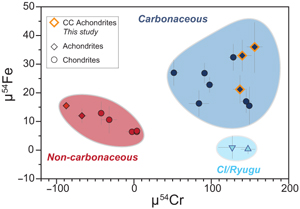
 | Halogens in proto-Iceland plume basalts Abstract: Melt inclusions in olivine phenocrysts from high 3He/4He proto-Iceland plume (PIP) basalts from Baffin Island and West Greenland have elevated Br/Cl ratios, extending to values significantly above those found in mid-ocean ridge basalt (MORB) and ocean island basalt (OIB). Chlorine isotope compositions are indistinguishable from MORB-source mantle and high Br/Cl occurs in the absence of geochemical indicators for serpentinite, altered oceanic crust or sediment. The highest Br/Cl occurs in melt inclusions from basalts with the highest 3He/4He. The high Br/Cl ratios are at the high end of the range of putative Earth-source meteorites (CI- and CM-type carbonaceous chondrites). The PIP melt inclusion compositions are consistent with the addition of a small volume of halogen-rich, high Br/Cl chondritic material to halogen-depleted, low Br/Cl mantle. |
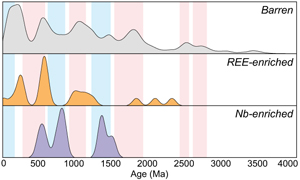 | Zircon as a pathfinder to REE mineralisation Abstract: Carbonatites and alkaline silicate rocks are major primary sources of the rare earth elements (REE) and other critical metals, such as Nb. Despite the economic significance of these rocks, their formation and the processes of REE enrichment are poorly understood. Here, statistical analysis of a global dataset demonstrates that zircon geochemistry is a powerful recorder of REE metallogenesis and a potential pathfinder for REE deposits. Zircons from REE and Nb fertile intrusions lack Eu anomalies and have elevated Gd/Yb and Th/Yb, indicating they crystallised from magmas that originated from deep, oxidised and enriched mantle sources. Complexes with Nb enrichment have low U/Nb, reflecting an enriched mantle source, whereas high U/Nb in REE-only fertile intrusions suggest a subduction-metasomatised mantle source. Machine learning models demonstrate high accuracy in classifying zircon from barren and fertile deposits. Classification of detrital zircons shows that REE-enriched deposits correlate with supercontinent assembly, whereas Nb fertile complexes are associated with supercontinent breakup. This approach offers a new, mineral to global scale, petrologic and exploration tool that enhances understanding of REE metallogenesis. |
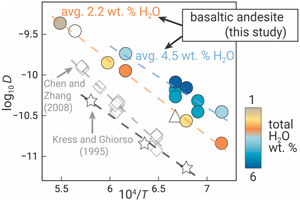 | Expanding time-temperature chronometry for arc magmas with MgO diffusion in hydrous melts Abstract: The diffusion of MgO in olivine hosted melt inclusions is a geochemical chronometer that can effectively quantify magma cooling rates and track the thermal histories of volcanic eruptions. MgO diffusion in dry silicate melts has been experimentally measured, but the currently available data are insufficient to provide an accurate assessment of model time-temperature processes in H2O-bearing magmas. Here, we conducted piston cylinder experiments (T = 1125–1550 °C, P = 1 GPa, and varying dissolved H2O contents) to constrain MgO diffusivities during olivine dissolution in a hydrous basaltic andesite melt. We calculated diffusion coefficients for MgO (DMgO) using a semi-infinite solution approach and forward modelling. DMgO showed two congruent Arrhenius relationships at average ∼2.2 and ∼4.5 wt. % dissolved H2O, with DMgO increasing linearly as more dissolved water was added at constant temperature. The applications of our new, internally consistent data set of MgO diffusivities will improve models that seek to understand minute-to-hour timescales and derive thermal histories recorded by arc magmatic systems. |
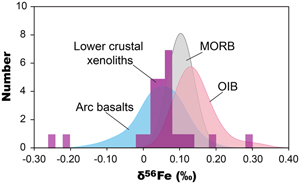 | Iron isotopic evidence for growth of continental crust at convergent margins Abstract: Iron (Fe) isotopic compositions of 26 well characterised granulite-facies xenoliths from the Chudleigh and McBride volcanic provinces, North Queensland, Australia, exhibit large variations in δ56Fe, from −0.248 ‰ to 0.287 ‰. The variations result from differences in protoliths and subsequent fractionation processes driven by Fe-Mg interdiffusion. The data yield a weighted mean δ56Fe of 0.045 ± 0.007 ‰ (2 s.e.) for the lower continental crust, significantly lighter than the best estimate of δ56Fe in average upper crust (0.109 ± 0.008 ‰, 2 s.e., compiled from published data). Using these data, the bulk continental crust has a mean Fe isotopic composition of ∼0.060 ‰, which is lower than that of oceanic island basalts and Archean tonalite-trondhjemite-granodiorite rocks, but closely resembles that of arc basalts. These results suggest 90−11+13% of the continental crust formed in convergent margins, where arc basalts with light Fe are prevalent due to fO2-buffered water-fluxed melting of the mantle wedge. |
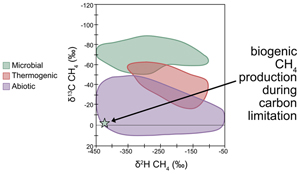 | The stable carbon isotope fractionation of methanogenesis products at complete carbon consumption Abstract: The stable carbon isotope signature (δ13C) of methane (CH4) is used to discriminate between biological, thermogenic, and abiotic sources. Methanogens, or methane producing archaea, inhabit a broad range of chemical conditions. Many of these environments are replete in dissolved inorganic carbon (DIC), causing isotopically depleted δ13C biogenic CH4. However, some extreme environments inhabited by methanogens, such as serpentinising systems, exhibit low carbon dioxide (CO2) availability, replete H2, and isotopically enriched δ13C CH4 that is outside the known biogenic range. We measured the δ13C of CO2, biomass, lipids, and CH4 during hydrogenotrophic methanogenesis under hydrogen replete conditions with a limited carbon pool to investigate carbon isotope dynamics at complete DIC consumption. As theory predicts, we found that the final, accumulated methane δ13C values closely reflect the δ13C of the initial DIC supply, and that methane is more 13C enriched than biomass and lipids. This provides the first experimental evidence that methanogens can achieve complete carbon consumption and thus can produce accumulated CH4 products that isotopically reflect the initial CO2. These data show that the range of possible δ13C values from biogenic methane needs to be expanded for natural environments impacted by extreme carbon limitation. |
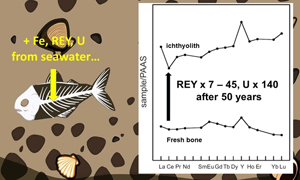 | Rare earth elements and U uptake by fish remains in seawater: how fast? Abstract: During diagenesis, biogenic phosphates are considerably enriched in trace elements, particularly in U and rare earth elements (REEs), which makes them palaeoceanographic proxies for the composition of past seawater. The rate at which this enrichment occurs is unknown. Here, we report on present day ichthyoliths that have spent the last 50 years in contact with seawater and show that their uptake of REEs is largely dominated by quantitative incorporation without fractionation, probably via the development of authigenic phases, in particular Fe oxides. Enrichments take place rapidly, for example at a rate of around 1.2 ng/g per year for Nd and 300 ng/g per year for U. Transposed to known fossils displaying the highest REE and U abundances, these results suggest that contact with seawater may have persisted for several thousand years, implying very slow sedimentation rates. Alternatively, post-burial enrichment processes could be much more efficient, which would imply that the signatures shown by these kind of fossils, rich in rare earth elements and yttrium, may largely reflect diagenetic overprinting rather than pristine marine signatures. |
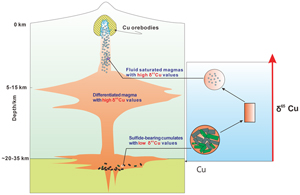 | Copper isotope fractionation during lower crustal sulfide accumulation Abstract: Copper isotopes are key tracers for understanding metal behaviour in porphyry Cu deposits, the dominant global source of the copper. However, although shallow magmatic-hydrothermal processes are well studied, the isotopic fingerprint of sulfide saturation at depth, i.e. a pivotal control on porphyry Cu formation, remains enigmatic. We analyse Cu isotopes in sulfide-rich cumulate xenoliths and genetically linked porphyries from Tongling ore district, China. The cumulates are relatively enriched in Cu (263 ± 163 ppm, n = 4) and light Cu isotopes (–0.19 ± 0.04 ‰) compared to the porphyries (Cu = 55.4 ± 41.5 ppm, n = 17; δ65Cu = +0.20 ± 0.21 ‰) in porphyries. This dichotomy reflects isotopic fractionation during early sulfide saturation, where sulfides sequester light Cu, enriching residual melts in 65Cu. Synthesising global datasets, we identify a systematic δ65Cu enrichment trajectory from mantle sources through lower crustal cumulates (–0.19 ‰) to upper crustal porphyries (+0.20 ‰). This depth dependent isotopic stratification implies that near surface 65Cu enrichment signatures may serve as a first order exploration vector, particularly where erosional windows expose upper level porphyries. |
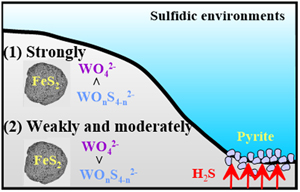 | Pyrite: an authigenic host phase for tungsten in sulfidic sediments Abstract: Tungsten (W) has recently gained recognition as a potentially powerful tool for reconstructing palaeo-oceanic conditions, yet its enrichment mechanisms in sulfidic environments remain poorly constrained. Here, we investigate W cycling in sulfidic sediments from the Haima Cold Seep (South China Sea), revealing a paradoxical decoupling of low W concentrations and high enrichment factors (WEF), which we attribute to pyrite-mediated W sequestration. Sulfidation promotes pyrite formation and Fe-Mn (hydrogen)oxides dissolution. Inadequate W uptake by pyrite causes low bulk W content, yet the high (Wpy)EF can elevate the bulk sediment WEF, thereby producing the decoupling between low W content and high WEF in the sediment. Furthermore, varying environmental sulfidic levels drive aqueous W speciation, affecting subsequent pyrite adsorption and leading to differences in pyrite W content and WEF. This study significantly enhances our understanding of the W cycle in sulfidic marine environments. |
<< Previous issueNext issue >>