


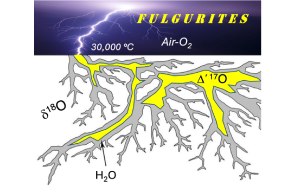
 | Fulgurites: the Earth’s minute melts and their interaction with the atmosphere Abstract: We here report the first triple oxygen isotope analyses on a collection of natural and synthetic fulgurites generated in natural lightning and high current experiments, and fulgurites generated by electrical power line accidents. The goal is to investigate whether fulgurites experience very high Δ’17O due to UV photolysis or record rapid exchange with high δ18O, low Δ’17O air-O2. Experiments used a variety of pristine materials spanning from dunite to rhyolitic bulk rock composition and monomineralic materials like quartz and apatite. All experimental and natural fulgurites from igneous bedrock are anhydrous and exhibit moderate −0.02 to −0.04‰ Δ’17O negative shifts (or 4–8 %) toward air-O2, regardless of their bulk composition. Several tektites of similar ∼2–15 mm size, analysed for comparison, show more substantial −0.2‰ negative shifts, ∼40 % toward air-O2. Fulgurites formed by fallen powerlines on wet soil are highly vesicular and they exhibit both positive and negative 0.02 ‰ Δ’17O shifts, indicating interaction with both low Δ’17O air-O2 and high-Δ’17O meteoric waters during formation and rapid (minutes long) cooling after melt formation. It appears that neither ground nor suspended particle experimental lightning produces unexpected photolytic mass independent 17O/18O/16O fractionation effects, in contrast to UV photolysis. Fulgurites in the geologic record can be further explored as monitors of O2 pressure in CO2 rich ancient atmospheres via their Δ’17O values, even if devitrified. |
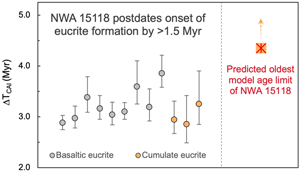 | High precision Al-Mg dating of NWA 15118 challenges a primary anorthositic crust on Vesta Abstract: A lunar-like magma ocean model has been proposed for the asteroid 4 Vesta, where a global primary anorthositic crust formed from buoyant plagioclase floating above complementary diogenitic cumulates. In this hypothesis, the crystallization of the anorthosite should predate the formation of eucrites that are thought to reflect secondary magmatism at the surface of Vesta. To test this model, we present the first 26Al-26Mg age of the anorthosite Northwest Africa (NWA) 15118. The NWA 15118 yields a model 26Al-26Mg age younger than 4.35 ± 0.03 Myr after CAIs formation. However, eucritic crust formation initiated at ∼2.88 Myr after CAIs, and predating NWA 15118 by over 1.5 Myr, contradicting the proposed global primary anorthositic crust of Vesta formed from a magma ocean. Instead, anorthosite NWA 15118 more plausibly represents a fragment of regional crust formed after the primary crustal differentiation of Vesta, potentially related to late stage basaltic eucrites with negative Eu anomalies or derived from a chemically distinct source. |
 | Testing ab initio garnet-clinopyroxene Ca-isotope fractionation models with natural data Abstract: Calcium stable isotope variations help track processes from melt generation to crustal recycling in the mantle, but applying this system requires understanding of inter-mineral and mineral-melt isotopic fractionation. Density functional theory (DFT) models have been used to constrain Ca-isotope fractionation between garnet and clinopyroxene as a function of temperature, pressure, and composition, because garnet can strongly fractionate Ca. However, experimental and empirical data to test DFT predictions for equilibrium Δ44/40Cagrt-cpx remain limited. We measured δ44/40Ca values of clinopyroxene and garnet from eclogite xenoliths in the Navajo Volcanic Field, Colorado Plateau (USA). Combining these low-temperature samples with higher-temperature literature data, we find Δ44/40Cagrt-cpx is correlated with 106/T2 (Δ44/40Cagrt-cpx = 0.63 × 10⁶/T2). No correlations were found with mineral composition after correcting for temperature, and pressure is not expected to have a significant effect. To first order, DFT model predictions agree well with observed trends in natural samples. |
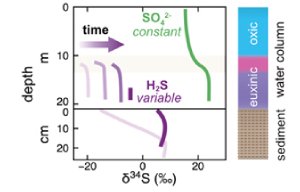 | Decadal, sediment-driven sulfur isotope evolution in Lake Cadagno Abstract: The sulfur isotope composition (δ34S) of sedimentary pyrite has been widely used to reconstruct the past global marine sulfur cycle, yet local diagenetic conditions may exert a greater influence than previously recognised. In this work, we present new dissolved H2S and SO42− isotope data alongside microscale sulfur isotope analyses of sedimentary pyrite from the redox stratified Lake Cadagno, Switzerland. A comparison with previously published data reveals a ∼15 ‰ shift in the δ34S values of water column H2S over the past two decades. Constant δ34S values of sulfate in the water column over the same time interval and mass balance calculations indicate that this shift is likely driven by the diffusion into the water column of highly 34S enriched H2S, microbially produced in the sediment porewaters. This 34S enrichment of H2S was recorded by sedimentary pyrite that formed during this period. Additionally, the near-equilibrium microbial isotope fractionation observed in incubations of Lake Cadagno sediment is poorly recorded in pyrite, possibly due to isotopic homogenisation of the H2S pool within the sediment. Our findings offer a complementary perspective on the conventional model of euxinia, where H2S production primarily occurs in the water column, by highlighting the importance of sedimentary processes in shaping the dynamics of the sulfur pool and pyrite isotope composition. |
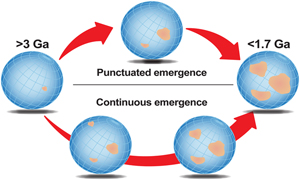 | Continental crust had fully emerged by the end of the Paleoproterozoic Abstract: Earth has bimodal hypsometry, with emergent, subaerial continents and submerged oceanic crust. The tempo and history of emergence is imprecisely understood. We estimate the oxygen isotope composition of seawater (δ18OSW) via tracer mass balance inversion of sections of hydrothermally altered ocean crust as a proxy for emergent crust. Using data from Sturgeon Lake, Canada (∼2735 Ma) and the Pecos Greenstone Belt, USA (∼1720 Ma), we find δ18OSW decreased from about +3 to +4 ‰ to −0.2 ‰, indicating near-modern levels of emergence by ∼1720 Ma, with minimal emergence at ∼2735 Ma. We employ a steady state δ18OSW model, driven either by continuous or punctuated continental growth, to interpret our findings. Such reconstructions indicate continental growth and emergence were decoupled until the end of the Archean. |
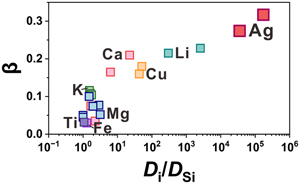 | Silver isotope fractionation by chemical diffusion in granitic melt Abstract: We report the first study of silver (Ag) isotope fractionation during diffusion in anhydrous granitic melts using diffusion couple experiments. The mass dependence of the diffusion coefficients of the Ag isotopes can be described by D109Ag/D107Ag = (107/109)β. In this study, we performed piston-cylinder experiments to constrain the β-factor for Ag isotopic fractionation by diffusion in anhydrous granitic melts. By regression and error estimation of the diffusive isotope profiles, we obtained β-values of 0.317 ± 0.036 and 0.274 ± 0.016 for the two diffusion experiments. These β-values are the largest in metal stable isotopes reported for silicate melts, reflecting rapid diffusion and minimal interaction of Ag+ with the melt network. A theoretical model was established based on experimental data, predicting significant diffusive Ag isotope fractionation (>6 ‰) during granitic magma ascent and fluid exsolution. The modelling results suggest that Ag isotopes can be used to trace silver migration, magma mixing and mineralisation processes. |
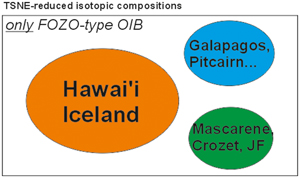 | Earth’s foundational geological events stored in the fundamental mantle source of hotspots Abstract: The geochemical signatures of nearly all Earth’s volcanic hotspots converge on a common isotopic composition, which is often termed the ‘focal zone’ (FOZO) and has been associated with a shared deep mantle source. Yet, unlike other characteristic geochemical components of hotspots, the origin and nature of FOZO remain unclear. Geochemical evidence has been invoked to support both an ancient and a relatively young age for FOZO, and long lived radiogenic isotopic data support many potential geochemical relationships between geographically disparate hotspots. We examine this issue using the short lived 146Sm-142Nd isotopic system, which can identify diverse geochemical origins in the Hadean Eon, more than four billion years ago. Two hotspots with strong geochemical affinity to FOZO, the Crozet and Juan Fernandez hotspots, have statistically distinct 142Nd compositions, meaning that despite the similarity in their long lived radiogenic isotopic compositions, they must reflect different Hadean-aged geological heritages. Detailed analysis of the isotopic compositions of global hotspots using machine learning further reveals that FOZO is most likely not singular but rather represents a spectrum of discrete domains that each have histories dating back to the first 10 % of Earth’s history. |
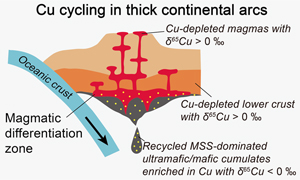 | Dominant monosulfide solid solution fractionation causes Cu deficit in continental crust Abstract: It remains unclear how Earth’s continental crust became deficient in Cu. Lower crustal cumulates from the Gangdese continental arc present key evidence. These cumulates are Cu-rich and exhibit significant δ65Cu variability (−2.09 ‰ to +0.51 ‰), attributed primarily to the fractionation involving Monosulfide Solid Solution (MSS). Combined with the systematic Cu depletion and positive δ65Cu signatures of the Gangdese differentiated arc magmas and the bulk continental crust, we propose that widespread MSS segregation occurs at the base of continental arcs. This process distinguishes continental arcs from island arcs: in the former, higher pressures promote earlier sulfide saturation, and MSS dominated segregation slows the rate of Cu depletion during differentiation. Ultimately, the continuous foundering of these sulfide-rich mafic cumulates drives the continental crust toward a silica-rich and Cu depleted bulk composition. |
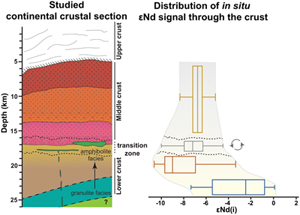 | Tracing anatexis and bottom-up crustal homogenisation with in situ Sm-Nd isotopes Abstract: Whole rock Nd isotopes are commonly used to assess mantle-crust contributions in magma sources and to constrain the timing of magmatic and metamorphic events. However, such measurements provide limited insights into deep crustal roots, where complex processes (e.g., open system melting, magma hybridisation) may occur. Here, we combine whole rock and in situ Sm-Nd isotopic analyses across a 25–30 km thick crustal section in Calabria (Italy). This section exposes lower crustal granulites and migmatites overlain by mid-crustal post-collisional granitoids, forming a 13 km thick batholith. The lower crust is strongly heterogeneous (whole rock ɛNd(i) = −10.5 to +1.7) with isotopic variability evident from outcrop to grain scale. By contrast, the mid-crustal igneous rocks display remarkable homogeneity with consistent crustal signatures (ɛNd(i) ≈ −7). Our results indicate efficient isotopic homogenisation from a 1–2 km thick transition zone at the lower-middle crust boundary, where hybridisation between mafic and felsic magmas is evidenced at the grain scale using Sm-Nd isotopic analyses. A minor mantle contribution was likely involved in the batholith genesis but largely obscured by processes like crustal assimilation and cannot be resolved in the granitoids using the Sm-Nd system. |
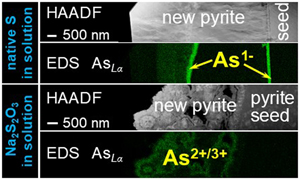 | Pyrite records fluid evolution: sulfur sources controls on arsenic speciation and zonation Abstract: Zoning and speciation of arsenic (As) in pyrite are used to infer changes in the chemical composition of hydrothermal fluids and conditions of ore deposit formation. Yet, the processes controlling the distribution and oxidation state of As during pyrite formation are poorly understood. We report the results of experiments designed to test the capacity of pyrite to record changes in fluid composition under dynamic reaction conditions. When pyrite seeds were exposed alternately to As-bearing and As-free fluids, concentric As-rich (≤6.0 wt. % of As1−) and As-free pyrite overgrowths formed when native S was used as the sulfur source. In contrast, a sodium thiosulfate source produced randomly oriented aggregates of concentrically zoned microparticulate (∼1 μm) As-bearing pyrite (<1.5 wt. % of As2+/3+), failing to record the changes of fluid composition. We demonstrate that by controlling H2S(aq) availability, the source of sulfur affects the degree of pyrite supersaturation under conditions relevant to natural hydrothermal systems, which controls the nucleation rate, crystal growth, As uptake, As oxidation state, and consequently, the ability of pyrite to record individual fluid pulses. This sulfur source effect has significant implications for metal incorporation into pyrite and understanding of the formation of many ore deposits. |
<< Previous issueNext issue >>