


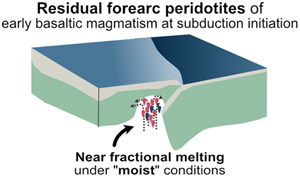
 | Residual forearc peridotites recording the early magmatic stage of subduction initiation Abstract: Subduction initiation is fundamental to plate tectonics. Early basaltic magmatism preceding boninitic magmatism is key to understanding the onset and mechanism of subduction initiation. However, the mantle processes during the early basaltic magmatism remain poorly understood due to the scarcity of corresponding residual peridotites. To find the residual peridotites from the early stage of subduction initiation, we compiled spinel data and examined peridotites from the Izu-Bonin-Mariana and Tonga forearc regions that contain some of the lowest spinel Cr/Al ratios. These samples present small amounts of pargasitic amphibole and light rare earth elements depleted patterns in their clinopyroxenes and amphiboles. These features differ from depleted forearc peridotites associated with boninitic magma, abyssal peridotites, and backarc peridotites, but resemble lherzolites from the Oman ophiolite. Melting models can reproduce the compositions of clinopyroxene and the corresponding early basalts for each region. We suggest that the studied forearc peridotite samples are residues after early basaltic magma extractions, which potentially involved a common process of near fractional melting under moist conditions. |
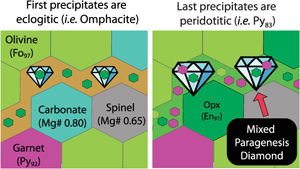 | Mixed paragenesis diamond inclusions form during metasomatic fluid evolution Abstract: Mineral inclusions in diamond provide the context for diamond formation, yet some diamonds contain disequilibrium ‘mixed paragenesis’ mineral inclusions. Mixed paragenesis diamonds are inferred to somehow record growth of a single diamond in both mafic eclogitic and peridotitic substrates. Here we use thermodynamic modelling with the Extended Deep Earth Water (DEW) model to show that mixed paragenesis mineral inclusions can form during a single episode of diamond growth via fluid-rock metasomatism in the lithospheric mantle. Simulations of fluid infiltration and reactions predict sequential mineral precipitation, with early eclogitic minerals (omphacite and garnet) followed by more peridotitic minerals (e.g., olivine and Mg-rich garnet) during continued diamond growth. Concurrently, modelled fluids evolve from silicic toward carbonatitic compositions and reproduce the compositional range of high density fluids observed in fibrous diamonds. These results demonstrate that mixed paragenesis inclusions and the diversity of diamond-forming fluids can arise from progressive metasomatic reactions during a single diamond-forming event, rather than requiring a diamond to grow first in eclogite and then in peridotite. |
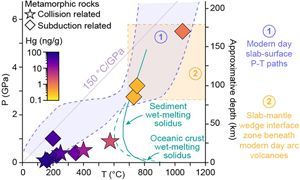 | Is Hg recycling into the Earth’s mantle negligible? Abstract: Mercury (Hg), with its ultra-trace abundance in rocks and high volatility, challenges the investigation of its distribution and mobilisation in geological systems. Based on similar Hg isotope mass independent fractionation (i.e. Δ199Hg) values between marine and terrestrial sediments and magmatic rocks, it is commonly suggested that Hg has been continuously exchanged between the Earth’s mantle and the atmosphere through subduction recycling. However, a review of Hg concentrations in ophiolites and orogenic peridotites, mantle xenoliths, mantle derived basalts and mafic rocks (Mg# ≥60), and variably metamorphosed collision and subduction related rocks suggests otherwise. Ultra-trace Hg concentrations in mantle rocks and mantle derived magmas are inconsistent with Hg recycling into the mantle. In fact, collision and subduction related rocks progressively lose Hg with increasing metamorphic grade, indicating that only ≤1 ng/g of Hg is transferred to the sub-arc mantle melting regions. These observations also suggest that Hg recycling was inhibited during the Archean. Here we warn about the risk of using Hg isotopes alone to interpret the Hg cycle on Earth and urge the need for new and accurate Hg concentrations in crystalline rocks from different geological settings. |
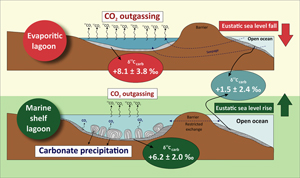 | Can CO2 outgassing and carbonate precipitation explain the Lomagundi Excursion? Abstract: The Lomagundi-Jatuli event (2.3–2.0 Ga) is one of the striking carbon isotopic (δ13Ccarbonate) excursion events in the Earth’s history, marked by anomalously high δ13Ccarbonate reaching up to +30 ‰. The conventional explanation attributes it to enhanced organic carbon burial. However, the lack of organic-rich strata synchronous with the excursion demands the reconsideration of alternative biogeochemical processes to explain this isotopic anomaly. Moreover, the excursion is observed only in the evaporitic and near shore carbonates, with no evidence from the open ocean, demanding a facies based biogeochemical explanation. Here, we propose a depositional framework for Lomagundi successions and explore the possibility of CO2 outgassing and carbonate precipitation as potential drivers responsible for this excursion, as these processes remain the least explored among the proposed hypotheses. Through sedimentological evidence from previous studies and Rayleigh fractionation calculations, we argue that dominant loss of dissolved inorganic carbon (DIC) through CO2 outgassing in the evaporitic facies and carbonate precipitation in the near shore facies along with a well mixed DIC reservoir in the open ocean explains the observed Lomagundi Excursion. |
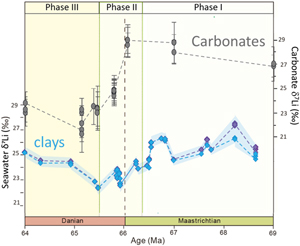 | Revisiting K-Pg boundary with lithium isotopes: divergent marine and continental responses Abstract: Seawater lithium isotope records (δ7Li) are powerful tools for investigating long term climate change and its relationship with continental silicate weathering. While most past ocean δ7Li reconstructions rely on foraminifera-rich carbonates, we introduce a novel approach using marine authigenic clays. Our findings demonstrate that clay authigenesis is an abiotic process that fractionates Li isotopes consistently in laboratory settings and across marine sediments. We apply this method to the Cretaceous-Paleogene (K-Pg) boundary, a critical interval marked by one of Earth’s five largest mass extinctions, and present a new clay derived seawater δ7Li record (64–69 Ma). Our results, compared with those of the carbonate record, uncover a dual environmental disturbance. The clay record indicates a protracted perturbation initiated at 69 Ma, driven by gradual shifts in soils, fluvial systems, and continental weathering, which remained largely unaffected by Deccan volcanism or the meteorite impact. In contrast, abrupt fluctuations are recorded in marine carbonates at 66 ± 0.3 Ma, signaling short lived yet significant changes of oceanic carbon chemistry. These findings highlight the asynchronous behaviour of terrestrial and marine systems during this major ecological transition. |
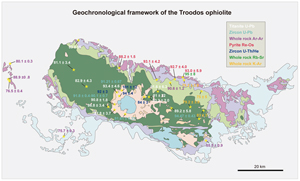 | Pyrite Re-Os dating confirms synchronous magmatism and hydrothermalism in Troodos ophiolite Abstract: The Troodos ophiolite in Cyprus represents one of the best preserved ophiolites globally, yet its precise formation time scale remains debated. This study presents the first Re-Os isochron dating of pyrite from four Cyprus-type sulfide deposits (Agrokipia, Memi, Kokkinopezoula, and Apliki) hosted within the Troodos pillow lava sequence. The results yield ages of 93.0 ± 5.9 Ma, 93.1 ± 4.2 Ma, 92.7 ± 4.0 Ma, and 88.2 ± 1.5 Ma, respectively, directly constraining the timing of seafloor hydrothermal mineralisation. These ages, combined with recently published high precision U-Pb zircon/titanite ages from plutonic and sheeted dike rocks, reveal that (1) the main phase of crustal accretion and high temperature hydrothermal activity occurred synchronously at ∼93–90 Ma, (2) post-accretion low temperature alteration and cooling persisted until ∼74 Ma, and (3) localised magmatism continued episodically to ∼81 Ma, with minor boninitic activity as late as ∼55 Ma. This refined geochronological framework indicates that the Troodos ophiolite formed during a brief (∼3 Myr) episode of subduction-initiation related spreading, followed by prolonged thermal evolution. The sulfide deposits serve as precise chronometers for fossil seafloor hydrothermal systems, providing critical new constraints on tectonic evolution of ophiolites worldwide. |
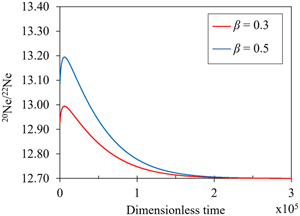 | Diffusional fractionation of neon isotopes in MORB melts: a molecular dynamics study Abstract: Neon isotopes are key tracers of Earth’s volatile origin, yet their signatures in volcanic glasses may be modified by kinetic fractionation during magmatic degassing. Recent experiments have revealed vesicle-scale variations in 20Ne/22Ne, highlighting the need for quantitative constraints on the mass dependence of neon diffusion in silicate melts. Here, we use classical molecular dynamics simulations and a pseudo-isotope approach to determine the mass dependence exponent β for neon diffusion in a MORB melt over temperatures of 1473–1873 K and pressures of 0 to 10 kbar. We find a robust linear relationship between log D and log m, with β ≈ 0.24–0.29 at low pressure, significantly lower than the gas kinetic prediction of 0.5, and decreasing approximately linearly with pressure. These results indicate that diffusion-driven fractionation is limited at the melt scale but can generate measurable, transient isotopic enrichments in vesicles under strongly non-equilibrium degassing conditions. Our findings provide a physically grounded framework for interpreting neon isotope signatures in MORB glasses and assessing the preservation of mantle-derived volatile signals. |
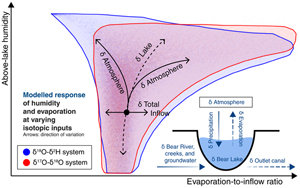 | Contrasting controls on δ18O-δ2H and δ18O-δ17O systematics in a balance filled lake Abstract: Recent analytical advancements now allow precise quantification of 17O excess (Δ'17O), introducing the triple oxygen isotope system (δ17O-δ18O) as a complementary tool to d-excess, its analogue in the classic δ18O-δ2H system. Therefore, the objective of this study is to contrast the sensitivities of the δ18O-δ2H and δ18O-δ17O systems to varying environmental and isotopic parameters. To do this, we present a new triple oxygen isotope data set from the Bear River watershed (Utah/Idaho, USA) and model lake evaporation trajectories using Monte Carlo driven steady state mass balance modelling. Results demonstrate that Δ'17O provides more accurate humidity constraints. Modelling the evaporation trajectories of the balance filled Bear Lake, we show that the uncertainty of the calculated lake isotopic composition increases with increasing evaporation-to-inflow ratio (Xe). This observation implies the need to better constrain isotopic inputs, particularly that of atmospheric moisture, in dry environments where Xe is high. Further, this study highlights the need for a larger Δ'17O data set aggregation across environmental conditions to better characterise variability and reduce uncertainty in calibrating isotope mass balance models. |
 | Accurate equilibrium Δ47-Δ48 values in bivalves despite bulk differences in inner layer Abstract: Dual clumped isotope (Δ47-Δ48) measurements are a relatively new palaeothermometry technique with an inbuilt “check” on the equilibrium state of carbonate minerals. Bulk shells of bivalves seem not to be kinetically biased in Δ47, making them potentially ideal palaeoclimate archives. A few examples of bivalves with kinetically biased Δ47 localised to the inner shell layer or juvenile portion exist, but mounting evidence documents systematic δ18O and δ13C differences between the inner and outer shell layers. We present the first inter-layer comparisons using high precision Δ47, Δ48, δ18O, and δ13C measurements of the bivalves Arctica islandica, Glycymeris bimaculata, Senilia senilis, and Geloina erosa from different climatic areas. Δ47-Δ48 values for all these species are within local annual temperat |
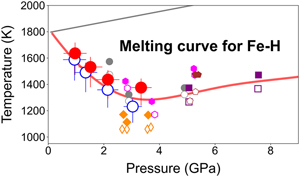 | Fe-H melting curve below 3 GPa: implications for hydrogen in the lunar core Abstract: It has been assumed that hydrogen is negligibly incorporated into core forming metals below ∼3 GPa, and therefore the presence of hydrogen in iron cores of small terrestrial bodies including the moon has not been considered. Here we performed high pressure melting experiments on the Fe-H system under H2 saturated conditions, combined with synchrotron X-ray diffraction (XRD) measurements. Results demonstrate substantial depression of the Fe-H melting curve compared to that for Fe at 1.0–3.3 GPa, indicating that hydrogen is incorporated into liquid iron even at low pressures (less than 1 GPa) and the solubility is enhanced with increasing pressure. Based on the density of liquid Fe-H derived from diffuse scattering signal in XRD data, we found that the solubility of hydrogen in liquid iron is about 0.9 wt. % at 3.6 GPa and likely enhanced to 1.1 wt. % at 5 GPa corresponding to lunar core conditions. The 1.1 wt. % H causes 9 % density reduction, which might fully explain the observed density deficit of the lunar core with respect to iron, depending on the density estimate from seismological data, although the presence of sulfur and carbon is not excluded. |
<< Previous issueNext issue >>