



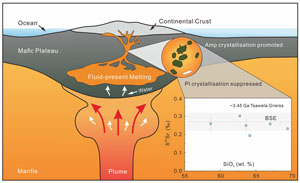
 | Fluid-present melting of early Archean crust: Stable Sr isotopes from the Kaapvaal Craton Abstract: Stable Sr isotopes (δ88Sr) provide a process specific tracer of plagioclase behaviour in magmatic systems. Because plagioclase liquidus is sensitive to the water content of melt, δ88Sr can be applied as a tool to discriminate fluid-present from fluid-absent melting to form early continental crust. Here, we present high precision δ88Sr data for the ∼3.45 Ga Tsawela gneiss (TG) of the Kaapvaal Craton. The samples display a narrow, mantle-like δ88Sr range (0.19–0.30 ‰, average 0.25 ± 0.07 ‰) and low initial 87Sr/86Sr that shows no correlation with SiO2, Sr content and Eu anomaly. Plagioclase fractional crystallisation would produce melts with lighter δ88Sr values and lower Sr content. The results indicate suppressed plagioclase crystallisation during melt evolution, providing direct isotopic evidence for fluid-present melting. This interpretation aligns with the calc-alkaline trends and the low pressure TTG trace element signature of the TG suite. Phase equilibria modelling also indicates that a progressive increase in melt H2O content lowers the plagioclase liquidus from >1200 °C to ∼750 °C. Given that the TG samples were formed in an Archean mafic plateau setting, this indicates that the early felsic crust can be efficiently generated under water-rich conditions without requiring modern style subduction. |
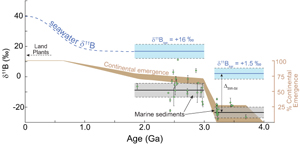 | Boron isotopes in Archean-Proterozoic marine deposits trace continental emergence Abstract: We present a novel approach to trace continental emergence by reconstructing the oceanic boron isotope composition from marine deposits (chert, iron formations and shales). Boron enrichment in continental crust means runoff directly influences ocean boron concentration and isotopic composition, with continental runoff representing the largest boron source on the modern Earth. Our Archean-Proterozoic marine B isotope record reveals a major compositional shift at 3.0 Ga: pre-3.0 Ga deposits show mean δ11B values of −23.5 ± 3.6 ‰, projecting to seawater δ11Bsw = +1.5 ± 3.6 ‰, whereas post-3.0 Ga sediments exhibit mean δ11B of −8.8 ± 4.6 ‰, projecting to seawater δ11Bsw = +16.1 ± 4.6 ‰. The rapid change at this time likely reflects enhanced emergence and subaerial erosion after 3.0 Ga, substantially increasing the boron flux to the ocean. A second elevation to modern values (δ11Bsw, modern = +39.6 ‰) occurred throughout the Phanerozoic due to increased chemical weathering and fractionation following land plant appearance, also reflected in the δ7Li record. |
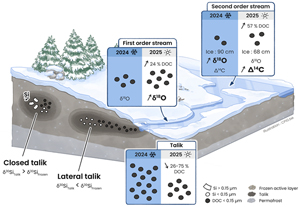 | Deep winter dissolved organic carbon transfer from taliks in permafrost landscapes Abstract: In permafrost landscapes, taliks (unfrozen ground zones) represent year round hydrological pathways that can transfer dissolved organic carbon (DOC) to streams during winter. When laterally connected, taliks enhance winter hydrological flow and DOC transfer to streams, yet their connectivity and biogeochemical role remain poorly constrained. Here, we use silicon isotopes (δ30Si) in soil pore waters to distinguish closed from lateral taliks at a water track in Alaska, and study DOC transfer to first and second order streams across two contrasting winters (2025 warmer than 2024). Silicon isotopes emerge as a promising tracer of talik connectivity, with lateral taliks showing systematically lighter Si isotope composition than in the frozen soil, whereas closed taliks exhibit systematically heavier Si isotope compositions. Stream water data reveal enhanced transfer of younger, soil derived DOC from lateral taliks during the warmer winter, with up to 57 % higher DOC concentrations compared to the colder winter, despite similar dissolved CO2 and CH4 concentrations. This offers a first biogeochemical view of talik connectivity (closed/lateral) in deep winter and calls for integration with geophysical approaches to fully resolve its role in winter carbon cycling. |
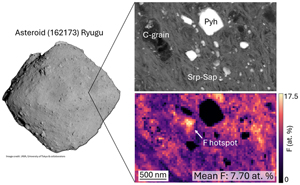 | Fluorine in the late fluids of asteroid Ryugu Abstract: Fluorine is a highly reactive halogen whose distribution and speciation may provide key insights into fluid evolution and element mobility in planetary materials. Yet, despite its cosmochemical significance, the phase carrier(s) of fluorine, its speciation and behaviour during fluid-rock interactions are still enigmatic. Here, we report the occurrence of fluorine associated with phyllosilicates at the nanometre scale in Ryugu samples. We carefully evaluated the possibility of exogeneous contamination, but several lines of evidence indicate that fluorine is most likely indigenous. It is concentrated in particular in saponite, possibly via OH-F substitution, and/or as interstitial fluoride salts. These observations are interpreted as the result of fluorine release from primary carrier(s) and its subsequent concentration within late stage, highly saline fluids. Limited phosphorus and sodium availability likely restricted apatite, Mg, Na phosphates and Na carbonate formation, preventing them from acting as a major sink for fluorine and favouring its retention within phyllosilicates. This finding expands the scope of previously documented brine related mineral assemblages in Ryugu and Bennu and reveals an unexpected behaviour of halogens in primitive Solar System bodies. |
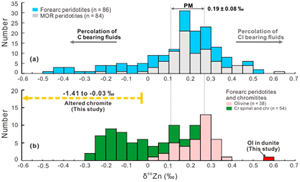 | Altered chromite as hidden carrier of isotopically light Zn in forearc mantle Abstract: Cr spinel is a major Zn carrier in oceanic peridotites, yet its role in bulk rock Zn isotopic variations remains poorly constrained. Here, we report unprecedented δ66Zn variations (−1.41 to −0.03 ‰) in variably altered chromites from ophiolitic chromitites in Tibet, China. Chromites from least altered samples show limited Zn and δ66Zn variability, largely reflecting primary compositional signatures. By contrast, chromites from intensely altered samples show heterogeneously enriched Zn in secondary Fe enriched zones relative to primary cores, with highly negative δ66Zn. The negatively correlated δ66Zn with bulk Zn indicates addition of isotopically light Zn by precipitation of secondary Zn, Fe enriched chromites from hydrothermal solution. Interstitial chlorite + dolomite further suggest involvement of carbonate bearing fluids, which are expected to create strong Zn isotope fractionation between aqueous carbonate and other Zn species under certain conditions. Such altered chromites may substantially affect Zn isotopic variations in Cr-rich forearc mantle rocks. |
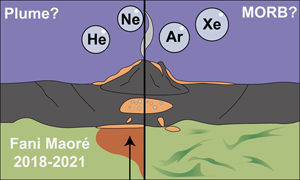 | Xenon isotopes in the Fani Maoré lavas: Implications for upper mantle heterogeneity Abstract: Xenon isotopes provide unique constraints on mantle evolution but remain rarely investigated in oceanic intraplate lavas due to pervasive atmospheric contamination. The 2018–2021 Fani Maoré eruption (Mayotte) produced gas-rich lavas, allowing the first investigation of xenon in the Comoros. While helium, neon, and argon systematics are MORB-like, consistent with derivation from a depleted upper mantle, xenon displays a distinct behaviour: the Fani Maoré mantle 129Xe/130Xe is below 7.1, potentially consistent with a mantle plume contribution. Deconvolution of fissiogenic Xe isotopic signatures, however, reveals (1) substantial contribution from recycled air, and (2) nearly pure 238U spontaneous fission pattern (XePu/XeU ∼ 0), arguing against derivation from a deep primordial plume reservoir. Instead, it supports a shallow origin, perhaps involving ancient, U-rich, strongly degassed recycled lithologies that have pervasively metasomatised the Comorian lithosphere. The low 129Xe/130Xe of the Comoros mantle may reflect a higher contribution of a recycled atmospheric component in the local mantle. Together, this points toward a shallow origin for the archipelago and shows that recycled volatiles in the upper mantle are spatially variable and not fully homogenised. |
<< Previous issue